

⭐⭐⭐⭐ 3.8/5 — A fascinating exploration of how snap judgments can be brilliant or disastrous, told through Gladwell’s signature storytelling.
Best for: Anyone who makes decisions under pressure and wants to understand when to trust instinct and when to override it.
Reading time: ~4 hours (296 pages) | Difficulty to apply: Low-medium (awareness-focused; practical takeaways require extraction)
Blink in one minute
Your unconscious mind can reach conclusions in two seconds that your conscious mind takes months to figure out — but it can also be spectacularly wrong. Malcolm Gladwell explores the phenomenon of “thin-slicing” — the ability to make accurate judgments from very thin slices of experience. Art experts spot a forged statue in seconds that scientists missed for over a year. Marriage researchers predict divorce with 95% accuracy from fifteen minutes of conversation. But Gladwell also shows the dark side: implicit bias can hijack snap judgments, causing police to shoot unarmed people and orchestras to reject talented musicians. The book argues that rapid cognition is a powerful tool that can be trained, protected, and refined — but only if you understand when it works, when it fails, and why.
Key takeaways
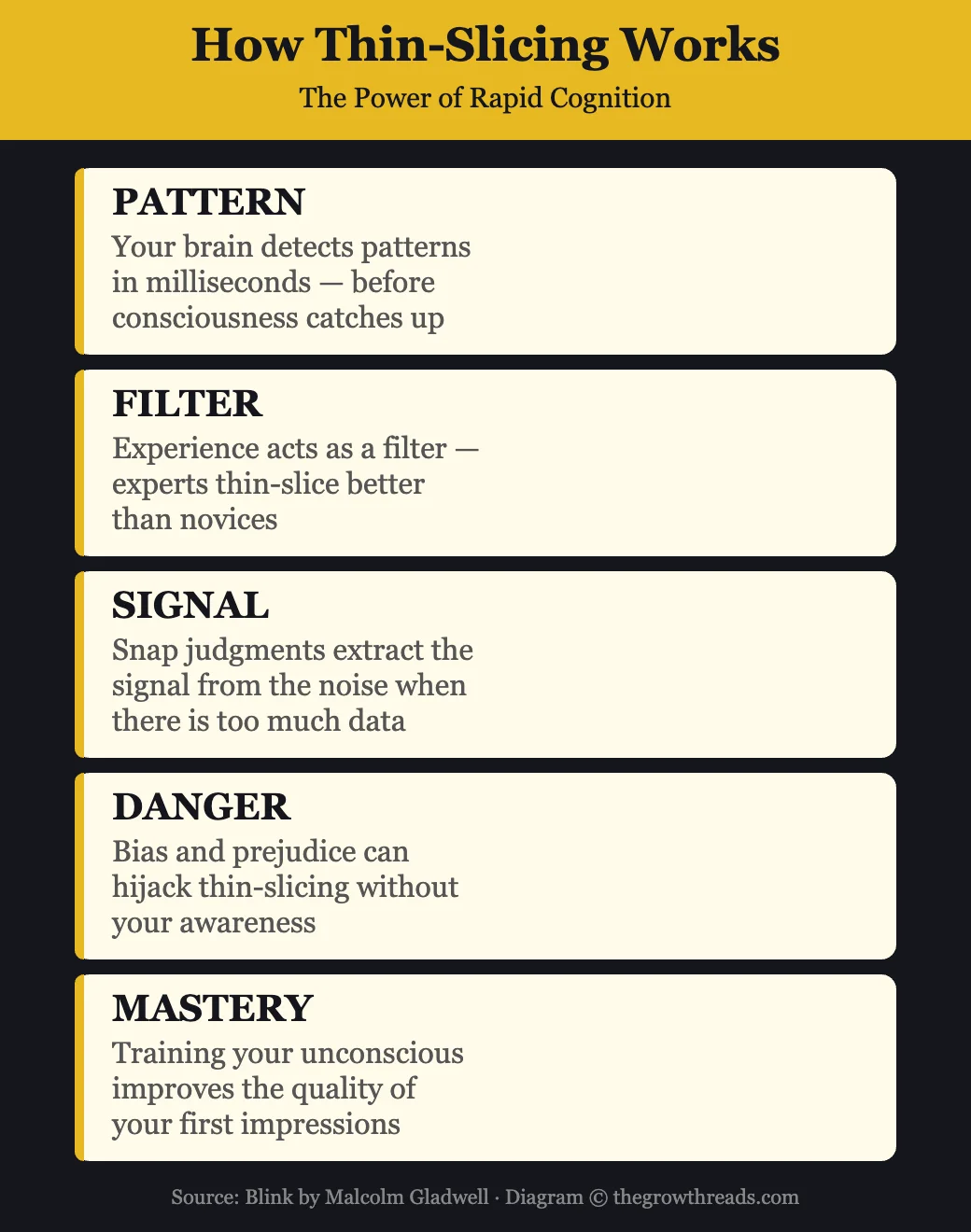
- Thin-slicing is real and measurable: Your brain can extract meaningful patterns from very small samples of behavior or data — often more accurately than lengthy analysis.
- Experts thin-slice better than novices: Years of experience train the adaptive unconscious to detect patterns invisible to beginners. The “gut feeling” of an expert is actually deep expertise expressed as intuition.
- Too much information kills good judgment: More data does not always mean better decisions. Sometimes additional information adds noise that drowns out the signal your unconscious already detected.
- Snap judgments can be trained: Through deliberate practice and exposure, you can improve the quality of your first impressions — making your unconscious smarter.
- Implicit bias is the dark side of thin-slicing: The same rapid cognition that enables brilliant intuition also enables racial, gender, and appearance-based prejudice — often without your awareness.
- Stress and arousal narrow perception: Under extreme stress, thin-slicing degrades. People in high-arousal states miss obvious cues and make errors they would never make when calm.
- Structure protects against bad snap judgments: Blind auditions in orchestras, structured interviews in hiring — removing irrelevant information improves decision quality.
- First impressions are not the full picture: The Pepsi Challenge showed that sip tests and full-can tests produce opposite preferences. Context and duration change judgment.
- Market research can destroy good instincts: Asking people to explain their preferences often produces different (and worse) answers than simply observing their behavior.
- The best decision-makers know when to trust their gut and when to slow down: Mastery is knowing which situations call for rapid cognition and which demand deliberate analysis.
What is Blink about?
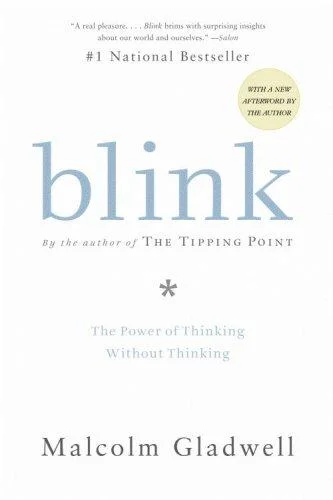
Blink examines the power and pitfalls of rapid cognition — the snap judgments and first impressions that happen in the first two seconds of encountering something new. Through case studies ranging from art forgery to police shootings, Malcolm Gladwell shows when instantaneous decisions outperform careful analysis, when they fail catastrophically, and how understanding the mechanism behind them can improve decision-making in every domain.
About the author
Malcolm Gladwell is a staff writer for The New Yorker and one of the most influential nonfiction authors of the past two decades. Born in England and raised in Canada, he has a gift for translating academic research into compelling narratives that reshape how people think. His books — including The Tipping Point, Outliers, and Talking to Strangers — have collectively sold over 15 million copies. Gladwell’s strength is connecting research across disciplines that academics themselves rarely bridge. Before writing books, he covered science and business for The Washington Post. Explore all Malcolm Gladwell book summaries →
Key concepts at a glance
| Concept | What it means | Use it when |
|---|---|---|
| Thin-Slicing | Making accurate judgments from very small samples of behavior or data | You need to make a rapid assessment and have relevant expertise |
| The Adaptive Unconscious | A mental computer that processes patterns faster than conscious thought | You want to understand why “gut feelings” can be surprisingly accurate |
| The Locked Door | We often cannot explain why we know what we know — intuition operates behind a locked door | Someone asks you to justify a feeling and your explanation makes it worse |
| The Warren Harding Error | Judging people by appearance and presence rather than substance | You catch yourself being impressed by someone’s looks or charisma without evidence of competence |
| Implicit Association | Unconscious biases that affect judgment even in people who consciously reject prejudice | You want to audit your own hidden biases in hiring, evaluating, or first meetings |
| Temporary Autism | Under extreme stress, the ability to read faces and situations shuts down | You make decisions under pressure and want to understand why you miss obvious cues |
| Structured Evaluation | Removing irrelevant information from decisions to improve quality | You want to design better hiring, audition, or evaluation processes |
Part 1: The power of thin-slicing — why less is more
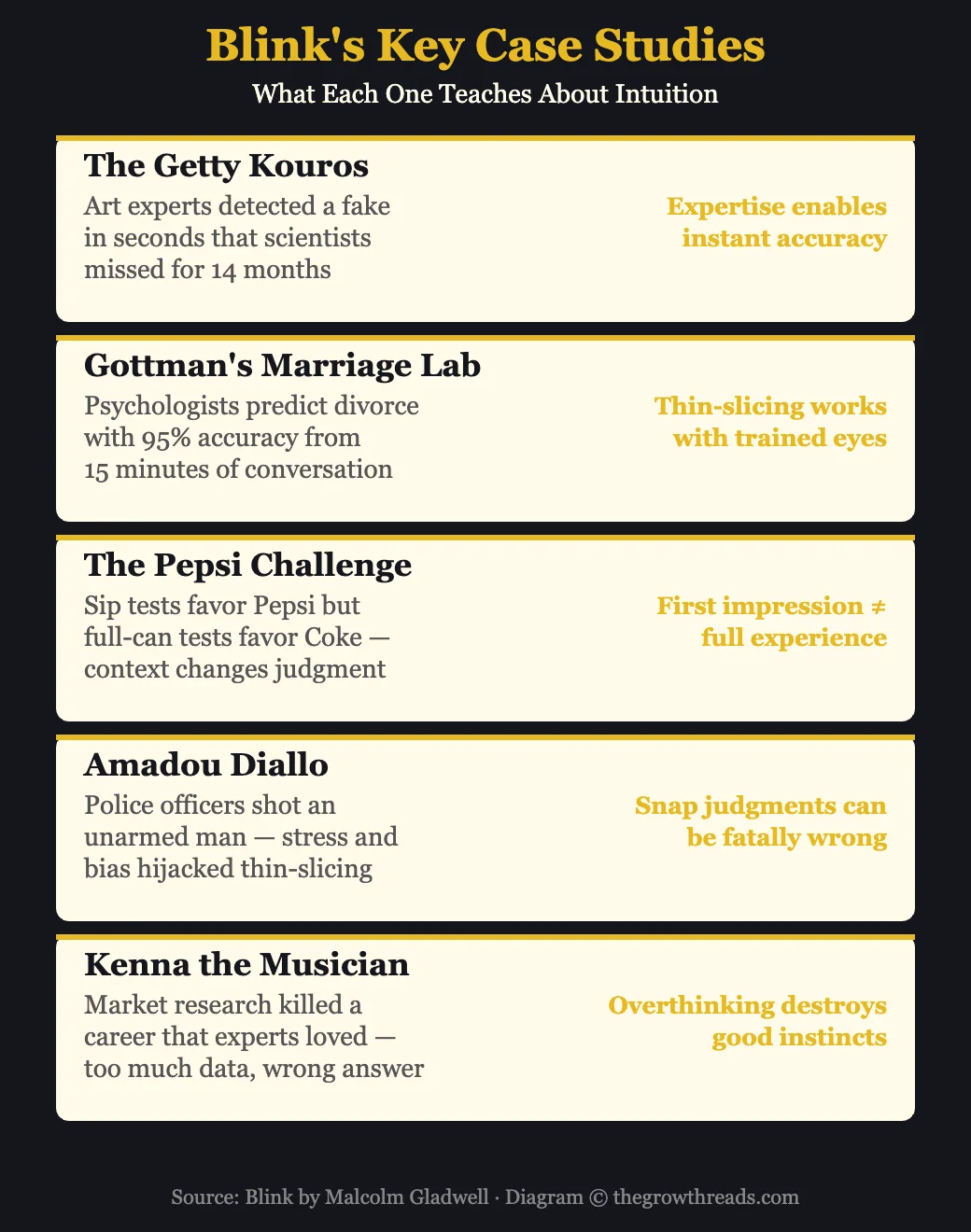
Gladwell opens with the story of the Getty kouros — a marble statue that the J. Paul Getty Museum bought for nearly $10 million after fourteen months of scientific analysis confirmed its authenticity. Then art historians walked in, looked at it, and knew instantly it was a fake. One felt a wave of “intuitive repulsion.” Another looked at the fingernails and said the word “fresh” popped into his mind — the statue looked too new. They were right. The scientists, with all their data, had been fooled. The experts, with two seconds of looking, had not.
Gladwell introduces the concept of thin-slicing through the work of psychologist John Gottman, who can predict with 95% accuracy whether a married couple will still be together in fifteen years — after watching just fifteen minutes of conversation. Gottman identifies specific patterns: contempt (the single most destructive behavior), defensiveness, stonewalling, and criticism. These “Four Horsemen” are so diagnostic that even brief exposure to them reveals the health of a relationship. With enough experience, Gottman’s team can thin-slice down to three minutes and still maintain 90% accuracy.
The mechanism behind thin-slicing is what psychologist Timothy Wilson calls the “adaptive unconscious” — a mental processor that runs constantly, detecting patterns and reaching conclusions long before conscious thought catches up. It is not mystical; it is computational. Your brain has processed thousands of similar situations and compressed that experience into a rapid-fire pattern recognition system.
Part 2: The dark side — when snap judgments betray us
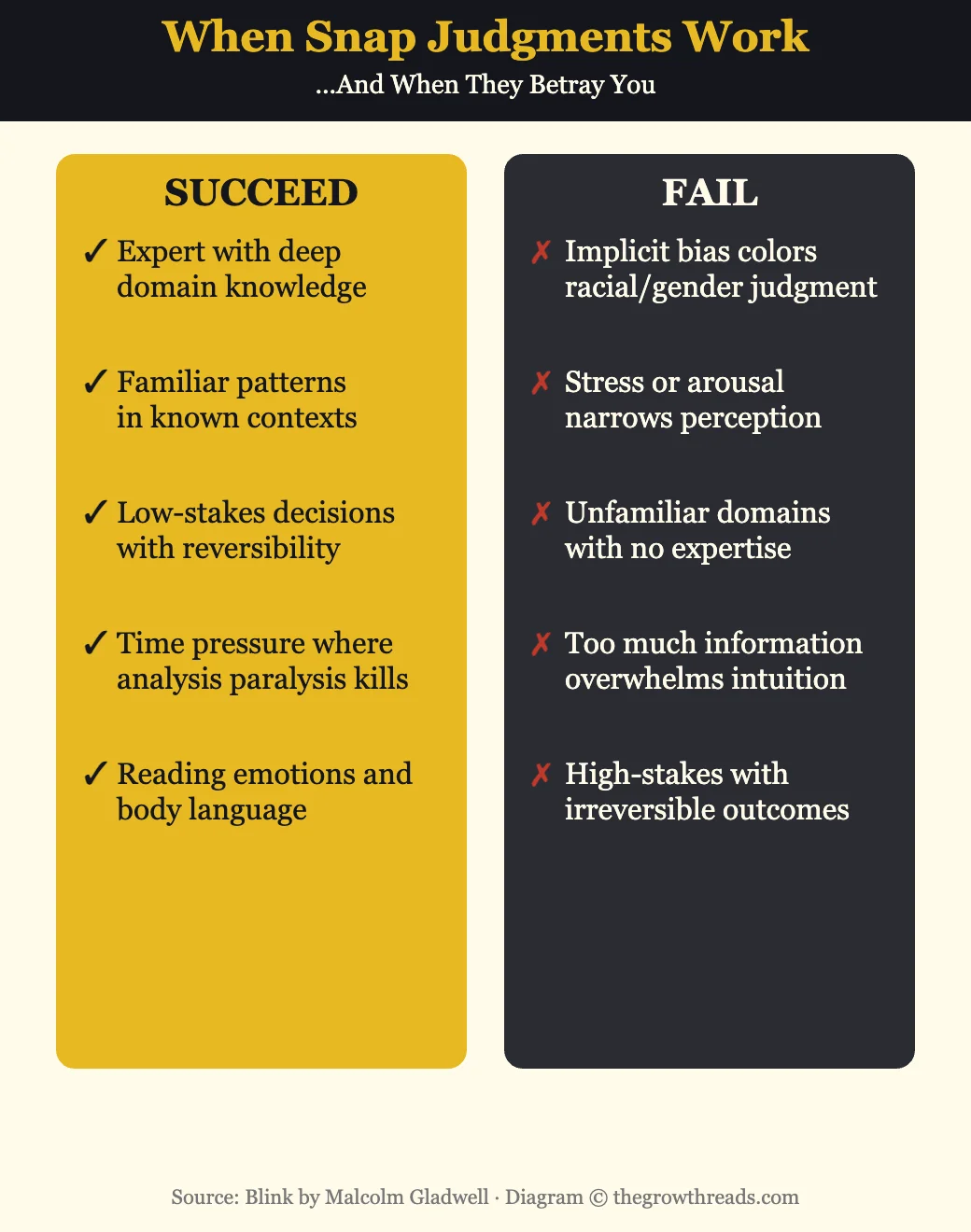
Gladwell pivots to the failures of rapid cognition. The “Warren Harding Error” describes how Warren G. Harding became president largely because he looked presidential — tall, handsome, distinguished. People thin-sliced his appearance and assumed competence. He is widely considered one of the worst presidents in American history. This error repeats constantly: tall people earn more on average, attractive defendants receive lighter sentences, and imposing-looking candidates win elections at higher rates — regardless of actual ability.
The most devastating example is the shooting of Amadou Diallo — an unarmed West African immigrant killed by four New York City police officers who fired 41 shots in a darkened vestibule. The officers believed he was reaching for a gun. He was reaching for his wallet. Gladwell uses this case to show how extreme stress triggers what he calls “temporary autism” — under high arousal, the ability to read faces, body language, and context shuts down. The officers’ thin-slicing was hijacked by fear, racial bias, and adrenaline.
Gladwell introduces the Implicit Association Test (IAT), which reveals that most people — including those who consciously reject prejudice — harbor unconscious biases related to race, gender, age, and appearance. These hidden associations influence snap judgments in hiring, policing, medicine, and everyday interaction. The implications are unsettling: your first impression of someone may be shaped by biases you do not even know you have.
The solution, Gladwell argues, is not to eliminate snap judgments (that is impossible) but to structure environments that prevent bias from contaminating them. The most famous example: when orchestras began holding blind auditions behind screens, the proportion of women hired increased dramatically. The musicians’ ability had not changed — but the evaluators could no longer be influenced by appearance and gender.
Part 3: Training your snap judgments — from Pepsi to Paul Van Riper
The Pepsi Challenge is one of Gladwell’s most counterintuitive examples. In blind sip tests, people consistently prefer Pepsi over Coke. But when they drink a full can, the preference reverses. Why? Because a sip test measures a different thing than the experience of drinking an entire beverage. Pepsi is sweeter, which is appealing in small doses but cloying in large ones. The snap judgment (sip preference) diverges from the full judgment (can preference). The lesson: first impressions are not always the same as complete assessments.
Gladwell then explores the story of Kenna, a musician universally praised by music industry experts who could not succeed with focus groups. When ordinary listeners heard his music cold and were asked to rate it, they disliked it — it was too unfamiliar. But when they listened repeatedly, they loved it. Market research, by asking people to articulate their reactions to something new, effectively killed a career that expert thin-slicing had correctly identified as exceptional. The problem was not the music; it was the method of evaluation.
The book’s most dramatic case study is the Millennium Challenge war game of 2002, where retired Marine general Paul Van Riper, playing the Red Team (enemy force), defeated the entire United States military in a simulated war. Van Riper won by relying on rapid, intuitive decision-making — bypassing the Pentagon’s data-heavy, analysis-dependent command structure. When the military reset the game and constrained Van Riper’s options, the Blue Team (US forces) won. The lesson: in rapidly changing, uncertain environments, speed and intuition beat exhaustive analysis.
Who is Blink best for — and who should read something else first?
This book is ideal for decision-makers in fast-paced environments (emergency rooms, trading floors, military, sports coaching), hiring managers who want to understand how bias infiltrates interviews, and anyone fascinated by the intersection of psychology and real-world judgment. Gladwell’s storytelling makes complex research accessible and entertaining.
If you want the rigorous academic framework behind the phenomena Gladwell describes, start with Thinking, Fast and Slow by Daniel Kahneman. If you are more interested in how to build the expertise that makes thin-slicing accurate, read Peak by Anders Ericsson. If you want Gladwell’s exploration of success factors more broadly, Outliers is the natural companion.
Questions to reflect on
- Think of a time your first impression of someone was completely right — and a time it was completely wrong. What made the difference?
- In your professional domain, what can you thin-slice accurately that a novice could not? What does that tell you about the role of experience in intuition?
- Have you ever made a worse decision because you gathered more information? When might less data have served you better?
- If you took an Implicit Association Test today, what biases might it reveal — and how might those biases affect your professional judgments?
- What “screens” could you put up in your evaluation processes to prevent irrelevant factors from contaminating your decisions?
🔥 Ready to understand the power hiding in your first two seconds?
Gladwell reveals when to trust your snap judgments — and when they are lying to you.
How to apply Blink (7-day plan)
- Day 1 — Notice your first impressions: Throughout the day, pay attention to the snap judgments you make about people, situations, and ideas. Write down three first impressions and check them against later evidence.
- Day 2 — Take the IAT: Go to implicit.harvard.edu and take the Implicit Association Test for race, gender, or another category. Reflect on the results without judgment — the goal is awareness, not shame.
- Day 3 — Practice thin-slicing in your domain: In your area of expertise, make a rapid assessment of something (a proposal, a candidate, a design) and write it down before doing any analysis. Compare your snap judgment with your analytical conclusion.
- Day 4 — Add a screen: Identify one decision process where irrelevant information (appearance, credentials, reputation) might bias your judgment. Design a “blind audition” equivalent — remove the irrelevant data before evaluating.
- Day 5 — Watch for the Warren Harding Error: Notice when you are impressed by someone’s appearance, confidence, or presence. Ask yourself: what actual evidence of competence do I have beyond how they look and sound?
- Day 6 — Practice stress awareness: The next time you feel stressed or rushed while making a decision, pause and acknowledge the state. Remember that arousal narrows perception — if possible, delay the decision until you are calmer.
- Day 7 — Trust with boundaries: Make one decision today using only your gut — but set a boundary: choose a low-stakes, reversible situation where expert intuition is likely accurate. Notice how it feels to act without exhaustive analysis.
Frequently asked questions
Is Gladwell saying we should always trust our gut?
No — that is the most common misreading of Blink. Gladwell’s argument is more nuanced: snap judgments are powerful tools that work well under specific conditions (relevant expertise, low stress, familiar patterns) and fail badly under others (bias-prone situations, high stress, unfamiliar domains). The book is a guide to understanding when rapid cognition helps and when it hurts, not a blanket endorsement of going with your gut on everything.
How does this relate to Thinking, Fast and Slow?
Kahneman’s System 1 (fast, automatic thinking) is the scientific framework underlying Gladwell’s thin-slicing. Both books are about the same phenomenon, but the approach differs: Kahneman is rigorous and academic, emphasizing the errors of rapid cognition. Gladwell is narrative-driven, showing both the brilliance and the failures. Many readers find Gladwell more engaging and Kahneman more intellectually complete. Reading both gives you the full picture — the stories and the science.
Can I train my snap judgments to be more accurate?
Yes. Gladwell shows that expert thin-slicing is a product of deep experience — the more patterns you have absorbed in a domain, the better your rapid cognition in that domain. Deliberate practice (studying many examples with feedback) builds the pattern library your unconscious draws on. You can also reduce the contamination of bias by structuring your evaluation processes to remove irrelevant information, which is what blind auditions and structured interviews accomplish.
What is the Implicit Association Test and should I take it?
The IAT, developed by researchers at Harvard, measures unconscious associations between concepts (such as race and positive/negative attributes) by timing response speeds. Most people who take it discover biases they did not know they had — even people who consciously hold egalitarian values. Gladwell himself found pro-white bias despite being half-Jamaican. Taking the IAT is eye-opening and free at implicit.harvard.edu. It does not mean you are a bad person; it means you are a human with unconscious pattern recognition shaped by cultural exposure.
What are the main criticisms of Blink?
Critics note that Gladwell cherry-picks compelling stories but does not always address contradicting evidence. Some psychologists argue that he oversimplifies the research on intuition and that the practical takeaways are unclear — the book is better at describing the phenomenon than prescribing what to do about it. The IAT’s predictive validity has been debated in subsequent research, though the core concept of implicit bias remains well-supported. Despite these criticisms, the book remains a valuable introduction to rapid cognition.
Should I read Blink or Outliers first?
They explore different questions. Blink asks: how do we make rapid judgments? Outliers asks: why do some people succeed at extraordinary levels? If you are interested in decision-making and psychology, start with Blink. If you are interested in the factors behind exceptional achievement, start with Outliers. Both are quintessential Gladwell — combining compelling storytelling with social science research. They complement each other and share the same accessible style.
How can I use Blink’s ideas in hiring?
The most direct application is structured interviewing: ask every candidate the same questions in the same order, evaluate responses against predefined criteria, and delay looking at resumes until after the interview. Remove photos, names, and school names from applications when possible. These “screens” prevent the Warren Harding Error (being swayed by appearance and presence) and implicit bias from contaminating your hiring decisions. Research consistently shows that structured interviews predict job performance far better than unstructured ones.
Related summaries
- Thinking, Fast and Slow Summary & Review — The academic framework behind everything Gladwell describes in Blink.
- Outliers Summary & Review — Gladwell’s exploration of why some people succeed at extraordinary levels.
- Influence Summary & Review — Cialdini on the psychological triggers that drive automatic human behavior.
- Best Psychology & Mindset Books — Our full ranked guide to books that change how you think.