

★★★★☆ 4.1/5 — A clear, compassionate guide to setting and maintaining boundaries in every relationship.
Best for: People-pleasers, overgivers, and anyone who feels drained by relationships but doesn’t know where to draw the line.
Reading time: ~4.5 hours (240 pages)
Difficulty to apply: Medium — the concepts are simple but the emotional work of enforcing boundaries takes practice.
Practical value: Very high — Tawwab provides scripts, scenarios, and specific language you can use immediately.
Set Boundaries, Find Peace in one minute
Most relationship problems are actually boundary problems in disguise. Licensed therapist Nedra Glover Tawwab draws on over fifteen years of clinical experience to show that burnout, resentment, anxiety, and codependency often stem from a single root cause: the absence of healthy boundaries. She identifies six types of boundaries — physical, sexual, intellectual, emotional, material, and time — and provides a practical framework for recognizing where yours are weak, communicating your needs clearly, and holding firm when others push back. The book is less about building walls and more about building relationships that actually work.
Key takeaways
- Boundaries are not selfish: They are the foundation of healthy, sustainable relationships. Without them, resentment builds until the relationship breaks.
- Six types of boundaries exist: Physical, sexual, intellectual, emotional, material, and time — most people have gaps in at least two.
- Resentment is a signal: When you feel consistently resentful toward someone, it almost always means a boundary is being crossed repeatedly.
- Boundaries are communicated, not assumed: Other people cannot read your mind. You must state your needs clearly using “I” statements.
- Expect pushback: People who benefited from your lack of boundaries will resist when you start setting them. This is normal, not a sign you should stop.
- You cannot set boundaries for others: You can only control your own actions and consequences. A boundary is about what you will do, not what they must do.
- Guilt does not mean you are wrong: Feeling guilty after setting a boundary is a sign of growth, not a sign of selfishness.
- Consistency matters more than perfection: One enforced boundary teaches more than ten stated ones.
- Trauma often creates boundary problems: People raised in chaotic or enmeshed families frequently struggle with boundaries as adults because their limits were never respected.
- Healthy boundaries improve, not destroy, relationships: The relationships that end when you set boundaries were surviving on your self-sacrifice, not mutual respect.
What is Set Boundaries, Find Peace about?
Set Boundaries, Find Peace is a therapist’s guide to identifying, communicating, and maintaining healthy boundaries across all relationships — romantic, family, friendships, and work. Nedra Glover Tawwab provides a framework of six boundary types, practical scripts for difficult conversations, and strategies for managing guilt and pushback.
About the author
Nedra Glover Tawwab is a licensed clinical social worker and relationship therapist based in Charlotte, North Carolina, with over fifteen years of clinical experience. She built one of the largest therapy-focused social media platforms, with millions of followers across Instagram and TikTok, where her boundary-related content regularly goes viral. Tawwab trained at Wayne State University and has been featured in The New York Times, The Guardian, Psychology Today, and Oprah Daily. Her therapeutic approach centers on helping clients recognize how childhood patterns shape adult relationship dynamics. She is also the author of Drama Free, a follow-up focused on family relationships. Explore all Nedra Glover Tawwab book summaries →
Key concepts at a glance
| Concept | What it means | Use it when |
|---|---|---|
| Porous boundaries | Too flexible — you absorb others’ emotions, over-share, and struggle to say no | You feel drained after every social interaction |
| Rigid boundaries | Too inflexible — you wall people off, avoid intimacy, and rarely ask for help | You realize isolation is not the same as independence |
| Healthy boundaries | Flexible but firm — you express needs, tolerate discomfort, and maintain connection | You want to model what balanced relationships look like |
| Boundary burnout | Exhaustion caused by consistently overgiving without protecting your own needs | You feel resentful toward people you love |
| The boundary script | “I feel ___ when ___ because ___. I need ___.” | You need to communicate a boundary in any relationship |
| Consequences vs. ultimatums | A consequence is what you will do; an ultimatum is a threat about what they must do | You want to enforce without escalating |
Part 1: Understanding boundaries — what they are and why you don’t have them
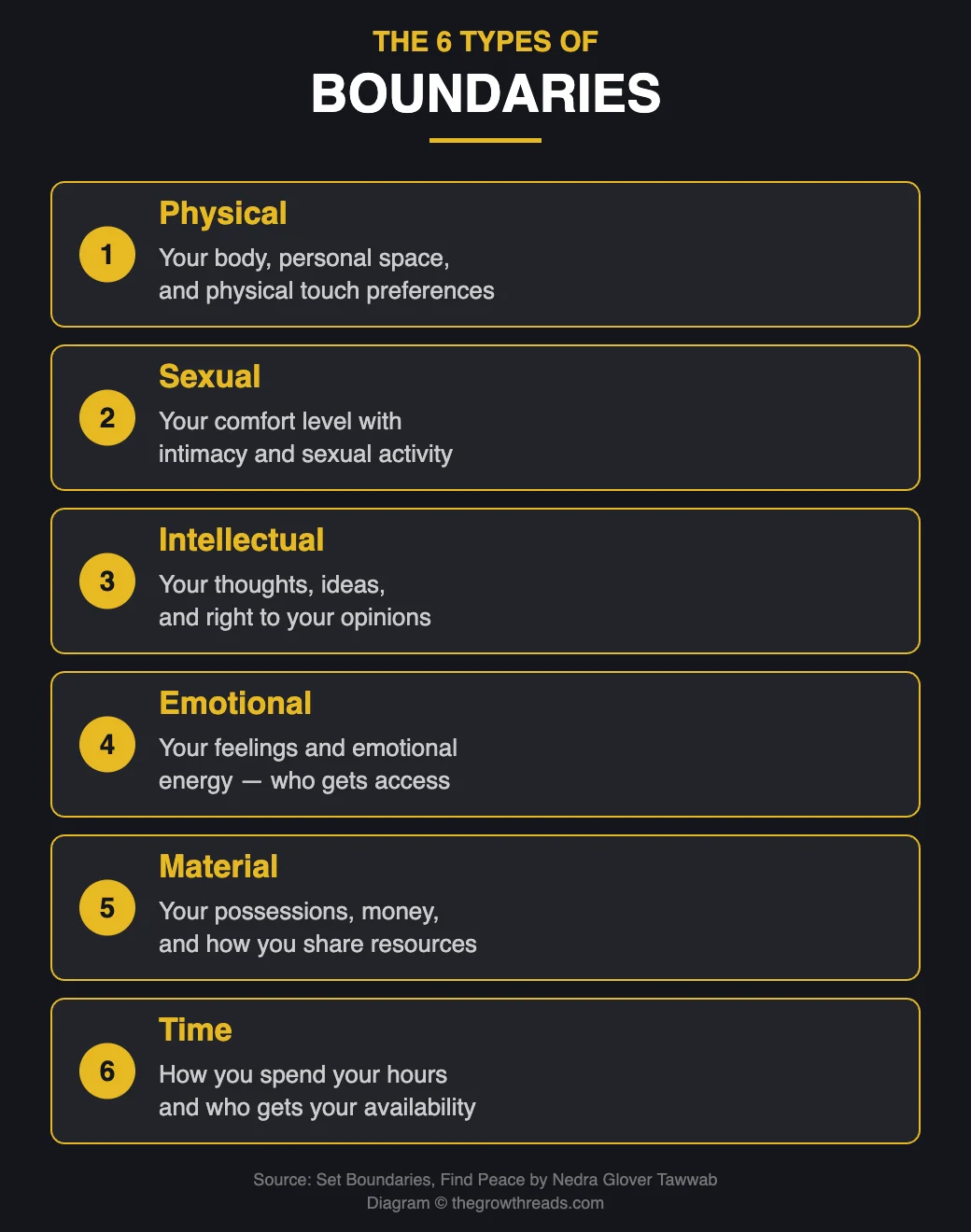
Tawwab begins by redefining boundaries. A boundary is not a wall, a punishment, or an act of aggression. It is simply a statement of what you need to feel safe, respected, and functioning in a relationship. She defines six types: physical (your body and space), sexual (your comfort with intimacy), intellectual (your right to your own thoughts and opinions), emotional (your emotional energy and who gets access to it), material (your possessions and money), and time (how you spend your hours).
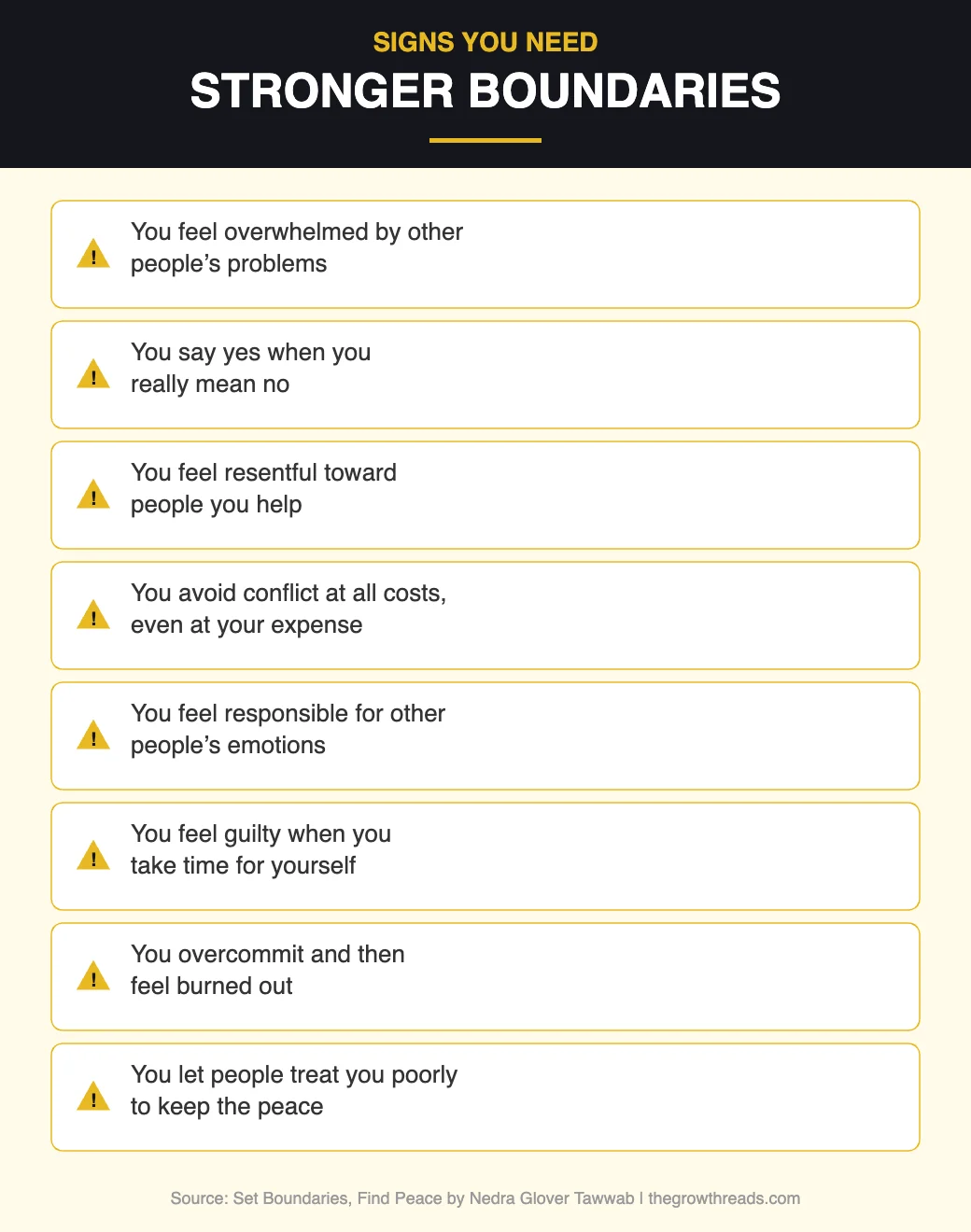
The core insight of this section is that most people with boundary problems don’t know they have them. They experience the symptoms — burnout, resentment, anxiety, codependency — without connecting them to the cause. Tawwab introduces a self-assessment: if you frequently feel overwhelmed by others’ problems, say yes when you mean no, feel guilty taking time for yourself, or avoid conflict at all costs, your boundaries are likely porous.
She traces boundary problems to their roots, often in childhood. Children raised in families where their “no” was overridden, where they were expected to manage a parent’s emotions, or where love was conditional on compliance learn that their own needs are secondary. This pattern becomes automatic in adulthood. The people-pleaser isn’t generous by nature — they are terrified of rejection.
Part 2: Why setting boundaries is so hard
The middle section addresses the emotional barriers that keep people stuck. Tawwab identifies three primary obstacles: guilt, fear of conflict, and the belief that boundaries are selfish. She dismantles each one systematically.
Guilt, she argues, is often a sign of growth rather than wrongdoing. When you’ve spent years prioritizing everyone else, doing something for yourself feels foreign and uncomfortable. That discomfort is not evidence that you’re being selfish — it is evidence that you’re breaking a pattern. She draws a clear line: guilt says “I did something bad.” Boundary-setting discomfort says “I did something new.”
The fear of conflict is really a fear of abandonment. People avoid boundaries because they believe the relationship will end. Tawwab’s reframe: if a relationship cannot survive you having basic needs, it was not a healthy relationship to begin with. The relationships that end when you set boundaries were built on your self-sacrifice, not on mutual respect.
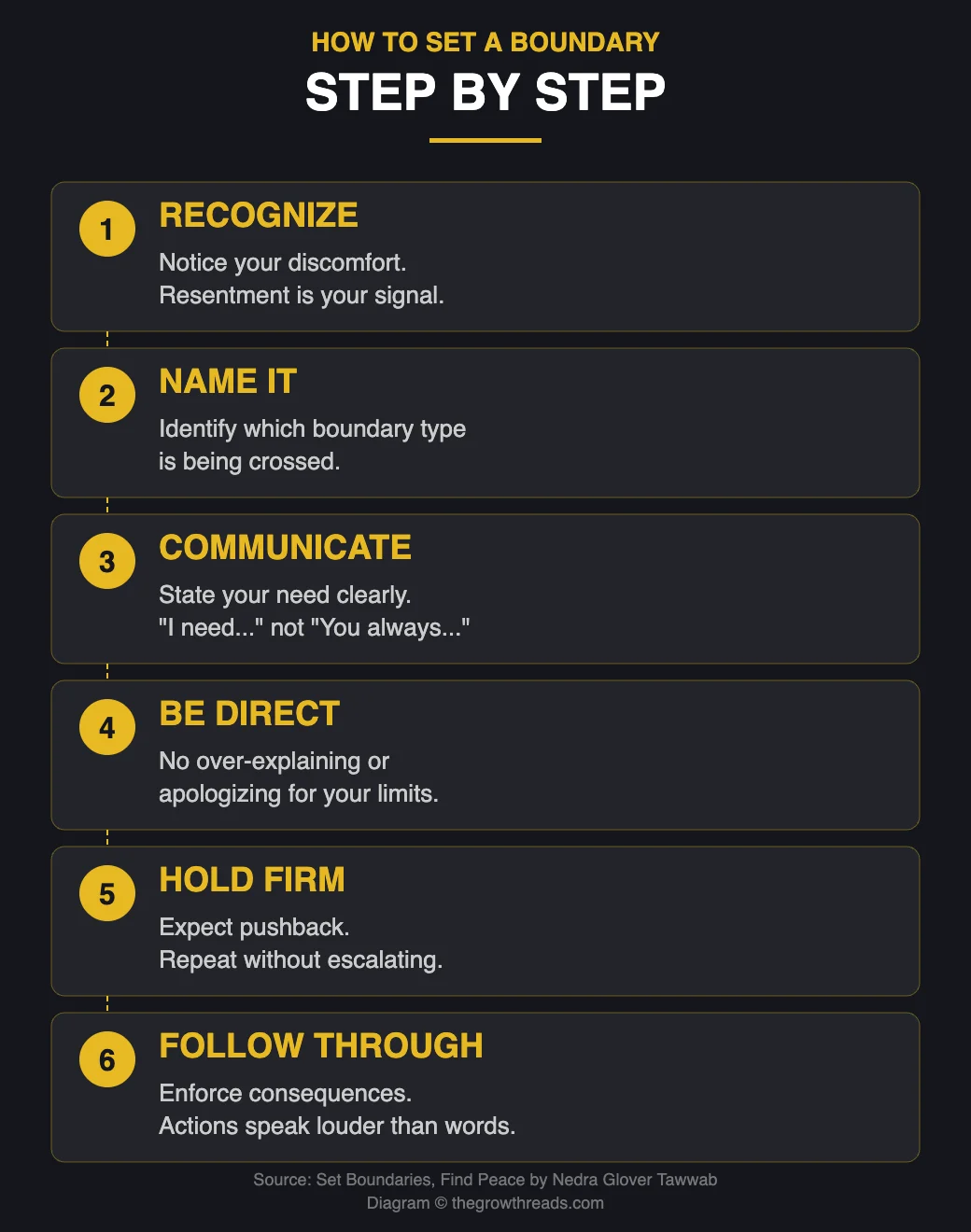
She also addresses the “boundary backlash” phenomenon. When you start setting limits with people who have benefited from your lack of boundaries, they will push back. They may guilt-trip, rage, withdraw affection, or recruit others to pressure you. Tawwab normalizes this: it is not a sign you should retreat. It is a predictable reaction from someone who is losing a benefit. The key is to hold firm without escalating — repeat your boundary calmly, enforce your consequence, and resist the urge to over-explain.
Part 3: Setting boundaries in practice
The final section is where the book earns its practical reputation. Tawwab provides specific scripts and scenarios for setting boundaries in romantic relationships, with family, at work, in friendships, and on social media.
Her universal formula: “I feel ___ when ___ because ___. I need ___.” This structure keeps the focus on your experience rather than the other person’s behavior. Instead of “You always dump your problems on me,” you say “I feel overwhelmed when I’m the only person you come to with problems because I don’t have the emotional capacity for that. I need you to also talk to a therapist or another friend.”
She distinguishes between consequences and ultimatums. A consequence is what you will do: “If you continue to show up unannounced, I won’t answer the door.” An ultimatum is a threat about what they must do: “You need to stop showing up or else.” Consequences are enforceable because they depend only on your actions. Ultimatums create power struggles.
Tawwab covers specific relationship contexts. With family, she addresses the guilt of setting limits with parents — “honoring your parents does not mean abandoning yourself.” At work, she tackles the glorification of overwork — boundaries around email after hours, taking on others’ tasks, and managing a boundary-violating boss. In friendships, she discusses the slow fade versus the direct conversation, and when each is appropriate.
The book closes with a section on maintaining boundaries over time. She emphasizes that boundary work is not a one-time conversation but an ongoing practice. Some days you will slip. Some relationships will require repeated conversations. The goal is not perfection but consistency.
Who is Set Boundaries, Find Peace best for — and who should read something else first?
This book is ideal for anyone who identifies as a people-pleaser, overgiver, or conflict-avoider. It is especially powerful for adults who grew up in enmeshed or emotionally chaotic families and recognize that their relationship patterns were set in childhood. Therapists and coaches will also find the frameworks useful as tools to share with clients.
If your boundary issues are specifically romantic, Attached by Levine and Heller provides a complementary attachment-theory lens. If your primary challenge is family dysfunction, Adult Children of Emotionally Immature Parents by Lindsay Gibson goes deeper on the root cause. And if you want a boundary framework specifically for saying no at work, Boundaries by Cloud and Townsend offers a faith-informed approach.
Questions to reflect on
- In which of the six boundary types (physical, sexual, intellectual, emotional, material, time) am I consistently weakest?
- Who in my life would I describe as “draining” — and is that because of who they are, or because of the boundaries I haven’t set?
- When was the last time I said yes to something I wanted to say no to? What was I afraid would happen if I declined?
- Do I confuse being needed with being loved? Where did I first learn that pattern?
- If I imagine my most important relationship with clear, healthy boundaries on both sides, what does it look like differently from today?
🔥 Ready to stop overgiving and start living?
Learn the six types of boundaries and get scripts you can use today.
How to apply Set Boundaries, Find Peace (7-day plan)
- Day 1 — Boundary audit: Review the six types and rate yourself 1–10 on each. Identify the two weakest areas — these are your starting points.
- Day 2 — Track your resentment: Write down every moment you feel irritated, drained, or resentful today. Next to each, note which boundary type is being crossed.
- Day 3 — Practice one small no: Decline one low-stakes request today. Notice how it feels without acting on the guilt.
- Day 4 — Write your script: Using “I feel ___ when ___ because ___. I need ___,” draft a boundary conversation for one ongoing issue. Don’t deliver it yet.
- Day 5 — Have the conversation: Deliver your scripted boundary to the person involved. Focus on staying calm and not over-explaining.
- Day 6 — Handle the pushback: If you receive guilt, anger, or silent treatment, remind yourself: discomfort is growth. Repeat your boundary without escalating.
- Day 7 — Reflect and reinforce: Journal about what you learned this week. Identify one boundary you want to make permanent and define the consequence if it’s violated.
Frequently asked questions
How is this different from Boundaries by Cloud and Townsend?
While both books address boundary-setting, they come from very different perspectives. Cloud and Townsend write from a Christian counseling framework, using biblical principles to justify boundaries as healthy and God-honoring. Tawwab writes from a secular, clinical therapy perspective rooted in attachment theory and family systems. Tawwab’s book is more practical and script-heavy, with specific language for modern scenarios including social media and workplace dynamics.
Is this book only for people-pleasers?
No. While people-pleasers will find it immediately relevant, Tawwab also addresses people with rigid boundaries — those who wall others off, avoid vulnerability, and mistake isolation for independence. The book covers the full spectrum from porous to rigid boundaries and helps readers find the healthy middle. Anyone who struggles with relationship dynamics will find applicable insights.
What are the six types of boundaries?
Tawwab identifies physical (body and personal space), sexual (comfort with intimacy), intellectual (thoughts and opinions), emotional (feelings and emotional energy), material (possessions and money), and time (how you spend your hours) boundaries. Most people have healthy boundaries in some areas but significant gaps in others. The framework helps you pinpoint exactly where your limits are weakest.
What if setting boundaries ruins my relationships?
Tawwab addresses this fear directly. Healthy relationships can absorb boundaries — both people adjust, communicate, and the relationship becomes stronger because it’s built on mutual respect rather than one person’s self-sacrifice. Relationships that end when you set boundaries were surviving on your overgiving, not on genuine connection. Losing those relationships, while painful, creates space for healthier ones.
How do I set boundaries without sounding aggressive?
Tawwab’s formula keeps communication non-confrontational: “I feel ___ when ___ because ___. I need ___.” This structure focuses on your experience, not the other person’s character. She also emphasizes tone — boundaries are best delivered calmly, briefly, and without over-explaining. You don’t need to justify your needs with a five-minute monologue. A clear, direct statement respects both you and the other person.
Can I set boundaries with family members?
Yes, and Tawwab devotes significant space to this because family boundaries are often the hardest to set. She addresses guilt around setting limits with parents, the pressure of cultural expectations, and the enmeshment patterns that make family boundary work so emotionally loaded. Her key principle: honoring your parents does not mean abandoning yourself. She provides specific scripts for common family scenarios.
Is this book backed by research or just opinion?
Tawwab draws from established therapeutic frameworks including attachment theory, family systems theory, and cognitive behavioral principles. While the book is written for a popular audience rather than an academic one, her recommendations are grounded in over fifteen years of clinical practice and align with mainstream psychological research on boundaries, codependency, and relationship dynamics. It is more practitioner-informed than research-citation-heavy.
Related summaries
- Boundaries by Henry Cloud & John Townsend — the faith-based companion to Tawwab’s secular approach.
- Nonviolent Communication by Marshall Rosenberg — the language framework that makes boundary conversations work.
- Adult Children of Emotionally Immature Parents by Lindsay Gibson — the root-cause companion for family boundary work.
- Best Relationship Books — our full curated list of essential relationship reads.
How we analyze books: Every book review at The Growth Reads follows a structured evaluation across five criteria: practical applicability, scientific rigor, writing quality, uniqueness of insight, and lasting impact. We read each book cover to cover, cross-reference key claims with primary research, and test the frameworks in real life before publishing. Read our full methodology.