

★★★★½ 4.5 / 5
One-liner: A clinical psychologist explains how emotionally immature parents create lasting relational patterns in their children — and provides a clear, compassionate framework for finally understanding why your childhood felt so lonely.
Best for: Adults who grew up feeling unseen, unheard, or emotionally responsible for their parents; anyone who struggles with emotional intimacy; and therapists working with family-of-origin issues.
Reading time: ~5 hrs (guide: 22 min)
Difficulty to apply: High (confronting childhood patterns is emotionally demanding work)
Adult Children of Emotionally Immature Parents in one minute
Your parents may have kept you fed, clothed, and sheltered — and still failed you emotionally in ways that shaped every relationship you have had since. Lindsay C. Gibson, a clinical psychologist specialising in recovery from emotionally immature parents, identifies four types of EI (emotionally immature) parents — emotional, driven, passive, and rejecting — and explains how each creates specific wounds in their children. The children of these parents, especially the sensitive “internalizers,” develop coping strategies that served them in childhood but sabotage them in adult relationships: chronic people-pleasing, suppressed needs, difficulty with boundaries, and a persistent feeling of emotional loneliness even in close relationships. The book provides a framework for seeing your parents clearly (without demonising them), grieving the emotional connection you missed, and building the capacity for genuine intimacy with emotionally mature adults.
Key takeaways
- Emotional immaturity is distinct from bad parenting: EI parents may genuinely love their children but lack the emotional capacity to provide attunement, validation, and genuine connection — they were often raised by EI parents themselves.
- There are four types of EI parents: Emotional (unpredictable, mood-driven), Driven (achievement-obsessed, controlling), Passive (conflict-avoidant, emotionally absent), and Rejecting (dismissive, hostile toward emotional needs).
- Children adapt as internalizers or externalizers: Internalizers become sensitive, over-responsible people-pleasers who suppress their own needs. Externalizers become impulsive, reactive, and demanding. Both are survival strategies, not character flaws.
- Emotional loneliness is the core wound: The child learns that their inner world — their feelings, thoughts, and experiences — is not important or welcome. This creates a pervasive loneliness that persists even in adult relationships.
- The healing fantasy keeps you stuck: Many adult children unconsciously believe that if they try hard enough, their parent will finally “see” them. This fantasy prevents grieving and keeps the adult child trapped in a childhood role.
- You must grieve the parent you needed: Recovery requires acknowledging that you did not receive the emotional connection every child deserves, and that no amount of adult effort will retroactively provide it.
- Maturity awareness protects you: Once you can identify emotional immaturity in others, you can set realistic expectations and stop expecting emotionally immature people to give you what they cannot.
- Your true self survived: Despite suppression, the authentic self — your real preferences, feelings, and identity — was never destroyed, only hidden. Recovery is about uncovering it, not creating something new.
- Seek emotionally mature relationships: The antidote to EI parent wounds is finding relationships with people who are emotionally responsive, empathetic, and capable of genuine connection.
- Understanding is not the same as excusing: You can understand why your parent is the way they are without excusing the harm they caused or obligating yourself to tolerate it indefinitely.
What is Adult Children of Emotionally Immature Parents about?
This book explains how emotionally immature parents — those who lack the capacity for genuine emotional connection — create lasting relational wounds in their children. Gibson identifies four types of EI parents, describes how children adapt, and provides a recovery framework centred on grief, self-understanding, and building emotionally mature relationships.
About the author
Lindsay C. Gibson, PsyD, is a clinical psychologist in private practice in Virginia Beach who has spent over 30 years working with adults recovering from emotionally immature parents. She developed the concept of “emotional immaturity” as a framework that captures a broader range of parental inadequacy than existing diagnostic categories like narcissism or borderline personality disorder. Adult Children of Emotionally Immature Parents has sold over a million copies worldwide and spawned two follow-up volumes: Recovering from Emotionally Immature Parents and Self-Care for Adult Children of Emotionally Immature Parents. Gibson’s clinical approach is notable for its compassion — she avoids villainising parents while never minimising the harm they cause. Explore all Lindsay C. Gibson book summaries →
Key concepts at a glance
| Concept | What it means | Use it when |
|---|---|---|
| Emotional immaturity (EI) | Inability to engage with the emotional complexity of close relationships | A parent seems loving but emotionally unavailable |
| Emotional loneliness | The feeling of being unseen even when surrounded by family | You felt lonely as a child despite having parents present |
| Internalizer | A child who copes by becoming sensitive, over-responsible, and self-suppressing | You are a people-pleaser who ignores your own needs |
| Externalizer | A child who copes by becoming reactive, demanding, and impulsive | You act out when emotionally overwhelmed |
| Healing fantasy | The unconscious belief that the parent will eventually provide the missed connection | You keep trying to earn a parent’s emotional approval |
| Role self vs true self | The adapted persona (role self) developed to survive EI parenting, versus the authentic identity hidden underneath | You feel like you do not know who you really are |
| Maturity awareness | The ability to assess someone’s emotional maturity before investing emotionally | You want to stop repeating EI relationship patterns |
Part 1 — Understanding emotional immaturity
Gibson opens by defining emotional immaturity not as a personality disorder but as a developmental limitation. Emotionally immature parents are not necessarily abusive, neglectful, or malicious — many are hardworking, well-intentioned people who simply lack the capacity to engage with the emotional inner world of another person. They can provide food, shelter, transportation, and education while being fundamentally unable to provide attunement, validation, emotional support, or genuine reciprocal connection.
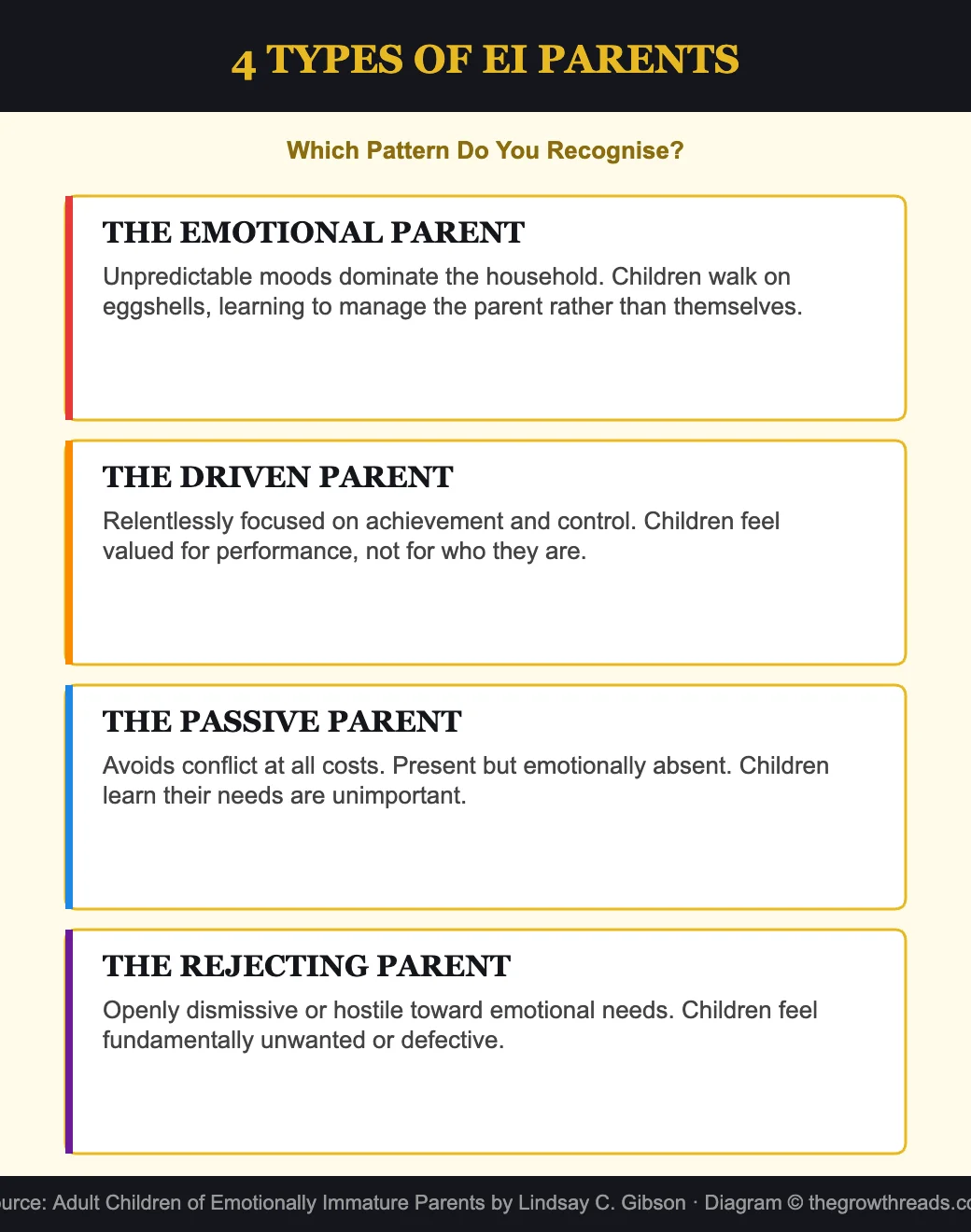
The four EI parent types provide the classification framework. The Emotional Parent is ruled by volatile moods — the household revolves around managing the parent’s emotional state, and children learn to read the room before speaking. The Driven Parent channels everything into achievement, control, and perfectionism — children feel valued for performance, never for simply existing. The Passive Parent is physically present but emotionally vacant — they go along with whatever happens, including allowing the other parent to dominate or abuse, and children learn that their needs are inconsequential. The Rejecting Parent is openly hostile toward emotional expression — children’s feelings are mocked, dismissed, or punished, and the child concludes that something is fundamentally wrong with them for having feelings at all.
Gibson emphasises that most EI parents are themselves products of EI parenting — the pattern is intergenerational. This does not excuse the harm, but it explains the mechanism: if you never experienced emotional attunement as a child, you do not develop the neural circuitry to provide it to your own children. The EI parent is not withholding deliberately; they literally do not have the capacity. Understanding this distinction is the first step in recovery — it allows the adult child to stop personalising their parent’s limitations (“they just didn’t love me enough”) and start seeing the structural pattern (“they didn’t have the emotional skills”).
Part 2 — How children adapt
The second section explains the survival strategies children develop in response to emotional deprivation. Gibson’s internalizer/externalizer distinction is the book’s most clinically useful framework. Internalizers — who make up the majority of her readers — respond to EI parenting by becoming hyper-attuned to others, suppressing their own needs, and developing a finely calibrated radar for other people’s emotional states. They become the “good child,” the one who causes no trouble, achieves high marks, and instinctively knows what everyone else needs. The cost is severe: by the time they reach adulthood, many internalizers genuinely do not know what they feel, what they want, or who they are outside of their role as caretaker.
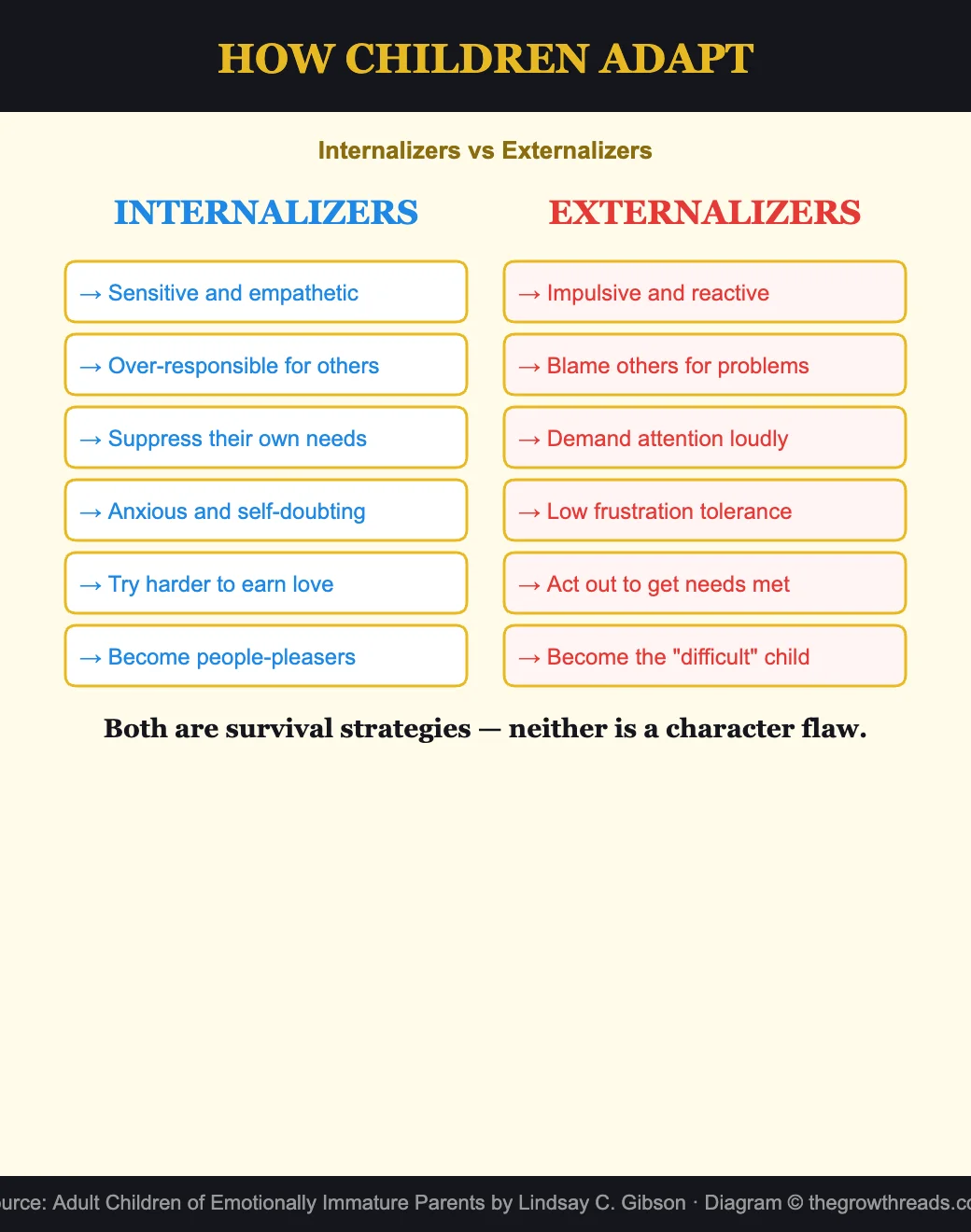
Externalizers cope differently: they act out, demand attention, and force the environment to respond to them. They may become the “problem child” whose disruptive behaviour is actually a bid for emotional engagement from a parent who would otherwise ignore them. While externalizers’ distress is more visible, their underlying wound is identical to the internalizer’s — the absence of genuine emotional connection.
The healing fantasy is one of Gibson’s most liberating concepts. Many adult children unconsciously maintain the belief that if they are good enough, successful enough, accommodating enough, their EI parent will eventually “wake up” and provide the emotional validation they missed. This fantasy can persist for decades, driving the adult child to exhaust themselves performing for a parent who cannot recognise what they are offering. Releasing the fantasy — accepting that the parent will never provide what they cannot give — is the emotional equivalent of finally setting down a weight you have been carrying since childhood.
Part 3 — Recovery and new relationships
The recovery framework is practical and sequential. First, see your parent clearly — not as a villain, not as a hero, but as an emotionally limited person. This clarity removes the confusion (“they loved me, so why do I feel so empty?”) and replaces it with understanding. Second, grieve — not the parent you had, but the parent you needed. Many adult children skip this step because grieving a living parent feels strange or disloyal. But until you acknowledge the loss, you remain trapped in the healing fantasy.
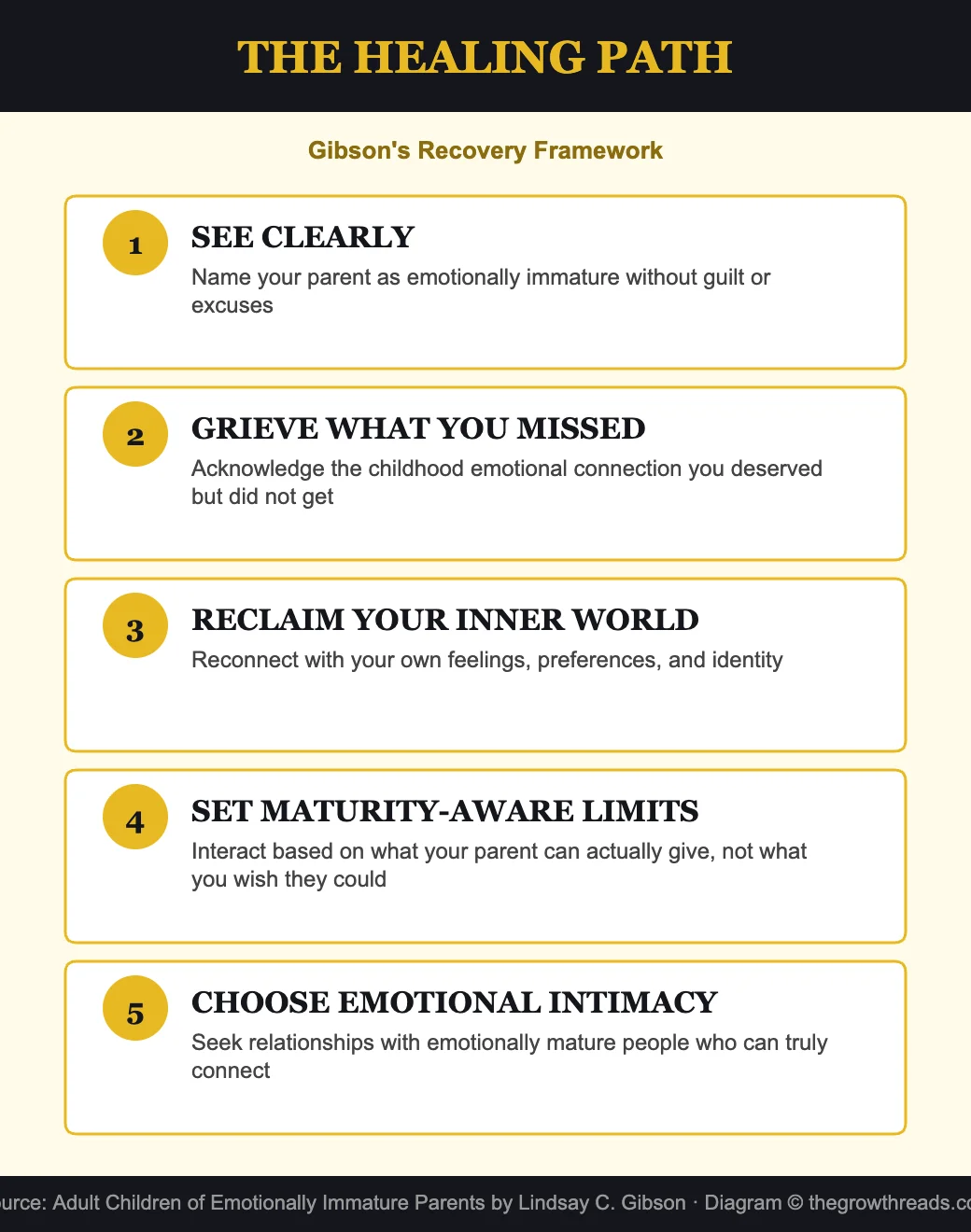
Third, reclaim your inner world. This means reconnecting with your own feelings (which may have been suppressed since childhood), identifying your actual preferences (not what you think you “should” want), and gradually building an identity that is not contingent on managing other people’s emotions. Gibson calls this recovering your “true self” from underneath the “role self” — the adapted persona you created to survive EI parenting.
Fourth, set maturity-aware limits with your parent. This does not mean cutting them off (though some adult children choose that). It means interacting based on what the parent can actually provide, not what you wish they could. If your parent can manage a 30-minute dinner but not an emotional conversation, accept that and stop setting yourself up for disappointment. The goal is a relationship based on reality rather than fantasy.
Finally, seek emotionally mature relationships. Gibson describes the signs of emotional maturity: the ability to tolerate ambiguity, take responsibility for one’s own feelings, engage with another person’s inner world with genuine curiosity, and repair ruptures instead of punishing. For many adult children, encountering true emotional maturity in a partner, friend, or therapist is a revelation — it is the first time they have experienced the kind of connection they always craved but could not name.
Who is this book best for — and who should read something else first?
This book is for any adult who grew up feeling emotionally invisible, over-responsible, or fundamentally lonely in their family — and who recognises those patterns repeating in their adult relationships. It is particularly powerful for high-functioning people-pleasers who look “fine” on the outside but feel persistently empty, anxious, or unable to access their own needs. Gibson writes with clinical precision and deep compassion, never pathologising the reader or their parents.
If your primary issue is romantic attachment patterns, start with Attached. If codependency is the presenting issue, Codependent No More addresses the behaviour before you explore the origin. And if boundary-setting is your immediate need, Boundaries provides a practical framework. But for understanding why you developed these patterns in the first place, this book is unmatched.
Questions to reflect on
- Which of the four EI parent types most closely describes your experience growing up?
- Are you more of an internalizer or an externalizer — and how has that strategy served and limited you as an adult?
- Is there a “healing fantasy” you are still holding onto — a hope that your parent will one day see and validate you?
- When was the last time someone asked how you were feeling and you answered honestly rather than automatically saying “fine”?
- What would change in your life if you stopped performing and started being yourself?
🔥 Ready to understand why your childhood felt so lonely?
Learn how emotionally immature parents shape adult relationships — and how to heal.
How to apply Adult Children of Emotionally Immature Parents (7-day plan)
- Day 1 — Identify your parent type: Read through the four EI parent descriptions and identify which best matches each of your parents. Write a paragraph about how each parent’s pattern shaped your childhood experience. This is assessment, not blame.
- Day 2 — Are you an internalizer or externalizer? Review the characteristics of each and identify your dominant pattern. List three ways this strategy protected you as a child and three ways it limits you as an adult.
- Day 3 — Name one healing fantasy: Write down one hope you still carry about your parent — something you wish they would say, do, or acknowledge. Ask yourself honestly: based on everything you know about them, will this ever happen? Let the answer settle.
- Day 4 — Reconnect with one feeling: At three points today, pause and ask: “What am I actually feeling right now?” Not what you think you should feel, but what you actually feel. If the answer is “I don’t know,” that itself is important information.
- Day 5 — Identify one suppressed need: What is something you need (rest, space, recognition, fun, help) that you have been ignoring because it feels selfish? Write it down. Take one small action to honour it today.
- Day 6 — Set one maturity-aware limit: In your next interaction with your parent (or any emotionally immature person), decide in advance what you will and will not engage with. If they escalate emotionally, practice responding neutrally: “I understand. I need to go now.”
- Day 7 — Seek one emotionally mature connection: Reach out to someone who makes you feel genuinely seen — a friend, therapist, or partner who listens without fixing and responds with empathy. Notice how this connection feels different from interactions with your EI parent.
Frequently asked questions
Is this book saying my parents are bad people?
No. Gibson is careful to distinguish emotional immaturity from malice. EI parents often love their children and genuinely believe they are doing a good job. The problem is capacity, not intent — they lack the emotional skills to provide attunement and genuine connection. Most EI parents were themselves raised by EI parents, creating an intergenerational pattern. The book encourages understanding without excusing: you can recognise your parent’s limitations without demonising them, and you can acknowledge the harm caused without blaming them for something they did not have the tools to do differently.
Do I need to cut off my parents to heal?
Not necessarily. Gibson does not advocate for estrangement as the default. She recommends “maturity-aware” interactions: engaging with your parent based on what they can realistically provide rather than what you wish they could. For some people, this means shorter, less emotionally charged visits. For others, it means reducing contact significantly. For a smaller number, it means ending contact entirely. The right answer depends on the severity of the pattern, your own emotional resources, and whether continued contact causes ongoing harm.
How is emotional immaturity different from narcissism?
There is overlap, but emotional immaturity is a broader category. Narcissistic personality disorder (NPD) is a specific clinical diagnosis characterised by grandiosity, lack of empathy, and exploitation. Emotional immaturity encompasses NPD but also includes passive parents who are not grandiose, driven parents who are not exploitative, and emotional parents whose volatility stems from anxiety rather than entitlement. Gibson chose the EI framework because it captures a wider range of parental inadequacy than narcissism alone, and it is less stigmatising — which makes it easier for readers to apply to their own parents.
Can emotionally immature parents change?
It is possible but uncommon. Emotional maturity requires genuine self-reflection, willingness to tolerate discomfort, and sustained effort over time — precisely the capacities that EI parents lack. Some EI parents do grow, usually through therapy or significant life events that force self-examination. But Gibson is realistic: most EI parents will not change fundamentally, and waiting for that change keeps the adult child trapped. Recovery is about changing your own responses and expectations, not changing your parent.
What if I see EI patterns in myself?
This is common and expected. EI patterns are intergenerational — if you were raised by an EI parent, you may have developed some of the same limitations, particularly around emotional expression, boundary-setting, or attunement. The difference is awareness: by reading this book and recognising the patterns, you are already doing something your EI parent could not — reflecting on your own emotional behaviour. Gibson encourages readers to pursue therapy, practice emotional vulnerability in safe relationships, and extend themselves the compassion they wish they had received as children.
Is therapy necessary for recovery?
Gibson recommends therapy, particularly with a therapist experienced in attachment or family-of-origin issues. The book provides significant insight and self-help tools, but the wounds of EI parenting are relational — they were created in relationship and often heal best in relationship. A skilled therapist provides the emotionally mature connection that was missing in childhood, and can guide you through the grief and identity work that the book outlines. That said, many readers report significant benefit from the book alone, especially as a starting point for understanding their experience.
How does this book compare to The Body Keeps the Score?
Both address how childhood experiences create lasting patterns, but from different angles. The Body Keeps the Score by Bessel van der Kolk focuses on trauma — events that overwhelm the nervous system — and emphasises somatic (body-based) approaches to healing. Gibson focuses on the subtler, chronic wound of emotional neglect: not a single traumatic event but the ongoing absence of emotional attunement. Many readers find both books relevant: The Body Keeps the Score for understanding how the body stores unprocessed childhood experiences, and Gibson for understanding the specific relational patterns that emerge from emotionally unavailable parenting.
Related summaries
- Codependent No More by Melody Beattie — The adult behaviour pattern that often originates from EI parenting.
- Attached by Amir Levine — How childhood attachment patterns shape romantic relationships.
- Boundaries by Cloud and Townsend — Practical tools for the boundary-setting that EI recovery requires.
- The Body Keeps the Score by Bessel van der Kolk — How childhood experiences are stored in the body and what heals them.
- See all Relationships book summaries on our Best Relationship Books pillar page.