

★★★★ 4.3/5 — a bracing, argument-driven introduction to Adlerian psychology that reframes freedom as the willingness to be disliked. Challenging, occasionally provocative, quietly liberating.
Best for: anyone trapped by the past, by anxiety, or by the need for other people’s approval · Reading time: ~6 hours (this guide: 16 min) · Difficulty to apply: Moderate — the ideas are simple to state and hard to accept
The Courage to Be Disliked in one minute
Freedom, this book argues, is the courage to be disliked — to stop living for other people’s approval and start choosing your own life. Written by philosopher Ichiro Kishimi and writer Fumitake Koga as a dialogue between a skeptical young man and a wise philosopher, it popularizes the ideas of Alfred Adler, the often-overlooked contemporary of Freud and Jung. Adler’s psychology is radical and hopeful: your past does not determine you, all your problems are ultimately interpersonal, and happiness comes not from being praised but from contributing to others. The book’s most famous idea is the “separation of tasks” — clearly distinguishing what is your responsibility from what belongs to others, including their opinions of you. When you truly grasp that other people’s judgments are their task and not yours, you gain a startling freedom. It is a demanding read that overturns comfortable assumptions, but its payoff is a genuinely different way to live.
Key takeaways
- Your past does not determine you: Adler’s “teleology” says you act to achieve present goals, not because of past trauma — so you can change now.
- Trauma is not destiny: events don’t cause your life; the meaning you give them and the goals you pursue do.
- All problems are interpersonal: nearly every worry, when traced back, is really about relationships with other people.
- Feelings of inferiority are normal — inferiority complexes are excuses: using your weaknesses as reasons not to act is a choice.
- The separation of tasks: distinguish your tasks from others’ tasks; other people’s opinions of you are their task, not yours.
- The courage to be disliked: freedom means accepting that living authentically will lead some people to dislike you.
- Seek horizontal, not vertical, relationships: relate to others as equals rather than ranking above or below them.
- Don’t live for recognition: chasing praise makes you a prisoner of others’ expectations.
- Happiness is contribution: a sense of belonging and worth comes from being useful to your community, not from being superior.
- Live in the now: life is a series of moments; you can be happy this instant, not only after some future achievement.

What is The Courage to Be Disliked about?
The Courage to Be Disliked is a philosophy and self-help book by Ichiro Kishimi and Fumitake Koga that presents the psychology of Alfred Adler as a dialogue. It argues that we are not determined by our past, that all problems are interpersonal, and that true freedom and happiness come from separating our tasks from others’, releasing the need for approval, and contributing to our community.
About the authors
Ichiro Kishimi is a Japanese philosopher who has spent decades studying and translating Alfred Adler and ancient Greek philosophy, and who counsels people using Adlerian principles. Fumitake Koga is a professional writer who, after discovering Adler’s ideas through Kishimi, was determined to bring them to a wide audience. Together they chose an unusual and deliberate form: a Socratic dialogue, staged over five nights, between a troubled, argumentative young man and a patient philosopher who answers his objections one by one. Published in Japan in 2013 and translated into English in 2018, the book became an enormous international bestseller, particularly across Asia. Its purpose is not original research but faithful, accessible popularization — making the counterintuitive, liberating ideas of a psychologist too often overshadowed by Freud and Jung available to ordinary readers wrestling with real problems.
Key concepts at a glance
| Concept | What it means | Use it when |
|---|---|---|
| Teleology | Behavior serves present goals, not past causes | You feel stuck in your history |
| Interpersonal problems | Nearly all worries are about relationships | Analyzing what’s really bothering you |
| Separation of tasks | Know whose responsibility something is | You’re anxious about others’ views |
| Courage to be disliked | Accepting disapproval as the price of freedom | You’re people-pleasing |
| Horizontal relationships | Relating as equals, not ranking | Competing or feeling inferior |
| Community feeling | Belonging through contribution | Seeking meaning and worth |
Part 1: Your past does not determine you — teleology over etiology
The dialogue opens with the book’s most jarring claim: trauma, in the way we usually think of it, does not exist. The philosopher is not denying that terrible things happen or that they hurt; he is challenging the Freudian model of “etiology,” in which past causes determine present outcomes — you are the way you are because of what happened to you. Adler proposes the opposite, “teleology”: we are not driven by our past but pulled by our present goals. We do not act because of what happened; we choose our behavior, and even our emotions, to serve some purpose in the here and now.
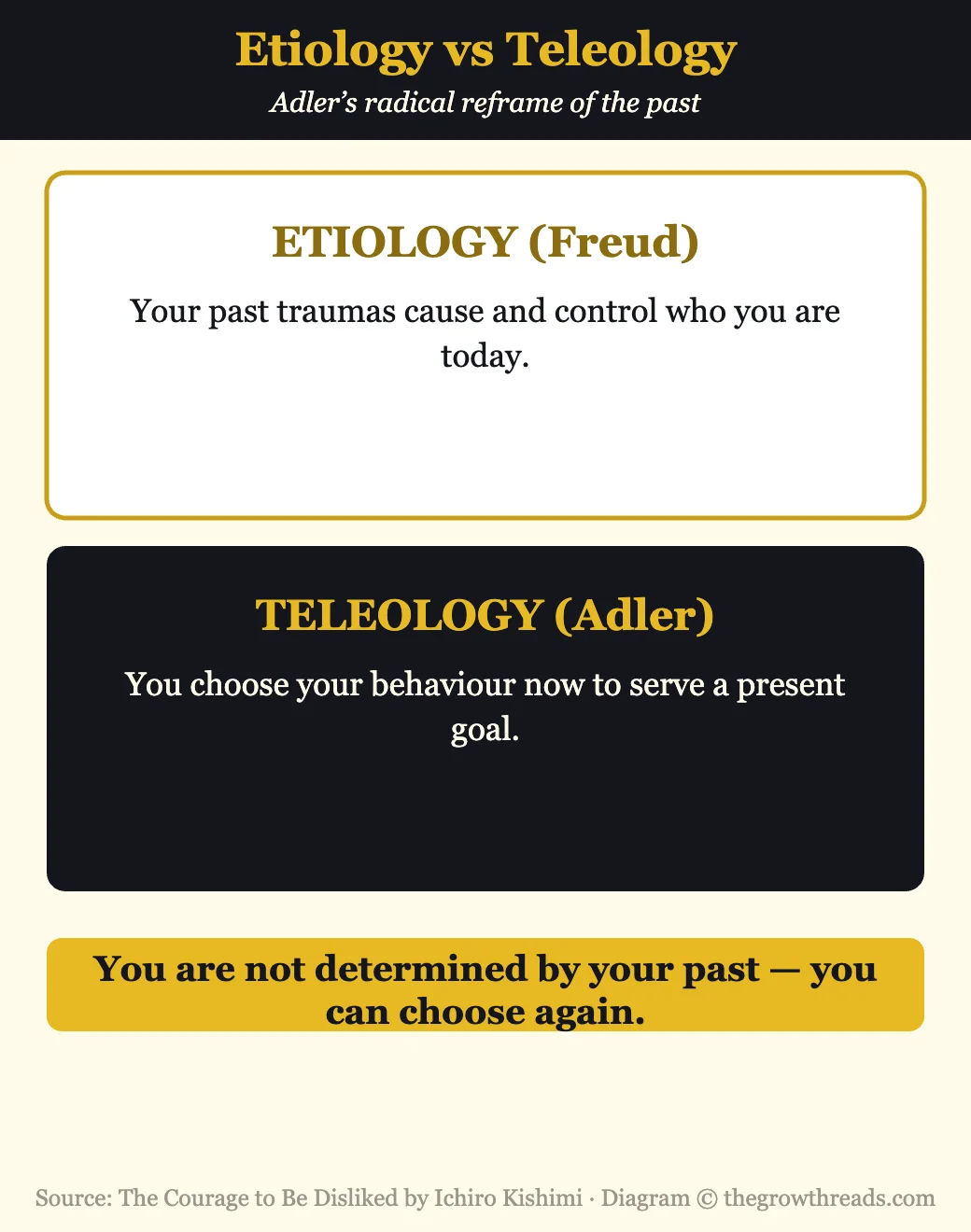
The classic illustration is a person who says they cannot leave their room because of past anxiety. Adler would say the causation runs the other way: the person has decided, at some level, not to go out — perhaps to avoid rejection or to keep their parents’ attention — and produces the anxiety to justify staying in. This is deliberately provocative, and the young man in the dialogue resists it fiercely. But the liberating implication is enormous: if you are not simply a product of your history, then you are free to choose differently now. Your lifestyle — Adler’s word for your overall way of thinking and behaving — was chosen, and can be re-chosen. The past loses its power to sentence you.
Part 2: All problems are interpersonal — inferiority and the separation of tasks
Adler makes a second sweeping claim: all problems are interpersonal relationship problems. Trace almost any anxiety, insecurity, or unhappiness to its root, and you find another person — comparison, judgment, rejection, competition. This is why so much of the book is about how to relate to others. Central to it is the idea of inferiority. Feelings of inferiority, the philosopher explains, are universal and even useful, since they can spur growth. The problem is the “inferiority complex” — using your perceived deficiencies as an excuse not to act (“I can’t do X because I’m not smart/attractive/wealthy enough”). That is a choice to avoid the effort and risk of change, dressed up as an inability.
The book’s most practical and famous tool is the separation of tasks. To reduce the friction of relationships, ask a simple question about any given concern: whose task is this? Whose responsibility, and who ultimately bears the consequences?
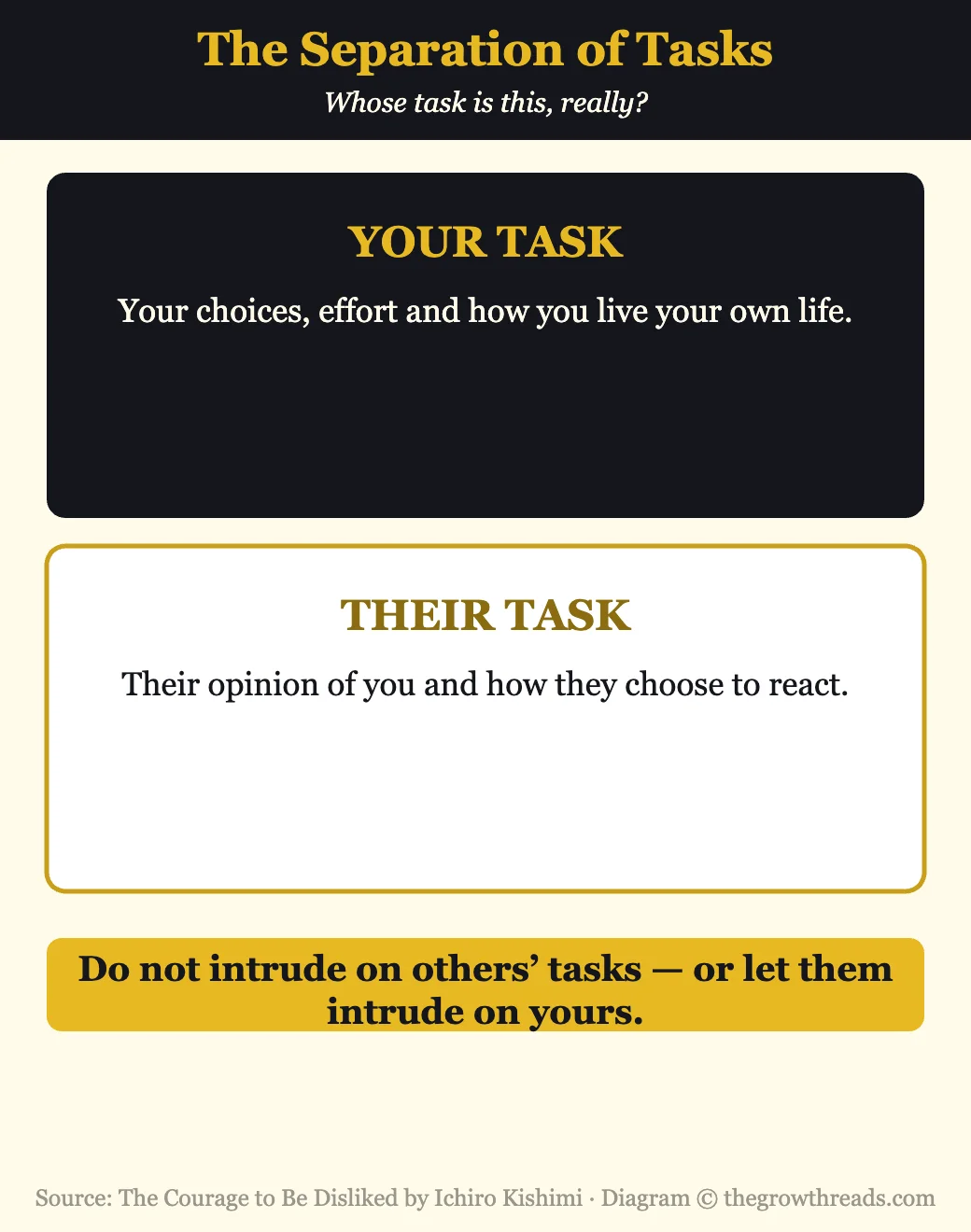
Studying is the child’s task, not the parent’s; you can offer help, but you cannot live their life. Crucially, what another person thinks of you is their task, not yours. You cannot control it, you are not responsible for it, and trying to manage it is intruding on a task that was never yours. Likewise, your choices are your task, and you should not let others intrude on them. Most interpersonal trouble, Adler argues, comes from meddling in other people’s tasks or letting them meddle in ours. Cleanly separating the two dissolves an astonishing amount of anxiety.
TGR Note: The separation of tasks is the intellectual backbone of Mel Robbins’s The Let Them Theory — “Let Them” is literally letting others own their task, and “Let Me” is owning yours. It is also the deep version of what Mark Manson argues in The Subtle Art of Not Giving a F*ck: reserve your care for what is actually yours to control.
Part 3: The courage to be disliked — the shape of freedom
From the separation of tasks flows the book’s title idea. If other people’s opinions of you are their task, then you must accept that some people will dislike you — and that this is not only unavoidable but a sign that you are living freely. The philosopher makes the point sharply: the desire for recognition, the craving to be liked and approved of by everyone, is a kind of unfreedom, because it hands the steering of your life to others. To live according to your own values inevitably means that someone, somewhere, will disapprove. The courage to be disliked is the willingness to pay that price. It is not about being deliberately unpleasant; it is about no longer organizing your life around avoiding disapproval.
This connects to Adler’s insistence on horizontal rather than vertical relationships. We tend to rank ourselves against others — better or worse, above or below — which breeds both arrogance and inferiority, and turns life into competition. Adler urges us instead to see everyone, including children, parents, bosses, and strangers, as equals moving alongside us rather than on a ladder. In a horizontal relationship you neither seek to dominate nor submit, and you neither praise nor scold from above; you encourage as an equal. Releasing the need to win the vertical game, and the recognition it promises, is what makes the courage to be disliked possible.
Part 4: Community feeling and living in the now
If not recognition, then what makes a life feel worthwhile? Adler’s answer is “community feeling” — a sense of belonging and connection to something larger than yourself, rooted in contribution rather than superiority. The philosopher lays out three interlocking keys to it.
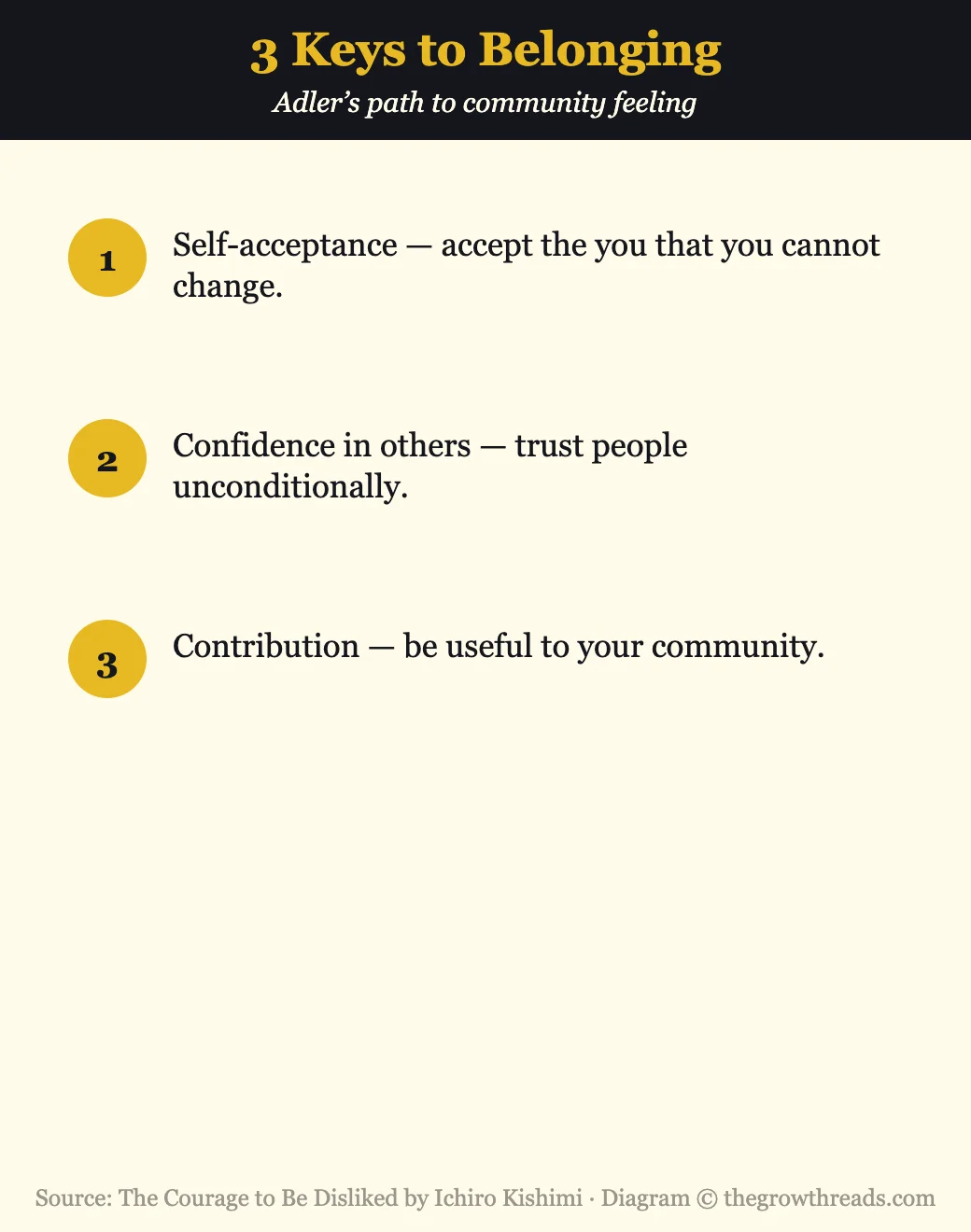
The first is self-acceptance: honestly accepting the parts of yourself you cannot change, while focusing your energy on what you can. The second is confidence in others: choosing to trust people unconditionally, without demanding guarantees, because relationships built on suspicion cannot become deep. The third is contribution to others: the felt sense that you are useful to your community, which is where a durable sense of worth actually comes from. Notably, contribution does not require being thanked or recognized; the value is in the giving, not the applause. Together these produce belonging — the feeling that “it’s okay to be here.”
The dialogue ends by collapsing time. The young man keeps asking how to reach happiness, as if it lies at the end of a long road. The philosopher replies that this is the trap: treating life as a journey toward a distant destination means the present is always merely preparation, never enough. Instead, he says, life is a series of moments — like a dance — and you can be happy now, this instant, by living earnestly in the present and contributing where you are. You do not need to have arrived. This is a difficult book precisely because it refuses easy comfort; it asks you to give up excuses, the safety of blaming your past, and the reassurance of others’ approval. But readers willing to sit with its provocations often find in it one of the most genuinely freeing philosophies of living available.
TGR Note: Adler’s “life is a series of moments, be happy now” is the same door The Power of Now opens from a spiritual angle — presence over a future-chasing mind. And its refusal to be ruled by the past pairs naturally with the radical self-ownership of 12 Rules for Life. Read together, they triangulate a life defined by responsibility, presence, and freedom from approval.
Who is The Courage to Be Disliked best for — and who should read something else first?
This book is ideal for anyone weighed down by their past, by anxiety, or by the exhausting need for approval, and for readers who enjoy being intellectually challenged. Its dialogue format makes difficult philosophy accessible and even gripping. It is not for you if you want gentle, feel-good encouragement or quick tactics — the ideas are provocative, sometimes uncomfortable, and demand real reflection, and the claim that “trauma does not exist” can land badly if taken too literally rather than as a philosophical reframing. For a lighter entry to the same freedom, start with The Subtle Art of Not Giving a F*ck or The Let Them Theory, then come here for the depth.
Questions to reflect on
- What are you blaming on your past that might actually be a present choice?
- Where are you using a feeling of inferiority as an excuse not to act?
- In your current worry, whose task is it really — yours, or someone else’s?
- Whose approval are you organizing your life around, and what would change if you let them dislike you?
- Where could you replace a vertical, competitive relationship with a horizontal, equal one?
🔥 Ready to trade approval for freedom?
This guide is the map — the philosopher-and-youth dialogue is what makes the ideas land.
How to apply The Courage to Be Disliked (7-day plan)
- Day 1 — Reframe one “cause.” Take something you blame on your past and ask what present goal it might serve.
- Day 2 — Spot an inferiority complex. Notice one excuse that starts with “I can’t because…” and question it.
- Day 3 — Separate a task. In one worry, identify clearly whose task it is and step back from what isn’t yours.
- Day 4 — Let someone dislike you. Make one small choice for yourself, accepting that someone may disapprove.
- Day 5 — Go horizontal. Encourage someone as an equal instead of praising or judging from above.
- Day 6 — Contribute quietly. Do one useful thing for others without seeking recognition.
- Day 7 — Live in the now. Spend the day treating this moment as enough, not just preparation for later.
Frequently asked questions
Is The Courage to Be Disliked worth reading?
Yes, if you are open to being challenged. It is one of the most accessible and impactful introductions to Adlerian psychology, and its ideas — that your past need not define you, that all problems are interpersonal, and that freedom means accepting disapproval — can be genuinely life-changing. The dialogue format makes difficult philosophy readable. The caveat is that it is provocative and sometimes uncomfortable, and some claims (like “trauma does not exist”) need to be read as philosophical reframing rather than literal denial. For reflective readers, it is a standout.
What is the main message of The Courage to Be Disliked?
That true freedom and happiness come from letting go of the need for approval and taking ownership of your own life. Drawing on Alfred Adler, the book argues you are not determined by your past, that most problems are interpersonal, and that by separating your tasks from others’ — especially recognizing that their opinion of you is their task — you can stop living for recognition. Happiness then comes from self-acceptance, trust in others, and contribution to your community.
What is the separation of tasks?
It is the book’s central practical tool. For any concern, you ask whose task it is — whose responsibility, and who bears the consequences. Your choices are your task; another person’s opinion of you and how they react are their tasks. Most interpersonal conflict, Adler argues, comes from intruding on others’ tasks or letting them intrude on ours. By cleanly separating the two, you release a huge amount of anxiety, because you stop trying to control what was never yours to control.
Does the book really say trauma does not exist?
It says so provocatively, but the point is philosophical, not a denial that painful events happen or hurt. Following Adler’s “teleology,” the book argues we are not simply determined by past causes; instead we choose behaviors and even emotions to serve present goals. So the meaning we give an experience, and the purpose it serves now, matter more than the event itself. This reframing is meant to be liberating — you are not sentenced by your history — but it should be taken as a lens on agency, not as a dismissal of genuine suffering.
What does “the courage to be disliked” mean?
It means the willingness to accept that living authentically, by your own values, will lead some people to dislike you — and that this is the price of freedom. Because you cannot control others’ opinions (their task, not yours), chasing universal approval hands the steering of your life to other people. The courage to be disliked is not about being rude; it is about no longer organizing your life around avoiding disapproval, which is what makes real freedom possible.
How long does it take to read The Courage to Be Disliked?
The book is around 280 pages and most readers finish it in about six hours. The Socratic dialogue format keeps it moving, though the ideas reward slow reading and reflection, so many people take longer or revisit sections. Our summary above captures the core Adlerian framework in roughly 16 minutes, which is a good way to grasp the big ideas before engaging with the full back-and-forth.
Is The Courage to Be Disliked based on real psychology?
Yes. It is a faithful popularization of the work of Alfred Adler, a real and influential early psychologist who, alongside Freud and Jung, helped found modern psychotherapy. Adler’s “individual psychology” emphasizes goals over causes, the social nature of problems, and the drive for belonging and contribution. The book presents these ideas through a fictional dialogue rather than clinical studies, so it is philosophy and applied psychology rather than a research text, but the underlying framework is a genuine, established school of thought.
Related summaries
- The Let Them Theory Summary — the separation of tasks in two words.
- The Subtle Art of Not Giving a F*ck Summary — caring less about approval.
- The Power of Now Summary — living fully in the present moment.
- 12 Rules for Life Summary — responsibility and meaning.
- Browse all our best psychology books.
How we analyze books: We work from the full book — reconstructing its core arguments in our own words, adding commentary that connects it to related research and other books in our library, and pressure-testing the advice against how it plays out in real life. We never reproduce the text; we synthesize it. Read our full methodology.
Disclosure: The Growth Reads is reader-supported. When you buy through links on our site we may earn an affiliate commission at no extra cost to you. We only recommend books we believe are worth your time, and our summaries and opinions are written independently.
Related Psychology Summaries
Blink Summary & Review: The Power of Thinking Without Thinking
Nudge Summary & Review: How Small Design Changes Shape Better Decisions
Self-Compassion Summary and Review
The Art of Thinking Clearly Summary & Review: 99 Biases That Sabotage Your Decisions
The Gifts of Imperfection Summary & Review: Embrace Who You Are