

⭐⭐⭐⭐ 4.3/5
One-liner: A fascinating, sometimes unsettling look at why our tools for understanding strangers are fundamentally broken — and what that means for everything from policing to diplomacy.
Best for: Anyone who works with people (leaders, negotiators, educators, law enforcement) and wants to understand why first impressions are dangerously unreliable.
Reading time: ~7 hours (304 pages)
Difficulty to apply: Moderate — the concepts are intuitive but rewiring your instincts about strangers takes deliberate practice.
Talking to Strangers in one minute
We are fundamentally bad at understanding strangers — and our overconfidence in that ability causes enormous harm. Malcolm Gladwell weaves together stories of spies, criminals, suicide, sexual assault, and police encounters to reveal three interconnected traps: we default to believing people are truthful, we assume their expressions transparently reveal inner states, and we ignore how tightly behaviour is coupled to specific contexts. The result is a world where honest people get deceived, innocent people get punished, and our strategies for dealing with strangers — from interrogation to policing — systematically fail. The fix is not to become more suspicious, but to accept our limitations and build better systems around them.
Key takeaways
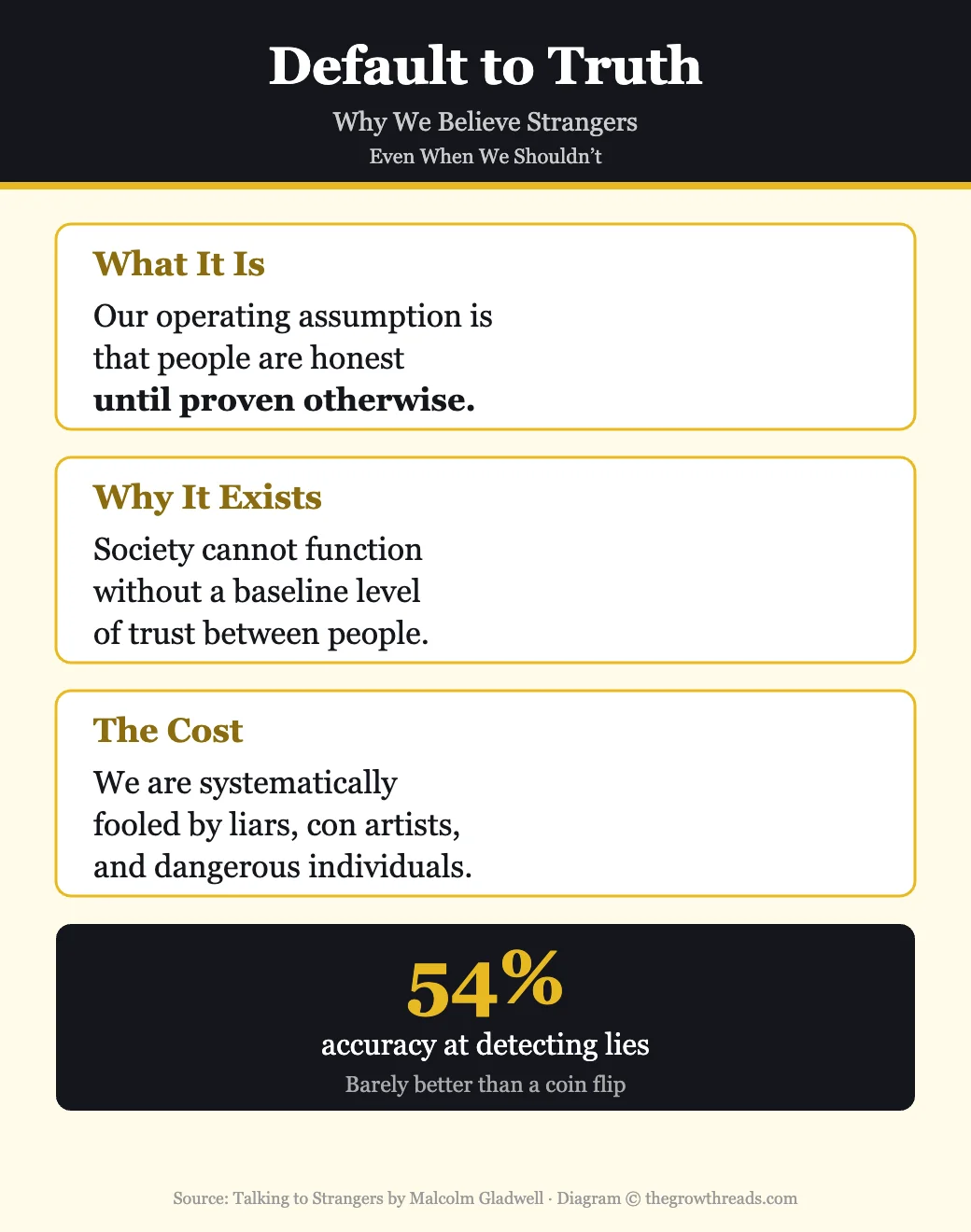
- Default to truth: Humans have a hardwired tendency to assume others are telling the truth, which makes society possible but leaves us vulnerable to deception.
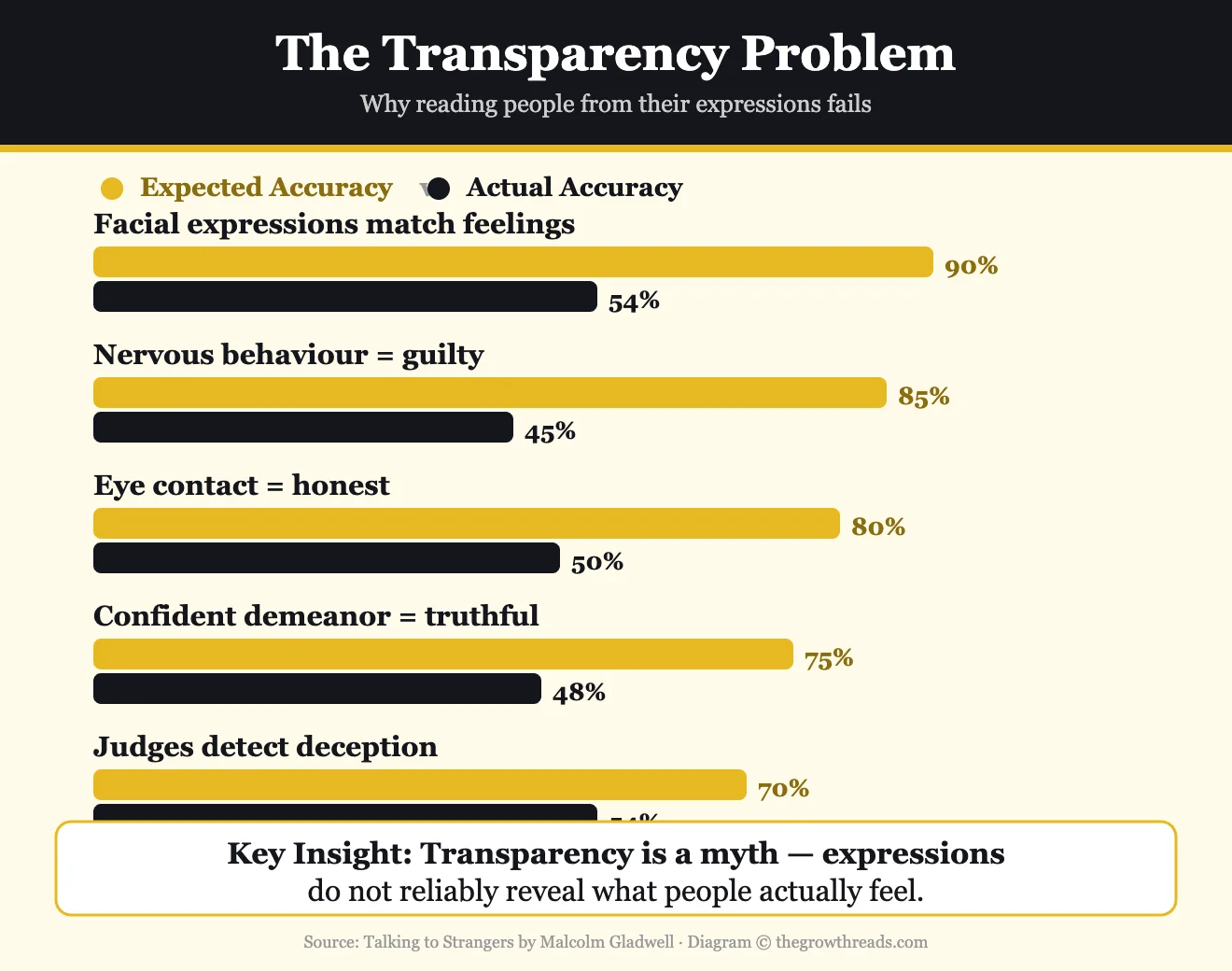
- Transparency is a myth: We believe people’s external expressions match their internal feelings, but research consistently shows expressions are unreliable indicators of emotion.
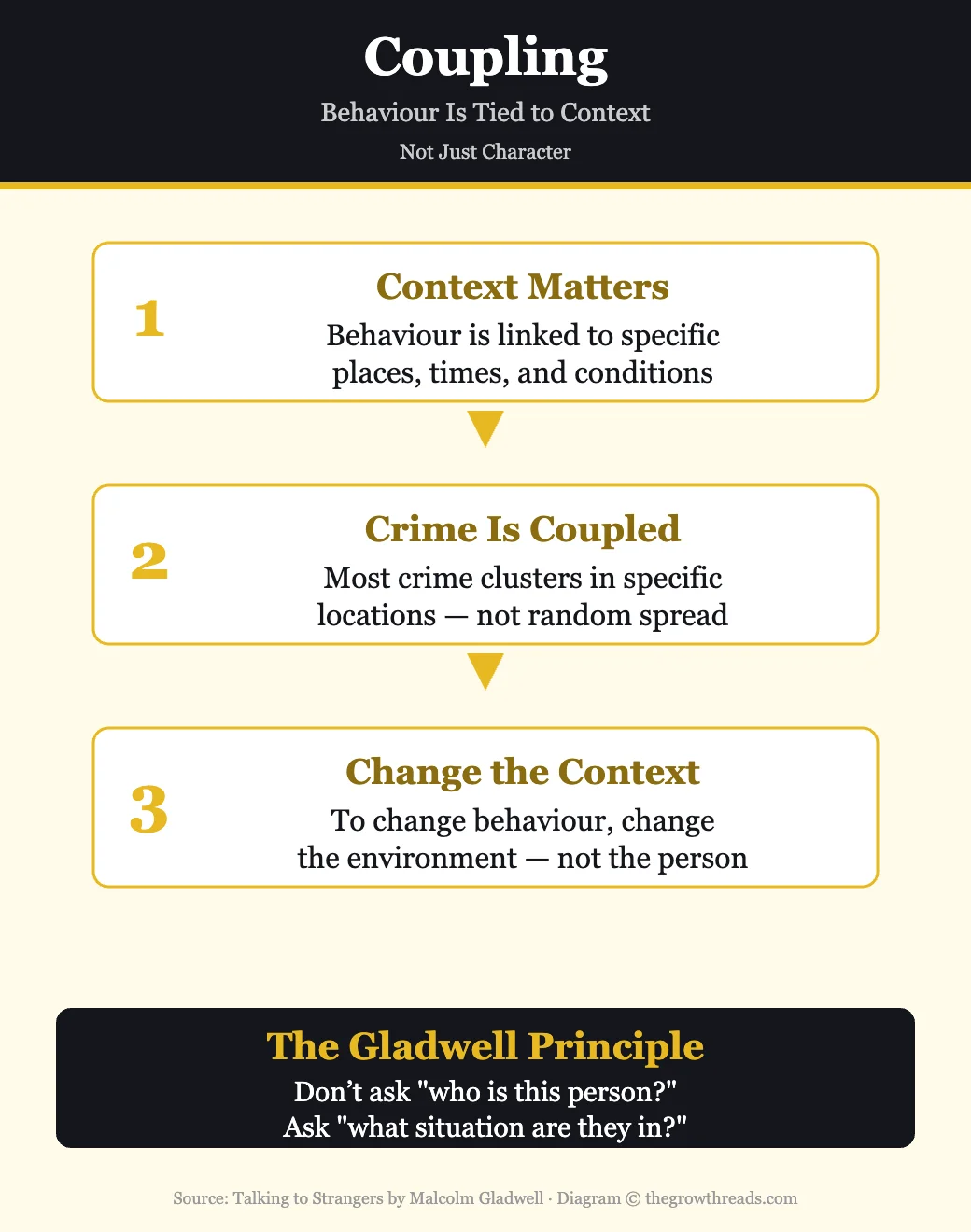
- Coupling explains behaviour: Actions are tied to specific contexts, times, and places — not just personality traits or character flaws.
- Mismatched individuals confuse us: People whose behaviour does not match expected emotional displays (e.g. a grieving person who does not cry) are systematically misjudged.
- Spies exploit our trust: The case of Cuban double agents and Ana Montes shows how defaulting to truth lets skilled liars operate for decades undetected.
- Torture and interrogation fail: Enhanced interrogation and aggressive questioning often produce false confessions rather than truth, because our lie-detection instincts are wrong.
- Suicide is coupled to method: When access to a specific means of suicide is removed (like town gas in England), overall suicide rates drop — people do not simply switch methods.
- Policing goes wrong at the margins: When aggressive stop-and-frisk strategies expand beyond high-crime hot spots, innocent people get harassed and trust in law enforcement collapses.
- Humility is the answer: We cannot become better lie detectors, but we can build institutions and processes that account for our natural limitations.
- Context over character: When someone behaves badly, the first question should not be “who are they?” but “what situation are they in?”
What is Talking to Strangers about?
Talking to Strangers examines why humans are so poor at understanding people they do not know. Through cases spanning CIA intelligence failures, wrongful convictions, the death of Sandra Bland, and the Bernie Madoff scandal, Gladwell identifies three systematic errors we make when encountering strangers: defaulting to truth, assuming transparency of emotion, and ignoring how behaviour couples to context.
About the author
Malcolm Gladwell is a Canadian-born journalist and author who has spent his career at The New Yorker turning social science research into compelling narratives. Born in England and raised in rural Ontario, Gladwell studied history at the University of Toronto before moving to journalism. His previous bestsellers — The Tipping Point, Blink, Outliers, David and Goliath, and What the Dog Saw — have collectively sold over 10 million copies worldwide. Talking to Strangers, published in 2019, marked his first audiobook designed as a full audio experience with interviews and sound. He was named one of Time magazine’s 100 Most Influential People and hosts the podcast Revisionist History. Explore all Malcolm Gladwell book summaries →
Key concepts at a glance
| Concept | What it means | Use it when |
|---|---|---|
| Default to Truth | We believe people are honest unless overwhelming evidence forces us to reconsider | You notice you are trusting someone despite small red flags |
| Transparency | The assumption that people’s expressions reliably reveal their inner feelings | You catch yourself judging someone’s honesty by how they “look” |
| Coupling | Behaviour is tied to specific contexts, not just individual character | You want to understand why someone acted out of character |
| Mismatched | When someone’s external behaviour does not align with expected emotional cues | You feel uneasy about someone who “doesn’t seem right” despite no evidence |
| Holy Fool | The rare person who refuses to default to truth and questions everyone | You consider whether you should be more sceptical in a specific situation |
| The Friends Fallacy | Even close contact does not make us good at detecting deception in others | You assume familiarity equals understanding |
| Kansas City Preventive Patrol | Concentrated policing works in hot spots; spreading it widely causes harm | You are designing any system that deploys limited resources |
Part 1: Spies, diplomats, and the puzzle of default to truth
Gladwell opens with one of the most embarrassing intelligence failures in American history. Fidel Castro’s Cuban intelligence service had placed double agents throughout the CIA’s Cuban operations — and when the CIA finally discovered the scope of the betrayal, it turned out that virtually every piece of intelligence they had gathered from Cuba for decades was compromised. The Americans had defaulted to truth: they believed their Cuban sources were genuine because the information seemed plausible and the sources seemed trustworthy.
The pattern repeats with Ana Montes, one of the most damaging spies in American history. Montes worked at the Defense Intelligence Agency for sixteen years while secretly reporting to Cuban intelligence. Her colleagues described her as brilliant and dedicated. Nobody suspected her because she matched every expectation of what a loyal intelligence analyst should look like. The few people who did raise concerns were dismissed.
Gladwell introduces psychologist Tim Levine’s “default to truth” theory to explain why. Levine’s research shows that humans do not simply “trust” — we have a cognitive bias toward believing others that can only be overcome by a “trigger” powerful enough to force us out of our default state. This is not stupidity; it is a necessary feature of social life. A society where everyone questioned everything would grind to a halt. The cost is that skilled liars can exploit the system for years.
The chapter on Neville Chamberlain and Adolf Hitler crystallises the point. Chamberlain met Hitler face-to-face in 1938 and came away convinced that Hitler was a man of his word. History judges Chamberlain as naive, but Gladwell shows that virtually every diplomat and leader who met Hitler in person was similarly deceived. The few who were not — like Winston Churchill — never met Hitler. They judged him from his actions, not his demeanour. Meeting a stranger can actually make you worse at understanding them.
Part 2: The illusion of transparency
The middle section of the book tackles our second major error: the belief that people’s outward expressions transparently reveal their inner states. Gladwell calls this the “transparency assumption” — the idea that a guilty person looks guilty, a grieving person looks sad, and an honest person looks sincere.
He begins with the case of Amanda Knox, the American student convicted (and later acquitted) of murder in Italy. Knox was judged as suspicious largely because her behaviour did not match what investigators expected from someone who had just lost a roommate to violence. She did cartwheels in the police station, kissed her boyfriend, and seemed insufficiently distraught. She was “mismatched” — her external behaviour did not align with the expected emotional template.
Gladwell presents research showing that this happens far more often than we think. In studies where participants watched videos of people describing real tragedies, viewers were surprisingly poor at determining whether the grief was genuine. People who cried were believed; people who did not cry were suspected of lying, even when the non-criers were telling the truth and the criers were acting.
The television show Friends becomes an unlikely data point. Gladwell notes that sitcoms train us in a world where emotions are always transparent — characters always look exactly how they feel. Real life does not work this way. Different cultures express emotions differently, individuals vary enormously, and the same person may express the same emotion differently on different days. The transparency assumption works on television; it fails in real life.
He extends this to criminal justice. Judges who conduct bail hearings in person — who can see the defendant’s face, hear their voice, and observe their body language — actually make worse bail decisions than a simple algorithm that uses only criminal history and charge severity. The face-to-face encounter does not help; it adds noise.
Part 3: Coupling, context, and the Sandra Bland case
The final section introduces “coupling” — the idea that behaviours are linked to specific contexts rather than being free-floating traits of an individual. This is the most practically important concept in the book.
Gladwell presents the landmark study of suicide and “town gas” in England. Before the 1960s, the most common method of suicide in Britain was putting one’s head in the oven and breathing in carbon monoxide from coal gas. When Britain switched to natural gas (which is not toxic), suicide by gas plummeted — and the overall suicide rate dropped substantially. People did not simply switch to other methods. Suicide, it turned out, was “coupled” to a specific, easily accessible means. Remove the means, and the behaviour decreases.
The same principle applies to crime. Gladwell examines the famous Kansas City Preventive Patrol Experiment and its successor strategies. When police concentrated their efforts on specific high-crime hot spots (a strategy sometimes as small as a few blocks), crime dropped dramatically in those areas. But when cities tried to expand these aggressive tactics across entire neighbourhoods, they ran into a devastating problem: the vast majority of people in those wider areas were law-abiding, and subjecting them to repeated stops and searches destroyed community trust while doing little to reduce crime.
This leads to the book’s emotional centrepiece: the story of Sandra Bland. In 2015, Bland was pulled over by Texas state trooper Brian Encinia for a minor traffic violation — failing to signal a lane change. What should have been a routine stop escalated into a confrontation, arrest, and three days later, Bland’s death in a jail cell. Gladwell argues that this tragedy was the result of coupling failures on multiple levels: an aggressive policing strategy (designed for crime hot spots) was applied on a quiet suburban road; a police officer trained to read “suspicious” behaviour was confronting someone whose demeanour did not match his templates; and the systems meant to protect people from these errors were absent.
Who is Talking to Strangers best for — and who should read something else first?
This book is ideal for leaders, managers, and anyone in a role where they regularly make judgments about people — hiring managers, negotiators, educators, law enforcement professionals, and therapists. If you frequently rely on “gut feeling” about people, this book will productively unsettle that confidence.
If you are looking for a more actionable framework for interpersonal communication, start with Never Split the Difference by Chris Voss or Crucial Conversations by Patterson, Grenny, McMillan, and Switzler. Come back to Gladwell once you want to understand why even skilled communicators get strangers wrong.
Questions to reflect on
- Think of a time you were deceived by someone you trusted. Looking back, were there triggers you dismissed because of your default to truth?
- Have you ever judged someone as dishonest or suspicious based on their facial expressions or body language alone? What evidence did you actually have?
- In what areas of your life are you relying on the transparency assumption — believing you can read a person’s intentions from how they present themselves?
- Consider a behaviour you want to change in yourself or your team. Instead of asking “why is this person like this?” ask “what in the environment is enabling this behaviour?”
- How would your hiring, management, or relationship decisions change if you accepted that your first impressions of strangers are unreliable?
🔥 Ready to rethink how you read people?
Get Gladwell’s most thought-provoking book and discover why everything you think you know about strangers is wrong.
How to apply Talking to Strangers (7-day plan)
- Day 1 — Audit your assumptions: Write down three recent interactions where you made a judgment about someone based on how they looked or sounded. Note what evidence (beyond expression) you actually had.
- Day 2 — Test your default to truth: In one meeting today, consciously notice the moment you decide someone is being honest. Ask yourself: what triggered that belief? Is it their words, their evidence, or their demeanour?
- Day 3 — Look for mismatched people: Identify someone in your life whose emotional expression does not match the expected template. Practice separating their behaviour from your assumptions about what it means.
- Day 4 — Map your coupling: Choose one behaviour you want to change (procrastination, snacking, distraction). Instead of relying on willpower, identify the environmental cues coupled to that behaviour and alter one of them.
- Day 5 — Replace gut with process: For one decision you would normally make by “instinct” (hiring, evaluating, judging credibility), create a simple checklist of objective criteria and use it instead of your impression.
- Day 6 — Practice strategic humility: In a conversation with someone you do not know well, notice when you start forming a mental model of “who they are.” Consciously label it as provisional and remind yourself you are probably missing context.
- Day 7 — Design a better system: Pick one area where you or your team regularly interact with strangers (customer service, hiring, evaluation). Propose one structural change that reduces reliance on reading people and increases reliance on objective data.
Frequently asked questions
What is the main point of Talking to Strangers?
The main point is that humans are systematically bad at understanding strangers because of three cognitive errors: we default to believing people are truthful, we assume facial expressions transparently reveal inner states, and we ignore how behaviour is coupled to specific contexts. These errors are not personal failures — they are features of human psychology that make social life possible but leave us vulnerable to deception and misjudgment.
What does “default to truth” mean?
Default to truth is psychologist Tim Levine’s theory that humans have a baseline cognitive bias toward believing others are telling the truth. We do not simply assess each statement for honesty — we start from an assumption of truthfulness and only abandon it when we encounter a trigger strong enough to overcome the default. This is why skilled liars can deceive people for years: the threshold for disbelief is much higher than most people realise.
Is Talking to Strangers worth reading?
Yes, especially if you work in a role that requires evaluating people — hiring, management, law enforcement, therapy, or negotiation. The book challenges comfortable assumptions about our ability to read others and provides a research-backed framework for understanding why our instincts fail. It is less prescriptive than some self-help books, but the concepts (default to truth, transparency, coupling) are immediately applicable to professional and personal life.
What is the “transparency” concept in Talking to Strangers?
Transparency is the assumption that people’s outward expressions — facial movements, body language, tone of voice — reliably reveal their inner emotional states. Gladwell argues this assumption is wrong: research shows that different cultures express emotions differently, individuals vary enormously, and people whose behaviour does not match expected templates (called “mismatched” individuals) are routinely misjudged as dishonest or suspicious.
What is “coupling” in Talking to Strangers?
Coupling is the principle that behaviours are linked to specific contexts — particular places, times, and conditions — rather than being free-floating personality traits. Gladwell illustrates this with the example of suicide in England: when the primary method (town gas) was removed, overall suicide rates dropped because the behaviour was coupled to that specific means. The practical implication is that changing behaviour often requires changing the environment, not the person.
How long does it take to read Talking to Strangers?
The paperback edition is 304 pages, which takes approximately 7 hours to read at an average reading pace. The audiobook, which Gladwell specifically designed as an immersive experience with interviews and sound effects, runs about 8 hours and 42 minutes. Many readers recommend the audiobook for this title because the interviews with real participants add significant depth to the case studies.
How does Talking to Strangers compare to Gladwell’s other books?
Talking to Strangers is darker and more focused than Gladwell’s earlier work. While Blink examined the power of snap judgments and Outliers explored how context shapes success, this book concentrates entirely on why our interactions with strangers go wrong. It is more emotionally challenging — the Sandra Bland case and discussions of sexual assault are difficult reading — but it is also his most unified argument. If you loved the storytelling in Outliers but wanted deeper practical implications, this book delivers that.
Related summaries
- Blink by Malcolm Gladwell — Gladwell’s earlier exploration of rapid cognition and when snap judgments work (and when they fail).
- Thinking, Fast and Slow by Daniel Kahneman — The foundational work on cognitive biases that underpin Gladwell’s default-to-truth theory.
- Influence by Robert Cialdini — How social psychology drives persuasion and why we are so susceptible to manipulation.
- The Laws of Human Nature by Robert Greene — A comprehensive guide to reading and understanding the people around you.
📚 Explore more Psychology books: See our full curated list at Best Psychology Books to Read in 2026.