

★★★★☆ 4.4/5 — The definitive playbook for navigating high-stakes conversations without damaging relationships.
Best for: Managers who avoid giving tough feedback, couples stuck in recurring arguments, and anyone who defaults to silence or aggression when emotions run high.
Reading time: ~5 hours (this summary: 18 min)
Difficulty to apply: Medium-high — the tools are simple to understand but require consistent practice under emotional pressure.
Crucial Conversations in One Minute
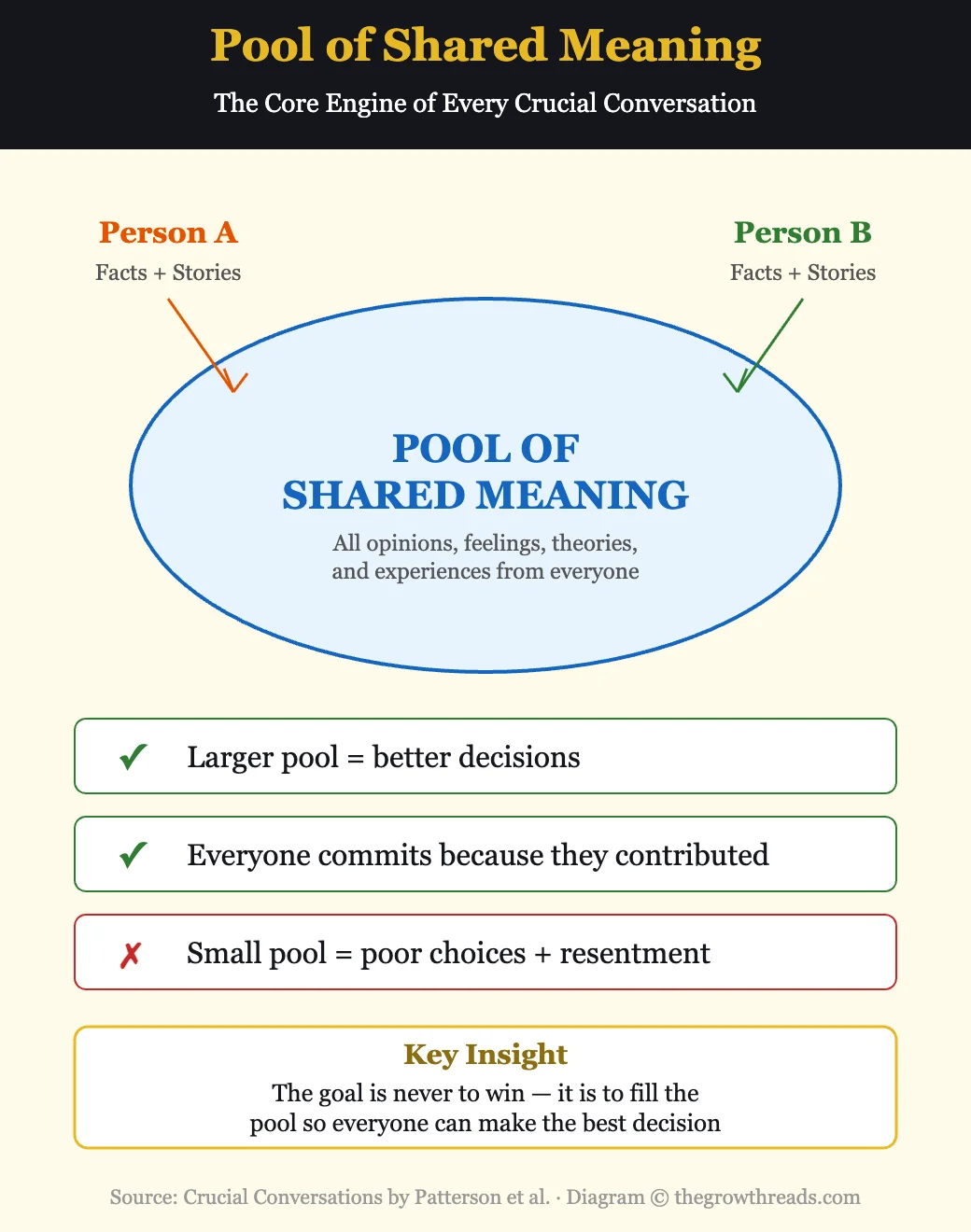
Every failed relationship, stalled career, and dysfunctional team can be traced to a crucial conversation someone either handled badly or avoided entirely. Kerry Patterson and his co-authors spent 25 years studying people who are extraordinarily effective at high-stakes dialogue — and found they all share the same set of learnable skills. The central framework is the “Pool of Shared Meaning”: when people feel safe enough to add their honest opinions, facts, and feelings to a shared pool, groups make dramatically better decisions and individuals stay committed to the outcome.
Key Takeaways
- A crucial conversation has three markers: opposing opinions, strong emotions, and high stakes. Most people handle these moments worst precisely because they matter most.
- Your body betrays you: When stakes rise, adrenaline diverts blood from your brain to your limbs — you are literally dumber in the moments that matter most.
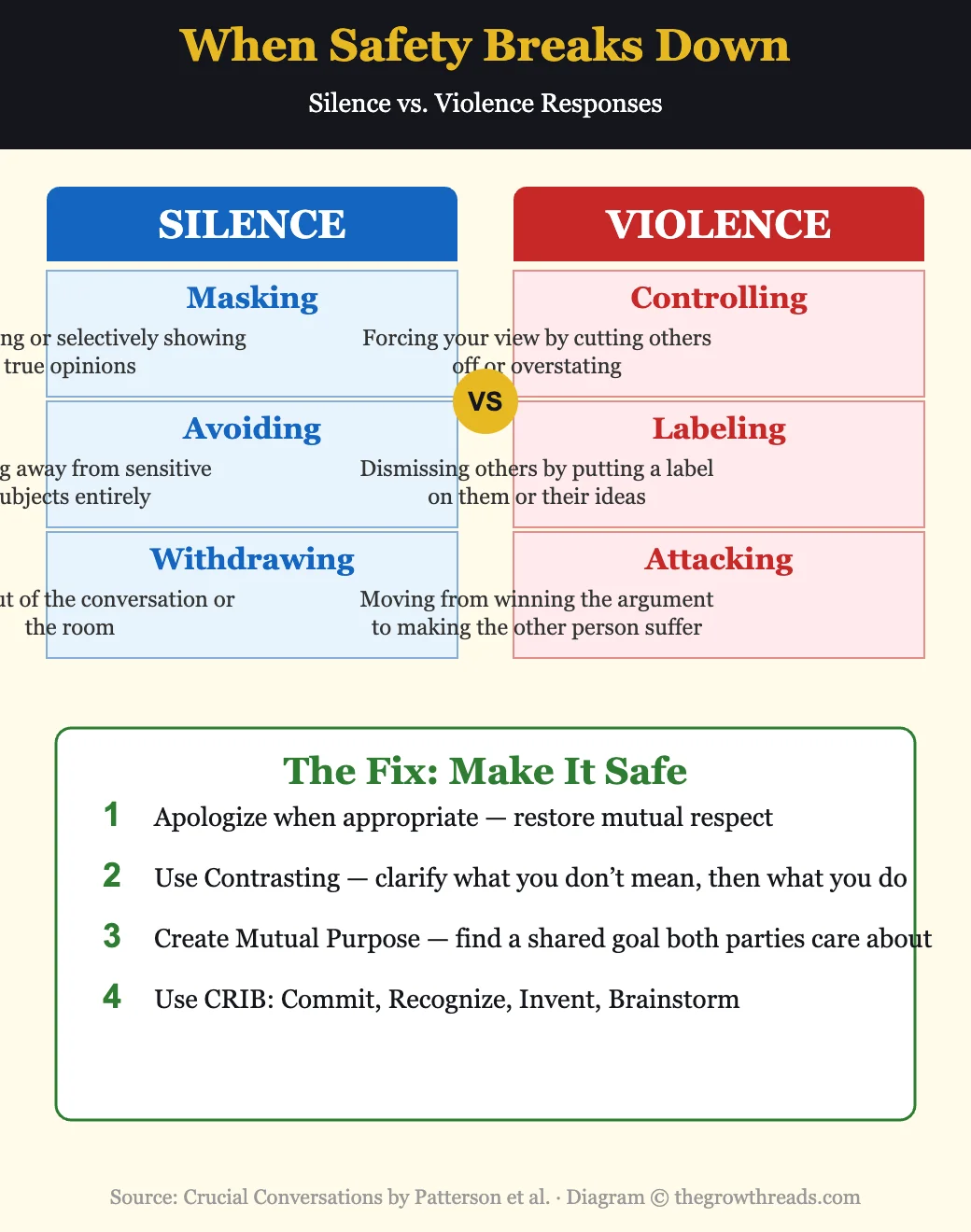
- Silence and violence are the two failure modes: Under pressure, people either withhold meaning (masking, avoiding, withdrawing) or force meaning (controlling, labeling, attacking).
- Safety is the prerequisite for honesty: People do not become defensive because of what you say — they become defensive because they no longer feel safe. Restore safety first, then return to the content.
- Start with heart: Before opening your mouth, clarify what you really want — for yourself, for the other person, and for the relationship.
- Master your stories: Between an event and your emotion sits a story you tell yourself. Change the story and you change the emotion — and the conversation.
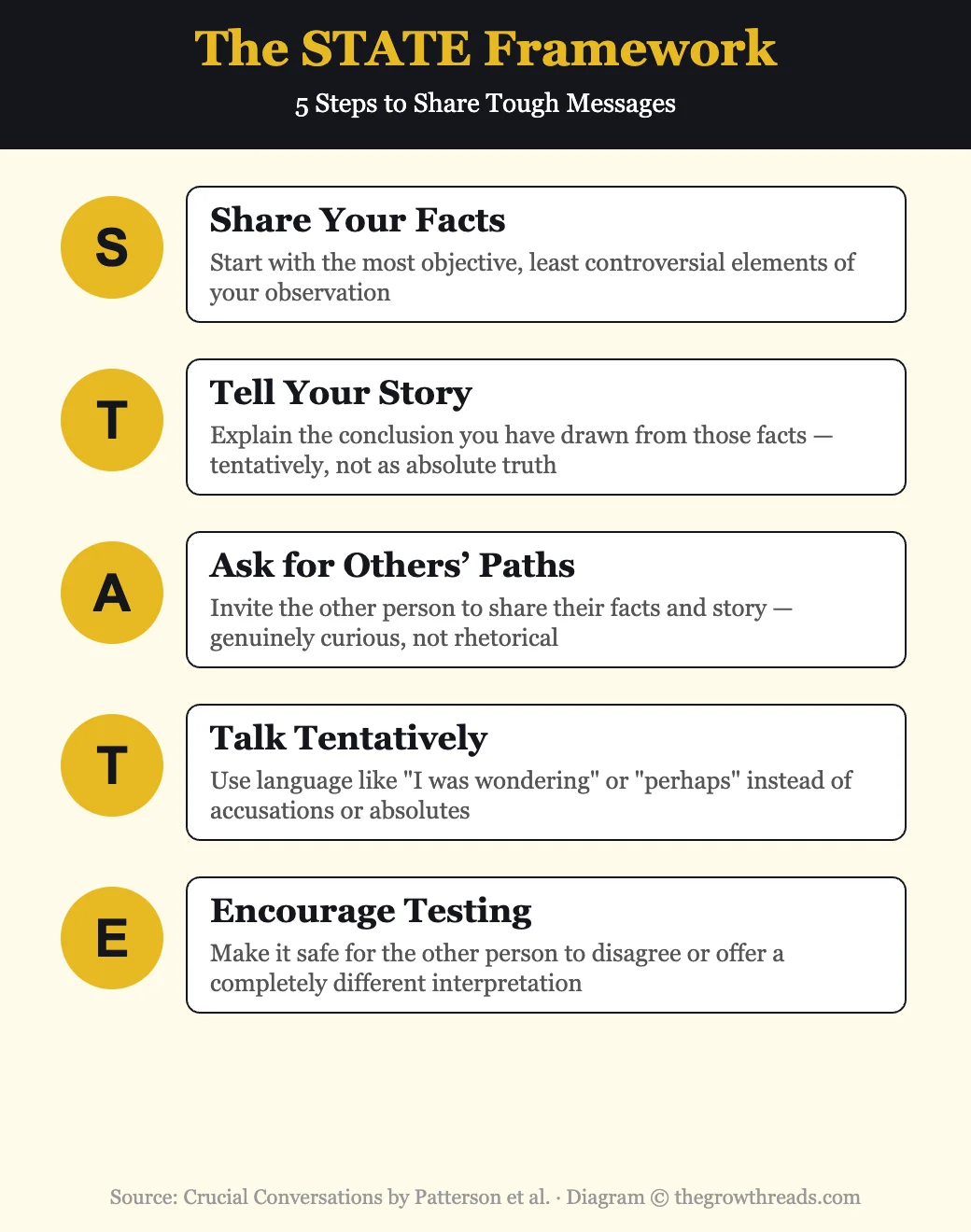
- STATE your path: Share facts, Tell your story, Ask for others’ paths, Talk tentatively, and Encourage testing — in that order.
- Explore others’ paths with AMPP: Ask, Mirror, Paraphrase, and Prime to draw out someone who has gone to silence.
- Move to action: A conversation without a clear decision method (command, consult, vote, or consensus) is just a nice chat that changes nothing.
- The best predictor of relationship health is the average lag time between identifying a problem and raising it: The faster you speak up, the healthier the relationship.
What Is Crucial Conversations About?
Crucial Conversations teaches a step-by-step method for handling high-stakes, emotionally charged discussions without resorting to silence or aggression. Drawing on 25 years of organizational research, the authors show how to make any conversation safe, express controversial opinions honestly, help others open up, and convert dialogue into action and results.
About the Authors
Kerry Patterson, Joseph Grenny, Ron McMillan, and Al Switzler are the co-founders of VitalSmarts (now Crucial Learning), a corporate training company that has taught communication skills to millions of employees at Fortune 500 companies. Their research began by identifying individuals within organizations who achieved dramatically better results than their peers — then reverse-engineering the conversational habits those high performers shared. The team has collectively published five New York Times bestsellers and holds doctorates in organizational behavior and communication.
Key Concepts at a Glance
| Concept | What It Means | Use It When |
|---|---|---|
| Pool of Shared Meaning | The collective information available to a group during dialogue | A team keeps making poor decisions because key opinions go unspoken |
| Start with Heart | Clarifying your true objective before speaking | You notice yourself wanting to win rather than solve |
| Safety First | Mutual purpose and mutual respect must exist before honest dialogue can happen | Someone shuts down or becomes aggressive during a conversation |
| Contrasting | A don’t/do statement that fixes misunderstandings | Someone misinterprets your intent and becomes defensive |
| Master My Stories | Separating facts from the stories you tell about those facts | You feel an intense emotion and want to check whether it matches reality |
| STATE Path | A five-step method for sharing risky opinions | You need to deliver feedback or raise a sensitive topic |
| AMPP Listening | Ask, Mirror, Paraphrase, Prime — drawing others out of silence | Someone clearly has something to say but will not say it |
| Move to Action | Deciding who does what by when after every conversation | A meeting ends and nobody is sure what was actually decided |
Part 1: What Makes a Conversation Crucial — and Why We Fail
Patterson and his team define a crucial conversation by three conditions occurring simultaneously: the people involved hold opposing opinions, the emotions are strong, and the stakes are high. These are the performance reviews that determine promotions, the relationship talks that decide whether couples stay or leave, the team meetings where strategic direction gets set — or sabotaged.
The cruel irony is that humans perform worst in exactly these moments. When your brain detects a social threat, your adrenal glands flood your bloodstream with cortisol and adrenaline. Blood flows away from your higher reasoning centers (the prefrontal cortex) toward your muscles, preparing you to fight or flee. You are left arguing with the cognitive capacity of a reptile about something that requires the finesse of a diplomat.
Under this pressure, people default to one of two failure modes: silence or violence. Silence means withholding information from the Pool of Shared Meaning — you mask your true opinion behind sarcasm, avoid the subject entirely, or withdraw from the conversation. Violence means forcing your meaning into the pool — you cut people off, use hyperbolic language, label their ideas as stupid, or escalate to personal attacks. Both modes have the same result: the pool stays empty, and the decision suffers.
Part 2: Making It Safe and Mastering Your Stories
The single most important skill in the book is the ability to notice when safety breaks down — and restore it before trying to continue the conversation. Patterson’s research found that the primary reason people go to silence or violence is not that they disagree with the content being discussed. It is that they no longer feel safe. Specifically, they have lost confidence in one of two conditions: mutual purpose (they believe you care about their goals, not just your own) or mutual respect (they believe you value them as a person).
When either condition vanishes, no amount of logic, evidence, or eloquence will land. The authors’ advice is counterintuitive: step out of the content entirely and rebuild safety. Two tools accomplish this. Contrasting is a don’t/do statement: “I don’t want you to think I’m unhappy with your overall work. I do want to discuss one specific project so we can make it even better.” It addresses the misinterpretation before it metastasizes. Creating Mutual Purpose uses the CRIB framework: Commit to seeking a mutual goal, Recognize the purpose behind the other person’s strategy, Invent a mutual purpose if one does not exist, and Brainstorm new strategies that serve both purposes.
The second major skill is “mastering your stories.” Between an observable event (your colleague did not invite you to the meeting) and your emotional reaction (anger, hurt, fear) sits a story you construct — often instantly and unconsciously. Patterson calls these “clever stories” because they serve a self-protective function: victim stories (“It is not my fault”), villain stories (“It is entirely their fault”), and helpless stories (“There is nothing I can do”). The antidote is to separate the facts from the story, ask why a reasonable person would behave that way, and then choose a more complete narrative that accounts for all the evidence.
Part 3: STATE Your Path — How to Speak Honestly Without Destroying Relationships
The STATE framework is the procedural heart of the book — a five-step method for expressing controversial, sensitive, or risky opinions in a way that maintains safety while still being completely honest.
Share your facts: Begin with the most objective, least controversial elements. Facts are the least likely to trigger defensiveness because they are verifiable. Saying “You have been 20 minutes late to the last three team meetings” is radically different from “You obviously don’t respect anyone’s time.”
Tell your story: Once the facts are on the table, share the conclusion you have drawn — but flag it explicitly as your interpretation, not as truth. “The story I’m telling myself is that the project isn’t a priority for you” invites dialogue; “You clearly don’t care about this project” invites war.
Ask for others’ paths: Genuinely invite the other person’s facts and stories. This is not a rhetorical device — you must actually be curious. The question “What am I missing?” works better than “Don’t you agree?”
Talk tentatively: Tentative language (“I was wondering…” “It seems to me…” “Perhaps…”) signals that your story is a hypothesis, not a verdict. This makes it safe for the other person to offer a different interpretation without having to call you a liar.
Encourage testing: Explicitly invite disagreement. “I could be wrong about this — push back if you see it differently.” When you make it safe to disagree, you get the truth faster.
Part 4: Moving from Talk to Action
The final section addresses the most common failure point after a productive conversation: the complete absence of follow-through. Patterson observes that even teams who have mastered safety and the STATE framework often end meetings with a vague sense of agreement but no clear decision about who does what by when. The conversation felt good, but nothing changes.
The authors identify four decision-making methods, each appropriate for different situations. Command decisions are made by authority without involvement — efficient but low buy-in. Consult decisions gather input before one person decides — better buy-in with reasonable speed. Vote decisions are efficient for large groups with clear options. Consensus decisions require everyone to agree — slowest but highest commitment. The crucial move is to explicitly name which method you are using before the conversation ends.
Once the decision method is chosen, the final step is assigning action items with four elements: who will do it, what exactly they will do, by when, and how you will follow up. Patterson argues that unclear assignments are worse than no assignments, because they create the illusion of progress while breeding resentment when nothing materializes.
Who Is Crucial Conversations Best For — and Who Should Read Something Else First?
Crucial Conversations is ideal for managers who dread performance reviews, couples who avoid hard topics until they explode, and team leads who notice that their meetings produce heat but not light. The STATE framework is immediately useful for anyone who has something important to say but keeps putting it off.
If your challenge is less about navigating tough talks and more about understanding emotional connection patterns, start with Attached to understand why some conversations feel threatening at a neurological level. If you want to influence people in everyday interactions rather than high-stakes moments, How to Win Friends and Influence People covers the softer end of the spectrum. And if your issue is saying “no” and setting boundaries rather than navigating conflict, The Four Agreements provides a complementary philosophy.
Questions to Reflect On
- Think of a conversation you have been avoiding. What story are you telling yourself about why it is too risky? Is that story based on facts or assumptions?
- When you feel threatened in a conversation, do you default to silence (withdrawing, masking, avoiding) or violence (controlling, labeling, attacking)? Can you name a specific recent example?
- Recall the last argument that went badly. At what point did safety break down? What was the trigger — a loss of mutual purpose or mutual respect?
- If you applied the STATE framework to your most dreaded upcoming conversation, what are the verifiable facts you would share first?
- How does your team or family currently make decisions? Is the method explicit, or does everyone assume a different process?
🔥 Ready to master the conversations that matter most?
Crucial Conversations gives you the exact words and frameworks to speak honestly without destroying relationships.
How to Apply Crucial Conversations (7-Day Plan)
- Day 1 — Identify your crucial conversation: Write down the one conversation you have been avoiding longest. Note who is involved, what is at stake, and what outcome you want for yourself, the other person, and the relationship.
- Day 2 — Map your default style: Recall two recent conflicts. Did you go to silence or violence? Write the specific behavior (masking, avoiding, controlling, labeling) and what triggered it.
- Day 3 — Separate facts from stories: Take the conversation from Day 1 and list only the verifiable facts — things a camera would record. Then list the stories you have built on top of those facts. Challenge each story: why might a reasonable person have done this?
- Day 4 — Draft your STATE opening: Write out the first two minutes of your crucial conversation using the STATE framework. Share facts first, tell your story tentatively, and prepare your genuine question to invite their perspective.
- Day 5 — Practice the safety restore: With a friend, rehearse recognizing when safety breaks down (look for silence or violence signals) and using a Contrasting statement to restore it: “I don’t mean X. I do mean Y.”
- Day 6 — Have the conversation: Use your STATE script from Day 4. Before you begin, state your mutual purpose out loud. If safety breaks, pause content and restore it before continuing.
- Day 7 — Move to action: After the conversation, write down the decision made, the method used (command, consult, vote, consensus), who does what by when, and when you will follow up. Share this summary with everyone involved.
Frequently Asked Questions
What is a crucial conversation?
A crucial conversation is any discussion where three conditions exist simultaneously: the people involved hold opposing opinions, the emotions are strong, and the stakes are high. Examples include asking for a raise, confronting a partner about broken trust, giving critical feedback to a direct report, or disagreeing with a boss in a meeting. The authors found that how people handle these specific moments predicts career success, relationship satisfaction, and organizational performance more reliably than almost any other factor.
What is the Pool of Shared Meaning?
The Pool of Shared Meaning is the collective body of information — facts, opinions, feelings, theories, and experiences — that is available to a group during a conversation. When people feel safe, they add their meaning to the pool freely, producing better decisions and stronger commitment. When people withhold meaning (silence) or force it in aggressively (violence), the pool stays shallow and decisions suffer. The entire Crucial Conversations framework is designed to fill this pool as completely as possible.
What is the STATE framework?
STATE is a five-step method for sharing sensitive opinions: Share your facts (start with objective, verifiable observations), Tell your story (explain your interpretation tentatively), Ask for others’ paths (genuinely invite their perspective), Talk tentatively (use language like “perhaps” or “I was wondering”), and Encourage testing (make it safe to disagree). The sequence matters — facts are the least controversial starting point, while stories are riskier and should come second, clearly flagged as interpretation rather than truth.
What is the difference between silence and violence?
Silence and violence are the two ways people withhold or force meaning when they no longer feel safe. Silence includes masking (understating your true opinion), avoiding (steering away from the topic), and withdrawing (leaving the conversation). Violence includes controlling (dominating the discussion), labeling (dismissing others with stereotypes), and attacking (making personal insults). Both are signs that safety has broken down. The fix is not to push harder on content but to step back and restore mutual purpose and mutual respect.
How do you make a conversation safe again?
Two tools restore safety. Contrasting is a don’t/do statement that corrects misunderstandings: “I don’t want you to think I’m questioning your competence. I do want to solve this one issue so the project stays on track.” Creating Mutual Purpose uses the CRIB framework: Commit to finding a mutual goal, Recognize the purpose behind the other person’s strategy, Invent a mutual purpose if none exists, and Brainstorm new strategies that serve both parties. Always restore safety before returning to the content of the conversation.
Can Crucial Conversations help with personal relationships?
Absolutely. While the book draws many examples from corporate settings, the authors explicitly apply the framework to marriages, parenting, and friendships. The STATE framework works identically whether you are giving feedback to a direct report or raising a concern with your partner. In fact, the research shows that relationship satisfaction correlates directly with the average lag time between identifying a problem and raising it — meaning couples who speak up early using safe, honest dialogue have healthier, longer-lasting relationships.
What should I read after Crucial Conversations?
The authors wrote a companion book, Crucial Accountability, which focuses on follow-through after agreements are made. For understanding the emotional patterns underneath tough conversations, try Attached by Amir Levine, which explains why some people default to silence (avoidant attachment) and others to violence (anxious attachment). For everyday influence rather than high-stakes dialogue, How to Win Friends and Influence People by Dale Carnegie remains the classic. And for the neuroscience of why we tell ourselves stories, Thinking, Fast and Slow by Daniel Kahneman provides the cognitive science foundation.
Related Summaries
- Attached Summary — Understand the attachment styles that drive your communication patterns
- How to Win Friends and Influence People Summary — Build rapport and influence in everyday interactions
- Never Split the Difference Summary — FBI negotiation tactics for getting what you want
- Best Relationship Books — Our complete guide to the top books on love, communication, and connection
How we analyze books: We read every book cover to cover, cross-reference key claims with peer-reviewed research, and distill the most actionable ideas into frameworks you can apply immediately. Our infographics are original, and our 7-day plans are designed for real-world implementation. Read our full methodology.