

⭐⭐⭐⭐ 4.3/5 — A paradigm-shifting look at success that reveals the hidden advantages, timing, and cultural forces behind extraordinary achievement.
Best for: Anyone who wants to understand why talent alone never explains success — and what actually does.
Reading time: ~5 hours (309 pages)
Difficulty to apply: Low to Medium — the value is in reframing how you think about opportunity, practice, and context.
Outliers in one minute
Success is not a solo act — it is a product of timing, culture, opportunity, and relentless practice. Malcolm Gladwell dismantles the myth of the self-made genius by examining everyone from the Beatles to Bill Gates, Canadian hockey players to Korean airline pilots. The pattern that emerges is consistent: behind every outlier is a web of accumulated advantages — the right birth date, the right era, the right cultural legacy, and thousands of hours of practice that most people never see. Outliers does not diminish hard work; it redefines what makes hard work possible in the first place.
Key takeaways
- The 10,000-Hour Rule: Mastery in any complex field requires roughly 10,000 hours of deliberate practice — a threshold that separates the elite from the merely good.
- Timing matters enormously: When you are born — the year, the month, even the era — can determine whether you get the opportunities needed to succeed.
- The Matthew Effect is real: Small initial advantages compound over time, creating widening gaps between those who get early boosts and those who do not.
- Culture shapes performance: Cultural legacies — attitudes toward authority, work ethic, communication style — influence outcomes in fields from aviation safety to mathematics.
- Opportunity is not random: The luckiest outliers were positioned at the intersection of preparation and a transformative moment in history.
- IQ has a threshold: Beyond about 120, additional IQ points add diminishing returns — practical intelligence and creativity matter more.
- Community and family shape grit: The environment you grow up in — values, parenting style, economic context — determines whether talent gets developed or wasted.
- Meaningful work drives effort: People work hardest when their effort has a clear connection to reward — a lesson embedded in rice paddy agriculture and Jewish garment trades alike.
- Legacy effects persist for generations: Regional cultures of honor, attitudes toward authority, and work habits can trace back centuries and still influence behavior today.
- Success can be engineered: Once you understand the ecology of success, you can design better systems — schools, sports leagues, workplaces — that create more outliers.
What is Outliers about?
Outliers examines the hidden forces behind extraordinary success. Malcolm Gladwell argues that individual talent and ambition are not enough — success depends on timing, cultural heritage, family background, and accumulated opportunities that compound over a lifetime. Through case studies spanning hockey leagues, Silicon Valley, airline cockpits, and rice paddies, the book reveals that outliers are not self-made but rather products of their environments and eras.
About the author
Malcolm Gladwell is a Canadian-born journalist and author who spent nearly a decade as a staff writer at The New Yorker before publishing his first book, The Tipping Point, in 2000. Gladwell has a gift for making social science research accessible and narrative-driven, and his work has shaped popular understanding of concepts from thin-slicing (Blink) to tipping points in social epidemics. Born to a Jamaican mother and a British father, Gladwell draws on his own multicultural background throughout Outliers, particularly in the book`s closing chapter on his mother`s improbable educational journey in Jamaica. He has published seven books, all of them bestsellers, and hosts the podcast Revisionist History. Explore all Malcolm Gladwell book summaries →
Key concepts at a glance
| Concept | What it means | Use it when |
|---|---|---|
| 10,000-Hour Rule | Mastery requires ~10,000 hours of deliberate practice | Evaluating what it really takes to become world-class |
| The Matthew Effect | Small advantages compound into large ones over time | Designing fairer selection systems (sports, schools) |
| Relative Age Effect | Older children in age-grouped cohorts get disproportionate advantages | Understanding why some kids “bloom late” |
| Practical Intelligence | Knowing how to navigate social situations and institutions | Distinguishing book smarts from street smarts |
| Cultural Legacy | Inherited attitudes and behaviors passed down through generations | Understanding persistent regional or ethnic performance patterns |
| Power Distance Index | How much a culture defers to authority | Improving team communication and safety |
| Demographic Luck | Being born in the right year for a transformative opportunity | Spotting emerging opportunities in your own era |
| Meaningful Work | Effort tied directly to visible reward drives exceptional persistence | Designing work environments that sustain motivation |
Part 1: Opportunity — the Matthew Effect and the 10,000-Hour Rule
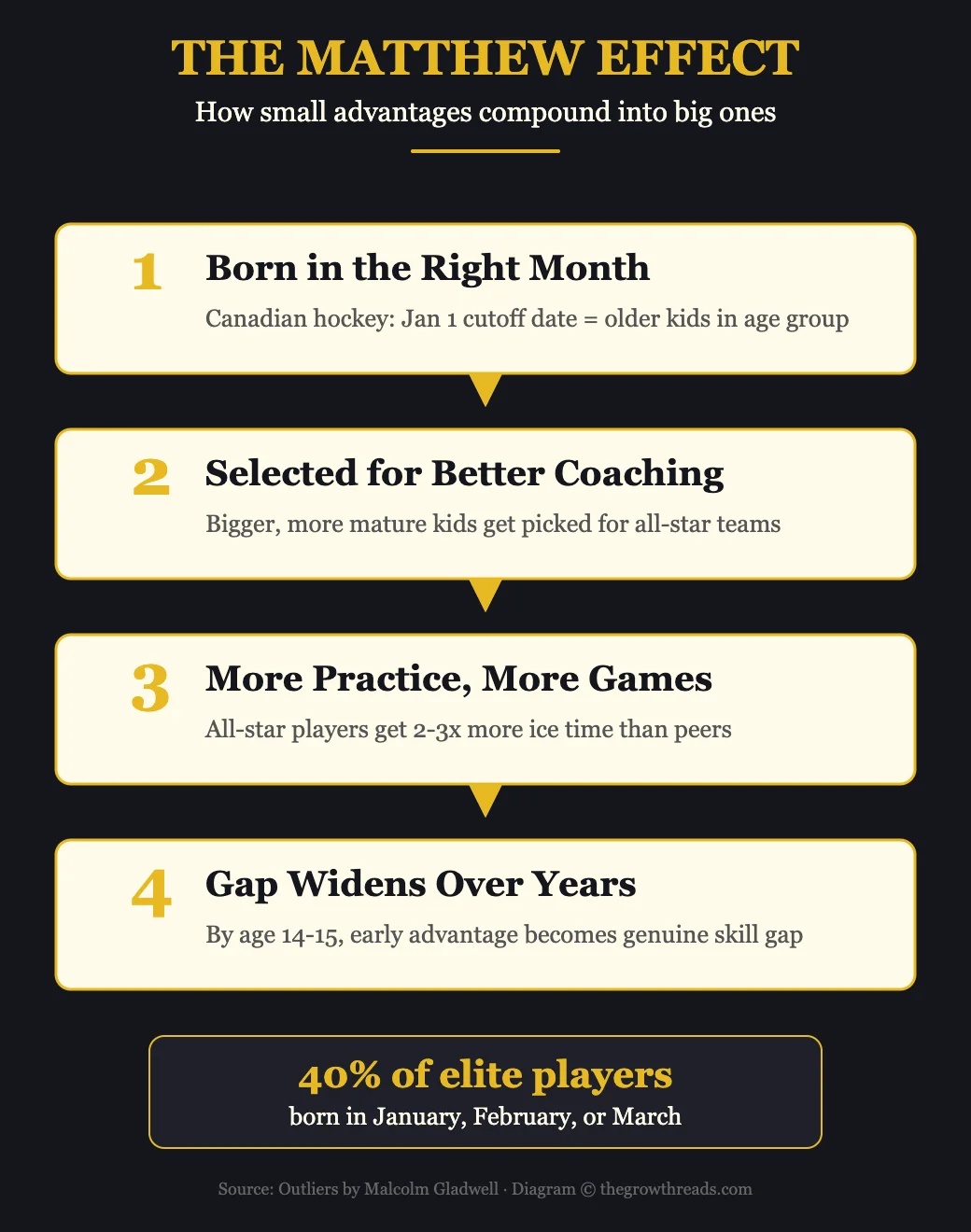
Gladwell opens with a striking observation from Canadian hockey. When researchers looked at the birth dates of elite players in the Ontario Hockey League, they found a staggering over-representation of boys born in January, February, and March. The reason was simple but profound: the eligibility cutoff date was January 1. Boys born just after the cutoff were almost a full year older — and therefore bigger, stronger, and more coordinated — than their youngest teammates. Coaches selected these larger boys for all-star teams, which meant better coaching, more ice time, and more competitive games. By the time the cohort reached their teens, the gap between the “talented” (older) kids and the “average” (younger) kids had become real — not because of innate ability, but because of accumulated advantage.
Gladwell calls this the Matthew Effect, borrowing a term from sociologist Robert Merton, who took it from the biblical Gospel of Matthew: “For unto every one that hath shall be given.” The pattern repeats everywhere selection systems sort young people by age-grouped cohorts — in European soccer, American baseball, and educational streaming.
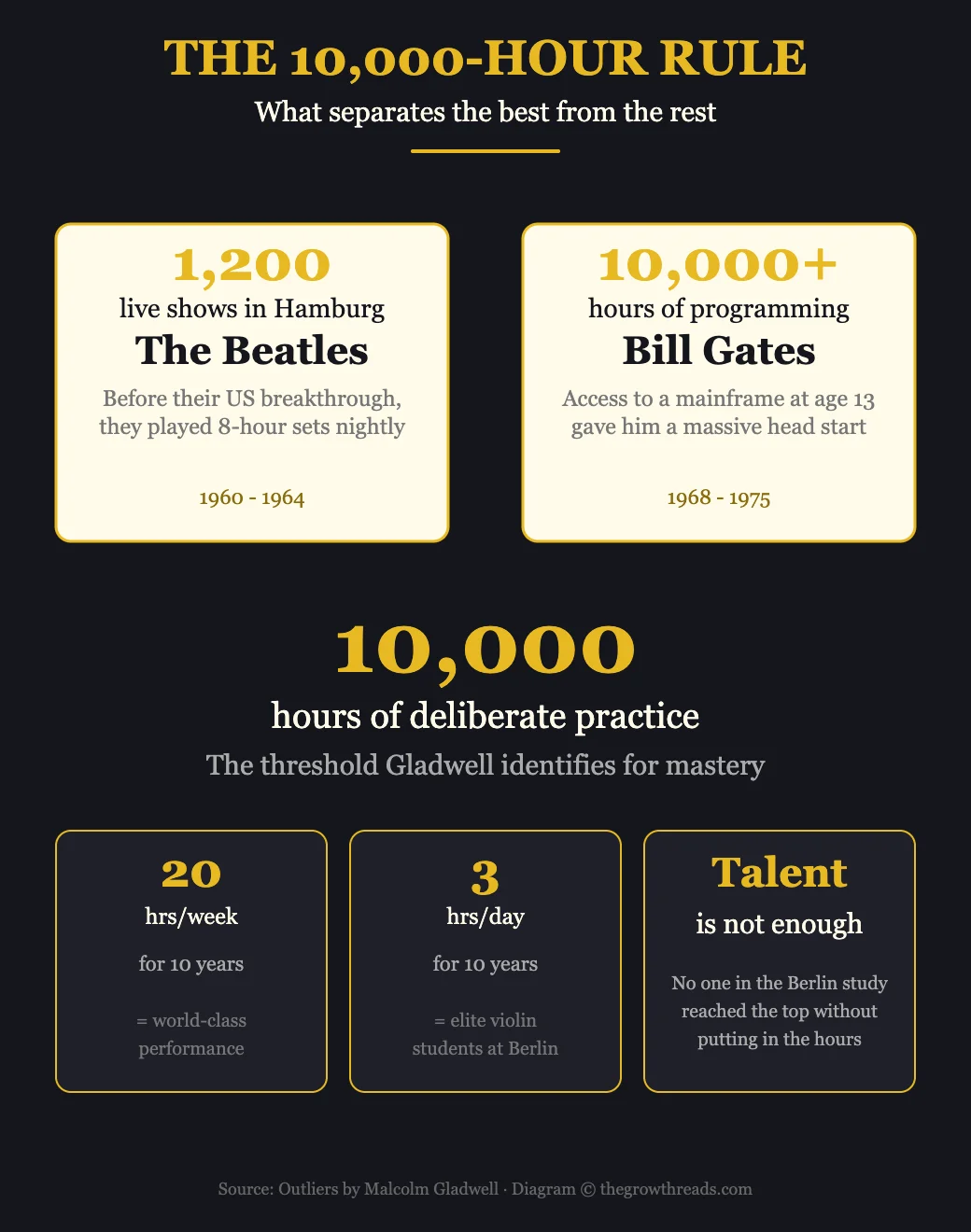
The 10,000-Hour Rule extends this logic. Gladwell draws on psychologist K. Anders Ericsson`s research at Berlin`s Academy of Music, where elite violinists had accumulated over 10,000 hours of practice by age 20 — while merely good students logged around 8,000, and future music teachers around 4,000. The pattern held for composers, chess grandmasters, and athletes. Talent mattered for entry, but hours of deliberate practice separated the tiers.
The Beatles offer a vivid example. Before conquering the world, they played an estimated 1,200 performances in Hamburg, Germany — marathon eight-hour sets in strip clubs that forced them to develop stamina, versatility, and stagecraft. Bill Gates had a similarly improbable advantage: access to a time-sharing computer terminal at his Seattle prep school in 1968, when almost no one his age could have logged the programming hours he accumulated before graduating high school.
Part 2: Legacy — IQ, practical intelligence, and family
In the second section, Gladwell challenges the assumption that raw intelligence is the main predictor of life outcomes. He introduces Chris Langan, a man with an IQ reportedly between 195 and 210 — one of the highest ever measured — who spent most of his adult life working as a bouncer on Long Island. Langan`s extraordinary intellect never translated into academic or professional success because he lacked what Gladwell calls practical intelligence: the social savvy to navigate institutions, negotiate with authority figures, and advocate for himself.
Gladwell contrasts Langan with J. Robert Oppenheimer, who as a troubled graduate student at Cambridge reportedly tried to poison his tutor — and talked his way into a mere probation. Oppenheimer had been raised in a wealthy family that cultivated what sociologist Annette Lareau calls “concerted cultivation” — active coaching in how to interact with the adult world. Langan, raised in poverty with an abusive stepfather, received what Lareau calls “natural growth” parenting: love, but no instruction in the art of navigating institutions.
The takeaway is not that IQ does not matter — it does, up to a point. Gladwell cites research suggesting a threshold of roughly 120, above which additional IQ points yield diminishing returns. Beyond the threshold, practical intelligence, creativity, and persistence become the differentiators. The implication is uncomfortable: society wastes enormous talent by failing to provide the scaffolding that turns raw intelligence into realized achievement.
Part 3: Demographic luck — the importance of when and where
Gladwell makes a powerful case that being born in the right era is one of the most underappreciated factors in success. He compiles a list of the 75 wealthiest people in human history and discovers that an astonishing 14 of them were Americans born within nine years of each other — in the 1830s and 1840s. These men — Rockefeller, Carnegie, J.P. Morgan, and others — came of age just as the American economy was being transformed by railroads and Wall Street. They did not just happen to be talented; they happened to be the right age at the right moment.
The pattern repeats in technology. A disproportionate number of Silicon Valley`s founders were born around 1955: Bill Gates (1955), Steve Jobs (1955), Paul Allen (1953), Eric Schmidt (1955), Bill Joy (1954). The personal computer revolution began in 1975, when these men were in their early twenties — old enough to be technically skilled, young enough to have nothing to lose. Being born ten years earlier would have meant established careers in the mainframe industry; ten years later would have meant arriving after the land rush.
The lesson extends beyond technology. Gladwell examines how Jewish lawyers born in the 1930s — largely shut out of white-shoe law firms because of anti-Semitism — were forced into the then-unglamorous work of hostile takeovers and corporate litigation. When the M&A boom of the 1970s arrived, they were the only lawyers with decades of experience in exactly the right specialty. Their disadvantage became their greatest advantage — but only because of timing.
Part 4: Cultural legacy — rice paddies, plane crashes, and the ecology of success
The final section of Outliers is its most provocative. Gladwell argues that cultural legacies — ingrained attitudes and behaviors passed down across generations — play a decisive role in how well groups perform in specific domains.
He begins with aviation disasters. In the 1990s, Korean Air had a crash rate 17 times higher than United Airlines. Investigation revealed that the cockpit culture mirrored Korea`s high Power Distance Index — a measure of how much a society defers to authority. First officers were so conditioned to show respect to the captain that they would use indirect, face-saving hints rather than direct warnings even as the plane was about to crash. Korean Air solved the problem radically: they made English the mandatory cockpit language. Speaking a foreign language stripped away the hierarchy embedded in Korean honorifics, allowing first officers to communicate directly. The crash rate plummeted.
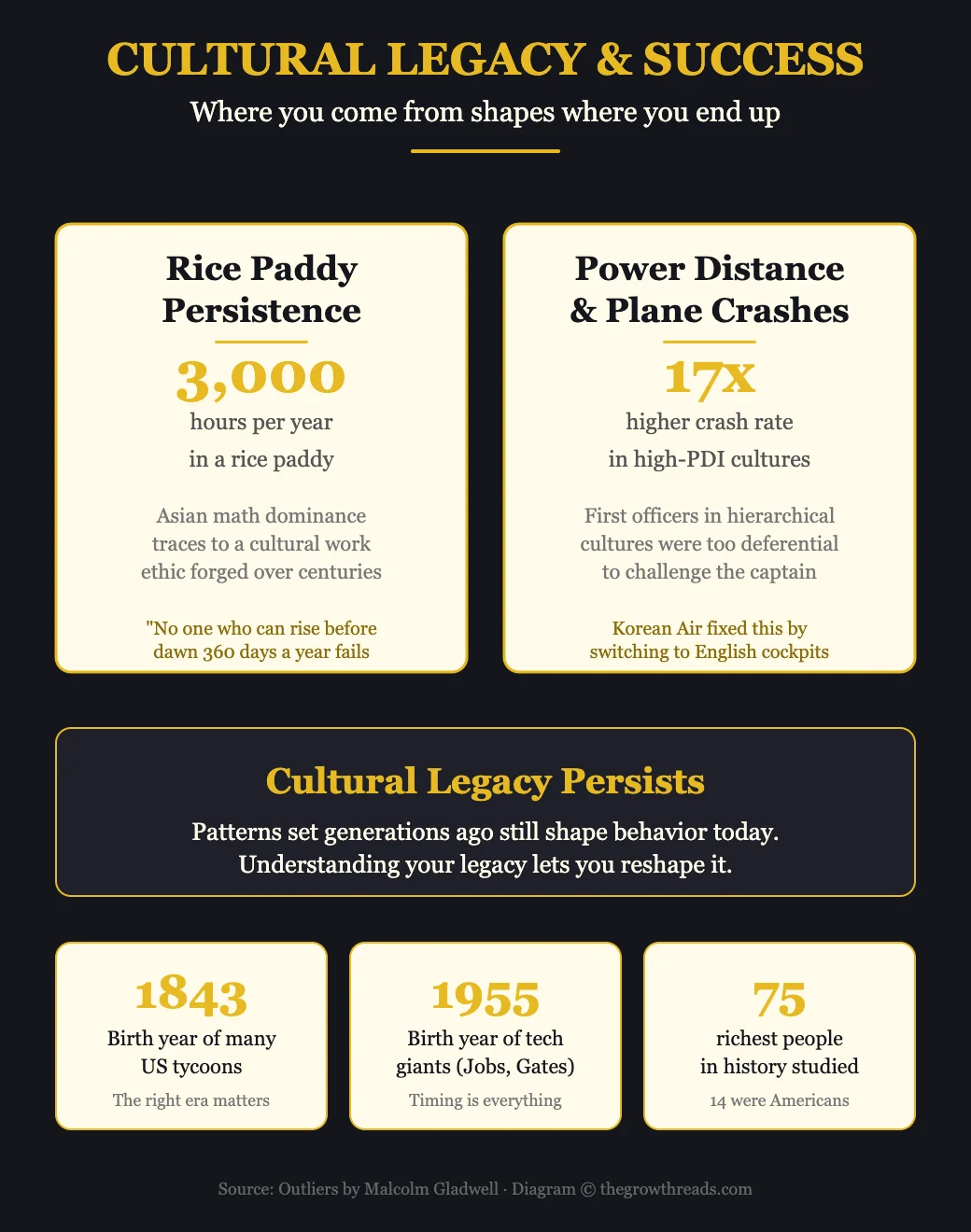
Gladwell then turns to mathematics. On international math tests like the TIMSS, students from East Asian countries consistently dominate — a gap usually attributed to genetics or curriculum. Gladwell offers a different explanation rooted in agriculture. Wet-rice farming is extraordinarily labor-intensive: a farmer might work 3,000 hours per year in the paddies, compared to about 1,200 for a European wheat farmer. The reward, however, is directly proportional to effort — more care means more yield, season after season. This creates a cultural proverb embedded in the language itself: “No one who can rise before dawn three hundred and sixty days a year fails to make his family rich.”
Gladwell argues that this attitude — that effort and reward are tightly linked, that persistence pays — carries forward into how East Asian students approach math. When given a difficult problem, they are more willing to sit with it, try multiple approaches, and resist the urge to give up. The advantage is not cognitive; it is cultural. He bolsters this with evidence from TIMSS questionnaire completion rates: the countries whose students were most persistent in filling out a tedious background survey (an indicator of conscientiousness) were also the countries that scored highest on the math test.
The book closes with the story of Gladwell`s own mother, Daisy Nation, who grew up in rural Jamaica and — through a chain of lucky breaks, family sacrifice, and colonial-era scholarship programs — ended up studying in England. Gladwell uses her story to illustrate every theme in the book: timing, cultural legacy, meaningful opportunity, and the compounding of small advantages across generations. He is, in a sense, his own case study: the product of a specific ecology of success.
Who is Outliers best for — and who should read something else first?
Outliers is ideal for anyone who has ever felt that the standard “work hard and you`ll succeed” narrative is incomplete. Parents designing their children`s educational paths, managers building teams, educators designing selection systems, and anyone fascinated by why some people succeed spectacularly while equally talented peers do not — all will find Gladwell`s reframing revelatory. The book requires no background in psychology or sociology and reads like a collection of gripping detective stories.
If you are looking for a more tactical, action-oriented framework for building personal grit and persistence, start with Grit by Angela Duckworth or Peak by Anders Ericsson. If you want a deeper dive into how cognitive biases shape decision-making (rather than success), try Thinking, Fast and Slow by Daniel Kahneman. And if your main interest is in building better habits as the practical engine of the 10,000 hours, Atomic Habits by James Clear is the natural next step.
Questions to reflect on
- What accumulated advantages have you benefited from — birth date, family background, era, geography — that you may have overlooked?
- In what area of your life are you closest to (or furthest from) 10,000 hours of deliberate practice, and what would it take to close the gap?
- How does your cultural legacy — your family`s attitudes toward work, authority, and persistence — shape your approach to challenges today?
- Are there systems in your workplace or community that create Matthew Effects, rewarding early advantage rather than actual potential?
- If success is ecological rather than individual, what changes could you make to your environment to create better conditions for the outcomes you want?
🔥 Ready to rethink what success really requires?
Outliers will permanently change how you see talent, timing, and opportunity.
How to apply Outliers (7-day plan)
- Day 1 — Map your accumulated advantages. Write down every advantage you have received that was not purely the result of talent: your birth year, family resources, early mentors, geographic luck, access to tools. Be honest about what was given, not earned.
- Day 2 — Audit your practice hours. Pick your most important skill and estimate how many hours of genuine deliberate practice you have invested. Identify the gap between where you are and the 10,000-hour benchmark, then plan a realistic weekly practice schedule.
- Day 3 — Identify your Matthew Effects. Look at the systems around you — your workplace, your children`s school, your local sports leagues. Where do small early advantages compound unfairly? Write down one concrete change you could advocate for.
- Day 4 — Examine your cultural legacy. Reflect on the attitudes your family and community passed down about work, authority, and persistence. Which ones serve you? Which ones hold you back? Write a one-paragraph “cultural audit.”
- Day 5 — Develop your practical intelligence. Choose one institutional interaction you have been avoiding — a negotiation, a request for resources, a difficult conversation with an authority figure. Script what you will say and rehearse it.
- Day 6 — Spot your demographic moment. What is the transformative trend of your era — AI, remote work, longevity science, the creator economy? Write down how your current skills position you to catch this wave, and what gaps you need to fill.
- Day 7 — Design your ecology of success. Based on everything you have reflected on this week, create a one-page plan that combines practice, environment design, and opportunity-seeking. Share it with someone you trust for accountability.
Frequently asked questions
What is the main point of Outliers?
The main point of Outliers is that extraordinary success is not primarily the result of individual talent or hard work alone. Malcolm Gladwell argues that outliers — people who achieve at levels far beyond the norm — are the products of hidden advantages, cultural legacies, demographic timing, and accumulated opportunities. The book reframes success as an ecological phenomenon: the right person, in the right place, at the right time, with enough practice hours and institutional support to capitalize on their potential.
Is the 10,000-hour rule actually true?
The 10,000-hour rule is a useful approximation but not a precise scientific law. Gladwell based it on K. Anders Ericsson`s research, but Ericsson himself later clarified that the quality of practice matters more than the quantity — deliberate practice (structured, feedback-rich, at the edge of ability) is what drives improvement, not merely logging hours. The exact number varies by field: it may take fewer hours in some domains and more in others. The core principle — that mastery requires sustained, intensive effort far beyond what most people realize — remains well-supported by research.
What is the Matthew Effect in Outliers?
The Matthew Effect, named after a verse in the Gospel of Matthew, describes how small initial advantages compound into large ones over time. In Outliers, Gladwell illustrates this with Canadian hockey: boys born in January are nearly a year older than December-born teammates, so they are bigger and get selected for better teams, which means better coaching and more practice, which widens the gap further. By adulthood, the advantage looks like talent but is actually accumulated opportunity. The same dynamic appears in education, sports leagues, and professional development worldwide.
How long does it take to read Outliers?
Outliers is approximately 309 pages and takes most readers between 4.5 and 5.5 hours to read cover to cover. The writing is accessible and narrative-driven — Gladwell is a journalist, not an academic, so the prose moves quickly through stories and case studies. The audiobook, narrated by Gladwell himself, runs about 7 hours and 18 minutes. Many readers report finishing the book in two or three sittings because the stories are compelling enough to sustain momentum through the more data-heavy sections.
What does Outliers say about cultural legacy?
Gladwell argues that cultural legacies — attitudes, behaviors, and values passed down through generations — have a measurable impact on performance in specific domains. He uses two main examples: Korean Air`s high crash rate, caused by a hierarchical cockpit culture that prevented first officers from challenging captains, and the dominance of East Asian students on international math tests, which he links to the work ethic embedded in wet-rice farming cultures. The key insight is that cultural legacy is not destiny — Korean Air fixed its problem by switching cockpit language to English — but it is a powerful, often invisible force.
Is Outliers worth reading in 2026?
Yes, Outliers remains highly relevant in 2026. While some specific data points (like the exact 10,000-hour figure) have been refined by later research, the book`s central thesis — that success is shaped by environment, timing, and culture as much as by individual effort — has only grown more important as conversations about equity, privilege, and systemic advantage have intensified. The frameworks Gladwell introduces (the Matthew Effect, cultural legacy, demographic luck) give readers a powerful vocabulary for understanding patterns they see in their own lives, workplaces, and communities.
What should I read after Outliers?
If Outliers made you curious about deliberate practice, read Peak by Anders Ericsson for the definitive scientific account. For building the persistence Gladwell describes, try Grit by Angela Duckworth. If the cultural and cognitive aspects fascinated you, Thinking, Fast and Slow by Daniel Kahneman is the logical next step. For a practical system to build the daily habits that accumulate to mastery, see Atomic Habits by James Clear. And if the privilege and equity angles resonated, Gladwell`s own later book David and Goliath extends the argument.
Related summaries
- Grit by Angela Duckworth — the science of passion and perseverance
- Thinking, Fast and Slow by Daniel Kahneman — how cognitive biases shape decisions
- Mindset by Carol Dweck — how beliefs about talent affect performance
- Best Psychology Books — our full ranked list