

★★★★☆ 4.5 / 5 — A former FBI hostage negotiator reveals the psychological techniques that work in every conversation, from boardrooms to car dealerships.
Best for: Anyone who negotiates — which is everyone. Professionals, entrepreneurs, managers, and anyone who wants to get better outcomes in difficult conversations.
Reading time: ~6 hours (288 pages)
Difficulty to apply: Medium — the techniques are simple to understand but require practice and the courage to use them in real situations.
Never Split the Difference in one minute
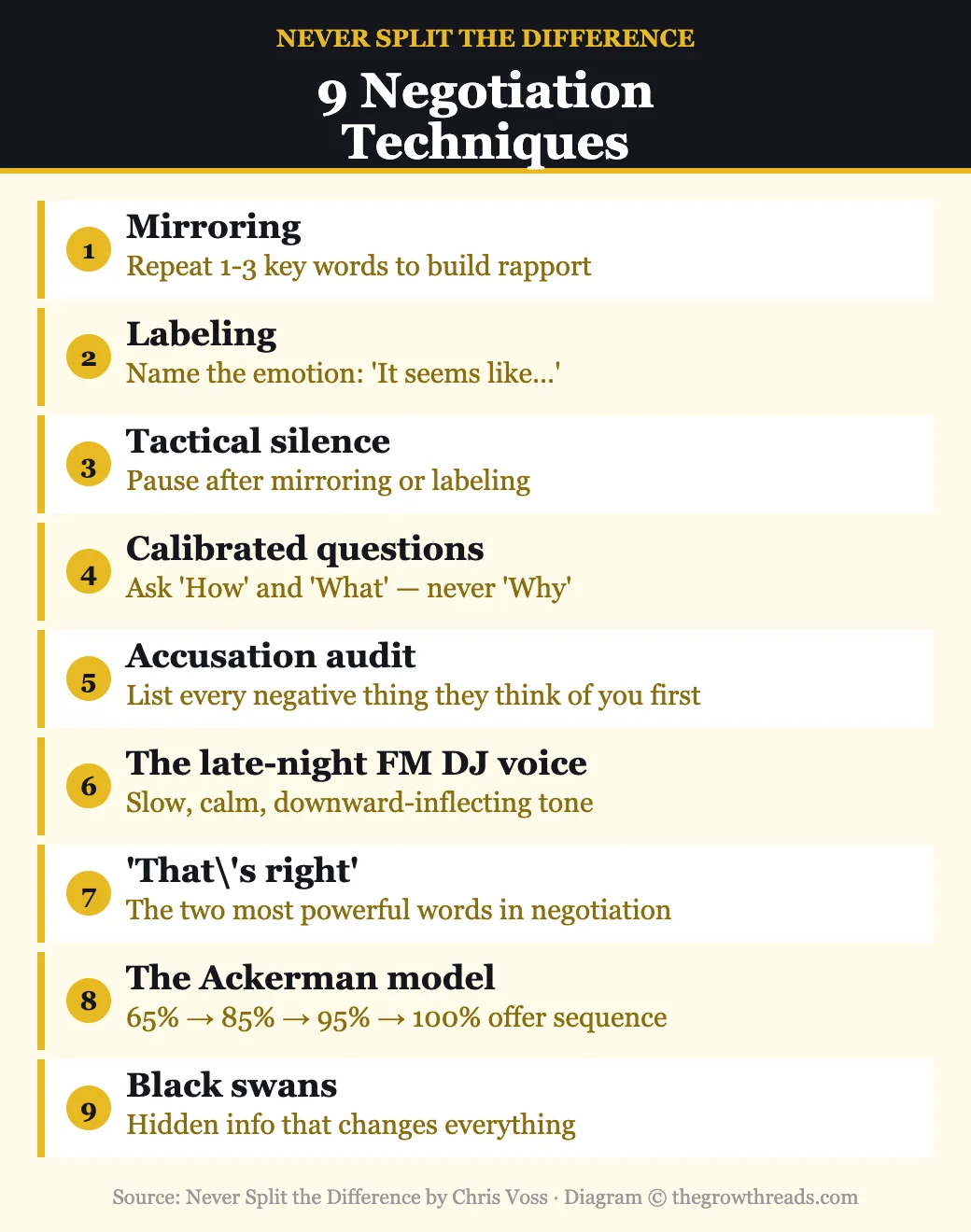
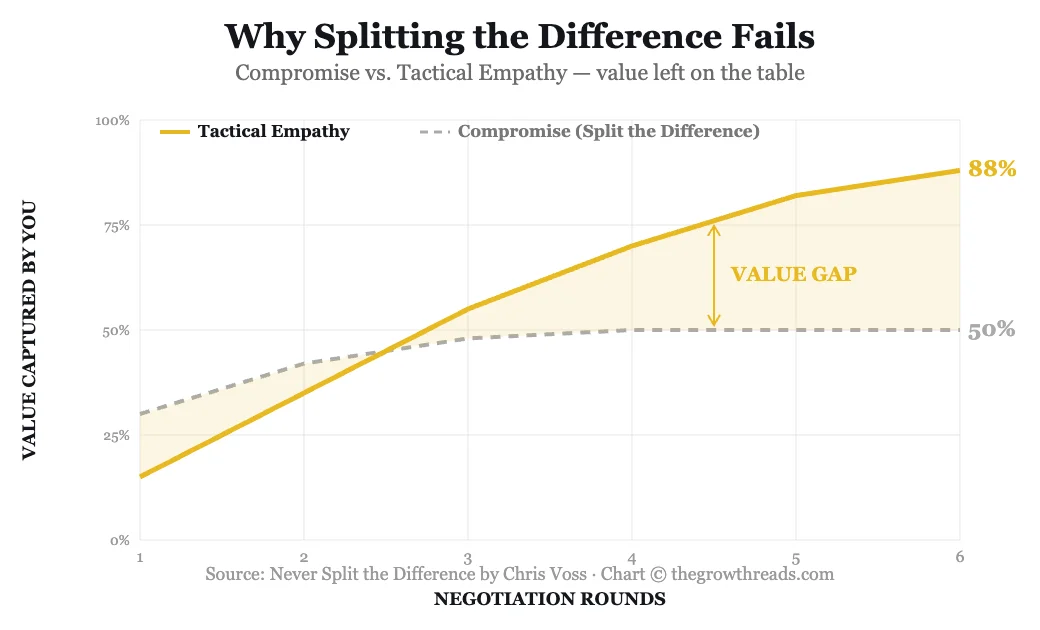
Compromise is the worst possible negotiation outcome. Chris Voss spent 24 years as an FBI hostage negotiator, including as the Bureau’s lead international kidnapping negotiator. He learned that the academic models of negotiation — rational actors, win-win frameworks, splitting the difference — fail catastrophically when lives are on the line. What works instead is tactical empathy: a set of techniques rooted in emotional intelligence and cognitive psychology that help you understand what the other side truly wants, make them feel heard, and guide them to your preferred outcome without confrontation. Voss distills these techniques into nine core tools — mirroring, labeling, calibrated questions, the Ackerman model, and more — that work just as well in salary negotiations and business deals as they do in hostage crises.
Key takeaways
- Never compromise: Splitting the difference gives both sides a bad deal. Tactical empathy finds creative solutions that leave you with more.
- Tactical empathy is not agreement: Understanding the other side’s perspective is not the same as agreeing with it. You can empathize deeply while pursuing your own interests.
- Mirroring builds instant rapport: Repeating the last one to three words someone said encourages them to elaborate and makes them feel heard.
- Labels defuse negative emotions: Saying “It seems like…” or “It sounds like…” names the other person’s emotion, which reduces its power and opens the conversation.
- “That’s right” is the breakthrough moment: When the other side says “that’s right,” they feel genuinely understood. This is the moment trust forms and real negotiation begins.
- Calibrated questions put them to work: “How am I supposed to do that?” and “What does that look like?” force the other side to solve your problem for you without saying no.
- The accusation audit neutralizes negativity: List every terrible thing the other side might think about you upfront. Once spoken, the negatives lose their power.
- “No” is the start, not the end: Getting a “no” makes people feel safe and in control. A “no” early in a negotiation is often more productive than a premature “yes.”
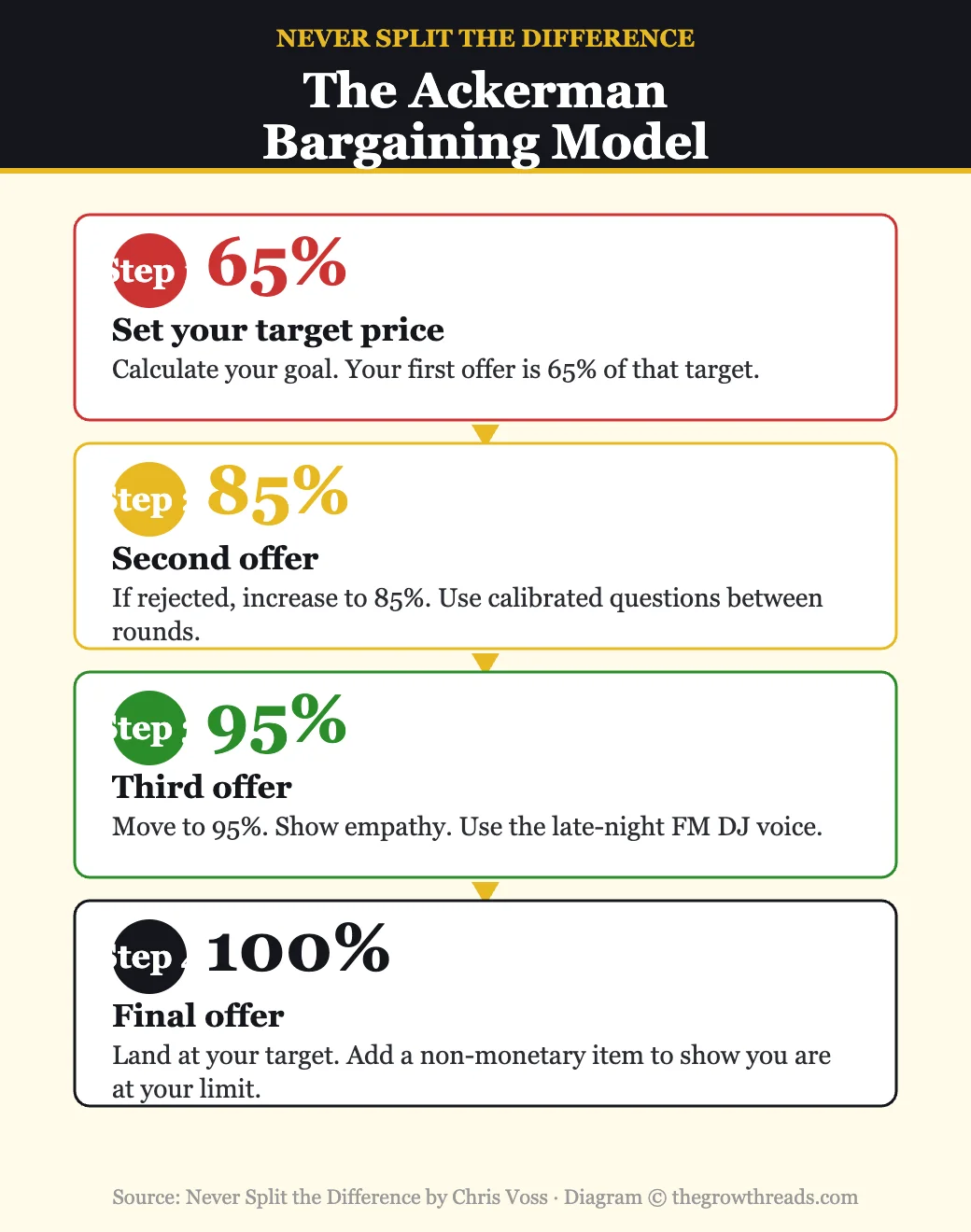
- The Ackerman model structures your offers: Start at 65% of your target, then increase to 85%, 95%, and finally 100%. The decreasing increments signal you are reaching your limit.
- Black swans change everything: Every negotiation has hidden information — unknown unknowns — that, once discovered, can completely transform the dynamic.
What is Never Split the Difference about?
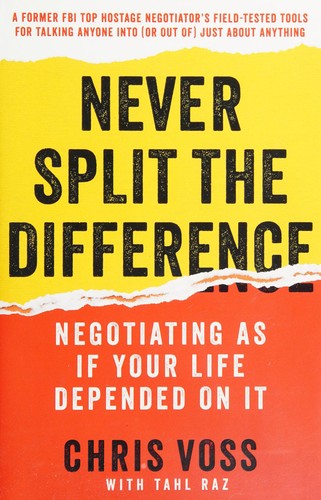
Never Split the Difference is Chris Voss’s guide to negotiation based on his career as the FBI’s lead international hostage negotiator. He presents nine tactical empathy techniques — including mirroring, labeling, calibrated questions, and the Ackerman bargaining model — that replace traditional compromise-based negotiation with a psychologically grounded approach that works in business, salary talks, and everyday life.
About the author
Chris Voss grew up in a working-class family in Iowa and joined the FBI in 1986 after a stint as a beat cop in Kansas City. Over 24 years, he worked some of the Bureau’s highest-profile kidnapping cases, from the Philippines to Haiti to the Middle East. He rose to become the FBI’s lead international kidnapping negotiator and its lead Crisis Negotiation Unit representative at the National Security Council. After retiring from the FBI, Voss founded the Black Swan Group, a negotiation consulting firm, and became an adjunct professor at Georgetown University’s McDonough School of Business and at Harvard Law School. He co-wrote Never Split the Difference with journalist Tahl Raz. Explore all Chris Voss book summaries →
Key concepts at a glance
| Concept | What it means | Use it when |
|---|---|---|
| Tactical empathy | Understanding the other side’s feelings and mindset to influence their behavior | You want to build trust and rapport before making any demands |
| Mirroring | Repeating the last 1–3 words to encourage elaboration | You need more information or want to keep the other person talking |
| Labeling | Naming emotions: “It seems like…” or “It sounds like…” | You sense negative emotions that need to be defused before progress is possible |
| Calibrated questions | “How” and “What” questions that make the other side solve your problem | You need to say no without actually saying no |
| Accusation audit | Listing every negative assumption the other side might have about you | You are entering a negotiation where the other side may be hostile or suspicious |
| The Ackerman model | 65% → 85% → 95% → 100% offer progression with decreasing increments | You are negotiating price or salary and need a structured bargaining framework |
| Black swans | Hidden pieces of information that can transform the negotiation | You sense the other side has motivations or constraints they have not revealed |
| Three negotiator types | Analyst, Accommodator, and Assertive — each requires a different approach | You want to tailor your tactics to the specific person across the table |
Part 1 — The new rules of negotiation
Voss opens by dismantling the dominant negotiation paradigm taught at business schools: the rational, win-win model popularized by “Getting to Yes.” He argues that this model fails because it assumes people are rational actors — and they are not. In a hostage crisis, there is no splitting the difference. You cannot give a kidnapper half a hostage. The stakes force you to develop techniques that work with the messy reality of human psychology rather than the clean fiction of rational self-interest.
The foundation of Voss’s approach is tactical empathy — the deliberate, systematic understanding of another person’s emotional state and perspective, used not to be nice but to be effective. Tactical empathy is not sympathy or agreement. You can empathize deeply with a bank robber holding hostages without agreeing that robbing banks is a good idea. The point is to understand what they feel and why, so you can predict and influence their behavior.
Voss introduces mirroring as the simplest entry point: repeat the last one to three critical words your counterpart just said, then go silent. The mirror signals to the other person that you are listening closely and invites them to elaborate. In a hostage situation, Voss used mirroring to keep subjects talking for hours — every word they spoke revealed information, built rapport, and moved them closer to resolution. In everyday life, mirroring works just as powerfully in job interviews, sales conversations, and arguments with your spouse.
Part 2 — The power of “no” and labels
The most counterintuitive chapter argues that “no” is more valuable than “yes.” Most people chase early agreement, but a premature “yes” is often fake — a polite way to end the conversation. “No,” on the other hand, gives the other side a sense of safety and control. When someone says no, they feel they have protected themselves, which paradoxically makes them more open to hearing you out. Voss teaches his students to deliberately structure questions that invite a “no” rather than a “yes.” Instead of “Do you have a few minutes to talk?” (which triggers defensive yeses), ask “Is now a bad time to talk?” The “no” costs them nothing and opens the door.
Labeling is the technique Voss considers most universally useful. When you detect an emotion — fear, frustration, excitement, suspicion — name it aloud: “It seems like you’re frustrated with the timeline” or “It sounds like this deal matters a lot to your team.” Labeling does two things simultaneously: it shows the other side you understand them (building trust) and it forces the emotion into conscious processing (reducing its disruptive power). Neuroscience research by Matthew Lieberman at UCLA confirmed what Voss learned on the job: labeling negative emotions activates the prefrontal cortex and reduces amygdala activity. In plain English, naming a fear makes it smaller.
The breakthrough moment Voss looks for is “that’s right.” Not “you’re right” (which is a dismissal) but “that’s right” — the spontaneous expression of genuine agreement. When your counterpart says “that’s right,” they feel fully understood. This is the moment the dynamic shifts from adversarial to collaborative. Voss builds toward this moment by stacking mirrors, labels, and paraphrases until the other side hears their own worldview reflected back to them with perfect accuracy.
Part 3 — Calibrated questions and the Ackerman model
Calibrated questions are Voss’s most elegant tool. They are open-ended questions beginning with “How” or “What” — never “Why” (which feels accusatory) — designed to make your counterpart solve your problem for you. “How am I supposed to do that?” said in a sincere, slightly helpless tone, is a devastatingly effective way to say no without confrontation. The other side hears a reasonable question and starts working on an answer that serves your interests. “What does a successful outcome look like for you?” opens the door to understanding their real priorities. “How can we make this work?” turns them into a collaborator.
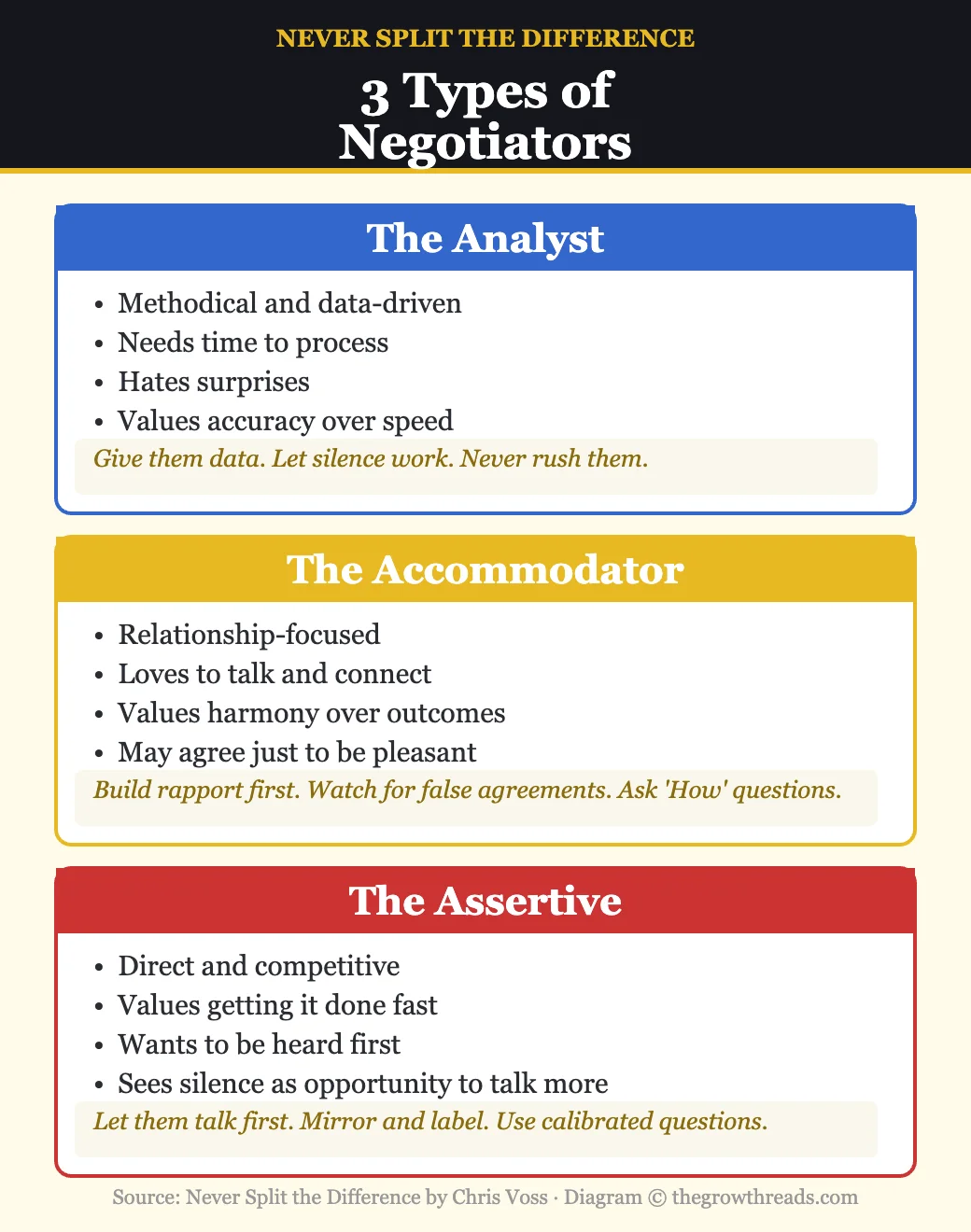
Voss also introduces the three types of negotiators: Analysts (data-driven, need time, hate surprises), Accommodators (relationship-focused, love to talk, may agree just to be pleasant), and Assertives (direct, competitive, want to be heard first). Understanding which type you are dealing with — and which type you are — allows you to adjust your tactics accordingly. An Assertive counterpart needs to feel heard before they will listen; an Analyst needs data and time; an Accommodator needs rapport but must be watched for false agreements.
The Ackerman bargaining model provides the structure for price negotiations. Set your target price, then make your first offer at 65% of that target. If rejected, move to 85%, then 95%, then your target at 100%. The decreasing increments (20%, then 10%, then 5%) signal to the other side that you are approaching your absolute limit. At the final offer, add a non-monetary item — something that costs you nothing but shows you are giving everything you have. Voss has used this model in everything from hostage ransoms to real-estate negotiations, and it consistently produces outcomes within 5% of the target price.
Part 4 — Black swans and the unknown unknowns
The final section introduces the concept that gives Voss’s consulting firm its name: Black Swans. In every negotiation, there are three types of information. Known knowns (things both sides are aware of), known unknowns (things you know you do not know), and unknown unknowns — information whose existence you cannot even predict. Black Swans are these unknown unknowns, and discovering them can completely transform a negotiation.
Voss tells the story of a kidnapping in the Philippines where the standard ransom model was failing. Weeks into the negotiation, his team discovered a Black Swan: the kidnapper was not a professional criminal but a desperate man trying to fund a family member’s medical treatment. That single piece of hidden information changed the entire approach — from a tactical standoff to a conversation about finding medical funding. The ransom dropped dramatically, and the hostage was released unharmed.
In business, Black Swans might be a counterpart’s undisclosed deadline pressure, a competitor’s offer they have not mentioned, a personal relationship with a decision-maker, or a regulatory constraint. Voss teaches that Black Swans are discovered through the same techniques used throughout the book: deep listening, mirroring, labeling, and calibrated questions. The person across the table always knows more than they reveal at the start. Your job is to create enough trust and psychological safety that the hidden information surfaces.
Who is Never Split the Difference best for — and who should read something else first?
This book is ideal for salespeople, managers, and entrepreneurs who negotiate daily, anyone preparing for a salary negotiation or major purchase, and people who avoid difficult conversations because they dislike confrontation — Voss’s techniques make it possible to be firm without being aggressive.
If your challenge is less about negotiation and more about having hard conversations in relationships, start with Difficult Conversations (which Voss actually respects despite criticizing the broader Harvard model). If you want the academic psychology behind persuasion before learning the applied tactics, try Influence by Robert Cialdini first.
Questions to reflect on
- In your last major negotiation, did you split the difference? What might you have achieved with a different approach?
- Which of the three negotiator types — Analyst, Accommodator, or Assertive — are you? How does that shape how others perceive you at the table?
- When was the last time someone said “that’s right” to you in a conversation — and how did the dynamic shift afterward?
- What Black Swans might be hiding in your current most important professional relationship?
- How would your approach to difficult conversations change if you saw “no” as a starting point rather than a dead end?
🔥 Ready to negotiate like an FBI hostage expert?
Voss’s nine tactical empathy techniques will transform every difficult conversation you have — at work and at home.
How to apply Never Split the Difference (7-day plan)
- Day 1 — Practice mirroring: In three conversations today, repeat the last one to three words your counterpart says, then pause. Notice how they elaborate and reveal more information.
- Day 2 — Label one emotion: When you sense frustration, excitement, or hesitation in a conversation, say “It seems like…” and name the feeling. Observe how the dynamic changes.
- Day 3 — Run an accusation audit: Before a difficult conversation, write down every negative thing the other person might think or say about you. Open the conversation by addressing these head-on.
- Day 4 — Use calibrated questions: Replace one statement or demand with a “How” or “What” question. Instead of “That price is too high,” try “How am I supposed to make that work within my budget?”
- Day 5 — Identify your negotiator type: Take note of how you handle silence, conflict, and relationship-building. Are you an Analyst, Accommodator, or Assertive? Adjust one interaction accordingly.
- Day 6 — Practice the late-night FM DJ voice: In one conversation, deliberately slow your pace, lower your pitch, and let your inflection curve downward. Notice the calming effect on the other person.
- Day 7 — Plan an Ackerman offer: For your next price negotiation, calculate your target and set up the 65% → 85% → 95% → 100% sequence. Prepare a non-monetary sweetener for the final round.
Frequently asked questions
What is tactical empathy?
Tactical empathy is the deliberate understanding of another person’s emotional state and perspective, used strategically to influence outcomes. Unlike ordinary empathy (feeling what others feel), tactical empathy is a skill deployed with intention. You do not need to agree with or like the other person — you need to understand them deeply enough to predict their reactions and guide the conversation. Voss developed it through thousands of FBI hostage negotiations where the stakes made academic theories irrelevant and only real psychological insight worked.
Does Never Split the Difference work for everyday situations?
Absolutely — that is the core premise. Voss argues that the same techniques that resolve hostage crises work in salary negotiations, car purchases, contractor disputes, and even conversations with your children. The psychology is identical: people want to feel heard, they react to emotional dynamics more than logic, and they respond to calibrated questions and empathetic labels regardless of context. Most readers report the biggest impact in salary negotiations, vendor negotiations, and difficult workplace conversations.
What is mirroring in negotiation?
Mirroring is the technique of repeating the last one to three critical words (or occasionally a key phrase) that your counterpart just said, then pausing in silence. The mirror signals deep listening, encourages the other person to elaborate, and creates a sense of connection. Voss calls it the simplest yet most consistently effective tool in his arsenal. In FBI negotiations, mirroring kept subjects talking for hours, revealing critical information. In business, it helps you gather intelligence while building rapport without asking direct questions that might trigger defensiveness.
What is the Ackerman model?
The Ackerman model is a structured bargaining system for price negotiations. You set your target price, then make offers at 65%, 85%, 95%, and finally 100% of that target. The decreasing increments (20%, then 10%, then 5%) psychologically signal that you are approaching your absolute limit. At the final number, you add a non-monetary item (like an extra service or a small concession that costs you little) to demonstrate you are giving everything you can. Voss reports this model consistently delivers outcomes within 5% of the target price.
Why does Voss say you should never split the difference?
Because compromise is a lazy shortcut that leaves value on the table for both sides. Voss uses a vivid example: if one person wants to wear black shoes and the other wants brown, splitting the difference means both wear one black and one brown shoe — nobody wins. The same logic applies to business: meeting in the middle on price or terms often means neither side gets what they actually need. Tactical empathy techniques help you discover creative solutions where both sides can get more of what they truly value, rather than settling for the mathematical midpoint.
What are black swans in negotiation?
Black Swans are pieces of hidden information — unknown unknowns — that, once discovered, can completely transform a negotiation. They might be a counterpart’s undisclosed deadline, a competing offer they have not mentioned, a personal motivation behind their position, or a constraint they have not revealed. Voss teaches that Black Swans are uncovered through deep listening, mirroring, labeling, and calibrated questions. The techniques in the book are not just negotiation tools — they are intelligence-gathering methods designed to surface exactly this kind of hidden, game-changing information.
Is Never Split the Difference manipulative?
Voss addresses this directly: the techniques are about understanding, not deception. Tactical empathy requires genuinely listening to and understanding the other person — which is the opposite of manipulation. The tools work because they make people feel heard and respected, which builds real trust. Manipulation relies on hiding your true intent; Voss’s approach relies on revealing the other side’s true needs so you can find solutions that actually work for everyone. The ethical line is clear: use these techniques to find better outcomes, not to exploit people.
Related summaries
- Influence Summary — Robert Cialdini’s six principles of persuasion from the academic side
- Thinking, Fast and Slow Summary — the cognitive biases that underpin Voss’s negotiation tactics
- Emotional Intelligence Summary — Daniel Goleman on the science of reading and managing emotions
- Best Psychology Books — our full ranked list