

★★★★★ 4.7/5 — The book that put “EQ” into everyday language, and still the clearest single explanation of why feelings steer decisions more than logic does.
Best for: Anyone who wants to understand and manage their own reactions, plus managers, parents, and partners who deal with other people’s feelings daily.
Reading time: ~7 hrs to read the book · ~12 min to read this guide
Difficulty to apply: Moderate — the ideas are simple to grasp, but rewiring automatic reactions takes repetition
Emotional Intelligence in one minute
Your feelings hijack your thinking before you even notice — and the people who thrive aren’t the smartest in the room, they’re the ones who catch themselves in time. In 1995, psychologist and former New York Times science journalist Daniel Goleman pulled together two decades of neuroscience and psychology to argue that IQ is a surprisingly weak predictor of who succeeds in life, work, and relationships. What matters more, he says, is emotional intelligence, or EQ: the capacity to recognize your own feelings as they happen, manage them instead of being managed by them, stay motivated through setbacks, read what other people are feeling, and handle relationships with skill. Goleman never asks you to suppress emotion. Instead he shows exactly how your brain’s alarm system, the amygdala, can override your better judgment in a fraction of a second, and what you can do to stay in control when it fires. The result is part brain-science primer, part practical playbook for marriage, parenting, leadership, and even physical health.
Key takeaways
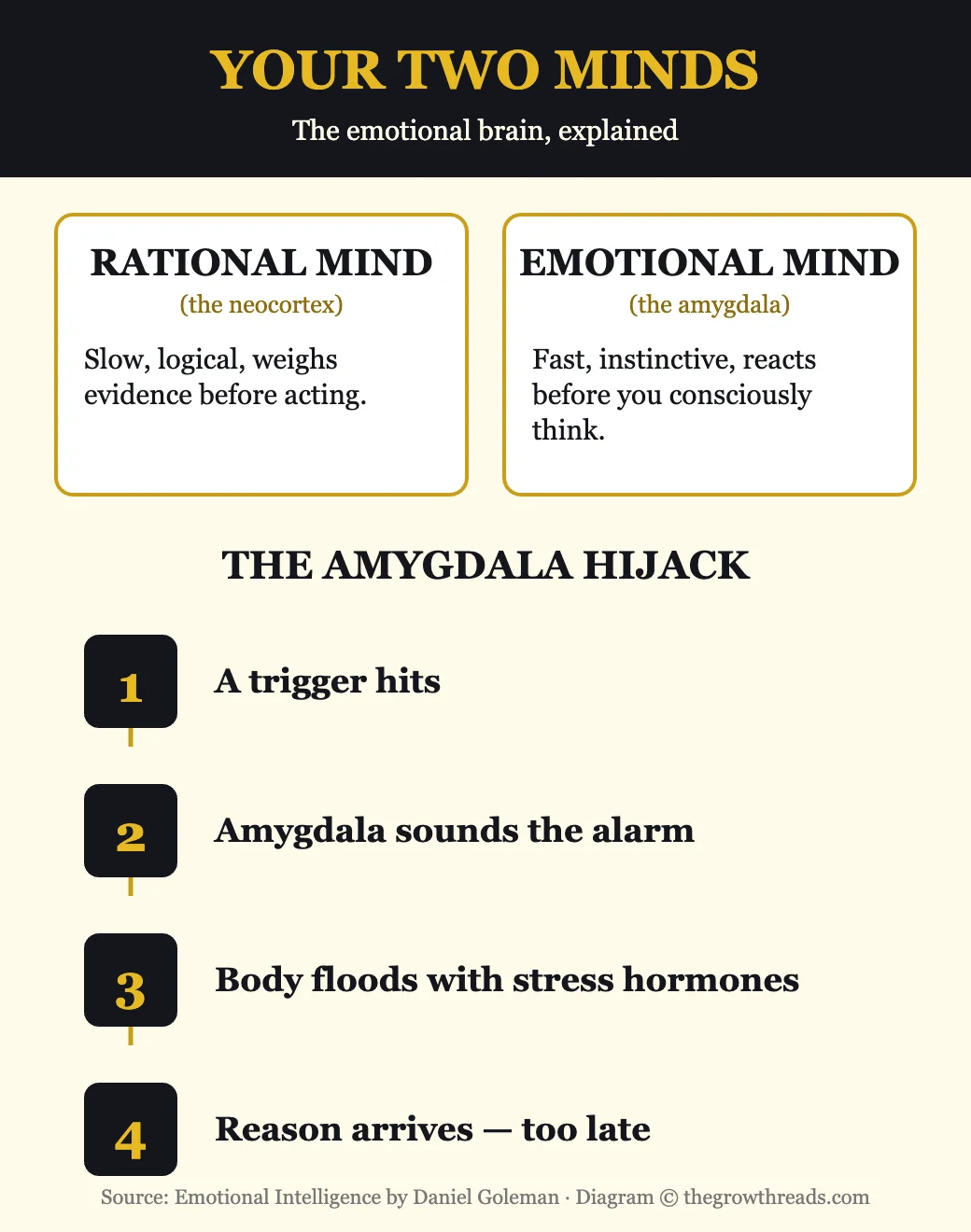
- You have two minds, not one: a rational mind that thinks things through, and an emotional mind that reacts first and asks questions later.
- The amygdala can hijack your reasoning brain: a strong emotional trigger can flood your body with stress hormones before your neocortex has even finished processing what happened.
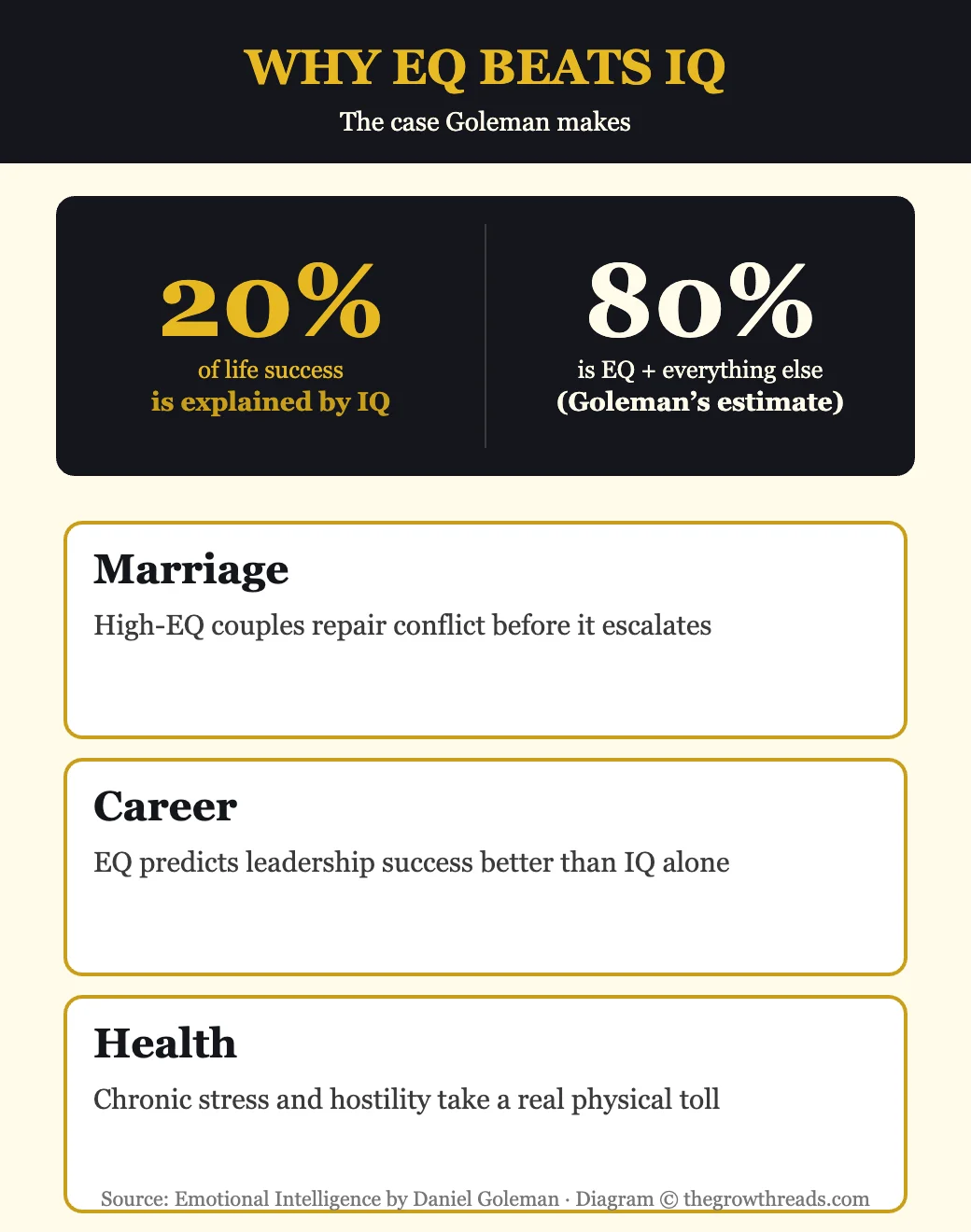
- IQ explains only a slice of life outcomes: Goleman estimates it accounts for roughly 20 percent of what determines success, leaving the rest to character, circumstance, and EQ.
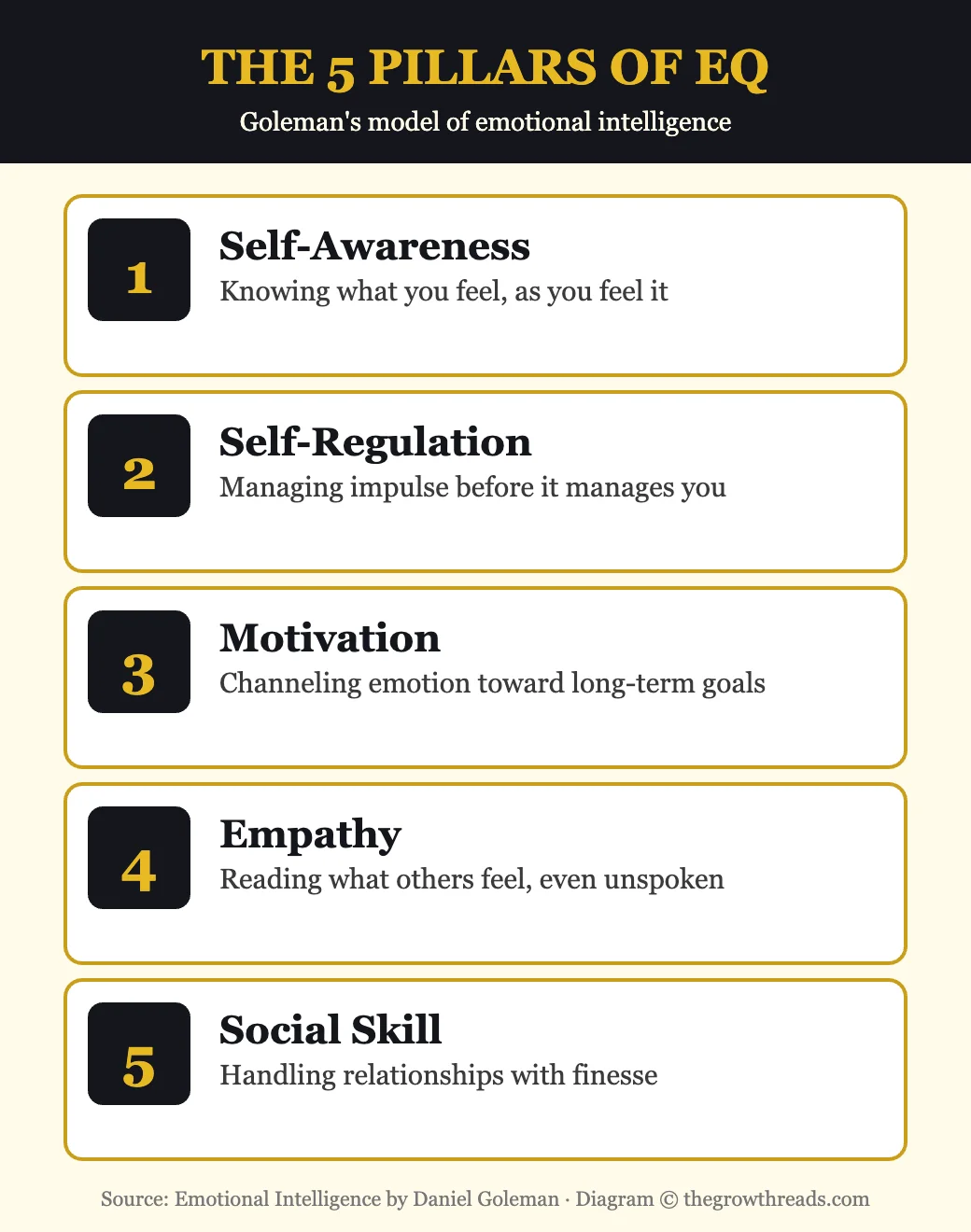
- EQ breaks down into five components: self-awareness, self-regulation, motivation, empathy, and social skill.
- Self-awareness comes first: you cannot manage a feeling you have not noticed yet.
- Impulse control is a trainable skill, not a fixed trait — children who could delay gratification in the famous “marshmallow test” fared better decades later.
- Empathy is built, not just born: it comes from paying attention to tone, posture, and pauses, not only to words.
- Marriages succeed or fail on emotional repair, not on avoiding conflict entirely — how couples recover after a fight predicts more than how often they fight.
- Workplaces run on EQ too: technical skill gets people hired, but self-regulation and social skill tend to determine who gets promoted, who leads well, and who burns out.
- Emotional skills can be taught, especially in childhood — classrooms that build emotional literacy see fewer behavior problems and sharper academic focus.
What is Emotional Intelligence about?
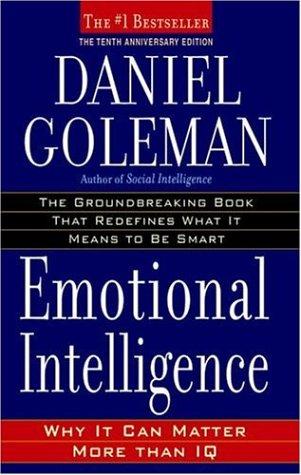
Emotional Intelligence: Why It Can Matter More Than IQ argues that self-awareness, self-control, empathy, and social skill predict success in relationships, work, and health better than raw intelligence does. Drawing on neuroscience, Daniel Goleman shows how emotion can override rational thought in an instant, and lays out the five skills that keep that override in check.
About the author
Daniel Goleman is a psychologist and former science journalist for The New York Times, where he covered brain and behavioral research for more than a decade. He earned a PhD in clinical psychology and personality development from Harvard University, studying under psychologist David McClelland, whose research on competency and motivation shaped much of Goleman’s later thinking. By the time Emotional Intelligence was published in 1995, Goleman had spent years translating academic psychology for general readers, and the book went on to spend more than a year on the New York Times bestseller list. He followed it with Working with Emotional Intelligence (1998), which applied the framework to the workplace, and co-authored Primal Leadership (2002) on emotionally intelligent leadership. Goleman also co-founded the Collaborative for Academic, Social, and Emotional Learning (CASEL), which helped bring emotional literacy programs into schools worldwide. Explore all Daniel Goleman book summaries →
Key concepts at a glance
| Concept | What it means | Use it when |
|---|---|---|
| Amygdala hijack | The brain’s alarm system overrides rational thought in a split second | You feel a sudden flash of anger or fear and are about to react |
| Self-awareness | Noticing what you feel, as you feel it | Before any high-stakes decision or difficult conversation |
| Self-regulation | Managing an impulse instead of being ruled by it | You are about to send an angry email or text |
| Motivation | Channeling emotion toward a goal despite setbacks | Facing a long project with no immediate payoff |
| Empathy | Reading what someone else feels, even when unspoken | Managing people, resolving conflict, parenting |
| Social skill | Handling relationships and influence well | Leading teams, negotiating, networking |
| Hijack recovery | Techniques that calm an activated amygdala | Mid-conflict, when you need to de-escalate fast |
| Flow | Full immersion in a task, fueled by intrinsic motivation | Trying to do your most focused, best work |
Part 1: The Emotional Brain
Goleman opens with neuroscience, not self-help advice. He explains that an emotional trigger — a slammed door, a cutting remark, a near-miss on the highway — reaches your brain along two paths at once. One path runs to the neocortex, the thinking brain, which takes its time weighing context and consequence. The other, shorter path runs straight to the amygdala, a small almond-shaped structure buried in the limbic system that acts as the brain’s alarm bell. Drawing on neuroscientist Joseph LeDoux’s research, Goleman calls this the “low road”: a signal from the thalamus can reach the amygdala before the neocortex has even finished registering what happened.
When the amygdala sounds the alarm, it can trigger what Goleman famously named an “amygdala hijack” — a flood of stress hormones that primes you to fight, flee, or freeze before your rational mind gets a vote. This response kept our ancestors alive against predators, but in modern life it misfires constantly: it is what turns a minor criticism into a shouting match, or a delayed flight into a screaming exchange with a gate agent. The hijack itself is not the problem, Goleman argues — it is a normal, even useful, piece of biology. The problem is not recognizing it in the moment, and not having a way to recover once it has fired.
TGR Note: If the two-minds framing clicks for you, Daniel Kahneman’s Thinking, Fast and Slow covers similar ground from a decision-science angle — his “System 1” (fast, intuitive) and “System 2” (slow, deliberate) map closely onto Goleman’s emotional and rational minds, though Kahneman focuses on judgment errors rather than emotional regulation.
Goleman was not the first to use the term “emotional intelligence” — psychologists Peter Salovey and John Mayer had coined it a few years earlier in an academic paper — but his book is what carried the idea out of journals and into boardrooms, classrooms, and living rooms. Within a year of publication, “EQ” had become a shorthand people used the way they already used “IQ,” and companies began asking whether it could be measured and hired for. That popularization is part of why the book still holds up: it did not just name a concept, it gave readers a working vocabulary — hijack, self-regulation, flow — for something they had always sensed but never had precise words for.
Part 2: The Five Components of Emotional Intelligence
The heart of the book is Goleman’s five-part model of EQ. Self-awareness comes first because it is the foundation for everything else: noticing “I am angry” or “I am anxious” the moment it happens, rather than an hour later, gives you the split-second choice point that people without that awareness never get. Self-regulation is what you do with that awareness — the ability to feel an impulse and not act on it immediately. Goleman leans heavily on Walter Mischel’s Stanford “marshmallow test,” in which four-year-olds who could resist eating one marshmallow to earn two later went on, as a group, to have better academic and social outcomes years afterward. The lesson is not that delay is always virtuous, but that the capacity to manage impulse in the moment compounds over a lifetime.
Motivation, in Goleman’s model, means the ability to marshal feeling in the service of a goal — optimism and hope that keep you going after a setback, rather than the passing enthusiasm that fades at the first obstacle. He connects this to psychologist Mihaly Csikszentmihalyi’s concept of “flow,” the state of full absorption where skill and challenge are perfectly matched. Empathy is the ability to read what someone else feels, often from tone, posture, and timing rather than their words. Goleman cites research showing people vary widely in this skill, and that it can be sharpened with attention. Social skill is the capstone: it is empathy and self-regulation put to work in the actual give-and-take of a relationship — persuading, leading, negotiating, and building rapport.
TGR Note: The motivation component overlaps closely with the territory Angela Duckworth covers in Grit. Where Goleman explains why sustained motivation matters for EQ broadly, Duckworth goes much deeper on how passion and perseverance compound over years — read that one next if this section resonated most.
Part 3: EQ Applied — Relationships and Health
Goleman then turns from theory to application, starting with marriage. He draws heavily on psychologist John Gottman’s research, which found that the strongest predictor of divorce was not how often couples fought, but how they fought — specifically, patterns of criticism, contempt, defensiveness, and stonewalling that Gottman called the “four horsemen.” Couples who stayed together were not conflict-free; they were skilled at emotional repair, catching a fight before it spiraled and making small gestures — a joke, a touch, an apology — that de-escalated tension before it caused lasting damage. The chapter reframes a happy marriage not as the absence of conflict but as a couple’s shared ability to manage the amygdala hijacks that conflict inevitably triggers. Gottman’s research, which Goleman leans on throughout this chapter, found that stable couples maintained roughly five positive interactions for every negative one during conflict — not because they avoided friction, but because they consistently balanced it with warmth, humor, and affection.
The health chapter makes a parallel case for the body: chronic hostility, unmanaged stress, and suppressed emotion take a measurable physical toll, showing up in cardiovascular strain and a weakened immune response. Goleman is careful not to claim emotions alone cause disease, but the mind-body connection he lays out is a reminder that self-regulation is not just a soft skill — it has a physiological cost when it is missing.
TGR Note: If the health chapter resonates, our summary of Man’s Search for Meaning is a useful next stop — Viktor Frankl approaches emotional resilience under extreme stress from a completely different angle, but arrives at a similar conclusion: how you relate to your own emotional response matters more than the circumstance itself.
Part 4: EQ at Work — and Raising Emotionally Intelligent Kids
In the workplace chapters, Goleman argues that technical competence gets people through the door, but self-management and social skill decide who gets promoted, who leads well, and who eventually burns out or gets pushed out. Managers who pair clear standards with genuine empathy — what he calls “managing with heart” — tend to build teams that stay motivated even when the news is bad, because people trust that criticism is meant to help them, not humiliate them.
The final section turns to childhood, and it is arguably the book’s most consequential argument: emotional skills are most malleable early in life, and they are teachable. Goleman describes the difference between parents who coach a child through a feeling — naming it, validating it, then problem-solving together — and parents who dismiss or explode at the same feeling. Children raised with emotion-coaching tend to develop stronger self-regulation and social skill years later. He extends the same logic to schools, pointing to early emotional-literacy curricula that reduced behavior problems and improved academic focus simply by teaching children to name and manage feelings the way they are taught to read and add. These programs typically run in short weekly sessions: naming an emotion out loud, practicing a calming technique before reacting, and role-playing a conflict to a better ending. The results Goleman cites are modest individually — fewer trips to the principal’s office, slightly better test scores — but they compound over a school career, and they cost far less than remedial programs aimed at the same behavior problems after they have already become entrenched.
TGR Note: The workplace argument here pairs well with Radical Candor and Multipliers — both go deeper on what “managing with heart” looks like day-to-day for a team leader, from giving direct feedback to bringing out a team’s best thinking.
Who is Emotional Intelligence best for — and who should read something else first?
This book is best for anyone who has ever said something in anger they immediately regretted, or who manages, parents, or lives closely with other people and wants a working model for why feelings escalate the way they do. If you are more interested in cognitive biases and decision-making broadly, start with Thinking, Fast and Slow instead. If your priority is specifically building long-term motivation and perseverance, Grit goes deeper on that single component. And if you are looking for a framework for personal growth and belief change rather than emotional regulation, Mindset is the better starting point.
Questions to reflect on
- Think of the last time you felt “hijacked” by anger or anxiety — what triggered it, and how long did it take you to feel rational again?
- Which of the five components — self-awareness, self-regulation, motivation, empathy, social skill — is your weakest? What situation this week will test it?
- Who in your life reads your emotions accurately, even when you say nothing? What do they notice that others miss?
- Think of a recent disagreement with someone close to you — did you repair it well, or did it linger? What would a genuine repair have looked like?
- If you could raise your own EQ by one notch this month, which single habit would move the needle most?
🔥 Ready to build your own EQ?
Get the book that started the conversation on emotional intelligence — in print, on paper, or in your ears.
How to apply Emotional Intelligence (7-day plan)
- Day 1 — Notice without acting. Every time you feel a strong emotion today, silently name it (“that’s frustration,” “that’s anxiety”) before you respond to it.
- Day 2 — Catch one hijack. Identify a moment your amygdala took over. Write down the trigger and how long it took you to feel calm again.
- Day 3 — Practice the pause. Before your next difficult reply — email, text, or conversation — wait sixty seconds and take three slow breaths before responding.
- Day 4 — Read one room. In a meeting or at dinner, spend ten minutes just reading faces and tone instead of planning what to say next.
- Day 5 — Make one repair. If there has been tension with someone this week, make a small repair gesture: a text, a check-in, a genuine apology.
- Day 6 — Find your motivation anchor. Write down one long-term goal and the feeling you want when you reach it. Use it the next time you want to quit early.
- Day 7 — Review and pick one habit. Look back at the week and choose the single practice — naming feelings, pausing, repairing — you will keep doing next week.
Frequently asked questions
What is emotional intelligence, according to Daniel Goleman?
Goleman defines emotional intelligence as the capacity to recognize your own feelings and those of others, to manage your own emotions well, and to handle relationships effectively. He breaks it into five components: self-awareness, self-regulation, motivation, empathy, and social skill. Unlike IQ, which he treats as largely fixed, Goleman argues EQ can be built and strengthened throughout life, which is what makes it a practical lever rather than just a diagnostic label.
Is EQ more important than IQ?
Goleman does not claim EQ replaces IQ — he argues it explains a much larger share of real-world outcomes than most people assume. His estimate, often cited from the book, is that IQ accounts for roughly 20 percent of the factors that determine life success, leaving character, opportunity, and emotional skill to explain the rest. In practice, IQ tends to matter most for getting into a field, while EQ tends to matter most for how far you go once you are there.
What is an “amygdala hijack”?
An amygdala hijack is Goleman’s term for the moment a strong emotional trigger causes the amygdala, the brain’s threat-detection center, to override rational thought before the neocortex has finished processing what happened. It floods the body with stress hormones and primes a fight, flight, or freeze response. It explains why people say and do things in anger or panic that they would never choose to do if they had a moment to think first.
Can emotional intelligence be learned, or is it fixed?
Goleman’s central argument is that EQ, unlike IQ, is highly learnable at any age, though it is most malleable in childhood. He points to classroom emotional-literacy programs that measurably reduced behavior problems, and to adults who improved specific components like self-regulation or empathy through deliberate practice. The skills are simple to describe but take repetition to build, the same way physical fitness does.
What are the 5 components of emotional intelligence?
Goleman’s model has five components: self-awareness (noticing your feelings as they happen), self-regulation (managing impulses instead of being ruled by them), motivation (channeling emotion toward long-term goals), empathy (reading what others feel), and social skill (handling relationships and influence well). He treats them as building on each other, with self-awareness as the foundation the other four depend on.
Is the science behind Emotional Intelligence still considered accurate?
The book’s core neuroscience, particularly its account of the amygdala’s role in fast emotional reactions, holds up well and is still widely cited. Some of the more specific statistics popularized by the book, like precise percentage breakdowns of what predicts success, have been debated by researchers and are best read as illustrative rather than exact. The field has also evolved since 1995, with formal EQ assessments like the Mayer-Salovey-Caruso test now used alongside Goleman’s more accessible framework. The book’s central claims about the practical value of self-regulation and social skill remain broadly uncontroversial.
How long does it take to read Emotional Intelligence?
At 352 pages, most readers finish Emotional Intelligence in six to eight hours of reading time, or a bit less at audiobook speed. The book is organized in short, largely self-contained chapters, so it works well read in a handful of sittings rather than all at once. This guide covers every major idea in about twelve minutes if you want the core takeaways before deciding whether to read the full book.
Related summaries
- Thinking, Fast and Slow by Daniel Kahneman
- Grit by Angela Duckworth
- Mindset by Carol Dweck
- Man’s Search for Meaning by Viktor Frankl
Or browse all best psychology books.
How we analyze books: Every TGR summary is built from a full read of the source book, cross-checked against the author’s other published work and relevant follow-up research where claims are testable. We focus on application — what you would actually do differently after reading — rather than a chapter-by-chapter retelling. Read our full methodology.