

★★★★½ 4.7/5 — the definitive system for building good habits and breaking bad ones.
Best for: anyone starting (or restarting) their self-improvement journey · Reading time: ~5–6 hours (this guide: 18 min) · Difficulty to apply: Easy — starts working day one
🎧 Prefer to listen? Audio overview of this book
AI-narrated audio overview · ~4 minutes
Atomic Habits in one minute
Forget goals. Build systems. Become the person first. Habits are the compound interest of self-improvement: 1% better daily = 37x better in a year. Your brain runs a four-step loop — cue, craving, response, reward — and the Four Laws let you engineer it: make good habits obvious, attractive, easy, and satisfying. Every rep is a vote for the identity you want. Cast enough votes, and the person you’re becoming does the rest.
Key takeaways
- Habits compound: 1% better daily makes you 37.8x better in a year — outcomes are lagging measures of systems, not goals.
- Identity drives behavior: lasting change works inside-out — decide who you want to be, then prove it with small wins. Every action is a vote.
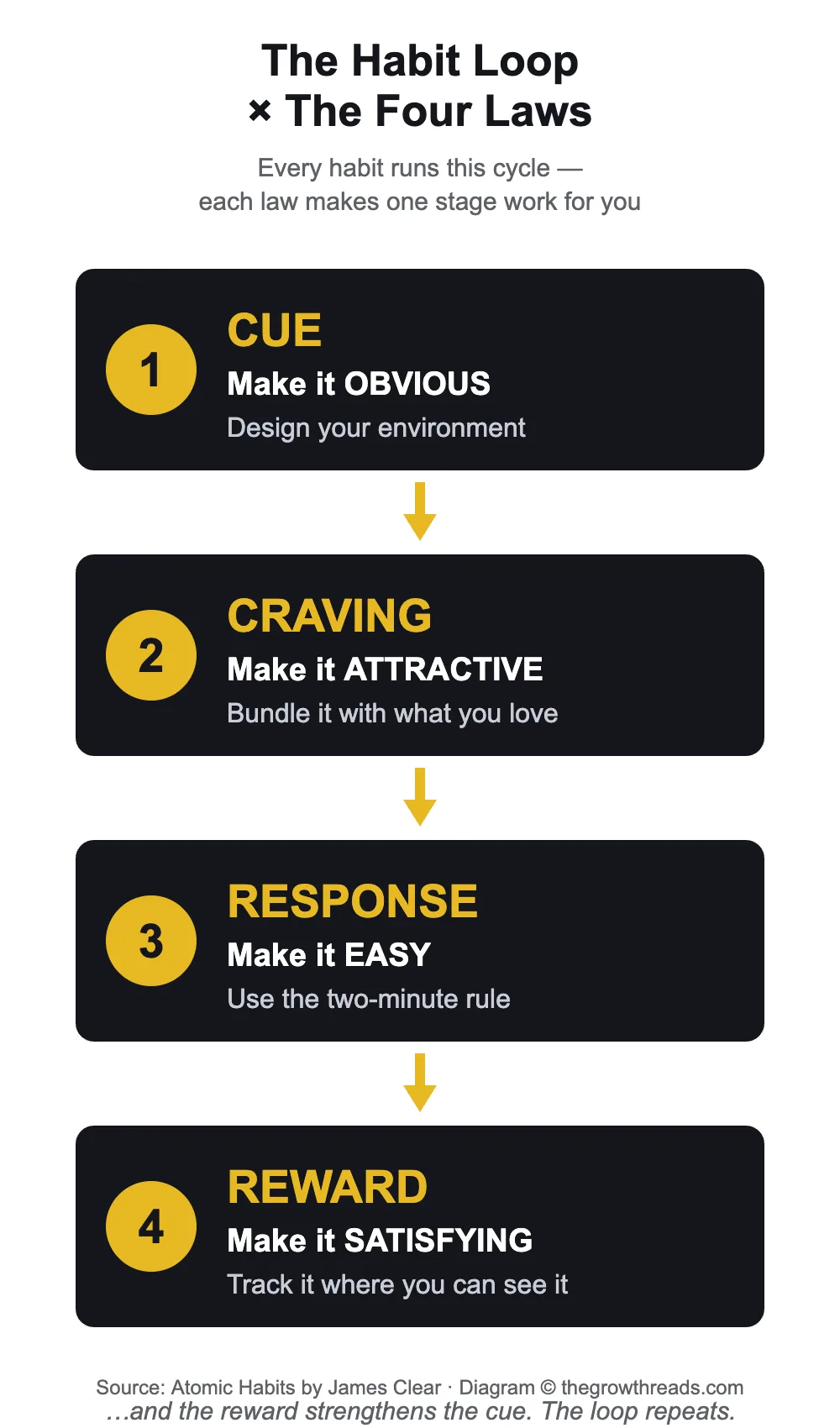
- The habit loop has four stages: cue → craving → response → reward. Diagnose any habit by finding its four parts.
- Make it obvious: design your environment so good cues are visible and bad cues are invisible. Implementation intentions (“at [time] in [place]”) triple follow-through.
- Make it attractive: dopamine rises on anticipation — bundle needs with wants, and join groups where your desired behavior is normal.
- Make it easy: the two-minute rule — master showing up before scaling up. Friction decides more than motivation.
- Make it satisfying: what’s immediately rewarded repeats — track streaks visibly and never miss twice.
- Results lag effort: breakthrough moments follow a Plateau of Latent Potential — the ice melts at 32°, not 31°.
- Boredom, not failure, kills mastery: professionals keep the reps when novelty dies; the Goldilocks zone (~4% beyond ability) keeps flow alive.
What is Atomic Habits about?
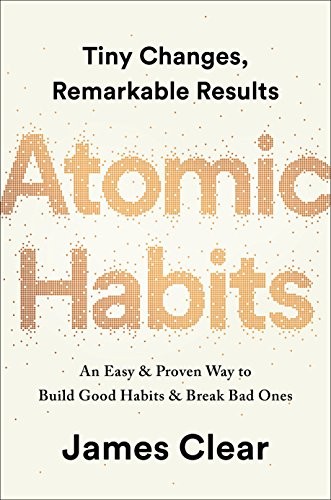
Atomic Habits by James Clear is a practical framework for changing behavior through small, compounding improvements. Published in 2018 and now past 20 million copies sold, it argues that habits — not motivation or goals — determine outcomes, and provides a four-step system (the Four Laws of Behavior Change) for engineering them deliberately.
About the author
James Clear’s origin story anchors the book: a sophomore-year baseball injury — a bat to the face, a medically induced coma — took away the sport that defined him. His recovery ran on small habits: sleep, study, tiny weight-room gains, compounded over years until he became an academic All-American. He spent the 2010s refining these ideas in a newsletter read by millions, and Atomic Habits distills that decade of testing. Clear writes as a synthesizer — pulling from behavioral science (much of it mapped in Duhigg’s The Power of Habit) and converting it into checklists that survive contact with real life. Explore all James Clear book summaries →
Key concepts at a glance
| Concept | What it means | Use it when |
|---|---|---|
| 1% rule | Tiny gains compound to 37x/year | You feel progress is too slow |
| Identity-based habits | Become the type of person, not chase the result | Motivation keeps collapsing |
| Habit loop | Cue → craving → response → reward | Diagnosing any habit |
| Habit stacking | “After [current habit], I will [new habit]” | Starting something new |
| Two-minute rule | Scale every habit down to a 2-min gateway | You keep procrastinating |
| Environment design | Make cues visible, friction low | Willpower keeps losing |
| Habit tracking | Visible streak = immediate reward | Habits fade after week two |
| Goldilocks rule | Peak motivation at the edge of ability | Boredom threatens mastery |
Part 1: Why tiny changes make a big difference
Clear opens with the mathematics of self-improvement: improve 1% daily and you end the year 37.8x better; decline 1% daily and you erode to nearly zero. The British Cycling story makes it concrete — performance director Dave Brailsford’s “aggregation of marginal gains” (better pillows, washed hands, repainted truck floors) took a team that had won one Tour de France in 110 years to five wins in six. The point isn’t cycling: it’s that outcomes are lagging measures of habits. Your weight lags your eating habits; your knowledge lags your reading habits.
Two ideas make Part 1 the book’s foundation. First, forget goals, build systems: winners and losers share the same goals, so goals can’t be what separates them. Goals also create a binary pass/fail happiness and end when achieved; systems compound forever. Second, the Plateau of Latent Potential: results lag effort, like an ice cube that only melts at 32° after warming silently from 25°. Most people quit in what Clear calls the Valley of Disappointment — doing the right things without visible results — precisely when the compounding is loading.
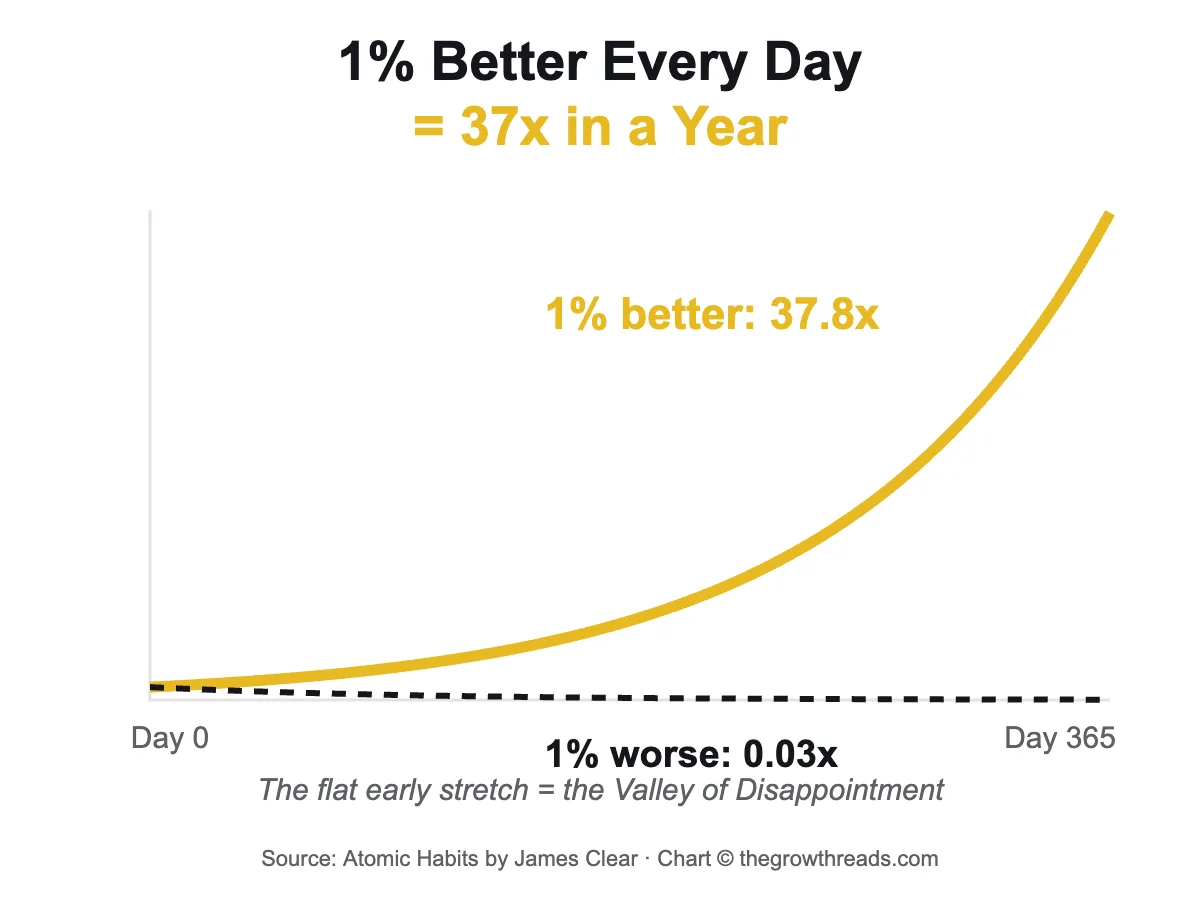
TGR Note: The 37x math assumes improvements multiply rather than add — a simplification Clear acknowledges. Read it as a mental model, not a forecast: the durable claim, well-supported in the research Duhigg documents, is that repetition automates behavior and automated behavior compounds. Kahneman’s System 1 is doing the heavy lifting here: habits move choices from effortful to automatic.
Part 2: Identity — the real engine of change
The book’s deepest idea arrives early: there are three layers of change — outcomes (what you get), processes (what you do), and identity (what you believe). Most people work outside-in: “I want to lose 10kg” (outcome), then pick a diet (process). Lasting change works inside-out: decide who you want to be, then prove it with small wins. Every action is a vote for a type of person. Write one page — a vote for “writer.” Skip one cigarette — a vote for “non-smoker.” No single vote converts the election, but the votes accumulate into evidence, and identity is simply the story your evidence tells.
Clear’s two-step loop: decide the type of person you want to be, then prove it to yourself with small wins. The pattern also explains relapse: when behavior conflicts with identity, identity wins. The smoker who says “I’m trying to quit” still holds the smoker identity; “I’m not a smoker” ends the negotiation.
TGR Note: This is where Atomic Habits quietly borrows from psychology’s deepest well — Dweck’s Mindset shows why identity statements change effort tolerance, and Duckworth’s Grit finds the same mechanism in “calling” language. If you take one page from the whole book, take this one: habits are how you cast votes; identity is why you keep casting them.
Part 3: The Four Laws — the operating manual
Every habit runs a four-stage loop — cue (you notice), craving (you want), response (you act), reward (you learn). Clear’s contribution is converting each stage into a design lever, one law per stage, each invertible for breaking bad habits.
Law 1: Make it obvious (cue)
Most habit failure is cue failure. The tools: the Habits Scorecard (list every daily behavior, mark +/–/= — awareness precedes change); implementation intentions (“I will [behavior] at [time] in [location]” — people who wrote when and where they’d exercise stuck at 91% in the study Clear cites, versus ~35% for the motivated-but-unplanned); habit stacking (“After I pour my coffee, I will meditate for one minute”); and environment design — put the book on the pillow, the fruit on the counter, and to invert, make bad cues invisible: the phone in another room outlasts any focus app.
Law 2: Make it attractive (craving)
Dopamine spikes on anticipation, not delivery — which is why the craving, not the reward, drives action. Tools: temptation bundling (pair what you need to do with what you want to do — Netflix only while on the treadmill); joining cultures where your desired behavior is normal (we imitate the close, the many, and the powerful — choose tribes where your target identity is the default); and motivation rituals. Inversion: reframe the bad habit’s benefit story until it repels.
TGR Note: Law 2 is Carnegie’s insight pointed inward: How to Win Friends teaches you to arouse eager want in others; Clear teaches you to arouse it in yourself. The tribe point is the underrated one — it’s the same mechanism as Duckworth’s finding that grit is contagious through culture.
Law 3: Make it easy (response)
The law procrastinators need most. Motion (researching, planning) feels productive but is often procrastination in disguise; only action builds habits, and habits form on frequency, not time — which retires the “21 days” myth. The Two-Minute Rule scales any habit to a gateway version (“read before bed” → “read one page”) because a habit must be established before it can be improved: master showing up first. Reduce friction for good habits (gym clothes laid out, guitar on a stand) and add friction to bad ones (log out, unplug, hide). Commitment devices — Victor Hugo locking away his clothes to finish Notre-Dame — make the wrong choice impractical.
Law 4: Make it satisfying (reward)
The cardinal rule of behavior change: what is immediately rewarded is repeated; what is immediately punished is avoided. Your brain prices the present far above the future, so give good habits instant payoffs: habit tracking (the streak itself becomes the reward — “don’t break the chain”), never miss twice (one miss is an accident; two is the start of a new habit), and accountability partners or habit contracts for stakes. Inversion: make bad habits immediately painful — social cost works faster than health warnings.
Part 4: Advanced tactics — genes, Goldilocks, and boredom
The final section answers the mastery question. Genes don’t determine your outcome, but they do determine your area of maximum leverage — play games where your nature gives you an edge. The Goldilocks Rule keeps motivation alive at the edge of ability: tasks roughly 4% beyond current skill sustain flow, which is why both boredom and overwhelm kill habits. And the book’s most honest admission: the greatest threat to success isn’t failure but boredom — professionals keep showing up when the reps stop being novel. Habits plus deliberate practice equals mastery; reflection and review keep identity from becoming a cage.
TGR Note: Cal Newport’s Deep Work picks up exactly where this chapter ends — once showing up is automatic, depth becomes the differentiator. And Duckworth’s “hard thing rule” in Grit is the Goldilocks Rule applied to a family.
Who is Atomic Habits best for — and who should read something else first?
Best for: beginners building their first deliberate habits; anyone rebuilding after a life disruption; teams and parents who want a shared behavior vocabulary. If your problem is prioritization rather than consistency, start with The ONE Thing; if you want the neuroscience before the checklist, read The Power of Habit first; if habits form fine but focus is the bottleneck, go straight to Deep Work.
Questions to reflect on
- Which of your current results — good or bad — is a lagging measure of a system you’re running on autopilot?
- Who is the person you’re trying to become, in one sentence — and what did you do today that voted for them?
- What’s the two-minute version of the habit you’ve failed to start three times?
- Which cue in your environment most reliably triggers your worst habit — and can you make it invisible tonight?
- Where are you in a Valley of Disappointment right now, and what evidence suggests the ice is actually warming?
🔥 Ready to make it stick?
This guide is the map — the book is the training. Get every story, template, and detail a summary can’t carry. Readable in a weekend, useful for life.
How to apply Atomic Habits (7-day plan)
- Day 1: Fill in the Habits Scorecard: list your daily behaviors, mark each +, – or =. Just observe.
- Day 2: Write your identity sentence: “I am the kind of person who ___.” Pick ONE keystone habit that proves it.
- Day 3: Shrink it with the two-minute rule and stack it: “After [existing habit], I will [2-minute habit].”
- Day 4: Design the environment: place the cue in plain sight; add two steps of friction to your worst habit’s cue.
- Day 5: Make it satisfying: start a visible tracker and mark the first X.
- Day 6: Temptation-bundle one dreaded task with one loved indulgence.
- Day 7: Review: any misses? Apply never-miss-twice, and scale the habit by 10%, not 100%.
Frequently asked questions
What are the 4 laws of Atomic Habits?
The Four Laws of Behavior Change are: make it obvious (expose the cue — habit stacking, implementation intentions, environment design), make it attractive (raise the craving — temptation bundling, joining cultures where the habit is normal), make it easy (lower friction — the two-minute rule, preparing your space), and make it satisfying (immediate reward — habit tracking, accountability). To break a bad habit you invert each law: make the cue invisible, the craving unattractive, the response difficult, and the reward unsatisfying. The laws map one-to-one onto the habit loop’s four stages, which is what makes the system diagnostic as well as prescriptive.
What is the 1% rule in Atomic Habits?
Improving just 1% per day compounds to roughly 37.8x better over a year (1.01^365), while getting 1% worse daily decays to nearly zero (0.99^365 ≈ 0.03). Clear presents it as a mental model rather than literal math: small choices seem insignificant in the moment, but their compounded trajectory is enormous. The rule’s practical implication is to stop seeking dramatic transformations and instead protect tiny daily improvements — and to keep going through the “Valley of Disappointment,” where compounding is working but not yet visible.
What is the two-minute rule?
When starting a new habit, scale it down until it takes two minutes or less: “read before bed” becomes “read one page”; “do yoga” becomes “roll out the mat.” The point isn’t the two minutes — it’s mastering the art of showing up, because a habit must exist before it can be improved. The gateway version establishes the identity and the neurological pattern; volume and intensity can scale later. It also defeats procrastination’s real cause: the perceived size of starting, not the work itself.
What is habit stacking?
Habit stacking links a new habit to an existing one using the formula “After [current habit], I will [new habit]” — for example, “After I pour my morning coffee, I will meditate for one minute.” Your established routine becomes the cue for the new behavior, borrowing its reliability instead of depending on memory or motivation. The keys to making it work: choose an anchor habit you truly do daily, match the location and frequency, and keep the new habit two-minute small until the stack feels automatic.
How long does it take to form a habit according to Atomic Habits?
Clear explicitly rejects the popular 21-day and 66-day myths: habits form based on frequency of repetition, not elapsed calendar time. Fifty reps in two weeks beats fifty reps spread over six months. The honest answer is “as long as it takes to become automatic,” which varies with the habit’s complexity, the strength of the cue, and how satisfying the reward is. The practical takeaway: stop counting days, start counting reps — and use the Four Laws to raise the odds each rep happens.
Should I read Atomic Habits or The Power of Habit first?
Read Atomic Habits first if you want a system you can apply today — it converts the science into checklists, formulas, and rules. Read The Power of Habit first if you want the deeper research story: Duhigg’s book explains the neurology of the habit loop, the corporate and societal case studies, and the golden rule of habit change that Clear builds upon. They complement rather than repeat each other; most readers get the most from Clear for practice and Duhigg for understanding. Our library has full summaries of both.
Is Atomic Habits worth reading if I’ve read this summary?
Yes — if you intend to apply it. A summary gives you the map: the concepts, formulas, and the order they fit together. The book supplies what a map can’t: dozens of worked examples across fitness, business, parenting, and art that train your pattern recognition, plus the repetition that makes the ideas stick when motivation dips. Use this guide to decide whether the system fits your current bottleneck and as your revision tool afterward; read the full book when you’re ready to run the 30-day implementation seriously.
Related summaries
The Power of Habit · Deep Work · The ONE Thing · Mindset — or browse all the best productivity books.
How we analyze books: We work from the full book — reconstructing its core arguments in our own words, adding commentary that connects it to related research and other books in our library, and pressure-testing the advice in a practical 7-day plan. Ratings weigh usefulness, readability, and evidence quality. Read our full methodology.