

★★★★★ 4.8/5 — The book that named the six switches your brain flips before you consciously decide anything.
Best for: Anyone who negotiates, sells, markets, manages, or just wants to stop getting talked into things they didn’t actually want.
Reading time: ~7.5 hrs to read the full book · 12 min to read this guide
Difficulty to apply: Easy to notice, harder to resist — these triggers keep working even after you know how they work.
Influence in one minute
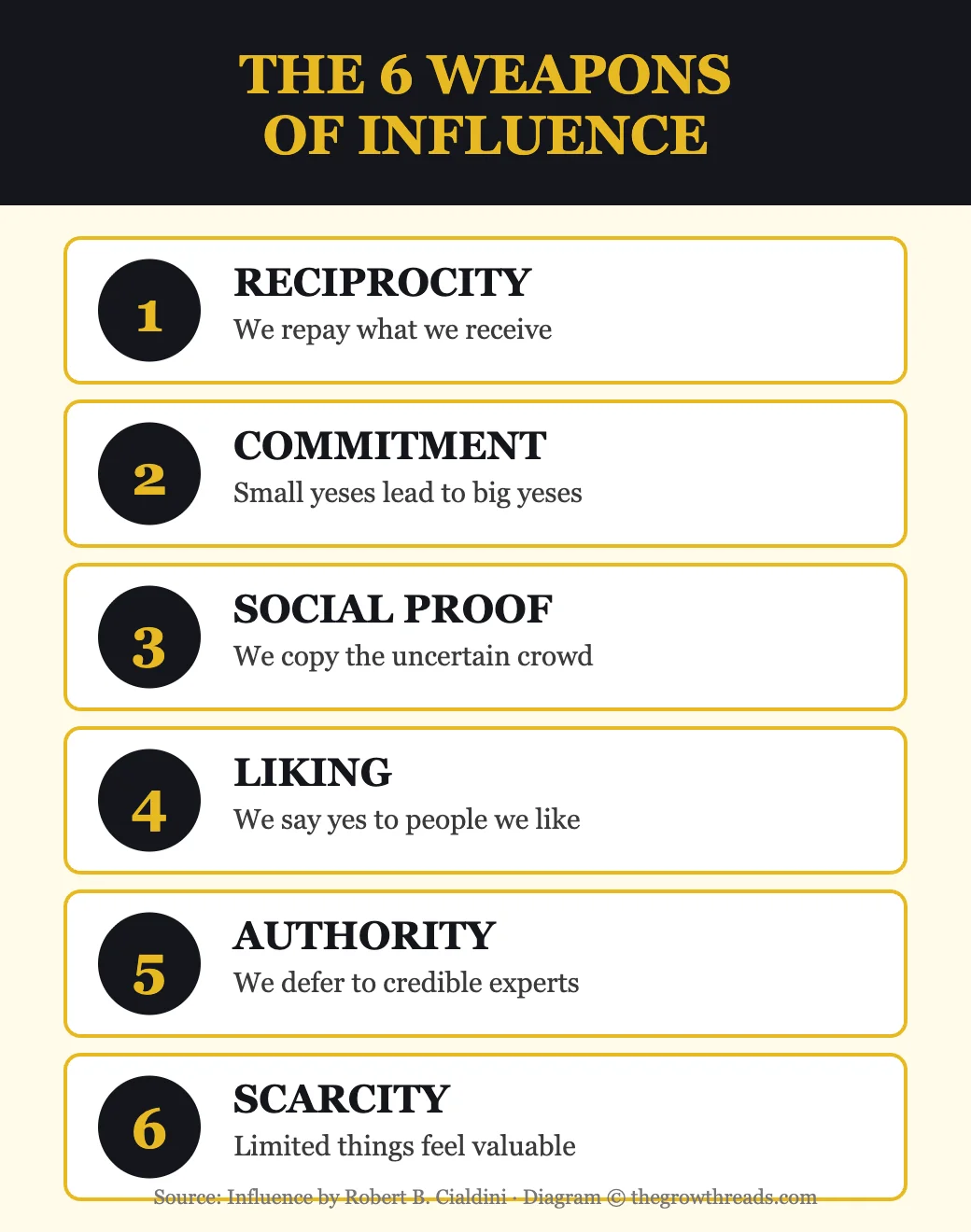
Robert Cialdini spent nearly three years working undercover as a car salesman, fundraiser, and telemarketing trainee to answer one question: why do we say yes? His answer is six automatic triggers — reciprocity, commitment and consistency, social proof, liking, authority, and scarcity — mental shortcuts that usually serve us well but that “compliance professionals” can trigger deliberately to extract a yes we wouldn’t otherwise give. Influence isn’t a manual for manipulating people. It’s a field guide to noticing when the switches in your own head are being flipped, so you can decide on purpose whether to say yes.
Key takeaways
- Reciprocity: an unsolicited gift, favor, or concession creates a felt obligation to repay it — even from total strangers.
- Commitment and consistency: a small, freely-made commitment makes people work hard to stay consistent with it later, sometimes against their own interest.
- Social proof: in ambiguous situations we copy what similar others are doing, which is why testimonials and “most popular” labels outsell direct claims.
- Liking: we say yes more often to people who are similar to us, who compliment us genuinely, or who cooperate with us toward a shared goal.
- Authority: titles, uniforms, and credentials trigger automatic deference — even when the “authority” has nothing to do with the actual request.
- Scarcity: things feel more valuable the instant they seem limited, and losing access to a choice makes us want it more than when it was freely available.
- The “click, run” response: humans, like animals, have fixed-action patterns triggered by a single feature — the word “because” makes a request more persuasive even when the reason that follows is meaningless.
- Contrast principle: showing an expensive option first — or a flawed one before a good one — resets what feels “reasonable” for everything that follows.
- Unity: shared identity (family, community, “people like us”) is a persuasion lever stronger than plain similarity or liking.
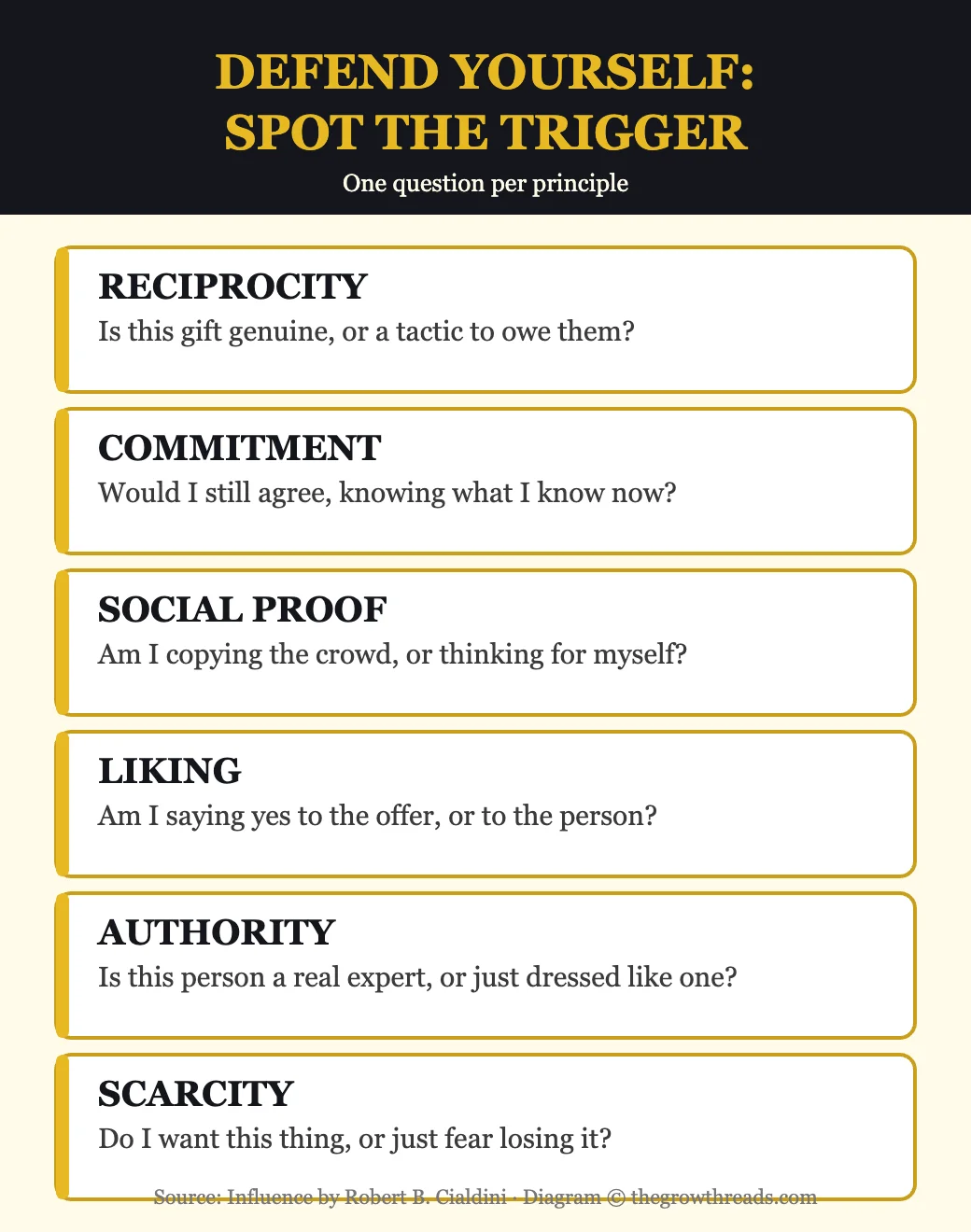
- The real defense isn’t refusing every influence attempt — it’s noticing the automatic reaction, pausing, and asking whether you’d choose the same thing on the merits alone.
What is Influence about?
Influence: The Psychology of Persuasion is Robert Cialdini’s research-backed breakdown of six psychological principles — reciprocity, commitment and consistency, social proof, liking, authority, and scarcity — that make people say yes automatically, often without weighing a request on its actual merits. Cialdini shows how each principle gets used by salespeople, marketers, and fundraisers, and how ordinary people can recognize and resist each one.
About the author
Robert B. Cialdini is Regents’ Professor Emeritus of Psychology and Marketing at Arizona State University. Before writing Influence, he spent nearly three years going undercover — training as a salesperson, fundraiser, and advertiser — to study persuasion tactics from the inside rather than from the lab alone. That mix of controlled experiments and documented sales-floor tactics is what separates the book from typical pop psychology. First published in 1984, Influence has sold more than five million copies and is a staple text in psychology and MBA courses worldwide. Cialdini later added a seventh principle, unity, in the 2021 expanded edition, and followed up with Pre-Suasion (2016), which examines how the moment right before a request shapes whether it succeeds. Explore all Robert B. Cialdini book summaries →
Key concepts at a glance
| Concept | What it means | Use it when |
|---|---|---|
| Reciprocity | We feel obligated to repay what we’re given | Give value first, before asking for anything |
| Commitment & Consistency | Small, freely-made commitments predict later behavior | You want a decision to stick — get it said or written |
| Social Proof | We copy similar others, especially when uncertain | You have real numbers, reviews, or examples to show |
| Liking | We say yes more to people we like, trust, or resemble | Building any relationship before you’ll need to ask |
| Authority | We defer to perceived expertise or credentials | Establishing credibility matters as much as the claim |
| Scarcity | Limited availability raises perceived value | The offer is genuinely time- or quantity-limited |
| Contrast Principle | The second option is judged relative to the first | Presenting choices in sequence, not in isolation |
| Unity | Shared identity persuades more than mere liking | You share a real in-group with the other person |
Part 1: Why We Say Yes Automatically
Cialdini opens with a simple observation from ethology: animals respond to complex situations with fixed-action patterns — a single trigger feature sets off a whole behavior sequence, automatically. A mother turkey will smother a polecat decoy in affection if it merely plays the right chirping sound, even while the fake predator is inches from her chicks. Humans have our own “click, run” tapes. In a famous study, Harvard psychologist Ellen Langer had researchers ask to cut in a copy-machine line. “Excuse me, may I use the Xerox machine?” worked 60% of the time. Adding a real reason — “because I’m in a rush” — worked 94% of the time. But adding a completely meaningless reason — “because I have to make copies” — also worked 93% of the time. The word “because” itself was the trigger, not the logic behind it.
This matters because it explains why persuasion so often bypasses our reasoning entirely. We don’t evaluate every request from scratch; we run mental shortcuts — “expensive = good,” “expert = trustworthy,” “everyone’s doing it = safe” — because full analysis of every decision would be exhausting. Compliance professionals (Cialdini’s term for the salespeople, marketers, and con artists who study these shortcuts professionally) don’t need to change your mind. They just need to trigger the tape.
TGR Note: Cialdini’s “click, run” tapes are the same automatic machinery Daniel Kahneman calls System 1 in Thinking, Fast and Slow — fast, effortless, and prone to being hijacked by the wrong cue. If you want the underlying cognitive science, read that one alongside this book.
Part 2: Reciprocity and Commitment & Consistency
The reciprocity rule is one of the most powerful and least examined forces in human behavior: we feel obligated to repay what others give us, even when we didn’t ask for it. Cialdini cites the Hare Krishna Society, which raised enormous sums at airports in the 1970s by first pressing a free flower into a traveler’s hand before asking for a donation — most people gave, even after tossing the unwanted flower in the trash minutes later. Free samples, complimentary consultations, and “we threw in a bonus” offers all lean on the same wiring. Reciprocity also powers the door-in-the-face technique: Cialdini’s own study found that asking students to commit two years to a juvenile counseling program (a near-certain no), then retreating to “would you at least chaperone one zoo trip?” nearly tripled compliance compared with asking for the zoo trip alone. The refusal-then-retreat sequence reads as a concession, and concessions get reciprocated.
Commitment and consistency work differently but compound just as powerfully. Once we make a small, freely-chosen commitment, we work to behave in ways that are consistent with it — because inconsistency is socially costly and mentally taxing. Freedman and Fraser’s classic foot-in-the-door study found that homeowners who first agreed to a small request (sign a petition for driver safety) were far more likely to later agree to a huge one (allow a giant, ugly “Drive Carefully” billboard on their front lawn) than homeowners approached cold. Car dealers exploit the same mechanism with low-balling: agree to a great price, wait for the buyer to mentally commit (tell friends, cancel other test drives), then “discover” the price was wrong — most buyers still complete the purchase at the higher price, because they’ve already committed to owning the car. Public and written commitments are stickier than private ones, which is why sign-up sheets, verbal confirmations, and “type YES to confirm” exist.
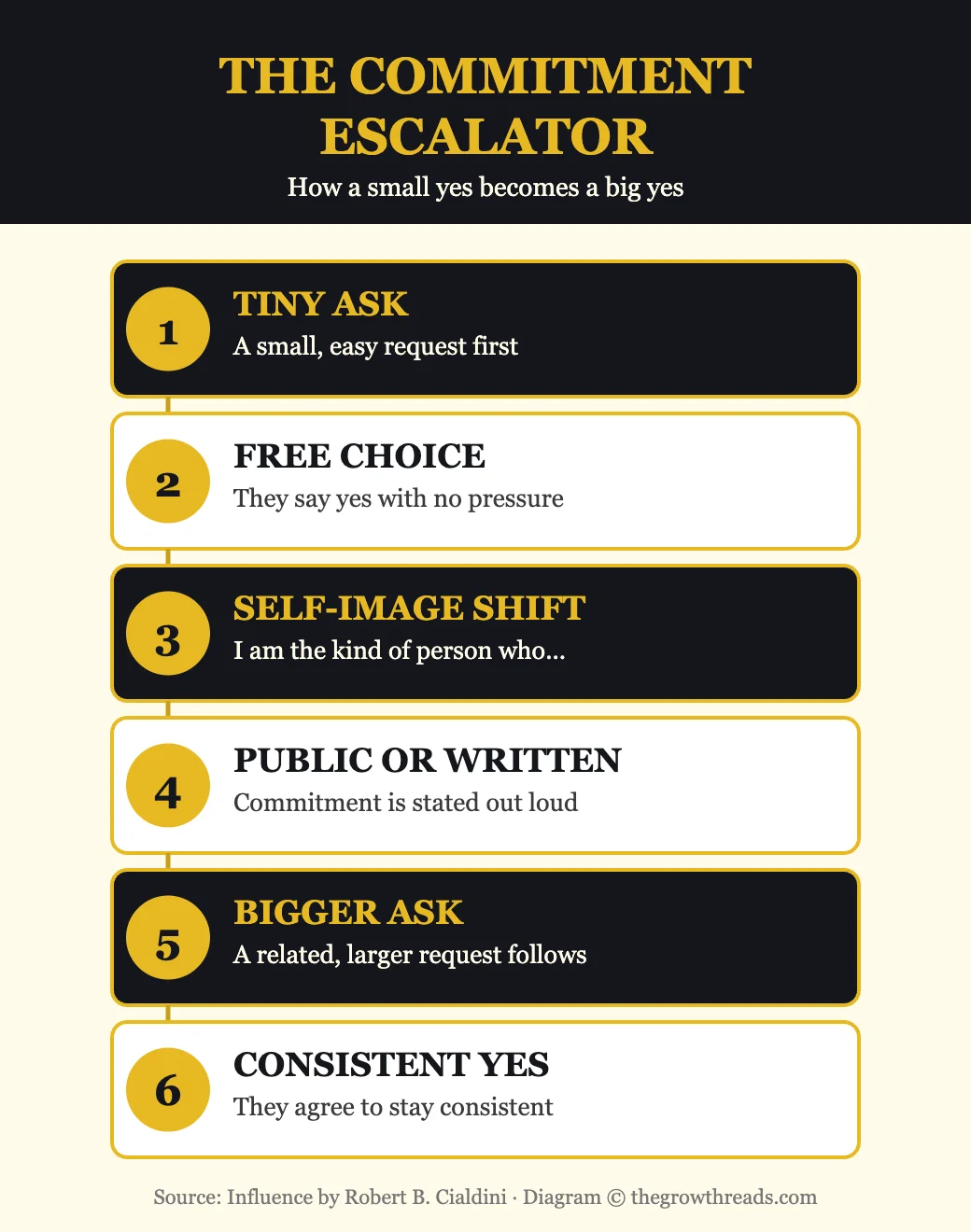
TGR Note: The commitment escalator is a close cousin of the labeling and calibrated-question tactics in Never Split the Difference — both use small, voluntary steps to build toward a bigger yes. Read them together if you negotiate for a living.
Part 3: Social Proof and Liking
Social proof is the shortcut of “if everyone’s doing it, it must be correct” — and it’s strongest exactly when we’re uncertain and when the people we’re watching seem similar to us. Sitcom producers add canned laughter because audiences rate the same joke as funnier and laugh longer when they hear others laughing, even when they consciously find canned laughter annoying. Bartenders and street musicians seed their tip jars with a few bills before opening, because an empty jar signals “nobody tips here” while a seeded one signals “this is normal.” Cialdini also documents a darker version: after high-profile suicides receive heavy news coverage, suicide rates and single-car fatal accidents spike measurably in the following days — a phenomenon researchers call the Werther effect, where vulnerable people unconsciously use others’ actions as a script for their own. The lesson isn’t that social proof is bad; it’s that in an emergency or an unfamiliar situation, everyone waiting to see what others do is exactly how bystander apathy happens, and knowing that is itself a defense.
Liking is simpler but no less powerful: we’re persuaded more easily by people we like, and Cialdini identifies the specific levers that build liking fast. Physical attractiveness creates a “halo effect” — attractive people are automatically rated as more talented, kind, and honest in studies, and attractive defendants receive lighter sentences on average. Similarity works even on trivial dimensions — salespeople trained to mention a shared hometown, alma mater, or even just a similar name close measurably more deals. Genuine compliments work, and mild flattery still nudges people favorably even when they suspect the motive behind it. Contact and cooperation matter too: people who work toward a shared goal, even one manufactured by circumstance, come to like each other more — the basis of team-building exercises and “we’re in this together” sales pitches. And simple association can transfer feeling: restaurants that pair a sales pitch with a good meal, or brands that pair a product with an admired celebrity, are borrowing positive feelings that have nothing to do with the product itself.
TGR Note: If Part 3 sounds familiar, it should — Dale Carnegie built an entire practical system around the liking principle decades earlier in How to Win Friends and Influence People. Cialdini explains the psychology behind why Carnegie’s advice works; Carnegie gives you the day-to-day script.
Part 4: Authority and Scarcity
Authority is one of the deepest-wired triggers, and Cialdini leans on Stanley Milgram’s famous obedience experiments to show how far it extends: ordinary volunteers delivered what they believed were dangerous, possibly lethal electric shocks to another person simply because a researcher in a lab coat calmly said to continue. What’s unsettling is how little “authority” actually needs to be real. A hospital study found that nurses complied with a phoned-in instruction from an unfamiliar “doctor” to administer a clearly excessive drug dose 95% of the time, based on nothing but a confident voice claiming a title. Advertisers exploit the same shortcut with actors in white coats, invented credentials, and expensive cars — the trappings of authority (titles, clothing, symbols of status) trigger deference almost as reliably as the substance of it.
Scarcity closes the book, and it’s the one most people already sense intuitively but still fall for: opportunities feel more valuable the moment they seem limited, whether the limit is on quantity (“only 3 left”) or time (“offer ends tonight”). Cialdini traces this to psychological reactance — when a choice is threatened or restricted, we want it more than we did when it was freely available, the same “Romeo and Juliet effect” that makes forbidden relationships more intense. In one of his own studies, participants rated identical cookies as tastier and more desirable when they came from a jar with only two cookies in it rather than ten — nothing about the cookie changed, only its apparent scarcity. Competitive scarcity (an auction, a bidding war, “someone else is looking at this house”) adds urgency on top of value, which is why so many sales tactics manufacture competition even when none exists.
TGR Note: Authority and scarcity are also central to the status games described in The 48 Laws of Power — that book focuses on wielding power, while Cialdini focuses on recognizing when it’s being used on you. Read both to see the same dynamics from opposite sides of the table.
Who is Influence best for — and who should read something else first?
Influence rewards anyone whose work involves asking people for things: salespeople, marketers, fundraisers, managers, and negotiators will find immediately usable tactics on both the giving and the defending side. It’s equally valuable for anyone who simply wants to stop being an easy mark — the book works as well as a shield as it does as a tool. If you specifically want negotiation scripts rather than psychological theory, start with Never Split the Difference instead, then come back to Influence for the “why” behind the tactics. If you’re more interested in the cognitive-science foundation of automatic decision-making than in sales and marketing examples, Thinking, Fast and Slow is the deeper, more academic companion.
Questions to reflect on
- Which of the six principles do you personally fall for most often, and in what kinds of situations?
- Think of a recent purchase or decision you regret. Which trigger was pulling you toward it?
- Where in your own work or relationships could you ethically use reciprocity — giving value first, expecting nothing back — rather than transactionally?
- When did a public or written commitment change your later behavior, for better or worse?
- How would you redesign one of your own habitual “asks,” at work or at home, using one of these six principles without crossing into manipulation?
🔥 Ready to spot every persuasion tactic aimed at you?
Grab Influence and read Cialdini’s original undercover research in full.
How to apply Influence (7-day plan)
- Day 1 — Reciprocity: Give one genuine, unsolicited favor to a colleague or customer with no ask attached. Notice how the relationship shifts afterward.
- Day 2 — Commitment: Write down one goal and say it out loud to another person today.
- Day 3 — Social proof: Before your next purchase, check reviews from people similar to you specifically, not just the star average.
- Day 4 — Liking: Find one genuine point of similarity with someone you need to influence this week, and mention it naturally.
- Day 5 — Authority: Next time you defer to someone’s opinion, check whether their credentials are actually relevant to this specific decision.
- Day 6 — Scarcity: When you feel “I have to decide right now,” wait 24 hours before acting and see whether the urgency was real.
- Day 7 — Full review: Pick one real upcoming ask — a raise, a sale, a favor — and consciously apply one principle ethically, then reflect on what changed.
Frequently asked questions
What are Cialdini’s six principles of influence?
The six principles are reciprocity (we repay what we’re given), commitment and consistency (we act in line with prior commitments), social proof (we copy similar others, especially when uncertain), liking (we say yes more to people we like), authority (we defer to perceived experts and credentials), and scarcity (limited things feel more valuable). Cialdini developed these from a mix of controlled psychology experiments and nearly three years spent undercover in sales, fundraising, and advertising roles, studying which tactics reliably produced compliance across very different industries.
Is there a seventh principle now?
Yes. In the 2021 expanded edition, Influence: New and Expanded, Cialdini added unity as a seventh principle. Unity describes how a shared identity — being part of the same family, community, or in-group — persuades more powerfully than simple similarity or liking, because it taps into a sense of “we” rather than just “I like this person.” The original six-principle framework from the 1984 and 2006 editions remains the core of the book and the version most commonly referenced.
Is Influence by Cialdini still relevant today, decades after it was written?
Yes — the psychological mechanisms Cialdini documented are wired into human decision-making and haven’t changed, even though the delivery channels have. The same reciprocity, scarcity, and social-proof tactics that worked in 1980s door-to-door sales now show up as “free trial” offers, countdown timers, and review counts on e-commerce sites. Some of the specific studies cited are decades old, and a handful of classic findings (including some in adjacent psychology research) have faced later replication questions, but the core behavioral patterns are still widely observed and taught in current marketing and negotiation training.
What’s the difference between Influence and Pre-Suasion?
Influence explains the six (or seven) triggers that make people say yes once a request is on the table. Pre-Suasion, Cialdini’s 2016 follow-up, focuses on what happens right before the request — how the context, environment, and the exact thought you’re prompted to have in the seconds beforehand can make you far more receptive to what follows. Influence is the foundational text; Pre-Suasion is a more advanced, narrower extension for readers who already know the six principles and want to go deeper on timing and framing.
Can I use these principles ethically, or are they inherently manipulative?
Cialdini frames all six principles as ethically neutral tools that become manipulative only when the underlying offer is false — for example, faking scarcity that doesn’t exist, or manufacturing a credential you don’t have. Used honestly, reciprocity means genuinely giving value first, social proof means pointing to real evidence, and authority means being transparent about real expertise. The book’s own stance, and the one this summary follows, is that the principles are worth learning primarily so you can both persuade honestly and recognize when they’re being used dishonestly on you.
What is the “click, run” response Cialdini describes?
The “click, run” response is Cialdini’s term, borrowed from ethology, for automatic behavior sequences triggered by a single feature rather than full evaluation of a situation — like a mother turkey caring for a predator decoy simply because it makes a chick’s chirping sound. Humans have similar automatic tapes: in one study, adding the word “because” to a request nearly doubled compliance even when the reason given was meaningless, showing that the trigger word mattered more than the logic behind it.
What’s the best way to defend myself against these tactics?
Cialdini’s recommended defense isn’t to refuse every gift, compliment, or deadline — that’s impractical and would make you a poor social partner. Instead, the defense is to notice when a request is triggering a strong, fast emotional pull (obligation, urgency, warmth toward the requester) and pause to ask: would I still say yes to this if I evaluated it on its own merits, separate from the trigger? If the answer is no, that gap between the automatic reaction and the honest evaluation is your signal to slow down.
Related summaries
- How to Win Friends and Influence People — the classic practical companion on the Liking principle
- Thinking, Fast and Slow — the cognitive science behind automatic, System-1 decisions
- Never Split the Difference — negotiation tactics that draw on several of Cialdini’s principles
- The 48 Laws of Power — for readers focused on authority and status dynamics
See the full Best Psychology Books list for more.
How we analyze books: Every TGR summary is built from a full read of the source book, cross-checked against the author’s interviews and published research where relevant, and structured around practical application rather than just a plot or argument recap. We do not use chapter-by-chapter reproduction, and all quotes are short and attributed. Read our full methodology.