

⭐⭐⭐⭐⭐ 4.5/5
Actionability: 4.3/5 · Evidence Quality: 4.7/5 · Writing Clarity: 4.6/5 · Uniqueness: 4.5/5 · Lasting Relevance: 4.4/5
One-liner: The greatest investors in the world share timeless lessons on wealth, wisdom, and the art of living well.
Best for: Investors at any level who want to learn from decades of real-world success — and anyone curious about how the best thinkers approach decisions.
Reading time: ~8 hours (304 pages)
Difficulty to apply: Moderate — the principles are clear, but building the temperament and patience to follow them takes years of practice.
Richer, Wiser, Happier in One Minute
The world’s greatest investors are not just great at making money — they are great at thinking. William Green spent decades interviewing legendary investors including Sir John Templeton, Charlie Munger, Howard Marks, Mohnish Pabrai, Joel Greenblatt, and many others. The book distills their collective wisdom into principles that extend far beyond finance: think independently, embrace simplicity, build resilience, play long-term games, and design a life worth living. Green argues that the habits of mind that produce extraordinary investment returns — patience, rationality, humility, and the courage to go against the crowd — are the same habits that produce extraordinary lives.
Key Takeaways
- Clone the best: Mohnish Pabrai built his fortune by systematically studying and replicating the strategies of proven investors rather than trying to reinvent the wheel.
- Buy at maximum pessimism: John Templeton made his greatest returns by investing when fear was at its peak and valuations were at their lowest — during wars, crashes, and crises.
- Simplify ruthlessly: The best investors reduce complexity rather than adding it — one great idea, executed with conviction and patience, beats a hundred mediocre ones.
- Think in decades, not days: Nick Sleep and Qais Zakaria compounded capital at extraordinary rates by holding just a handful of businesses for 10 to 20 years.
- Build inner resilience: Howard Marks emphasizes that the ability to tolerate discomfort and uncertainty is the single greatest edge an investor can have.
- Avoid stupidity over seeking brilliance: Charlie Munger’s inversion principle — focus on what to avoid rather than what to chase — is a recurring theme across every great investor profiled.
- Play games you can win: Joel Greenblatt succeeds by focusing exclusively on his circle of competence — special situations and value investing where he has a genuine informational edge.
- Design your life intentionally: The happiest investors Green profiled were not the richest but the ones who had consciously designed their lives around what mattered most to them.
- Embrace being different: Every great investor in the book was willing to look foolish in the short run in exchange for being right in the long run.
- Money is a means, not an end: The book’s deepest lesson is that wealth without wisdom, purpose, and human connection is hollow — the goal is to be richer, wiser, AND happier.
What Is Richer, Wiser, Happier About?
Richer, Wiser, Happier is a book about what the greatest investors in the world can teach us — not just about money, but about how to think, make decisions, and live well. William Green draws on decades of personal interviews with legends like Sir John Templeton, Charlie Munger, Howard Marks, Mohnish Pabrai, and Joel Greenblatt to distill the habits, mental models, and life philosophies that made them exceptional.
About the Author
William Green is a British-born journalist and author who has spent more than 25 years interviewing the world’s top investors and business leaders. His work has appeared in Time, Fortune, Forbes, The New Yorker, Bloomberg Markets, and The Economist. He was editor-in-chief of the Asian edition of Time magazine and has lived and worked in New York, London, Hong Kong, and Tokyo. His unique access to investing legends — spanning multiple continents and decades — gives the book an intimacy and depth that purely analytical investing books cannot match. Explore all William Green book summaries → Explore all William Green book summaries →
Key Concepts at a Glance
| Concept | What It Means | Use It When |
|---|---|---|
| Cloning | Systematically study and replicate what proven investors do | Building a portfolio without decades of personal experience |
| Maximum Pessimism | Buy when fear is greatest and prices are lowest | Markets crash and everyone is panic-selling |
| Circle of Competence | Only invest in what you genuinely understand | Evaluating any new opportunity or idea |
| Margin of Safety | Pay far less than intrinsic value to protect against mistakes | Setting a buy price for any investment |
| Inner Scorecard | Judge yourself by internal standards, not external validation | Feeling pressure to follow the crowd |
| Simplification | Reduce holdings, distractions, and complexity ruthlessly | Feeling overwhelmed by too many investments or decisions |
| Compounding Goodwill | Generosity and integrity compound like financial capital | Making career and relationship decisions |
Part 1: The Art of Cloning — Mohnish Pabrai and the Power of Copying
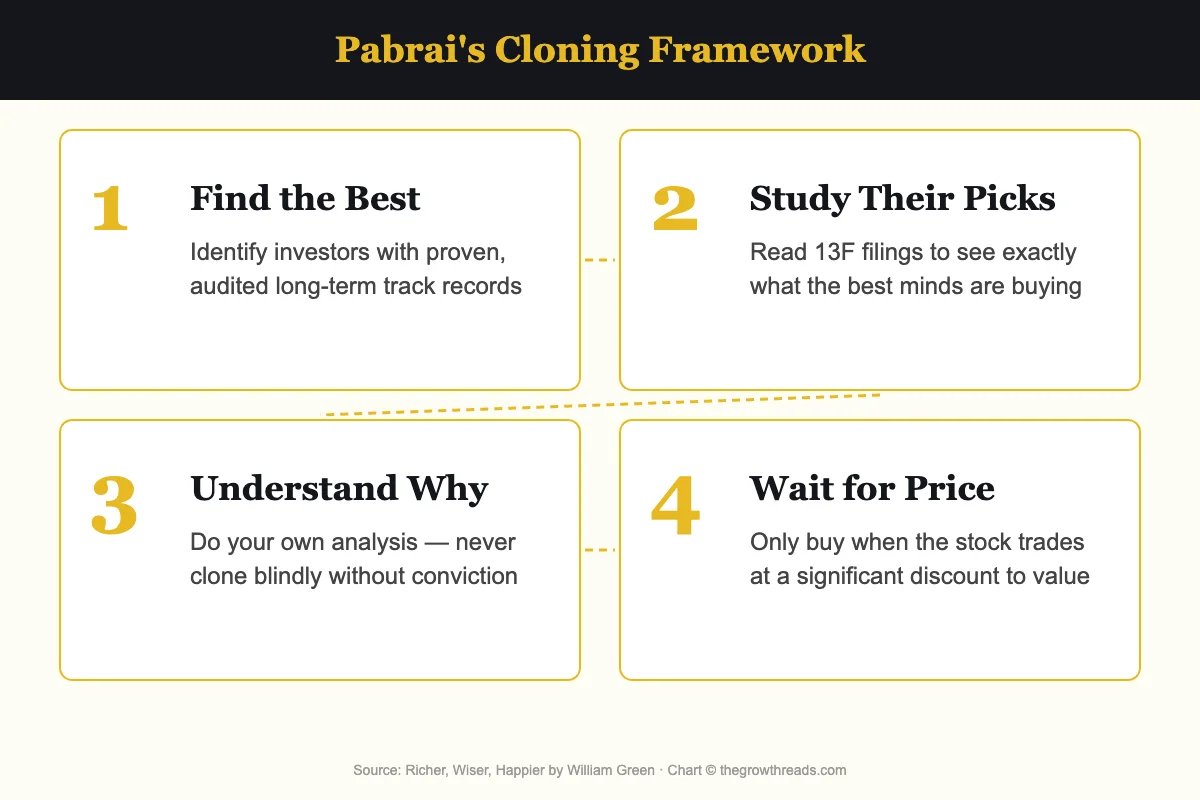
Green opens with one of investing’s most counterintuitive success stories: Mohnish Pabrai, who built a fortune not through original research but through the systematic art of cloning. Pabrai, who emigrated from India and built an IT company before turning to investing, studied Warren Buffett’s approach with the intensity of a PhD student. His insight was disarmingly simple — if the greatest investors have already done the analysis, why not study their public filings and piggyback on their best ideas?
Pabrai’s framework is more rigorous than simple mimicry. He reads the 13F filings of investors with audited, decades-long track records, identifies their highest-conviction positions, then conducts his own independent analysis to understand why the investment makes sense. He only buys when the stock trades at a significant discount to his own estimate of intrinsic value, providing an additional margin of safety beyond the original investor’s thesis.
But Pabrai’s most profound contribution goes beyond stock-picking. He practices what he calls “compounding goodwill” — the idea that generosity, integrity, and genuine helpfulness compound over decades just as reliably as financial capital. His Dakshana Foundation has helped thousands of impoverished Indian students pass elite university entrance exams. Pabrai embodies the book’s central thesis: the principles that make great investors also make great human beings.
Part 2: Buying at the Point of Maximum Pessimism — Sir John Templeton
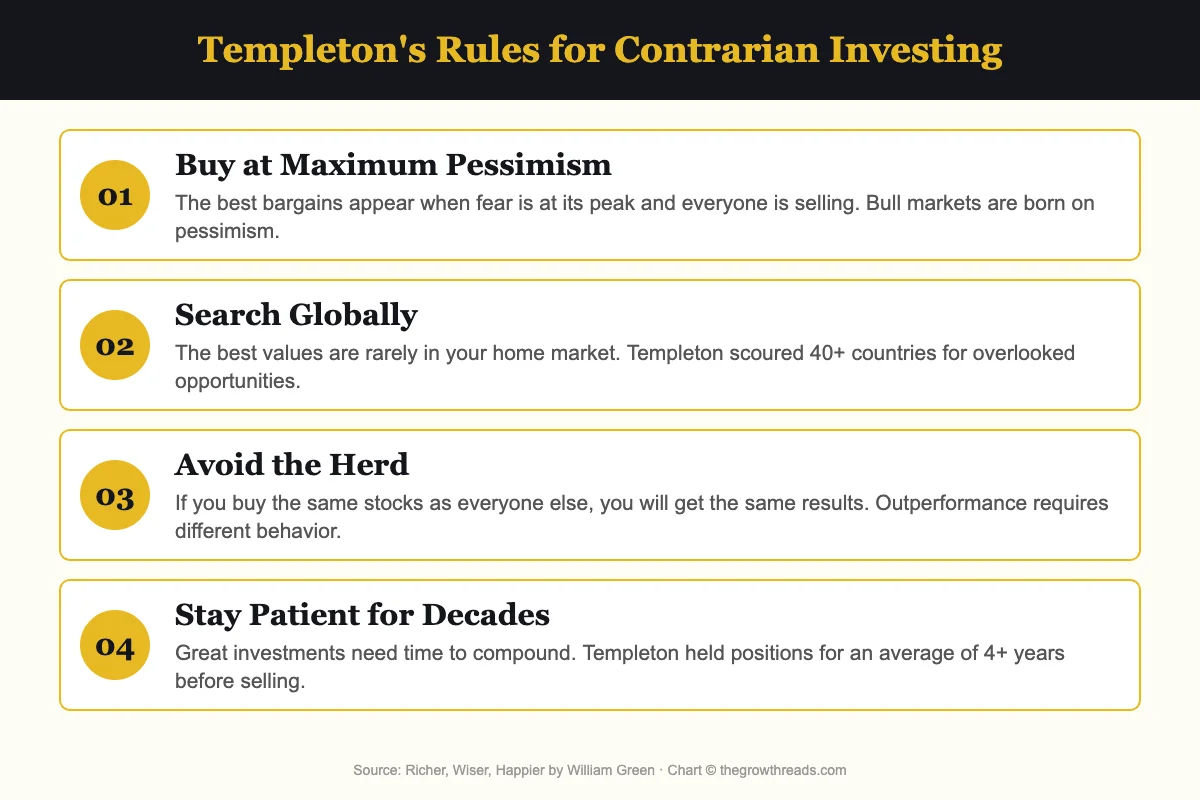
Sir John Templeton was arguably the greatest global investor of the twentieth century, and Green’s portrait of him is the book’s most vivid. Templeton’s central principle was breathtakingly simple: buy at the point of maximum pessimism. When bombs are falling, banks are failing, and investors are liquidating in panic, Templeton would calmly step in with his shopping list.
His most famous trade came in 1939, at the outbreak of World War II. While the world was gripped by fear, Templeton borrowed money to buy shares in every company on the New York Stock Exchange trading below one dollar per share — 104 companies in total. He held them for years and made a fortune. The lesson was not about recklessness but about understanding that human emotions create systematic mispricings. Fear makes stocks cheap; greed makes them expensive. The rational investor exploits both.
Templeton later expanded his approach globally, becoming one of the first major investors to buy Japanese stocks in the 1960s when the country was still rebuilding from the war. He searched more than 40 countries for opportunities that domestic investors overlooked, applying a discipline that most fund managers still lack today. His Templeton Growth Fund delivered returns of over 15 percent annually for nearly five decades.
Beyond investing, Templeton lived with extraordinary frugality and generosity. Despite amassing enormous wealth, he drove used cars, lived modestly in the Bahamas, and gave away hundreds of millions to fund scientific and spiritual research through the Templeton Foundation. Green argues that this combination — the discipline to accumulate wealth and the wisdom to deploy it for the world’s benefit — is what made Templeton not just richer but genuinely happier.
Part 3: The Power of Simplicity — Nick Sleep, Qais Zakaria, and Joel Greenblatt
One of the book’s most compelling threads is the case for radical simplicity. Green profiles Nick Sleep and Qais Zakaria of the Nomad Investment Partnership, who compounded capital at 20.8 percent annually over 13 years by holding an extraordinarily concentrated portfolio. At their peak, their top three holdings — Costco, Amazon, and Berkshire Hathaway — represented the vast majority of their fund.
Sleep’s key insight was the concept of “scale economics shared” — companies that use their growing scale to lower prices for customers rather than extract higher profits. This creates a virtuous cycle: lower prices attract more customers, which creates more scale, which enables even lower prices. Amazon, Costco, and GEICO all follow this pattern. Sleep recognized that these businesses become more valuable over time precisely because they give value away, making them almost impossible to compete against.
Joel Greenblatt offers a different kind of simplicity. His “Magic Formula” approach ranks stocks by combining two factors — earnings yield and return on capital — and buys the highest-ranked ones systematically. The formula is deliberately simple because Greenblatt believes that complexity is the enemy of discipline. When an approach is simple enough to follow mechanically, investors are less likely to abandon it during inevitable periods of underperformance.
The deeper lesson Green draws from all these investors is that simplicity is not a limitation but a competitive advantage. In a world where most investors are drowning in data, adding complexity with every quarterly report, the few who reduce their approach to its essential core — and then stick with it through discomfort — are the ones who compound wealth most reliably.
Part 4: Resilience, Wisdom, and the Inner Game — Howard Marks and the Art of Living
The book’s final major section shifts from strategy to temperament. Howard Marks, co-founder of Oaktree Capital, is Green’s primary example of an investor whose edge comes not from superior analysis but from superior emotional control. Marks’s memos to Oaktree clients — which Warren Buffett has said he reads the moment they arrive — are masterclasses in second-level thinking: the ability to ask “what does everyone else think, and why might they be wrong?”
Marks emphasizes that risk is not volatility but the permanent loss of capital, and that the greatest risk arises precisely when everyone believes there is no risk at all. His career has been built on recognizing that the pendulum of market psychology swings predictably between euphoria and despair, and positioning himself to profit from the extremes. He is not a market timer but a market temperature reader — he adjusts his aggressiveness based on where sentiment sits on the cycle.
Green weaves in broader life wisdom throughout this section. He profiles investors who found that the relentless pursuit of wealth without attention to relationships, health, and purpose led to misery despite enormous financial success. The happiest and most fulfilled investors in the book — Templeton, Pabrai, and Sleep among them — were those who treated money as a means to freedom and service rather than as an end in itself.
The book closes with Green’s own reflections on what he learned from decades of interviewing these extraordinary thinkers. His conclusion is that the greatest investors are not distinguished by their intelligence or their techniques but by their character: patience, humility, discipline, generosity, and the willingness to be different. These qualities, he argues, are not innate — they can be cultivated by anyone willing to study the masters and apply their principles to both investing and life.
Who Is Richer, Wiser, Happier Best For — and Who Should Read Something Else First?
This book is ideal for any investor — beginner or experienced — who wants to understand the mindset and principles behind extraordinary long-term returns. It works especially well for readers who have absorbed the basics (index fund investing, compound interest) and are ready to explore what separates good investors from truly great ones. It is also an excellent book for non-investors who are interested in decision-making, psychology, and the habits of exceptional thinkers.
If you are completely new to investing, start with The Psychology of Money by Morgan Housel for the emotional foundations, or The Simple Path to Wealth by JL Collins for a practical getting-started system. If you want the academic case for passive investing (which many of Green’s investors would respectfully disagree with), try A Random Walk Down Wall Street by Burton Malkiel.
Questions to Reflect On
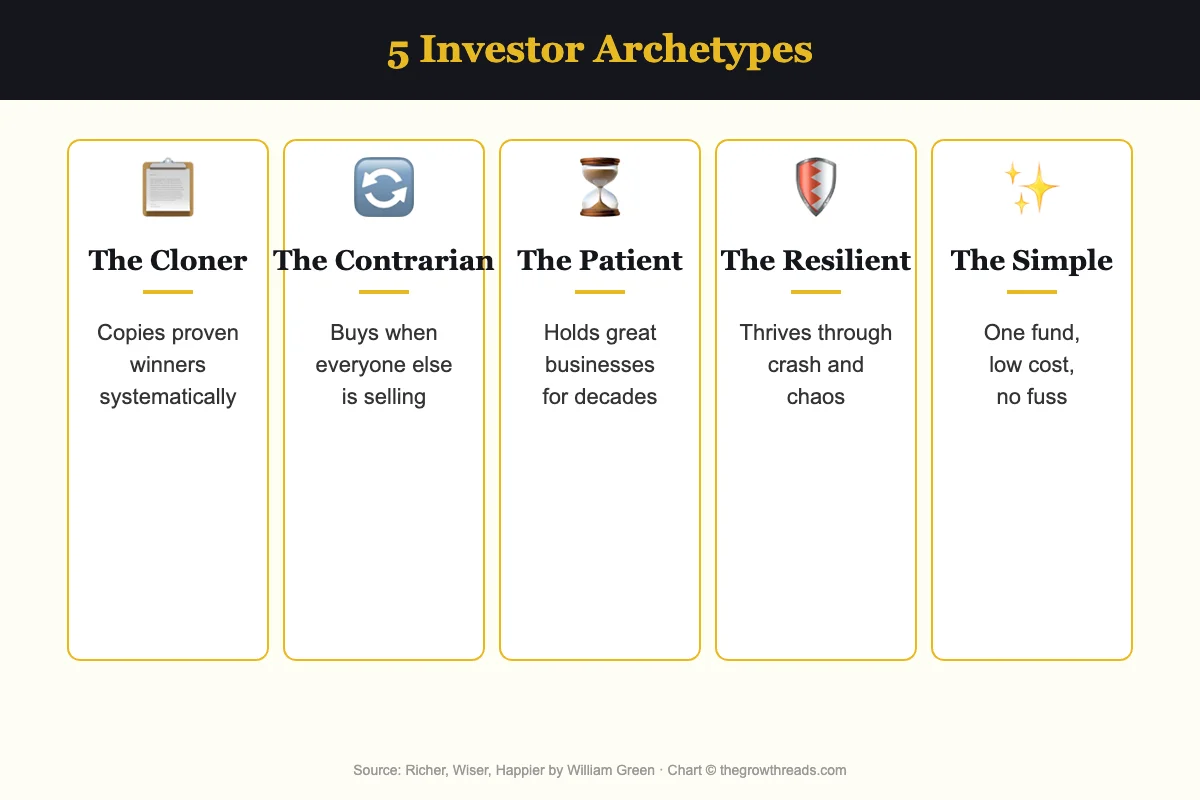
- Which of the investor archetypes in this book — the cloner, the contrarian, the simplifier, the patient holder — resonates most with your natural temperament?
- When was the last time you went against the crowd on an important decision — and what made it difficult or easy?
- If you applied the principle of simplification to your financial life today, what would you eliminate?
- How would you define “enough” — the point at which accumulating more money would not meaningfully improve your life?
- What are you compounding besides money — skills, relationships, reputation, knowledge — and are you giving those assets the same patient attention?
🔥 Ready to Learn From the Greatest Investors?
Discover the timeless principles of wealth, wisdom, and happiness from investing legends.
How to Apply Richer, Wiser, Happier (7-Day Plan)
- Day 1 — Audit your complexity. List every investment you own. If you cannot explain each one’s thesis in two sentences, mark it for review. The best investors Green profiled held concentrated, simple portfolios they understood deeply.
- Day 2 — Study one great investor. Pick one investor from the book — Templeton, Pabrai, Marks, Sleep, or Greenblatt — and read their original letters, interviews, or 13F filings. Cloning starts with studying.
- Day 3 — Define your circle of competence. Write down the three industries or business types you genuinely understand from personal experience. Commit to staying inside this circle for all new investments.
- Day 4 — Build a pessimism watchlist. Identify three to five high-quality companies or funds you would love to own at a lower price. Set price alerts and commit to buying only when fear has driven them to your target — Templeton’s maximum pessimism principle.
- Day 5 — Practice inversion. Write down the five behaviors most likely to destroy your investment returns (panic selling, chasing trends, over-trading, ignoring fees, borrowing to invest). Post this list where you will see it before making any financial decision.
- Day 6 — Simplify one area of your financial life. Consolidate scattered accounts, cancel subscriptions you do not use, or reduce your portfolio to fewer positions held with higher conviction. Simplicity compounds.
- Day 7 — Define your “enough.” Write a one-page description of the life you would live if money were no longer a constraint. Compare it to your current life and identify the gaps. The goal is not maximum wealth but maximum alignment between your money and your values.
Frequently Asked Questions
Is Richer, Wiser, Happier worth reading if I am a passive index fund investor?
Yes — and it might actually reinforce your approach. Several investors Green profiles, including Joel Greenblatt and John Bogle (referenced throughout), acknowledge that most people are better off with index funds. The book’s deeper lessons about patience, simplicity, and emotional discipline apply regardless of whether you pick individual stocks or own a total market fund. You will also gain perspective on what the active investors who do beat the market look like — and how rare they are.
How is this book different from other investing books?
Most investing books focus on techniques — valuation formulas, screening methods, portfolio construction. Green focuses on the investors themselves: their characters, philosophies, life stories, and the inner qualities that produced their results. The book reads more like a collection of deeply reported profiles than a how-to manual. This makes it both more enjoyable to read and more likely to change how you think, rather than just what you do with your money.
What is the cloning strategy that Mohnish Pabrai uses?
Cloning means studying the publicly disclosed portfolios of investors with proven, audited long-term track records — through 13F filings that all large fund managers must file quarterly. Pabrai identifies their highest-conviction new positions, conducts his own analysis to understand the thesis, and only buys when the stock trades at a significant discount to his own estimate of value. It is not blind copying — it is using the best investors’ research as a starting point for your own informed decision-making.
Who are the main investors profiled in the book?
The most extensively profiled investors are Mohnish Pabrai (cloning and compounding goodwill), Sir John Templeton (contrarian investing at maximum pessimism), Howard Marks (second-level thinking and risk management), Nick Sleep and Qais Zakaria (concentrated long-term holding and scale economics shared), Joel Greenblatt (Magic Formula and value investing), and Charlie Munger (mental models and rational thinking). Dozens of other investors appear in shorter profiles and anecdotes throughout.
What does “scale economics shared” mean?
Scale economics shared is a concept identified by investor Nick Sleep. It describes businesses that use their growing scale to lower prices for customers rather than increase margins for shareholders. Amazon, Costco, and GEICO all follow this model. By sharing the benefits of scale with customers, these companies attract even more customers, creating a virtuous cycle that makes them nearly impossible to compete against. The businesses get bigger and more dominant precisely because they give value away.
Is the book only about making money?
Not at all — and that is what makes it special. The “Wiser” and “Happier” in the title are not afterthoughts. Green devotes significant attention to the life philosophies of the investors he profiles: Templeton’s spiritual generosity, Pabrai’s philanthropy through the Dakshana Foundation, Sleep’s decision to close his fund and pursue a simpler life, and Munger’s emphasis on character over cleverness. The book argues that the same qualities that produce great investment returns — patience, humility, discipline — also produce great lives.
What should I read after Richer, Wiser, Happier?
For the behavioral foundations of investing, read The Psychology of Money by Morgan Housel. For Charlie Munger’s own words on mental models and rational thinking, pick up Poor Charlie’s Almanack. For Howard Marks’s framework on risk and market cycles, read The Most Important Thing. For a passive investing approach that many of Green’s investors would respect, try The Little Book of Common Sense Investing by John Bogle. And for the academic case that underpins the whole debate, see A Random Walk Down Wall Street by Burton Malkiel. This is not financial advice — consult a qualified financial advisor for personalized guidance.
Related Summaries
- The Psychology of Money by Morgan Housel — The behavioral foundations of wealth-building, deeply influenced by the same investors Green profiles.
- Poor Charlie’s Almanack by Charles T. Munger — Munger’s own collected wisdom on mental models, biases, and rational investing.
- The Intelligent Investor by Benjamin Graham — The analytical foundation that many of Green’s profiled investors built upon.
- The Dhandho Investor by Mohnish Pabrai — Pabrai’s own book on low-risk, high-return value investing.
📚 Explore more Money & Finance book summaries: Best Money Books →