

⭐⭐⭐⭐ 4.4/5
One-liner: A guide to making better decisions by focusing on what never changes about human behavior — greed, fear, impatience, overconfidence, and the power of stories.
Best for: Investors, decision-makers, and anyone who wants timeless mental models instead of chasing the latest trend.
Reading time: ~4.5 hours (256 pages)
Difficulty to apply: Low — the lessons are conceptual shifts, not step-by-step processes.
Same as Ever in one minute
Stop trying to predict the future and start understanding the behaviors that never change. Morgan Housel’s follow-up to The Psychology of Money argues that the world is too complex and chaotic to forecast accurately — but certain aspects of human nature have remained constant for thousands of years. People will always be greedy after booms and terrified after crashes. Expectations will always outpace reality. Stories will always beat statistics in shaping decisions. Risk will always be what no one saw coming. By anchoring your financial and life strategy to these timeless truths rather than to predictions about technology, politics, or markets, you make decisions that hold up regardless of what the future throws at you. The book is structured as 23 short essays, each exploring one unchanging aspect of behavior.
Key takeaways
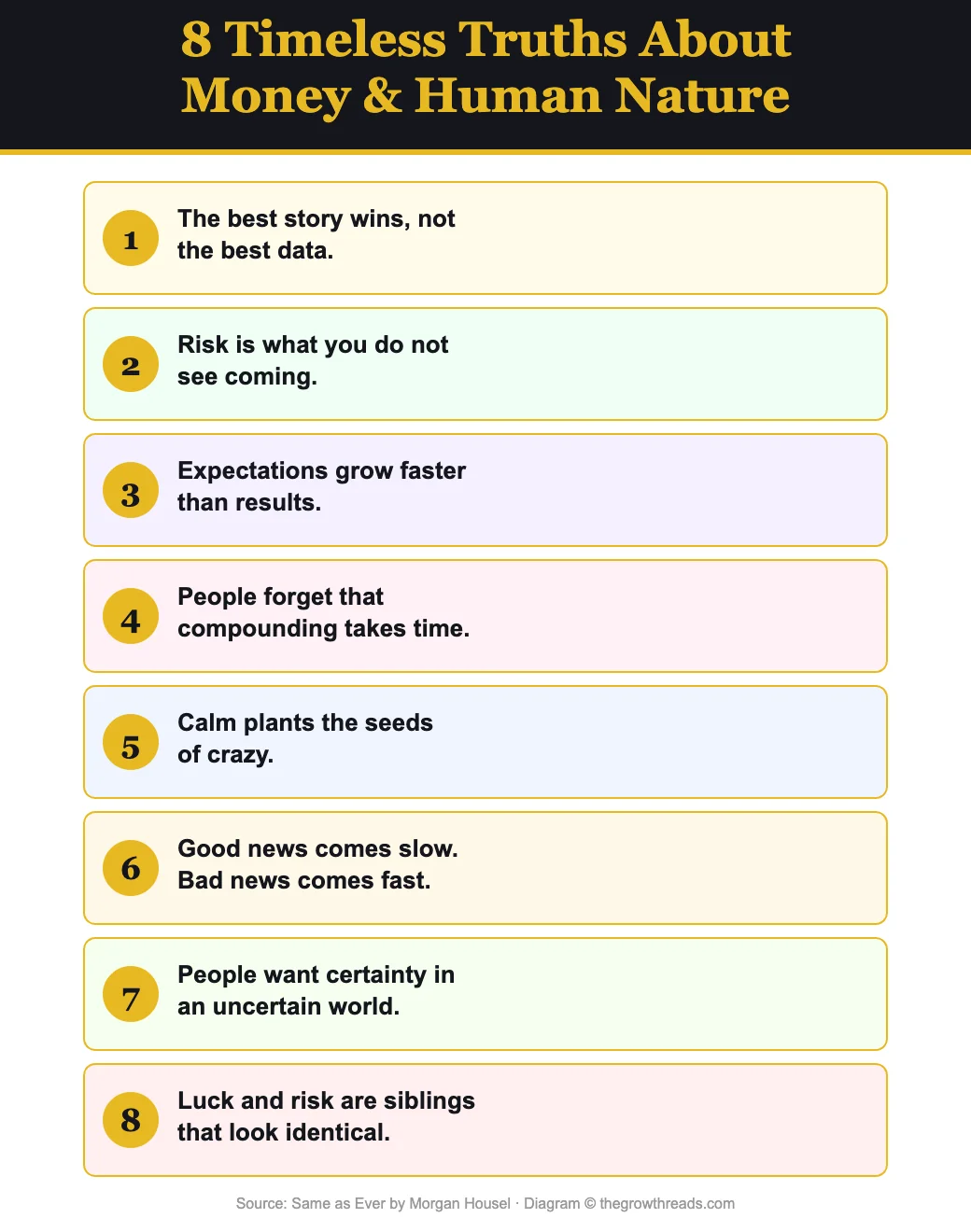
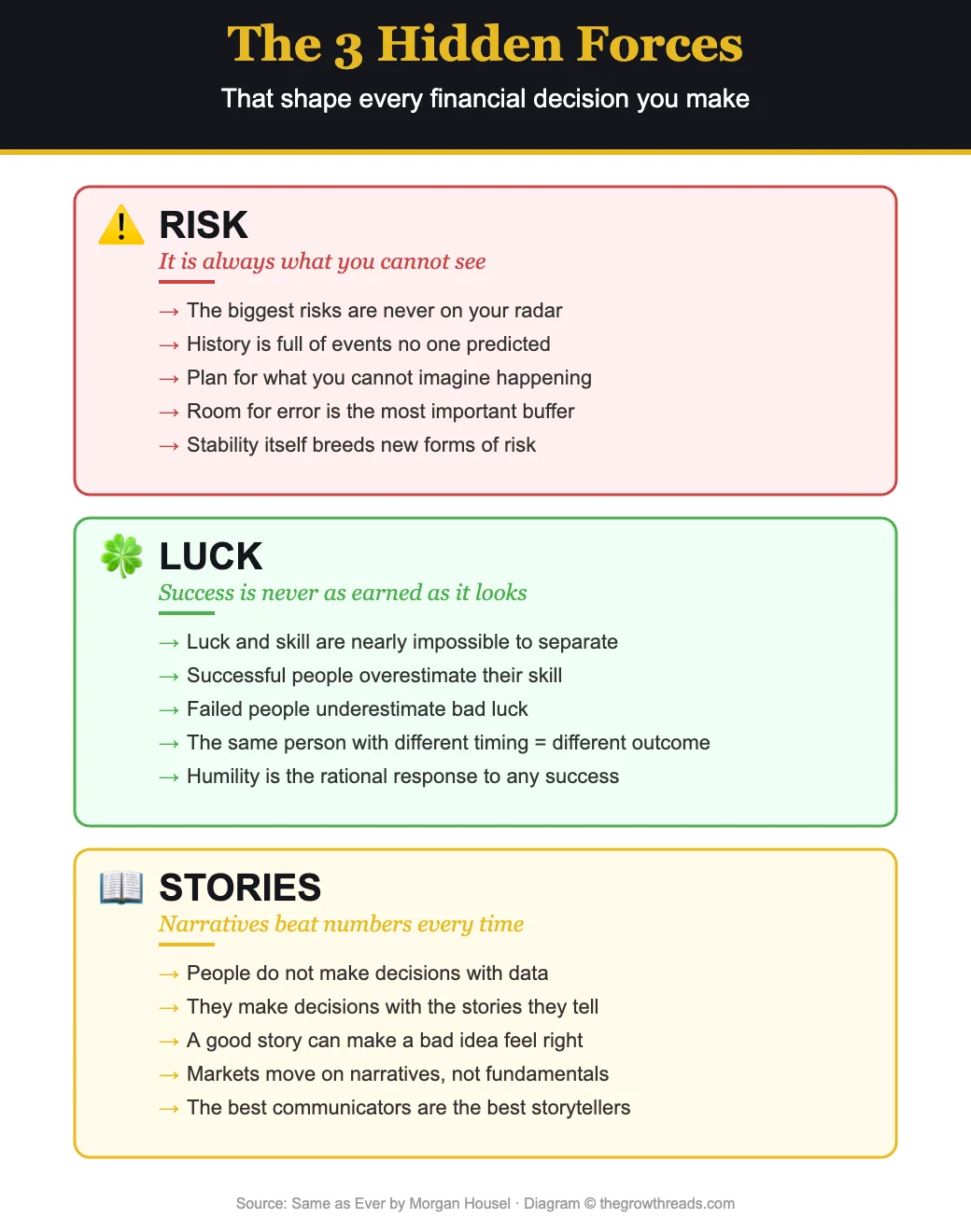
- The best story always wins: People do not make decisions based on data — they make decisions based on the narratives that feel right. The most persuasive person in the room is the best storyteller, not the person with the best spreadsheet.
- Risk is what you cannot see: The biggest risks are never the ones on your watchlist. History’s worst events (pandemics, crashes, wars) were, by definition, things almost nobody predicted. Plan for surprises, not specific scenarios.
- Expectations always outrun results: Getting richer does not make you feel richer because your expectations rise at least as fast as your income. Happiness equals reality minus expectations.
- Calm plants the seeds of crazy: Long periods of stability breed complacency, excessive risk-taking, and leverage — which then cause the next crisis. Stability is inherently destabilizing.
- Luck and risk are siblings: The line between a genius decision and a disastrous one is often determined by factors completely outside your control. Humility is the rational response to any outcome.
- Good news comes slowly, bad news comes fast: Compounding, progress, and growth happen gradually and are easy to miss. Destruction, panic, and failure happen in an instant and dominate attention.
- People want certainty in an uncertain world: The demand for confident predictions is driven by anxiety, not by any evidence that accurate predictions are possible.
- Long tails drive everything: A tiny number of events (investments, inventions, decisions) produce the majority of outcomes. You only need a few things to go right — but they really need to go right.
- Incentives are the most powerful force: People respond to incentives in predictable ways. When you cannot understand behavior, follow the incentives.
- Complexity is the enemy of endurance: The strategies that survive are the ones simple enough to follow under stress. Complexity breaks under pressure.
What is Same as Ever about?
Same as Ever is a collection of 23 essays about the aspects of human behavior, psychology, and decision-making that remain constant across centuries. Morgan Housel argues that while the world changes constantly in unpredictable ways, certain patterns — greed, fear, overconfidence, the power of stories, and the nature of risk — never change, and that the wisest strategy is to build your plans around these timeless truths.
About the author
Morgan Housel is a partner at The Collaborative Fund, a former columnist at The Motley Fool and The Wall Street Journal, and one of the most widely read financial writers in the world. His first book, The Psychology of Money (2020), has sold over ten million copies and was translated into more than 50 languages, making it one of the bestselling finance books in history. Housel is known for combining behavioral psychology, history, and storytelling to explain money and decision-making in ways that feel intuitive rather than technical. Before writing, he studied economics at the University of Southern California. Explore all Morgan Housel book summaries →
Key concepts at a glance
| Concept | What it means | Use it when |
|---|---|---|
| The Expectation Gap | Happiness = reality minus expectations; wealth does not fix the gap | You feel dissatisfied despite financial progress |
| Calm Plants Crazy | Stability breeds complacency that causes the next instability | Markets have been calm for too long and you are tempted to take extra risk |
| Risk Is What You Cannot See | The most dangerous risks are the ones no one is discussing | You are building a financial plan and need to account for surprises |
| The Best Story Wins | Narratives shape decisions more powerfully than data | You need to persuade someone or understand a market move |
| Long Tails | A tiny percentage of events produce the majority of outcomes | You are evaluating an investment portfolio or career strategy |
| Room for Error | Building a margin of safety is more important than being right | You are deciding how much risk to take with your savings |
| Incentives Drive Everything | Follow the incentives to understand any behavior | You cannot understand why someone (or a market) acts irrationally |
| Complexity Breaks | Simple strategies survive stress; complex ones shatter | You are designing an investment or business strategy meant to last decades |
Part 1: The nature of change and prediction
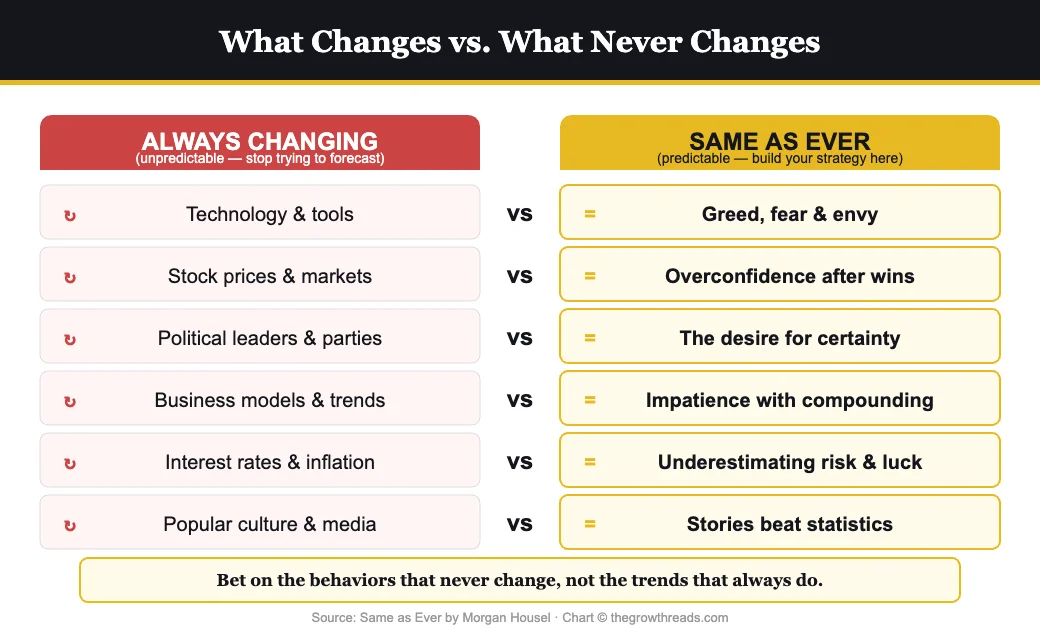
Housel opens with a question that sounds paradoxical: why write a book about things that do not change? His answer is that almost everyone — investors, business leaders, policymakers — spends their energy trying to predict what will change next. What will technology look like in ten years? Which stocks will outperform? Which political party will win? The problem is that these predictions are almost always wrong. Not because the forecasters are stupid, but because the world is too complex, too interconnected, and too dependent on random events to be reliably predicted.
The alternative, Housel argues, is to focus on what has remained constant across all of recorded history. Human psychology, emotional patterns, and behavioral biases have not changed meaningfully in thousands of years. The ancient Romans experienced greed, overconfidence, and herd behavior in exactly the same way modern investors do. The details change (stock markets instead of grain markets), but the underlying patterns repeat because they are hardwired into human biology.
This reframing has profound practical implications. Instead of asking “What will the market do next year?” you ask “What behaviors will people always exhibit during booms and busts?” Instead of trying to pick the next big stock, you design a portfolio that survives any environment because it accounts for the timeless realities of fear, greed, and overconfidence.
Part 2: Stories, expectations, and the gap that never closes
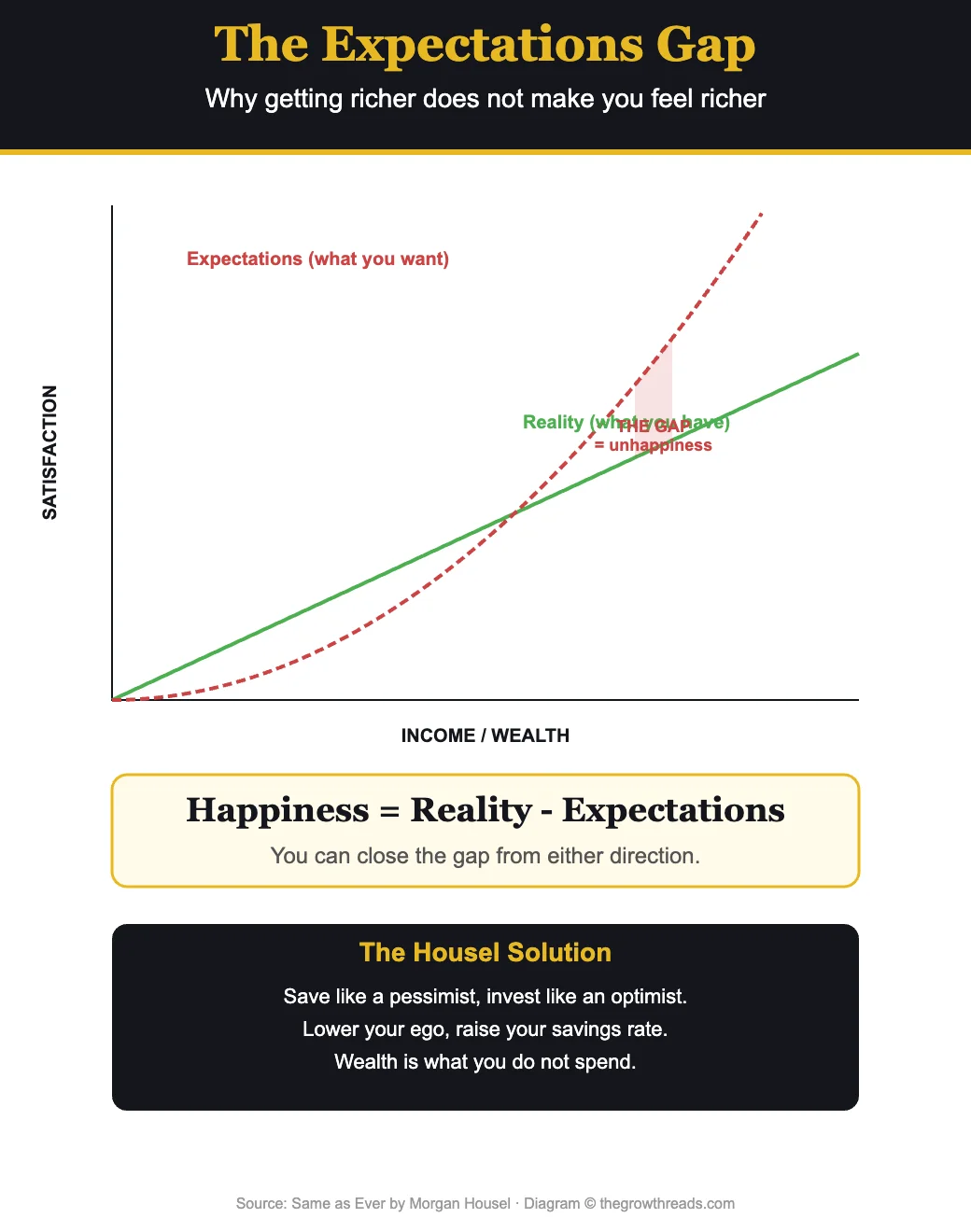
Several of the book’s strongest essays cluster around a single theme: the gap between reality and how we interpret reality. Housel argues that this gap explains most financial unhappiness. Income rises, lifestyles inflate. A promotion that should bring satisfaction instead triggers comparison to the people one level above. Wealth accumulates, but so do expectations — and expectations always move faster.
His framework is elegant: happiness = reality minus expectations. This means there are two ways to become happier: improve your reality (earn more, build more, achieve more) or lower your expectations (want less, compare less, accept more). The first approach is what most people try. The second is what actually works, because the first approach also raises expectations. A person earning $50,000 who wants nothing feels richer than a person earning $500,000 who wants everything.
Housel extends this to one of his most memorable claims: the best story always wins. People do not decide based on evidence; they decide based on whichever narrative feels most compelling. This is true in investing (market bubbles are powered by stories, not fundamentals), in business (consumers buy from brands with resonant stories), and in personal life (you narrate your own past to make sense of it, often inaccurately). The person who controls the story controls the outcome.
Part 3: Risk, luck, and why calm creates chaos
The book’s essays on risk form its most intellectually rigorous section. Housel’s central argument is counterintuitive: the biggest risks are, by definition, the things nobody is talking about. If a risk is on your radar, it is probably already priced into markets and accounted for in plans. The risks that actually destroy portfolios, careers, and institutions are the ones that arrive as complete surprises.
This creates a paradox for planning. You cannot prepare for specific unknown risks (because they are unknown). But you can prepare for the reality that unknown risks will inevitably arrive. This is the case for room for error — maintaining cash reserves, avoiding excessive leverage, keeping your lifestyle below your income. These are not strategies for specific scenarios. They are strategies for the universal truth that surprises happen.
Housel’s most provocative essay in this section is “Calm Plants the Seeds of Crazy.” The argument: long periods of economic stability cause people to take on more risk (more debt, more leverage, more aggressive investments) because stability makes risk feel lower. But this risk-taking itself creates fragility that makes the next crisis worse. The very thing that feels safe (stability) is what makes the system unsafe. This is Hyman Minsky’s instability hypothesis made accessible — and it explains why financial crises seem to arrive precisely when everyone has stopped worrying about them.
Equally important is Housel’s treatment of luck versus skill. He argues that luck and risk are siblings — two names for the same force (randomness) applied to positive and negative outcomes. When things go well, we call it skill. When things go badly, we call it bad luck. In reality, both outcomes usually involve a significant amount of randomness that we refuse to acknowledge. The rational response to any outcome — good or bad — is humility.
Part 4: Simplicity, long tails, and endurance
The closing essays focus on what makes strategies durable. Housel argues that complexity is the enemy of endurance. The strategies that survive decades of change are almost always simple: save more than you spend, diversify, stay the course, maintain room for error. Complex strategies may outperform for short periods, but they break under stress because they have too many moving parts — and stress eventually arrives for everyone.
He pairs this with the concept of long tails: in almost every domain, a tiny number of events produce the vast majority of outcomes. A few investments in a portfolio generate most of the returns. A few products in a company generate most of the revenue. A few decisions in a career generate most of the opportunities. The implication is that you do not need to be right about everything — you need to be positioned to benefit when the rare, outsized events occur, and to survive everything else.
The practical conclusion is clear: build a life and portfolio that can endure anything. This means keeping things simple enough that you can maintain them under stress, staying invested long enough for compounding to work, and keeping your ego small enough that rising expectations do not destroy the gains you have already made.
Who is Same as Ever best for — and who should read something else first?
This book is ideal for anyone who has already read basic financial advice and wants a deeper understanding of why those principles work. It is particularly valuable for investors who are tempted to chase predictions, trade on news, or overcomplicate their portfolios. The essay format makes it accessible even if you have limited time — each chapter stands alone.
If you have not read The Psychology of Money, start there — it is more actionable and provides the behavioral foundation that Same as Ever builds on. If you want a specific investment strategy rather than mental models, The Simple Path to Wealth by JL Collins is more prescriptive. Same as Ever is the book that explains why simple strategies work — it is the “why” behind the “how.”
Questions to reflect on
- Where in your financial life are you trying to predict the future instead of preparing for uncertainty?
- Is your current investment or career strategy simple enough to follow under extreme stress?
- What expectations have risen alongside your income — and are they making you less satisfied despite being better off?
- What risks are you not currently thinking about? How much room for error do you have if a surprise arrives?
- When you look at your past successes, how much was skill and how much was luck? Does the answer change how you approach the future?
🔥 Ready to focus on what never changes?
Same as Ever will transform how you think about risk, expectations, and long-term strategy.
How to apply Same as Ever (7-day plan)
- Day 1 — Identify your predictions: Write down every assumption you are making about the next 1–5 years (market returns, career trajectory, income growth). Circle the ones that are really predictions disguised as plans.
- Day 2 — Build room for error: Calculate your current financial margin of safety. If an unexpected expense or income drop hit tomorrow, how many months could you survive? Aim for at least 6.
- Day 3 — Audit your expectations: List three areas where your expectations have risen with your income. For each, ask: “Would I be happier if I kept the old expectation and saved the difference?”
- Day 4 — Simplify one strategy: Take your most complex financial plan (investment portfolio, budget system, or side project) and ask: “What would the simplest version look like that still achieves 80% of the goal?”
- Day 5 — Follow the incentives: Pick one decision you are struggling with and map the incentives of every person involved. The answer usually becomes obvious.
- Day 6 — Acknowledge luck: Review your three biggest professional successes. For each, honestly assess: how much was skill, how much was timing, and how much was luck? Let the answer inform how you approach risk going forward.
- Day 7 — Write your “same as ever” list: List the 5 behaviors and principles you will follow regardless of what the market, economy, or world does next year. Post it where you will see it during the next crisis.
Frequently asked questions
Is Same as Ever a sequel to The Psychology of Money?
It is a companion book, not a direct sequel. The Psychology of Money focuses on how emotional and psychological biases shape financial decisions. Same as Ever zooms out further, examining which human behaviors have remained constant throughout history and using those patterns to build better long-term strategies. The books share Housel’s storytelling style and behavioral approach but address different questions: the first asks “Why do we behave this way with money?” while the second asks “What about human nature will never change?”
What is the main idea of Same as Ever?
The main idea is that the most useful knowledge is knowledge about things that never change. While the world is too complex to predict, certain aspects of human nature — greed, fear, overconfidence, the power of stories, the nature of risk — have remained constant for thousands of years. By building strategies around these timeless patterns rather than trying to forecast the future, you make decisions that hold up regardless of what happens next.
What does “calm plants the seeds of crazy” mean?
It means that long periods of economic stability cause people and institutions to take on more risk, because stability makes risk feel lower. This increased risk-taking creates fragility that makes the next disruption worse. It is a version of Hyman Minsky’s financial instability hypothesis, made accessible: the longer things are calm, the more dangerous the system becomes, because the calm itself encourages the behavior that will eventually end it.
How is Same as Ever different from other investing books?
Most investing books tell you what to buy, when to buy, and how to build a portfolio. Same as Ever does none of that. Instead, it gives you mental models for understanding why markets, people, and economies behave the way they do — and why those behaviors repeat across centuries. It is closer to philosophy than to financial advice, but the philosophical insights have direct practical implications for how you invest, save, and plan.
What does Morgan Housel mean by “the best story wins”?
Housel argues that people do not make decisions based on objective data — they make decisions based on whichever narrative feels most compelling. A charismatic CEO can raise billions with a good story and mediocre numbers. A boring company with excellent fundamentals struggles to attract investors. This is true in markets, politics, careers, and personal relationships. The implication is that if you want to influence outcomes, learn to tell better stories — not just gather better data.
How long does it take to read Same as Ever?
The book is 256 pages and reads in about four to five hours. It is structured as 23 standalone essays, each 8–12 pages, which makes it easy to read in short sessions. The audiobook, narrated by Chris Hill, runs about six hours. Many readers find it ideal for one essay per sitting, treating it as a daily reflection rather than a cover-to-cover read.
Should I read Same as Ever or The Psychology of Money first?
Start with The Psychology of Money. It provides the behavioral foundation — how emotions, biases, and personal history shape your financial decisions — that Same as Ever builds on. The Psychology of Money is also more actionable, with clearer takeaways for your savings rate, investment approach, and relationship with wealth. Same as Ever works best as the “advanced course” that deepens the ideas introduced in the first book.
Related summaries
- The Psychology of Money Summary — Housel’s first book on how behavior drives financial outcomes.
- The Intelligent Investor Summary — Benjamin Graham’s timeless guide to value investing and emotional discipline.
- Die with Zero Summary — Bill Perkins on optimizing money for fulfillment, not just accumulation.
- Best Money Books — Our curated guide to the most impactful books on personal finance and investing.