

⭐⭐⭐⭐ 4.4/5
One-liner: A concentrated value investing framework inspired by Patel motel entrepreneurs — buy simple businesses at distressed prices where the downside is minimal and the upside is enormous.
Best for: Individual investors who want to build a concentrated, high-conviction portfolio using principles borrowed from Warren Buffett and real-world immigrant entrepreneurs.
Reading time: ~4 hours (208 pages)
Difficulty to apply: Moderate — the concepts are clear but require patience, emotional discipline, and the ability to act against the crowd.
The Dhandho Investor in one minute
“Dhandho” means endeavours that create wealth in Gujarati — and the core principle is breathtakingly simple: take bets where heads you win big and tails you do not lose much. Mohnish Pabrai studied how Patel motel entrepreneurs from Gujarat, India, arrived in the United States with almost nothing and came to own more than half of all American motels. Their secret was not genius or luck. It was a systematic approach to risk: buy distressed assets at rock-bottom prices, minimise operating costs by running the business yourself, and reinvest profits into the next opportunity. Pabrai then shows how the same asymmetric-risk framework applies to stock market investing, creating a practical method for building wealth through concentrated bets on undervalued businesses with durable competitive advantages.
Key takeaways
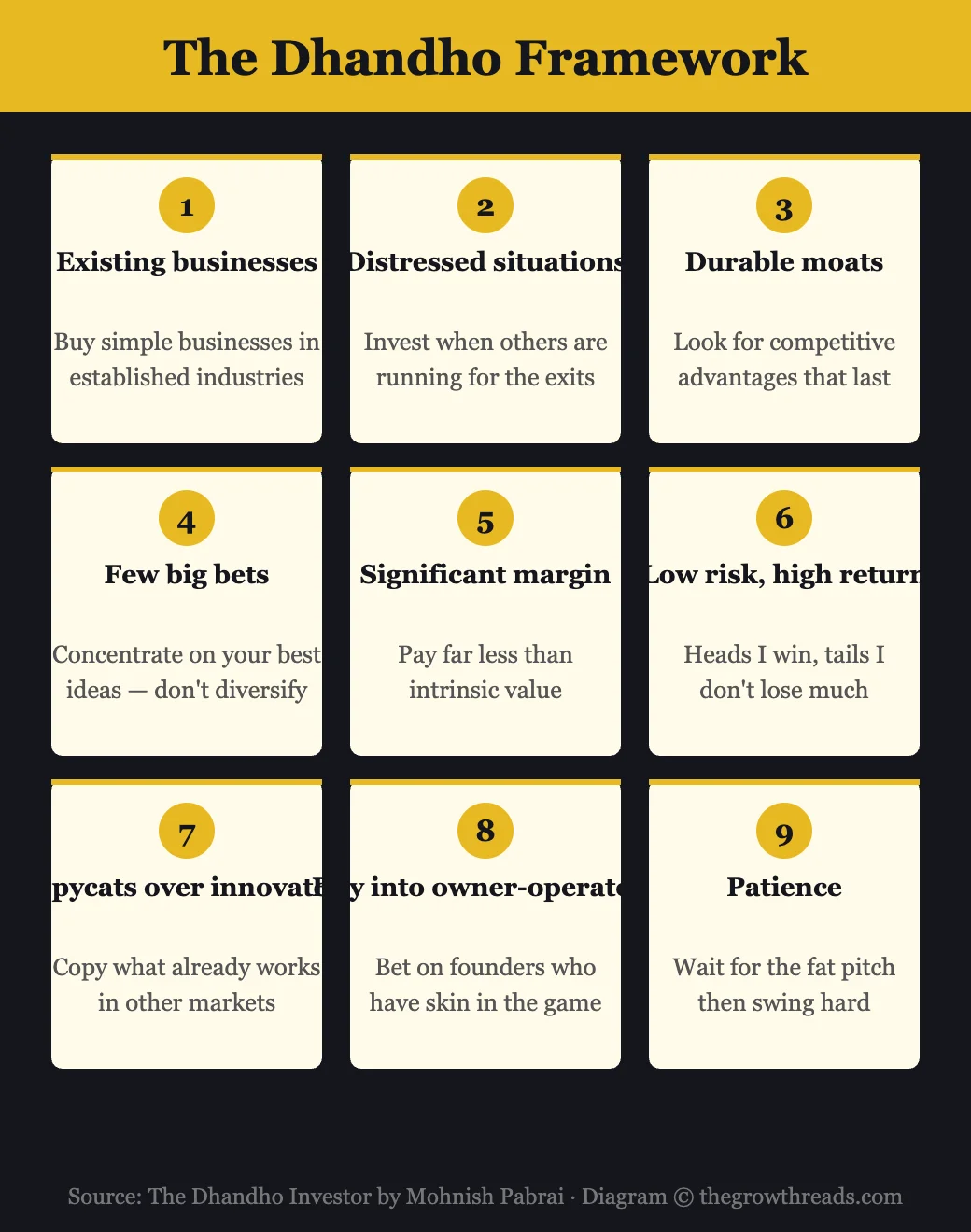
- Dhandho is about asymmetric risk: The fundamental principle is structuring every investment so that the downside is small and the upside is large. If you lose, you lose a little. If you win, you win a lot.
- Buy existing businesses in established industries: Innovation is risky. The Patels did not invent a new type of lodging — they bought existing motels at distressed prices and ran them more efficiently than anyone else.
- Bet on distressed situations: The best investment opportunities arise when a solid business is temporarily suffering — from a recession, a scandal, a product recall, or a market overreaction. Fear creates the biggest mispricings.
- Focus on businesses with durable moats: A competitive advantage that lasts decades — brand loyalty, network effects, switching costs, regulatory barriers — protects your downside even if your timing is slightly off.
- Make few bets and make them big: Diversification is protection against ignorance. If you have done your homework and found a genuinely undervalued business, concentrate your capital rather than spreading it thin.
- Copy, do not innovate: Pabrai argues that the best entrepreneurs and investors are not inventors. They are brilliant copycats who take proven business models and apply them in new markets or situations.
- Buy into owner-operators: Businesses run by founders who own a significant stake tend to outperform those run by hired managers because the incentives are naturally aligned.
- Margin of safety is non-negotiable: Never pay full price. Benjamin Graham’s margin of safety — buying at a significant discount to intrinsic value — is the single most important concept in investing.
- Patience is the ultimate edge: The stock market is a mechanism for transferring wealth from the impatient to the patient. Wait for fat pitches — obvious, asymmetric opportunities — and do nothing the rest of the time.
- Sell reluctantly: The best returns come from holding great businesses for years or decades. Transaction costs and taxes erode returns, so trade as little as possible.
What is The Dhandho Investor about?
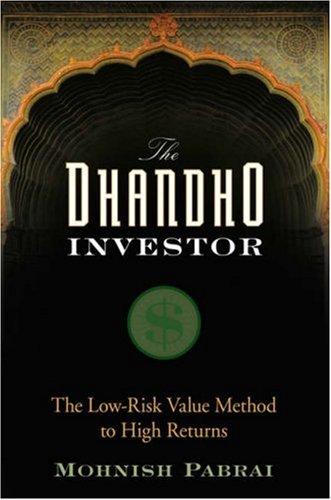
The Dhandho Investor presents a low-risk, high-return value investing framework inspired by the wealth-building strategies of Patel motel entrepreneurs from Gujarat, India. Mohnish Pabrai distills their approach into nine principles for stock market investing: buy simple, existing businesses at distressed prices with durable moats and significant margins of safety, concentrate your bets, and hold patiently for asymmetric returns.
About the author
Mohnish Pabrai is an Indian-American investor, philanthropist, and the managing partner of Pabrai Investment Funds. Born in Mumbai, he moved to the United States and built a successful IT consulting firm before pivoting to full-time investing in 1999. Pabrai explicitly models his investment approach on Warren Buffett and Charlie Munger, and in 2007 he famously paid $650,100 at a charity auction to have lunch with Buffett — an investment he considers among his best. His funds have delivered exceptional long-term returns by following the concentrated, value-oriented approach described in the book. Pabrai is also the founder of the Dakshana Foundation, which provides free coaching to gifted students from impoverished backgrounds in India to help them pass competitive entrance exams for elite engineering and medical schools. Explore all Mohnish Pabrai book summaries →
Key concepts at a glance
| Concept | What it means | Use it when |
|---|---|---|
| Dhandho | Gujarati for wealth-creating endeavours — business ventures structured for asymmetric returns | Evaluating any investment or business opportunity |
| Heads I win, tails I don’t lose much | Structure bets so the maximum loss is small but the potential gain is many multiples | Sizing a position and deciding whether to invest |
| Margin of safety | The gap between the price you pay and the intrinsic value of the business | Setting your buy price for any stock |
| Moat | A durable competitive advantage that protects a business from competitors | Assessing whether a business will still be dominant in 10 years |
| Circle of competence | The set of businesses and industries you genuinely understand | Deciding which opportunities to analyse and which to skip |
| Fat pitch | An obvious, low-risk, high-reward opportunity that demands action | Deciding when to deploy capital aggressively |
| Abraaj principle | Buy into situations where the downside is protected by hard asset value | Evaluating distressed businesses with tangible assets |
| Kelly criterion | A formula for optimal position sizing based on edge and odds | Deciding how much of your portfolio to allocate to a single idea |
Part 1: The Patel motel story and the Dhandho framework
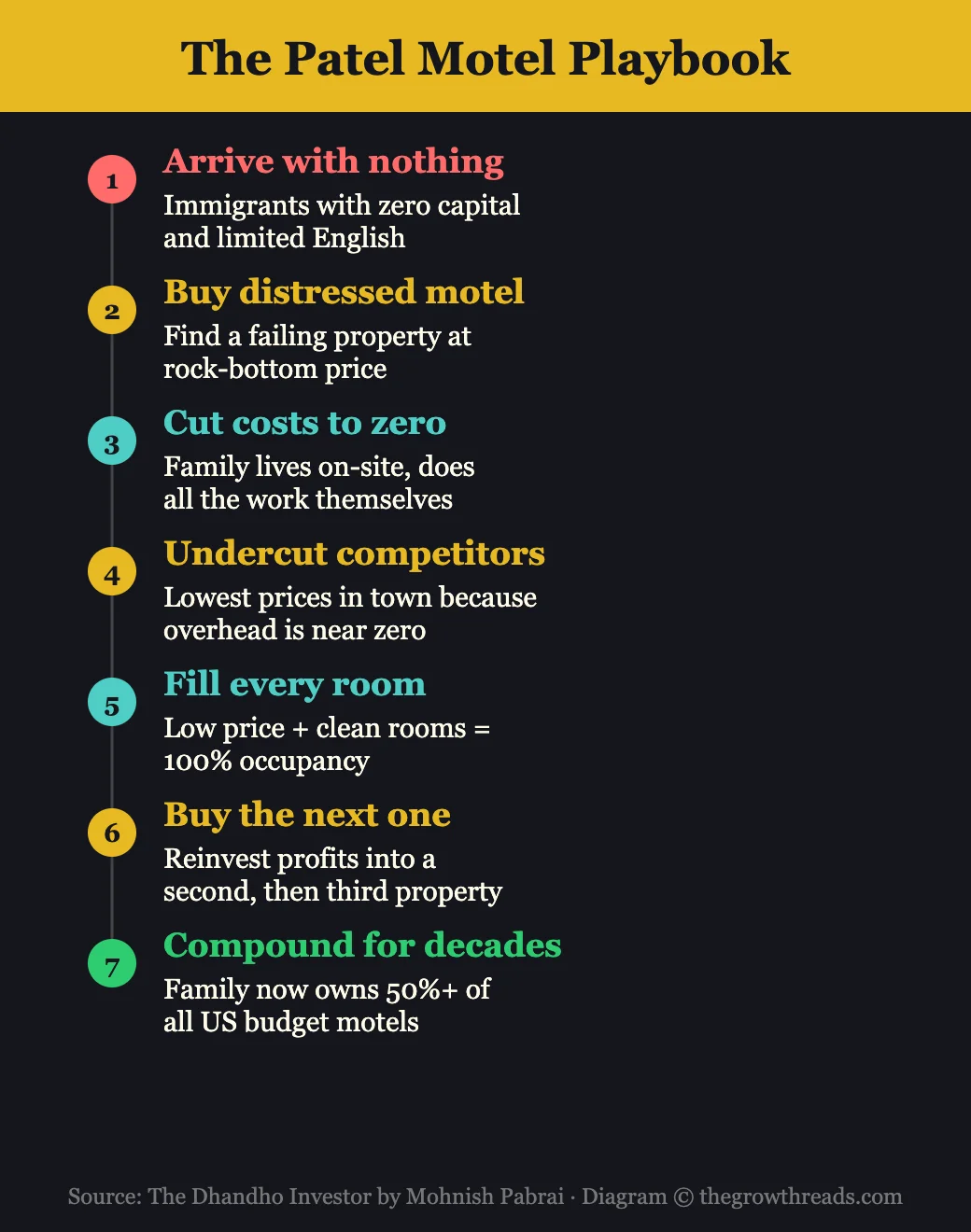
Pabrai opens with the remarkable story of how Gujarati Patels came to dominate the American motel industry. Beginning in the 1970s, immigrants from the Indian state of Gujarat arrived in the US with virtually no capital and limited English. They observed that small motels in rural areas could be purchased cheaply, especially during economic downturns when owners were desperate to sell. The Patels structured these deals brilliantly: they bought distressed motels at rock-bottom prices, moved their families into the manager’s quarters (eliminating housing costs), and handled all operations themselves (eliminating labour costs).
With near-zero overhead, they could undercut every competitor on price while still maintaining clean, functional rooms. Occupancy rates soared. Profits were reinvested into the next motel, and the next. Within two generations, Patels owned more than half of all motels in the United States — a stunning feat of wealth creation built not on innovation or risk-taking, but on the systematic exploitation of asymmetric opportunities.
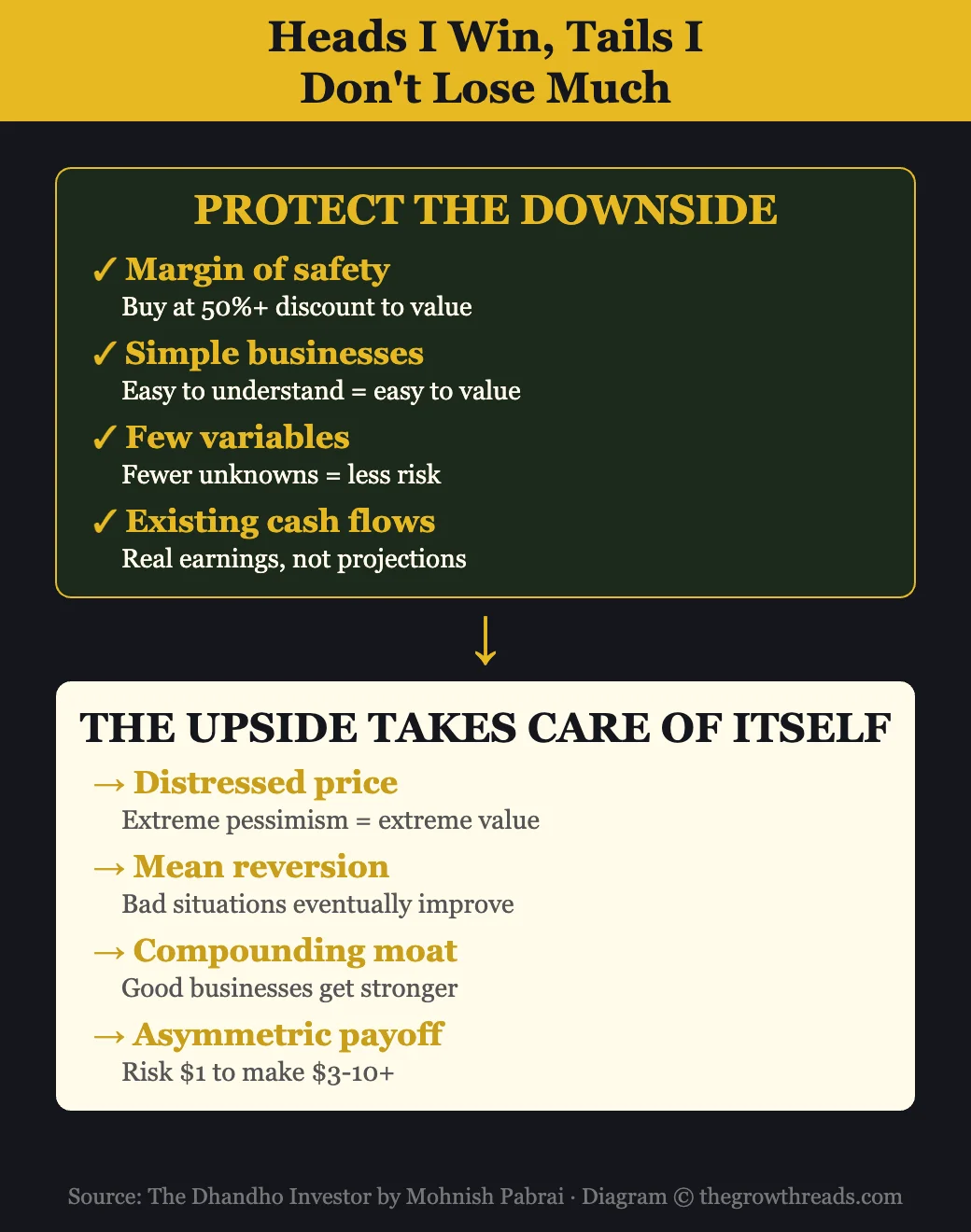
Pabrai extracts the underlying framework: in every Patel motel deal, the downside was minimal (if the motel failed, they had lost little because they bought cheap and had no debt) and the upside was enormous (if it succeeded, they had a cash-flowing asset bought at a fraction of replacement cost). This is the Dhandho principle in its purest form.
Part 2: Applying Dhandho to the stock market
The heart of the book translates the Patel motel framework into a stock-picking methodology. Pabrai argues that the stock market regularly offers the same type of asymmetric opportunity the Patels found in motels — but only to investors with the patience and discipline to wait for them.
The first requirement is buying existing, simple businesses. Pabrai has no interest in start-ups, turnarounds, or complex financial structures. He wants companies with straightforward business models that generate real cash flow — the stock market equivalent of a motel that fills rooms and collects rent. The simpler the business, the more accurately you can estimate its intrinsic value, and the less likely you are to make a catastrophic analytical error.
The second requirement is distress. Pabrai actively seeks out businesses trading at steep discounts because of temporary problems — an industry downturn, a one-time legal issue, a management scandal. The key word is temporary. He distinguishes carefully between businesses that are cheap because they are permanently impaired and businesses that are cheap because the market is overreacting to a fixable problem. The latter creates the fat pitch.
The third requirement is a durable moat. Even a cheap business is a bad investment if competitors can easily replicate its advantages. Pabrai looks for the same moat characteristics Warren Buffett describes: brand power, network effects, switching costs, cost advantages, and regulatory barriers that protect the business for decades.
Part 3: Concentration, patience, and the art of selling
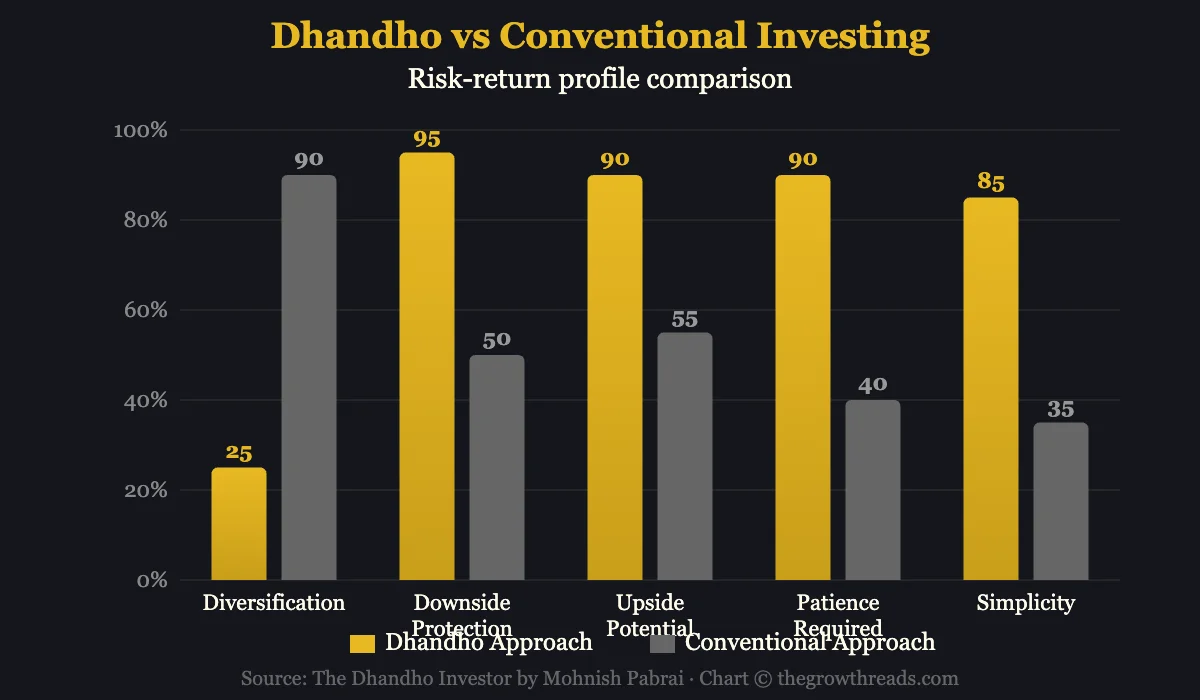
Pabrai makes a provocative case against diversification. Conventional wisdom says to spread your money across dozens or hundreds of positions to reduce risk. Pabrai argues that this merely guarantees mediocre returns. If you have genuinely done your homework and found a business trading at half its intrinsic value with a durable moat and limited downside, why would you allocate only two percent of your portfolio to it?
He recommends holding no more than ten positions at a time, with the top three to five ideas receiving the largest allocations. He references the Kelly criterion — a mathematical formula for optimal bet sizing — to support his argument that concentration is rational when you have a genuine edge. The caveat is that concentration demands rigour: you must truly understand the business, and your margin of safety must be large enough to absorb analytical errors.
On selling, Pabrai follows a simple rule: sell when the stock reaches its estimated intrinsic value, or when you find a significantly better opportunity, or when the original thesis is broken. He warns against premature selling driven by impatience and emphasises that the biggest returns come from holding compounders for years. Every sale triggers taxes and transaction costs, so the bar for selling should be high.
Part 4: Case studies and the Dhandho mindset
The final section brings the framework to life through real-world case studies. Pabrai examines how other immigrant entrepreneurs — from the Mittals in steel to the Ambani family in Indian telecommunications — applied the same Dhandho principles to build empires. The pattern is consistent: identify an existing, proven business model; find a distressed or overlooked market; acquire assets cheaply; operate with radical cost discipline; and reinvest profits into the next asymmetric opportunity.
He also profiles his own investments, walking through the analysis that led him to buy companies like Frontline (a shipping company trading below its scrap value), Stewart Enterprises (a funeral home business trading at a steep discount during an industry downturn), and other situations where the downside was protected by hard asset values and the upside was driven by mean reversion and improving fundamentals.
Pabrai closes with a meditation on the psychological requirements of Dhandho investing. The biggest obstacle is not analytical but emotional: the discipline to do nothing for months or years while waiting for a fat pitch, the courage to act aggressively when everyone around you is panicking, and the patience to hold positions through volatility without succumbing to fear or greed. The Dhandho investor, he writes, is not someone with a higher IQ — it is someone with a better temperament.
Who is The Dhandho Investor best for — and who should read something else first?
This book is ideal for individual investors who already understand the basics of value investing and want a concentrated, high-conviction framework. It is particularly valuable for anyone drawn to the Buffett-Munger style but looking for a more accessible, actionable distillation of those principles with vivid real-world examples.
If you are completely new to investing, start with The Simple Path to Wealth by JL Collins for the foundational case for index investing, or The Psychology of Money by Morgan Housel for the behavioural principles that underpin all good investing. If you want the original source material that Pabrai builds on, The Intelligent Investor by Benjamin Graham is the foundational text.
Note: This summary discusses investment philosophy. It is not financial advice. Consult a qualified financial adviser before making investment decisions.
Questions to reflect on
- What is one business or industry within your circle of competence that you understand well enough to evaluate with confidence?
- When was the last time you saw a high-quality business trading at a significant discount because of temporary bad news — and what did you do?
- How many positions are in your current portfolio, and would concentrating into your five best ideas improve or worsen your expected returns?
- What is the biggest psychological barrier between you and the patience required to wait months or years for a fat pitch?
- If you applied the “heads I win, tails I don’t lose much” filter to your next financial decision, would you still make the same choice?
🔥 Ready to invest like the Patel entrepreneurs?
Get Mohnish Pabrai’s framework for low-risk, high-return value investing.
How to apply The Dhandho Investor (7-day plan)
- Day 1 — Define your circle of competence. List three to five industries or business types you genuinely understand from personal or professional experience. These are the only areas where you should look for investments. Be honest — if you cannot explain how a business makes money in two sentences, it is outside your circle.
- Day 2 — Build your watchlist. Within your circle of competence, identify ten high-quality businesses with durable competitive advantages. Write down what makes each one’s moat strong and what a temporary crisis in that business might look like.
- Day 3 — Learn to estimate intrinsic value. Pick one business from your watchlist and calculate a rough intrinsic value using owner earnings (free cash flow) and a conservative growth rate. Compare your estimate to the current stock price. What discount would you need to feel the downside is minimal?
- Day 4 — Study a past distressed situation. Research a time when one of your watchlist companies traded at a significant discount (check historical prices during 2008-2009, 2020, or any industry-specific crisis). What caused the fear? What happened to investors who bought at the bottom?
- Day 5 — Apply the Dhandho filter. For any current investment you are considering, answer three questions: (1) What is the maximum I can lose? (2) What is the realistic upside? (3) Is the ratio at least 3:1 in my favour? If not, pass.
- Day 6 — Audit your portfolio for concentration. Review your current holdings. Are you spread across dozens of positions with small allocations? Identify your three highest-conviction ideas. Consider whether reallocating toward concentration would improve your expected returns.
- Day 7 — Set up your patience system. Create a simple tracking sheet for your watchlist with intrinsic value estimates and buy prices. Set price alerts. Then close your brokerage app and commit to checking it no more than once per week. The Dhandho investor’s greatest edge is the ability to wait.
Frequently asked questions
What does “Dhandho” mean?
Dhandho is a Gujarati word that loosely translates to “endeavours that create wealth” or “business.” In the context of the book, Pabrai uses it to describe a specific approach to business and investing where the risk of loss is minimised while the potential for gain is maximised. The Dhandho framework is characterised by asymmetric bets — situations where you risk a little to gain a lot — and it was practised instinctively by Gujarati Patel entrepreneurs long before Pabrai codified it for stock market investing.
How is the Dhandho approach different from standard value investing?
Standard value investing, as practised by most Graham-Dodd followers, emphasises buying cheap stocks with a margin of safety and diversifying across many positions. Dhandho differs in three key ways: it strongly favours concentration over diversification (few bets, big bets), it specifically seeks distressed situations rather than merely cheap stocks, and it explicitly models the asymmetric payoff structure (what is the worst case and the best case) rather than focusing primarily on valuation metrics. The philosophy is closer to Buffett’s evolved approach than to classical Graham screening.
Is the Dhandho approach suitable for beginner investors?
Partially. The principles — buy quality, demand a margin of safety, be patient — are universally applicable and worth understanding early. However, the concentrated portfolio approach requires significant analytical skill and emotional discipline. Beginners who cannot yet evaluate businesses with confidence are better off starting with a broad index fund and studying valuation on the side. Once you have developed a genuine edge in a specific area, you can begin applying Dhandho principles to individual stock picks.
What is the Kelly criterion and how does Pabrai use it?
The Kelly criterion is a mathematical formula originally developed for gambling that determines the optimal fraction of your capital to bet based on your edge and the odds. Pabrai adapts it for investing: when you have a high-confidence, asymmetric opportunity (large margin of safety, limited downside), the Kelly formula suggests allocating a larger portion of your portfolio to that single idea. In practice, Pabrai recommends a modified Kelly approach — never betting more than 10% of your portfolio on a single position, even when the formula suggests more, as a safeguard against analytical errors.
How many stocks should a Dhandho portfolio hold?
Pabrai recommends holding no more than ten positions at any time, with the top three to five ideas receiving the largest allocations. He argues that if you truly understand a business and have identified a significant margin of safety, concentration is safer than diversification because you are making informed bets rather than spreading ignorance across many positions. The caveat is that each position must have been analysed thoroughly — concentration without conviction is reckless.
Why does Pabrai prefer copycats over innovators?
Pabrai argues that innovation carries enormous risk — most new ideas fail — while copying a proven business model and applying it in a new market or context carries much less risk. The Patel motel entrepreneurs did not invent motels; they took an existing model and operated it more efficiently. Similarly, Pabrai prefers investing in businesses that have refined proven approaches rather than those betting on untested innovations. The copycat approach aligns with the Dhandho principle of minimising downside while capturing upside.
How does The Dhandho Investor compare to The Intelligent Investor?
The Intelligent Investor by Benjamin Graham is the foundational value investing text — it establishes the concepts of margin of safety, Mr. Market, and the distinction between investing and speculation. The Dhandho Investor builds on Graham’s foundation but takes it further: it advocates concentration over Graham’s diversification, it emphasises the asymmetric payoff structure (not just cheapness), and it draws on real-world entrepreneurial case studies rather than purely financial analysis. Think of Graham as the philosophy professor and Pabrai as the entrepreneur who took the class and built a fortune.
Related summaries
- The Intelligent Investor by Benjamin Graham — Summary & Review
- The Psychology of Money by Morgan Housel — Summary & Review
- Common Stocks and Uncommon Profits by Philip Fisher — Summary & Review
- One Up on Wall Street by Peter Lynch — Summary & Review
- Best Money Books — The Complete TGR List