

★★★★☆ 4.3 / 5 — A compelling, research-rich argument that quiet temperaments are an undervalued superpower in modern culture.
Best for: Introverts seeking validation and strategies, extroverts wanting to understand quiet colleagues, and anyone navigating open-plan workplaces or group-heavy cultures.
Reading time: ~9 hours (333 pages) | This summary: ~22 min
Difficulty to apply: Low to moderate — most changes are about choosing environments, not building new habits.
Page and product links in this article may earn us a small commission at no extra cost to you.
Quiet in one minute
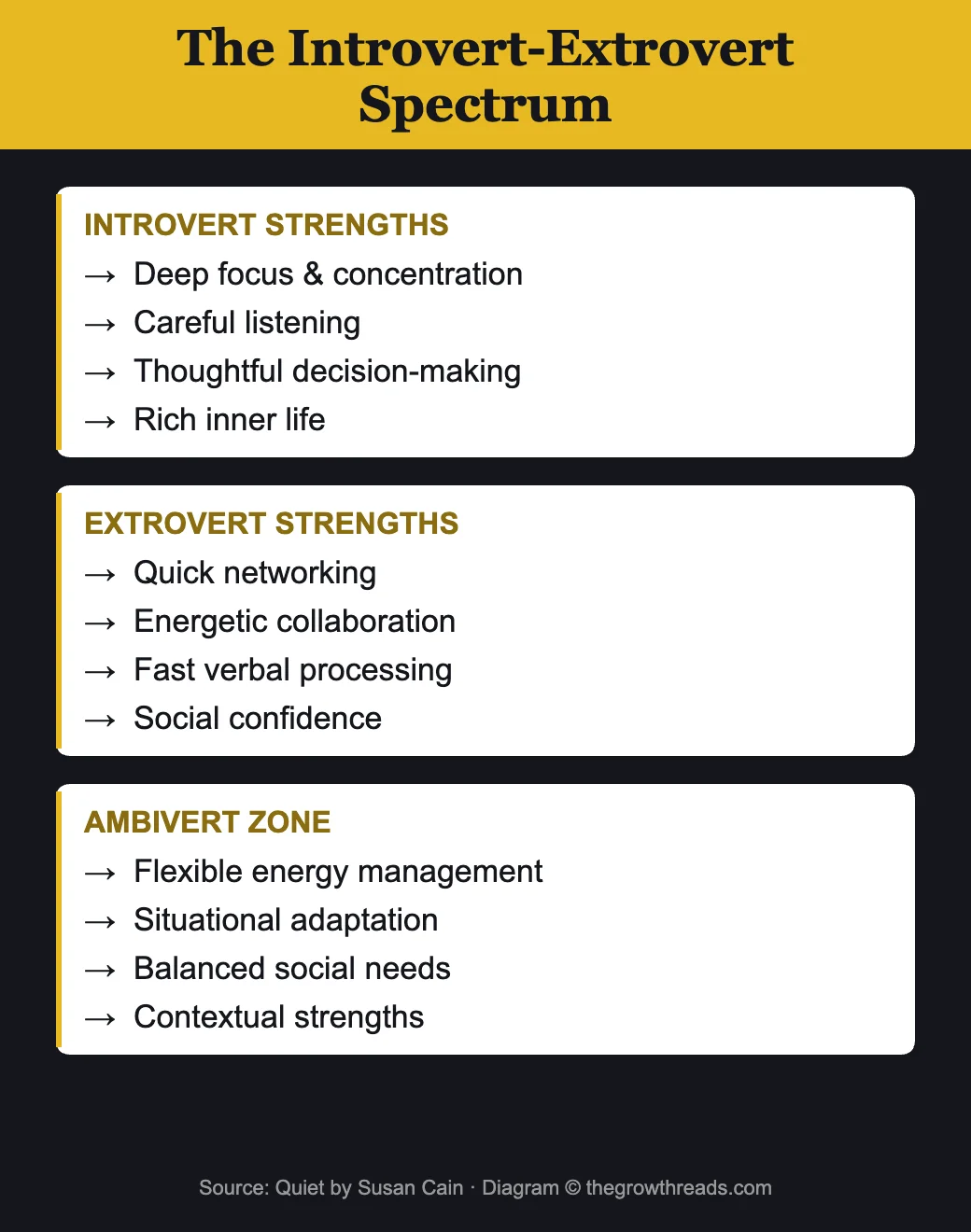
Western culture has spent the past century building a world optimised for extroverts — and it has cost us some of our best thinking. Susan Cain traces how the “Extrovert Ideal” rose to dominance in American life, why it persists in classrooms and boardrooms, and what science actually says about introversion. Drawing on neuroscience, evolutionary biology, and dozens of case studies — from Rosa Parks to Steve Wozniak — she shows that between one-third and one-half of the population are introverts whose quiet strengths (deep focus, careful listening, creative persistence) are routinely sidelined by open offices, group brainstorms, and charisma-obsessed hiring. The fix is not for introverts to fake extroversion but for all of us to redesign how we work, teach, and relate so that every temperament can contribute its best.
Key takeaways
- The Extrovert Ideal is a cultural invention, not a biological law: Before the twentieth century, character (integrity, self-discipline) mattered more than personality (magnetism, charisma). The shift created structural bias against quiet people.
- One-third to one-half of people are introverts: They are not shy, anti-social, or broken — they simply process stimulation differently and recharge through solitude.
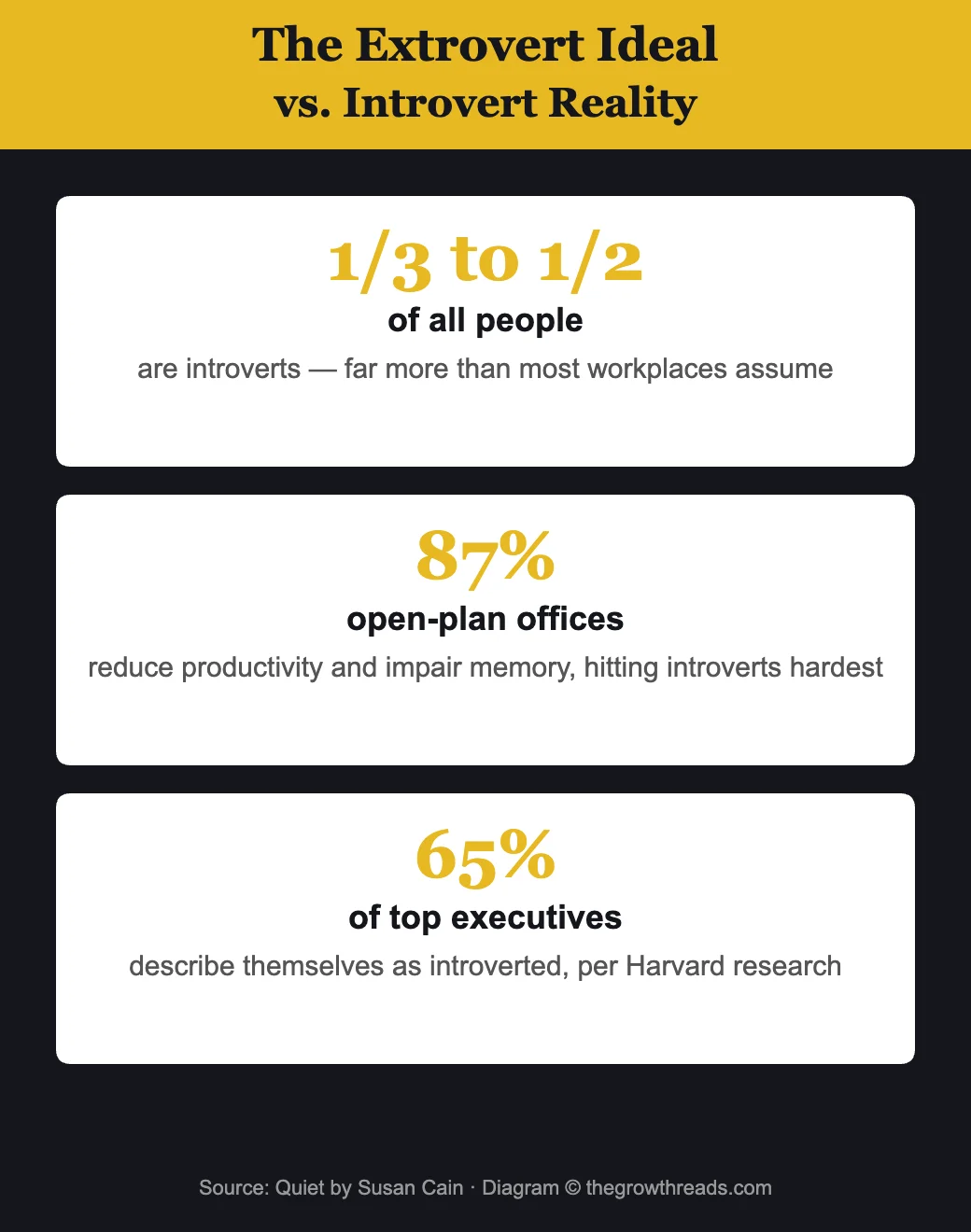
- Open-plan offices reduce productivity for almost everyone: Research shows they impair memory, increase stress hormones, and cut deep-focus time — introverts suffer most.
- Group brainstorming produces fewer and worse ideas than solo ideation: The best creative work usually starts alone, and only improves through careful, structured collaboration.
- High reactivity in infancy predicts introversion, not anxiety: Jerome Kagan’s longitudinal studies show that babies who react intensely to new stimuli grow into thoughtful, cautious adults — not fearful ones.
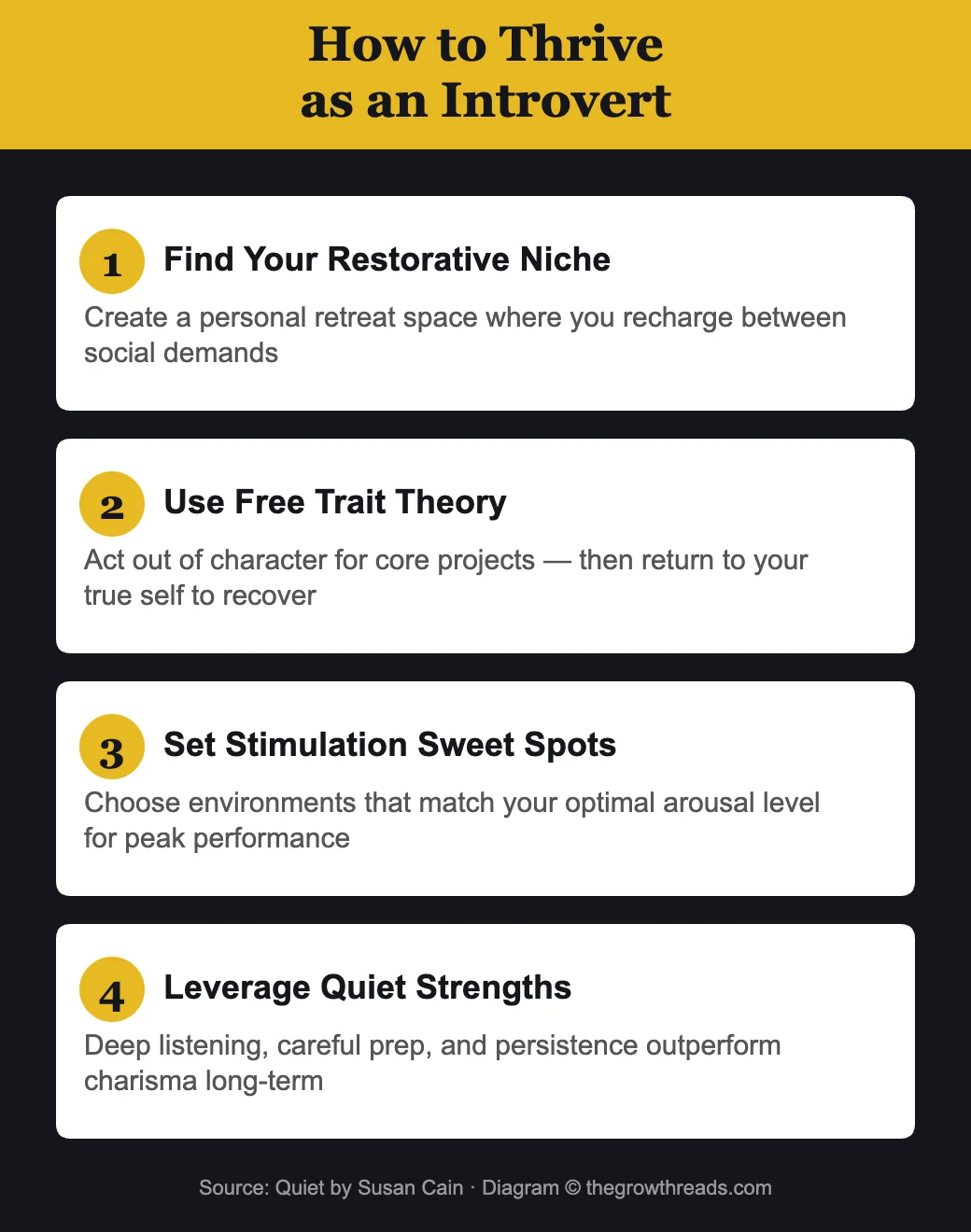
- Free Trait Theory explains why introverts can act extroverted: People can step outside their natural temperament for “core personal projects” they care deeply about — but they need recovery time afterward.
- Restorative niches are essential: Introverts perform best when they have a physical or temporal retreat — a quiet room, a solo walk, a closed-door hour — built into their daily routine.
- Stimulation sweet spots differ by person: Introverts hit peak performance at lower stimulation levels; pushing past that threshold tanks focus and well-being.
- Quiet leadership often outperforms charismatic leadership: Studies by Adam Grant show introverted leaders get better results from proactive teams because they listen rather than dominate.
- Introvert-extrovert partnerships thrive on complementary strengths: The key is understanding each other’s needs — introverts need downtime, extroverts need social fuel — and negotiating rather than converting.
What is Quiet about?
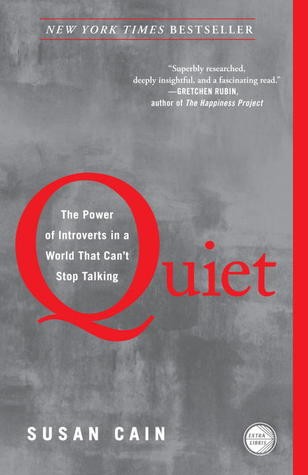
Quiet explores why Western society prizes extroversion over introversion, what neuroscience reveals about temperament, and how introverts can leverage their natural strengths — deep focus, careful listening, and creative persistence — in a world that rewards louder, faster personalities. It is both a cultural history and a practical guide.
About the author
Susan Cain is a former corporate lawyer and negotiations consultant who left Wall Street to write about the power of introversion. A self-described introvert who spent years forcing herself into extroverted roles, she channeled that tension into a TED talk that has been viewed over 40 million times and a book that spent years on the New York Times bestseller list. She went on to found Quiet Revolution, an organisation that helps schools and workplaces create space for introverts to thrive. Cain holds degrees from Princeton and Harvard Law School and lives with her family in the Hudson River Valley. Explore all Susan Cain book summaries →
Key concepts at a glance
| Concept | What it means | Use it when |
|---|---|---|
| The Extrovert Ideal | The cultural belief that the ideal self is gregarious, bold, and comfortable in the spotlight | You notice hiring, teaching, or social norms that penalise quiet people |
| High reactivity | Infants who react strongly to new stimuli tend to become introverted adults — their nervous systems are more sensitive | You want to understand why some people need less stimulation to feel engaged |
| Stimulation sweet spot | Every person has an optimal level of external input; introverts peak lower, extroverts peak higher | You are choosing a workspace, social schedule, or meeting format |
| Free Trait Theory | People can act against their temperament for projects they value — but it costs energy | An introvert needs to give a big presentation or lead a workshop |
| Restorative niche | A physical or temporal retreat where you return to your natural temperament to recharge | You feel drained after sustained extroversion and need a recovery plan |
| Soft power | Quiet persistence, preparation, and empathy as leadership tools — contrasted with dominance | You are leading a proactive team or managing through influence rather than authority |
| Rubber-band theory of personality | Temperament can stretch but always snaps back; you can flex, not permanently change | You are tempted to “become” an extrovert instead of designing around your nature |
Part 1: The rise of the Extrovert Ideal
Cain opens by tracing a cultural shift that most people never notice. In the nineteenth century, advice manuals stressed character: duty, honour, integrity, manners. What you did mattered more than how you came across. Then, around 1920, the United States pivoted. Dale Carnegie’s speaking courses exploded. Self-help books began coaching readers on magnetism, pep, and personality. Advertisers sold products by promising social confidence. The Extrovert Ideal — the belief that the model citizen is sociable, dominant, and at ease in the spotlight — became the water Americans swam in.
Cain shows how this ideal colonised institutions. Harvard Business School runs almost entirely on vocal classroom participation and aggressive networking; students who prefer to think before speaking are graded down. Evangelical mega-churches celebrate charismatic pastors and turn worship into stadium-scale socialising, leaving reflective believers feeling like outsiders. Corporate America adopted open-plan offices and mandatory team-building, mistaking constant interaction for productivity. The message, repeated everywhere, is that speaking up is smart and staying quiet is suspect.
The problem is not that extroversion is bad — it is that making it the only acceptable mode of being squanders the talents of a third to a half of the population. Cain’s argument is structural, not personal: the issue is design, not personality.
Part 2: The biology of temperament
The heart of Quiet’s scientific argument rests on the work of developmental psychologist Jerome Kagan at Harvard. In a landmark longitudinal study, Kagan exposed four-month-old infants to new stimuli — mobiles, recorded voices, popped balloons — and sorted them by how intensely they reacted. About 20 percent pumped their arms, arched their backs, and cried (high-reactive); about 40 percent stayed calm and curious (low-reactive); the rest fell in between.
Kagan followed these children for decades. The counterintuitive finding: high-reactive babies, the ones who seemed most distressed, did not grow into anxious wrecks. They grew into thoughtful, careful, introverted teenagers and adults. Their amygdalae — the brain’s threat-detection centre — were simply more sensitive to novelty, which made them cautious processors of new information rather than impulsive risk-takers. Low-reactive babies, the calm ones, tended toward extroversion: they craved more stimulation because their nervous systems needed more input to feel engaged.
Cain layers on additional research. Introverts show greater blood flow to brain regions associated with internal processing (planning, remembering, problem-solving). Extroverts show more activity in regions tied to sensory processing and reward. The neurotransmitter dopamine plays a starring role: extroverts’ reward networks light up more in response to external stimulation, which is why they chase novelty; introverts’ systems are already closer to saturation, which is why a quiet room feels right and a loud party feels draining.
The practical implication is the concept Cain calls the stimulation sweet spot. Every person has an optimal level of external input at which they perform best. Push an introvert past theirs with an open office and back-to-back meetings, and focus collapses. Leave an extrovert below theirs in a silent cubicle, and motivation craters. Designing for both is not a perk — it is a performance strategy.
Part 3: Quiet at work and in relationships
Cain pivots from science to application with a series of vivid case studies. She profiles a soft-spoken woman who led her community through a contentious environmental battle — not by being the loudest voice but by preparing obsessively, listening carefully, and outlasting more aggressive opponents. She examines the partnership between Steve Wozniak and Steve Jobs: Wozniak, the introvert, built the original Apple computer alone in his bedroom; Jobs, the extrovert, sold it. Neither could have done it alone, but the creative breakthrough happened in solitude.
The research on group dynamics is some of the book’s most actionable material. Cain cites studies showing that group brainstorming — the default creative tool in most organisations — consistently produces fewer and lower-quality ideas than the same number of people working alone and then pooling results. The reason is a cocktail of production blocking (only one person can talk at a time), evaluation apprehension (people censor themselves in front of peers), and social loafing (effort drops when responsibility is shared). Electronic brainstorming, where people type ideas simultaneously, eliminates most of these problems — and introverts thrive in it.
On leadership, Cain highlights Adam Grant’s research at Wharton. Grant found that introverted leaders actually outperform extroverted ones when managing proactive employees — people who take initiative and bring ideas. Why? Introverted leaders listen, process, and implement their team’s suggestions rather than dominating the conversation. Extroverted leaders, by contrast, can inadvertently shut down proactive employees by imposing their own vision. The implication is clear: matching leadership style to team culture matters more than charisma.
Cain also explores how introvert-extrovert differences play out in intimate relationships. She profiles couples where one partner craves social weekends and the other needs quiet Saturday mornings. The solution is never conversion — trying to make an introvert more outgoing or an extrovert more reflective. It is negotiation: agreeing on how many social events per week, building in recovery time, and understanding that a partner’s need for solitude is not rejection but recharging.
Part 4: Designing a life that fits your temperament
The final section of Quiet turns prescriptive. Cain introduces Free Trait Theory, developed by psychologist Brian Little. The idea is that we are born with certain fixed traits (like introversion) but can act “out of character” when pursuing core personal projects — goals or causes that matter deeply to us. A naturally introverted professor can deliver electrifying lectures because teaching is her core project. A quiet entrepreneur can pitch investors with genuine passion because the startup is his life’s work. The key is that this flexibility has a cost: it depletes energy and requires deliberate recovery.
This is where the concept of the restorative niche becomes essential. Cain defines it as any place or practice that returns you to your true self. For an introvert, it might be a ten-minute walk between meetings, a private office with a closed door, or an agreement with a spouse that Sunday mornings are sacred solo time. For an extrovert who has been stuck in a quiet research role all day, it might be a team lunch or a quick phone call with a friend. The point is that we all need to oscillate — stretch, then return — and designing those returns into the structure of your day is not weakness but strategic self-management.
Cain also dedicates a chapter to raising introverted children, arguing that schools — with their emphasis on group projects, class participation grades, and noisy cafeterias — are often hostile environments for quiet kids. She advocates for more independent work options, teacher training on temperament, and a culture that values thoughtful contribution over enthusiastic hand-raising. The goal is not to shelter introverted children from the world but to give them the tools and confidence to engage with it on their own terms.
Who is Quiet best for — and who should read something else first?
Quiet is ideal for self-described introverts who have spent years feeling like something is wrong with them. It provides both the science and the cultural context to reframe introversion as a strength. It is equally valuable for extroverts in leadership roles who want to understand why some team members disengage in group settings. Parents of quiet children will find the education chapters immediately actionable.
If you are looking for a more tactical productivity system, start with Deep Work by Cal Newport, which builds directly on the focus principles Cain describes. If your challenge is more about managing difficult emotions than managing stimulation, Emotional Intelligence by Daniel Goleman may be a better first read. And if you want a companion piece on building courage as a quiet person, The Courage to Be Disliked pairs beautifully.
Questions to reflect on
- Where in your daily routine do you feel most like your natural self — and where do you feel like you are performing a role?
- What are your core personal projects, the ones worth stretching out of character for? Are you recovering adequately afterward?
- How is your current workspace designed — does it match your stimulation sweet spot or fight against it?
- Think of a recent group meeting. Did the best ideas come from the loudest voices, or were some good ideas never spoken?
- If you are a parent or teacher, how could you create more space for quiet children to contribute without requiring them to perform extroversion?
🔥 Ready to embrace the power of quiet?
Get Quiet and start designing your life around your natural strengths instead of fighting them.
How to apply Quiet (7-day plan)
- Day 1 — Identify your stimulation sweet spot: Notice when you feel most energised and most drained today. Write down the environment, noise level, and number of people around you at each point.
- Day 2 — Audit your workspace: List three things about your current work environment that push you past (or below) your sweet spot. Brainstorm one change for each — headphones, a different desk, a closed-door hour.
- Day 3 — Create a restorative niche: Block 20 minutes of solo recharge time into your calendar. Use it for a walk, reading, or simply sitting quietly. Protect it like a meeting.
- Day 4 — Name your core personal projects: Write down the 2–3 goals or causes that matter enough for you to act out of character. For each, note the extroverted behaviour it requires and plan a recovery window after.
- Day 5 — Redesign one meeting: Before your next group brainstorm, ask everyone to spend 10 minutes writing ideas individually first. Compare the quality and quantity to a normal session.
- Day 6 — Have the temperament conversation: Talk to a partner, close friend, or colleague about your introvert/extrovert needs. Use Cain’s framework: what drains you, what restores you, and what compromises would help both of you.
- Day 7 — Review and commit: Look back at the week. Which change had the biggest impact? Make it permanent. Schedule a monthly check-in to keep adjusting your environment as your life changes.
Frequently asked questions
Is Quiet anti-extrovert?
Not at all. Cain repeatedly emphasises that extroversion is a genuine strength. Her argument is against the cultural monopoly of one temperament, not against extroverts themselves. She advocates for a world that makes room for both styles, citing research showing that the best teams include a mix of temperaments. The book’s target is institutional design — open offices, participation grades, charisma-based hiring — not individual extroverts.
What is the difference between introversion and shyness?
Cain is careful to distinguish the two. Introversion is a preference for lower-stimulation environments — it is about energy management. Shyness is a fear of social judgement — it is about anxiety. An introvert might love small dinner parties but find large conferences draining; a shy person might want to attend the conference but feel paralysed by fear. You can be a shy extrovert (craving socialising but fearing rejection) or a confident introvert (comfortable socially but preferring solitude).
Can introverts become extroverts?
Cain argues no — and that trying is counterproductive. Temperament is rooted in neurobiology (amygdala sensitivity, dopamine pathways) and remains broadly stable across a lifetime. However, Free Trait Theory shows that introverts can temporarily act extroverted for goals that matter to them. The key is that this costs energy and requires deliberate recovery in a restorative niche. The goal is strategic flexibility, not permanent transformation.
What does Quiet say about open-plan offices?
The evidence Cain presents is damning. Studies show open-plan offices reduce productivity, impair memory, increase cortisol levels, and lead to more sick days. They are particularly harmful to introverts, who need lower stimulation to do focused work. Cain recommends flexible workspaces that offer both collaborative areas and private zones, allowing people to move between them based on the task. The most productive environments, she argues, give people control over their level of stimulation.
How does Quiet apply to parenting?
Cain dedicates several chapters to introverted children. She warns against pushing quiet kids into constant socialising or labelling their preference for solo play as a problem. Instead, she recommends gentle exposure to new situations at the child’s own pace, validating their need for downtime, and advocating for classroom structures that do not penalise quiet participation. The goal is to help introverted children develop confidence in their own style rather than learning to perform extroversion.
Is the science in Quiet still valid?
The core neuroscience — Kagan’s high-reactivity findings, the role of the amygdala, dopamine sensitivity differences — has held up well. Some specific statistics Cain cites (like exact percentages of introverts in the population) are estimates that vary by study and definition. The group brainstorming research has been replicated extensively and remains solid. Overall, the scientific foundation is strong, even if personality science continues to evolve and refine its categories.
What should I read after Quiet?
If you want to build on the focus and solitude themes, Deep Work by Cal Newport is the natural next step. For understanding your emotional patterns more broadly, try Emotional Intelligence by Daniel Goleman. If Quiet made you rethink workplace culture, Radical Candor by Kim Scott offers a leadership framework that values listening. And for the parenting angle, search for Cain’s follow-up book Quiet Power, written specifically for teens.
Related summaries
- Deep Work by Cal Newport — Build the focus muscles that introverts already have a head start on.
- Emotional Intelligence by Daniel Goleman — Understand the emotional landscape that shapes how introverts and extroverts interact.
- Thinking, Fast and Slow by Daniel Kahneman — The cognitive science behind the careful, slow processing introverts excel at.
- Best Psychology Books — Our full ranked guide to the psychology shelf.
This article contains affiliate links to Amazon and Bookshop.org. If you buy through these links, we may earn a small commission at no extra cost to you. This never influences our reviews — we only recommend books we have read and believe in. See our full disclosure.