

⭐⭐⭐⭐⭐ 4.5 / 5 — The essential framework for giving feedback that is both caring and direct — without falling into the trap of being too nice or too harsh.
Best for: Managers, team leads, and anyone who needs to give honest feedback without damaging relationships.
Reading time: ~6 hours (this guide: 14 min)
Difficulty to apply: Medium — the framework is simple, but overcoming the fear of candid conversations takes practice.
Radical Candor in one minute
The best bosses care deeply about their people AND challenge them directly — most managers do only one or neither. Kim Scott’s Radical Candor framework maps feedback along two axes: Care Personally and Challenge Directly. When you do both simultaneously, you achieve Radical Candor — honest guidance that helps people grow. When you care but don’t challenge, you fall into Ruinous Empathy, the most common management failure. When you challenge without caring, you become obnoxiously aggressive. Scott, who led teams at Google and coached executives at Apple, provides a practical system for soliciting, giving, and encouraging candid feedback — starting with asking for criticism yourself before ever giving it to others.
Key takeaways
- Care personally AND challenge directly: Great management requires both dimensions simultaneously. Dropping either one leads to one of three failure quadrants that erode trust and performance.
- Ruinous Empathy is the #1 trap: Most well-meaning managers avoid difficult conversations because they don’t want to hurt feelings — but withholding honest feedback is ultimately unkind because it prevents growth.
- Solicit feedback before giving it: Ask your team to criticize you first. This proves you can take what you dish out and creates psychological safety for honest dialogue.
- Praise in public, criticize in private: But make both specific. Vague praise (“Great job!”) is as useless as vague criticism (“You need to step up”).
- Focus on behavior, not personality: Say “Your presentation lacked data” not “You’re not analytical enough.” Challenge the work, not the person.
- Don’t personalize: Show that you care about the person’s growth and that feedback is about helping them succeed, not proving you’re right.
- Move toward candor gradually: Use the order of operations — solicit, praise, criticize, encourage — to build a culture of candor step by step.
- The GSD wheel drives results: Listen, clarify, debate, decide, persuade, execute, learn — this cycle keeps teams aligned without micromanagement.
- Manage your own emotions first: If you’re frustrated, wait. Radical Candor comes from a place of caring, not anger.
- Candor is a two-way street: It’s not just about bosses giving feedback — it’s about creating an environment where anyone can be honest with anyone.
What is Radical Candor about?
Radical Candor is a management philosophy and practical framework for giving and receiving feedback effectively. Kim Scott argues that the best leaders combine genuine personal care with the willingness to challenge directly, and she provides tools for building a culture where honest, kind guidance flows freely in every direction within an organization.
About the author
Kim Scott is a former CEO coach and faculty member at Apple University who previously led large teams at Google, including AdSense, YouTube, and DoubleClick. Before Google, she managed a pediatric clinic in Kosovo and started a diamond-cutting factory in Moscow. She co-founded Radical Candor, LLC, which develops tools to help managers put the book’s philosophy into practice. Her management approach was shaped by mentors including Sheryl Sandberg, who once told her that her tendency to say “um” too often was undermining her credibility — a piece of Radical Candor that Scott initially resisted but ultimately found transformative. The revised edition incorporates feedback from thousands of readers and organizations that adopted the framework. Explore all Kim Scott book summaries →
Key concepts at a glance
| Concept | What it means | Use it when |
|---|---|---|
| Radical Candor | Caring personally while challenging directly | You need to give tough feedback without damaging the relationship |
| Ruinous Empathy | Caring but not challenging — being “nice” at the expense of honesty | You catch yourself holding back feedback to avoid discomfort |
| Obnoxious Aggression | Challenging without caring — harsh feedback that humiliates | You notice a colleague giving blunt criticism without warmth |
| Manipulative Insincerity | Neither caring nor challenging — false praise or passive-aggression | You catch yourself saying things you don’t mean to avoid conflict |
| The GSD Wheel | Listen → Clarify → Debate → Decide → Persuade → Execute → Learn | You want to drive results without micromanaging |
| Rock Stars vs. Superstars | Stable high performers vs. ambitious high performers | You’re deciding promotions, stretch assignments, or team structure |
| Career Conversations | Three talks: past story, dreams, and a plan to connect the two | You want to understand what motivates each team member |
| Soliciting Feedback | Asking others to criticize you before you criticize them | You want to build trust before giving difficult feedback |
Part 1: The two dimensions — why most feedback fails
Scott opens with a confession: she once managed an employee named Bob who was well-liked but consistently underperformed. For ten months, Scott praised his effort and avoided giving him the direct feedback he needed. When she finally had to fire him, Bob asked a devastating question: “Why didn’t you tell me?” That moment crystallized the core insight: being “nice” is not the same as being kind.
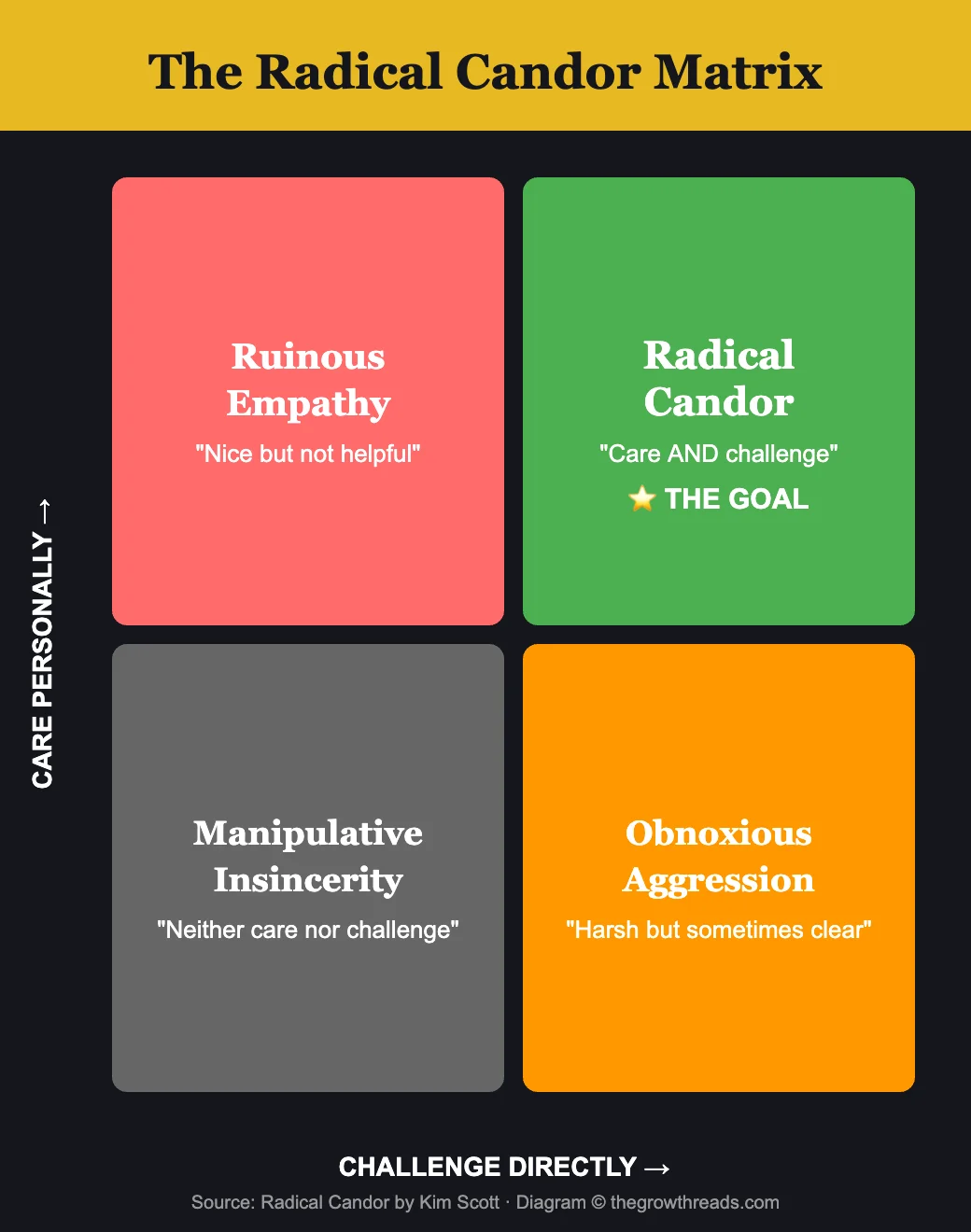
The Radical Candor framework maps feedback along two axes. The vertical axis is “Care Personally” — showing genuine concern for the whole person. The horizontal axis is “Challenge Directly” — being willing to tell someone the truth even when uncomfortable. These create four quadrants describing every feedback interaction.
Radical Candor (high care + high challenge) is the goal. Ruinous Empathy (high care + low challenge) is the most common failure — you care so much about feelings that you withhold honest feedback, preventing improvement. Obnoxious Aggression (low care + high challenge) delivers truth without compassion. Manipulative Insincerity (low care + low challenge) is the worst: empty praise, political maneuvering, and saying whatever keeps the peace.
Scott emphasizes that everyone moves between quadrants throughout the day — the framework is not about labeling people but about labeling behaviors and consciously shifting toward Radical Candor more consistently.
Part 2: Relationships — the foundation everything rests on
Before you can be radically candid, you need genuine relationships. Scott argues this is not about becoming best friends with your direct reports — it’s about showing you care about them as whole human beings, not just as producers of work output.
The book introduces “Rock Stars” and “Superstars” — two types of high performers needing fundamentally different management. Rock Stars are on a gradual growth trajectory: excellent at their role and wanting stability, mastery, and depth. Superstars are on a steep growth trajectory: they want new challenges, promotions, and rapid advancement. Neither is better; both are essential. But managing them identically — typically by pushing everyone toward promotion — drives Rock Stars away and frustrates Superstars.
Scott outlines three “Career Conversations” every manager should have with each team member: a life story conversation (what motivates them), a dreams conversation (where they want to be at their career peak), and a career action plan (what you can do together in the next 18 months). These conversations transform a manager from a task-assigner into a genuine career partner.
The chapter also confronts an uncomfortable reality: you will sometimes manage people in the wrong role. Rather than letting them languish (Ruinous Empathy), Radical Candor requires helping them find the right fit — even if that means leaving your team.
Part 3: Guidance — giving, receiving, and encouraging candor
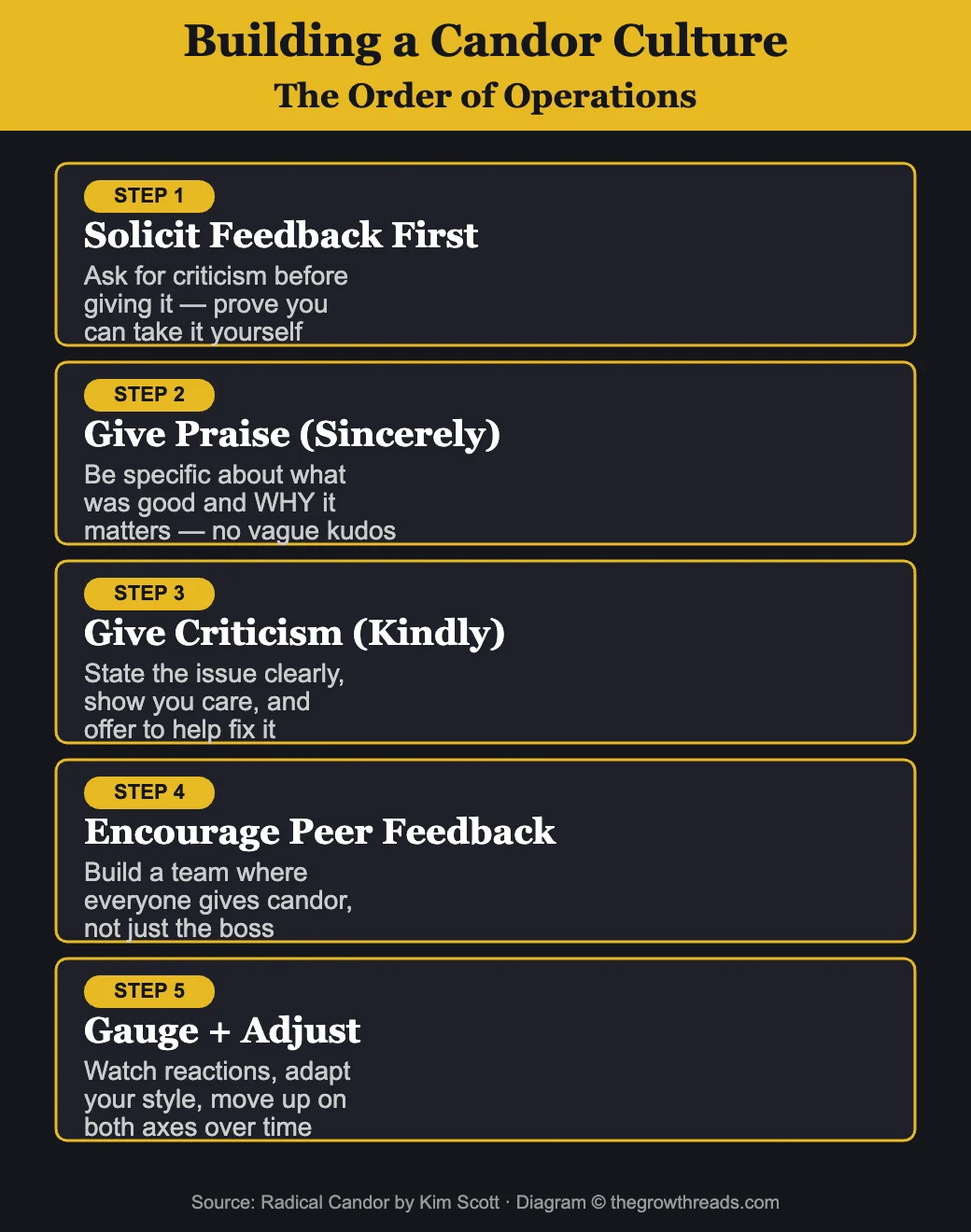
The heart of the book is its practical system for building a feedback culture. Scott insists on a specific order of operations: (1) solicit feedback first, (2) give praise, (3) give criticism, (4) encourage peer-to-peer feedback. Skipping ahead — especially jumping straight to criticism — undermines the entire system.
Soliciting feedback means literally asking your team, “What could I do differently that would make it easier to work with me?” Then listen, don’t defend. If the person hesitates, count to six silently — the discomfort of silence will often draw out the honest answer. When they give feedback, thank them, act on it visibly, and report back on what you changed.
For praise, Scott introduces the HHIPP framework: Humble, Helpful, Immediate, In Person, and not Personalizing. Instead of “You’re so smart,” try “The way you structured that analysis made the data instantly clear to the entire team — that’s the kind of clarity that changes decisions.”
For criticism, the same principles apply with added care: be specific, focus on behavior not character, do it privately, show you care by explaining why it matters for their growth, and offer to help. The “situation-behavior-impact” model works well: “In the client meeting (situation), when you interrupted the VP three times (behavior), it made us look unprepared (impact).”
Part 4: Results — getting stuff done collaboratively
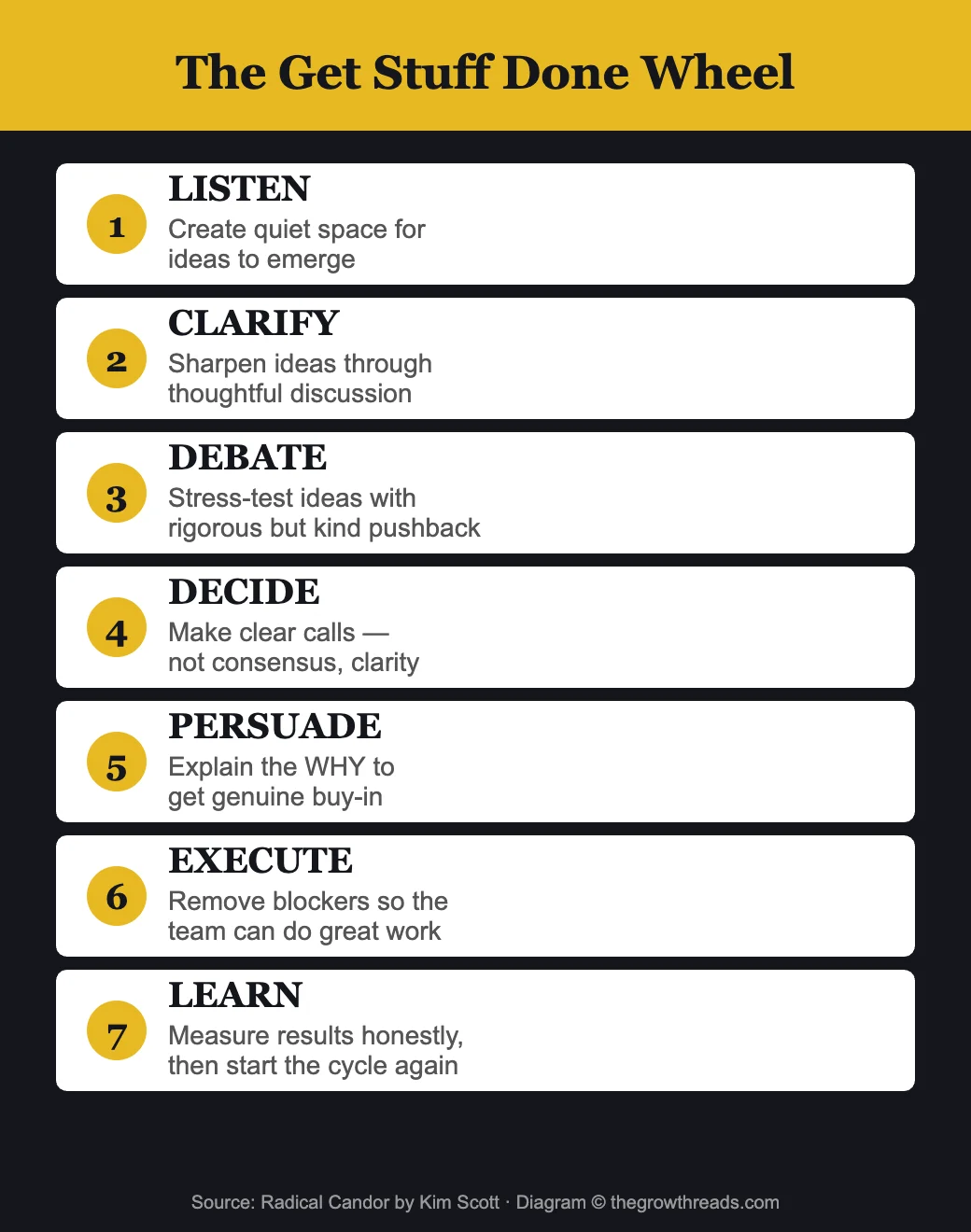
The final section introduces the GSD (Get Stuff Done) Wheel: Listen, Clarify, Debate, Decide, Persuade, Execute, Learn. Rather than simply telling people what to do, effective managers guide teams through this seven-step cycle.
Listening creates space for ideas. Clarification sharpens them. Debate stress-tests them. The decision step is where many teams stumble — Scott distinguishes between group decisions and boss decisions, arguing that most managers either decide too much (autocracy) or too little (consensus paralysis). The key is being explicit about which mode you’re in.
Persuasion is often skipped but essential: even after a decision is made, people need to understand the reasoning to execute with commitment rather than mere compliance. Execution means removing blockers and trusting people. And Learning means measuring results honestly and feeding insights into the next cycle.
The wheel applies at every level — from planning a product launch to running a weekly team meeting. The manager’s job is not to be the hub but to ensure the wheel keeps turning.
Who is Radical Candor best for — and who should read something else first?
This book is essential for anyone who manages people — first-time managers, experienced directors, and executives alike. It’s particularly valuable for people who need to give more honest feedback but struggle with the discomfort of difficult conversations.
If you’re not yet in a management role, start with Start with Why for foundational leadership thinking or Dare to Lead for a vulnerability-based approach. If your team’s primary issue is dysfunction rather than feedback, The Five Dysfunctions of a Team addresses root causes that must be fixed before candor can take hold.
Questions to reflect on
- Which quadrant of the Radical Candor matrix do you default to most often — and what specific situations trigger that default?
- When was the last time you asked a direct report or colleague to criticize your work — and what did their answer reveal?
- Are there any “Bobs” on your team right now — people you know are underperforming but you’ve been too afraid to address honestly?
- Do you know the difference between your Rock Stars and Superstars, and are you managing them accordingly?
- What would change if everyone on your team felt safe enough to be radically candid with each other?
🔥 Ready to become the boss everyone deserves?
Learn the framework for giving honest feedback that helps people grow without destroying relationships.
How to apply Radical Candor (7-day plan)
- Day 1 — Map your defaults. Reflect on your last five feedback interactions. For each, place yourself in the 2×2 matrix. Where do you land most often?
- Day 2 — Solicit feedback from one person. Ask one colleague: “What is one thing I could do differently to make it easier to work with me?” Count to six if they hesitate.
- Day 3 — Give specific praise. Find one person who did something excellent and tell them exactly what they did and why it mattered — in person, not Slack.
- Day 4 — Give one piece of kind criticism. Use situation-behavior-impact: “In X situation, when you did Y, the effect was Z.” Deliver it privately.
- Day 5 — Schedule a Career Conversation. Pick one team member and schedule the Life Story conversation. Ask about pivotal decisions in their past.
- Day 6 — Identify your Rock Stars and Superstars. List your team members by growth trajectory. Ask: Am I managing them according to their actual trajectory?
- Day 7 — Apply the GSD Wheel. For a current initiative, identify which stage you’re in and run the appropriate process — don’t skip to execution.
Frequently asked questions
What is Radical Candor in simple terms?
Radical Candor is communicating where you show genuine care for the person while being directly honest about what they need to improve. Think of it as telling your friend they have food in their teeth — it’s momentarily awkward but fundamentally kind because it helps them avoid embarrassment later. The framework plots all feedback along two axes: Care Personally and Challenge Directly. The goal is to score high on both simultaneously.
What are the four quadrants of the Radical Candor framework?
The four quadrants are: Radical Candor (care personally + challenge directly — the goal), Ruinous Empathy (care but don’t challenge — the most common trap), Obnoxious Aggression (challenge without caring — harsh but sometimes clear), and Manipulative Insincerity (neither care nor challenge — political backstabbing and empty praise). Most well-meaning managers default to Ruinous Empathy because they prioritize being liked over being helpful.
Is Radical Candor only for managers and bosses?
No. While the book primarily addresses managers, the principles apply to any relationship where honest communication matters — peer relationships, upward feedback to your boss, cross-functional partnerships, and even personal relationships. Kim Scott emphasizes that Radical Candor should flow in all directions, not just top-down. Individual contributors can practice it with colleagues, mentors, and anyone they collaborate with.
How is Radical Candor different from Dare to Lead?
Both Kim Scott and Brené Brown emphasize courage and caring in leadership, but they approach it from different angles. Brown focuses on vulnerability as the foundation of strong leadership, while Scott focuses on a specific communication framework for giving and receiving feedback. They’re highly complementary — Brown’s work builds the emotional foundation that makes Scott’s Radical Candor framework possible. Many leaders read both books together.
What is the GSD (Get Stuff Done) Wheel?
The GSD Wheel is Scott’s seven-step framework for collaborative execution: Listen (create space for ideas), Clarify (sharpen ideas), Debate (stress-test), Decide (make clear calls), Persuade (explain the why), Execute (remove blockers), and Learn (measure and iterate). It prevents both autocratic management and consensus paralysis by being explicit about which stage you’re in at any given moment.
What are Rock Stars vs. Superstars in Radical Candor?
Rock Stars are high performers on a gradual growth trajectory — they excel at their current role and want stability, depth, and mastery. Superstars are high performers on a steep growth trajectory — they crave new challenges, promotions, and rapid advancement. Both are equally valuable, but they need different management approaches. Pushing Rock Stars toward unwanted promotions is as harmful as holding back Superstars who are ready for bigger roles.
How long does it take to read Radical Candor?
The revised edition is approximately 320 pages and takes about 6 hours to read at an average pace. Kim Scott writes in an engaging, story-driven style with plenty of real-world examples from Google, Apple, and her coaching practice. The audiobook, narrated by Scott herself, runs about 11 hours and is excellent because her natural delivery adds warmth and context to the management stories throughout.
Related summaries
If you enjoyed this summary, explore more from our best leadership books collection:
- Dare to Lead Summary — Brené Brown’s vulnerability-based leadership framework.
- The Five Dysfunctions of a Team Summary — why trust must come before candor.
- Multipliers Summary — how the best leaders amplify everyone’s intelligence.
- Extreme Ownership Summary — Navy SEAL principles for taking full responsibility.