

★★★★ 4.3/5 — a landmark, career-defining tour of how the mind really makes decisions, from the Nobel laureate who mapped it. Dense but foundational.
Best for: anyone who wants to understand — and distrust — their own thinking · Reading time: ~14 hours (this guide: 17 min) · Difficulty to apply: Moderate — awareness is immediate; overriding your biases is lifelong
Thinking, Fast and Slow in one minute
Your mind runs on two systems — one fast, intuitive, and error-prone, the other slow, deliberate, and lazy — and most of your thinking is done by the one you trust least wisely. Daniel Kahneman, a psychologist who won the Nobel Prize in Economics, spent a lifetime studying how people actually make judgments and decisions, and this book is the culmination. System 1 is automatic and effortless: it jumps to conclusions, reads emotions, and handles almost everything without you noticing. System 2 is effortful and rational, but it is slow and easily depleted, so it often just endorses whatever System 1 suggests. The result is a mind riddled with predictable biases — anchoring, availability, loss aversion, overconfidence — that lead us astray in systematic ways. The book will not make you immune to these errors, but it gives you the vocabulary to recognize them in yourself and others, which is the first step toward thinking a little more clearly.
Key takeaways
- Two systems run your mind: System 1 is fast, automatic, and intuitive; System 2 is slow, effortful, and logical.
- System 2 is lazy: thinking hard is costly, so we default to System 1’s quick answers far more than we realize.
- Anchoring: an initial number, even a random one, powerfully biases the estimates and judgments that follow.
- Availability: we judge how likely something is by how easily examples come to mind, so vivid events feel more common than they are.
- WYSIATI (What You See Is All There Is): we build confident stories from the limited information we have, ignoring what we don’t know.
- Substitution: faced with a hard question, System 1 quietly answers an easier one instead.
- Loss aversion: losses feel roughly twice as painful as equivalent gains feel good, distorting our choices.
- Overconfidence: we vastly overestimate how much we understand, mistaking coherent stories for truth.
- Regression to the mean and the planning fallacy: we misread luck as skill and chronically underestimate time and cost.
- Two selves: the experiencing self lives each moment, but the remembering self — which judges by peaks and endings — makes our decisions.
What is Thinking, Fast and Slow about?
Thinking, Fast and Slow is a psychology book by Nobel laureate Daniel Kahneman about how the mind makes judgments and decisions. It describes two systems of thought — fast, intuitive System 1 and slow, deliberate System 2 — and catalogs the many cognitive biases that arise when we rely on intuition, reshaping how we understand rationality, risk, and choice.
About the author
Daniel Kahneman (1934–2024) was a psychologist whose work reshaped economics, medicine, and public policy. Together with his longtime collaborator Amos Tversky, he pioneered the study of cognitive biases and heuristics, and developed prospect theory, a more realistic account of how people make decisions under risk. In 2002 he was awarded the Nobel Prize in Economic Sciences — remarkable for a psychologist — largely for this work, which helped found the field of behavioral economics. Published in 2011 near the end of his career, Thinking, Fast and Slow distills decades of research into a single, sweeping account of the mind, written for a general audience but with the rigor of an academic. Kahneman is unusually honest about the limits of his own rationality, repeatedly confessing that understanding these biases has not made him immune to them — a humility that gives the book much of its authority. Explore all Daniel Kahneman book summaries →
Key concepts at a glance
| Concept | What it means | Watch for it when |
|---|---|---|
| System 1 | Fast, automatic, intuitive thinking | You react instantly |
| System 2 | Slow, effortful, deliberate thinking | A decision really matters |
| Anchoring | First numbers bias later judgments | Negotiating or estimating |
| Availability | Easy-to-recall = feels likely | Judging risk |
| Loss aversion | Losses hurt more than gains please | Weighing a risk |
| Peak-end rule | We judge experiences by peak and end | Recalling how good something was |
Part 1: Two systems — fast and slow
Kahneman’s central device is a distinction between two modes of thinking, which he calls System 1 and System 2. System 1 operates automatically and quickly, with little or no effort and no sense of voluntary control — it recognizes a friend’s face, completes the phrase “bread and…,” detects hostility in a voice, and drives a car on an empty road. System 2 allocates attention to the effortful mental activities that demand it, including complex computation and self-control — multiplying 17 by 24, filling out a tax form, or checking the validity of a logical argument. System 2 believes itself to be in charge, but Kahneman’s key point is that System 1 is really the hero (and villain) of the story: it runs continuously, generates impressions and intuitions, and feeds them to System 2, which usually accepts them with little scrutiny.
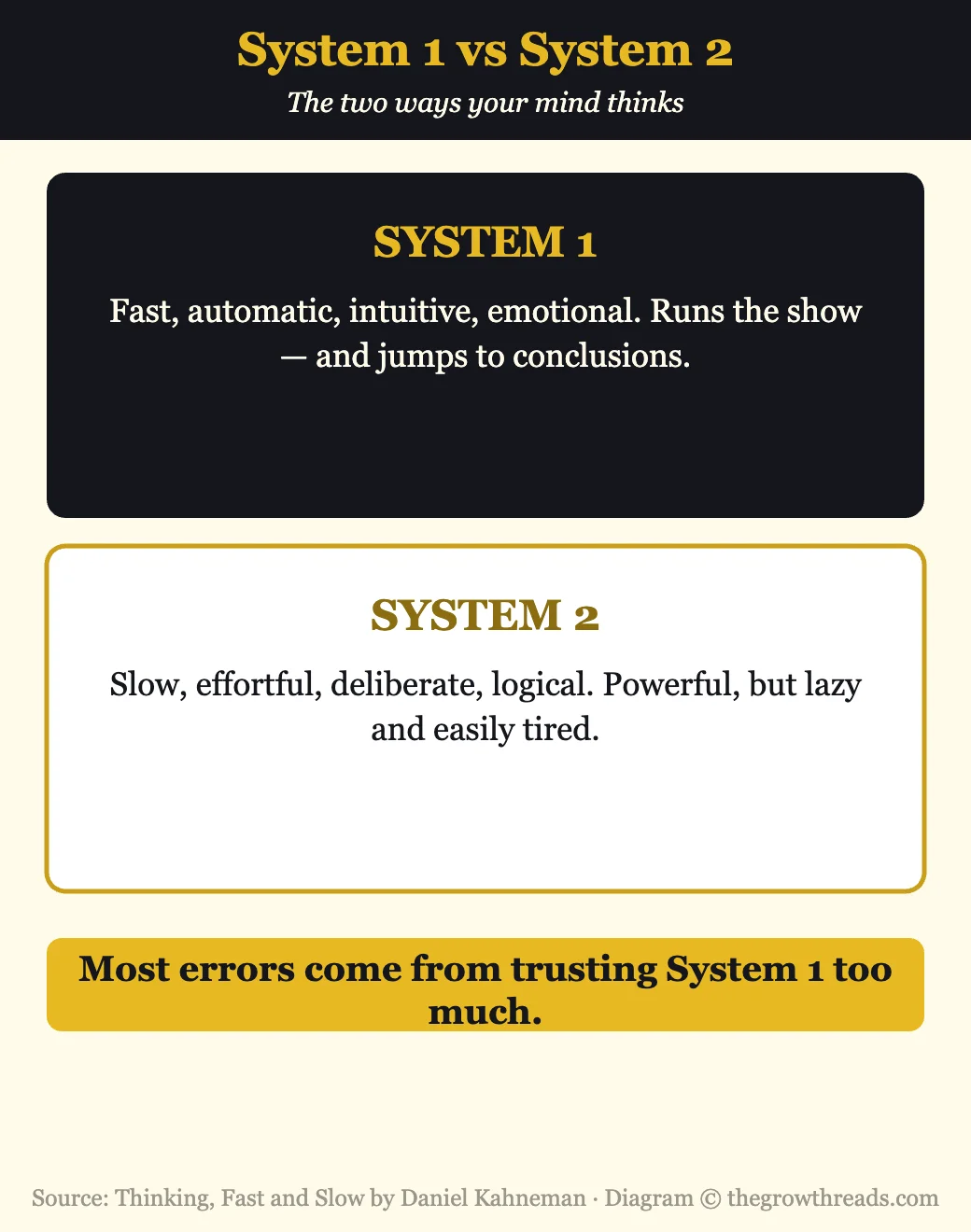
The trouble is that System 2 is lazy. Deliberate thinking is metabolically costly and tiring, so we conserve it, defaulting to System 1’s quick, confident answers even when they are wrong. Kahneman shows that when System 2 is busy or depleted — a state he links to “ego depletion” — System 1 has even freer rein, and we become more impulsive and more prone to error. Much of the book is a catalog of the specific, predictable ways System 1 misleads us, and of how rarely lazy System 2 catches it. Understanding this architecture is the foundation for everything that follows: our errors are not random, but systematic features of how the mind is built.
Part 2: Heuristics and biases
System 1 works by heuristics — mental shortcuts that usually serve us well but produce reliable errors in certain situations. Kahneman walks through the most important ones. Anchoring is the tendency for an initial value to contaminate our estimates: told that Gandhi died at an implausibly high or low age before guessing, people’s guesses shift toward the anchor, even when it is obviously arbitrary. Availability is judging frequency or probability by how easily instances come to mind, which is why we overestimate dramatic risks like plane crashes and underestimate mundane ones. Substitution is System 1’s habit of quietly replacing a hard question (“How happy am I with my life?”) with an easier one (“What’s my mood right now?”) and answering that instead.
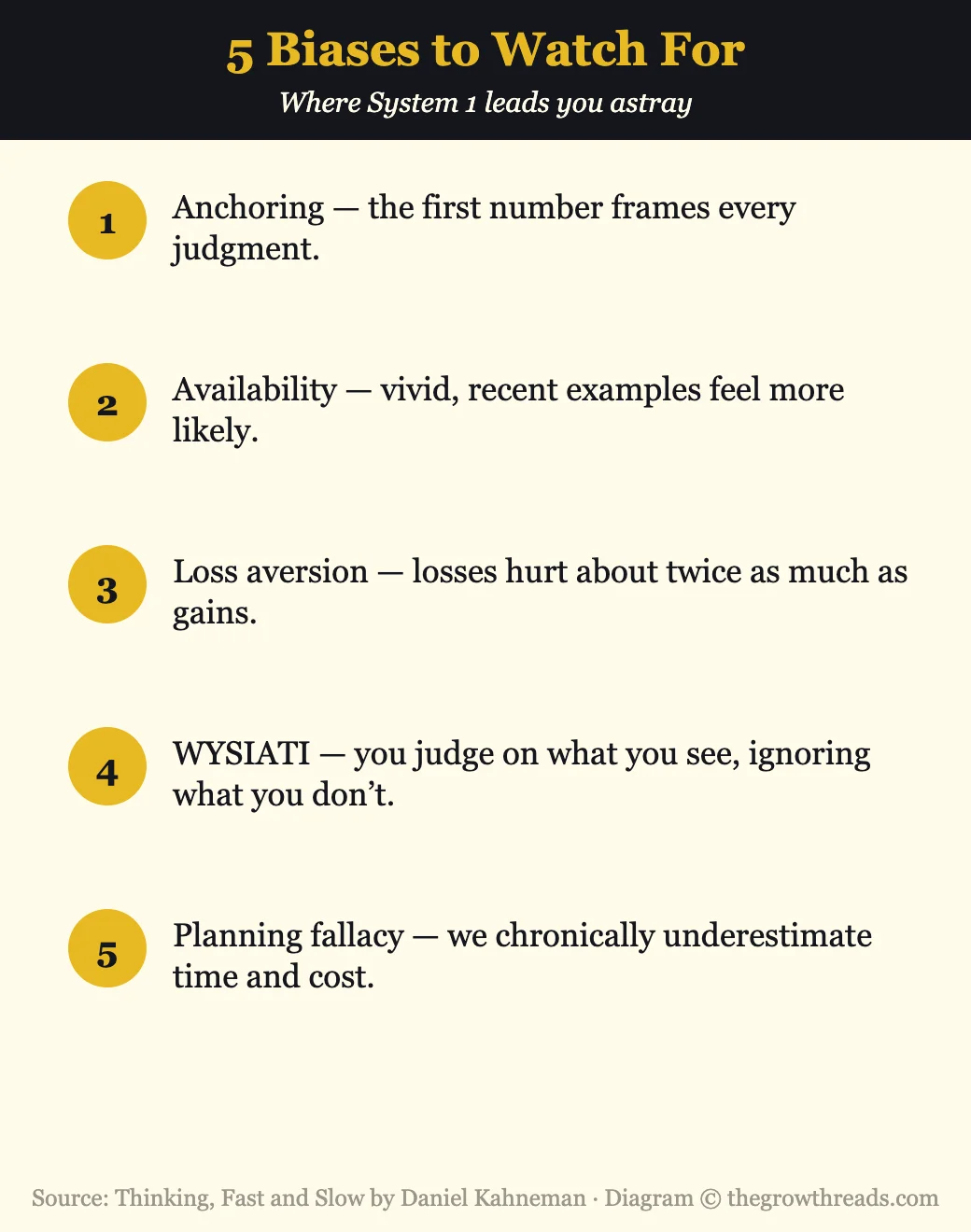
Perhaps the most important idea in this section is WYSIATI — “What You See Is All There Is.” System 1 builds the most coherent story it can from whatever information is available, and crucially, it does not account for the information it lacks. The result is confident conclusions from thin evidence, because the mind is not built to register how much it doesn’t know. This single idea explains a startling amount of overconfidence, jumping to conclusions, and susceptibility to framing. Together these heuristics reveal that human judgment is not a slightly noisy version of rationality — it is systematically biased in directions we can predict, which is both humbling and, once understood, genuinely useful.
TGR Note: Kahneman explains why we misjudge; two other books show the damage in specific arenas. The Psychology of Money is essentially loss aversion, availability, and overconfidence applied to your finances, while the influence tactics in Never Split the Difference work precisely because they exploit System 1. Read Kahneman first, and the others suddenly make deeper sense.
Part 3: Overconfidence and the illusion of understanding
Kahneman then turns his lens on the stories we tell ourselves. Because System 1 craves coherence, we are prone to the narrative fallacy — constructing tidy, causal stories about the past that make the world seem more understandable and predictable than it is. This breeds the illusion of understanding (we think we knew it all along) and the illusion of validity (we feel confident in judgments that have little predictive power). He is especially devastating on expert overconfidence: in many domains, from stock picking to long-range political forecasting, supposed experts perform little better than chance, yet remain serenely confident, because confidence is a feeling generated by the coherence of a story, not a measure of its accuracy.
He also examines two related traps. Regression to the mean — the statistical fact that extreme outcomes tend to be followed by more average ones — is constantly misread as cause and effect: a pilot who is praised after a great landing does worse next time (regression), and the instructor wrongly concludes that praise hurts performance. And the planning fallacy leads us to systematically underestimate the time, cost, and risk of our plans while overestimating their benefits, because we imagine the best-case scenario and ignore the base rate of how similar projects actually go. Kahneman’s recommended antidote — taking the “outside view,” grounding forecasts in how comparable cases turned out rather than in our optimistic inside story — is one of the book’s most practical lessons.
Part 4: Choices and the two selves
The book’s later sections cover Kahneman and Tversky’s Nobel-winning work on decision-making, prospect theory, which corrected classical economics’ assumption that people are rational calculators of value. In reality, we evaluate outcomes not in absolute terms but as gains and losses relative to a reference point, and losses loom much larger than gains — loss aversion means the pain of losing $100 is roughly twice the pleasure of gaining it. This asymmetry, combined with the way we overweight small probabilities and are powerfully swayed by how choices are framed (the same option described as “90% survival” versus “10% mortality” produces different decisions), explains much of the seemingly irrational behavior economics could not account for.
Finally, Kahneman distinguishes two selves whose interests conflict.
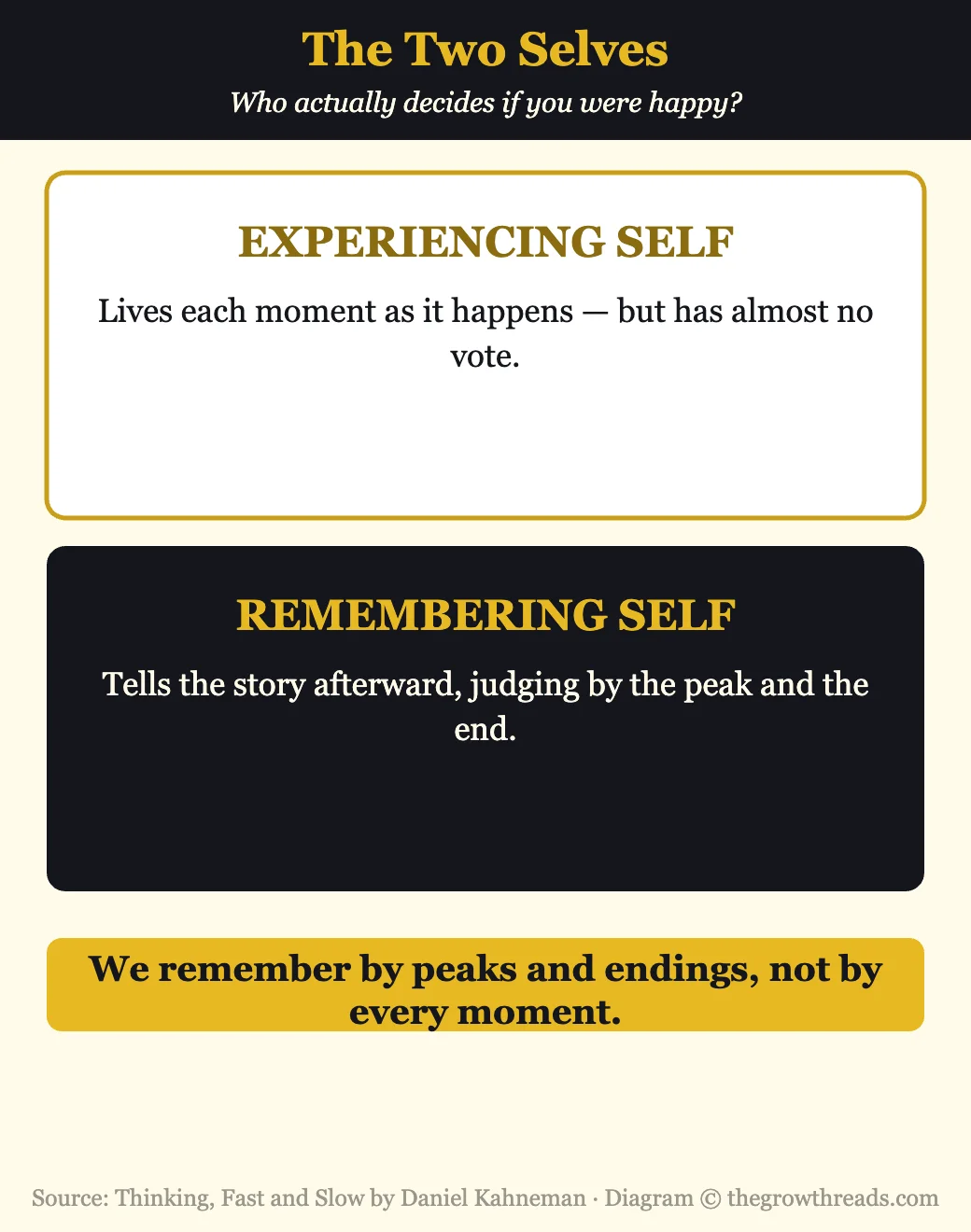
The experiencing self is the one that lives through each moment, feeling pleasure and pain as they happen. The remembering self is the one that keeps score afterward and tells the story of our lives — and, crucially, it judges an experience not by its total or average pleasure but by its peak and its ending (the “peak-end rule”), largely ignoring how long it lasted (“duration neglect”). Because it is the remembering self that makes our decisions, we often choose in ways that serve our memories rather than our actual moment-to-moment happiness — favoring a vacation that will photograph well over one we would enjoy more. It is a profound and slightly unsettling note to end on: even our sense of our own wellbeing is shaped by the quirks of a biased mind. The book does not promise to fix any of this. What it offers is something subtler and more valuable — a richer, more accurate, and more humble understanding of the machinery of thought, and a sharper eye for the errors it reliably produces.
Who is Thinking, Fast and Slow best for — and who should read something else first?
This book is ideal for serious readers who want to genuinely understand human judgment — anyone in business, investing, medicine, policy, or simply life who makes decisions and wants to make fewer errors. It is a foundational text that countless other books draw from. It is not a light or quick read: it is long, dense, and at times academic, and casual readers can find it heavy going. If you want the core ideas applied more breezily, start with a book like The Psychology of Money, then come to Kahneman for the deep, original source.
Questions to reflect on
- Where have you recently trusted a fast, confident gut reaction that deserved slow, careful thought?
- What “anchor” — a first price, a first impression — might be quietly biasing a current judgment?
- Which risks are you over- or under-estimating simply because of how vividly they come to mind?
- Where are you telling yourself a confident story from information you know is incomplete?
- Are you making a decision to please your remembering self or your experiencing self?
🔥 Ready to understand your own mind?
This guide is the map — Kahneman’s experiments are what make the biases impossible to unsee.
How to apply Thinking, Fast and Slow (7-day plan)
- Day 1 — Catch System 1. Notice one snap judgment today and deliberately ask what System 2 would conclude.
- Day 2 — Spot an anchor. Before a decision, identify the first number or impression and question its influence.
- Day 3 — Check availability. Take a fear or risk and ask whether it’s truly likely or just vivid.
- Day 4 — Name what you don’t know. On one confident opinion, list the information you’re missing (fight WYSIATI).
- Day 5 — Take the outside view. For a current plan, estimate time and cost based on how similar projects actually went.
- Day 6 — Reframe a choice. Describe one decision in terms of gains and again in terms of losses; notice the shift.
- Day 7 — Serve your experiencing self. Choose one activity for genuine in-the-moment enjoyment, not for the memory.
Frequently asked questions
Is Thinking, Fast and Slow worth reading?
Yes, for readers willing to engage with a demanding book. It is a landmark work that synthesizes a Nobel laureate’s life of research into how we think and decide, and it has profoundly influenced psychology, economics, and beyond. The frameworks — System 1 and 2, cognitive biases, prospect theory, the two selves — are genuinely foundational and change how you see your own mind. The honest caveat is that it is long, dense, and academic in places, so it rewards patience rather than skimming. For serious readers, it is close to essential.
What is the main idea of Thinking, Fast and Slow?
That the mind operates with two systems: System 1, which is fast, automatic, and intuitive, and System 2, which is slow, effortful, and logical. Most of our thinking is done by System 1, and because System 2 is lazy, we rely on intuition far more than we realize — which makes us subject to predictable cognitive biases. The book’s larger message is that human judgment is systematically, not randomly, flawed, and that understanding this is the first step to thinking more clearly.
What is the difference between System 1 and System 2?
System 1 is fast, automatic, effortless, and intuitive — it handles instant reactions, emotions, and routine tasks without conscious control. System 2 is slow, deliberate, effortful, and logical — it handles complex reasoning, calculation, and self-control. System 1 runs almost everything and generates impressions that System 2 usually accepts without scrutiny, because deliberate thinking is tiring. Most cognitive errors come from trusting System 1’s confident but sometimes wrong answers when a situation actually calls for System 2.
What are the main cognitive biases in Thinking, Fast and Slow?
Kahneman covers many, but key ones include anchoring (initial numbers bias later estimates), availability (easily recalled events feel more likely), substitution (answering an easier question than the one asked), WYSIATI or “what you see is all there is” (confident conclusions from incomplete information), loss aversion (losses hurt about twice as much as equivalent gains), overconfidence, and the planning fallacy (underestimating time and cost). Each reflects a mental shortcut that usually helps but produces reliable errors.
Is the research in Thinking, Fast and Slow still valid?
Mostly, but with an important caveat. The core frameworks — System 1 and 2, prospect theory, loss aversion, anchoring, and most of the heuristics-and-biases research — remain well supported and influential. However, some studies the book cited, particularly in the field of social “priming,” failed to replicate during psychology’s replication crisis, and Kahneman himself later acknowledged he had placed too much confidence in that specific area. The sensible view is that the book’s central architecture holds up well, while a few individual claims should be read with caution.
How long does it take to read Thinking, Fast and Slow?
The book is around 500 pages and quite dense, so most readers take roughly fourteen hours or more, often spread over weeks. Many treat it as a book to study rather than race through, revisiting chapters. Our summary above captures the core framework in about 17 minutes, which is a useful way to grasp the big ideas before deciding how deeply to engage with the full text.
Is Thinking, Fast and Slow good for beginners?
It is accessible in ideas but demanding in delivery. The concepts require no special background and are illustrated with clever, memorable experiments, but the writing is thorough and academic, and the length can overwhelm newcomers to psychology. Beginners often do best by reading it slowly, a chapter at a time, or by starting with a more applied book that draws on Kahneman’s ideas and then coming to the original for depth once the concepts feel familiar.
Related summaries
- The Psychology of Money Summary — Kahneman’s biases applied to your finances.
- Never Split the Difference Summary — influence tactics that exploit System 1.
- Atomic Habits Summary — building good System 1 automatic behavior.
- Browse all our best psychology books.
How we analyze books: We work from the full book — reconstructing its core arguments in our own words, adding commentary that connects it to related research and other books in our library, and pressure-testing the advice against how it plays out in real life. We never reproduce the text; we synthesize it. Read our full methodology.
Disclosure: The Growth Reads is reader-supported. When you buy through links on our site we may earn an affiliate commission at no extra cost to you. We only recommend books we believe are worth your time, and our summaries and opinions are written independently.