

★★★★☆ 4.3/5 — A psychiatrist’s compelling guide to understanding dopamine, breaking compulsive habits, and finding balance in an age of endless stimulation.
Best for: Anyone struggling with compulsive behaviors around screens, food, substances, or stimulation — or simply wanting to understand why moderation feels so hard.
Reading time: ~5 hrs (guide: 18 min)
Difficulty to apply: Moderate to high — the 30-day dopamine fast requires significant willpower upfront.
Dopamine Nation in one minute
We live in a world of unprecedented access to pleasure, and it is making us miserable. Dr. Anna Lembke, chief of the Stanford Addiction Medicine Dual Diagnosis Clinic, explains that the brain processes pleasure and pain on a shared seesaw — when one goes up, the other must come down. Every dopamine spike from a pleasurable activity (scrolling social media, eating sugar, watching explicit content, online shopping) is automatically followed by a compensatory dip below baseline. Over time, repeated stimulation tips the balance permanently toward pain, creating a state where you need more of the substance or behavior just to feel normal. The solution is counter-intuitive: deliberately seek discomfort, practice abstinence, and allow the brain to recalibrate through what Lembke calls the dopamine fast.
Key takeaways
- Pleasure and pain are co-located in the brain: The same neural circuits process both, operating like a seesaw that must always return to balance.
- We live in a dopamine-saturated world: Modern life offers more potent, accessible, and novel sources of pleasure than at any point in human history — and our brains were not designed for it.
- Tolerance is the brain defending itself: When you repeatedly flood your reward circuits, the brain compensates by reducing its response, requiring more stimulus for the same effect.
- The dopamine deficit state is modern suffering: Chronic overstimulation tips the balance toward pain: anxiety, irritability, insomnia, and a pervasive inability to enjoy simple pleasures.
- Abstinence resets the balance: A 30-day break from a compulsive behavior allows the brain to recalibrate to baseline, restoring the ability to feel pleasure from ordinary activities.
- Self-binding is freedom, not restriction: Creating barriers between yourself and your drug of choice (physical, chronological, categorical) is a form of self-care, not deprivation.
- Radical honesty accelerates recovery: Telling the truth about your behavior — to yourself and others — breaks the shame cycle that fuels compulsive consumption.
- Pain can be its own reward: Deliberate exposure to discomfort (cold water, intense exercise, fasting) produces a compensatory dopamine rise that is sustainable and health-promoting.
What is Dopamine Nation about?
Dopamine Nation is a neuroscience and self-help book that explains how the brain’s pleasure-pain balance system works, why modern overstimulation leads to compulsive behaviors and chronic dissatisfaction, and how to restore equilibrium through abstinence, self-binding strategies, and intentional exposure to healthy discomfort.
About the author
Dr. Anna Lembke is a psychiatrist and professor at Stanford University School of Medicine, where she serves as chief of the Stanford Addiction Medicine Dual Diagnosis Clinic. She has treated patients with every form of addiction for over 25 years, from heroin and alcohol to video games, social media, and romance novels. Lembke appeared in the Netflix documentary The Social Dilemma and has become one of the most cited experts on behavioral addiction and dopamine science. She brings unusual vulnerability to her writing, openly sharing her own struggles with compulsive reading of romance fiction — a detail that humanizes the clinical material and demonstrates that no one is immune to the pull of dopamine. Explore all Anna Lembke book summaries →
Key concepts at a glance
| Concept | What it means | Use it when |
|---|---|---|
| Pleasure-Pain Balance | Brain processes pleasure and pain on a shared seesaw | You want to understand why you feel worse after feeling good |
| Dopamine Deficit State | Chronic overstimulation tips the balance toward pain | You feel unable to enjoy simple pleasures |
| The Dopamine Fast | 30-day abstinence from a compulsive behavior to reset | You want to break a compulsive habit |
| Self-Binding | Creating barriers between yourself and your vice | Willpower alone is not enough |
| Radical Honesty | Telling the truth about your behavior to break shame cycles | Secrecy is fueling your compulsive behavior |
| Hormesis | Beneficial stress — cold, exercise, fasting — produces sustainable dopamine | You want to feel good without harmful substances |
| Prosocial Shame | Healthy accountability that connects rather than isolates | You need community support for behavior change |
Part 1: The pleasure-pain balance — why more pleasure leads to more pain
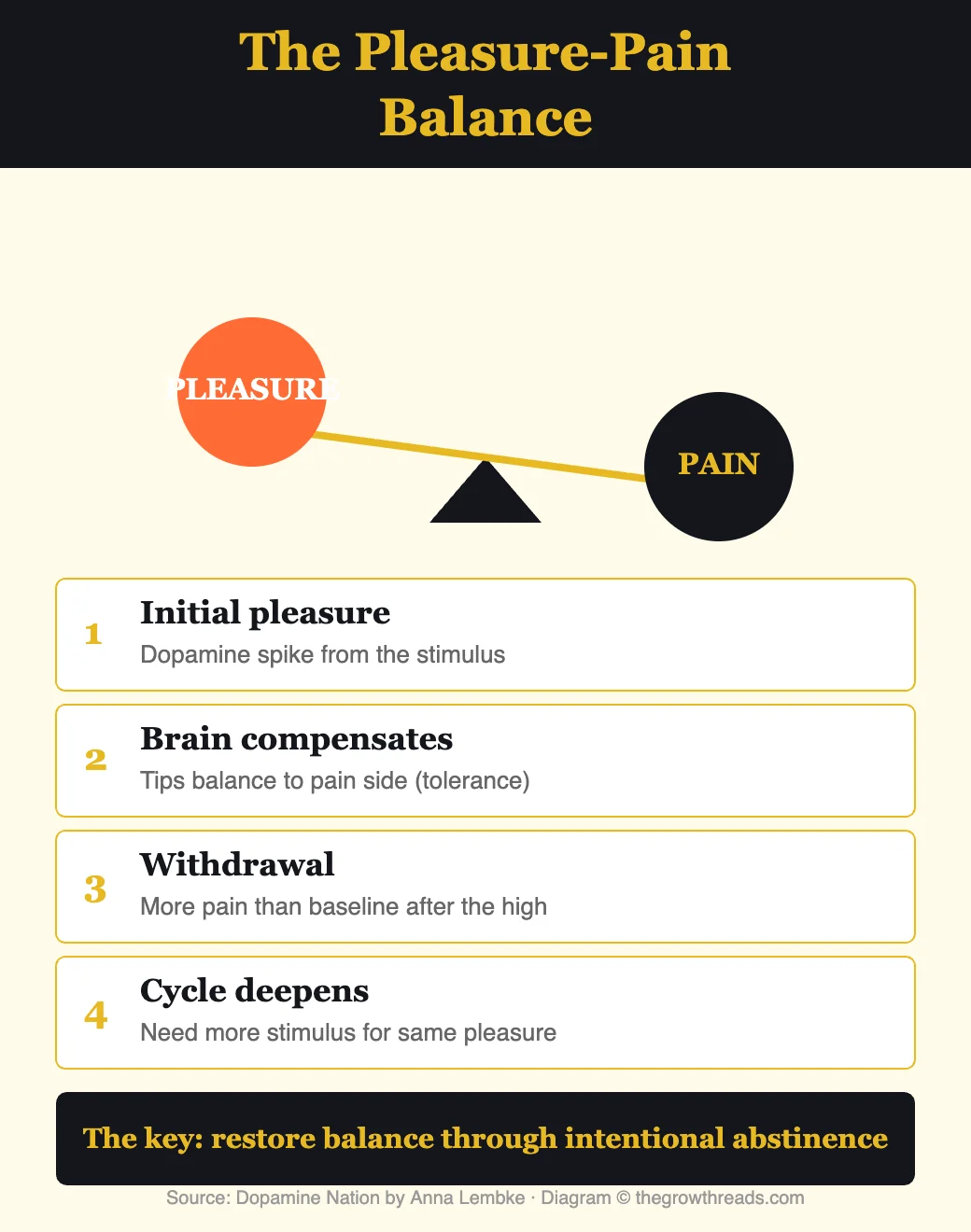
Lembke opens with the neuroscience of the pleasure-pain balance. The brain processes both pleasure and pain in overlapping regions — particularly the nucleus accumbens and the ventral tegmental area. She uses the metaphor of a seesaw: when pleasure goes up (dopamine is released), the brain immediately works to bring the seesaw back to level by tipping it toward pain. This compensatory response is called neuroadaptation, and it is the biological mechanism behind tolerance and withdrawal.
In a pre-industrial world, this system worked well. Pleasure signals were rare and required effort to obtain — food had to be hunted or gathered, social connection required physical presence, and novel stimulation was limited. The modern world has shattered this balance. We now have access to hyper-concentrated forms of pleasure delivered on demand: processed food engineered for maximum palatability, social media designed for infinite scrolling, substances of unprecedented purity, and digital content that caters to every possible desire.
The result is a global epidemic of what Lembke calls the “dopamine deficit state” — a condition where chronic overstimulation has tipped the balance so far toward pain that people need their drug of choice just to feel normal, and ordinary pleasures (a sunset, a conversation, a home-cooked meal) feel flat and unsatisfying. This is not moral weakness — it is neurobiology. And understanding the mechanism is the first step toward restoration.
Part 2: The dopamine fast — resetting your brain’s baseline
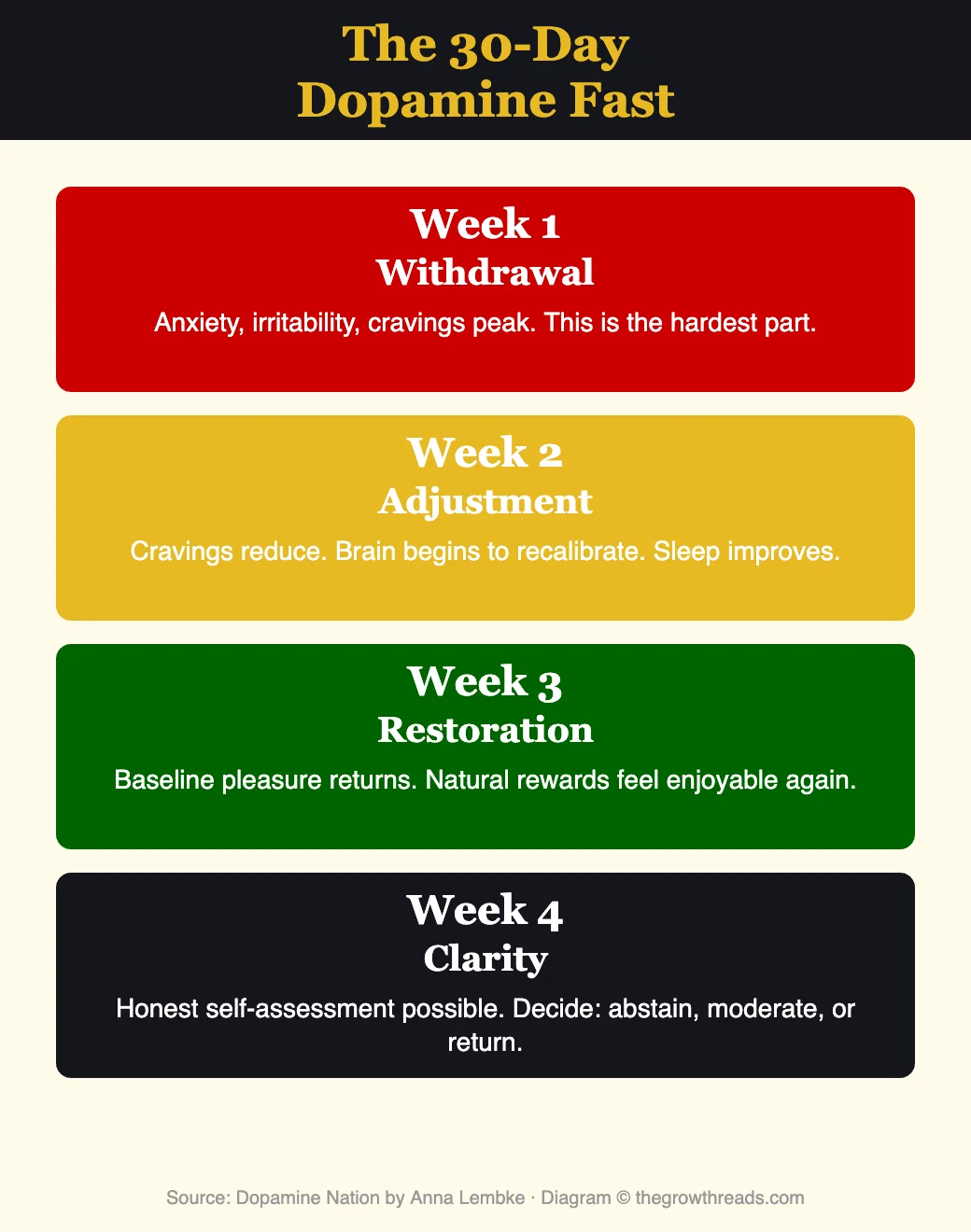
Lembke’s primary clinical intervention is the 30-day dopamine fast: complete abstinence from the problematic substance or behavior for four weeks. The timeline is not arbitrary — it typically takes two to four weeks for the brain’s reward pathways to recalibrate to a new baseline after chronic overstimulation. During the first week, patients experience the worst withdrawal symptoms: anxiety, irritability, insomnia, and intense cravings. By week two, symptoms begin to fade. By week three, many patients report that natural rewards — food, exercise, conversation, nature — begin to feel pleasurable again in a way they had not experienced in months or years.
The fast serves a diagnostic purpose as well. At the end of 30 days, patients can honestly assess their relationship with the substance or behavior. Some discover they can reintroduce it in moderation. Others realize the cost was always higher than they admitted and choose ongoing abstinence. A few discover that their compulsive behavior was masking an underlying condition (depression, anxiety, ADHD) that needs its own treatment.
Part 3: Self-binding and radical honesty — the tools for lasting change
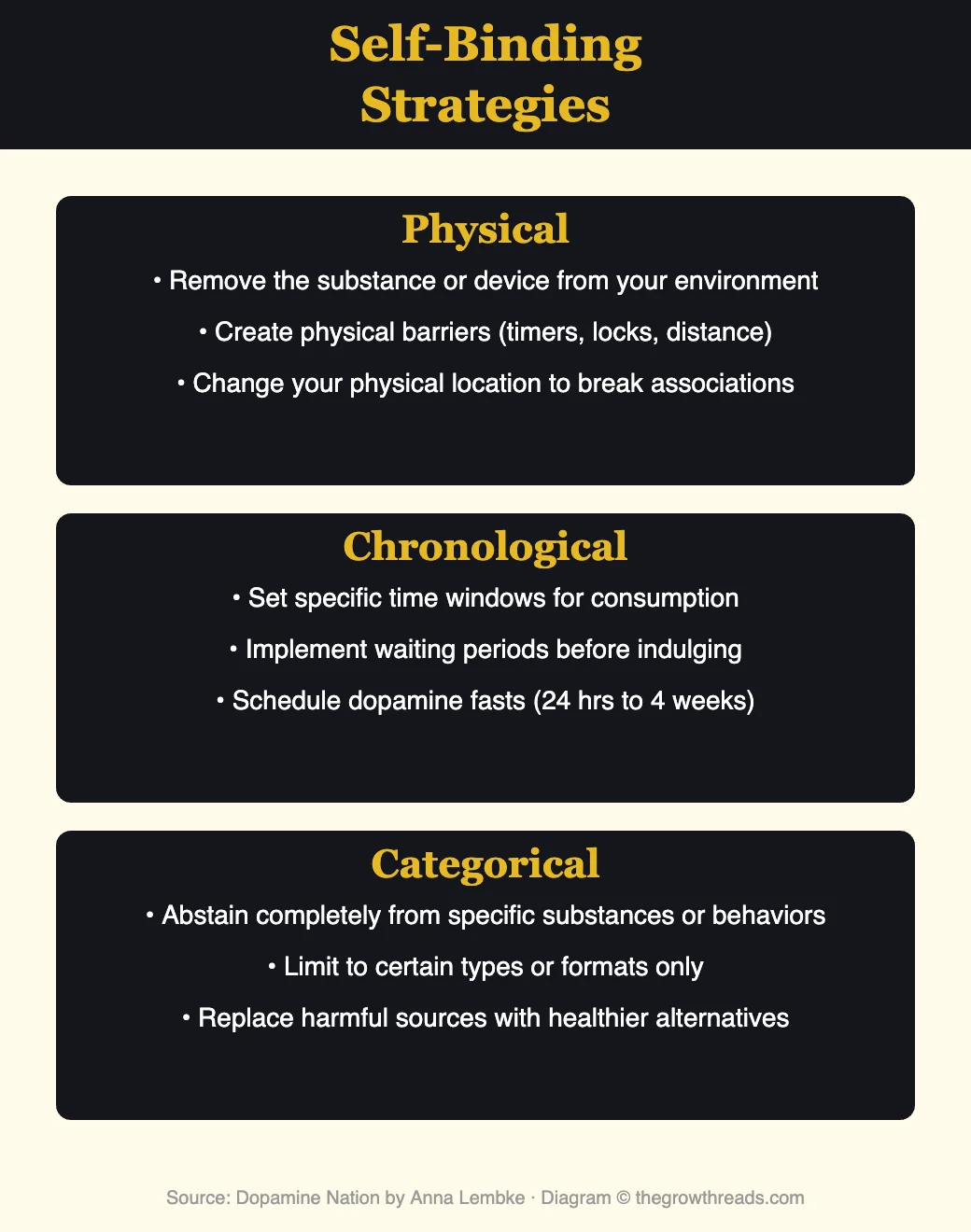
Lembke introduces three categories of self-binding strategies — ways to create barriers between yourself and your drug of choice that do not rely on willpower alone. Physical self-binding involves removing the substance from your environment or creating physical barriers (deleting apps, locking the liquor cabinet, putting the phone in another room at night). Chronological self-binding sets time-based limits (no screens after 9 PM, social media only on weekends). Categorical self-binding involves abstaining from specific subcategories while allowing others (no hard liquor but beer is fine, no social media but email is allowed).
Radical honesty is Lembke’s second major tool. She argues that secrecy and shame form a vicious cycle: you use the substance secretly, feel ashamed, and use more to numb the shame. Breaking this cycle requires telling the truth — first to yourself, then to a trusted person, and eventually to a wider circle. The act of honest disclosure is painful in the moment but produces a profound relief that Lembke compares to putting down a heavy burden you did not realize you were carrying.
The final section explores what Lembke calls “hormesis” — the principle that moderate exposure to stressors (cold water, vigorous exercise, fasting, intense focus) produces a beneficial adaptive response. Unlike pleasurable substances that create a dopamine spike followed by a crash, healthy stressors create a brief pain followed by a sustained, moderate dopamine elevation. This is why people who exercise regularly report improved mood, better sleep, and reduced cravings — the discomfort of the workout pays dividends in lasting neurochemical balance.
Who is Dopamine Nation best for — and who should read something else first?
Dopamine Nation is ideal for anyone who suspects their relationship with a substance or behavior has crossed from enjoyment into compulsion — whether that is alcohol, social media, gaming, shopping, food, or anything else that feels increasingly difficult to control. It is also excellent for clinicians, counselors, parents, and educators who want a scientifically grounded framework for understanding addictive behavior in the modern world.
If your focus is on physical health optimization rather than behavioral change, start with Outlive by Peter Attia. If you are looking specifically for sleep improvement, Why We Sleep by Matthew Walker provides deeper coverage of that single topic.
Questions to reflect on
- What is the first thing you reach for when you feel bored, anxious, or uncomfortable — and what does that reveal about your dopamine patterns?
- If you abstained from your most-used source of digital stimulation for 30 days, what do you predict would happen to your mood, sleep, and relationships?
- Where in your life are you using pleasure to avoid pain — and what is the pain you are avoiding?
- What forms of healthy discomfort (exercise, cold exposure, focused work) do you currently practice, and how do they affect your overall sense of well-being?
- Who in your life could you practice radical honesty with about a behavior you have been keeping secret?
🔥 Ready to reset your dopamine balance?
Learn why the path to feeling better starts with choosing the right kind of discomfort.
How to apply Dopamine Nation (7-day plan)
- Day 1: Identify your primary dopamine source — the substance or behavior you turn to most often for comfort, escape, or stimulation. Write down how many times per day you engage with it.
- Day 2: Implement one physical self-binding strategy: remove the app, move the device, change the environment. Make access harder, not impossible.
- Day 3: Add a chronological self-binding: set a specific time window (for example, no screens after 8 PM, or social media only between 12 and 1 PM).
- Day 4: Introduce one form of healthy discomfort: a cold shower (30 seconds at the end), a vigorous 20-minute workout, or 15 minutes of focused work on something you have been avoiding.
- Day 5: Practice radical honesty. Tell one trusted person about a behavior you have been concealing or minimizing. Notice how it feels to name it out loud.
- Day 6: Observe your cravings without acting on them. When the urge arises, set a 10-minute timer and simply sit with the discomfort. Most cravings pass within 15 minutes.
- Day 7: Assess your week. Rate your mood, sleep, and general sense of well-being compared to the previous week. If the improvements are noticeable, commit to extending your experiment to 30 days.
Frequently asked questions
What is a dopamine fast?
A dopamine fast, as Lembke defines it clinically, is a period of complete abstinence from a specific compulsive behavior or substance — typically lasting 30 days. The purpose is to allow the brain’s reward pathways to recalibrate to a normal baseline after chronic overstimulation. It is not about avoiding all pleasure or sitting in a dark room; it is about taking a targeted break from one specific behavior that has become compulsive. During the fast, patients are encouraged to engage in healthy activities like exercise, socializing, creative work, and time in nature.
Is dopamine actually bad for you?
No. Dopamine is essential for motivation, learning, movement, and survival. Lembke does not argue against dopamine itself — she argues against the chronic overstimulation of dopamine pathways through hyper-potent, readily available sources of pleasure. The problem is not dopamine but the imbalance created by too much too often. Natural dopamine release from exercise, meaningful work, social connection, and moderate enjoyment of food and entertainment is healthy and sustainable. The issue arises when synthetic or concentrated sources hijack the system.
Can I use the dopamine fast for screen addiction?
Yes. Lembke treats patients with compulsive screen use (social media, gaming, streaming, online shopping) using the same 30-day protocol she uses for substance addiction. For screens, she typically recommends a categorical approach: identify the specific digital behavior that is most compulsive (Instagram, not all apps) and abstain from that specific behavior for 30 days. Some patients choose to do a broader digital detox, but the clinical recommendation is to target the behavior that produces the strongest compulsive pull.
What is hormesis?
Hormesis is the biological principle that moderate exposure to stressors produces a beneficial adaptive response. Cold water immersion, vigorous exercise, intermittent fasting, and even certain forms of emotional discomfort trigger the brain’s pain-processing circuits, which respond with a compensatory dopamine release. Unlike the dopamine spike from pleasurable substances (which is followed by a crash below baseline), the dopamine elevation from hormetic stress is more moderate, more sustained, and produces no withdrawal. It is the neurological basis for the “runner’s high” and the mental clarity people report after cold showers.
Is Dopamine Nation only about addiction?
No. While Lembke draws heavily on her clinical experience treating addiction, the book’s principles apply to anyone living in a world of abundant stimulation. You do not need to be addicted to benefit from understanding how dopamine works, how tolerance develops, and how intentional breaks from overstimulation can restore your ability to enjoy simple pleasures. Most readers find the book relevant to their relationship with phones, food, news consumption, and online shopping — behaviors that are compulsive without being clinical addictions.
How does radical honesty help with compulsive behavior?
Secrecy and shame form a cycle that fuels compulsive behavior: you engage in the behavior privately, feel ashamed, and then use the behavior again to numb the shame. Radical honesty breaks this cycle at its root. By telling the truth about your behavior to yourself and one other person, you remove the shame’s power. Lembke reports that patients who practice radical honesty recover faster and maintain sobriety longer than those who continue concealing their behavior. The honesty does not need to be public — even one trusted confidant makes a significant difference.
Is Dopamine Nation backed by research?
Yes. Lembke is a Stanford psychiatrist with over 25 years of clinical and research experience. The book cites over 100 peer-reviewed studies in neuroscience, pharmacology, and behavioral psychology. The pleasure-pain balance model is grounded in decades of research on opponent-process theory, originally formulated by Richard Solomon and John Corbit in the 1970s. The self-binding and hormesis concepts are also supported by substantial research literature. Lembke combines the science with patient case studies that make the neuroscience tangible and relatable.
Related summaries
- Atomic Habits Summary & Review — James Clear on the compound power of small daily habits.
- Breath Summary & Review — James Nestor on the science of breathing and deliberate discomfort.
- Why We Sleep Summary & Review — Matthew Walker on sleep’s role in cognitive and emotional health.
- Best Health Books — Our complete guide to the top books on physical and mental well-being.
How we analyze books: Every summary on The Growth Reads is built from a close reading of the full text, cross-referenced with the author’s published interviews, peer-reviewed research where applicable, and reader feedback from multiple platforms. We focus on extracting actionable frameworks rather than abstract theory. Read our full methodology.