

★★★★½ 4.6/5 — the original, still-unmatched classic on human relations. The examples are dated, but the principles are timeless and genuinely life-changing.
Best for: anyone who wants to be more likable, persuasive, and effective with people — which is everyone · Reading time: ~6 hours (this guide: 15 min) · Difficulty to apply: Easy to grasp — the discipline is doing it sincerely, every day
How to Win Friends and Influence People in one minute
The secret to getting along with people is simple: make them feel genuinely valued, and see the world from their point of view. Dale Carnegie’s 1936 classic — one of the best-selling books of all time — distills the art of human relations into a set of clear, memorable principles. Its foundation is a single insight: people are driven not by logic but by emotion, pride, and a deep craving to feel important, so the way to influence anyone is to satisfy that craving sincerely rather than to argue, criticize, or push. Carnegie organizes his advice into four areas: fundamental techniques for handling people, six ways to make people like you, how to win others to your way of thinking, and how to lead and change people without arousing resentment. The through-line is that becoming genuinely interested in others, appreciating them honestly, and approaching every interaction from their perspective is not manipulation but the essence of good character — and it happens to be the most effective way to succeed with people, too.
Key takeaways
- Don’t criticize, condemn, or complain: criticism puts people on the defensive and rarely changes them; it only breeds resentment.
- Give honest, sincere appreciation: everyone craves to feel important, so genuine appreciation is one of the most powerful tools you have.
- Arouse in the other person an eager want: to influence someone, frame things in terms of what they want, not what you want.
- Become genuinely interested in others: you make more friends by being interested in people than by trying to make them interested in you.
- Remember and use people’s names: a person’s name is, to them, the sweetest sound in any language.
- Be a good listener: encourage others to talk about themselves; listening is the highest form of flattery.
- Talk in terms of their interests: connect what you want to what the other person cares about.
- Avoid arguments: the only way to get the best of an argument is to avoid it — you can’t win.
- Never say “you’re wrong”: respect people’s opinions and let them save face rather than attacking their views.
- Let people feel the idea is theirs: people support what they help create, so lead them to your conclusion.
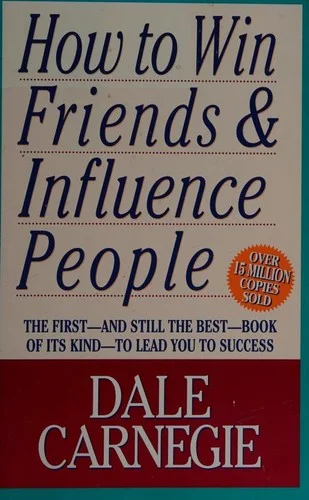
What is How to Win Friends and Influence People about?
How to Win Friends and Influence People is a classic self-help book by Dale Carnegie about human relations. It teaches timeless principles for handling people, becoming likable, persuading others, and leading — all rooted in the idea that people crave appreciation and importance, and that seeing things from their perspective, sincerely, is the key to getting along and succeeding with them.
About the author
Dale Carnegie (1888–1955) was an American writer and lecturer who rose from a poor Missouri farm background to become one of the most influential self-development educators in history. He developed and taught wildly popular courses in public speaking, salesmanship, and interpersonal skills, and the principles he refined through teaching thousands of businesspeople became the basis for this book. Published in 1936, How to Win Friends and Influence People went on to sell tens of millions of copies and to define the entire genre of interpersonal self-help; virtually every later book on communication, influence, and relationships owes it a debt. Carnegie’s method is to state each principle plainly and then illustrate it with a barrage of memorable anecdotes drawn from history, business, and everyday life. His examples are unmistakably of their era, but his understanding of human nature — our hunger for appreciation, our resistance to criticism, our love of feeling important — remains as accurate today as it was nearly a century ago. Explore all Dale Carnegie book summaries →
Key concepts at a glance
| Principle | What it means | Use it when |
|---|---|---|
| Don’t criticize | Criticism breeds resentment | Tempted to point out a fault |
| Sincere appreciation | Fulfill the craving to feel important | Every interaction |
| Arouse an eager want | Frame it around their desires | Asking anything of anyone |
| Genuine interest | Focus on them, not yourself | Meeting new people |
| Avoid arguments | You can’t win a fight | You disagree with someone |
| Let them save face | Correct without humiliation | Someone is wrong |
Part 1: Fundamental techniques in handling people
Carnegie builds everything on three fundamental principles for dealing with people, grounded in his core observation that human beings are creatures of emotion, driven by pride and a hunger to feel important.
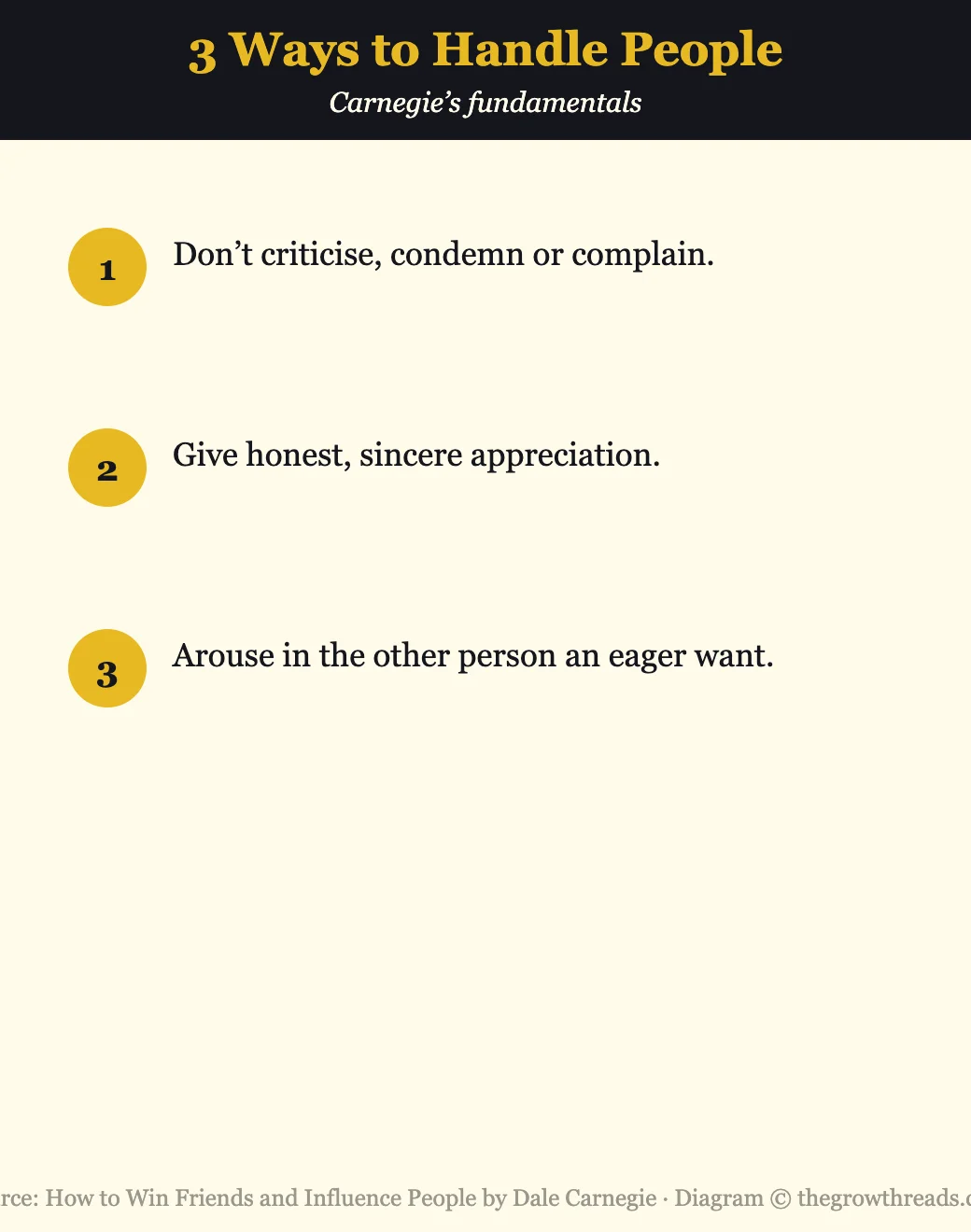
The first is: don’t criticize, condemn, or complain. Criticism, Carnegie argues, is futile because it puts people on the defensive, wounds their pride, and stirs resentment, while almost never producing lasting change; even hardened criminals, he notes, rationalize their own behavior and blame others. The second is: give honest and sincere appreciation. Because the deepest craving in human nature is the desire to feel important and appreciated, sincere praise is one of the most powerful ways to motivate and connect with people — the key word being sincere, as hollow flattery is quickly seen through and does the opposite. The third is: arouse in the other person an eager want. The only way to influence anyone, Carnegie says, is to talk about what they want and show them how to get it; you catch fish with worms the fish like, not the bait you prefer. To move someone, you must first see the situation from their angle and connect your request to their own desires. These three techniques — refrain from criticism, appreciate sincerely, and appeal to the other’s wants — are the foundation of everything that follows.
Part 2: Six ways to make people like you
The book’s most beloved section offers six practical ways to become genuinely likable.
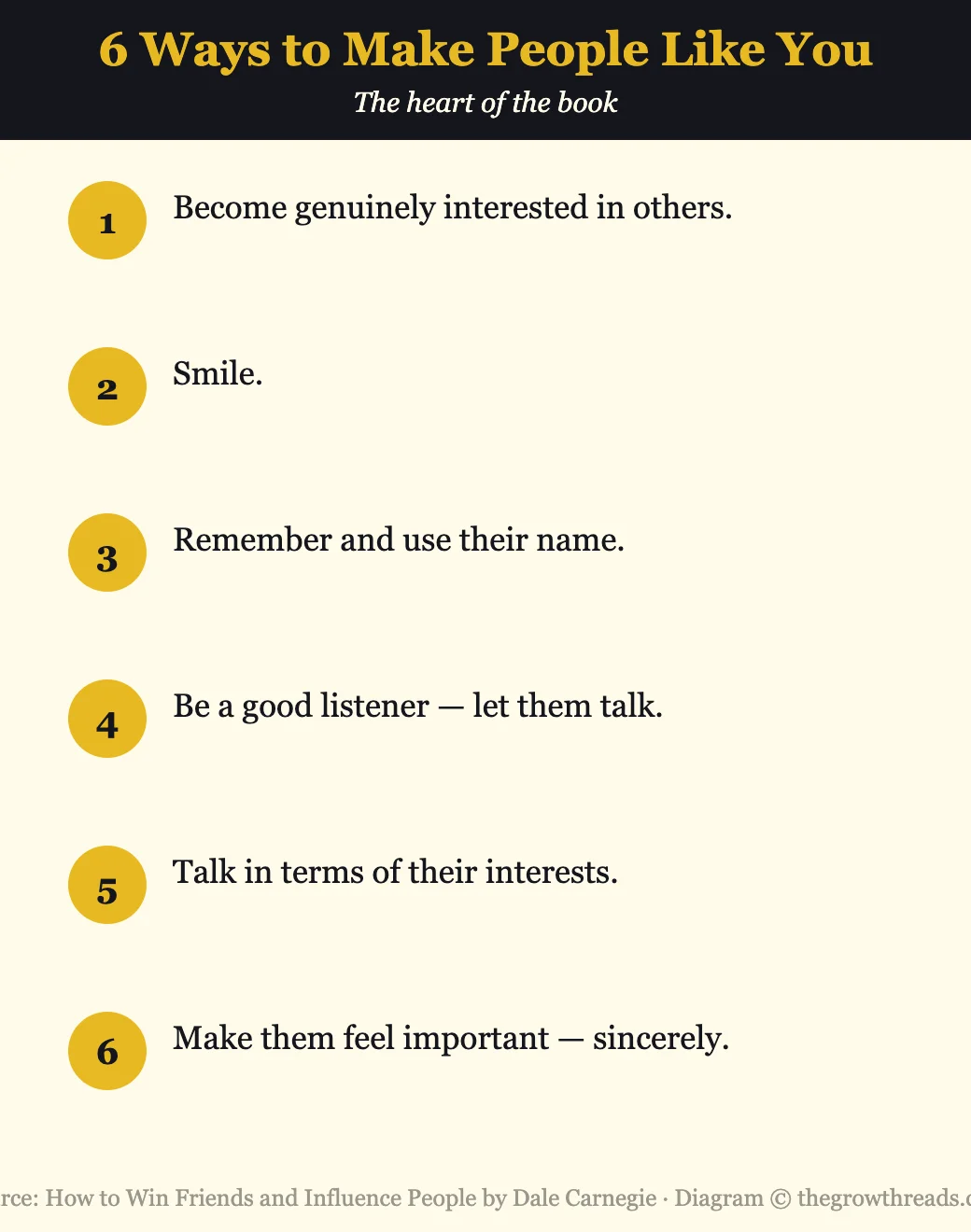
First, become genuinely interested in other people — you make more friends in two months by being interested in others than in two years trying to get others interested in you. Second, smile: a warm, genuine smile communicates goodwill instantly and costs nothing. Third, remember and use people’s names, because a person’s own name is, to them, the sweetest and most important sound in any language, and remembering it signals that they matter. Fourth, be a good listener and encourage others to talk about themselves; being a rapt, attentive listener is one of the highest compliments you can pay, and people will find you fascinating precisely when you let them do the talking. Fifth, talk in terms of the other person’s interests — the royal road to someone’s heart is to discuss what they treasure most. Sixth, make the other person feel important, and do it sincerely; applying the age-old principle of treating others as you’d wish to be treated, and genuinely valuing them, is the master key to likability. What unites all six is that they shift the focus off yourself and onto the other person, satisfying their need to feel seen and valued — which is exactly what makes people warm to you.
TGR Note: Carnegie’s “be a good listener” and “become genuinely interested” are the sincere, everyday version of the tactical empathy Chris Voss weaponizes for high-stakes deals in Never Split the Difference, and of the fifth habit — seek first to understand — in The 7 Habits. Master Carnegie’s warm basics first; the others build on them.
Part 3: How to win people to your way of thinking
The third part addresses persuasion — how to bring others around to your view without creating enemies.
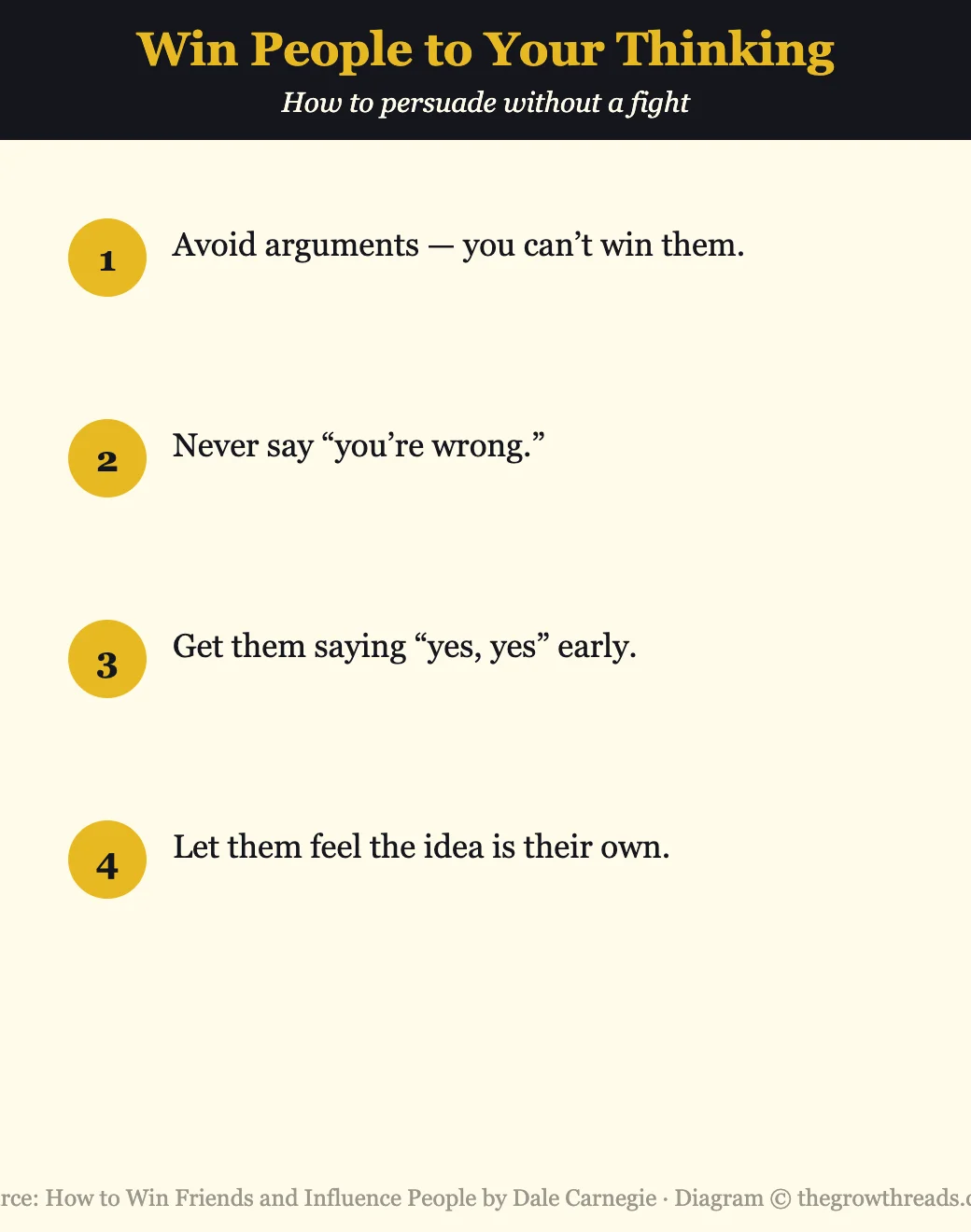
Carnegie’s most famous rule here is that the only way to get the best of an argument is to avoid it. You cannot win an argument, he insists: if you lose, you lose; and if you “win,” you still lose, because you’ve wounded the other person’s pride and made an enemy. Instead of arguing, show respect for the other person’s opinions and never tell someone flatly that they’re wrong, since doing so is a direct blow to their intelligence and self-esteem that only makes them dig in. If you yourself are wrong, admit it quickly and emphatically, which disarms people. Begin conversations in a friendly way, and get the other person saying “yes, yes” from the outset — because a person who has started by agreeing is far more likely to keep agreeing. Let the other person do most of the talking, and, crucially, let them feel that the idea is their own; people support conclusions they helped reach far more than ones imposed on them. Try honestly to see things from the other person’s point of view, be sympathetic to their ideas and desires, appeal to their nobler motives, dramatize your ideas to make them vivid, and, when needed, throw down a stimulating challenge. Every one of these techniques replaces confrontation with understanding, letting you influence people while leaving their dignity intact.
Part 4: Be a leader — changing people without offense
The final part is about leadership: how to correct, coach, and change people’s behavior without arousing resentment or rebellion. The unifying principle is to protect the other person’s pride at every step. Begin with honest praise and appreciation before addressing a problem, so the person is receptive rather than defensive. Call attention to mistakes indirectly, and talk about your own mistakes first before criticizing someone else’s, which puts you on the same level rather than above them. Ask questions instead of giving direct orders, since people resent being commanded but respond well to being invited to solve a problem. Let the other person save face — never humiliate someone, even when they’re clearly at fault, because the damage to the relationship outlasts any momentary satisfaction. Praise every improvement, even the slightest, to encourage more of it, and give the person a fine reputation to live up to, since people tend to rise to the good opinion others hold of them. Make faults seem easy to correct so the person feels capable, and make the other person happy about doing what you suggest by connecting it to their own interests.
Taken together, Carnegie’s principles amount to a philosophy as much as a technique: consistently put yourself in the other person’s shoes, honor their need to feel important, and lead with appreciation rather than criticism. Critics sometimes charge that the book teaches manipulation, but Carnegie is insistent throughout that sincerity is non-negotiable — the methods only work, and are only worth using, when the appreciation and interest are genuine. Applied cynically they ring false; applied honestly they are simply the habits of a considerate, emotionally intelligent person. The anecdotes are dated and the tone is earnestly old-fashioned, but the book’s understanding of human nature is timeless, which is exactly why it has helped tens of millions of people become more likable, persuasive, and effective for nearly a century.
TGR Note: Carnegie is the warm end of the influence spectrum; The 48 Laws of Power is the cold, strategic end. Fascinatingly, they agree on the mechanics — appeal to self-interest, avoid winning arguments, let people feel important — and differ only in spirit. Read Carnegie as your default and Greene as the armor for when good faith isn’t returned.
Who is How to Win Friends and Influence People best for — and who should read something else first?
This book is ideal for absolutely anyone — it is foundational reading on getting along with people, useful in work, friendship, family, sales, and leadership alike. Its principles are simple, memorable, and applicable immediately. It is not for you if you’re allergic to old-fashioned, anecdote-heavy writing, or if you dislike the (mistaken) impression that its techniques are manipulative rather than sincere. For a modern, high-stakes application of the same listening-and-empathy principles, read Never Split the Difference; for the broader character foundation beneath them, read The 7 Habits of Highly Effective People.
Questions to reflect on
- When did criticizing someone last actually change them — or did it just create resentment?
- Whose importance could you sincerely acknowledge today, and how?
- In your next request, how could you frame it around what the other person wants?
- In conversations, are you more interested in being interesting — or in the other person?
- Where are you winning arguments but losing relationships?
🔥 Ready to master people skills?
This guide is the map — Carnegie’s stories are what make the principles unforgettable.
How to apply How to Win Friends and Influence People (7-day plan)
- Day 1 — Cut the criticism. Go a full day without criticizing, condemning, or complaining about anyone.
- Day 2 — Appreciate sincerely. Give three people honest, specific appreciation for something real.
- Day 3 — Get genuinely interested. In one conversation, ask questions and listen instead of talking about yourself.
- Day 4 — Use names. Make a point of learning and using people’s names today.
- Day 5 — Frame it their way. Take one request and rephrase it around what the other person wants.
- Day 6 — Dodge an argument. When you disagree, resist arguing; find common ground and get a “yes” first.
- Day 7 — Lead with praise. Before pointing out any mistake, start with honest appreciation and let them save face.
Frequently asked questions
Is How to Win Friends and Influence People worth reading?
Yes — it is one of the most valuable and enduring self-help books ever written. Its principles for getting along with and influencing people are simple, memorable, and immediately useful in every area of life, from work to friendships to family. Nearly a century after publication, its understanding of human nature — our craving for appreciation, our resistance to criticism — remains strikingly accurate. The only real drawbacks are that the anecdotes feel dated and the earnest tone can seem old-fashioned, but the substance is timeless, which is why it has helped tens of millions of readers.
What is the main message of How to Win Friends and Influence People?
That the way to succeed with people is to make them feel genuinely valued and to see things from their point of view, rather than to criticize, argue, or push your own agenda. Carnegie’s core insight is that humans are driven by emotion and a deep desire to feel important, so sincere appreciation, real interest in others, and framing everything around what they want are the keys to being liked, persuasive, and effective. It is as much a philosophy of considerate character as a set of techniques.
Are the techniques in the book manipulative?
They can look that way, but Carnegie is emphatic throughout that sincerity is essential — the methods only work, and are only worth using, when the appreciation and interest behind them are genuine. Hollow flattery and fake interest are quickly seen through and backfire. Applied cynically, the techniques ring false; applied honestly, they are simply the habits of a considerate, emotionally intelligent person who genuinely cares about others. The book is best understood not as a manual for manipulation but as a guide to treating people with real respect — which happens to also be effective.
What are the six ways to make people like you?
Carnegie lists: 1) become genuinely interested in other people; 2) smile; 3) remember and use a person’s name; 4) be a good listener and encourage others to talk about themselves; 5) talk in terms of the other person’s interests; and 6) make the other person feel important, sincerely. What unites all six is that they shift attention off yourself and onto the other person, satisfying their need to feel seen and valued, which is precisely what makes people warm to you.
How do you win an argument according to the book?
You don’t — Carnegie’s famous advice is that the only way to get the best of an argument is to avoid it. He argues you can’t really win: if you lose you lose, and if you “win” you still lose because you’ve wounded the other person’s pride and made an enemy. Instead of arguing, show respect for their opinion, never tell them flatly they’re wrong, admit your own errors quickly, begin in a friendly way, get them agreeing early, and let them feel any good idea is their own. You influence far more through understanding than through confrontation.
How long does it take to read How to Win Friends and Influence People?
The book is around 290 pages and most readers finish it in about six hours. Its structure — clear principles followed by illustrative stories — makes it easy to read in sections and to revisit specific rules. Our summary above captures all the core principles across the four parts in roughly 15 minutes, which is enough to start applying them, though the anecdotes in the full book are part of what makes the lessons stick.
Is How to Win Friends and Influence People still relevant today?
Very much so. While the examples are drawn from the 1930s and can feel quaint, the human nature they illustrate has not changed — people still crave appreciation, still resent criticism, still love to feel important, and still respond to genuine interest. That is why the book remains a foundational text that modern communication, sales, and leadership books continue to build on. Read past the dated surface, and its principles are as practical and effective in today’s workplaces, relationships, and digital interactions as they were nearly a century ago.
Related summaries
- Never Split the Difference Summary — the same empathy, applied under pressure.
- The 7 Habits Summary — the character foundation beneath people skills.
- The 48 Laws of Power Summary — the colder, strategic end of influence.
- The Let Them Theory Summary — letting go of controlling others.
- Browse all our best relationship books.
How we analyze books: We work from the full book — reconstructing its core arguments in our own words, adding commentary that connects it to related research and other books in our library, and pressure-testing the advice against how it plays out in real life. We never reproduce the text; we synthesize it. Read our full methodology.
Disclosure: The Growth Reads is reader-supported. When you buy through links on our site we may earn an affiliate commission at no extra cost to you. We only recommend books we believe are worth your time, and our summaries and opinions are written independently.