
AI and emerging technology are reshaping how we work, create, and decide faster than almost anything before them. The best technology books don’t just explain what these tools do — they teach you how to think clearly about using them well.
Latest Summaries
Recently published reviews in this topic.
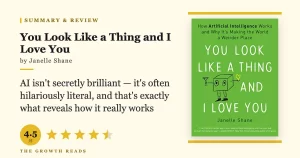
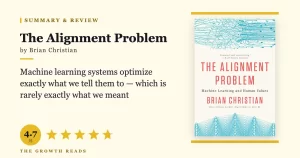
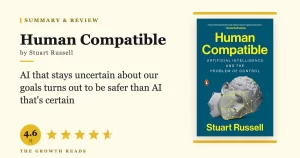
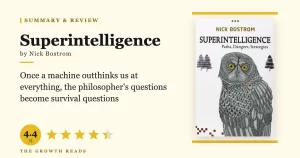
All Technology Book Reviews
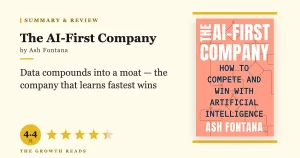
The AI-First Company Summary & Review (2026)
Ash Fontana's playbook for building a compounding data advantage: what to collect, who to hire, and how to redesign workflows around a feedback loop...
Read Review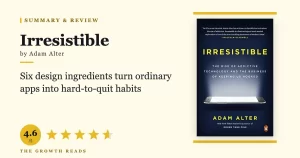
Irresistible Summary & Review: The Six-Ingredient Hook Behind Your Habits
Adam Alter's Irresistible breaks down the six design ingredients that make apps, games, and social media impossible to put down — plus the friction-based...
Read Review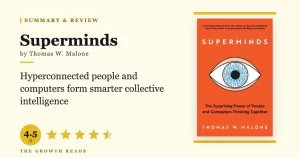
Superminds Summary & Review: How People and AI Think Smarter Together
Thomas W. Malone's Superminds shows how hyperconnected groups of people and AI, organized around four "genes," think more intelligently than any individual mind.
Read Review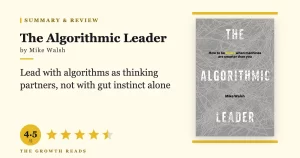
The Algorithmic Leader Summary & Review
Mike Walsh's practical guide to leading when algorithms are part of every decision — how to build an evidence-first mindset, blend human judgment with...
Read Review
Human + Machine Summary & Review: Redesigning Work for the AI Era
Daugherty and Wilson's HBR playbook for redesigning work around AI — the "Missing Middle," six fusion roles, and the MELDS framework for scaling past...
Read Review
Uncanny Valley Summary & Review: Silicon Valley’s Utopia, From the Inside
Anna Wiener's memoir of four Silicon Valley jobs — the mission-speak, the gender dynamics, and the surveillance economy she helped build, then walked away...
Read Review
The Creativity Code Summary & Review: Can AI Really Create?
Marcus du Sautoy's The Creativity Code tests whether AI is genuinely creative across games, art, music, and mathematics — using Move 37, GAN art,...
Read Review
Team Human
Douglas Rushkoff's manifesto argues that technology and markets increasingly pit people against each other — and makes the case for choosing human solidarity, on...
Read Review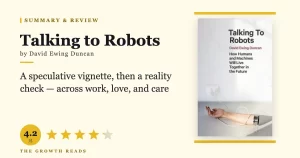
Talking to Robots by David Ewing Duncan Summary & Review
Talking to Robots pairs speculative fiction with grounded reporting to test how close robots really are to reshaping work, relationships, elder care, medicine, parenting,...
Read Review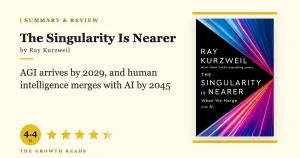
The Singularity Is Nearer Summary & Review: Kurzweil’s Case for 2029 and 2045
Ray Kurzweil argues AGI arrives by 2029 and the Singularity by 2045. Here's the book's core argument, its track record so far, and how...
Read Review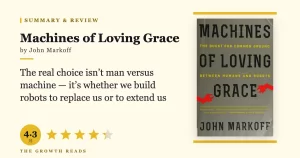
Machines of Loving Grace Summary & Review: The Hidden Fork Behind Every AI Debate
John Markoff traces AI and human-centered computing to the same 1960s Bay Area labs — and argues the fork between 'replace' and 'augment' is...
Read Review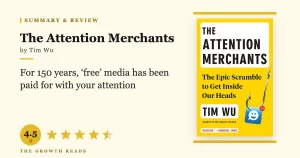
The Attention Merchants Summary & Review: Reclaiming Your Focus
Tim Wu's The Attention Merchants traces 150 years of attention-harvesting business models, from patent-medicine posters to algorithmic feeds, and what reclaiming your focus actually...
Read ReviewBrowse All Technology Summaries
New AI and technology book reviews are added regularly — practical takeaways, not just hype.
How We Select & Review AI Books
The Growth Reads editorial team reads every AI and technology book we cover in full before writing a summary. We aren’t chasing every new release — the field moves too fast for that — so we prioritize books that hold up over time: clear thinking about how AI actually works, how it’s changing work and decision-making, and what it means for the years ahead, rather than product hype or tool-of-the-month coverage.
Each book is evaluated against the same three criteria we use across every topic on this site: depth (does it go beyond the headline argument?), practicality (can you actually use the ideas?), and lasting impact (does it still hold up months or years after publication?). Where a book makes a specific factual or technical claim, we check it against the author’s own sources and, where relevant, more recent developments — and we flag it in the summary when a book’s examples have visibly aged, even if its core argument hasn’t.
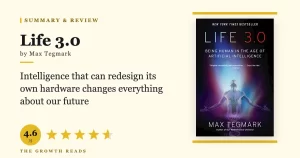
Books enter this topic from two directions: notable new AI titles as they publish, and older influential books that predate the recent AI boom but whose ideas remain foundational — Superintelligence and Life 3.0 were both years ahead of the mainstream AI conversation. We periodically re-review earlier summaries and refresh dating-sensitive references, like specific model or product comparisons, even when the underlying argument doesn’t need a rewrite.
Every summary ends with a practical takeaway, not just a recap of the book’s argument, and every rating reflects an honest read of the whole book, not the publisher’s marketing copy. We are an independent publisher: our reviews aren’t affiliated with or endorsed by the authors or publishers of the books we cover, and while some links on this page are affiliate links (Amazon, Bookshop.org), that has no bearing on which books make this list or how we rate them.
For our full ranked countdown, see 20 Best AI Books of All Time.
Frequently Asked Questions
What’s the best book to understand AI?
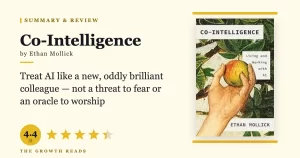
For a broad, non-technical starting point, Co-Intelligence by Ethan Mollick is the most practical current pick — it focuses on how to actually work with AI tools today. For the bigger-picture “where is this going” question, Life 3.0 by Max Tegmark and Superintelligence by Nick Bostrom are the two most-cited starting points.
Are AI books from 2018–2020 still worth reading?
Yes, for the ones that focus on ideas rather than products. Books like Superintelligence, Life 3.0, and The Second Machine Age argue about AI’s trajectory, incentives, and societal impact — that reasoning hasn’t gone stale. Where a book leans on a specific tool or product example, treat that detail as dated and focus on the underlying argument.
Do I need a technical background to read these books?
No. Almost every book on this list is written for a general audience — several, like You Look Like a Thing and I Love You, are written specifically to make AI concepts approachable without a computer science background.
Which AI book should I start with if I’m new to the topic?
Start with Co-Intelligence for a practical, work-focused angle, or You Look Like a Thing and I Love You for an accessible, often funny explanation of how machine learning actually works before moving on to denser arguments about AI’s future.
What’s the difference between books about AI risk and books about using AI at work?
Risk-and-safety books — Superintelligence, Human Compatible, The Alignment Problem — focus on what could go wrong as AI systems get more capable and how to keep them aligned with human goals. Practical/productivity books — Co-Intelligence, Working with AI, Prediction Machines — focus on how individuals and companies get value from AI today. Most readers benefit from at least one book from each category.
How often is this list updated?
We review and refresh this page at least yearly, and add new AI books as they’re published and reviewed. Older summaries are periodically checked for dated examples even when their core arguments still hold.
Explore Other Topics
More book summary hubs on The Growth Reads.