

★★★★☆ 4.4/5 — A short workplace fable that hands you the driver’s seat, a no-vampires rule, and a script for who gets on the bus.
Best for: managers, team leads, and anyone whose Monday is being driven by the loudest mood in the room.
Reading time: ~3.5 hours (192 pages) · this guide ~12 min
Difficulty to apply: Easy. Write who is driving. Stop feeding one vampire. Invite one passenger onto a real ride.
The Energy Bus in one minute
You are the driver of your bus. Act like it, or someone else’s mood will take the wheel. Jon Gordon’s The Energy Bus (Wiley, 2007) is a parable, not a lab manual. George is late, his team is failing, and his marriage is thinning. He misses his usual commute, boards a bus, and meets Joy — a driver who will not let him ride as a victim. Ten rules follow. They cluster into three jobs. Drive: pick a destination, fuel on purpose. Choose passengers: invite builders, stop wasting fuel on people who will not board, post a no-energy-vampires rule you actually keep. Run the ride: enthusiasm, care, a journey you can stand, and enough enjoyment that people stay. If you only take one move from this Energy Bus summary, write who is driving tomorrow’s first meeting, and who you will stop feeding for one day.
Key takeaways
- You are the driver: If you do not take the wheel, a rumor, a calendar, or a tired inner voice will.
- Desire needs a visor line: Vision and focus aim the bus. Restlessness without a destination is just spinning tires.
- Fuel is a practice: Positive energy is not a personality. It is what you put in before the first meeting.
- Invitation is a specific ride: “We should catch up” is not a ticket. A doc, a standup, a practice is.
- Not everyone gets on: Stop spending your best fuel arguing people onto a bus they have already refused.
- Energy vampires are a posted rule: Complaint, rumor, and the meeting after the meeting do not get a second loop.
- Enthusiasm is contagious on purpose: Flat leadership trains a flat ride. Name the work you are glad to do.
- Love the passengers you already have: Precise thanks beats a pep talk. People stay where they are seen.
- Love the journey, not only the launch: A destination with a miserable ride still loses the team.
- Joy is fuel, not a weekend reward: Protect a stretch of the job you actually like so the bus can keep running.
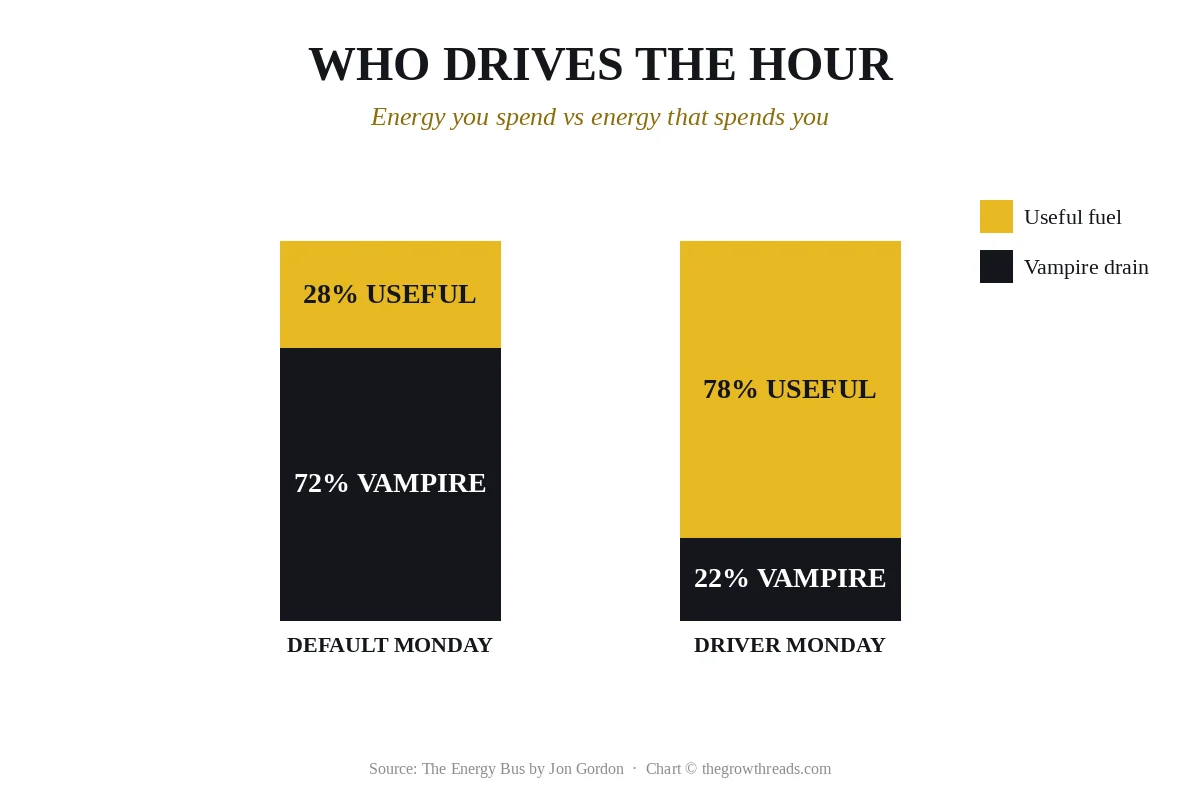
What is The Energy Bus about?
The Energy Bus is Jon Gordon’s 2007 Wiley parable: a failing manager meets a bus driver named Joy and learns ten rules for fueling work with positive energy. You drive the bus. You choose who rides. You stop feeding energy vampires.
About the author
Jon Gordon is an American consultant and parable writer whose work sits between locker rooms and Monday standups. Cornell-trained, he built a practice around one claim: a team’s energy is a leadership job, not a mood that happens to you. The Energy Bus (Wiley, 2007), with a foreword by Ken Blanchard, is the origin story — a short fable that made ten rules famous in offices that would never finish a dense management text. He later wrote The Carpenter, The Seed, The Power of Positive Leadership, and The Coffee Bean in the same plain voice: pick who gets on, stop feeding who drains the tank, and drive. Read him when you need a script for a tired room, not a new task app. Explore all Jon Gordon book summaries →
Key concepts at a glance
| Concept | What it means | Use it when |
|---|---|---|
| You’re the driver | You choose direction. Mood is not the chauffeur. | The week feels like it is happening to you. |
| Vision and focus | A visor line that aims the ride. | You are busy and cannot say what the week is for. |
| Positive fuel | Energy you put in on purpose before the first meeting. | You wait to feel ready, then start already empty. |
| Invitation | A ticket to a specific ride, not a vague catch-up. | You want “buy-in” and have not named the work. |
| Energy vampire | Complaint, rumor, or inner prosecution that feeds on loops. | The meeting after the meeting is where the real story lives. |
| No-vampires rule | A posted sentence you keep, including with yourself. | You keep rehearsing someone else’s bad mood. |
| Love the passengers | See the people already on the bus, precisely. | Thanks has become a vibe instead of a named piece of work. |
| Love the journey | The ride has to be livable or the destination will not hold. | The launch is exciting and every Tuesday is grim. |
Part 1: Take the wheel — driver, vision, fuel
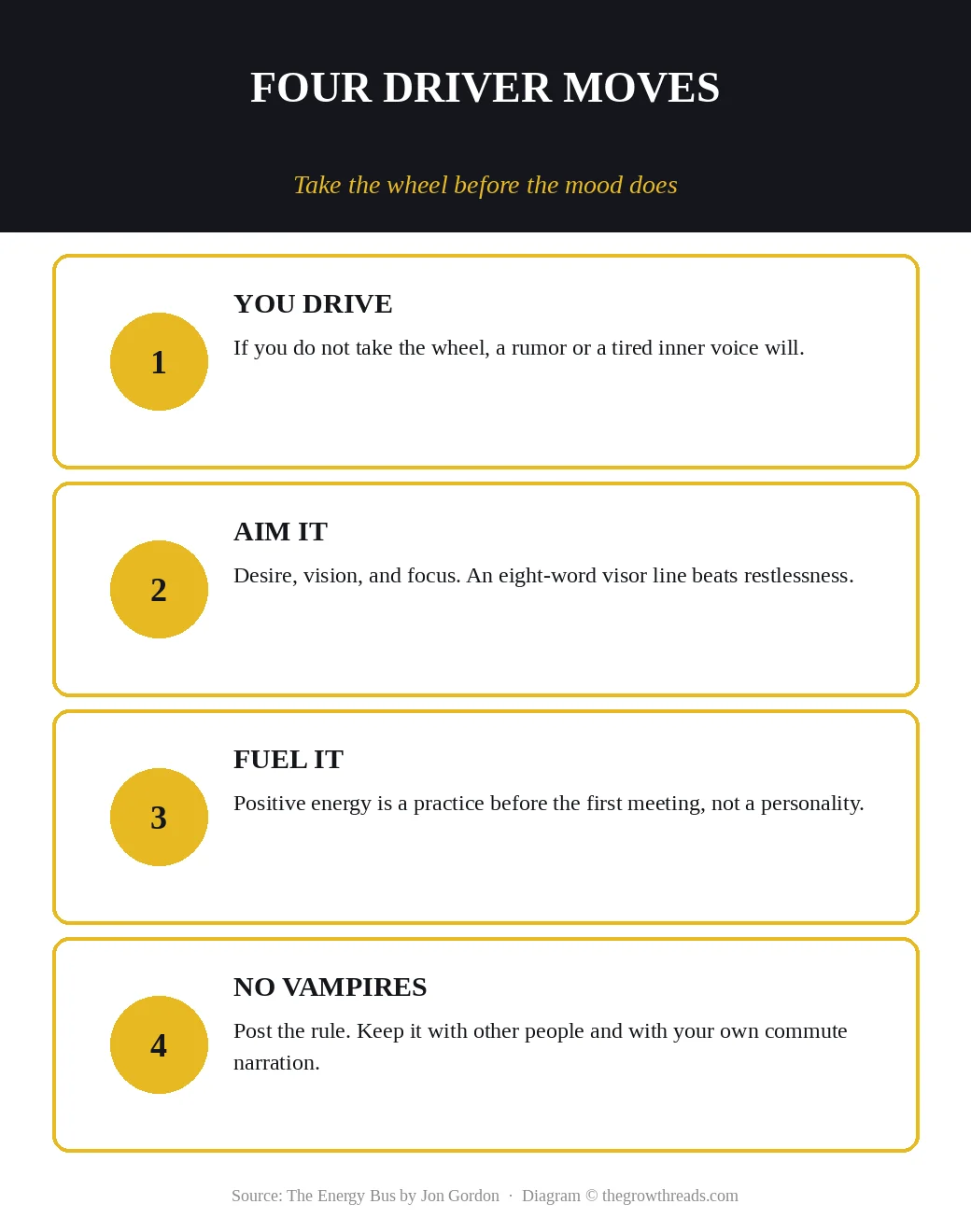
Gordon opens with a man who has already handed over the keys. George is late. The team is a problem he talks about, not a ride he is conducting. The marriage is thinning. The usual car commute would have let him stay inside that story. Missing it is the plot device: he boards a bus and meets Joy, who refuses to treat him as cargo. The first cluster of rules is ownership. You are the driver. Desire, vision, and focus point the bus. You fuel the ride on purpose instead of waiting for a better mood to arrive from traffic. None of this is a personality transplant. It is a visor card. What is this week for. Who is driving the first hour. What you will put in the tank before Slack opens. If The High 5 Habit is the inner coach in the mirror, this chapter is the same job with a steering wheel. You cannot love a team you will not drive.
Desk translation is unromantic. The bus is the standup, the sprint, the family dinner. Cargo is scrolling the worst thread before you have chosen a destination. If Soundtracks taught you to change the song in your head, Gordon wants that song on the visor. A private pep talk that never becomes a destination still leaves the team riding a rumor.
TGR Note: If the vampire is your own commentary before anyone else speaks, start with The High 5 Habit or Soundtracks. Come back here when the remaining leak is a room, not a mirror. If you still cannot start the first hour, Mini Habits is the on-ramp — one visor line, not a culture offsite.
Part 2: Who gets on — invitation and energy vampires
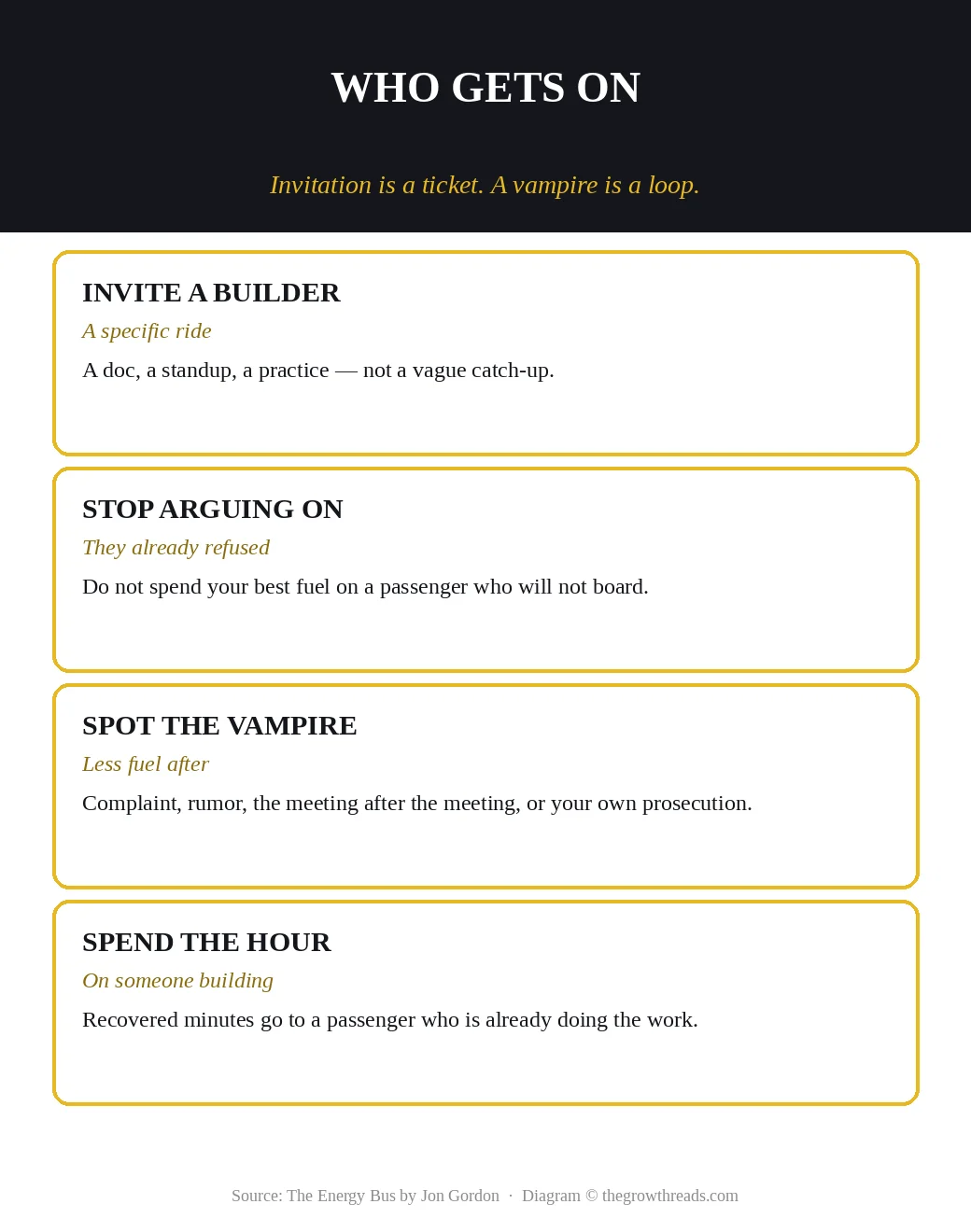
The middle rules are a hiring decision you make every week whether you notice or not. Invite people onto the bus. Do not waste fuel on people who have already refused. Post a sign: no energy vampires. Gordon’s vampire is not a brilliant skeptic. It is the person — and the inner voice — that feeds on complaint, rumor, and the unofficial meeting. The test is rude and useful. After you leave a conversation, do you have more fuel or less. If less, you just paid a fare you did not agree to. Stop rehearsing their story. Stop giving them the extra loop. Spend the recovered hour on a passenger who is already building. The posted rule is for you first. If you cannot keep it with your own narration on the commute, a poster in the kitchen will not save the standup.
Steal the move. Write one name. Write one thread you will not open before noon. If The Go-Giver is value first so the right people want on, this chapter is the gate. Generosity without a gate is how vampires eat the week. If Who Not How is finding the person who already knows the road, Gordon is refusing to chauffeur someone who only wants to critique the map. Invitation is specific: a document, a practice, a customer call — not “we should sync.”
TGR Note: Trust is the slower cousin of this gate. If the leak is that nobody believes the destination, The Speed of Trust is the operating system. If the leak is that you keep doing other people’s jobs, stay with Who Not How. The Energy Bus is the weekly version: one invitation, one refusal to feed a loop.
Part 3: Run the ride — enthusiasm, care, a livable journey
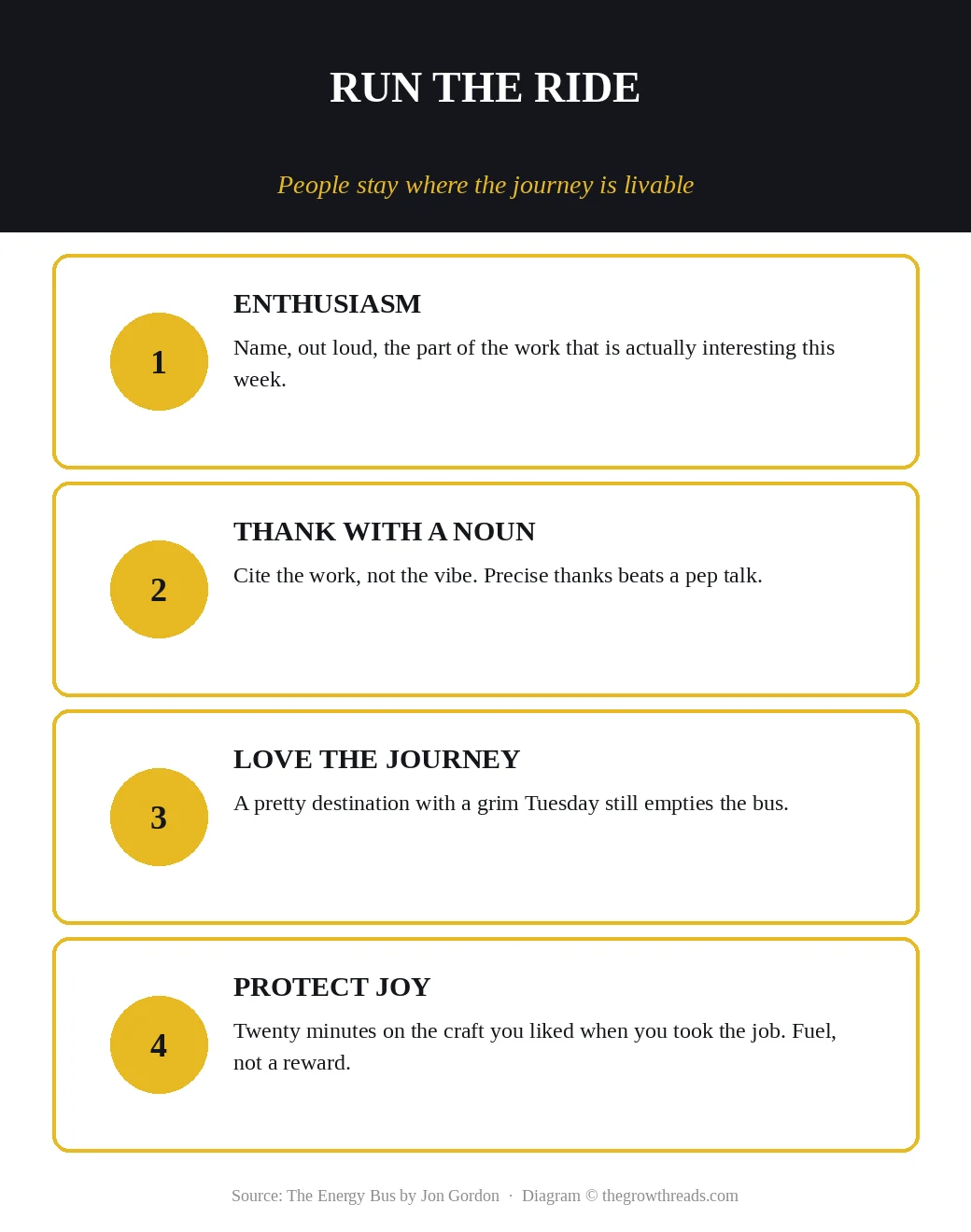
Once people are on, Gordon’s later rules are about whether they stay. Enthusiasm attracts more passengers. Love the people already seated. Love the journey, not only the launch party. Have fun enough that the ride is livable. This is where parables get dismissed as posters. The desk version is still concrete. Enthusiasm is you naming, out loud, the part of the work that is actually interesting this week — not fake volume. Love the passengers means one precise thank-you that cites the work, not the vibe. Love the journey means the process has to be survivable: a meeting that always runs hot will dump good people even if the destination is pretty. Fun is not a ping-pong table. It is twenty protected minutes on the craft you liked when you took the job. If every hour is grim, you should not be surprised when the bus empties.
Steal one behavior. Thank one person with a noun in the sentence. Protect one joyful stretch on the calendar like a customer call. If You Are a Badass is claiming your own ride, this chapter is claiming the shared one. If Finish is how you stop abandoning the destination, Gordon is why people abandon it with you: the journey felt like punishment. A livable Tuesday is a retention strategy.
TGR Note: If the remaining problem is a shop that only moves when you are the cheerful hero, Clockwork designs the machine so the ride does not depend on your mood. If you need a harder inner standard than a fable, The Power of Positive Thinking is the older cousin. Use Gordon for the team script; use those when the system or the self-talk is the actual leak.
Part 4: Keep driving — daily rules, not a kickoff poster
The last movement is maintenance. George’s story resolves the way parables do: the rules get used, the team turns, the private life gets a chance. The transferable part is less cinematic. A visor line dies in a week if you do not rewrite it. A no-vampires rule dies the first time you gossip to bond. Joy’s point is daily driving. You board, aim, refuse one loop, thank one passenger, and do it again on Thursday. Start with the commute and the first meeting. When the count of vampire loops drops, then talk about posters.
Steal the ending. Finish this week with a card and a refusal, or with a clear no — this mood is the driver I have chosen. If Atomic Habits is identity through a tiny cue, the visor line is that cue in public. If Deep Work is a door the rescue channel cannot enter, the no-vampires rule is the social version of that door. Pick the next ride when this one is boring.
TGR Note: If after two quiet days you still wait to feel official, stay with this book one more commute. If you need systems that manufacture fewer fires, walk Upstream. The Energy Bus is the energy layer. Upstream is the cause layer. You probably need both; start with the one that matches this week’s leak.
Who is The Energy Bus best for — and who should read something else first?
Best for managers, coaches, and individual contributors whose week is being driven by the loudest mood: a standup that always sours, a group chat that rehearses the worst story, a commute that is already a prosecution. If you want a team script you can finish on a flight, this is it. If you want the inner coach before anyone else is awake, go to The High 5 Habit. If you want give-first relationships, go to The Go-Giver.
Read something else first if you still cannot start a two-minute task — begin with Mini Habits. If you need the science of habits, start with Atomic Habits. If the shop only moves when you are in the room, start with Clockwork. If the repeating mess is a system, not a mood, start with Upstream. Come to The Energy Bus when you can already do the work and the remaining failure is that the room’s energy is nobody’s job.
Questions to reflect on
- Who drove your last commute — you, a rumor, or a calendar you did not choose?
- After which standing conversation do you always have less fuel?
- What is this week’s ride for, in eight words a passenger could repeat?
- Who have you been trying to argue onto the bus after they already refused?
- Where could twenty minutes of actual enjoyment sit on tomorrow’s calendar?
🔥 Ready to take the wheel?
One visor line. One vampire you will not feed. One passenger you actually invite.
How to apply The Energy Bus (7-day plan)
- Day 1 — Write who is driving. One sentence. Is it you, a rumor, or a calendar you did not pick? Put the card on the visor.
- Day 2 — Aim the bus. Write the destination for this week in eight words. Desire without a visor line is just restlessness.
- Day 3 — Name the vampire. Person, thread, or inner commentary. You will not feed it for one workday. Recovered minutes go to a builder.
- Day 4 — Invite one passenger. A specific ride: a doc, a standup, a practice. Not a vague ‘we should catch up.’
- Day 5 — Love one passenger in public. One precise thank-you that names the work, not the vibe. Enthusiasm without specifics is noise.
- Day 6 — Protect a joyful stretch. Twenty minutes on the part of the job you actually like. Joy is fuel, not a weekend reward.
- Day 7 — Keep the rule. Rewrite the no-vampires sentence. If you broke it, start the next commute clean. The bus runs daily.
Frequently asked questions
What is The Energy Bus about?
The Energy Bus is Jon Gordon’s 2007 Wiley parable about a manager named George who is losing his job, his marriage, and his team until a bus driver named Joy hands him ten rules for fueling work with positive energy. You drive. You choose who rides. You post a no-vampires rule and keep it. The fable is short on lab studies and long on scripts you can use in a standup: vision on the visor, one invitation, one person you stop feeding. Read it as a team-energy manual, not a new task app.
How long does it take to read The Energy Bus?
The Wiley hardcover is about 192 pages. Most readers finish in three and a half hours. This Energy Bus summary is a twelve-minute pass: the driver rule, the vampire rule, the passenger rule, and a seven-day plan aimed at one commute and one meeting. If you only have lunch, write who is driving your Monday, who is draining it, and one person you will invite onto a specific ride. Case studies and later Gordon titles can wait. A visor line and a no-vampires sentence cannot.
What are the 10 rules in The Energy Bus?
Gordon’s ten rules cluster. You are the driver: desire, vision, and focus aim the bus, and you fuel it on purpose. You choose passengers: invite people on, stop wasting fuel on people who will not board, and post a no-energy-vampires rule you actually keep. You run the ride: enthusiasm attracts, you take care of the people already seated, you love the journey, and you let the work be enjoyable enough that people stay. Do not laminate all ten. Pick driver, vampires, and one invitation this week.
Who is an energy vampire in The Energy Bus?
An energy vampire is not a difficult expert. It is the person — or the voice in your own head — that feeds on complaint, rumor, and the meeting after the meeting. Gordon’s move is a posted rule plus a private one: stop rehearsing their story, stop giving them the extra loop, and spend the recovered hour on a passenger who is already building. If the vampire is you, the same rule applies. Write the sentence you repeat on the way to work. If it is a prosecution, you are driving someone else’s bus.
Is The Energy Bus still worth reading in 2026?
Yes, if your week is still being driven by the loudest mood in the room. Slack and group chats made vampires cheaper to feed, which makes a posted rule more useful, not less. The parable will feel simple if you already run a tight culture. That is a feature: you can finish it on a flight and use a rule on Tuesday. If you need the science of habits, start with Atomic Habits or Good Habits, Bad Habits. If you need a shop that runs when you leave, start with Clockwork. Come here for the energy layer those books do not script.
How is The Energy Bus different from The Go-Giver or The High 5 Habit?
The Go-Giver is value first — give more than you take, then the bus fills. The High 5 Habit is the inner coach in the mirror before the commute starts. The Energy Bus sits between them. It is a team fable: who is allowed on, who is draining the tank, and whether you are even in the driver’s seat. Use High 5 when the vampire is your own commentary. Use The Go-Giver when the leak is stingy relationships. Use this when the Monday standup has a mood and nobody named it as a job.
What should I do on day one with The Energy Bus?
Do not host a values offsite. Write one line on a card: what this week’s ride is for. Write who is driving it — you, a rumor, a calendar you did not choose. Write one vampire you will not feed for twenty-four hours, including your own narration on the way in. That is the entry fee. A poster can wait. If you cannot name the ride, you are still collecting quotes. This is not medical or workplace-legal advice. Treat the fable as a pattern for one meeting, not a promise that a difficult person will transform overnight.
Related summaries
- The High 5 Habit — the inner coach before the commute; this book is the team ride after.
- Soundtracks — change the song in your head; put the new one on the visor.
- The Go-Giver — value first so the right people want on.
- Who Not How — find builders instead of arguing passengers onto the map.
- Best productivity books — the full Productivity silo.
How we analyze books: every book on The Growth Reads is read cover to cover, summarized in thousands of words of original analysis, and rated against our five-criteria rubric (lasting impact, evidence quality, practical application, writing & originality, external consensus). Read our full methodology.