

★★★★½ 4.5/5 — stop doing the work; design a business that runs without you.
Best for: Founders and operators who have become the bottleneck
Reading time: ~8 hours (304 pages, 2022 revised) · this guide ~12 min
Difficulty to apply: Medium — the worksheets are simple; handing over Doing is not
Clockwork in one minute
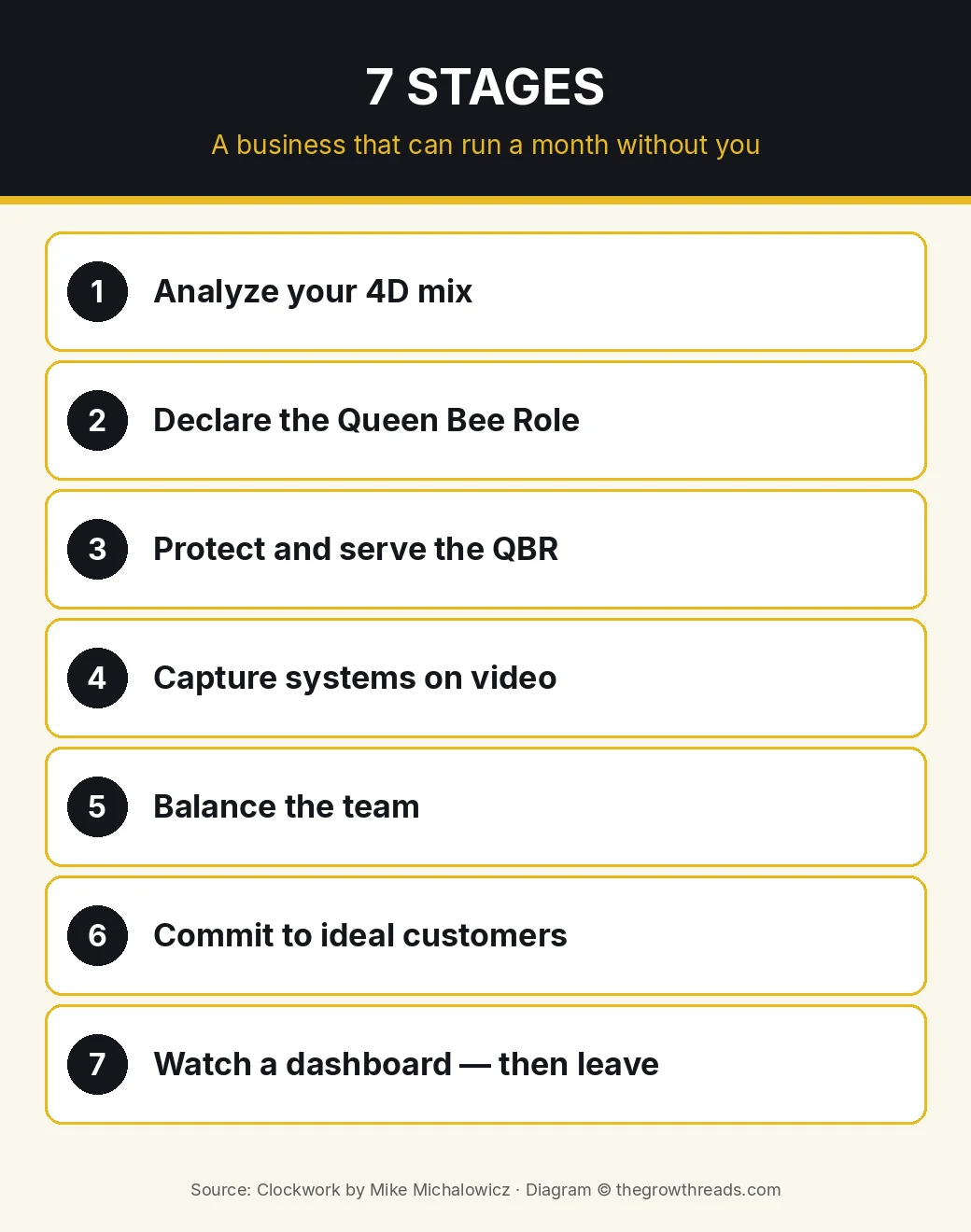
If the business dies when you take a week off, you do not own a company. You own a job with extra steps. Mike Michalowicz wrote Clockwork as the time twin of Profit First: first make cash a habit, then design the work so it does not need your hands. The method is blunt. Sort your week into Doing, Deciding, Delegating, and Designing. Name the one Queen Bee Role that delivers your promise to customers. Protect that function like a hive protects egg-laying. Record how work actually happens — on video, not in a 40-page SOP no one opens — file it under Attract, Convert, Deliver, Collect, and give someone a result to own. Then watch a short dashboard and take a four-week vacation. This TGR summary turns that into a concepts table, three diagrams, and a seven-day start you can run before you buy another tool.
Key takeaways
- You are the bottleneck: growth that still needs you in every loop is a heavier job, not a business.
- Ask a better question: not “how do I get more done?” but “what must get done, and who owns it?”
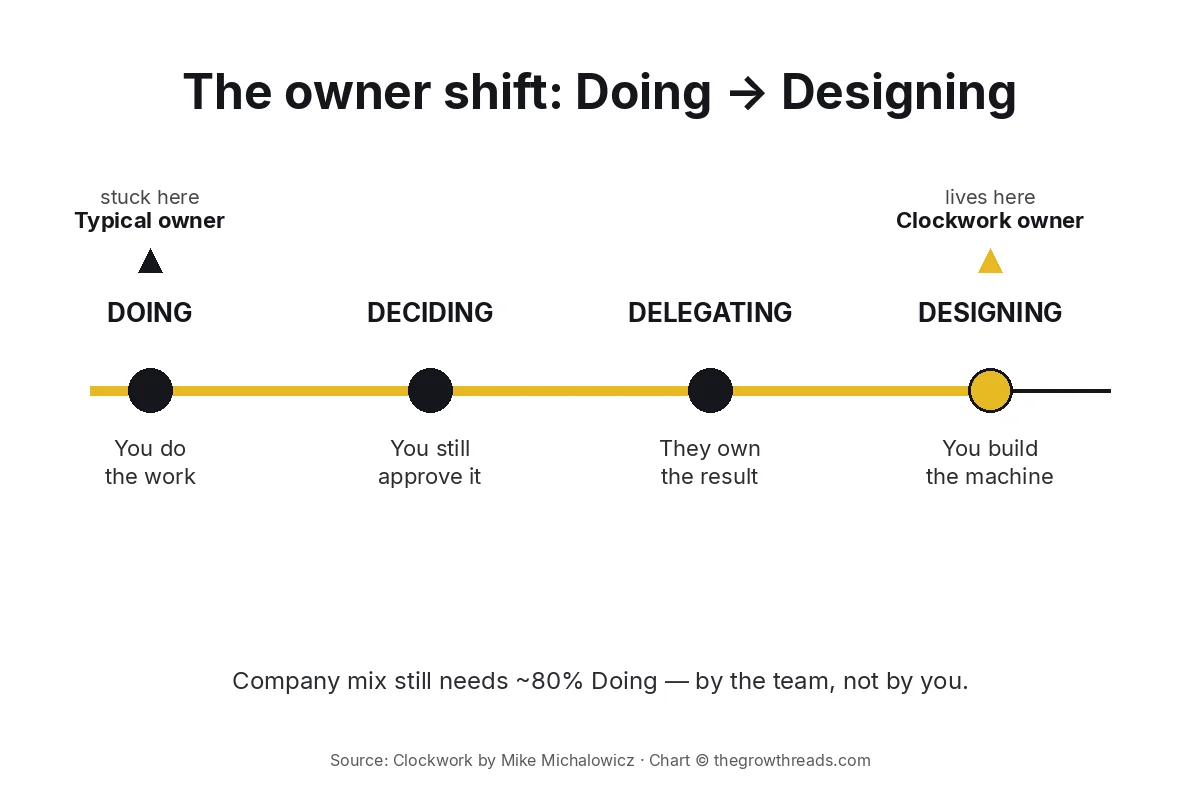
- The 4D mix: Doing, Deciding, Delegating, Designing. Owners drown in the first two.
- Company Doing stays high: ~80% of hours should still be Doing — by the team, not by you.
- Queen Bee Role: one function delivers the Big Promise. Protect the function, not a hero.
- Trash, transfer, trim: free time for the QBR before you add another hire or app.
- Capture on video: record the real process once; a written SOP is usually theater.
- ACDC filing: Attract, Convert, Deliver, Collect — one owner per outcome.
- The exam is four weeks: if they cannot reach you and the promise still holds, the design worked.
What is Clockwork about?
Clockwork is Mike Michalowicz’s practical book on designing a company that keeps its customer promise without the founder as the engine. It gives you a 4D time mix, a Queen Bee Role to protect, a seven-stage build, and a four-week vacation as the test that the system actually runs.
About the author
Mike Michalowicz is an American entrepreneur and author who built and sold two companies before losing a fortune as an angel investor and starting over. That crash is why he stopped treating “work harder” as a strategy. After Profit First — pay the business first — Clockwork (2018, revised 2022) is the time counterpart: a system for a company that keeps its promise when the founder is gone. He was a Wall Street Journal small-business columnist, hosted MSNBC’s Business Rescue segment, and now teaches the method through workshops and RunLikeClockWork.com. He graduated from Virginia Tech. Explore all Mike Michalowicz book summaries →
Key concepts at a glance
| Concept | What it means | Use it when |
|---|---|---|
| 4D mix | Doing, Deciding, Delegating, Designing — four ways time is spent | Your calendar is full and nothing important moved |
| Queen Bee Role | The one function that delivers the Big Promise to customers | Everything feels urgent and the promise still slips |
| Big Promise | The commitment a customer is actually buying | You cannot say what would make a week a success |
| Trash / transfer / trim | Cut, hand off, or shrink work that does not serve the QBR | You “have no time” to design the business |
| Capture on video | Record the real process once, then assign an owner | Training means shadowing you for a month |
| ACDC | Attract, Convert, Deliver, Collect — the four outcome folders | SOPs live in a drive no one can search |
| Ideal customer | The whom you can serve without breaking the system | Custom work keeps exploding the process |
| Four-week vacation | The test that the design works when you are unreachable | You still check Slack from the beach |
Part 1: You own a job — the 4D mix
Michalowicz opens where most founder books flatter you and he does not. The extra hours, the inbox at midnight, the “I just need one more hire” loop — those are not proof you are committed. They are proof the business is designed around your nervous system. Parkinson’s Law does the rest: when you get faster, you add more work, so the week stays full. Productivity theater is a great way to hide an unhealthy company.
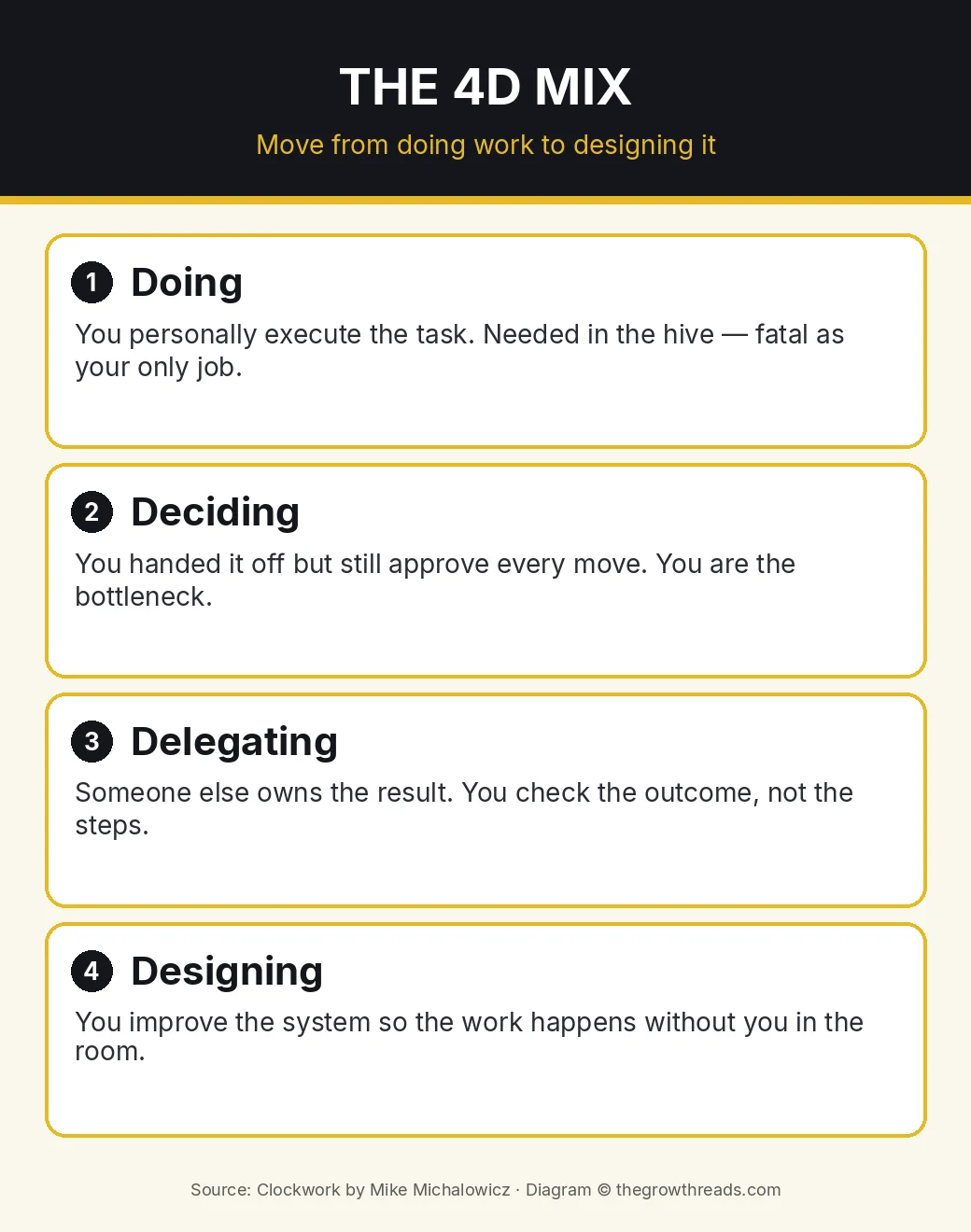
He splits work into four verbs. Doing is you executing. It is honest, visible, and addictive, because it feels like progress. Deciding is the silent tax: you delegated the task and kept the judgment. The team waits. You become a roundabout. Delegating is different — someone else owns the result and comes back with an outcome, not a question. Designing is work on the machine: the offer, the QBR, the handoff, the dashboard. A Clockwork owner is paid to live here.
The company mix still needs a lot of Doing. Summaries of the book put the target near 80% Doing, 2% Deciding, 8% Delegating, 10% Designing across the whole team. That is not a license for the founder to stay in the 80%. It is a picture of a hive: most bees forage; the queen is not supposed to. Log your own week first, then the company’s. The gap is the design brief.
TGR Note: The older version of this argument is The E-Myth Revisited: stop being the technician, build a system a stranger could run. Clockwork is that idea with a timesheet and a vacation date. If your real wound is that you never leave the work, The 4-Hour Workweek is the lifestyle twin — automation and absence as a design constraint, not a reward you earn after the grind.
Part 2: Declare, protect, and serve the Queen Bee Role
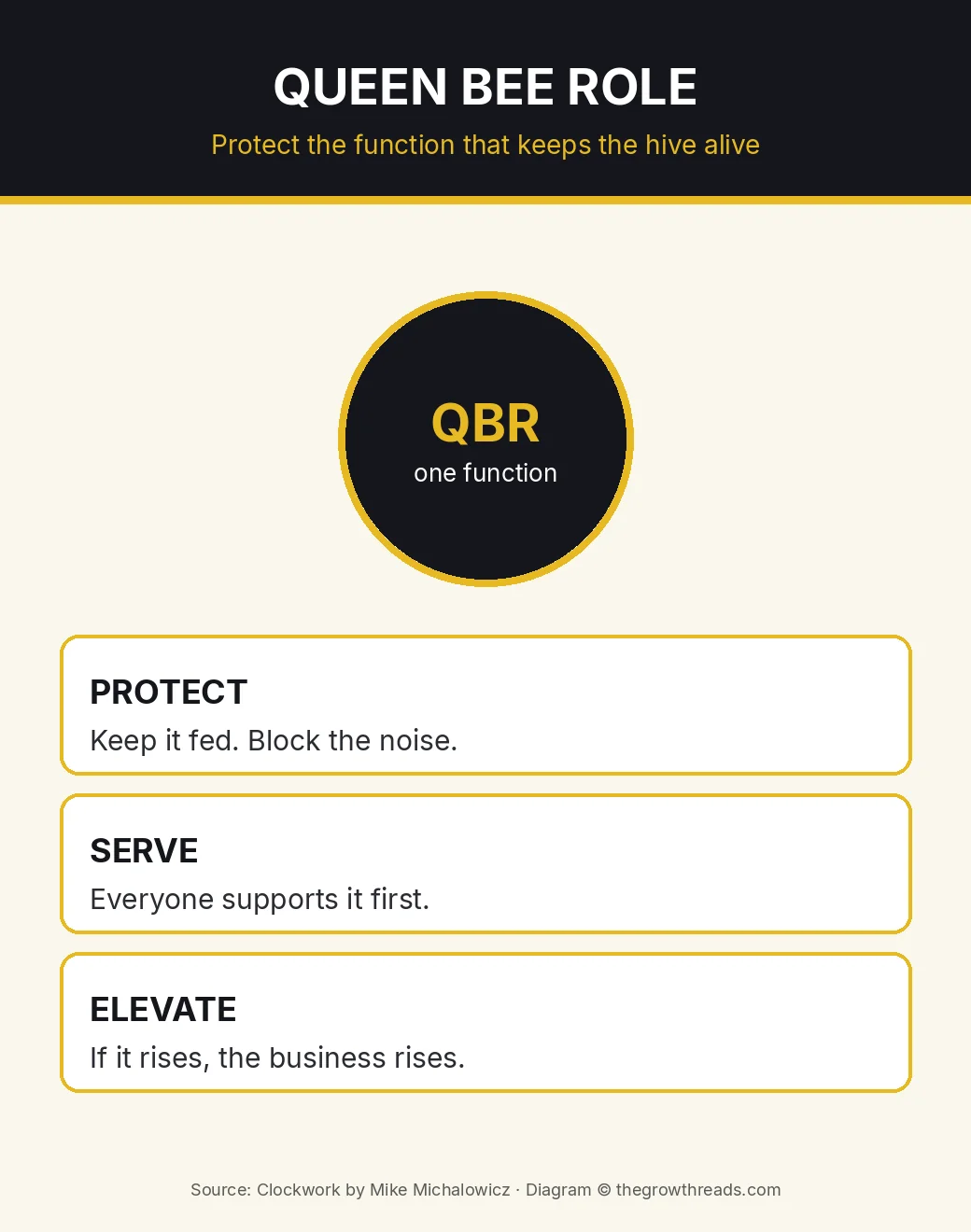
A hive does not survive because every bee is busy. It survives because one function never stops: eggs. Michalowicz’s Queen Bee Role is that function in your company — the activity the customer promise hangs on. It is not a person. If the queen stops laying, the colony replaces her. Protect the role, not the hero who currently happens to hold it. That is how you stop building a cult of you.
Start with the Big Promise: what the customer is actually buying when they pay. Michalowicz’s own author promise is simple tools for entrepreneurship; the QBR under it is making those tools clear enough to use. A bakery’s promise might be “fresh at 7 a.m.”; the QBR is the bake, not the Instagram. Write the promise in one line. Peel back one layer. The activity you cannot drop without breaking the promise is the QBR. Announce it. Put a name on who serves it this quarter. Plan for that name to change.
Then the whole team protects and serves it. Michalowicz uses a hub-and-spoke look at time: how much of your week is QBR, how much is your primary job, how much is noise. Trash work that does not serve the hive. Transfer work someone less scarce can do. Trim the work you must keep so it takes less of you. Time you free goes back to the QBR first, not into a new pet project. Serve the queen, then return to your own primary role.
TGR Note: If you cannot name one function, you do not have a QBR problem yet — you have a focus problem. The One Thing and Essentialism are the personal versions of the same cut. Use them to pick the promise. Use Clockwork to build the hive around it. Same author, money side: Profit First is how you stop funding noise with cash you never kept.
Part 3: Capture the work, then balance the team
Once the QBR is named, it has to be delivered the same way twice. Michalowicz is unimpressed by the binder of standard operating procedures nobody updates. His capture method is ruder and faster: do the task, film it, talk out loud. The video is the first draft of the system. File every clip in four outcome folders — Attract, Convert, Deliver, Collect (ACDC). One person is accountable for each outcome, including improving the video when the process changes. That is how you transfer without becoming the help desk.
Balancing the team is the next stage: the right people, doing the right work, in the right portions. Match traits to tasks instead of handing your leftover Tuesday to whoever is free. Hiring before you have captured the work just clones the chaos. Hiring after a video exists means the new person can watch the job before they sit next to you. For a solo operator, those clips are the job description you do not have yet.
This is also where Deciding has to die. If every transferred task comes back as a question, you did not delegate — you installed a delay. Define the outcome, the standard, and when they should ping you. Then stay out of the steps. Who Not How is the pairing book: once you know the result, find a who. The Checklist Manifesto is the pairing tool: a short list that makes the handoff boring in the best way.
TGR Note: If you are still the only person who can sell, you do not have a Clockwork gap — you have a transfer gap. Film the sales call. File it under Convert. Give someone the outcome “booked work that matches the promise,” not “help me with follow-up.” That one clip usually exposes whether you have a process or a personality.
Part 4: Serve the right customers, watch the dashboard, leave
A system cannot survive infinite exceptions. Stage six is a commitment: we serve [whom] by [how]. Write it as a mantra and use it as a filter. The customer who wants a custom version of the promise is expensive even when they pay well, because they force you back into Doing and Deciding. Ideal customers let the QBR stay boring. Boring is the point.
Stage seven is the founder’s new job: watch a dashboard instead of a queue. Pick a few numbers that tell you the promise is being kept — not thirty vanity charts. When a number slips, you design a fix; you do not jump in and do the task. Bottlenecks become visible once you are not standing inside them.
Then you leave. Michalowicz’s four-week vacation is not a spa coupon. It is the acceptance test. Plan it 18 to 24 months out. Make yourself hard to reach. If the team can keep the promise, the design worked. If they cannot, you have a list of systems to capture when you get back — which is still a win, because the failure is now specific. Pushback is normal: you will want to “just check.” The check is how the old job crawls back in.
Who is Clockwork best for — and who should read something else first?
Best for founders and operators who already make sales and have become the reason those sales cannot grow. If your team waits on you, if you cannot take a Friday, if every new hire still orbits your Slack — this is the book.
Read something else first if you do not yet have a promise people pay for. Start with The $100 Startup or The Mom Test so you are not systematizing a guess. If cash is the crisis, Profit First first — a Clockwork company that cannot pay itself is still a job. If you already have a leadership team and need a weekly operating cadence, Traction is the heavier OS. Clockwork can sit under EOS; it does not replace it.
Questions to reflect on
- If you vanished for four weeks starting Monday, which promise would break first — and who even knows it exists?
- What is your Big Promise in one sentence a customer would recognize?
- Looking at last week, what share of your hours was Doing versus Designing?
- Which task do people bring you that is actually a Deciding habit, not a skill only you have?
- What date, 18 months out, will you put on the calendar as the four-week test?
🔥 Ready to design the business so it can run without you?
Get Clockwork, then use the 7-day plan to name the QBR, film one process, and pick a vacation date.
How to apply Clockwork (7-day plan)
- Day 1 — Log the 4D mix. For one workday, mark every block Doing, Deciding, Delegating, or Designing. No fixing yet. Count the hours.
- Day 2 — Write the promise and the QBR. One sentence: we serve [whom] by [how]. One activity under it that cannot fail. Say it out loud to someone.
- Day 3 — Trash, transfer, or trim one hour. Cut a task, hand one off with an outcome, or shrink a meeting. Put the hour back on the QBR.
- Day 4 — Film one recurring process. Phone on a stand. Do the task. Talk. Stop at 12 minutes. Do not edit it into a documentary.
- Day 5 — File it ACDC and name an owner. Attract, Convert, Deliver, or Collect. Write who owns the result — even if that who is still you until Friday.
- Day 6 — Kill one exception. Say no to a custom request that would pull you back into Doing. Use the mantra from Day 2.
- Day 7 — Three numbers and a date. Pick three dashboard measures that prove the promise. Put a four-week vacation on the calendar 18 months out.
Frequently asked questions
What is Clockwork about in one paragraph?
Clockwork is Mike Michalowicz’s playbook for designing a company that keeps its customer promise when the founder is not in the room. Profit First fixed the cash habit; this book fixes the time habit. You log a 4D mix (Doing, Deciding, Delegating, Designing), name one Queen Bee Role, protect it, capture how work actually happens on video, balance the team, commit to the customers you can serve well, and watch a short dashboard. The exam is a four-week vacation. If the business holds, you own a company. If it calls you on day three, you still own a job.
What is the Queen Bee Role in Clockwork?
The Queen Bee Role is the single function the business cannot fail at — the activity that delivers your Big Promise to customers. In a hive that function is laying eggs, not a particular bee. If the queen stops, the colony replaces her. Same rule at work: protect the function, not a hero. Write the promise first (“we make X reliable for Y”), then peel back one layer to the activity that actually delivers it. Everyone else protects and serves that activity. When the QBR is fed, the rest of the work has somewhere to attach.
What is the 4D mix in Clockwork?
The 4D mix is how Michalowicz sorts work: Doing (you execute), Deciding (you still approve every move), Delegating (someone else owns the result), and Designing (you improve the system). A healthy company still spends most hours Doing — roughly 80 percent — because product has to ship. The trap is the owner living in that 80 percent. Your personal mix should slide toward Delegating and Designing so the team can Do. Log a week in those four buckets. The gap between your mix and the company mix is the first design job.
Is Clockwork only useful if I already have employees?
No. A solo operator can still run the first four stages: log the 4D mix, name the QBR, trash or trim work that does not serve it, and record the recurring tasks on video. Those clips become the job description for the first hire or a contractor. If you have no customers yet, start earlier — The $100 Startup or The Mom Test — so you know what promise is worth systematizing. Clockwork assumes you already deliver something people pay for and that you are the reason it cannot grow.
How is Clockwork different from Profit First, the E-Myth, and Traction?
Profit First, also by Michalowicz, puts cash on a “pay the business first” habit. Clockwork is the time twin: design the work so it does not need you. The E-Myth Revisited is the older argument that you must stop being the technician and build a franchise-like system; Clockwork gives that argument a QBR, a 4D log, and a vacation test. Traction (EOS) is a full operating system — rocks, scorecard, meeting pulse. Use Clockwork when the founder is the bottleneck. Use Traction when you already have a team and need a weekly cadence. They stack; they are not twins.
Do I need the 2022 revised edition of Clockwork?
The 2018 original already has the 4D mix, the Queen Bee Role, the seven stages, and the four-week vacation. That is the book this summary covers. The 2022 revised and expanded edition (ISBN 9780593538173, the edition we link) adds more case studies, a cleaner handoff method, and the 3.2-hour productivity rule from Michalowicz’s later training. If you are buying new, get the revised hardcover. If you already own 2018, you do not need to repurchase to run the 7-day plan below. The system did not change its spine.
How long does it take to apply Clockwork?
Michalowicz maps an 18-to-24-month build toward a four-week vacation, not a weekend overhaul. Week one can still move: a 4D log, a written QBR, one process on video, and three dashboard numbers. The slow part is trust — leaving Deciding, hiring for the QBR, and refusing custom work that breaks the promise. Plan the vacation date early so the system has a deadline. If the business cannot survive four weeks without you, keep capturing and transferring until it can. That is the point of the test, not a luxury.
Related summaries
- The E-Myth Revisited by Michael E. Gerber
- The 4-Hour Workweek by Timothy Ferriss
- Who Not How by Dan Sullivan and Benjamin Hardy
- The One Thing by Gary Keller
- Best productivity books
How we analyze books: every book on The Growth Reads is read cover to cover, summarized in thousands of words of original analysis, and rated against our five-criteria rubric (lasting impact, evidence quality, practical application, writing & originality, external consensus). Read our full methodology.