

★★★★☆ 4.4/5 — a short parable that turns “add more value” into a week you can actually run.
Best for: Sellers, founders, and managers who still treat every room as a ledger
Reading time: ~4 hours (176 pages) · this guide ~12 min
Difficulty to apply: Easy to understand — hard to keep when a quota is due
The Go-Giver in one minute
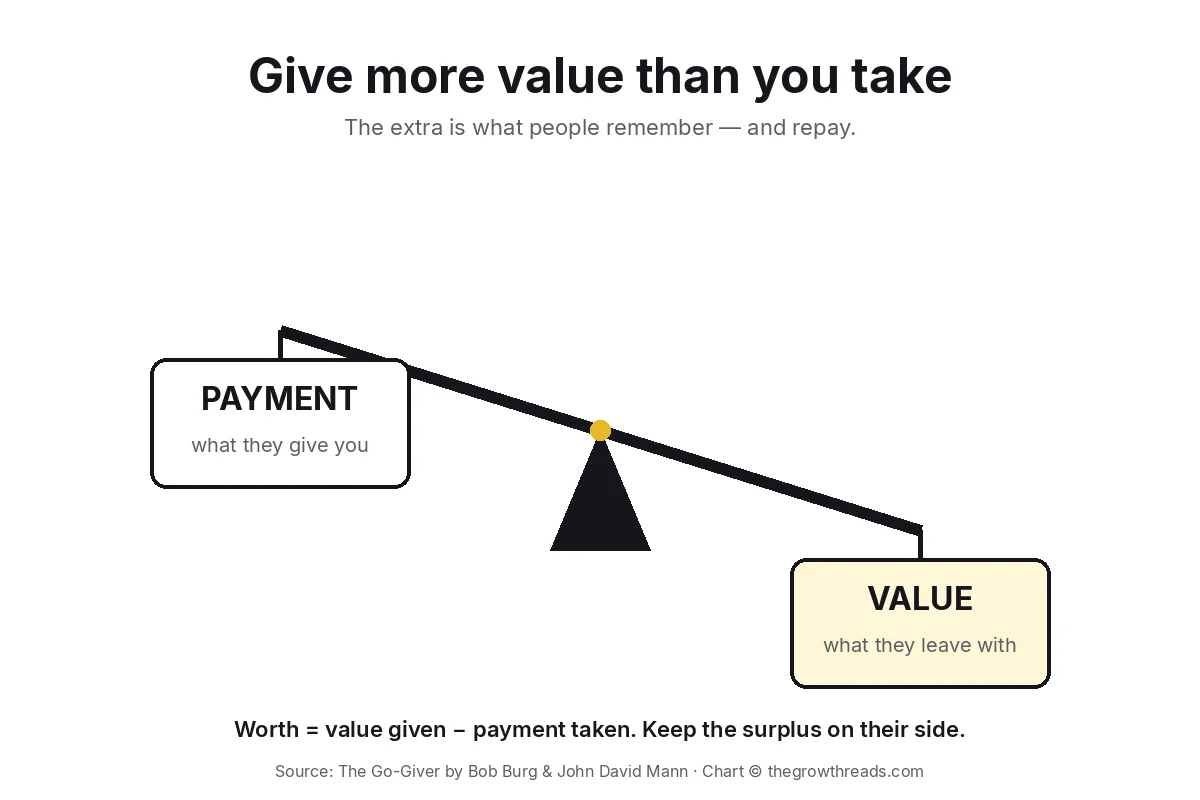
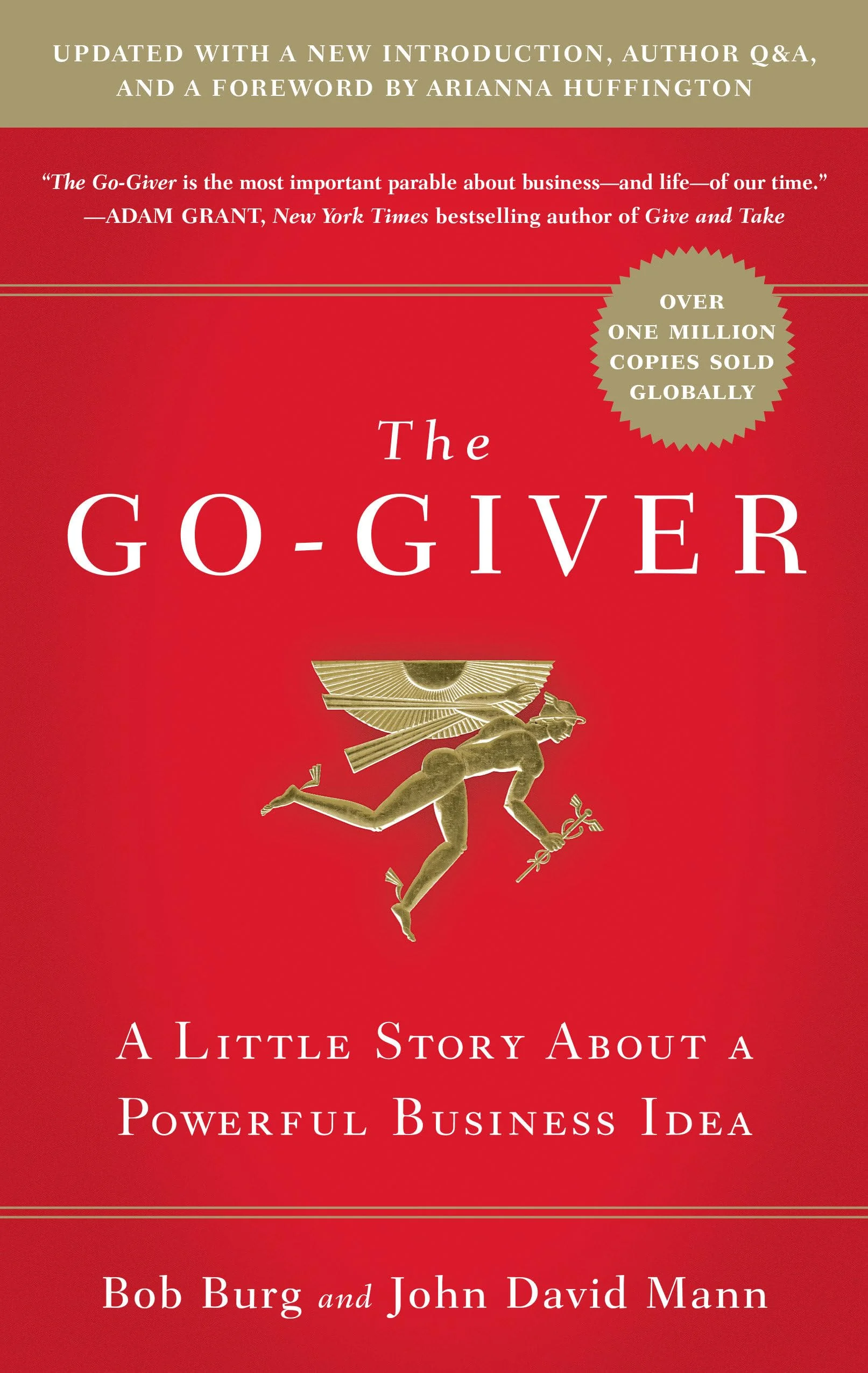
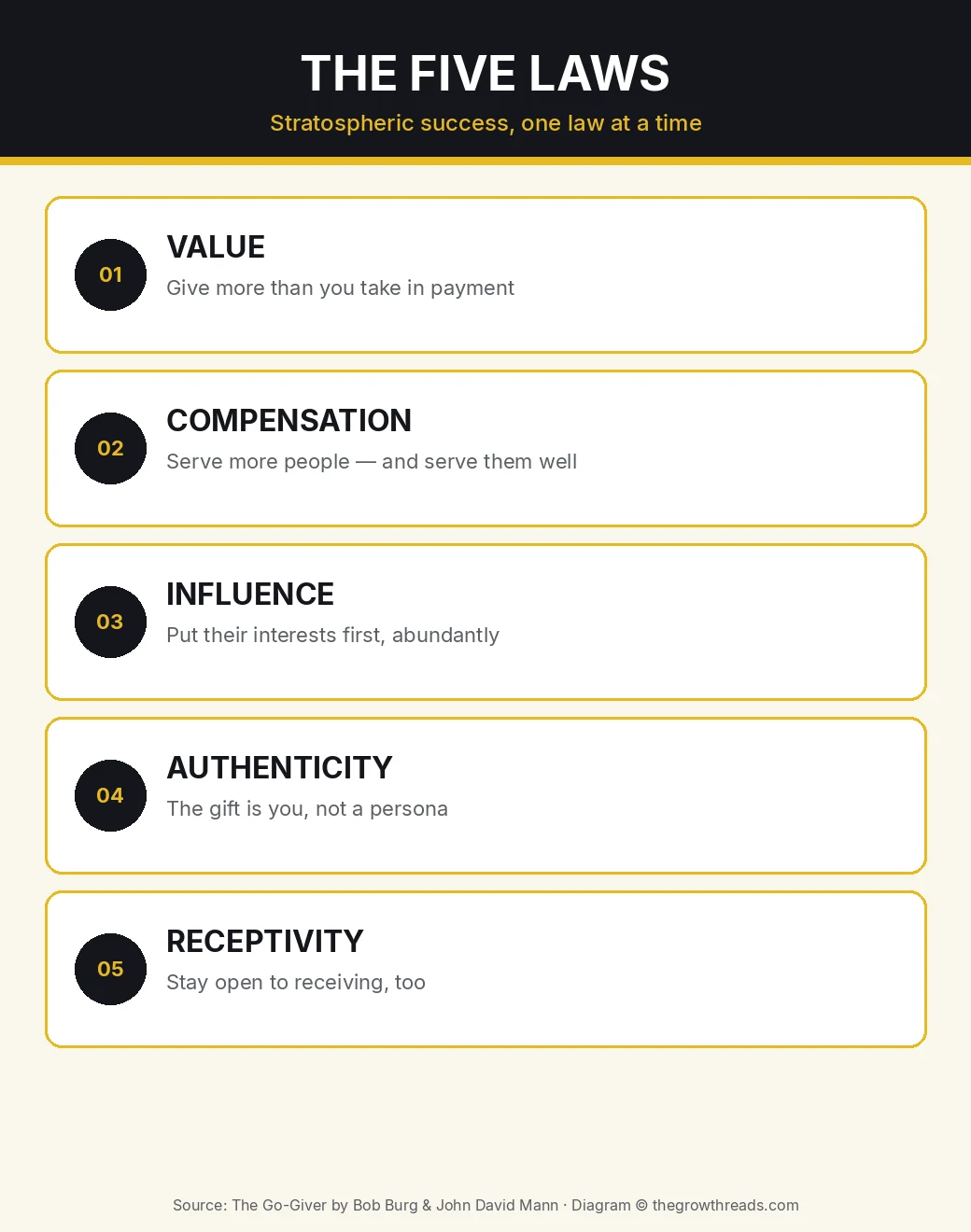
Your worth is not the invoice. It is how much extra the other person leaves with. Bob Burg and John David Mann’s The Go-Giver (Portfolio, 2007; expanded 2015) is a parable about Joe, a hungry go-getter who cannot close by pushing harder. A consultant known as Pindar walks him through five laws: give more value than you take, serve more people well, put their interests first, offer yourself instead of a persona, and stay open to receiving. Most go-getters already respect the first half. The bite is the last law. A lung that only exhales is not generous. It is empty.
Key takeaways
- Value beats payment: Worth is the surplus they walk out with, not the number on the invoice.
- The Condition is same-day use: A law you quote but do not run this afternoon is a poster.
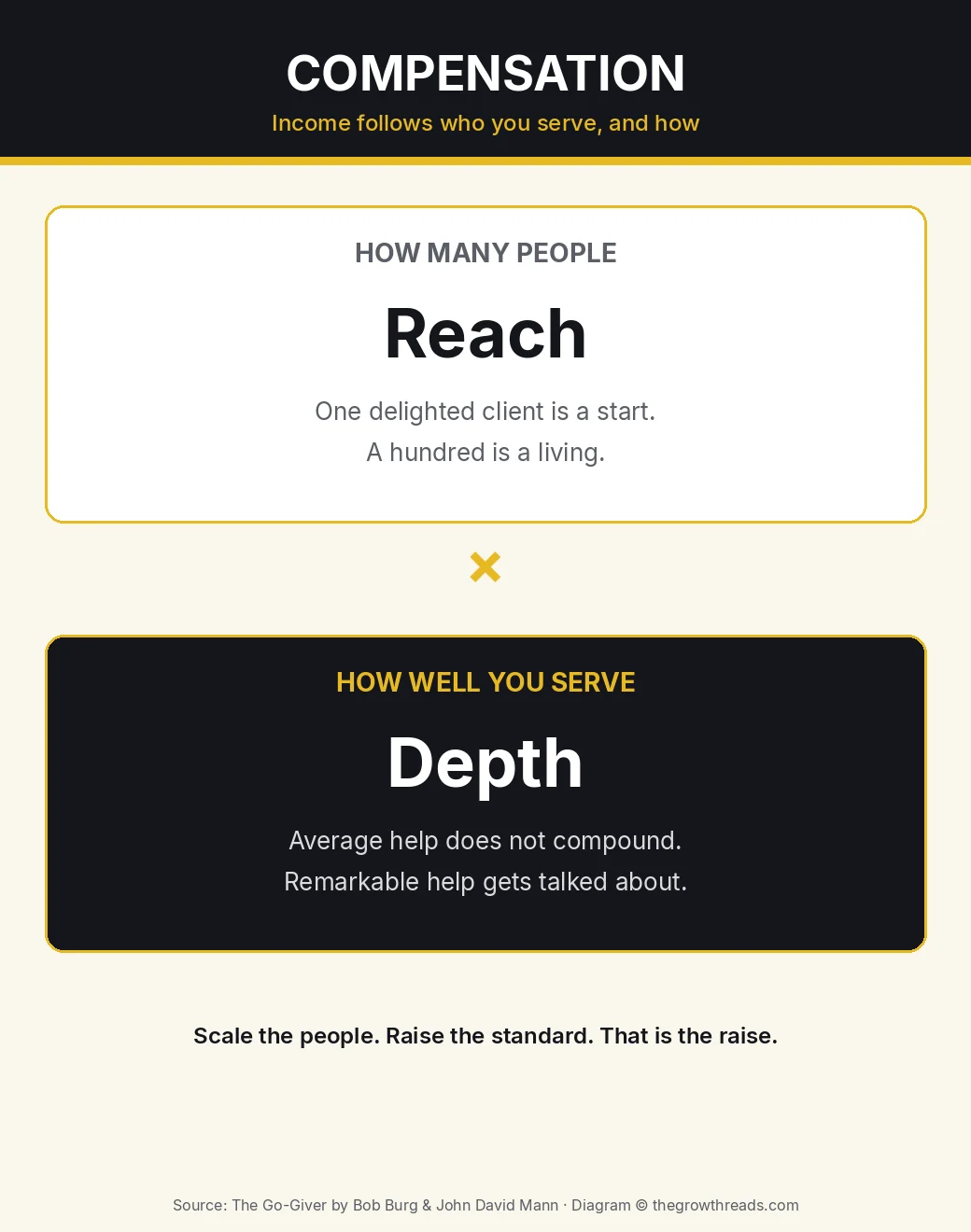
- Compensation is reach × depth: How many people you serve, and how well you serve them.
- Influence is their problem first: Pull comes from placing other interests ahead of your ask.
- Authenticity is the scarce gift: A polished pitch is common. You are not.
- Receptivity keeps the circuit on: Take the pay, the help, and the compliment or the next gift dies.
- Go-getter energy is not the enemy: Ambition is fine. Keeping score in the first five minutes is the leak.
- Giving is not undercharging: Extra value is real help, not a discount that trains people to take.
- One client delighted is a start: A hundred served well is a living. Scale the people, raise the standard.
- The story is a week, not a personality transplant: Run one law today. Do not wait to “become” a giver.
What is The Go-Giver about?
The Go-Giver is Burg and Mann’s parable about a salesman who cannot close by pushing harder. A mentor named Pindar teaches five laws: give more value than you take, serve more people well, put others first, be yourself, and stay open to receiving.
About the author
Bob Burg spent the 1990s teaching salespeople that referrals follow value, not a louder ask. Endless Referrals put him on the speaking circuit. The Go-Giver, written with storyteller John David Mann and published by Portfolio in 2007, is that argument as a week of scenes: Joe, Pindar, a restaurant, a connector, a hot-dog cart. Mann’s job is the story engine — turning a law into a room you can remember. Together they followed it with Go-Givers Sell More, The Go-Giver Leader, and The Go-Giver Influencer. Burg still keynotes on giving as a business strategy. Mann still writes the parable. Neither claims a laboratory. They claim appointments that go better when you stop keeping score in the first five minutes. Explore all Bob Burg book summaries →
Key concepts at a glance
| Concept | What it means | Use it when |
|---|---|---|
| Law of Value | Worth is how much more you give than you take in payment | The meeting is about your quota, not their outcome |
| Law of Compensation | Income follows how many people you serve and how well | You over-serve one client and stay broke |
| Law of Influence | Pull comes from putting their interests first, abundantly | You lead with the ask and the room cools |
| Law of Authenticity | The scarce gift is you, not the persona | The pitch sounds like everyone else’s deck |
| Law of Receptivity | Giving works only if you also receive | You wave away pay, help, or a compliment |
| The Condition | Apply the law the same day you hear it | You collect quotes instead of running one move |
| Go-getter vs go-giver | Ambition stays; the ledger in minute one goes | Effort is high and the account still will not move |
| Stratospheric success | Results that look outsized because the surplus was on their side | You want a raise without a new personality |
Part 1: Joe the go-getter, and the Law of Value
Joe is not lazy. That is the point. The quarter is ugly, a key account will not close, and the go-getter move is to add activity and treat the other person’s time as the obstacle. Pindar’s move is to change what Joe is even trying to extract from the room.
The Law of Value is the load-bearing sentence: your true worth is determined by how much more you give in value than you take in payment. That is not a request to discount. Discounting trains people to take. Extra value is the thing they did not pay for and can feel: a cleaner recommendation, a room that treats a two-top as if the house depended on it, a follow-up that saves an hour. Guests do not come back because the bill was small. They come back because they left bigger than they arrived.
Pindar’s Condition is the part most summaries skip. Joe has to use the law the same day, not file it under “nice ideas.” A law you cannot run before dinner is a poster. The first day’s job is one surplus: one person who leaves with more than they paid, including people who paid nothing but attention.
TGR Note: If you want the research sibling instead of a parable, our Give and Take summary is Adam Grant’s map of givers, takers, and matchers — otherish giving, not martyrdom. If your job is literally moving people this week, today’s To Sell Is Human summary is Pink’s modern sales book. Use Burg and Mann for the stance. Use Grant or Pink when you need a study or a tactic. Do not stack all three as a new way to delay the first surplus.
Part 2: Serve more people, then put them first
The second law stops the saint who over-serves one account and stays thin. Compensation, here, is not a vibe. Income follows how many people you serve and how well you serve them. Depth without reach is a boutique that cannot pay rent. Reach without depth is a blast nobody remembers. The raise is the product of both.
If your calendar is heroic rescues for the same three people, you are starving reach. If it is a spray of half-meetings, you are starving depth. Keep the extra on their side, and stop treating a single relationship as the whole firm.
The Law of Influence is the social version of the same surplus: your pull is how abundantly you place other people’s interests first. The 50/50 instinct — “I’ll help if they help” — is a matcher’s ceiling. Lead with their outcome. Your ask can ride in the second paragraph.
TGR Note: Classic people skills without the parable live in our How to Win Friends and Influence People summary — still the names-and-interest drill. If the room is a negotiation, Influence is Cialdini’s mechanics. The Go-Giver is the posture that walks in before those tools. Use Carnegie when you need lines. Use Burg when you need to stop opening with your quota.
Part 3: Authenticity — the gift is you
The fourth law is the one polished operators skip because it sounds soft. The most valuable gift you have to offer is yourself. A persona is expensive to maintain and cheap to replace. Anyone can buy a script. Nobody else can sit in your chair and tell the truth about what they actually know.
Authenticity here is not oversharing. It is dropping the borrowed voice that makes you interchangeable. The test is ugly and useful: would I still be useful in this room if I did not get the deal? If the answer is no, you are hunting with better manners. If the answer is yes — including sending them to someone else — you just became hard to swap out.
TGR Note: If the block is creative resistance rather than a sales persona, our War of Art summary is the colder book. If you want compounding without a parable, The Compound Effect is the math of small daily surplus. Stay with Burg and Mann when the leak is the first five minutes of the meeting, not the page or the gym.
Part 4: Stay open to receiving
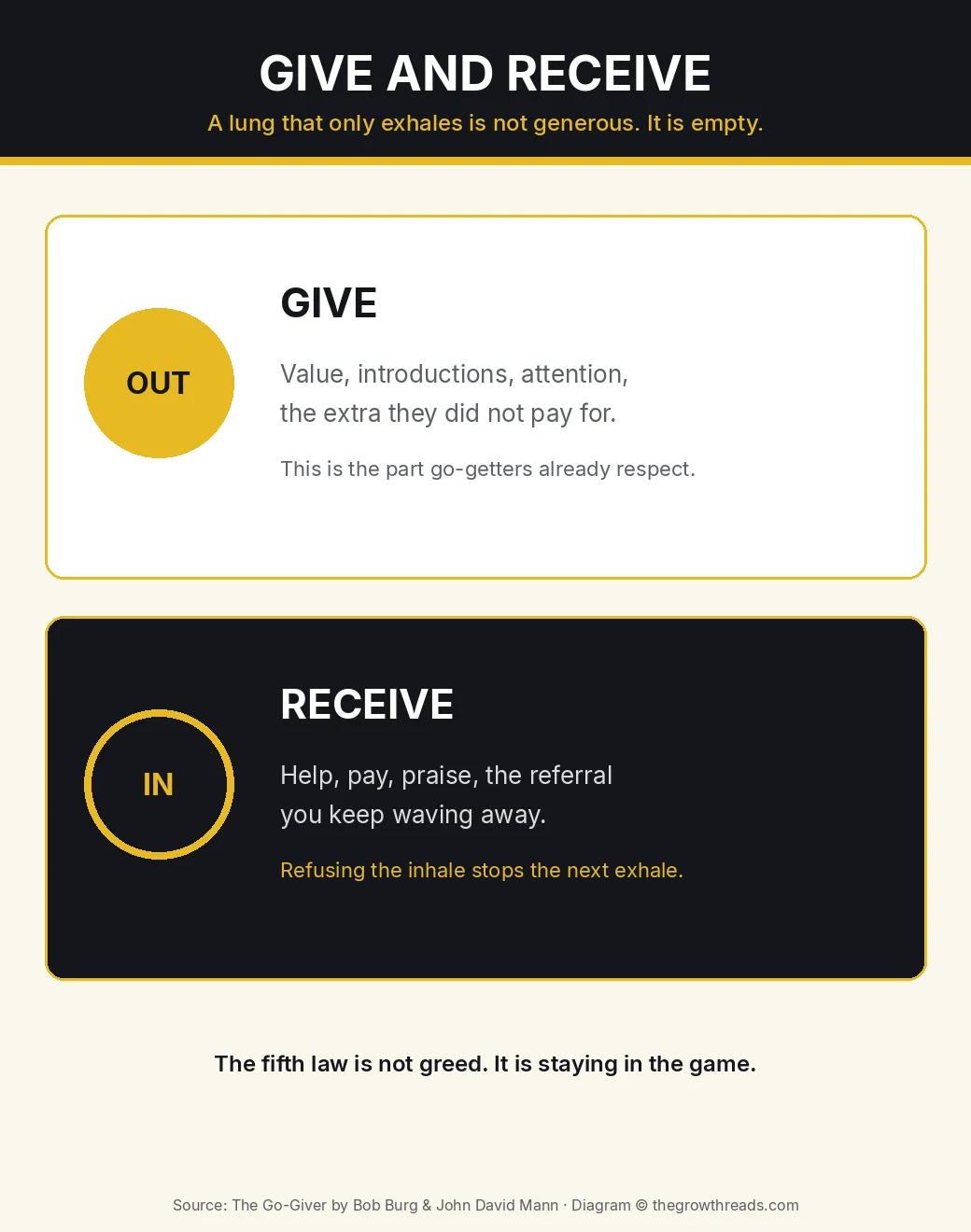
The last law is the one that keeps generous people broke. The key to effective giving is to stay open to receiving. The metaphor is breathing. Exhale only and you pass out. Joe can add value, serve more people, put them first, and show up as himself — then wave away the fee, the thanks, the introduction that comes back. That is not humility. It is a jammed circuit. The next person gets nothing because you refused the inhale.
Receptivity is practical. Send the invoice. Accept the compliment without a joke that shrinks it. Take the referral without immediately owing a bigger one. The go-getter kept score too early. The unwise giver refuses to let the scoreboard exist. Burg and Mann want the surplus on their side at the start, and an open hand when the world tries to even it up. That is how the week compounds instead of turning into a private charity that cannot hire.
TGR Note: If the real problem is doing too much for too many, Essentialism is the cut. If you need someone else to own the how, Who Not How is the delegation book. The Go-Giver is the posture inside the work you keep. Do not use five laws as a reason to become everyone’s unpaid intern.
Who is The Go-Giver best for — and who should read something else first?
Best for sellers, founders, rainmakers, and managers who are already working hard and still feel the room go cold. It is a good second book after a tactics manual, when the missing piece is the first five minutes.
Read something else first if the work is undefined. Capture still beats character. Getting Things Done holds the loops. If you need studies, Give and Take is denser. If you need classic social skill, How to Win Friends is the drill. If you need modern non-sales selling, To Sell Is Human is the field guide. If you need to do less, Essentialism is the cut. Come back here when the offer is real and the posture is the bottleneck.
Questions to reflect on
- Where did you last keep score in the first five minutes of a conversation?
- Who left your last meeting with more than they paid — including people who paid only time?
- Are you over-serving three people and calling it generosity, or serving many people well?
- What persona do you put on that makes you easier to replace?
- What pay, help, or compliment did you wave away this week that would have funded the next gift?
🔥 Ready to give more value than you take?
Get The Go-Giver, then run the 7-day plan before you add another sales book.
How to apply The Go-Giver (7-day plan)
- Day 1 — One surplus. Pick one person you will talk to today. Name the extra they can leave with that is not a discount. Deliver it before you mention your ask.
- Day 2 — Same-day Condition. Write the Law of Value on a card. Use it in one live conversation before dinner. If you only reread the card, it failed.
- Day 3 — Reach. Serve one additional person at the same standard as your favorite client, even if the task is small. Depth without reach stays a hobby.
- Day 4 — Their interests first. Open one meeting with their problem for a full five minutes. Park your update until they have been usefully heard.
- Day 5 — Drop the persona. In one conversation, say what you actually know — including “someone else is better for this.” Authenticity is the referral you did not force.
- Day 6 — Take the inhale. Accept one payment, compliment, or offer of help without shrinking it. Send the invoice if it is sitting in drafts.
- Day 7 — Repeat the weakest law. Score the week 1–5 on each law. Rerun only the lowest one tomorrow. Do not add a CRM, a slogan, or a new identity.
Frequently asked questions
What is The Go-Giver about in one paragraph?
The Go-Giver is Bob Burg and John David Mann’s business parable about Joe, an ambitious salesman who cannot close a key account by working harder. A legendary consultant called Pindar walks him through five go-givers and the Five Laws of Stratospheric Success. The load-bearing idea is simple: your worth is determined by how much more value you give than you take in payment. Serve more people, put their interests first, show up as yourself, and stay open to receiving. This summary turns those laws into a week of small moves rather than a personality transplant or a new pitch deck.
What are the Five Laws of Stratospheric Success?
The five laws are Value, Compensation, Influence, Authenticity, and Receptivity. Value: your worth is how much more you give than you take in payment. Compensation: income follows how many people you serve and how well you serve them. Influence: your pull is how abundantly you place other people’s interests first. Authenticity: the most valuable gift you have is yourself, not a sales persona. Receptivity: giving only works if you also stay open to receiving pay, help, and praise. Joe has to apply each law the same day he hears it.
Is The Go-Giver just “be nice and money shows up”?
No. The book is not a request to undercharge, skip a close, or become a doormat. The extra value has to be real: a cleaner handoff, a better introduction, a restaurant that treats the two-top like a banquet. Compensation still scales with how many people you serve well. Influence still asks you to put their problem first, which is different from saying yes to every favor. Receptivity is the guardrail against the martyr move — refusing the invoice, the compliment, or the referral. If you only exhale, you are not generous. You are empty, and the next person gets nothing.
How is The Go-Giver different from Give and Take or To Sell Is Human?
Adam Grant’s Give and Take is the research book: givers, takers, matchers, and why otherish giving outperforms being a doormat. Daniel Pink’s To Sell Is Human is the modern sales book: we all move people now, so make it useful and personal. The Go-Giver is the parable you can finish on a short flight. It names five laws, wraps them in a week of meetings, and asks you to run one law today. Read Grant if you want studies. Read Pink if you want tactics for a world of non-sales selling. Read Burg and Mann if you need a stance you can remember in a parking lot.
Who should read The Go-Giver — and who should start elsewhere?
Read it if you are a seller, founder, rainmaker, or manager who still treats every conversation as a ledger. It is the right short book when effort is high and the room is cold. Start elsewhere if your problem is capture, not character: Getting Things Done still wins on open loops. If you need the science of generosity, Give and Take is denser. If you need classic people skills, How to Win Friends lives in our relationships silo. If you need to do less, not give more, Essentialism is the cut. Come back here when the work is defined and the posture is the bottleneck.
How long does it take to read The Go-Giver?
The expanded Portfolio hardcover is 176 pages, including a discussion guide and author Q&A. Most readers finish the parable itself in three to four hours. It is a story, not a workbook: Joe, Pindar, a restaurant, a connector, a hot-dog cart. You can run the first law the same afternoon you start the book. The value is not collecting all five laws as quotes. The value is applying one of them before the day ends, which is the Condition Pindar sets. This guide is a twelve-minute pass so you can use the stance today and return to the scenes when you want the full voice.
Does The Go-Giver replace a pipeline, a CRM, or a price?
No, and it does not pretend to. A generous week will not invent a list, fix a broken offer, or replace skill. It changes the first five minutes of the meeting that uses those tools. If you have no next action, capture still wins. If the product is weak, extra value is a delay. If you are being used, boundaries still win — otherish giving, not unlimited giving. Use the five laws as the posture that walks into the CRM, the price, and the ask. The parable is the stance. The plan is still a plan, and the invoice still has to go out.
Related summaries
- Give and Take — the research map of givers, takers, and matchers
- To Sell Is Human — why moving people is now everyone’s job
- Essentialism — cut the work so the surplus is even possible
- Who Not How — when the generous move is to stop doing it yourself
- Best productivity books — the full silo list
How we analyze books: every book on The Growth Reads is read cover to cover, summarized in thousands of words of original analysis, and rated against our five-criteria rubric (lasting impact, evidence quality, practical application, writing & originality, external consensus). Read our full methodology.