

★★★★☆ 4.4/5 — A systems playbook for people who keep winning the same firefight and calling it a work ethic.
Best for: operators, managers, and founders who are the downstream hero of a repeating mess.
Reading time: ~5.5 hours (320 pages) · this guide ~12 min
Difficulty to apply: Medium. Name one fire. Put a person and two hours on prevention. Do not launch a transformation office.
Upstream in one minute
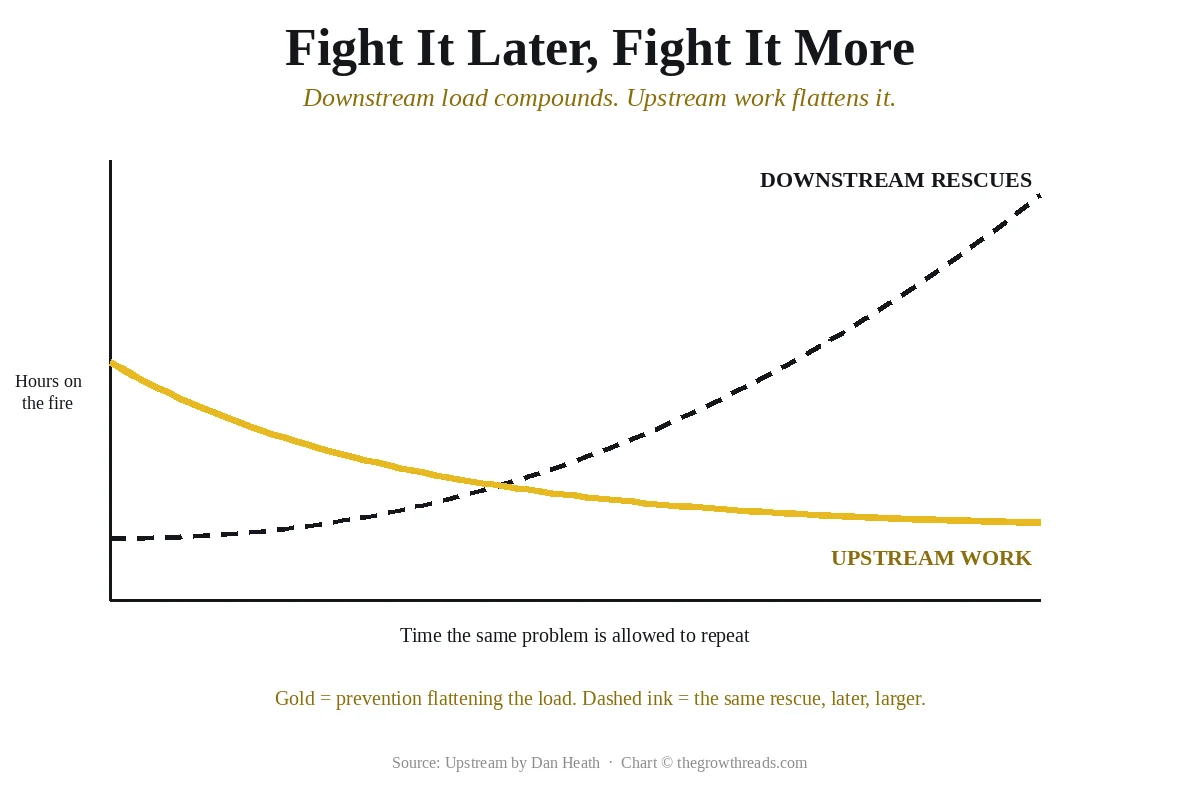
You are standing by the river pulling people out. Walk up the bank and stop whoever is throwing them in. Dan Heath wrote Upstream (Avid Reader Press, 2020) after watching smart teams spend their best hours on emergencies that had already happened. Reaction looks like work: a Slack channel, a hero, a standup story. Prevention looks like nothing happened. There is no medal for the outage that never shipped. Three barriers keep you in the water: the problem stops looking optional, nobody owns it when the channel is quiet, and today’s rescue eats the hour that would have stopped next week’s. Seven questions turn prevention into a job — unite people, change the system, find leverage, get early warning, score success, avoid harm, and pay for what does not happen.
Tonight, name the fire you personally touched in the last two weeks. Write who looks useful when it happens. Write who would own it if it never did. That is the whole entry fee.
Key takeaways
- Reaction is a costume of usefulness: Pulling people from the river feels like work. Walking upstream is the work.
- Problem blindness is the first leak: A repeating mess becomes weather. ‘That is just how we ship’ is a design choice.
- If everyone owns prevention, no one does: Put a name on the calendar for the week the fire does not start.
- Tunneling is a systems tax: Smart people stay downstream because the scoreboard pays rescues.
- Change the system, not the slogan: A poster about quality will lose to the incentive that rewards speed.
- Leverage beats volume: One handoff, template, or check before send is worth a hundred after-action reviews.
- Early warning is a count, not a vibe: Something that pings before the apology.
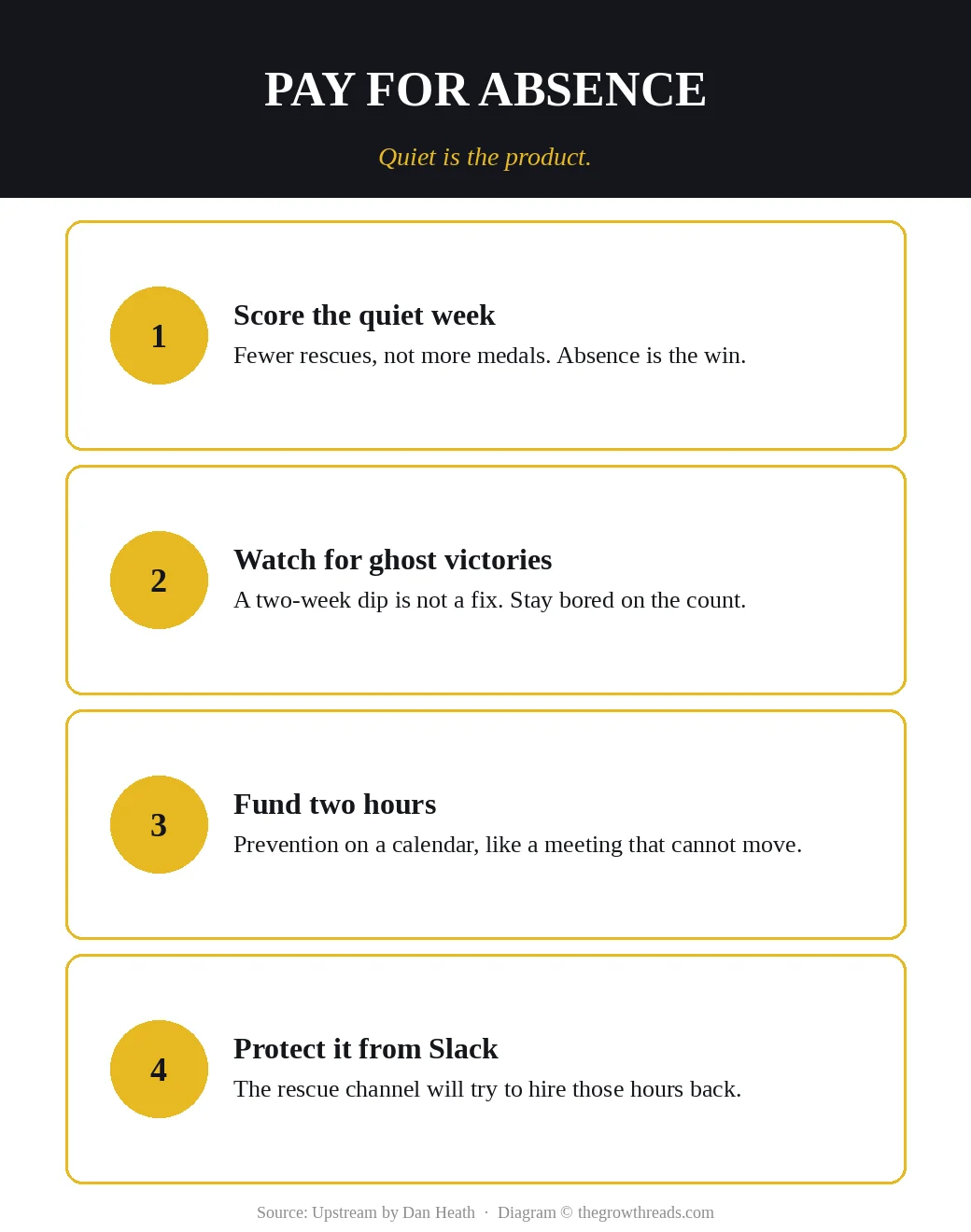
- Success is an absence: Score fewer rescues, not more heroics. Quiet is the win.
- Someone has to pay for what does not happen: If prevention has no budget, the emergency will keep hiring.
What is Upstream about?
Upstream is Dan Heath’s field guide for solving problems before they happen. Stop living as the hero of a repeating emergency. Name the cause, assign an owner, change the system, and score the quiet week. Prevention is the product. Rescue is the backup plan.
About the author
Dan Heath is an American writer and a senior fellow at Duke University’s CASE center, where he studies social entrepreneurship. With his brother Chip he wrote Made to Stick, Switch, Decisive, and The Power of Moments — books that taught a generation how ideas travel, how change actually happens, and how to stop trusting the first frame of a choice. Upstream (Avid Reader Press, 2020) is his solo turn: less about a pitch or a decision, more about the month after the decision, when the same fire is back on the calendar. The voice is still the Heath brothers’ case-study clarity — schools, hospitals, city halls, sports, software — aimed at operators who are tired of being indispensable. Read him when you can already execute and the remaining leak is that execution keeps happening in the water. Explore all Dan Heath book summaries →
Key concepts at a glance
| Concept | What it means | Use it when |
|---|---|---|
| Upstream | Fix the cause before the rescue. | You are the hero of a mess that already happened last month. |
| Problem blindness | A repeating fire becomes weather. | The team says ‘that is just how Mondays are.’ |
| Lack of ownership | Everyone agrees. Nobody’s name is on prevention. | The postmortem has actions and no calendar. |
| Tunneling | Today’s rescue eats the hour that would stop next week’s. | The scoreboard only counts fires fought. |
| Systems change | Incentives and defaults, not slogans. | A poster lost to a bonus that rewards speed. |
| Leverage point | The cheapest place the loop can break. | You are adding volume instead of moving one handoff. |
| Early warning | A signal before the apology. | You only learn from customer rage. |
| Ghost victory | A short dip you mistook for a fix. | The chart looked good for two weeks, then snapped back. |
Part 1: Walk upstream — you are standing by the river
Heath opens with a parable you already know in your bones. People are drowning. You jump in. You pull them out. You jump in again. Someone finally walks up the bank to see who is throwing them in. Downstream work has a costume: urgency, a channel, a story. Upstream work has a silence. There is no medal for the bug that never shipped, the inventory miss that never hit the floor, the apology that never had to be written. Organizations accidentally train the opposite. They promote the person who looks calm in the war room. They starve the person who made the war room unnecessary. If The Goal taught you to find the constraint, this chapter is what happens when the constraint is that you keep applying talent at the wrong end of the river.
Desk translation is unromantic. The river is the ticket queue, the rewrite cycle, the Friday scramble you personally patched. You are not behind. You are over-skilled at rescue. Pick one drowning and ask what threw the body in. If Getting Things Done is how you process what already arrived, this chapter is why the same class of thing keeps arriving. Capture is downstream. Cause is upstream. Start with one fire you touched with your own hands.
TGR Note: If the remaining leak is a bad frame on a one-time choice, stay with Decisive — WRAP, not your first story. Come here when the choice was fine and the same emergency is still on the calendar. If you need the original sticky-idea toolkit from the same brothers, Made to Stick is how the prevention story has to travel once you have one.
Part 2: Three barriers that keep you downstream
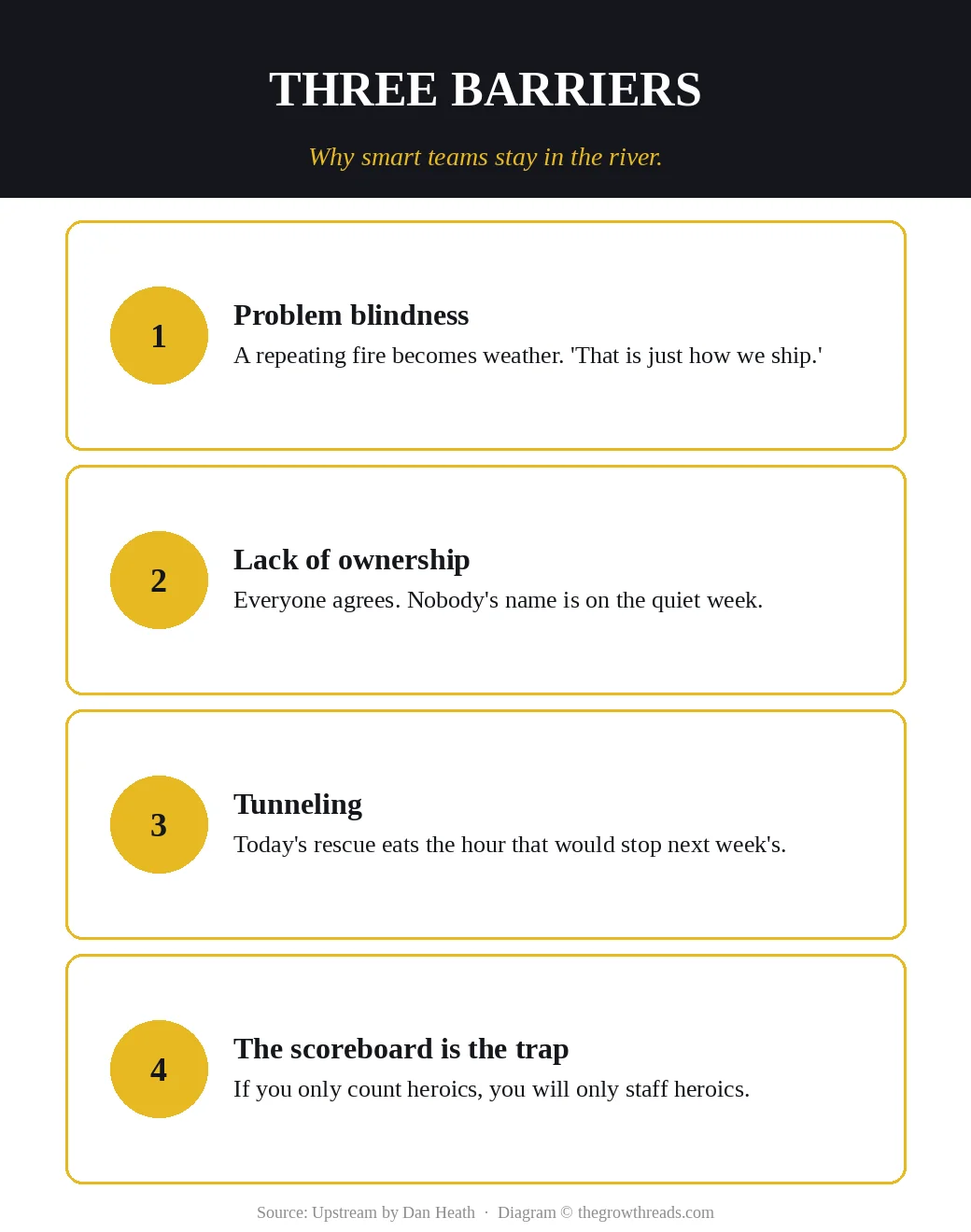
Heath’s middle is not a pep talk. It is a diagnosis of why smart teams stay in the water. Problem blindness: the mess becomes climate. ‘Expensive rework is just how we ship.’ Lack of ownership: everyone can describe the fire and nobody’s name is on the week it does not start. Tunneling: the rescue is so absorbing that looking up feels irresponsible. These are not character flaws. They are what you get when the scoreboard pays heroics. A nurse, a support lead, a founder who closes every escalation — the system is perfectly designed to keep them downstream. The first move is not a new app. It is writing the fire in one line and writing two names: the downstream hero, and the prevention owner. If those names are the same person with no protected hours, you still only have a hero.
Steal the test. If Clockwork is how a business runs when you leave the building, this chapter is why you cannot leave: you are the river. If Black Box Thinking is how aviation turns a crash into data, Heath is how you install collection before the crash. Collect one fire. Blindness lifts when a number sits next to a name. Tunneling lifts when two hours are labeled prevention. Ownership lifts when ‘we’ll all watch it’ becomes a person who looks stupid if the count does not move.
TGR Note: If buy-in is the leak — people know the path and will not walk it — Switch is the Heath brothers’ change book: rider, elephant, path. Use it to unite the right people. Use Upstream to give those people a fire that is actually preventable. If experts skip a step at the moment of work, The Checklist Manifesto is the memory aid. A checklist is often the early-warning device this chapter is hunting.
Part 3: Seven questions that make prevention real
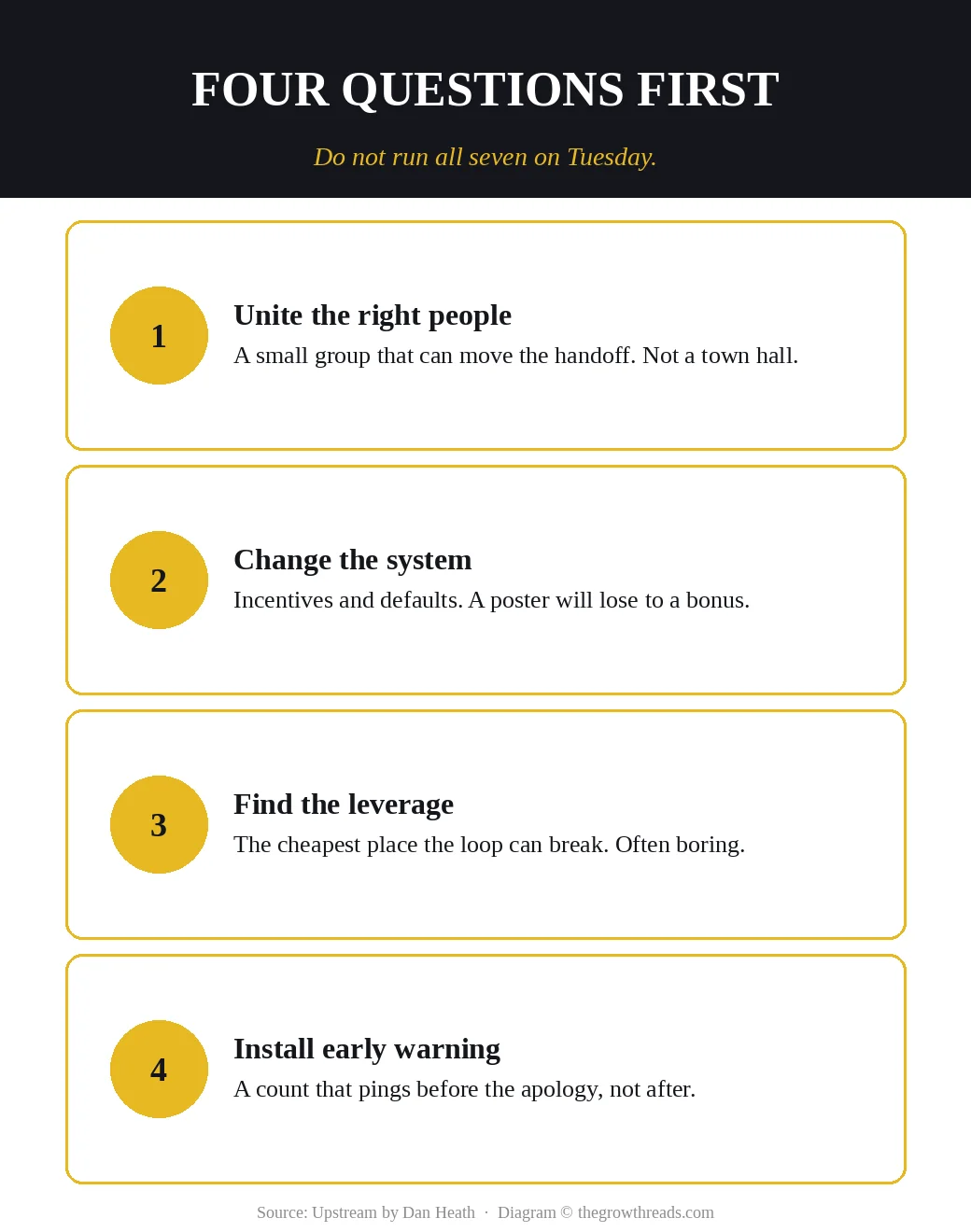
The seven questions are the book’s working surface. Unite the right people — not a town hall, a small group that can actually move the handoff. Change the system, not the slogan: if the bonus still pays speed, the poster about quality is decoration. Find the point of leverage: the cheapest place the loop can break, often boring (a template, a gate, a second pair of eyes before send). Get early warning: a count that moves before customers shout. Know you are succeeding: because success is an absence, you need a scoreboard that does not require a disaster to light up. Avoid doing harm: clumsy prevention creates new drowning. Who pays for what does not happen: if prevention is funded with leftover minutes, the emergency will keep winning the budget meeting. You do not run all seven on Tuesday. Run unite, leverage, and warning on one fire. Park the rest as gates before you scale a dashboard.
Steal one question this week. If The Lean Startup is experiment-and-measure for a product that might scale, these questions are the same loop for a problem you already have. If The E-Myth Revisited is systems for a shop that already has customers, this is the system for the mess those customers keep causing. Do the two hours. The awkward steps are the spec. A ghost victory is a two-week dip you celebrated too early. Watch the count long enough to be bored.
TGR Note: If after you name the fire you still cannot start the two hours, Mini Habits is the on-ramp — one push-up of prevention, not a transformation office. If the remaining leak is a missing deep-work door so the cause never gets an hour, close it with Deep Work. Upstream still needs a room the rescue channel cannot enter.
Part 4: Pay for what does not happen
The last movement is funding and far-upstream work — the unglamorous question of who pays for a quieter month. Heath keeps dragging readers back to incentives. A hospital, a school, a software team: the budget line that looks ‘idle’ is often the only thing preventing a more expensive line. If you only staff the war room, you will always have a war. Ghost victories show up here. A short dip, a speech, a dashboard in green, then the old volume returns because the system never moved. Far upstream is slower still: hiring, training, product defaults, the way a form is designed. You do not start there. You earn the right to go further up the bank by flattening one fire first. Give the prevention owner a number and two hours. When scale starts to look like a second command center, shrink. A quieter queue beats a decorated incident process.
Steal the ending. Finish this week with a count and a name, or with a clear no — this fire is weather you have chosen. If Rework is stay small after you have a shop, this chapter is how the shop stops setting itself on fire. If Company of One is stay small as strategy, you still need an upstream hour or the one person becomes the entire river. Pick the next fire when this count is boring.
TGR Note: If after two quiet weeks you still wait to feel official, stay with this book one more cycle. If you need identity through a tiny cue instead of a systems change, stay with Atomic Habits. Upstream is the layer those habit books can hang on when the skill is already there and the environment keeps manufacturing the same emergency.
Who is Upstream best for — and who should read something else first?
Best for people who can already execute and keep being the hero of a repeating mess: operators, managers, founders, support leads, anyone whose calendar is a museum of last week’s fires. If you want a decision protocol for a one-time choice, go to Decisive. If you want change when people already know the path, go to Switch. If you want a shop that runs when you leave, go to Clockwork.
Read something else first if you still cannot start a two-minute task — begin with Mini Habits. If you keep fighting the loudest work instead of the constraint, start with The Goal. If experts skip known steps at the point of work, start with The Checklist Manifesto. Come to Upstream when you can already do the rescue and the remaining failure mode is ‘we are so good at the emergency that nobody owns the cause.’
Questions to reflect on
- What fire did you personally touch in the last two weeks — not the industry, the ticket?
- Who looks useful when it happens, and who would look useless if it never did?
- What are you calling ‘just how we work’ that is actually a design choice?
- Where is the cheapest place this loop can break — a handoff, a template, a check before send?
- If prevention had to show up as a budget line, what number would you defend?
🔥 Ready to leave the river?
One fire. One owner. Two hours that are not a rescue.
How to apply Upstream (7-day plan)
- Day 1 — Name the repeating fire. One line. The mess you personally touched in the last two weeks. No strategy deck.
- Day 2 — Name the downstream hero. Who looks useful when it happens? Write the name. That person is paid to stay in the river.
- Day 3 — Name the prevention owner. If the fire never started, whose calendar would that live on? If the answer is ‘everyone,’ it is no one.
- Day 4 — Find one leverage point. Where does the mess become cheaper to stop? A handoff, a template, a check before send — not a new religion.
- Day 5 — Install one early warning. A count, a date, a ‘still red’ flag. Something that pings before the apology, not after.
- Day 6 — Score absence, not heroics. Write last week’s rescue count. Write the number you want next week. Quiet is the win.
- Day 7 — Fund two hours. Put prevention on a calendar like a meeting. Protect it from the Slack channel that will try to pull you back in.
Frequently asked questions
What is Upstream about?
Upstream is Dan Heath’s playbook for solving problems before they happen. You keep pulling people from a river. Walk up the bank and stop whoever is throwing them in. Reaction looks like work. Prevention looks like nothing happened. Three barriers keep you in the water — problem blindness, lack of ownership, tunneling — then seven questions turn prevention into a job you can actually calendar. Read it as an operator’s manual for one repeating fire, not a new personality.
How long does it take to read Upstream?
The Avid Reader Press hardcover is about 320 pages. Most readers finish in five and a half hours. This summary is a twelve-minute pass: the river parable, three barriers, seven questions, and a seven-day plan aimed at one fire on your desk. If you only have lunch, name last week’s rescue, write who owns it when nobody is drowning, and pick one early warning. Case studies can wait. A scoreboard for absence cannot. It is a prevention workshop, not a new org chart by Friday.
What are the three barriers in Upstream?
Problem blindness treats a repeating mess as weather — ‘that is just how Mondays are.’ Lack of ownership is everyone agreeing and nobody holding the match. Tunneling is smart people so buried in today’s rescue they cannot look up the bank. Downstream heroes are not lazy. The system pays them to stay in the water. Write the fire you keep winning, whose name is on prevention when Slack is quiet, and one hour that is not a rescue. No owner means no upstream plan — only a vibe.
What are the seven upstream questions?
Heath’s checklist is practical. Unite the right people. Change the system, not the slogan. Find leverage. Get early warning. Know you are succeeding when success is an absence. Avoid doing harm. Who pays for what does not happen? Do not run all seven on day one. Start with unite, leverage, and early warning on one fire. Later questions keep you from a dashboard that punishes the wrong thing. Use them as a gate, not as a workshop that never ships.
How is Upstream different from Decisive, Switch, or The Checklist Manifesto?
Decisive is how Chip and Dan Heath stop a bad choice in the moment — WRAP, not your first frame. Switch is change when people already know the path: rider, elephant, path. The Checklist Manifesto is a memory aid so experts do not skip a step. Upstream sits earlier. Why is the same emergency on the calendar every month, and who will fund a quieter next month? Use Decisive when the decision is the leak. Use Switch when buy-in is. Use checklists when steps exist and get skipped. Use this when you are the hero of a fire that should not start.
Who should read something else before Upstream?
If you still freeze on a two-minute start, begin with Mini Habits. If no thinking happens without a closed door, start with Deep Work. If you fight the loudest task instead of the constraint, start with The Goal. If the shop cannot run unless you are the rescuer, Clockwork designs the machine. Come here when you can already execute and the remaining failure is ‘we are so good at the emergency that nobody owns the cause.’ You need a name on prevention, not a new task app.
What should I do on day one with Upstream?
Do not launch a transformation office. Name one repeating fire you personally touched in the last two weeks — the outage, the rewrite, the apology. Write it in one line. Write who looks like the hero. Write who would own it if it never happened. That is the entry fee. A dashboard can wait. If you cannot name the fire, you are still collecting theories. This is not legal, medical, or investing advice. Treat each case study as a pattern for one preventable loop, not a promise that incentives will rearrange overnight.
Related summaries
- Decisive — stop a bad choice in the moment; this book is the month after, when the same fire returns.
- Made to Stick — how the prevention story has to travel once you have one.
- Switch — rider, elephant, path for the people you need to unite.
- Clockwork — design the machine so you are not the downstream hero.
- Best productivity books — the full Productivity silo.
How we analyze books: every book on The Growth Reads is read cover to cover, summarized in thousands of words of original analysis, and rated against our five-criteria rubric (lasting impact, evidence quality, practical application, writing & originality, external consensus). Read our full methodology.