

★★★★☆ 4.3/5 — A 1952 field manual for emptying worry and filling the next hour with a sentence you can act on.
Best for: capable people whose inner narrator is louder than the calendar.
Reading time: ~5 hours (218 pages) · this guide ~12 min
Difficulty to apply: Easy. The unit is one emptied worry and one filled sentence, not a new personality or a new church.
The Power of Positive Thinking in one minute
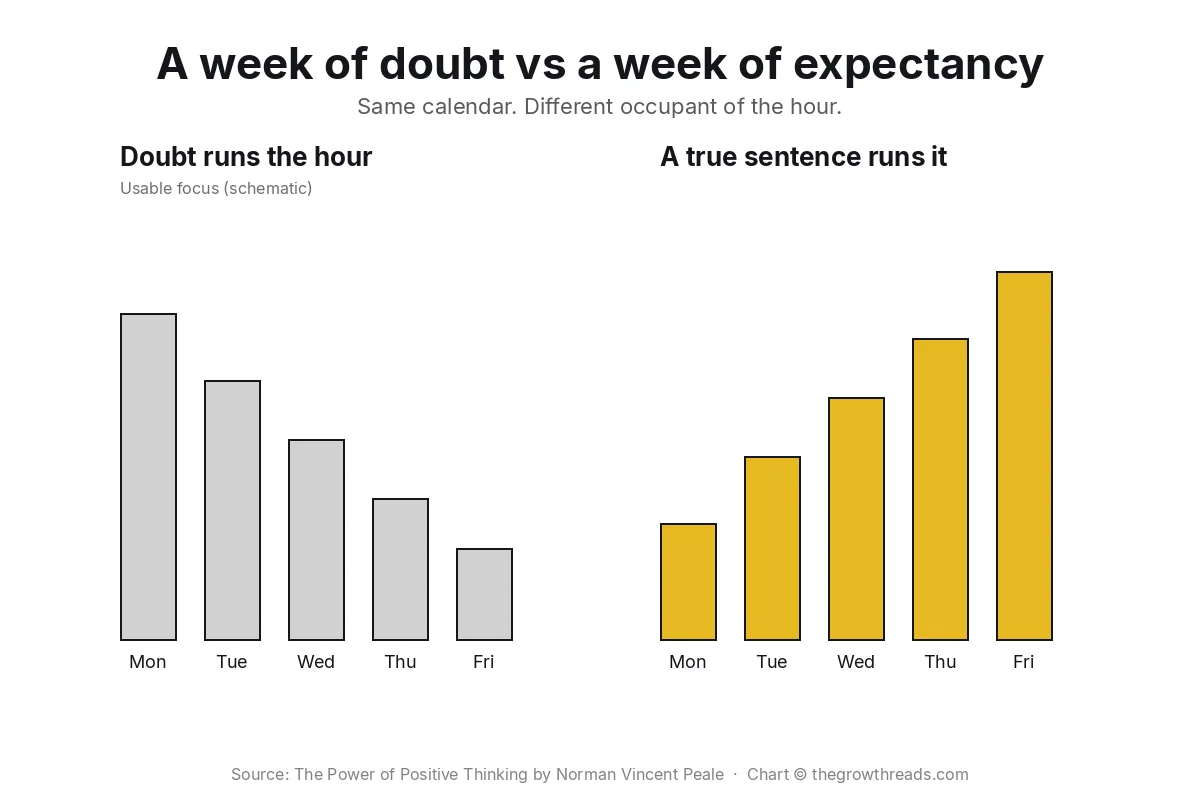
Worry occupies the hour until you give it a dump time and a replacement line. Norman Vincent Peale’s The Power of Positive Thinking is a practical method, dressed in mid-century faith language, for getting the mind out of the way of the work. Picture the next step going well. Empty the fear onto paper at a set appointment. Fill the gap with one true sentence. Then take the smallest move that matches it. The loop is empty, fill, act.
You do not need a new temperament by Friday. You need a 15-minute worry dump and one sentence that survives Tuesday.
Key takeaways
- Belief is a practice: Confidence is a sentence you repeat, then a step you take. Waiting to feel sure is how the week evaporates.
- Empty, then fill: A mind packed with rumination has no room for the next task. Dump the fear on a clock. Replace it with one usable line.
- Picture the next hour: Vague hope does not give the calendar a job. A detailed next-move picture does.
- Peace is a work tool: A fuming mind burns the fuel you needed for the hard thing. Quiet is not luxury. It is how power shows up.
- Energy follows the story: How you narrate tiredness becomes how tired you stay. Interrupt it, then do the next small unit.
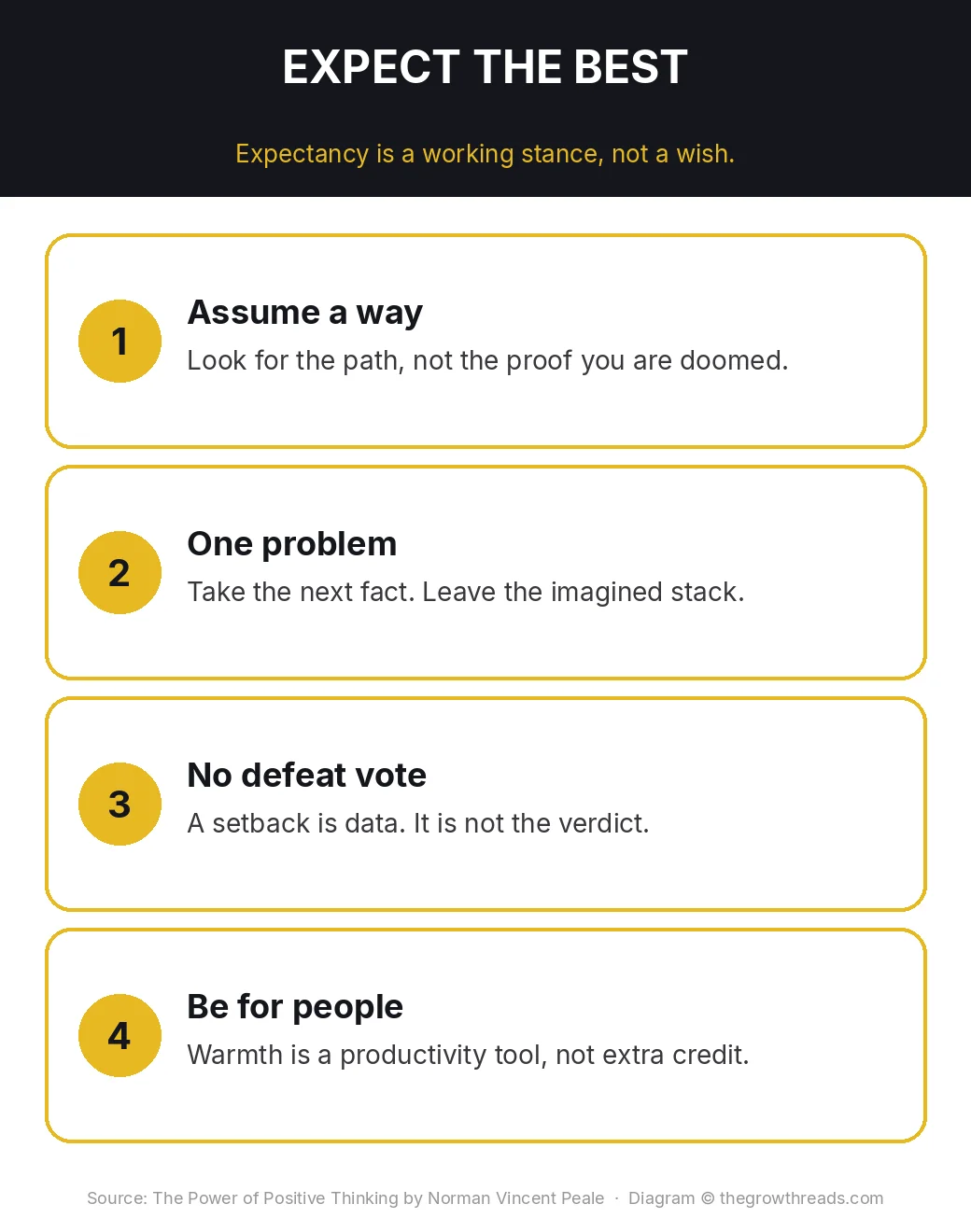
- Expectancy is a stance: Looking for a path is different from wishing. Assume there is a way, then take the first fact in front of you.
- Do not vote for defeat: A setback is data. It is not the verdict on the person doing the work.
- One problem at a time: The imagined stack is heavier than the actual next email. Shrink the wall in your head before you climb it.
- Be for people: Warmth and genuine interest open rooms faster than a private war.
- Suggestion cuts both ways: What you repeat becomes the room you live in. Pick the rehearsal.
What is The Power of Positive Thinking about?
The Power of Positive Thinking is Norman Vincent Peale’s 1952 method for emptying worry, filling the gap with one true sentence, and taking the next visible step. It is a thought-and-action manual for the working week, not a calendar system and not a theology textbook.
About the author
Norman Vincent Peale (1898–1993) was the long-serving pastor of Marble Collegiate Church in New York and the writer who turned “positive thinking” into a household phrase. Raised in Ohio, he trained as a Methodist minister, then spent more than fifty years in a Manhattan pulpit talking to salespeople, clerks, and executives who could do the work once the inner narrator quieted down. The Power of Positive Thinking (1952) sold in the millions, sat on American nightstands for a generation, and was followed by dozens of other books, radio, and a magazine. The authority is pastoral and practical: decades of counseling people whose talent was not the bottleneck. The method is older than the productivity internet and still maps onto a Tuesday: empty the fear, fill a line, move. Explore all Norman Vincent Peale book summaries →
Key concepts at a glance
| Concept | What it means | Use it when |
|---|---|---|
| Believe in yourself | A practiced “I can,” then a step that matches it. | You already know the move and then talk it away. |
| Empty then fill | Dump worry on a clock; replace it with one true line. | Rumination is doing the job instead of you. |
| Picture success | Rehearse the next hour going well, in detail. | Your only movie is the one where you fail. |
| Peace as power | A quiet mind has fuel left for the hard thing. | You are fuming before the meeting starts. |
| Expect the best | Look for a path, not proof you are doomed. | You broadcast the crash in advance. |
| No defeat vote | A setback is data, not a verdict. | One miss becomes a personality. |
| One problem | Take the next fact. Leave the imagined stack. | You are climbing a wall you decorated yourself. |
| Suggestion | What you repeat becomes the room you live in. | The inner radio is on all day, unchosen. |
Part 1: Believe in yourself
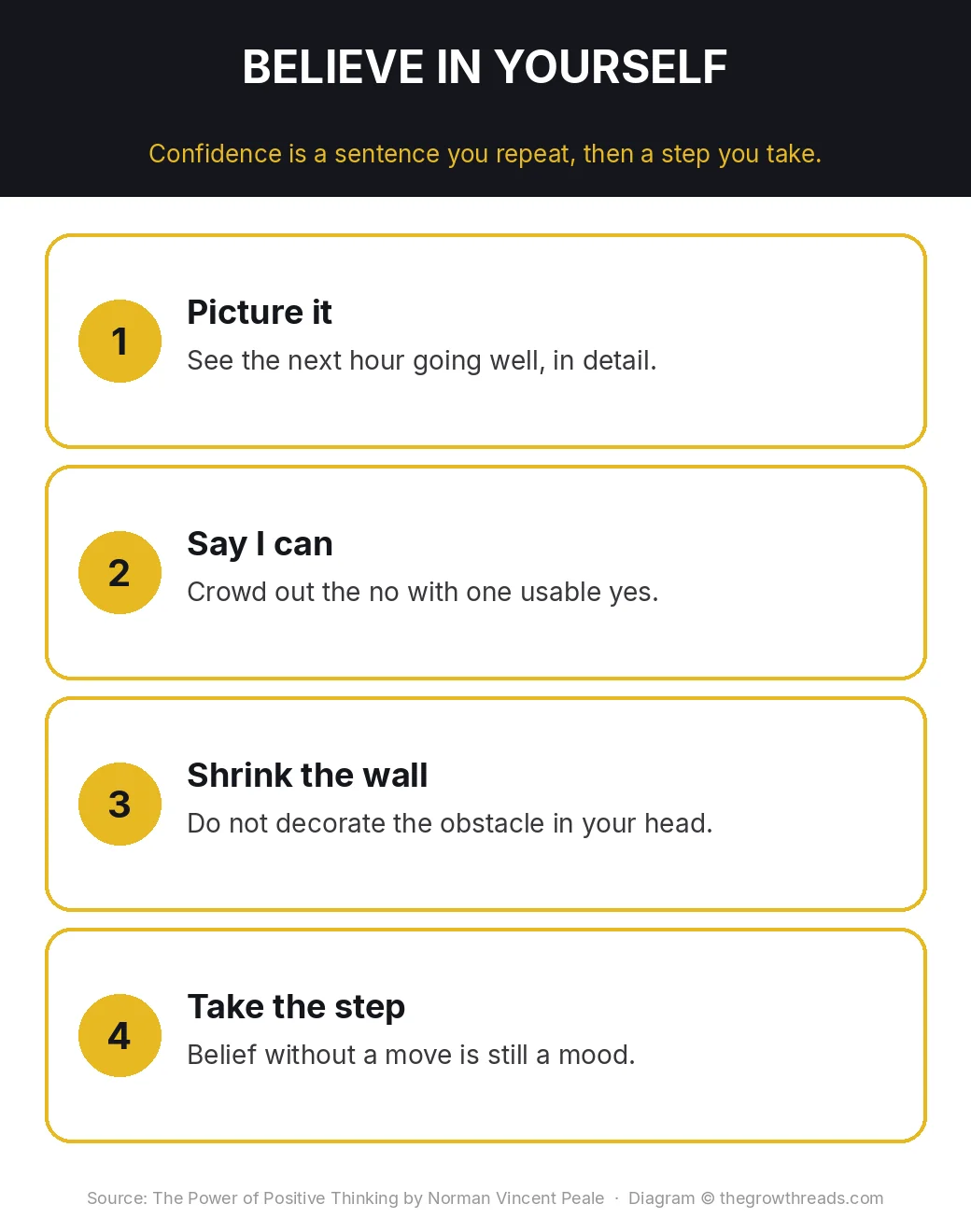
Peale opens where most productivity books skip: the person who has to sit down. He tells his own story as a shy Ohio boy who had to learn, out loud, that he could speak. The point is not autobiography. It is a working claim: self-belief is not a mood that arrives. It is a sentence you install, then a behavior that makes the sentence less of a lie. Picture the next hour going well — the email sent, the call held, the page written — in enough detail that your nervous system has something to rehearse besides the crash. Then say a usable yes. Not a slogan about your destiny. A line about the next unit: I can start the draft. I can make the ask. I can stay in the chair for twenty minutes.
The other half of belief is what you stop decorating. Peale is blunt about the inner architect who builds the obstacle taller than the actual task. Shrink the wall. Take the step. Belief without a move is still a mood. Fears are a radio, not a research department. Change the station, then put your hands on the work.
TGR Note: If the inner picture is the ceiling, Psycho-Cybernetics is the closer cousin — self-image as a thermostat. If the issue is the thought that becomes the week, As a Man Thinketh is the shorter ancestor. Peale is the pastoral, extraverted version of both: say the line, then walk into the room.
Part 2: A peaceful mind generates power
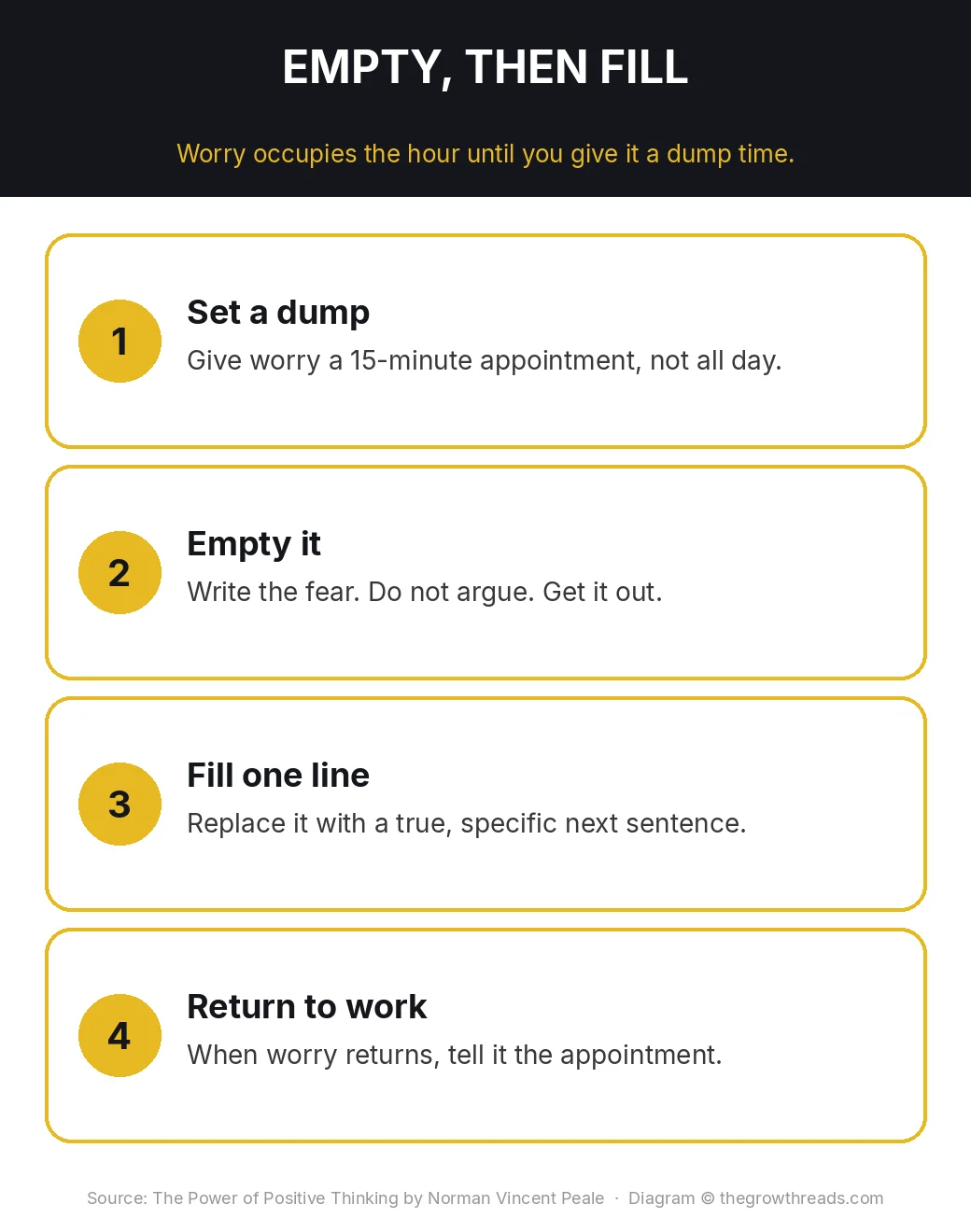
Peale’s second move is energy accounting. A mind that fumes, replays, and litigates all morning has already spent the fuel the afternoon needed. “A peaceful mind generates power” is not interior décor. It is a claim about the working week: quiet is how you have anything left for the hard thing. He teaches simple emptying — sit still, drain the noise, refuse to host the argument for fifteen minutes — then filling. Prayer, in his pulpit, is the name of that empty-and-fill. In TGR language the physics is the same if you never use the word. Empty the worry onto paper. Fill one true sentence. Return to the task. When the fear knocks, tell it it has an appointment, not the whole day.
Energy follows the story you tell about tiredness. Peale watched congregants exhausted by their own commentary more than by the hours. Drop the drama about how depleted you are, do the next small unit, and let the body catch up. Stop fuming before the meeting. You will have more of yourself in it.
TGR Note: If the job after the mind is quiet is simply to think at the size of the life, The Magic of Thinking Big is the classic install. If the fuming is a practiced soundtrack, Soundtracks is the newer, shorter cousin. Peale is the emptying ritual that has to happen before either book has a clean surface to write on.
Part 3: Expect the best and break the worry habit
Expectancy, in Peale, is not a vision board. It is a working stance: look for a path instead of collecting proof you are doomed. He tells of people who advertised their expected failure so thoroughly that the room had no job except to agree. Stop broadcasting the crash. Assume there is a way through the next constraint, then take the first actual fact — the email, the number, the draft — rather than the imagined stack of ten facts behind it. “I don’t believe in defeat” is the same stance in a harder key. A miss is data. It is not a vote on whether you are allowed to continue. The person who treats one bad call as a personality will need a new personality every Thursday.
Worry gets its own chapter because it is the unpaid intern running the company. Peale’s most practical device is a dump time: a 15-minute appointment on the calendar. Write the fears. Do not argue. Get them out of the day. When they return at 11:40, they can wait for the slot. This is scheduling, not suppression. The mind that knows it will be heard later can do the 11:40 task now. One short line still holds the stance: change your thoughts and you change your world. In TGR terms, change the occupant of the hour, then let the hour do its job.
TGR Note: If worry is the habit that needs a smaller first step, Mini Habits shrinks the unit until the narrator has less to fight. If the week is lost to tiny daily choices that compound the wrong way, The Compound Effect is the scoreboard. Peale is the inner radio the scoreboard is measuring.
Part 4: People, suggestion, and a working faith
The second half of the book turns outward. How to get people to like you, in Peale, is a productivity claim: rooms open for the person who is actually for other people. Be interested. Remember names. Drop the private war. Warmth is how the work gets a corridor. Drawing the good out of people is the same motion: look for the competent adult in the room instead of prosecuting the flaw. You will still give notes. You will give them to someone less busy defending themselves.
Suggestion is the mechanism underneath. What you repeat — to yourself, about other people, about the week — becomes the room you live in. Peale wants that rehearsal chosen. A working faith, in his language, is trust that empty-and-fill is allowed to work. You do not have to share his pulpit to keep the behavior: sit, empty, fill one true line, take the step, be for the next human, refuse to let a setback cast a vote. The close is a loop, not a conversion. Expect a way. Empty the file. Fill a sentence. Move. Repeat tomorrow, when the narrator tries to take the hour back.
TGR Note: If the remaining stall is a mean story about who you are allowed to be, You Are a Badass is the louder, funnier shove. If the job after the stance is 64 rules for showing up, The Success Principles is the longer checklist. Peale is the empty-and-fill that makes either book have somewhere to land.
Who is The Power of Positive Thinking best for — and who should read something else first?
Best for capable people whose inner narrator is louder than the calendar: operators, freelancers, managers, anyone who can do the work once rumination stops. If you want a cue-and-habit install after the stance is willing, go to Atomic Habits. If the picture in your head is the ceiling, start with Psycho-Cybernetics. If you need to think at the size of the life, read The Magic of Thinking Big.
Read something else first if you need an inbox, a deep-work protocol, or a two-minute rule. Those are other books. If you will not sit down at all, read The War of Art. If the inner prosecutor needs a smaller first step so the story has less to fight, read Mini Habits. Come to Peale when the stall is a radio in the head, not a missing system.
Questions to reflect on
- What sentence does your inner radio repeat by 10 a.m., and what true replacement line would fit on a sticky note?
- If worry had a 15-minute appointment on your calendar today, what would you actually dump onto the page?
- Which obstacle have you been decorating in imagination until it is taller than the next email?
- Where did you broadcast expected failure this week, and what would “assume a way” have sounded like in that room?
- Who in your week would work better if you were obviously for them, not at war with them?
🔥 Ready to empty the worry and take the hour back?
Dump the fear on a clock. Fill one true sentence. Move.
How to apply The Power of Positive Thinking (7-day plan)
- Day 1 — Name the radio. Write the sentence your inner narrator repeats before hard work. Do not debate it. Label it as a station, not a fact. Put the paper where you will see it tomorrow.
- Day 2 — Install a dump time. Give worry a 15-minute slot on the calendar. When it knocks outside that slot, tell it the appointment. That is the whole job today.
- Day 3 — Empty, then fill. At the dump time, write the fears without arguing. Then write one true replacement line about the next unit of work. Say it once out loud. Then do ten minutes that match it.
- Day 4 — Picture the next hour. Before the hardest block, spend two minutes seeing the block going well in detail: the chair, the first sentence, the send. Then start. The picture is rehearsal, not magic.
- Day 5 — Shrink one wall. Pick the task you have been enlarging. Write the actual next fact (one email, one call, one page). Do only that. Leave the imagined stack on the paper from Day 2.
- Day 6 — Be for one person. In one meeting or message, be obviously interested: remember the name, ask the real question, drop the private war. Warmth is part of the method, not a personality upgrade.
- Day 7 — Keep the loop. Rewrite the replacement line if it got clearer. Keep the dump slot next week. Grade the week on whether you emptied and acted, not on whether you felt new.
Frequently asked questions
What is The Power of Positive Thinking about?
The Power of Positive Thinking is Norman Vincent Peale’s 1952 field manual for getting worry out of the working hour. Empty the fear onto paper at a set time, fill the gap with one true specific sentence, picture the next step going well, and take the smallest move that matches it. The book wears mid-century faith language. The usable core is a loop you can run on a Tuesday: empty, fill, act. It is not an inbox system and not a demand that you join a church.
How long does it take to read The Power of Positive Thinking?
The Touchstone paperback is 218 pages, about five hours for most readers. This summary is a twelve-minute pass: belief as a practice, empty-then-fill, expectancy, and a seven-day plan. If you only have lunch, write the sentence your inner radio repeats and one true replacement line, then give worry a 15-minute appointment on today’s calendar. Come back to the later chapters once that appointment has actually run once, not once you feel converted. The book rewards a second sitting more than a speed-read.
Is The Power of Positive Thinking just wishful thinking?
Peale talks about faith, prayer, and expecting the best, and some readers hear that as a vision board. The usable core is more boring and more useful: rumination occupies the hour until you dump it on a clock and replace it with a sentence you can act on. Expectancy means looking for a path, then taking the next fact, not pretending the constraint is gone. Some of the book’s medical and statistical asides have been debated; the practical advice is uncontroversial. Keep the behavior if the metaphor is not yours.
How is this different from The Magic of Thinking Big or Psycho-Cybernetics?
The Magic of Thinking Big is the size-of-life install: think at the scale of the work, then act. Psycho-Cybernetics is the self-image thermostat: the picture in your head sets the ceiling. The Power of Positive Thinking sits beside both as an emptying ritual. Peale wants the fear out of the bloodstream of the day so either of those books has a clean surface. Read Schwartz when the life is too small. Read Maltz when the inner picture is the brake. Read Peale when the stall is a radio you never scheduled.
Do I need to be religious to use this book?
No. Peale was a pastor, and prayer is his name for empty-then-fill. You can keep the physics without the pulpit: sit still, dump the worry on paper, fill one true line, take the step. The faith chapters are sincere, not a trap. If a page feels like a sermon, keep the appointment-and-sentence and leave the rest. TGR’s interest is the Tuesday: a quieter inner radio and a visible move, not a new creed. Readers who already pray can use his language as written.
Who is The Power of Positive Thinking best for?
People who can already do the work once the narrator stops. Operators, freelancers, managers, and anyone whose rumination is doing a full-time job. It is less useful if you want GTD, deep-work blocks, or a two-minute rule — those are other books. This one is for the inner radio that eats the hour before the system even opens. If you need a smaller first step so the story has less to fight, start with Mini Habits, then come back.
What should I do on day one with The Power of Positive Thinking?
Write the sentence your inner radio repeats, and give worry a 15-minute slot on today’s calendar. At that slot, dump the fears without arguing, then write one true line about the next unit of work. Do ten minutes that match the line. Peale’s loop is empty, fill, act. The first sitting is not a personality transplant. It is an appointment the rumination no longer owns, plus a move small enough to finish before dinner. Do the dump even if the replacement line still sounds unconvinced.
Related summaries
- The Magic of Thinking Big — think at the size of the life, then act.
- Psycho-Cybernetics — the inner picture that sets the ceiling.
- As a Man Thinketh — the thought that becomes the week.
- You Are a Badass — the louder shove when the story is mean.
- Best productivity books — the full Productivity silo.
How we analyze books: every book on The Growth Reads is read cover to cover, summarized in thousands of words of original analysis, and rated against our five-criteria rubric (lasting impact, evidence quality, practical application, writing & originality, external consensus). Read our full methodology.