

★★★★☆ 4.4/5 — a DJ booth for the thoughts that keep stealing the work.
Best for: People who already know the next action and still stall in the story about themselves
Reading time: ~6 hours (240 pages) if you binge · this guide ~10 min
Difficulty to apply: Easy to name the song. Hard to repeat the new one when stress turns the old volume up
Soundtracks in one minute
Overthinking is not who you are. It is a song on repeat. Jon Acuff’s Soundtracks (Baker Books, 2021) treats the loop in your head like a playlist you can DJ. Broken tracks steal time, creativity, and goals — 99.5% of 10,000 people in a survey he commissioned said they overthink. The fix is not “stop thinking.” Retire the tracks that fail three tests (true, helpful, kind), replace them with a line you can believe, and repeat that new anthem until it is as automatic as fear. This summary is the application layer: one broken song named, one replacement written, one symbol in your bag, and a 7-day plan.
Key takeaways
- Overthinking is fear in work clothes: It masquerades as being prepared. It still costs the hour.
- Soundtracks, not moods: A thought you have replayed for years is a song. You already know the lyrics.
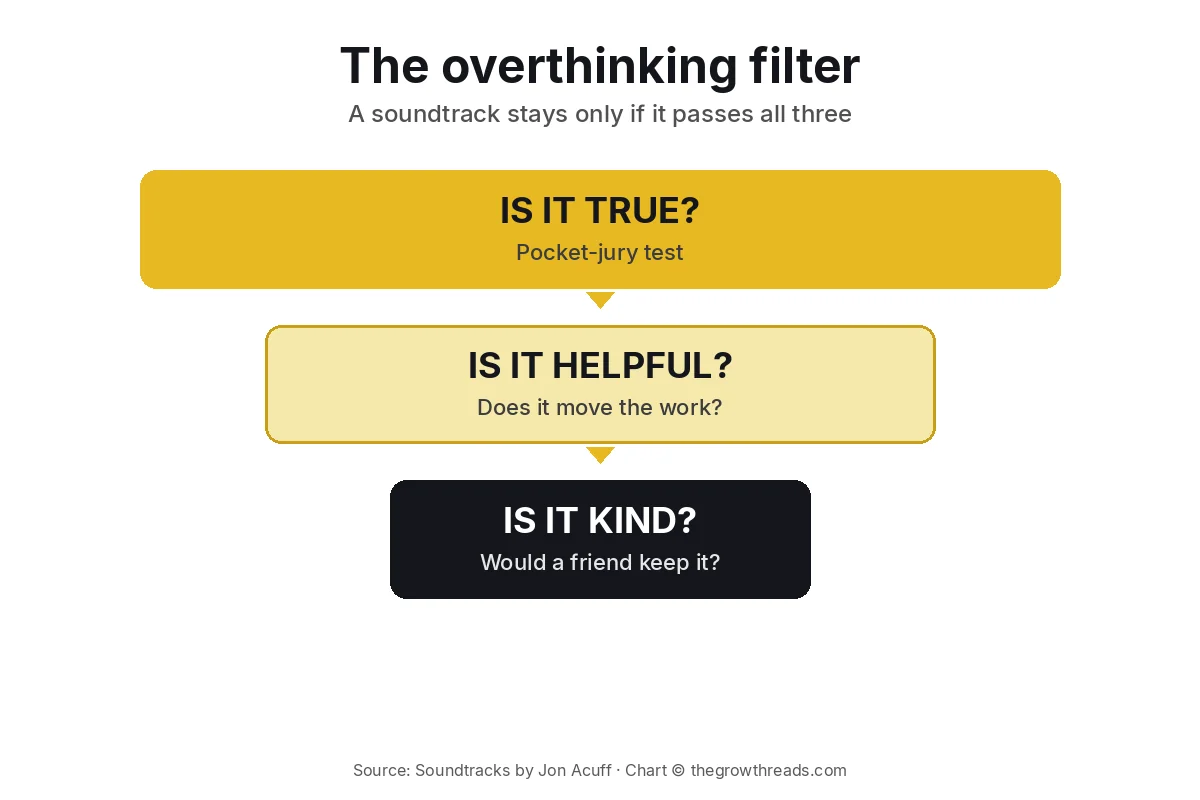
- Three questions: True? Helpful? Kind? Fail any one and the track is retired.
- True can still be unhelpful: A failed test is a fact. “You’ll fail again” is a broken sequel.
- A dial, not a switch: Old songs get loud under stress. Turn them down. Do not wait for silence.
- Retire, replace, repeat: Empty space fills with the old lyric. Write a better one and play it on purpose.
- Borrow and flip: Steal a line from someone you trust, or invert an absolute (“I have to finish it all”).
- Evidence beats the pocket jury: One proof a day starves the prosecution that only files losses.
- A symbol makes it stick: A coin, a note, a rock in the pocket — see it, play the new track.
What is Soundtracks about?
Soundtracks is Jon Acuff’s plan to turn overthinking from a super problem into a superpower. You learn to spot broken mental songs, run them through true/helpful/kind, and install a new anthem you repeat until it is automatic. The point is not quieter thinking. It is better DJing.
About the author
Jon Acuff is a New York Times bestselling author and Inc. Top 100 leadership speaker who writes the books he needs first. After years as a copywriter and corporate speaker — including a stretch at Dave Ramsey’s company — he built a career on honest, funny advice about goals, finishing, and the stories we tell ourselves. He lives outside Nashville with his family. Soundtracks (Baker Books, April 2021) came from his own overthinking and a survey of 10,000 people with researcher Mike Peasley: 99.5% said they overthink too. His other titles include Finish, Start, Do Over, and All It Takes Is a Goal. The usable through-line is the same: thoughts are not weather. You can pick the next track. Explore all Jon Acuff book summaries →
Key concepts at a glance
| Concept | What it means | Use it when |
|---|---|---|
| Soundtrack | A thought on heavy repeat | You know the lyric by heart |
| Broken soundtrack | Fails true, helpful, or kind | The loop steals the hour |
| Pocket jury | Evidence check, not vibes | The thought feels obviously true |
| The dial | Volume, not on/off | Stress makes the old song loud |
| Retire | Stop feeding the broken track | You keep arguing with it |
| Replace | Write a better, believable line | Silence fills with the old lyric |
| Repeat | Play the new anthem on purpose | You tried a quote once |
| Symbol | A physical cue for the new track | Your hands are busy, brain isn’t |
Part 1: Overthinking is a soundtrack, not a personality
Acuff opens with a domestic diagnosis. His wife’s line — that he might be overthinking this — becomes the book’s dare: what if the loop is not “who I am,” but a song queued so often it feels like identity? Overthinking, he argues, is the sneakiest form of fear. It steals time, creativity, and goals while wearing a lanyard that says I’m just being thorough.
He commissioned a study with Mike Peasley and asked 10,000 people if they struggle with overthinking. 99.5% said yes. The number is a relief, not a peer-reviewed trial: you are not the only person whose brain writes sequels nobody asked for. The useful picture is music. A song you heard at fifteen still hits harder than a song you heard last month. The same is true of a sentence a coach, parent, or tired version of you installed in a hallway years ago. “I’m not a natural leader” can still be playing at forty-five with no new evidence on the stand.
The movie metaphor is the click: a quiet house with a picket fence is a family. Add an ominous score and the same house is a warning. You did not change the picture. You changed the soundtrack. That is the whole thesis. You do not need a quieter mind for twenty-three hours a day. You need a better track list for the hours you actually work.
One short line from the book is worth keeping: “Overthinking isn’t a personality trait. It’s the sneakiest form of fear.” The rest of the pages are how to stop treating fear like a personality.
TGR Note: If the stall is not the lyric but the missing cue, start with our Atomic Habits review and the Tiny Habits summary. Soundtracks will not design the environment. It will stop the sentence that talks you out of walking into the environment you already built.
Part 2: Ask three questions, then turn down the dial
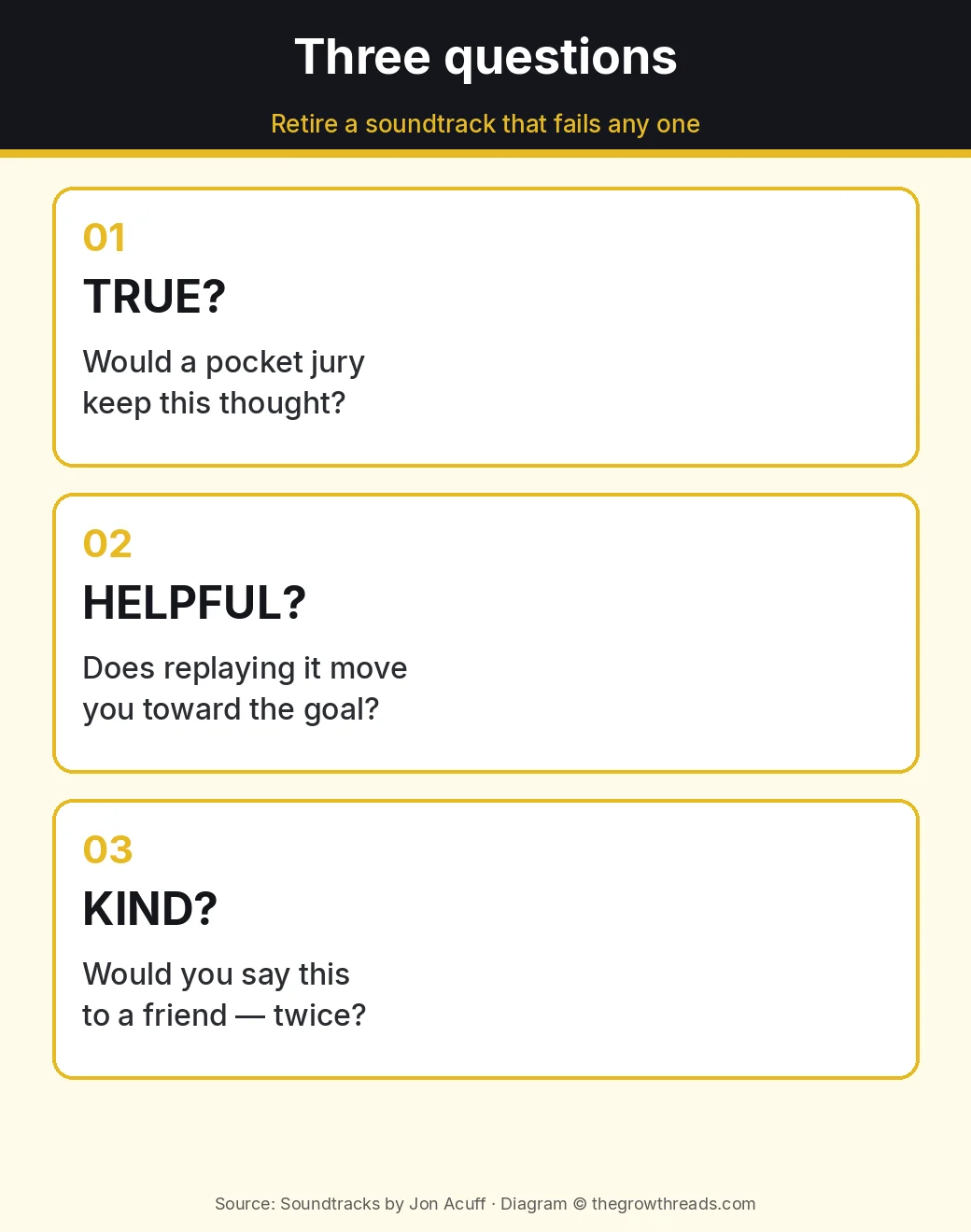
Once you can hear the song, Acuff hands you a pocket-sized audit. Three questions, almost too plain to take seriously, and therefore easy to skip:
Is it true? Pretend you have a pocket jury. Put the evidence on the table — including the wins your brain files under “doesn’t count.” Most broken tracks over-weight one ugly data point and ignore a decade of contrary reps.
Is it helpful? Some lyrics are factually correct and still pull you backward. His daughter fails a test (true). The sequel, “you will fail again,” on loop the night before the next exam, is not helpful. Helpful is a directional test: does this replay move the work?
Is it kind? Would you say this to a friend, twice, and still have a friend? If the answer is no, you are running a track you would never license for someone you love.
Fail any one and the soundtrack is broken. Then the second move: treat volume as a dial, not a switch. Broken songs get loud when the stakes go up. Waiting for total silence is how the afternoon disappears. Turn it down one notch and take the next two-minute action anyway.
TGR Note: If the noise is rumination you cannot name, pair this with our Think Like a Monk summary. Acuff is the DJ. Monk training is the room treatment. You still need both if the old song is also a habit of attention.
Part 3: Replace the song — borrow, flip, zig
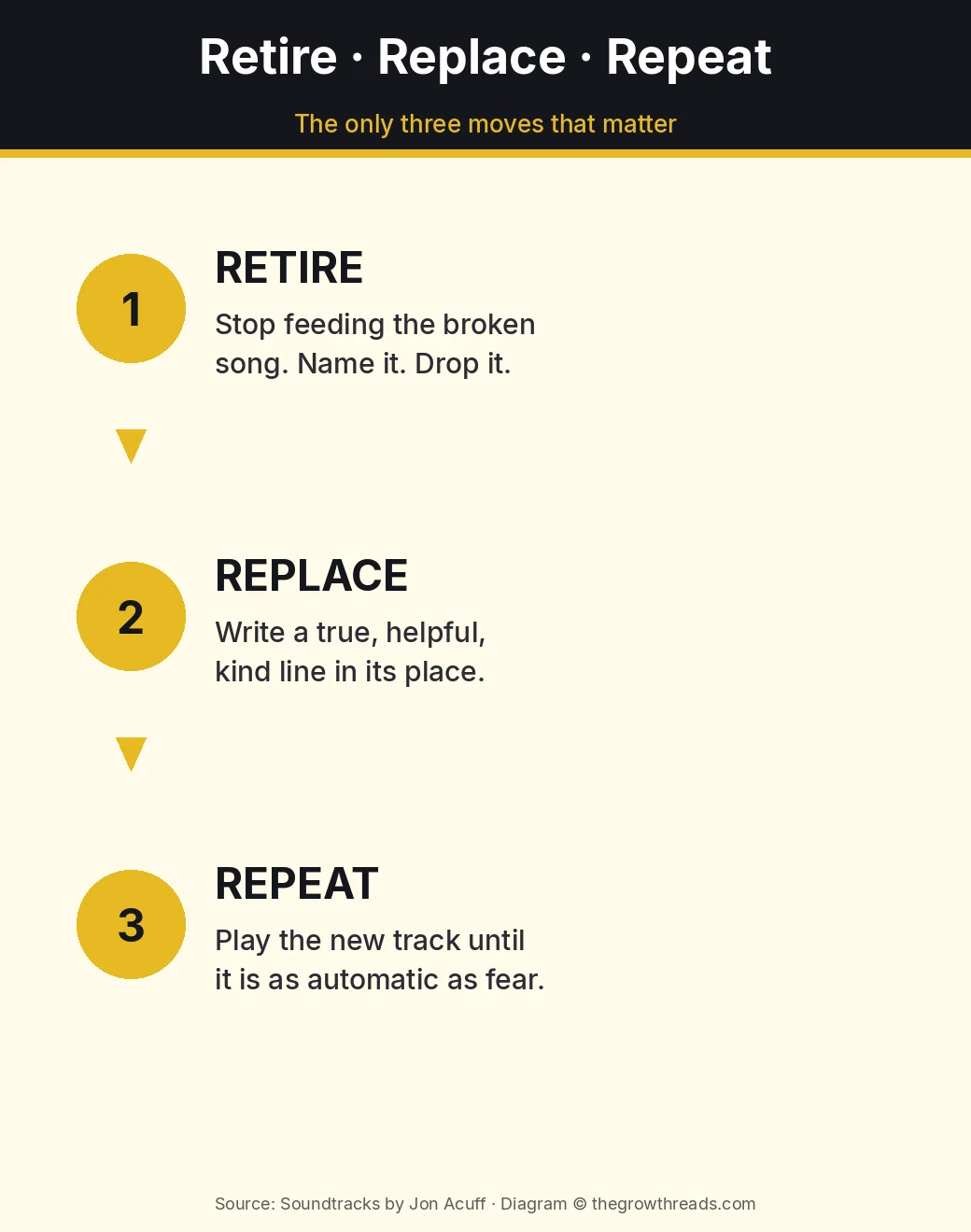
Retiring a track leaves a hole. Brains hate holes. They refill them with the old lyric unless you drop a new file in. Replacement, in this book, is not a vision board. It is a sentence you can say on a bad Tuesday without rolling your eyes.
Two sources. First, invert the absolute. Acuff’s own writing soundtrack was “I have to finish the whole book in one sitting.” He flipped it to a few pages. The work got done because the new line was small enough to obey. “It has to be perfect” becomes “prolific is better than perfect.” “That can’t work here” becomes “how could this work here?” You are using overthinking’s talent for sequels against itself.
Second, borrow from the best. Steal a line from a person whose life you want more of — a coach, a friend, a writer you trust — and put it in rotation. Acuff’s chapter titles tell you the vibe: borrow, win the week, don’t fight it, flip it, zig toward the useful thought. Winning the week is the anti-fantasy: one visible win, logged, beats a manifesto.
The test for a replacement is the same three questions. If the new anthem is a lie you cannot defend, the pocket jury will throw it out and the old song returns. Believable beats inspiring.
TGR Note: If the real problem is waiting to feel ready, read our The Practice summary. Godin wants you to ship. Acuff wants the sentence that lets you sit down. Use Soundtracks before the session and The Practice during it.
Part 4: Repeat until the new anthem is automatic
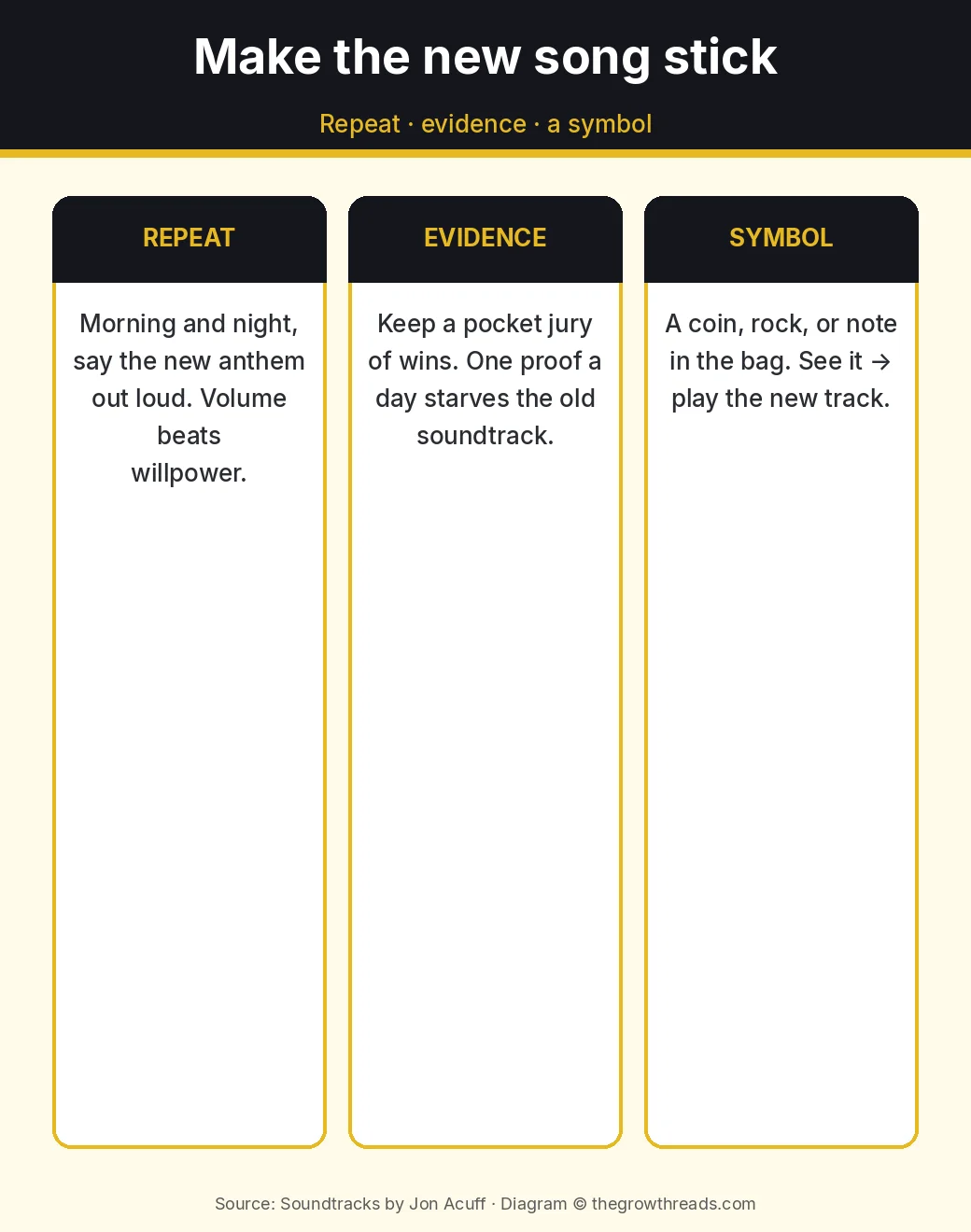
This is the chapter most readers will underline and then skip. Repeat is not inspiration. It is reps. Acuff wants the new anthem said out loud, morning and night, until it is as automatic as the fear it replaced. A quote on a lock screen is not repetition. Volume is.
Two amplifiers. Gather evidence: the pocket jury that prosecuted you on one loss will quiet down if you keep bringing in wins — even ugly, small ones. Win the week, then file the exhibit. Second, make the soundtrack stick with a symbol. A coin, a rock, a note in the bag you actually carry. When your hands are full, the object is the play button. See it, say the line, take the action.
The back of the book is a New Anthem Challenge: pick the song, put it on a schedule, collect proof. Stress will still turn the old dial up. That is not a broken method. That is the method telling you to reach for the symbol instead of a personality makeover. If you can worry, you can wonder. Same machine. Different track.
TGR Note: If the old song is Resistance with a capital R — the force that makes you clean the sink instead of write — pair this with our War of Art summary. Pressfield names the enemy. Acuff gives you something to play while you sit down anyway.
Who is Soundtracks best for — and who should read something else first?
Best for: knowledge workers, makers, and managers who can describe the next action and still lose the morning to a lyric. If you have a plan and a loop, this is the loop book.
Read something else first: if you do not have a plan, start with Atomic Habits so there is a cue to attach the new anthem to. If you wait to feel ready before you publish, The Practice is the more honest first door. If the stall is guilt-soaked procrastination, The Now Habit will unpack the emotion under the delay. If the blocker is mood, Feel-Good Productivity is the energy layer. Soundtracks will not replace those. It will stop the song that keeps them theoretical.
Questions to reflect on
- What sentence have you replayed so often you now treat it as a fact about yourself?
- If a friend said that sentence twice about their own work, would you still want to be on the call?
- What is the smallest true replacement you could say on a bad Tuesday without rolling your eyes?
- Where does the old song get loud — inbox, doorway, blank page — and what two-minute action sits on the other side?
- What object could you put in the bag you already carry so the new anthem has a play button?
🔥 Ready to change the song?
Get Soundtracks, then run the 7-day plan on one broken lyric — not on a mood board of other people’s mantras.
How to apply Soundtracks (7-day plan)
- Day 1 — Name three songs. Write the broken soundtracks you actually replay. Circle the loudest. If you cannot quote it, you are still in a mood.
- Day 2 — Run the filter. True / helpful / kind on that one song. If any answer is no, mark it retired. Do not argue with it for an hour.
- Day 3 — Write the replacement. One line you can say on a bad Tuesday. Stick it on the monitor. Believable beats poetic.
- Day 4 — Turn the dial once. The next time the old song spikes, take a two-minute action anyway. Log that you moved while it was playing.
- Day 5 — Borrow or flip. Invert one absolute (“I have to finish it all”) into a next page, or steal one line from someone you trust.
- Day 6 — Pick a symbol. Coin, note, rock — in the bag you actually carry. See it → play the new track.
- Day 7 — Repeat on a clock. Morning and night, out loud. File one proof that the new anthem is true. That is the whole challenge.
Frequently asked questions
What is Soundtracks about in one paragraph?
Soundtracks is Jon Acuff’s 2021 field manual for overthinking. He treats the loop in your head as a playlist, not a personality. Broken tracks feel like preparation and still steal the hour the work needed. The move is small: retire songs that fail true, helpful, or kind; replace them with a line you can believe; repeat that new anthem until it fires as fast as fear. Funny and practical, not a lab paper. You leave with a playlist, a symbol, and a week of reps.
What are the three questions for a broken soundtrack?
Ask every loud thought three things. Is it true — would a pocket jury, looking at the actual evidence, keep this lyric? Is it helpful — does replaying it move the email, the draft, the ask? Is it kind — would you say this twice to a friend and still have a friend? A thought can be factually true (you failed a test) and still fail helpful and kind when it becomes “you will fail again” the night before the next one. If you cannot say a fast yes to all three, retire it. That is the whole filter.
What does retire, replace, repeat mean?
Retire means you stop feeding the broken song. Name it out loud, write it down, and refuse to argue with it all afternoon. Replace means you do not leave a hole — brains want a track — so you write one new line that is true, helpful, and kind enough to say on a bad Tuesday. Repeat means volume: morning and night, out loud, until the new anthem is as automatic as the old fear. Acuff’s point is that you already know how to overthink. The same machine can wonder, if you give it a better song and enough plays.
How is a soundtrack different from a random thought?
A random thought shows up once and leaves. A soundtrack is the one you have played so often you know every lyric — often since a teacher, boss, or teenage locker-room version of you first queued it. That is why a 45-year-old still says “I’m not a natural leader” with no new evidence. The movie metaphor in the book is the tell: the same quiet house becomes a threat when the score turns ominous. You are not broken for having the thought. You are stuck because it is on repeat. Change the track, not the whole brain.
Does Soundtracks replace therapy, meditation, or a focus system?
No. Acuff is a speaker who commissioned a survey with researcher Mike Peasley — 10,000 people, 99.5% said they overthink — not a clinician running a trial. Some statistics in popular books get debated; the practical advice here is uncontroversial: notice the lyric, test it, swap it, rehearse it. Meditation still covers the quiet twenty minutes. Therapy still covers trauma you should not DJ alone. If the stall is cues and environment, start with Atomic Habits. Soundtracks is the layer for the sentence that talks you out of the work you already know how to do.
How long does it take to change a soundtrack?
Faster than a personality transplant, slower than a quote on a mug. Acuff treats the dial as a week of reps, not a switch. One new anthem, said morning and night, plus one piece of evidence a day, is the New Anthem Challenge at the back of the book. Symbols (a coin, a sticky note, a rock in the pocket) make the new track fire when your hands are busy. You will still hear the old song under stress. That is the dial, not failure. Turn it down and play the new one anyway. Most people skip repeat. Repeat is the whole game.
Who should read Soundtracks first versus another productivity book?
Read Soundtracks first if you already know the next action and still stall in the story about yourself. If you need a cue-routine-reward architecture, start with our Atomic Habits review. If you wait to feel ready before you ship, The Practice is the honest pair. If guilt and “I must be in the mood” are the loop, The Now Habit is a better first door. Soundtracks will not design your calendar. It will stop the song that keeps the calendar theoretical. Pair it with one systems book, not five more mindset books.
Related summaries
- Atomic Habits Summary & Review
- The Practice Summary & Review
- The Now Habit Summary & Review
- Feel-Good Productivity Summary & Review
- Best Productivity Books
How we analyze books: every book on The Growth Reads is read cover to cover, summarized in thousands of words of original analysis, and rated against our five-criteria rubric (lasting impact, evidence quality, practical application, writing & originality, external consensus). Read our full methodology.