

★★★★½ 4.5/5 — trust is the hidden tax on every slow week.
Best for: Managers, founders, and operators drowning in extra approvals, CYA, and “just checking”
Reading time: ~9 hours (354 pages) · this guide ~12 min
Difficulty to apply: Medium — you change how you make and keep promises, not how you talk about culture
The Speed of Trust in one minute
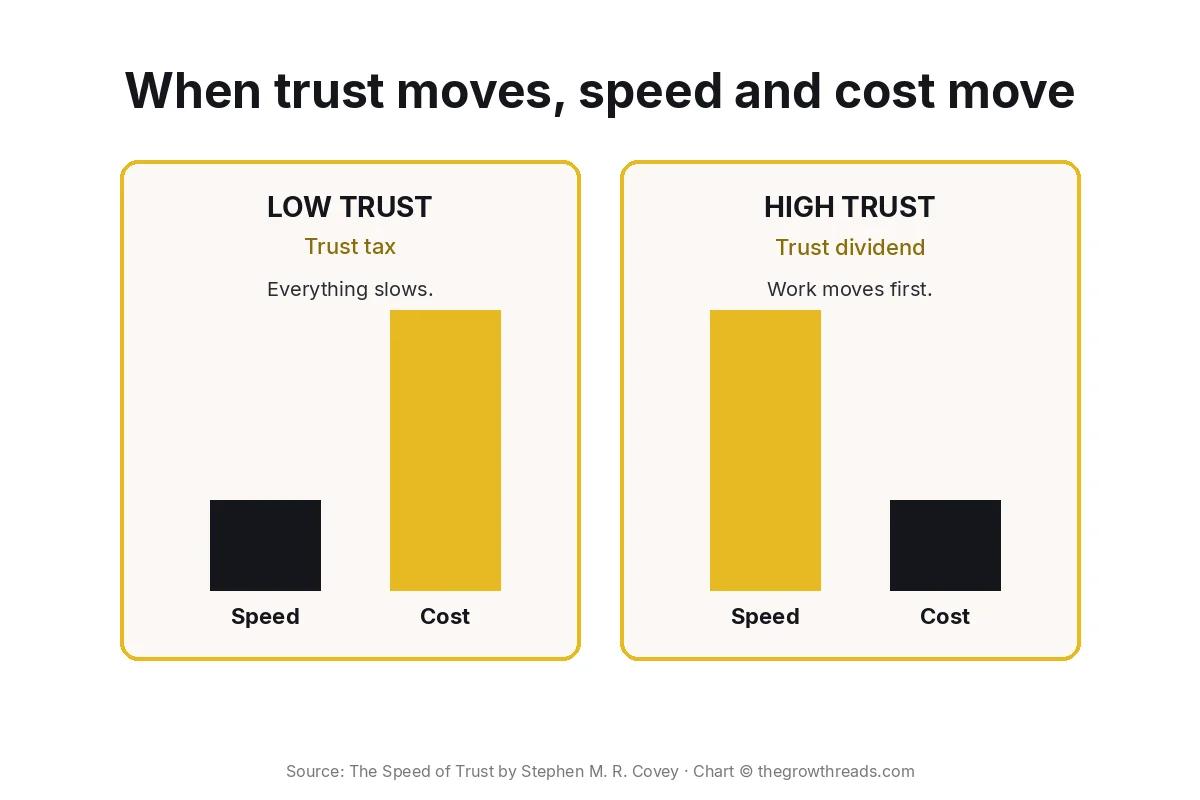
Trust is not a mood. It is a tax or a dividend on every meeting, hire, and handoff. Stephen M. R. Covey, writing with Rebecca R. Merrill, prices that tax. When trust is low, speed dies and cost explodes: extra reviews, extra contracts, extra “loop me in.” When trust is high, the same work moves. Credibility has four cores — integrity, intent, capabilities, results. Relationships have thirteen behaviors. Organizations, markets, and societies inherit whatever you built (or broke) closer in. You can restore trust on purpose. This is a productivity book wearing a leadership jacket. If your week is full of rework, the missing lever is rarely another tool.
Key takeaways
- Trust is economics: when it rises, speed rises and cost falls. Soft-skill talk hides a hard number.
- There is always a tax or a dividend: low trust pays in delays, checks, and politics. High trust pays in pace.
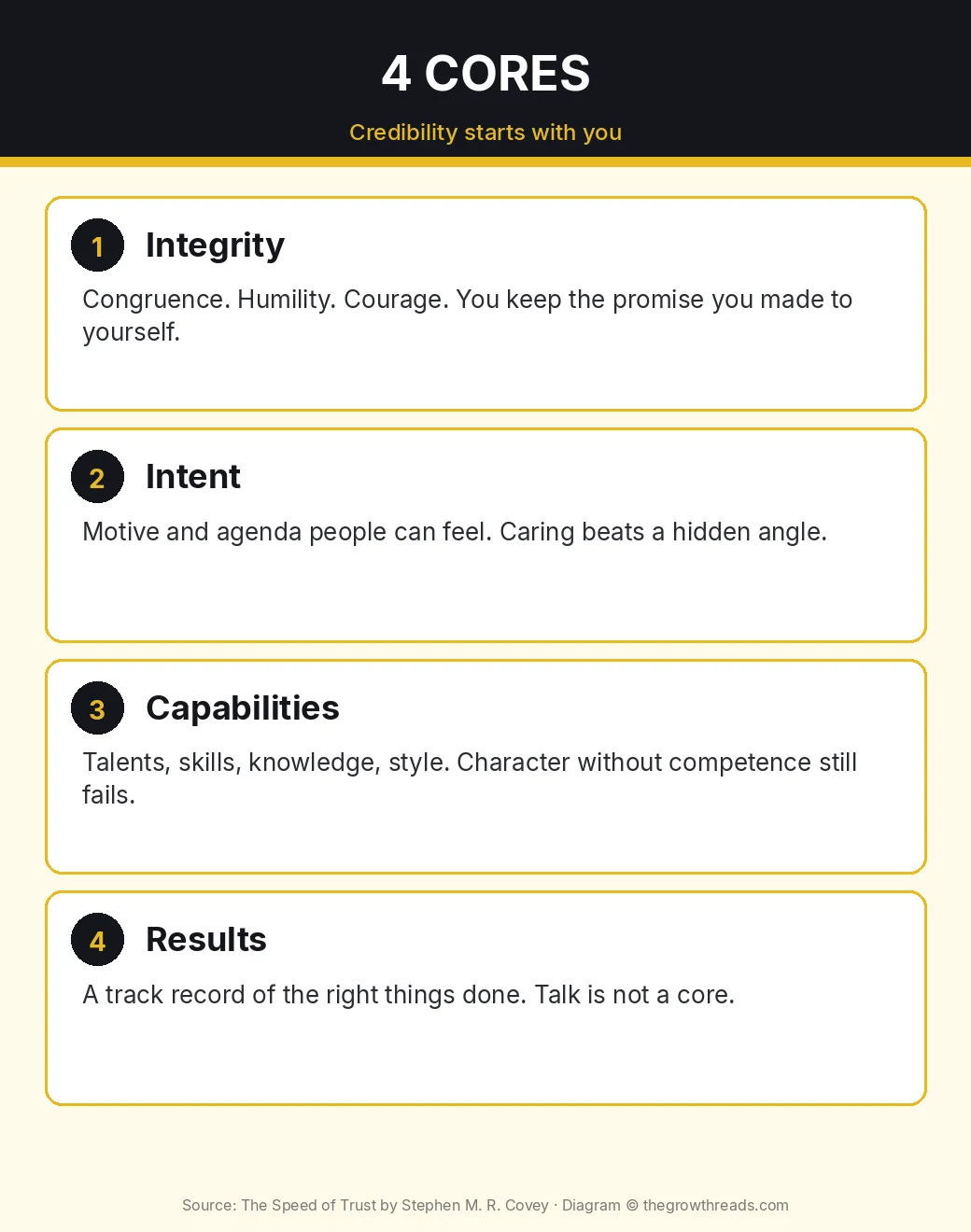
- Credibility is four cores: integrity, intent, capabilities, results. Miss one and people feel it.
- Character without competence still fails: nice people who cannot deliver are not trusted. Skilled people with a hidden agenda are not either.
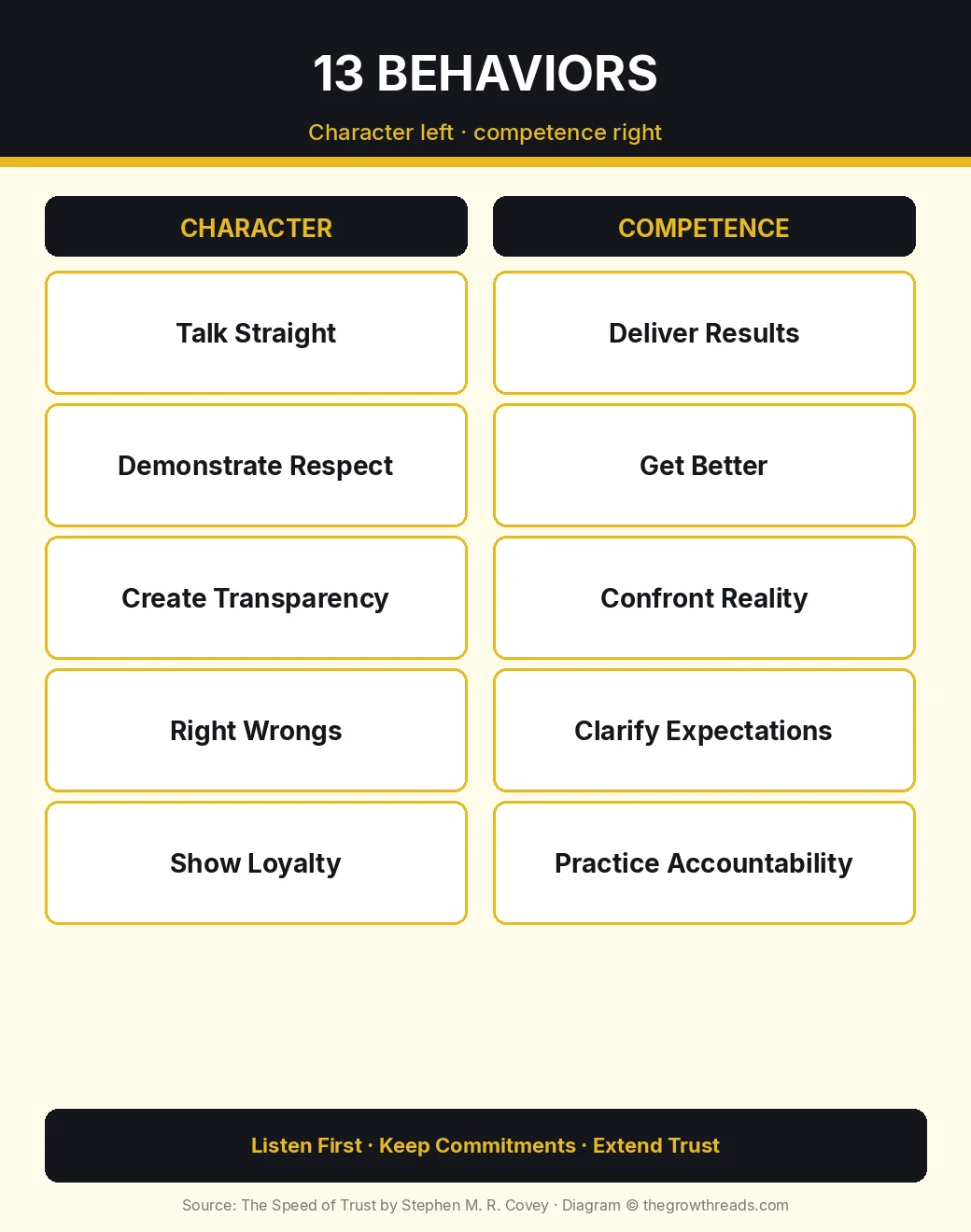
- Thirteen behaviors beat slogans: talk straight, keep commitments, deliver results, extend trust — on a calendar, not a poster.
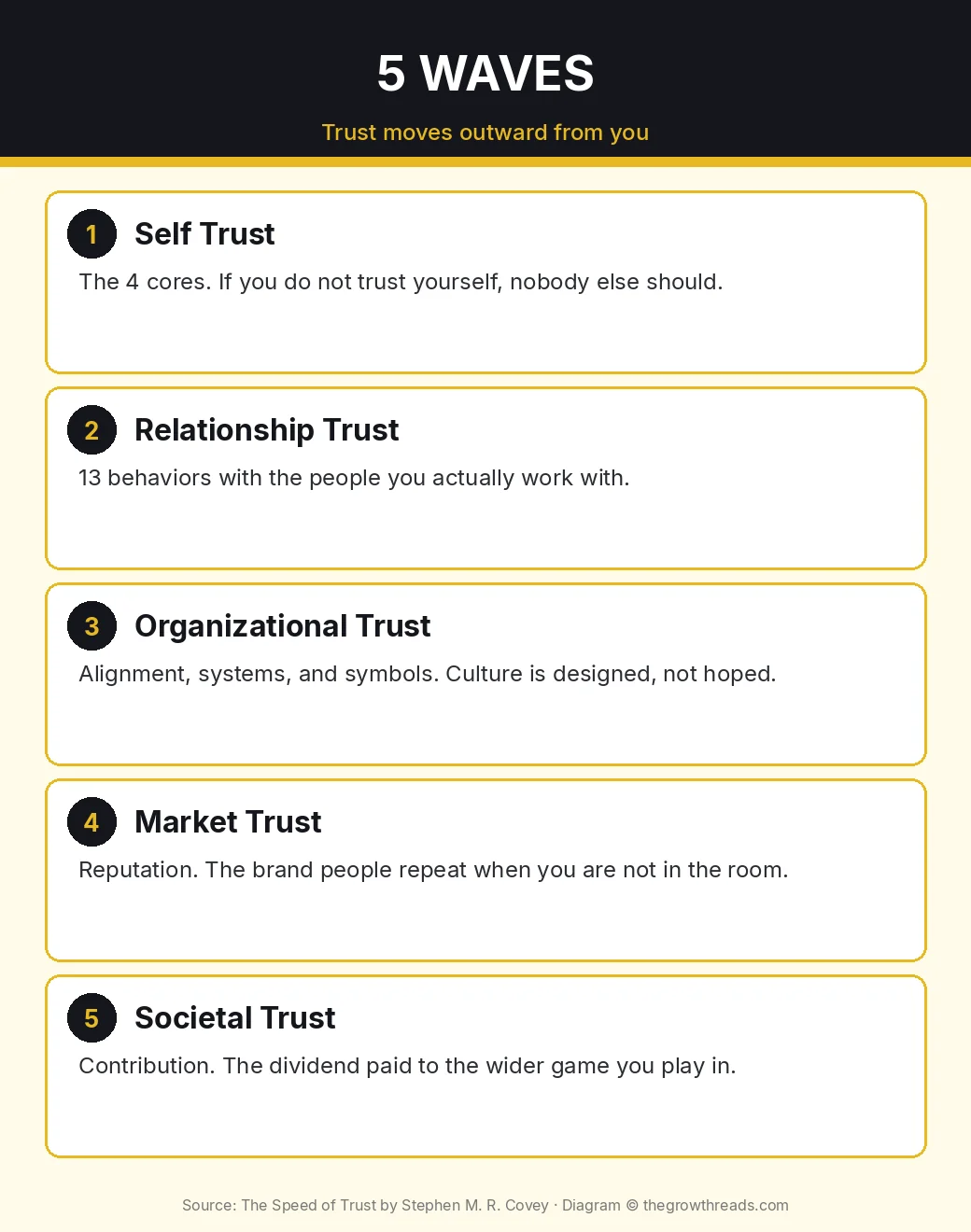
- Trust moves in five waves: self, relationship, organization, market, society. You cannot skip wave one.
- Smart Trust is not gullibility: a propensity to trust plus analysis. Blind faith and chronic suspicion both tax the room.
- You can restore it: right the wrong, make a new promise small enough to keep, then keep it in public.
- Symbols matter: one exception at the top teaches the whole system what is actually allowed.
What is The Speed of Trust about?
The Speed of Trust argues that trust is a measurable economic driver, not a soft social virtue. Stephen M. R. Covey maps how credibility, thirteen behaviors, and five outward waves raise speed and cut cost — and how to restore trust after you break it.
About the author
Stephen M. R. Covey is the eldest son of Stephen R. Covey. He is not a sequel writer sitting on a family brand. He ran Covey Leadership Center as CEO, grew the firm, and helped merge it with Franklin Quest to form FranklinCovey. A Harvard MBA, he later co-founded CoveyLink and now leads FranklinCovey’s Global Speed of Trust Practice. The book is the field manual from that work: trust as an operating system, taught to companies, governments, and schools. Rebecca R. Merrill, who also co-wrote First Things First with Stephen R. Covey and A. Roger Merrill, is the writing partner. Read this as the son’s own ledger, not a reprint of the seven habits. Explore all Rebecca R. Merrill book summaries →
Key concepts at a glance
| Concept | What it means | Use it when |
|---|---|---|
| Trust tax | The extra cost and delay you pay when people cannot rely on you | Every task needs a second check, a meeting, or a CYA email |
| Trust dividend | Speed and lower cost when credibility is already in the room | Work moves after a short conversation, not a 12-step approval |
| 4 cores | Integrity, intent, capabilities, results — the stack of credibility | Someone “seems off” and you cannot name why |
| 13 behaviors | Visible habits that raise or drain relationship trust | Culture posters exist and the week still feels political |
| 5 waves | Self → relationship → organization → market → society | You want a brand campaign but your own follow-through is leaky |
| Smart Trust | A bias to trust, paired with analysis — not gullibility | You either trust nobody or you skip due diligence |
| Counterfeit behavior | The fake version of a real behavior (spin instead of straight talk) | People sound open and you still cannot use the information |
| Restore | Right the wrong, then keep a smaller public promise | You already broke it and are hoping time will paper it over |
Part 1: Trust is a tax or a dividend
Most productivity advice attacks the calendar. Covey attacks the hidden surcharge on the calendar. Two people can run the same process and finish on different days because one room trusts the handoff and the other room re-does the work. That gap is not “culture.” It is a tax. You pay it in extra slides, extra approvers, extra legal, extra “quick syncs,” and the hour you spend rewriting an email so nobody can pin you. High trust is not niceness. It is the removal of that surcharge. Speed goes up because people stop padding for betrayal. Cost goes down because you stop buying insurance against your own colleagues.
The book’s load-bearing line is blunt: trust is not a soft social virtue. It is a hard-edged economic driver. That is why this review sits in Productivity, not in a compliments silo. If you have ever waited three weeks for a signature that took four minutes, you have met the tax. If you have ever shipped after one conversation because the person keeps promises, you have met the dividend. Covey’s move is to make that felt cost visible, then give you cores and behaviors instead of a pep talk.
He also kills a useful lie: that you should wait to be trusted. You raise it by changing the next kept promise, the next straight sentence, and the next result you finish. A team cannot dividend its way around a leader who does not believe their own word.
TGR Note: If you still need the character floor this book assumes, start with our 7 Habits summary. Stephen R. Covey built private victory before public victory. Stephen M. R. prices what that character is worth in speed. The 8th Habit is the voice-finding sequel; this one is the tax table. Do not read all three as a way to delay the first kept promise.
Part 2: Self trust — the four cores
Wave one is self trust: credibility. Covey splits it into four cores you can audit in an afternoon. Integrity is congruence — you do what you said, including the promise you made only to yourself. Intent is motive. People smell a hidden agenda faster than they parse a slide. Capabilities are the competence stack: talents, attitudes, skills, knowledge, style. Results are the track record. Talk is not a core. A kind person who misses every deadline is not trusted. A brilliant person who always has an angle is not trusted either. You need the set.
This is the part managers skip because it is embarrassing. It is easier to buy software than to admit you told the room Friday and shipped nothing. Covey’s diagnostic is practical: where are you overdrawn? Some people hit numbers and leave bodies. Some are loyal and unprepared. The fix matches the hole. Integrity gaps close with smaller public promises. Intent gaps close when you say the motive out loud and then behave as if it is true. Capability gaps close with learning you can show. Results gaps close only by delivering the next right thing, on time, without a speech. The first week is a private score: four cores, one sentence each, one gap. Small is how trust compounds. Grand announcements are how it gets counterfeited.
TGR Note: Peter Drucker’s Managing Oneself is the competence-and-values cousin: know what you are good at, and stop promising the rest. Covey adds the economic invoice. If your gap is “I do not know what I should even be trusted for,” Drucker first. If you know and still leak promises, stay here.
Part 3: Relationship trust — thirteen behaviors
Wave two is the people you actually work with. Covey lists thirteen behaviors and, more usefully, the counterfeits. Talk Straight is not cruelty; the counterfeit is spinning. Demonstrate Respect is not niceness theater; the counterfeit is fake courtesy with contempt underneath. Create Transparency is not dumping every feeling in Slack. Right Wrongs is not a performance apology. Show Loyalty is talking about people as if they were in the room. On the competence side: Deliver Results, Get Better, Confront Reality, Clarify Expectations, Practice Accountability. Three sit in both: Listen First, Keep Commitments, Extend Trust.
You do not need all thirteen this month. You need the one you are counterfeiting. Teams that “value honesty” and still sand every status are in a Talk Straight problem, not a values problem. Teams that celebrate ownership with no named owner are in Clarify Expectations. Keep Commitments quietly runs the list: small kept promises buy time when a big one slips. Slip the small ones and nobody believes the launch speech.
Extend Trust is the advanced move. Covey is not telling you to hand the keys to a stranger. That is gullibility, and he names it. You extend trust in doses that match the cores you can see, then you watch what they do with the dose. People often rise to a trust they can feel. They also reveal themselves faster when the extension is real. Either outcome is cheaper than a year of half-trust and double work.
TGR Note: If the relationship problem is generosity going one way, use Give and Take or The Go-Giver. If it is a hard conversation you keep dodging, Crucial Conversations is the talk-straight clinic. Covey tells you that straight talk is a trust behavior; Patterson’s crew tells you how to survive the minute you open your mouth. Never Eat Alone is the calendar for staying in the room after the talk.
Part 4: Waves, Smart Trust, and repair
Waves three to five are what your inner work becomes when other people can see it. Organizational trust is alignment: structures and symbols that match the story. If you preach ownership and require six signatures, the signatures win. Market trust is reputation — the sentence people repeat when you are not there. Societal trust is contribution. You cannot buy wave four with a rebrand if wave one still bounces checks.
Smart Trust is the guardrail. High propensity with no analysis is gullibility. Endless analysis with no propensity taxes everyone. The useful square is both: you are inclined to extend, and you still look. Repair is specific. You right the wrong, offer a new promise small enough to keep, and keep it where the original audience can see. Time does not restore trust. Evidence does.
Who is The Speed of Trust best for — and who should read something else first?
Best for people whose work is already competent and whose week is still slow because nobody can rely on the handoff. Managers who inherited a CYA culture. Founders who became the bottleneck by checking everything. Operators who keep adding process instead of keeping a cleaner promise. It transfers to a small team and a big company. You still start with your own four cores.
Read something else first if you do not yet have a character floor — use The 7 Habits. If you freeze in the first two minutes of a hard talk, use Crucial Conversations or How to Talk to Anyone. If you wanted a networking calendar rather than a credibility stack, Never Eat Alone is the better start. If you wanted a takedown of “soft skills,” this is the wrong shelf — Covey is pricing them, not roasting them.
Questions to reflect on
- Where is my week paying a trust tax — extra checks, extra meetings, extra rewriting — and whose cores is that tax actually about?
- Which of the four cores would the people closest to my work say is my leak?
- Which of the thirteen behaviors am I counterfeiting (spin, fake courtesy, vague ownership)?
- What is one promise small enough that I could keep it in public this week?
- Where am I extending zero trust, or too much, instead of Smart Trust — a real dose plus a look?
🔥 Ready to cut the hidden tax?
Get The Speed of Trust, then use the 7-day plan to keep one visible promise and remove one redundant check.
How to apply The Speed of Trust (7-day plan)
- Day 1 — Score the four cores. One sentence each. Circle the lowest. Do not score your team yet.
- Day 2 — Pick one counterfeit. Name the fake (spin, vague owners, apology with no change). Write the real behavior in eight words.
- Day 3 — Talk straight once. One status without padding. Facts, date, next move. No extra context that exists to protect you.
- Day 4 — Clarify one fuzzy expectation. Who owns it, what done looks like, when. Send it. Ask them to repeat it back.
- Day 5 — Keep one visible promise. Small enough to finish. Tell the person who is waiting. Finish it the same day you named it.
- Day 6 — Right one wrong or extend one Smart Trust dose. Specific repair, or a real chunk of work with a look — not a speech, not a blank check.
- Day 7 — Remove one trust tax. Kill one redundant check, meeting, or “loop me in” that exists only because last quarter’s promise slipped. If you cannot kill it yet, calendar the evidence that would let you.
Frequently asked questions
What is The Speed of Trust about in one paragraph?
The Speed of Trust is Stephen M. R. Covey’s field manual, written with Rebecca R. Merrill, for treating trust as an economic driver instead of a personality trait. Low trust is a tax: extra checks, extra time, extra cost. High trust is a dividend: the same work moves faster and cheaper. Credibility sits on four cores — integrity, intent, capabilities, results. Relationships run on thirteen behaviors. The effect then travels outward through organization, market, and society. This TGR summary turns that into a concepts table, three diagrams, and a seven-day plan you can run without a culture offsite.
What is a “trust tax” in The Speed of Trust?
A trust tax is everything you pay because people cannot rely on the handoff: duplicate reviews, slow signatures, padded estimates, political meetings, and the hour you spend rewriting a message so it cannot be used against you. Covey’s point is that this cost is real even when it never hits a budget line. The opposite is a trust dividend — speed and lower cost when credibility is already in the room. You do not eliminate every check. You stop buying insurance against colleagues who have already earned a simpler path. If your week is full of “just in case,” you are looking at the tax.
What are the 4 cores of credibility?
Integrity, intent, capabilities, and results. Integrity is congruence: you keep the promise, including the private one. Intent is motive and agenda people can actually feel. Capabilities are whether you can do the job — talents, skills, knowledge, style. Results are the track record of the right things done. Miss one core and trust wobbles even if the other three look strong. A kind person who never ships is not credible. A closer with a hidden angle is not either. The first practical move in the book is to score yourself on all four before you diagnose the team.
How is The Speed of Trust different from The 7 Habits?
The 7 Habits, by Stephen R. Covey, is the character operating system: private victory, then public victory. The Speed of Trust is the son’s ledger for what that character is worth in speed and cost. You can live the habits and still leak trust with vague ownership and broken small promises. This book prices the leak and names the behaviors that close it. Read 7 Habits first if you need the floor. Read this when the floor exists and the week is still slow because nobody believes the handoff. The 8th Habit is a third book, not a substitute for either.
Is The Speed of Trust still relevant in 2026?
More than in 2006, because remote and hybrid work moved the tax onto the calendar you cannot see. When you do not share a hallway, every fuzzy promise becomes a Slack thread and every missed date becomes a process. Covey’s cores and behaviors do not care whether the room is a Zoom. Talk straight, clarify expectations, keep commitments, and deliver results still cut the surcharge. Smart Trust is the remote-friendly middle: extend a real dose, look at what they do with it, skip both surveillance and wishful thinking. The examples are of-their-era. The invoice is not.
How long does it take to read The Speed of Trust?
Plan on about nine hours for the Free Press hardcover (roughly 350 pages), or a couple of commuting weeks on audio. You do not need a second pass of every story to use it. One core, one behavior, and one removed tax will teach more than highlighting the thirteen. This summary is a twelve-minute map: the economics, the four cores, the behaviors, the five waves, Smart Trust, and a seven-day plan. If you only steal one move, keep a small promise in public and kill one redundant check that exists because last quarter’s promise slipped.
Who should read The Speed of Trust?
Read it if you are already competent and still slow because the room cannot rely on you — or you cannot rely on them. Managers, founders, and operators who added process instead of cleaner promises will feel seen. Skip it as a first book if you do not yet have a character practice; start with The 7 Habits. Skip it if you wanted a networking calendar (Never Eat Alone) or a script for the scary conversation (Crucial Conversations). Stay if you want the economic argument for doing those things: trust raises speed and cuts cost, and you can raise it on purpose this week.
Related summaries
- The 7 Habits of Highly Effective People by Stephen R. Covey
- The 8th Habit by Stephen R. Covey
- Never Eat Alone by Keith Ferrazzi
- Give and Take by Adam Grant
- Best productivity books
How we analyze books: every book on The Growth Reads is read cover to cover, summarized in thousands of words of original analysis, and rated against our five-criteria rubric (lasting impact, evidence quality, practical application, writing & originality, external consensus). Read our full methodology.