

★★★★☆ 4.4/5 — a permission slip to be 90% and still cross the line.
Best for: Serial starters sitting on a graveyard of 80% projects
Reading time: ~5 hours (208 pages) if you binge · this guide ~10 min
Difficulty to apply: Easy to understand. Hard on the ego the day you cut the goal in half
Finish in one minute
Most goals do not die on day one. They die the morning after you were perfect. Jon Acuff’s Finish: Give Yourself the Gift of Done is the field manual for that morning — the skipped workout after a streak, the blank page after a good chapter, the shop that was “almost ready” in March and still “almost ready” in November. The book’s dare is rude on purpose: cut the goal in half, bomb a few other standards, and keep moving at 90% instead of waiting to feel flawless again.
If you already know what to do and still negotiate with a restart fantasy, this is the Acuff to read before you buy another planner.
Key takeaways
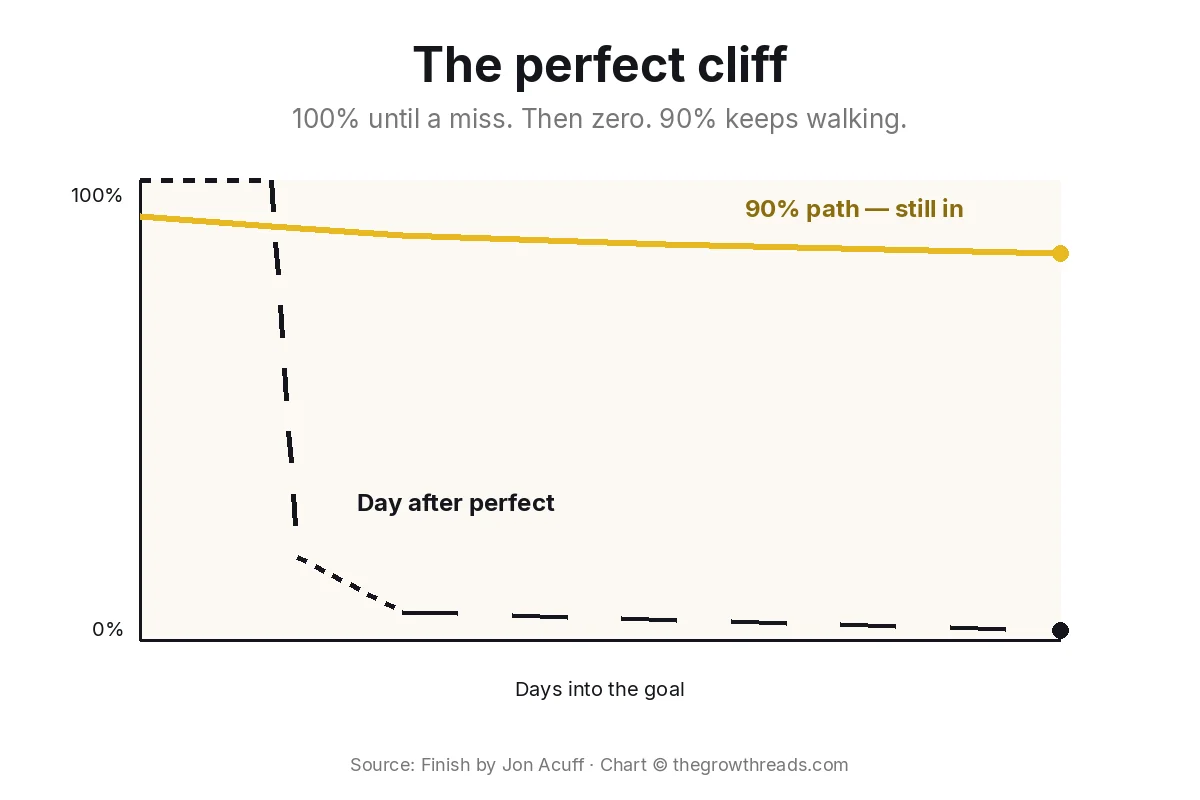
- The Day After Perfect is the real cliff: one miss is not the failure. The all-or-nothing restart is.
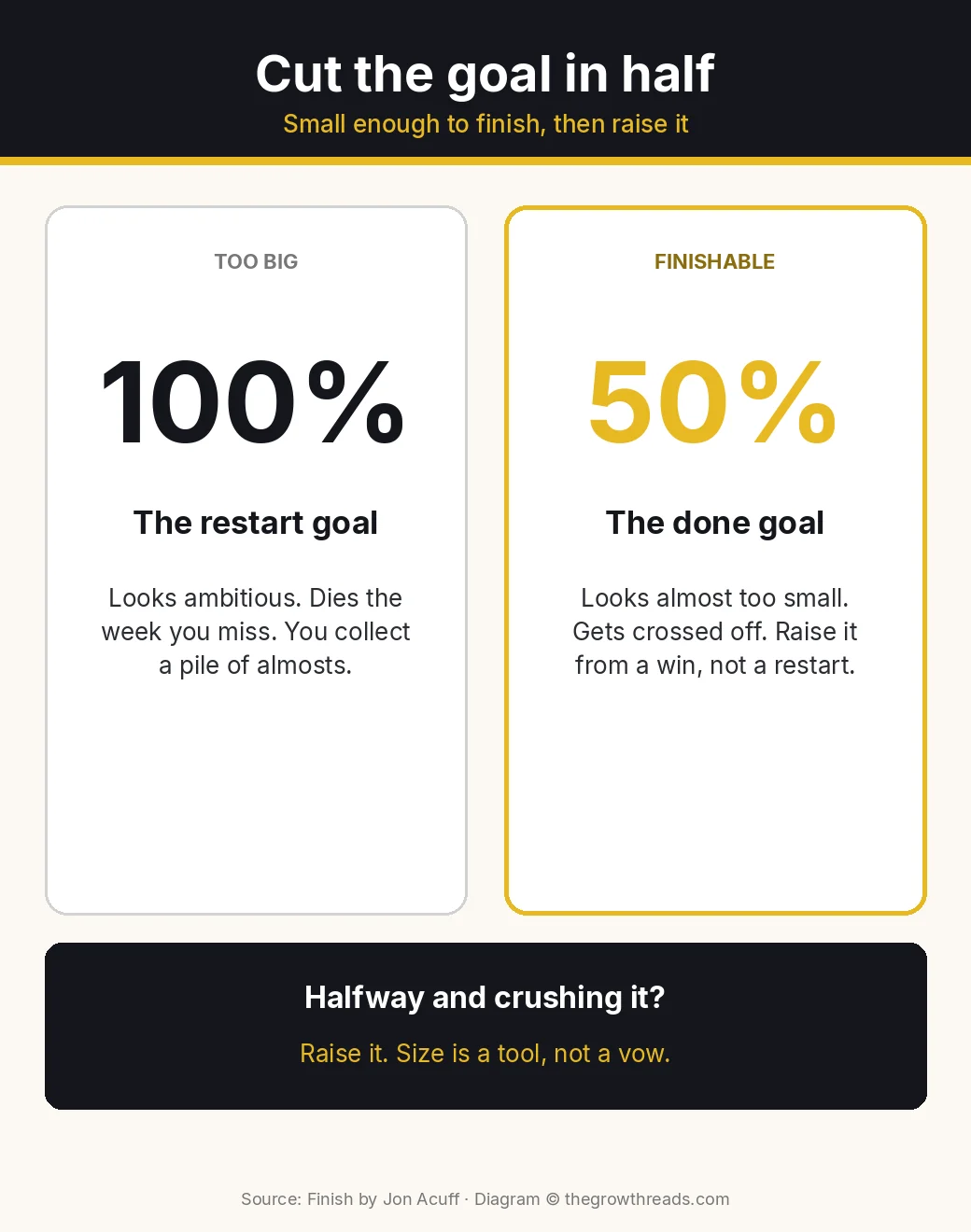
- Cut the goal in half: a finishable target beats a heroic one you will relaunch on Monday.
- Choose what to bomb: you cannot be excellent at the side quests and still cross this line.
- Make it fun if you want it done: pain is not proof. Enjoyment is a completion tool.
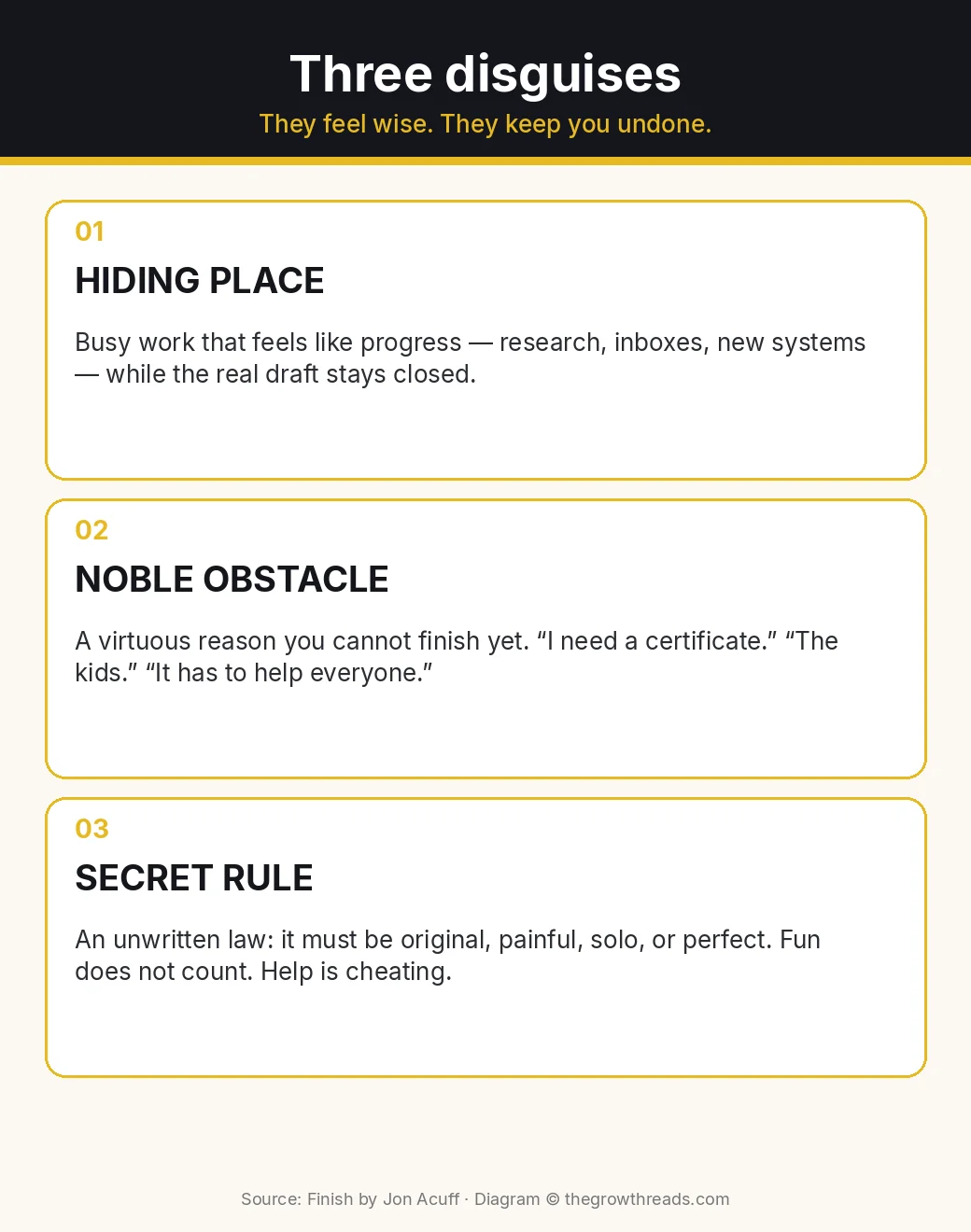
- Leave your hiding places: research, inboxes, and new systems can feel like work while the draft stays closed.
- Ignore noble obstacles: virtuous reasons (“I need another certificate”) often protect you from being judged for a finished thing.
- Write down secret rules: “It has to hurt,” “I have to do it alone,” “If I like it, it doesn’t count.”
- Use data to celebrate: most people only open the spreadsheet to prosecute themselves.
- Size is a tool, not a vow: if you are early at the halfway date, raise the goal from a win.
- Done is a skill: starting is cheap. Finishing is the rare practice the graveyard never taught you.
What is Finish about?
Finish is Jon Acuff’s short, funny playbook for turning unfinished goals into done ones. He shows why perfectionism kills projects the day after a streak, then hands you practical counters: cut the goal in half, choose what to bomb, make the work enjoyable, and stop hiding behind virtuous delays.
About the author
Jon Acuff is a New York Times bestselling author and Inc. Top 100 leadership speaker who writes the books he needs first. He spent years as a corporate copywriter and speaker — the kind of job where you can be “great at starting” in a brainstorm and still miss the ship date — then built a second career on honest, comic advice about goals. Quitter, Start, Do Over, Finish, and later Soundtracks all circle the same human: the person who is not lazy, just trapped in a story about how the work is supposed to feel. He lives outside Nashville and still talks like a copywriter who got tired of slogans that never shipped. Explore all Jon Acuff book summaries →
Key concepts at a glance
| Concept | What it means | Use it when |
|---|---|---|
| Day After Perfect | The morning a streak breaks and the restart voice wakes up | You missed once and want to wait until Monday |
| Cut it in half | Shrink the goal until finishing is likely | The current size only works on heroic weeks |
| Choose what to bomb | Pick standards you will let drop on purpose | You are trying to be great at everything beside the goal |
| Make it fun | Add enjoyment so the work gets done | You are using pain as proof you are serious |
| Hiding place | Busy work that avoids the real draft | You were “productive” and the file is still closed |
| Noble obstacle | A virtuous reason you cannot finish yet | The delay makes you look responsible |
| Secret rule | An unwritten law that blocks done | Help, fun, or a messy v1 “doesn’t count” |
| Cheer data | A number you use to celebrate, not indict | You only open tracking to feel behind |
Part 1: The Day After Perfect
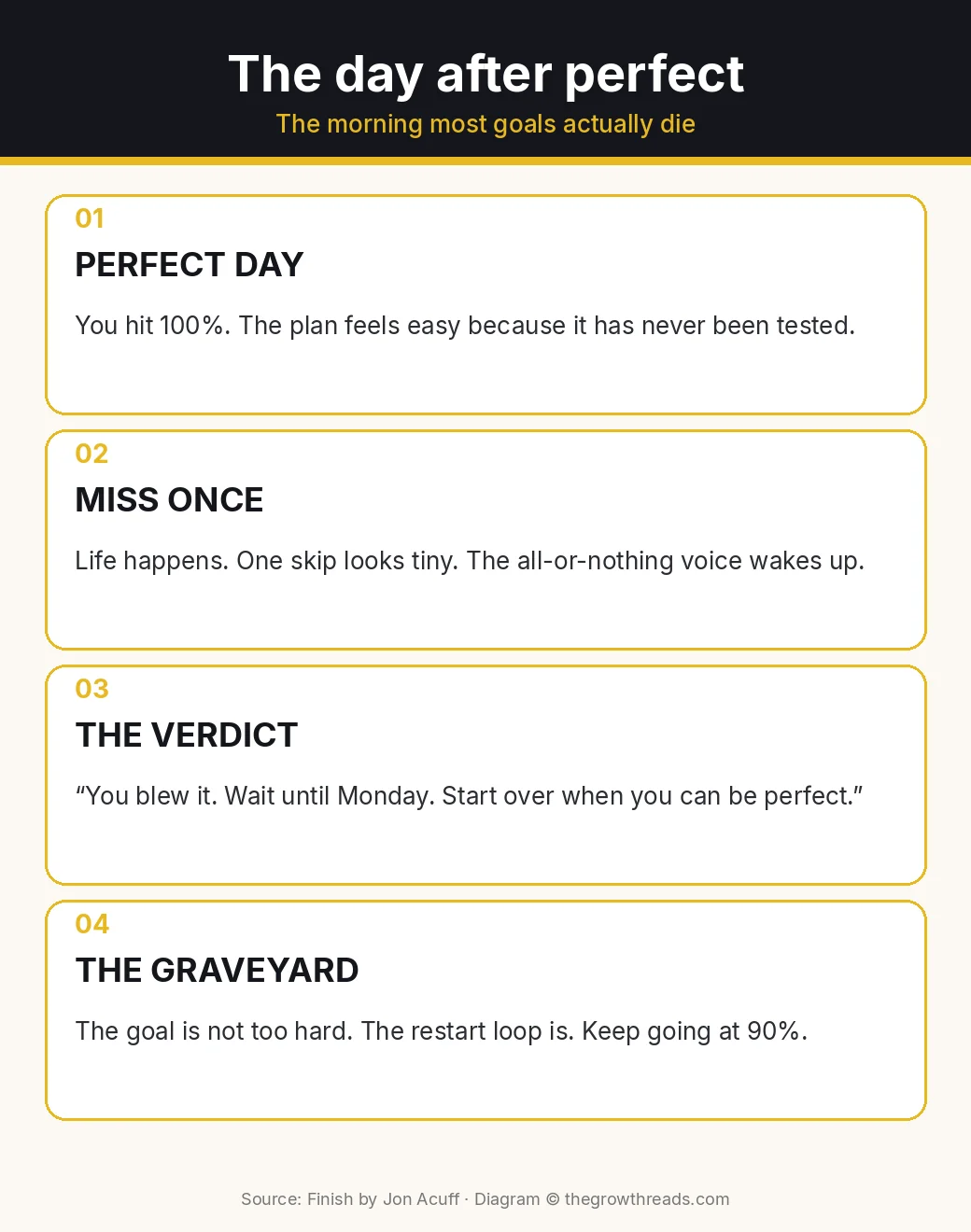
Acuff’s opening diagnosis is domestic and uncomfortably accurate. You do not fail the marathon on mile one. You fail it the morning after the week you ran every day, when one alarm does not go off and a courtroom opens in your head. Yesterday’s 100% becomes Exhibit A. Today’s miss becomes character evidence. The sentence is always some version of: wait until you can do it right.
That is the Day After Perfect. It is not laziness. It is perfectionism wearing a lanyard that says high standards. High standards would tell you to do a shorter session today so the project stays alive. Perfectionism tells you the whole calendar is contaminated. Acuff’s joke is the kindness: most of us are not addicted to starting. We are addicted to the clean feeling of a new Monday, because a new Monday has never been tested.
The wreckage is ordinary: the gym in February, the novel still “in a promising stretch,” the shop one more course from launching. First days are theatre. The dangerous day is the first imperfect one. If you have no script for that morning, the goal goes to the graveyard with a note that you will try again when life calms down. Life does not calm down.
The counter-script is almost insultingly small. Do the 90% version the same day. Walk if you cannot run. Write the ugly paragraph. Open the shop for one hour with the logo still ugly. Unfinished is not cleaner than imperfect. Imperfect can still be shipped, logged, and raised later.
TGR Note: If the stall is not the streak story but a missing cue — no time, no place, no next action — start with our Atomic Habits review and the Tiny Habits summary. Finish will not design the environment. It will stop you from burning the environment down because Tuesday was 80%.
Part 2: Cut the goal in half — then choose what to bomb
The second move sounds like a punchline until you try it on a live project. Cut the goal in half. Not “be nicer to yourself.” Half. Twenty miles a week becomes ten. A book draft this quarter becomes five chapters. A launch becomes one offer to ten people. Acuff’s reader experiments kept showing the same ugly kindness: people finish the smaller thing and stall on the impressive one. The impressive one was never a plan. It was a costume.
Size is a tool, not a personality. If you hit the halfway date ahead of pace, raise the goal from a win. That is a different nervous system than “I’ll do twice as much in June,” which is just the Day After Perfect in a quarterly hoodie. Catch-up math is how 80% projects live forever.
Cutting is not enough if the rest of your life is still auditioning for Employee of the Month in five categories. Choose what to bomb — a temporary, conscious drop in a competing standard: inbox, side hobby, cosmetic extras, catalog house. You already bomb things by accident when a goal is in season. Acuff wants the bombing chosen, so guilt cannot sneak in through the laundry and call itself a moral failure.
A half-size goal with no bombing still drowns in one more email. A bombed calendar with a still-heroic goal still feels like a test you wrote. Together they make a corridor. If that corridor feels embarrassing, good. Embarrassment is often the sensation of a goal becoming finishable.
TGR Note: If half still feels huge because the first step is a boulder, pair this with our Mini Habits summary and Eat That Frog! summary. Mini Habits will shrink the first action. Eat That Frog will put the ugly action first. Finish decides the size of the mountain you are even pointing at.
Part 3: Fun, hiding places, and noble obstacles
“Make it fun if you want it done” violates the religion a lot of ambitious readers were raised in. If it hurts, it counts. If you liked it, you cheated. Acuff flips the proverb. Enjoyment is not the enemy of discipline. It is how discipline gets enough reps to finish. Change the room, the playlist, the prize, the format. A boring goal is not automatically a noble one. Sometimes it is just a goal you will abandon.
Then he names the costumes that keep smart people undone. A hiding place is busy work that feels like progress: another course, a reorganized system, a research spiral, a new notebook because the old one is “messy.” You can screenshot it and it looks like a productive afternoon. The draft is still closed. The tell is simple. Did the actual artifact move?
A noble obstacle is sneakier because it is virtuous. You cannot launch until the certificate. You cannot write until the kids are older. You cannot ship until it helps everyone, so the brief keeps swelling. Acuff’s test is not “is this concern fake?” It is “does this condition have to be true before version one exists?” If yes, you may be hiding inside a halo.
TGR Note: If the hiding place is Resistance with a capital R — cleaning the sink instead of writing — pair this with our War of Art summary. If the noble obstacle is a sentence on loop (“I’m not the kind of person who finishes”), go to Acuff’s later Soundtracks summary. Finish names the delay. Soundtracks rewrites the lyric that makes the delay feel like you.
Part 4: Secret rules and data that cheers
Secret rules are the laws you never wrote down and still obey. The work must be original. You must do it alone. Help is cheating. It must hurt or it is not real. Acuff wants those rules on paper because paper is easier to cross out than a mood. A surprising number of stalled projects are not under-resourced. They are over-ruled. The first draft is not allowed to be a first draft, so it stays a fantasy that cannot be graded.
Write three. Read them out loud. If a rule would sound abusive said to a colleague — “you don’t get help,” “it only counts if you suffer” — it is a stall, not a standard. Replace it with a finish rule: messy v1 counts, a friend can read it, fun is allowed, the logo can be ugly until ten customers exist.
The last tool is data, and most of us already have the wrong relationship with it. We open the tracker to confirm we are behind. Acuff wants a number that can cheer: sessions, pages, minutes, days you showed up at 90%. Moods forget February. Tallies do not. A hash mark after a 90% day is not a party. It is evidence against the Day After Perfect. Starting-identity is cheap. Continuing-identity is the whole book.
TGR Note: If you need a model for quitting the wrong thing instead of finishing the right one, read our Dip summary. Acuff assumes the project is worth finishing. Godin asks whether you are in a dip or a dead end. Use both so you do not heroically complete a goal you should have closed.
Who is Finish best for — and who should read something else first?
Best for: people with a closet of 80% projects. You can start. You can even have a great first month. You disappear the week after the first miss, then buy a new notebook in January. If that is your pattern, Finish is the shortest honest book on it.
Read something else first if: you cannot start at all — go to Atomic Habits or Eat That Frog!. If the stall is Resistance (fear dressed as chores), start with The War of Art. If the stall is the sentence in your head, start with Soundtracks. If you want a more mechanical follow-through checklist, Finish What You Start is a different book by Peter Hollins — same verb, different thesis. Do not treat them as duplicates.
Questions to reflect on
- What project is sitting at 80% right now, and what story do you tell about why it is still open?
- When was the last Day After Perfect — and what did you do the morning after the miss?
- If you cut this goal in half, what would “done” look like by the end of the month?
- Which hiding place or noble obstacle has the best public reputation in your life?
- What secret rule would you never say out loud to a friend who was stuck on the same work?
🔥 Ready to give yourself the gift of done?
Get Finish, then run the 7-day plan on one live project — not on a fresh notebook.
How to apply Finish (7-day plan)
- Day 1 — Name it. Pick one unfinished project. Write the current goal in one sentence, including the size (“run 20 miles a week,” “draft 12 chapters”).
- Day 2 — Cut it in half. Rewrite the sentence at 50%. If you feel nothing, you may have the wrong project. If you feel relief, you found the finishable version.
- Day 3 — Bomb two things. Write two standards you will let drop this week. Put them on the calendar as allowed mess so guilt cannot relabel them as failure.
- Day 4 — Make today’s block fun. Change one sensory fact: room, music, timer game, walking meeting, tiny prize after 40 minutes. Then do the 90% session.
- Day 5 — Leave the hiding place. List three busy activities that felt like work last month. Close the top one before you open the real file.
- Day 6 — Rules and halos. Write three secret rules and three noble obstacles. Cross out any item that must be true before version one exists.
- Day 7 — Cheer data. Pick one number (sessions, pages, minutes). Log the week. Do not log a shame score. If you are early, raise the goal. If you missed a day, do the 90% version today — not next Monday.
Frequently asked questions
What is Finish about in one paragraph?
Finish is Jon Acuff’s 2017 field manual for people who start strong and stall. He argues that most goals do not die on day one. They die the morning after a perfect streak, when one miss triggers an all-or-nothing restart. The practical moves are rude on purpose: cut the goal in half, choose a few standards to bomb, make the work fun, leave hiding places, and use data as a cheerleader instead of a prosecutor. Funny, short, and aimed at done — not at a prettier plan.
What is the Day After Perfect?
The Day After Perfect is Acuff’s name for the morning you break a streak. Yesterday you hit 100%. Today you skipped. Perfectionism reads that skip as proof you are the kind of person who cannot be trusted, so it postpones the goal until you can be flawless again. That postponement is where January gyms empty out. The counter-move is to keep going at 90% the same day you miss — a shorter session, a smaller page, a walk instead of a run — so the streak’s story does not get a veto.
Why does Jon Acuff say to cut your goal in half?
Because the goal you set on a heroic Monday is sized for a person who never gets tired, sick, or scheduled. Acuff watched readers fail at full-size targets and finish far more often when they cut the target in half. Half is not a personality downgrade. It is a finishable first version. If you hit the halfway date ahead of pace, you raise it from a win. If you cannot get excited about the smaller version, you may have the wrong goal, not a discipline problem.
What is a noble obstacle in Finish?
A noble obstacle is a virtuous-sounding reason you cannot finish yet. You need another certificate. The kids deserve a parent who is not distracted. The product should help everyone, so you keep expanding the brief. None of those sentences are evil. That is why they work as camouflage. Acuff’s test is blunt: does this condition protect you from being judged for a finished thing? If yes, it is an obstacle wearing a halo. Write the smaller version that does not require the halo to be true first.
Is Finish the same book as Finish What You Start?
No. Finish is Jon Acuff’s 2017 book about perfectionism, goal size, and the stories that talk you out of done. Finish What You Start is Peter Hollins’s more mechanical follow-through manual — cues, environment, and grit tactics. If your problem is “I keep restarting Monday,” start with Acuff. If your problem is “I start, then my system has no next action,” Hollins is the tighter checklist. They share a verb. They do not share a thesis. Do not buy one thinking you already read the other.
How long does it take to read Finish?
The Portfolio paperback is 208 pages. Most readers finish it in four to six hours, or a couple of evenings. This summary is a ten-minute map plus a seven-day plan; it is not a substitute for the stories that make the advice stick. If you only steal one chapter, steal The Day After Perfect and Cut Your Goal in Half, then run those two moves on one live project this week. Reading without a named project is how Finish becomes another book you started.
Who should read Finish by Jon Acuff?
People with a graveyard of 80% projects: the draft, the training block, the shop, the certification they keep announcing in January. It is especially sharp if you already know what to do and still negotiate with a perfect-streak story. Skip it as a first book if you cannot start at all — go to Atomic Habits or Eat That Frog — or if the stall is Resistance with a capital R, in which case The War of Art names the enemy faster. Pair it with Soundtracks if the inner song is the real brake.
Related summaries
- Soundtracks Summary & Review
- Atomic Habits Summary & Review
- Mini Habits Summary & Review
- The War of Art Summary & Review
- Best Productivity Books
How we analyze books: every book on The Growth Reads is read cover to cover, summarized in thousands of words of original analysis, and rated against our five-criteria rubric (lasting impact, evidence quality, practical application, writing & originality, external consensus). Read our full methodology.