

⭐⭐⭐⭐⭐ 4.4/5
Actionability: 4.3/5 · Evidence Quality: 4.8/5 · Writing Clarity: 4.2/5 · Uniqueness: 4.5/5 · Lasting Relevance: 4.4/5
One-liner: The four things every investor must understand — theory, history, psychology, and the business of investing — to build lasting wealth.
Best for: Serious investors who want the intellectual foundation beneath index fund investing, not just the what-to-buy instructions.
Reading time: ~9 hours (368 pages, 2nd edition)
Difficulty to apply: Moderate — the concepts are rigorous but the recommended portfolio is simple. The real challenge is emotional discipline during crashes.
The Four Pillars of Investing in One Minute
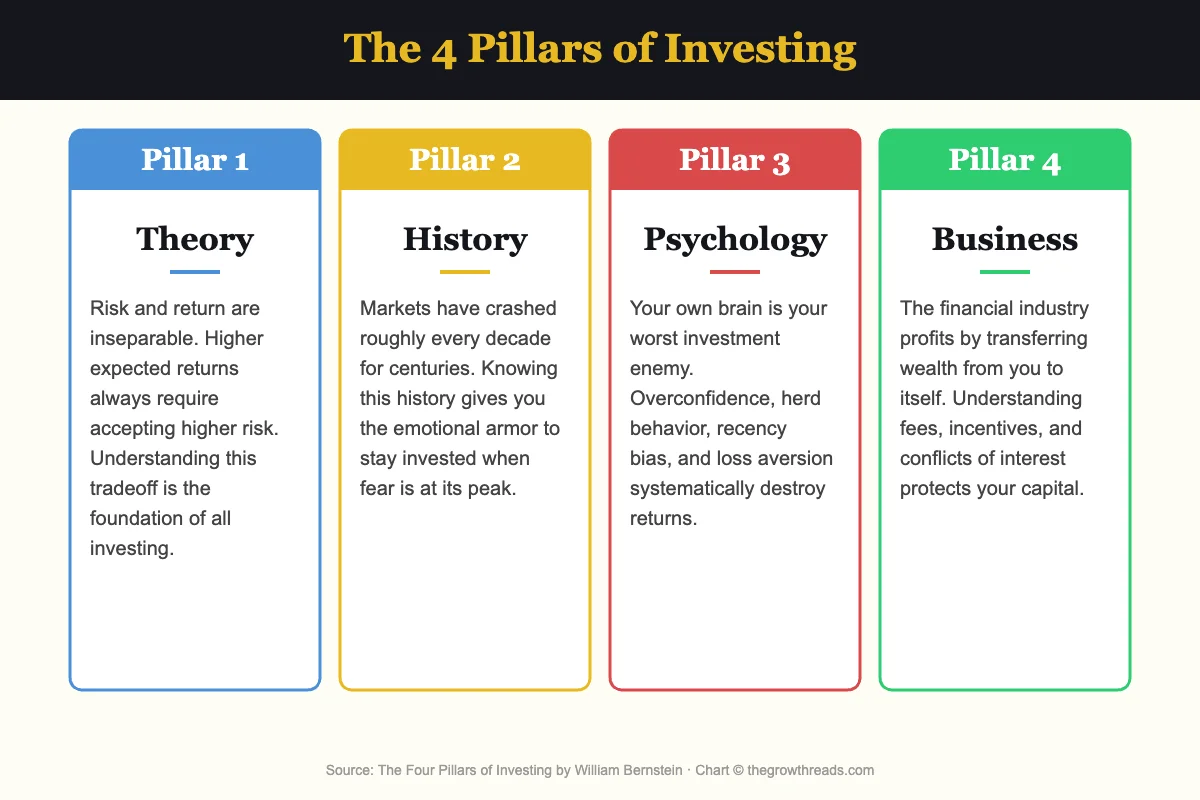
Most investors fail not because they pick the wrong stocks, but because they misunderstand four foundational truths about markets. William Bernstein — a neurologist turned financial theorist — argues that successful investing rests on four pillars: the theory of risk and return, the history of financial markets, the psychology of investor behavior, and the business of the financial industry. Master all four and you will naturally arrive at a low-cost, diversified, index-based portfolio held through decades of inevitable crashes. Ignore any single pillar and you will almost certainly make avoidable, expensive mistakes.
Key Takeaways
- Risk and return are inseparable: There is no such thing as a high-return, low-risk investment — any pitch that claims otherwise is either a fraud or a misunderstanding.
- Nobody can reliably time the market: Decades of data show that even professional fund managers cannot consistently predict when to buy or sell — and their fees guarantee underperformance.
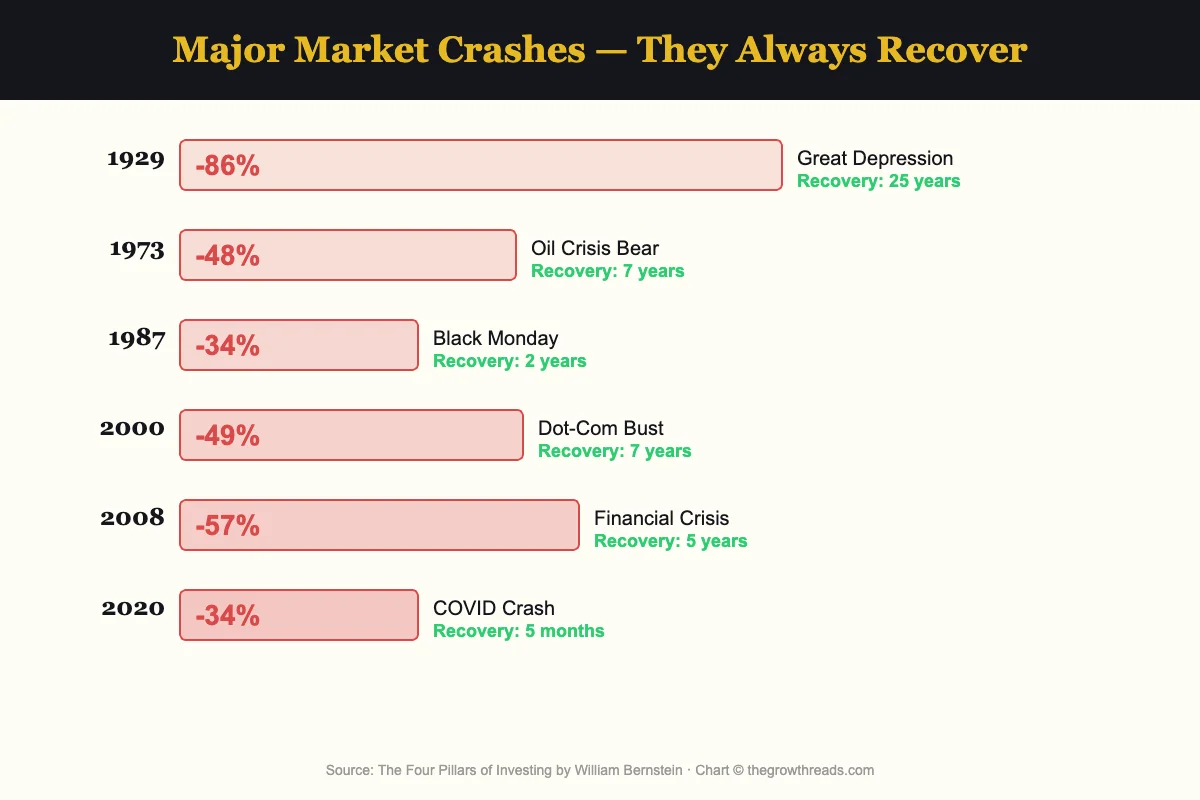
- Market crashes are normal and inevitable: Severe bear markets have occurred roughly every decade for the past two centuries — knowing this history prevents panic selling.
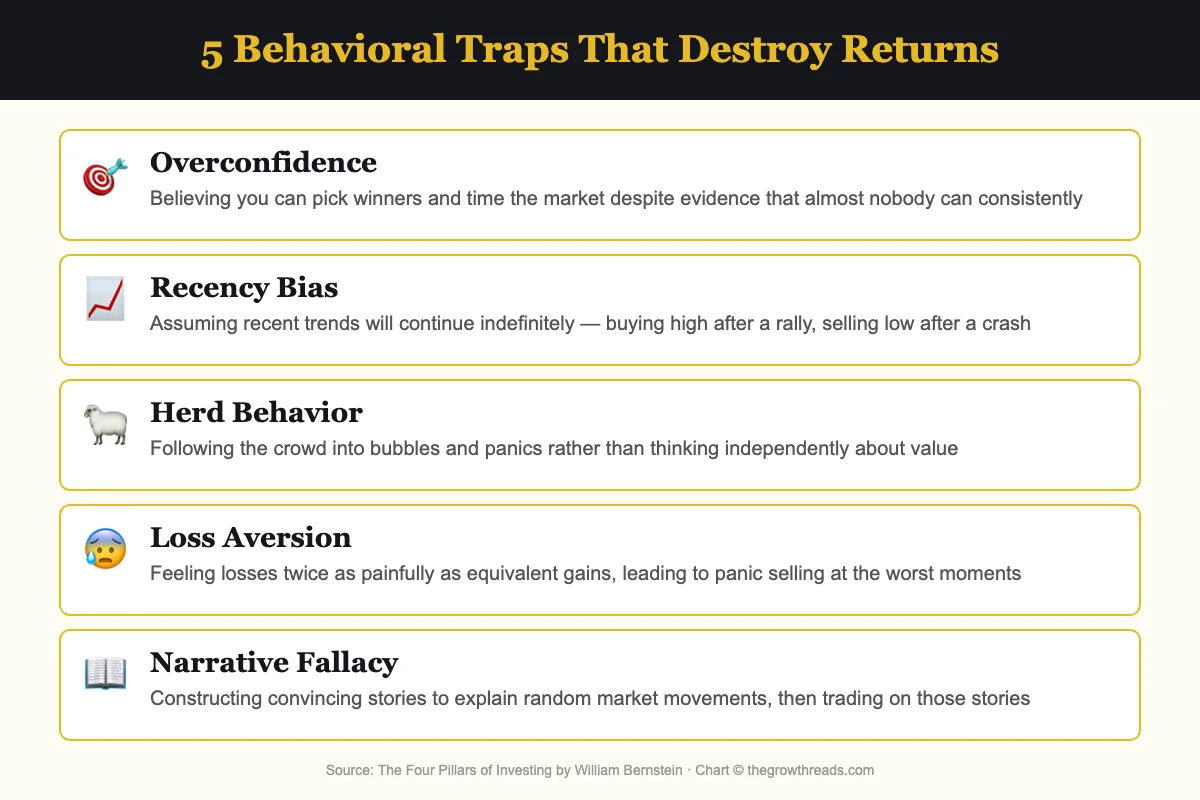
- Your biggest enemy is your own brain: Overconfidence, herd behavior, recency bias, and loss aversion destroy more wealth than any market crash.
- The financial industry is not your friend: Brokers, advisors, and fund companies profit by transferring your wealth to themselves through fees, commissions, and hidden costs.
- Diversification is the only free lunch: Spreading investments across asset classes, geographies, and time reduces risk without reducing expected returns.
- Low-cost index funds are the optimal vehicle: They minimize the drag of fees, eliminate manager risk, and guarantee you receive the market’s return.
- Rebalancing is your mechanical discipline: Periodically selling winners and buying losers forces you to buy low and sell high systematically.
- Your savings rate matters more than your returns: In the early years, how much you save dwarfs how cleverly you invest — the math is unambiguous.
- Stay the course through inevitable pain: The ability to hold your portfolio through a 50 percent drawdown is the single most valuable investing skill.
What Is The Four Pillars of Investing About?
The Four Pillars of Investing is a comprehensive guide to building a successful investment portfolio by mastering four essential areas: the theory of risk and return, the history of financial markets, the psychology of investor behavior, and the business mechanics of the financial industry. Bernstein synthesizes academic research, centuries of market data, and behavioral science into a practical framework for ordinary investors.
About the Author
William J. Bernstein is a neurologist, financial theorist, and co-principal of the investment management firm Efficient Frontier Advisors. A self-taught finance expert, he holds a PhD in chemistry and an MD, and began writing about investing after becoming frustrated with the financial industry’s conflicts of interest. His books — including The Intelligent Asset Allocator and The Birth of Plenty — are considered essential reading in the evidence-based investing community. He is a frequent contributor to financial publications and a respected voice in the Bogleheads community. Explore all William Bernstein book summaries → Explore all William J. Bernstein book summaries →
Key Concepts at a Glance
| Concept | What It Means | Use It When |
|---|---|---|
| Risk-Return Tradeoff | Higher expected returns always come with higher risk | Evaluating any investment that promises outsized returns |
| Efficient Market Hypothesis | Prices reflect all available information, making outperformance nearly impossible | Deciding between active and passive investing |
| Reversion to the Mean | Extreme performance — good or bad — tends to reverse over time | Resisting the urge to chase hot funds or dump cold ones |
| Behavioral Biases | Systematic psychological errors that lead to predictably bad investment decisions | Auditing your own decision-making during market stress |
| Agency Problem | Financial advisors’ interests often conflict with yours | Choosing who to trust with your money |
| Asset Allocation | The mix of stocks, bonds, and other assets determines most of your returns | Building or reviewing your portfolio |
| Dollar-Cost Averaging | Regular, fixed investments smooth out volatility over time | Starting to invest or investing during uncertain markets |
Part 1: The Theory Pillar — Risk, Return, and the Efficient Market
Bernstein begins with the fundamental law of investing: risk and return are joined at the hip. If someone offers you a high return with low risk, they are either lying or confused. The premium that stocks earn over bonds — the equity risk premium — exists precisely because stocks can and do lose 50 percent or more of their value. If they could not, everyone would own them, driving up prices and eliminating the premium. This single insight, once internalized, immunizes you against the majority of investment frauds and bad decisions.
He builds on the efficient market hypothesis — the idea that stock prices already reflect all available information — to explain why active fund management is a losing game for most investors. If prices are reasonably efficient, then the average dollar of active management must underperform the average dollar of passive management by the amount of fees charged. This is not a theory about whether markets are perfectly efficient; it is a mathematical certainty about averages.
Bernstein introduces the concept of reversion to the mean: asset classes that have performed exceptionally well tend to underperform in subsequent periods, and vice versa. This has profound practical implications — it means that chasing last year’s best-performing fund is almost certainly a mistake, and that the asset class everyone hates today may be tomorrow’s best performer.
Part 2: The History Pillar — Crashes, Bubbles, and the Long View
Bernstein argues that an investor who does not know financial history is doomed to repeat its most expensive mistakes. He walks through centuries of market crises — the South Sea Bubble of 1720, the Panic of 1907, the Great Depression, the 1973-74 oil crisis bear market, Black Monday in 1987, the dot-com collapse, and the 2008 financial crisis — to demonstrate one critical pattern: severe market declines are not anomalies. They are the normal cost of earning equity returns.
The average bear market decline in the US has been roughly 35 percent, and markets have experienced a drawdown of 40 percent or more approximately once every 25 years. The critical lesson is not that crashes happen — it is that markets have always recovered, often faster than anyone expected during the depths of panic. The investors who were destroyed were not those who experienced the crashes but those who sold during them.
Bernstein uses history to inoculate investors against both fear and greed. Understanding that the roaring 1990s dot-com boom was a near-perfect replay of the 1720 South Sea Bubble — right down to the same investor psychology and the same financial innovations designed to separate fools from their money — gives you the pattern recognition to step back when everyone around you is rushing in.
Part 3: The Psychology Pillar — Your Brain as Your Worst Enemy
The third pillar is behavioral finance — the study of how psychological biases lead investors to make systematically poor decisions. Bernstein catalogs the most destructive biases: overconfidence (believing you can pick winners), recency bias (projecting recent performance into the future), herd behavior (following the crowd into bubbles and out of crashes), loss aversion (feeling losses twice as painfully as equivalent gains), and the narrative fallacy (constructing stories to explain random market movements).
Overconfidence is perhaps the most expensive bias. Studies consistently show that the more confident investors are in their stock-picking ability, the worse they perform — because confidence leads to excessive trading, which incurs transaction costs and taxes that compound into massive wealth destruction over decades. Bernstein cites research showing that the most active individual traders underperform the market by six to seven percentage points annually.
He argues that the solution is not to try harder to overcome these biases — they are wired into our evolutionary firmware — but to build a portfolio and an investment process that removes the opportunity to act on them. A simple, diversified, low-cost portfolio with automatic rebalancing and dollar-cost averaging effectively takes your impulsive, emotion-driven brain out of the equation.
Part 4: The Business Pillar — How the Industry Profits at Your Expense
Bernstein’s final pillar is a warning about the financial industry itself. He argues that the primary business of Wall Street is not to make money for you — it is to make money from you. Brokers earn commissions whether you profit or lose. Fund companies charge management fees that compound over decades into staggering wealth transfers. Financial media sells advertising by creating urgency and excitement, encouraging the frequent trading that destroys returns.
The numbers are damning. An actively managed mutual fund charging 1.5 percent annually will consume roughly 30 percent of a 40-year investor’s total wealth compared to a 0.05 percent index fund. When you add trading costs, tax inefficiency, and survivorship bias (failed funds disappear from the records, making the survivors look better than they are), the case for active management becomes nearly impossible to sustain.
Bernstein’s practical recommendations follow naturally from the four pillars: build a diversified portfolio using low-cost index funds, allocate between stocks and bonds based on your risk tolerance and time horizon, rebalance annually, and ignore the noise. The portfolio itself is almost anticlimactically simple — a total US stock market index, an international stock index, and a bond index, held in proportions that match your ability to stomach volatility. The intellectual journey through theory, history, psychology, and business is what gives you the conviction to actually follow this simple plan through the inevitable storms.
Who Is The Four Pillars of Investing Best For — and Who Should Read Something Else First?
This book is ideal for intermediate investors who already understand the basics of stocks and bonds and want the deeper intellectual foundation for why index investing works. It is also excellent for readers who have been burned by active management, financial advisors, or their own emotional trading and want to understand what went wrong.
If you are a complete beginner, start with The Simple Path to Wealth by JL Collins for a simpler, more approachable introduction to index investing. If you want the emotional and behavioral side without the academic rigor, read The Psychology of Money by Morgan Housel first. For the original case for index investing from the founder of Vanguard, see The Little Book of Common Sense Investing by John Bogle.
Questions to Reflect On
- Which of the four pillars — theory, history, psychology, or business — is the weakest link in your own investing knowledge?
- How would you honestly react if your portfolio dropped 50 percent tomorrow — and does your asset allocation reflect that reality?
- How much are you paying in total investment fees (management, advisory, trading, taxes), and how much will that cost you over the next 30 years?
- When was the last time you made an investment decision based on emotion rather than evidence — and what triggered it?
- If you could only pass on one investing lesson to your children, which of Bernstein’s four pillars would you choose and why?
🔥 Ready to Master the Four Pillars?
Build the intellectual foundation that makes simple, disciplined investing possible.
How to Apply The Four Pillars of Investing (7-Day Plan)
- Day 1 — Calculate your total investment fees. Add up every management fee, advisory fee, and expense ratio across all your accounts. Multiply the total by 30 years of compounding to see the real cost.
- Day 2 — Study one major market crash. Read the Wikipedia entry on the 2008 financial crisis or the dot-com bust. Internalize that a 50 percent decline is not an anomaly — it is the historical price of equity returns.
- Day 3 — Audit your behavioral biases. Review your last three investment decisions. Were any driven by overconfidence, herd behavior, recency bias, or fear? Write down what you would do differently.
- Day 4 — Evaluate your financial advisor. If you have one, ask them to disclose all fees and commissions in writing. If the total exceeds 0.5 percent of assets, investigate lower-cost alternatives.
- Day 5 — Simplify your portfolio. Could your current holdings be replaced with two to four low-cost index funds? If yes, make a plan to consolidate over the next month.
- Day 6 — Set your asset allocation. Decide what percentage of your portfolio should be in stocks versus bonds based on your time horizon and your honest assessment of how much volatility you can tolerate without panic selling.
- Day 7 — Automate and rebalance. Set up automatic monthly contributions to your chosen index funds and schedule an annual rebalancing date. Write down your investment policy statement and commit to following it through the next crash.
Frequently Asked Questions
Is this book too technical for a beginner?
It depends on the beginner. Bernstein writes clearly but does not simplify his arguments — he expects readers to engage with concepts like the efficient market hypothesis, risk premiums, and standard deviation. If you want a gentler introduction, start with The Simple Path to Wealth by JL Collins or The Psychology of Money by Morgan Housel, then come back to Bernstein when you want the deeper intellectual foundation. The effort is worth it: no other investing book builds the full case for index investing as rigorously.
What is the difference between the first and second edition?
The second edition (2023) updates the data through the COVID crash and recovery, adds material on cryptocurrency and meme stocks, and refines Bernstein’s asset allocation recommendations. The core framework — the four pillars — remains unchanged because the underlying principles have not changed. If you are buying the book for the first time, get the second edition for the updated data and examples. If you already own the first edition, the fundamental lessons are the same.
What specific portfolio does Bernstein recommend?
Bernstein does not prescribe a single portfolio but provides a framework for building one. His baseline recommendations include a total US stock market index fund, an international stock market index fund, and a bond index fund, with allocations based on your risk tolerance and time horizon. Younger investors with long horizons might hold 80 percent stocks and 20 percent bonds; those approaching retirement might reverse toward 40 percent stocks and 60 percent bonds. He emphasizes that the specific percentages matter less than the discipline to maintain them through market turbulence.
Why does Bernstein say nobody can time the market?
Because the data is unambiguous. Studies spanning decades show that the vast majority of professional fund managers — people with teams of analysts, real-time data, and PhDs in finance — underperform a simple index fund after fees. The few who outperform in one period rarely repeat in the next. Market timing requires being right twice — when to get out and when to get back in — and the evidence shows that even getting out right leads most investors to get back in too late, missing the recovery that erases most of the damage.
How does rebalancing improve returns?
Rebalancing means periodically selling assets that have grown beyond their target allocation and buying those that have fallen below it. This mechanically forces you to sell high and buy low — the opposite of what most investors do emotionally. It also maintains your intended risk level: without rebalancing, a stock-heavy year might leave your portfolio far more aggressive than you intended, exposing you to a larger crash than you can handle. Bernstein recommends rebalancing annually or when an asset class drifts more than five percentage points from its target.
How does the financial industry take money from investors?
Through multiple layers of visible and hidden costs: management fees (expense ratios), advisory fees, trading commissions, bid-ask spreads, market impact costs, and tax inefficiency from frequent trading. A seemingly modest 1.5 percent annual fee, compounded over 40 years, will consume roughly a third of your total wealth compared to a 0.05 percent index fund. The industry also profits from survivorship bias — failed funds are quietly merged or closed, making the remaining funds’ track records look better than the industry’s actual average.
What should I read after The Four Pillars of Investing?
For the emotional side of investing, read The Psychology of Money by Morgan Housel. For the simplest practical implementation of Bernstein’s principles, read The Simple Path to Wealth by JL Collins. For the original case for index funds from their inventor, read The Little Book of Common Sense Investing by John Bogle. For the academic evidence behind efficient markets, read A Random Walk Down Wall Street by Burton Malkiel. And for an opposing perspective from investors who believe markets can be beaten, try Richer, Wiser, Happier by William Green. This is not financial advice — consult a qualified financial advisor for personalized guidance.
Related Summaries
- A Random Walk Down Wall Street by Burton Malkiel — The academic evidence for efficient markets and index investing.
- The Little Book of Common Sense Investing by John Bogle — The case for index funds from the man who invented them.
- The Psychology of Money by Morgan Housel — The behavioral and emotional foundations of wealth-building.
- Richer, Wiser, Happier by William Green — Lessons from legendary active investors who challenged efficient market theory.
📚 Explore more Money & Finance book summaries: Best Money Books →