

⭐⭐⭐⭐ 4.3/5 — A refreshingly practical system for protecting your time against the pull of technology and busyness.
Best for: Anyone who feels their day disappears into email, social media, and meetings — and wants a lightweight framework to take it back.
Reading time: ~5 hours (304 pages)
Difficulty to apply: Low — the tactics are modular and you can start with just one today.
Make Time in one minute
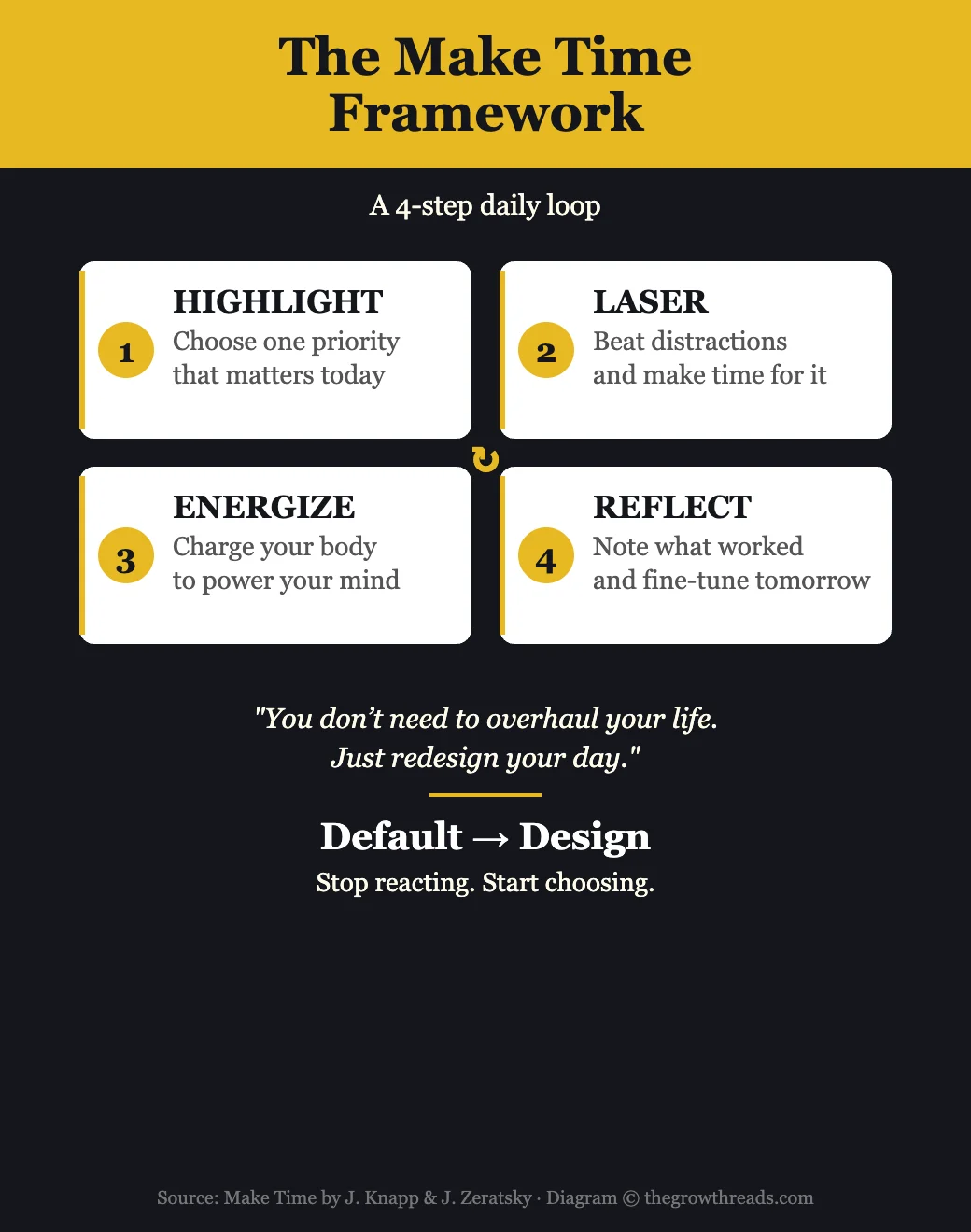
Your time is being stolen by two forces: the Busy Bandwagon and Infinity Pools. The Busy Bandwagon is the culture of constant productivity — packed calendars, overflowing inboxes, the pressure to always be doing more. Infinity Pools are apps designed to keep you scrolling forever — social media, email, news feeds, streaming. Together, they hijack your day before you even decide what matters. Make Time offers a dead-simple four-step framework to fight back: pick one Highlight each day, go Laser-focused on it, Energize your body so your brain can perform, and Reflect each evening to fine-tune the system. It is not about perfect productivity — it is about making time for the things you actually care about.
Key takeaways
- Default settings are designed against you: Technology companies and workplace culture optimise for their goals, not yours. You have to deliberately redesign your defaults to reclaim your attention.
- Choose one Highlight every day: Instead of an endless to-do list, pick one 60-to-90-minute activity that you want to be the satisfying centrepiece of your day.
- Infinity Pools are the real enemy: Email, social media, and news feeds are engineered to be bottomless. The solution is not willpower — it is removing access.
- Make your phone a tool, not a slot machine: Delete social apps, turn off notifications, and consider a distraction-free phone reset.
- Energy matters as much as time: You cannot focus on your Highlight if your body is running on caffeine and processed food. Movement, real food, sleep, and human connection are non-negotiable fuel.
- Caffeine has a strategy: Wait 60-90 minutes after waking to drink coffee, and cut off by 2 PM to protect sleep quality.
- Reflection is the adjustment dial: Spending two minutes each night noting what worked and what did not turns a rigid system into a personalised one.
- Perfection is not the goal: You will not nail every day. The framework is designed to be forgiving — just pick a new Highlight tomorrow and keep going.
- Tactics are like a menu: The book offers 87 tactics. You are not meant to do all of them — pick one or two, test for a few days, keep what works.
- Small experiments beat big overhauls: Changing one default — like logging out of social media — can reclaim hours you did not know you were losing.
What is Make Time about?
Make Time is a practical guide to reclaiming your daily schedule from the twin forces of busyness and digital distraction. Written by two former Google and YouTube designers who helped build the very products that steal our attention, the book presents a four-step framework — Highlight, Laser, Energize, Reflect — and 87 testable tactics for protecting time for what genuinely matters to you.
About the author
Jake Knapp spent ten years at Google, where he created the Design Sprint process used by teams at Slack, Uber, and the United Nations. He is also the bestselling author of Sprint. John Zeratsky is a former design lead at YouTube and Google Ventures who has coached startups on product strategy and team performance. Together, they bring an unusual vantage point: they helped build the attention economy, and then wrote the manual for escaping it. Their combined experience in product design gives Make Time its distinctive focus on defaults — the idea that the systems around you shape your behaviour more than your intentions do. Explore all Jake Knapp book summaries →
Key concepts at a glance
| Concept | What it means | Use it when |
|---|---|---|
| Highlight | One 60–90 min priority you choose each morning | You finish days feeling busy but unsatisfied |
| Laser | Tactics for deep focus — blocking distractions | You can not concentrate for more than 15 min |
| Energize | Body-care habits that fuel mental performance | You hit an afternoon wall every day |
| Reflect | A nightly 2-min review of what worked | You want to personalise the system over time |
| Infinity Pools | Apps with endless refreshing content | You lose hours to social media or news |
| Busy Bandwagon | Culture that equates busyness with productivity | Your calendar is full but your work feels hollow |
| Distraction-Free Phone | Removing all social and news apps from your device | You unlock your phone 80+ times a day |
| Might-Do List | A flexible alternative to rigid to-do lists | Long task lists stress you out |
Part 1: Highlight — choose your daily anchor
The first step in the Make Time framework is deceptively simple: pick one thing to prioritise today. Knapp and Zeratsky call this your Highlight — a single activity lasting 60 to 90 minutes that you want to protect. It is not necessarily the most urgent thing on your list. It is the thing that, at the end of the day, would make you say “that was a good day.”
The authors offer three lenses for choosing a Highlight. The Urgency lens asks what is most time-sensitive — a deadline, a meeting preparation, a bill to pay. The Satisfaction lens asks what would bring the most fulfilment — working on a creative project, having a deep conversation, exercising. The Joy lens asks what would simply make you happiest — playing with your kids, cooking a new recipe, reading for pleasure.
What makes this different from a to-do list is the singular focus. A to-do list is a guilt machine with 15 items. A Highlight is one deliberate choice. The authors recommend writing it down, scheduling it in your calendar as a time block, and — crucially — being willing to let other tasks wait.
One tactical gem is the Might-Do List: instead of a prescriptive to-do list, keep a running “might-do” list on a piece of paper. No checkboxes, no priorities. Each morning, scan it and pull one thing into your Highlight slot. The low pressure of “might” removes the anxiety that comes with tasks you “must” do.
Part 2: Laser — defeat the Infinity Pools
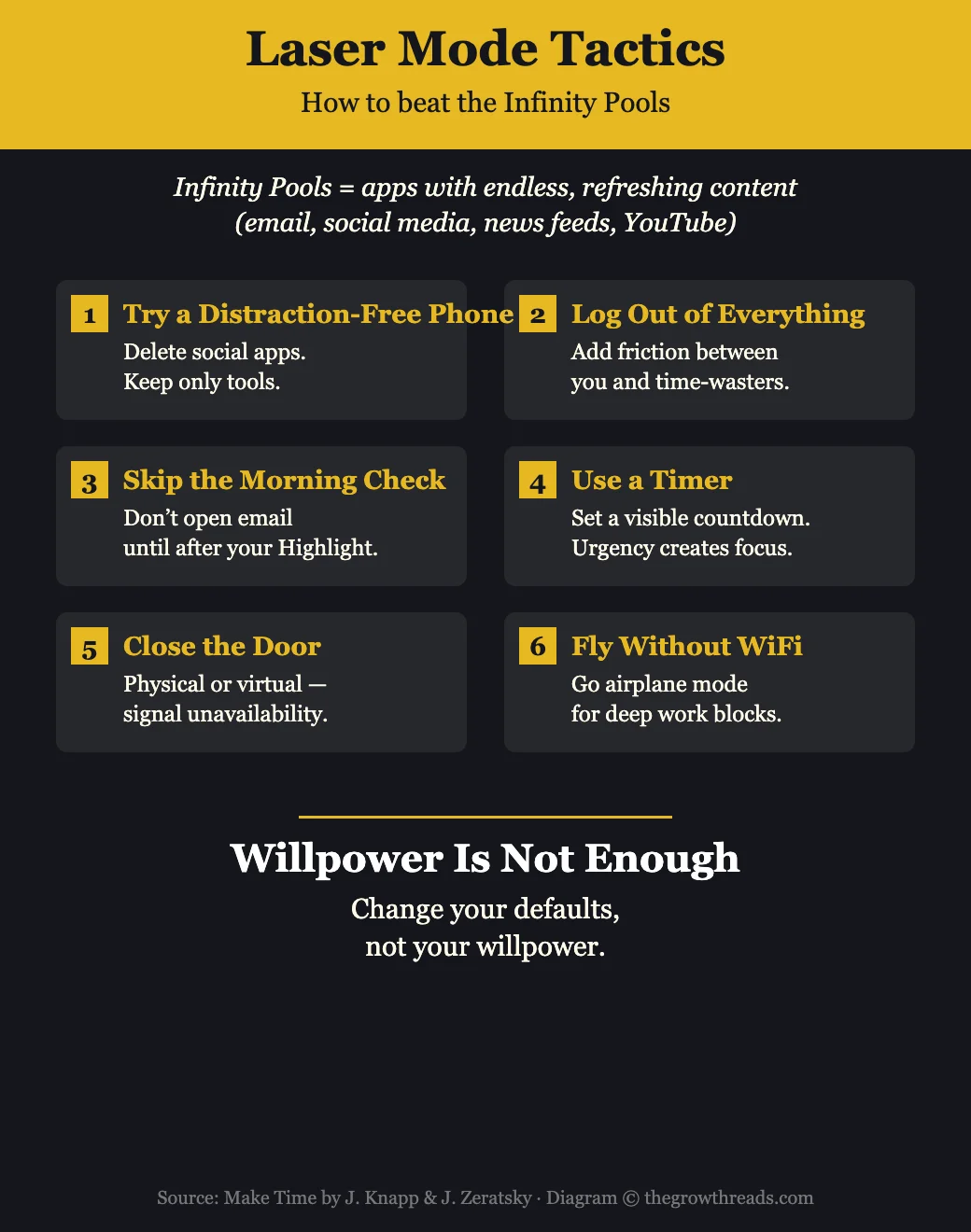
Once you have chosen your Highlight, you need to protect it. This is where Laser comes in — the set of tactics for creating focus and beating distraction. The central idea is that willpower is not a reliable strategy. Instead, you need to change your environment.
The authors introduce the concept of Infinity Pools: apps and platforms with algorithmically refreshing content that never ends. Email, Twitter, Instagram, YouTube, news sites — they are all designed by brilliant teams whose job is to keep you engaged for as long as possible. Knapp should know; he helped build some of them.
The Laser tactics are practical and escalating. At the gentlest level, you can log out of apps after each session — the friction of typing a password is often enough to break the autopilot reach for your phone. A step further is deleting social media apps entirely and only accessing them via a browser when you deliberately choose to. The most aggressive tactic is the Distraction-Free Phone: factory-reset your phone and only reinstall tools (maps, camera, ride-sharing) — no social, no email, no news.
For work-specific focus, they recommend closing your door (physically or metaphorically by wearing headphones), setting a visible timer for your Highlight session, and creating deadline pressure even when none exists. The timer tactic works because it converts an open-ended task into a bounded sprint, which triggers a healthy urgency response.
Another counterintuitive tactic: watch the clock, not the to-do list. Instead of measuring progress by tasks completed, measure it by time invested in your Highlight. This removes the paralysing effect of a task that feels too big — you just need to show up for 60 minutes.
Part 3: Energize — charge the battery that powers focus
The third step is often overlooked in productivity books, and it is what makes Make Time distinctive. Knapp and Zeratsky argue that time management is useless if your body cannot keep up. You can block out two hours for your Highlight, but if you are exhausted and brain-fogged from poor sleep and processed food, those hours are wasted.
The Energize tactics are grounded in evolutionary biology. Humans evolved to move throughout the day, eat whole foods, sleep in dark environments, and spend time in social groups. Modern life inverts all of these: we sit for hours, eat packaged snacks, stare at screens until midnight, and “connect” through text messages. The fix is not extreme — it is about nudging your defaults back toward what your body was built for.
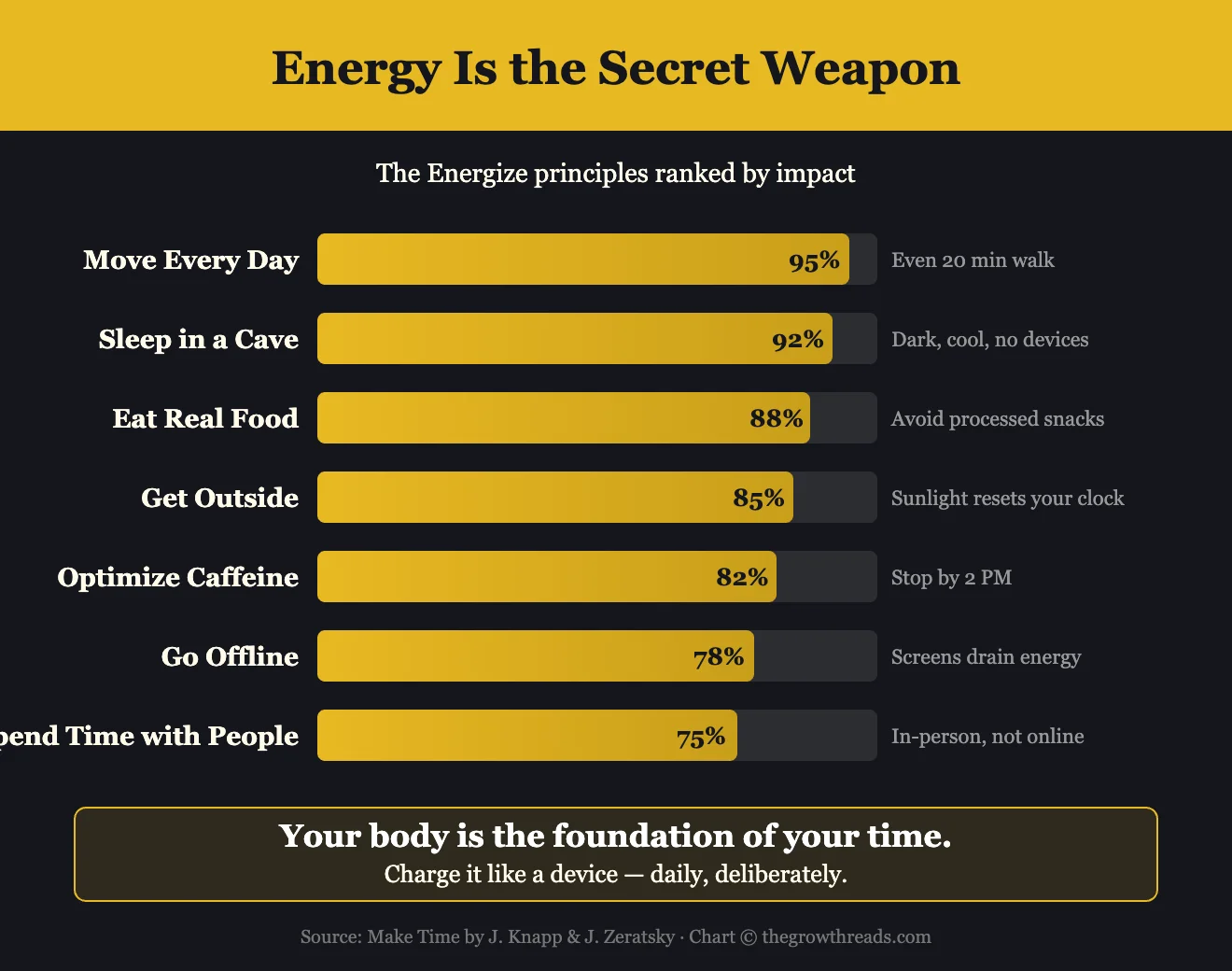
Movement is the keystone habit. The authors are not prescribing marathon training — a 20-minute walk counts. What matters is daily consistency. Exercise does not just burn calories; it floods the brain with BDNF and endorphins that sharpen focus and mood for hours afterward.
Caffeine strategy gets its own section, and it is surprisingly nuanced. The recommendation: wait 60 to 90 minutes after waking before your first coffee (cortisol is already high in the morning, so caffeine is redundant), ride the caffeine wave through your Highlight window, and stop all caffeine by 2 PM to protect sleep. Even caffeine consumed at 3 PM has a measurable half-life that degrades sleep quality at 11 PM.
Sleep is treated as a performance tool, not a luxury. The “cave” metaphor is practical: make your bedroom dark (blackout curtains), cool (around 65°F / 18°C), and device-free. The screen curfew — turning off all screens 30 to 60 minutes before bed — is one of the simplest high-impact changes in the book.
Part 4: Reflect — the compound interest of daily adjustment
The final step takes two minutes — and it is what transforms Make Time from a set of tips into a personalised system. Every evening, you jot down a few quick notes: what was your Highlight? Did you make time for it? How was your energy? What tactics did you try? What will you do differently tomorrow?
The Reflect step is inspired by the scientific method. Each day is an experiment. Your Highlight is the hypothesis (“I think deep writing will make today feel meaningful”), your tactics are the method, and your evening reflection is the data. Over weeks, you accumulate a personal dataset of what works for you — not for a productivity guru, not for a Silicon Valley CEO, but for your specific life, schedule, and temperament.
The authors recommend keeping this absurdly simple: a notebook, a notes app, or even a sticky note. The format does not matter. What matters is consistency — the reflection becomes a habit that compounds. After a month, you will have clear patterns: maybe you focus best in the morning, maybe walking before your Highlight doubles your output, maybe your energy tanks on days you skip breakfast.
This is the quiet genius of Make Time. The four-step loop is not a rigid system you follow or fail at. It is an iterative design process applied to your own life. Bad day? Adjust one variable. Great day? Note what you did. The system gets smarter as you use it.
Who is Make Time best for — and who should read something else first?
Make Time is ideal for knowledge workers drowning in email and meetings who feel busy all day but accomplished nothing meaningful. It is also excellent for parents, students, and creatives who want to protect time for passion projects without quitting their job or overhauling their routine. If you have ever reached the end of a day and thought “where did the time go?” — this book was written for you.
If you are looking for a comprehensive productivity system with projects, contexts, and reference filing, start with Getting Things Done instead. If your challenge is not distraction but procrastination rooted in perfectionism, The War of Art addresses the deeper resistance. And if you want the neuroscience of focus rather than practical tactics, Stolen Focus gives you the “why” behind the “what.”
Questions to reflect on
- If you could protect only one hour today for something meaningful, what would you spend it on?
- Which Infinity Pool steals the most of your time — and what would happen if you logged out of it for a week?
- When in the day is your energy highest? Are you spending that peak time on your Highlight or on email?
- What would a “distraction-free phone” look like for you — which apps would survive the cut?
- If you reflected on your days for 30 days straight, what pattern do you think would emerge?
🔥 Ready to take your day back from the Infinity Pools?
Make Time gives you 87 tested tactics to protect your attention and focus on what matters.
How to apply Make Time (7-day plan)
- Day 1 — Pick your first Highlight: Tonight, choose one 60-to-90-minute activity for tomorrow. Write it on a sticky note and put it where you will see it in the morning.
- Day 2 — Block your Highlight in your calendar: Schedule your Highlight as a real calendar event. Treat it like a meeting you cannot cancel.
- Day 3 — Try one Laser tactic: Log out of your most-used social media app after each use today. Notice how many times you reach for it on autopilot.
- Day 4 — Adjust your caffeine window: Wait 90 minutes after waking for your first coffee and stop all caffeine by 2 PM. Track how you sleep tonight.
- Day 5 — Go for a 20-minute walk: Move your body before or during your Highlight window. Notice how your focus changes afterward.
- Day 6 — Create a screen curfew: Turn off all screens 30 minutes before bed. Read a physical book, stretch, or talk to someone instead.
- Day 7 — Reflect and choose your keepers: Review the week. Which tactics made the biggest difference? Which felt forced? Keep two, drop the rest, and start your second week.
Frequently asked questions
Is Make Time a productivity book?
Not in the traditional sense. Most productivity books focus on doing more — optimising task lists, batching email, and squeezing extra output from every hour. Make Time focuses on doing less, better. The goal is not to cram more into your day but to protect time for the one thing that genuinely matters to you. The authors explicitly reject hustle culture and instead advocate for intentional design of your daily defaults. Think of it as an anti-productivity productivity book.
How is Make Time different from Digital Minimalism?
Cal Newport’s Digital Minimalism advocates a philosophical stance — a 30-day technology fast followed by a deliberate rebuild. Make Time is more tactical and modular. Instead of a wholesale reset, Knapp and Zeratsky offer 87 individual tactics you can mix and match. Digital Minimalism asks “why should I use this technology?” while Make Time asks “how do I design my day so technology serves me?” They complement each other well — start with Make Time for quick wins, then go deeper with Digital Minimalism for a values-based tech philosophy.
Do I need to do all 87 tactics?
Absolutely not — and the authors are emphatic about this. The tactics are presented as a menu, not a mandate. The recommendation is to pick one or two tactics from each step (Highlight, Laser, Energize), try them for a few days, and keep only what works for your life. Some people thrive with a distraction-free phone; others find it too extreme. The Reflect step helps you discover which tactics deliver results for you personally. Most readers settle on five to ten favourites.
What is the best Highlight strategy for beginners?
Start with the Satisfaction lens — choose the Highlight that would make you feel most fulfilled at the end of the day. Urgency-based Highlights tend to default to work tasks you would do anyway. Joy-based Highlights feel indulgent to people just starting out. Satisfaction sits in the productive middle: it gets meaningful work done while teaching you that you can protect time for what matters. After a week of Satisfaction Highlights, experiment with Joy and Urgency to find your balance.
Can Make Time work for parents with young children?
Yes, and the authors address this directly. Your Highlight does not have to be a solo deep-work session. It can be “spend one hour of undistracted play with my toddler” or “read bedtime stories without checking my phone.” The framework is flexible enough to accommodate unpredictable schedules. Parents often find the Energize tactics — especially the sleep and movement advice — more impactful than the Laser tactics, because sleep deprivation is usually the biggest bottleneck on their focus and mood.
What is the distraction-free phone and is it realistic?
The distraction-free phone means deleting every app that is an Infinity Pool — social media, email, news, games, streaming — and keeping only tools like maps, camera, music, ride-sharing, and messaging. It sounds radical, but the authors report that readers who try it rarely go back. The key insight is that you are not giving up access to these services; you are moving them to your computer, where you use them intentionally rather than reflexively. If a full reset feels too extreme, start by deleting just one app for a week.
How long does it take for the Make Time system to work?
Most people notice a difference within the first week. Choosing a daily Highlight immediately changes how your day feels, even before you add any Laser or Energize tactics. By week two or three, the Reflect step starts revealing patterns — you will know which tactics work and which do not. The full system typically feels natural within 30 days. The key is treating it as an experiment rather than a commitment: if a tactic does not work after three days, drop it and try another one. Low stakes, high iteration.
Related summaries
- Deep Work by Cal Newport — the case for undistracted focus as a professional superpower.
- Digital Minimalism by Cal Newport — a philosophy-first approach to reducing technology in your life.
- The ONE Thing by Gary Keller — the power of narrowing your focus to a single priority.
- Best Productivity Books — our complete ranked guide to the top titles in the category.
How we analyze books: Every book on The Growth Reads is read in full, distilled into original frameworks and infographics, and evaluated across five criteria: actionability, evidence quality, writing clarity, uniqueness, and lasting value. We focus on how to apply the ideas, not just understand them. Read our full methodology.