

★★★★ 4.3/5 — a focused, practical case that extraordinary results come from narrowing to a single priority. One big idea, well argued and immediately usable.
Best for: anyone scattered across too many goals who wants a simple rule for where to focus · Reading time: ~5 hours (this guide: 15 min) · Difficulty to apply: Easy to grasp — protecting the time is the discipline
The One Thing in one minute
Extraordinary results come from narrowing your focus to the single most important thing — and doing it first. Gary Keller and Jay Papasan argue that we sabotage ourselves by spreading our energy across too many tasks and goals, when success actually comes from identifying and relentlessly pursuing one priority at a time. Their central tool is the “Focusing Question”: What’s the ONE Thing I can do such that by doing it everything else will be easier or unnecessary? Ask it of your life, your year, and your day, and it points you to the highest-leverage action available. They use the metaphor of dominoes to show how one small, well-chosen action can topple progressively larger ones, producing a cascade of results over time. Success, they insist, is sequential, not simultaneous — you line up your priorities and knock them down one by one, protecting time for the most important through disciplined time blocking. It is a simple message, but a powerful antidote to the scattered busyness of modern life.
Key takeaways
- Go small: extraordinary results come from focusing on one thing, not from doing more.
- The domino effect: one small, well-chosen action can knock down progressively bigger goals over time.
- The Focusing Question: ask what one thing would make everything else easier or unnecessary.
- Success is sequential: you achieve big goals one priority at a time, not all at once.
- Multitasking is a myth: switching between tasks costs time and quality; focus on one at a time.
- Willpower is limited: it depletes like a battery, so do your most important work when your willpower is fresh.
- Forget balance, seek counterbalance: a perfectly balanced life is impossible; instead give your one thing extra time and counterbalance the rest.
- Purpose drives priority drives productivity: a clear purpose reveals your priority, which directs your most productive work.
- Time block your one thing: reserve and defend a large block of time each day for your most important work.
- Think big, then narrow: set a huge goal, then work backward to the one thing you can do right now.
What is The One Thing about?
The One Thing is a productivity book by Gary Keller and Jay Papasan about achieving extraordinary results by focusing on a single priority. Its core tool is the Focusing Question — what one thing would make everything else easier or unnecessary — and it teaches that success is sequential, built by protecting time for the most important task and knocking down goals like dominoes, one at a time.
About the authors
Gary Keller is the co-founder and chairman of Keller Williams Realty, one of the largest real estate franchises in the world, and the author of several bestselling books on business and success, including The Millionaire Real Estate Agent. Jay Papasan is a writer and executive at Keller Williams who has co-authored many of Keller’s books and who helped shape the company’s teaching materials. Published in 2013, The One Thing distilled the philosophy of focus that Keller credits for his own extraordinary business results into a single, accessible framework. The book became a long-running bestseller and a favorite in entrepreneurial and productivity circles. Keller and Papasan write from the vantage point of practitioners who built a huge company, and their emphasis is relentlessly practical: not a broad philosophy of life, but a specific, repeatable method for cutting through the noise and channeling your finite time and energy into what produces the greatest results.
Key concepts at a glance
| Concept | What it means | Use it when |
|---|---|---|
| The ONE Thing | Your single highest-leverage priority | You feel scattered |
| The domino effect | Small wins topple bigger goals | Facing a huge goal |
| The Focusing Question | What makes everything else easier? | Prioritizing anything |
| Sequential success | One priority at a time | Juggling many goals |
| Counterbalance | Give your one thing extra time | Chasing “balance” |
| Time blocking | Reserve time for your one thing | Every working day |
Part 1: Go small — the domino effect and sequential success
Keller and Papasan begin by challenging the instinct to do more. The path to extraordinary results, they argue, is not to add tasks but to subtract them — to “go small” by narrowing your focus to the one thing that matters most. They illustrate the power of this with the domino effect.
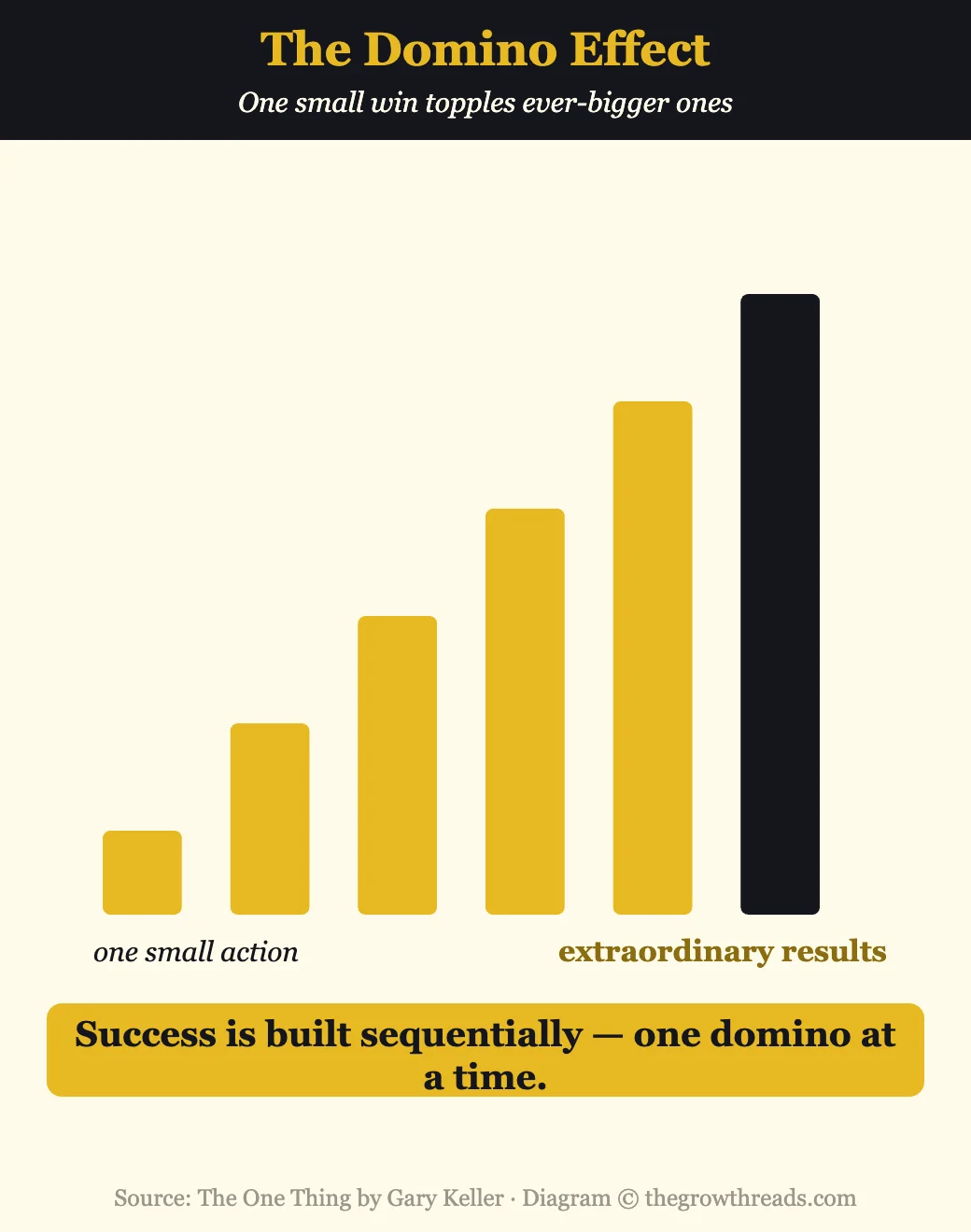
A single domino can knock over another domino about 50% larger than itself, and because the energy compounds, a chain that starts with a domino barely two inches tall could, in theory, topple one the size of a skyscraper after only a couple dozen dominoes. The lesson is that one small, well-chosen action, repeated and built upon, can produce results wildly out of proportion to its size. But the dominoes must fall in sequence. This leads to their crucial reframing: success is sequential, not simultaneous. We imagine successful people juggling many priorities at once, but in reality they line their priorities up and knock them down one at a time, giving each their full focus before moving to the next. Trying to do everything at once guarantees that the important dominoes never fall. Extraordinary results, then, come from finding the right first domino and hitting it again and again.
Part 2: The six lies between you and success
Before the how-to, the authors clear away six widely believed “lies” that keep us scattered.
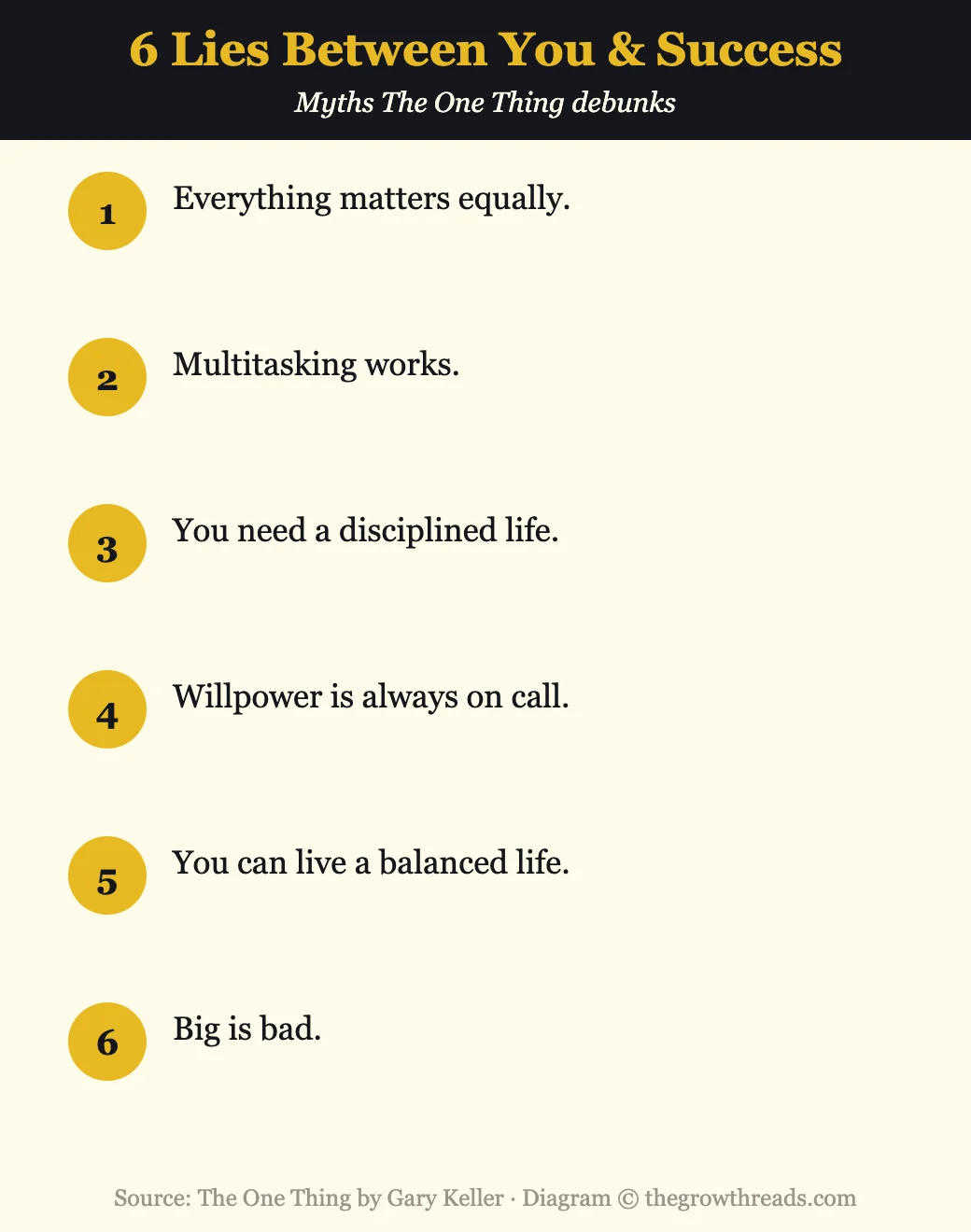
The first lie is that everything matters equally — in truth, a few things matter far more than the rest, so treating all tasks as equally important is a recipe for mediocrity. The second is that multitasking works; research shows switching between tasks costs time and degrades quality, so what feels like doing more actually accomplishes less. The third is the ideal of a disciplined life — Keller argues you don’t need endless discipline across the board, just enough to build the right habits, which then run on autopilot. The fourth is that willpower is always on call; in fact willpower is a limited resource that depletes through the day, so you should schedule your most important work for when it’s strongest. The fifth is the myth of a balanced life: perfect balance is impossible, and chasing it means never giving anything enough to excel; instead the authors recommend “counterbalancing,” periodically going all-in on your one thing while letting other areas wait, then rebalancing. The sixth lie is that big is bad — fear of big goals makes us play small, when in fact thinking big is what opens the door to extraordinary results. Debunking these frees you to focus.
TGR Note: The One Thing and Essentialism are close cousins — both preach radical focus and saying no to the merely good — with The One Thing narrowing all the way to a single priority. And the deep, protected time it demands is exactly what Deep Work teaches you to use well. Pick your one thing, then go deep on it.
Part 3: The Focusing Question
At the center of the book sits its single most useful tool: the Focusing Question. Its full form is, “What’s the ONE Thing I can do such that by doing it everything else will be easier or unnecessary?”
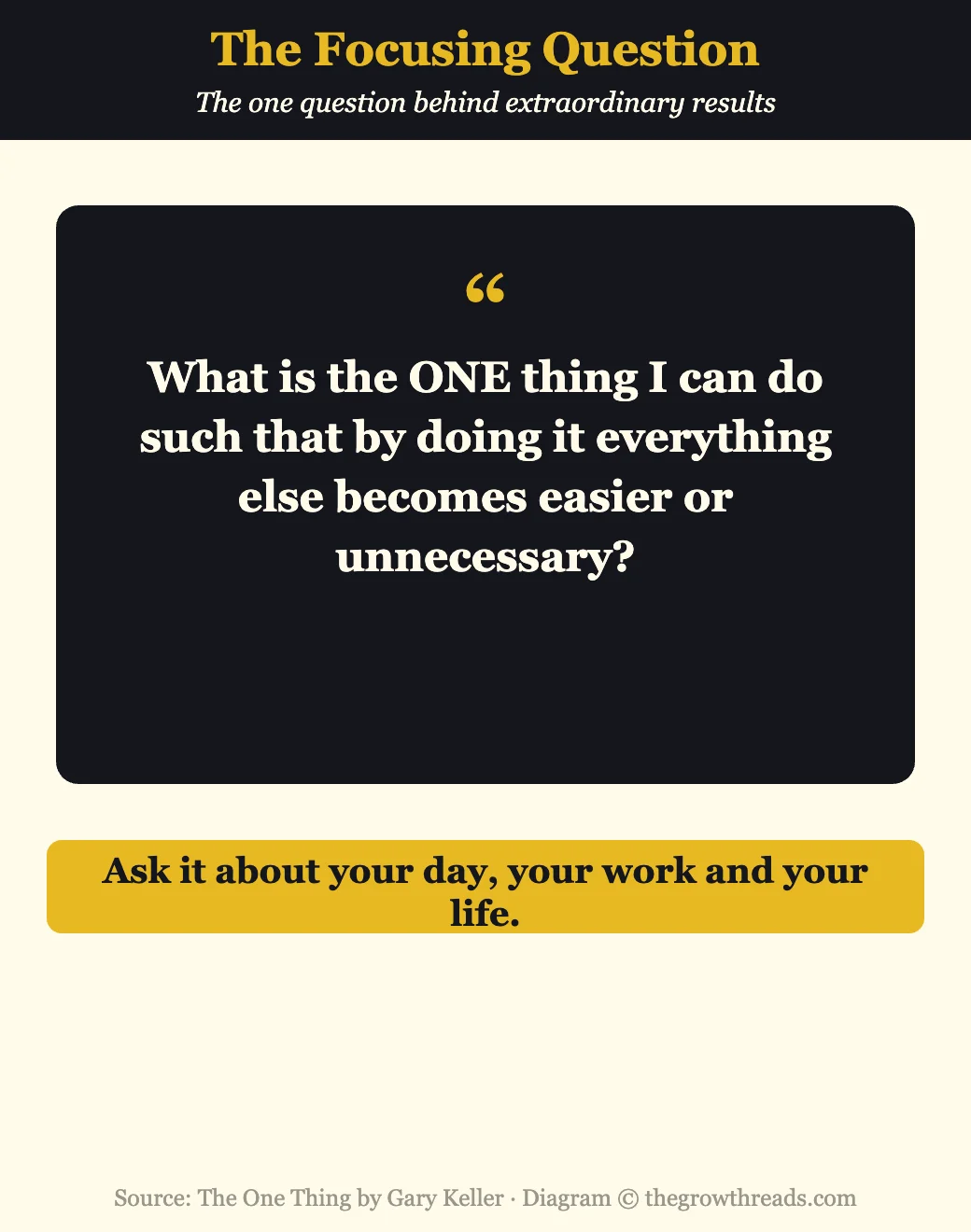
The question is powerful because it forces two things at once: it makes you think big (what would make everything else unnecessary?) while acting small (the ONE thing you can do right now). The authors show how to apply it at every level and timescale — you can ask it about your life, your five-year plan, your year, your month, your week, and your day, each answer flowing from the larger one. Your one thing for today should be the domino that sets up your one thing for the week, which sets up the month, and so on, all the way up to your life’s purpose. This connects to their formula for a productive life: purpose leads to priority leads to productivity. A clear sense of purpose — knowing what you ultimately want — reveals your true priority, which in turn tells you the single most productive thing to work on. Most people, the authors note, get this backward, staying busy without a clear priority and wondering why they feel unproductive. The Focusing Question, asked honestly and often, cuts through that fog and keeps you pointed at what actually matters.
Part 4: Living the one thing — time blocking and productivity
Knowing your one thing is useless if you don’t protect time to do it, so the final section is about execution, and its central practice is time blocking. The authors recommend reserving a large, uninterrupted block of time each day — ideally around four hours in the morning, when willpower is freshest — dedicated solely to your one thing, and defending it fiercely against interruptions, meetings, and lesser tasks. They also advise time blocking for planning and for rest, treating these appointments with yourself as non-negotiable. Protecting the block is the hard part, because the world will constantly try to fill it; the authors offer tactics for guarding it, from building physical and social barriers to preparing responses for the inevitable requests to encroach on it.
They frame lasting success around three commitments: to pursue mastery of your one thing (which is a lifelong path, not a destination); to move from an “entrepreneurial” approach of doing what comes naturally to a “purposeful” one of seeking out the best models and systems; and to be accountable for your results, taking full ownership rather than making excuses. Finally, they warn against the “four thieves of productivity” that steal your focus: the inability to say no, the fear of chaos (worrying that focusing on one thing will let everything else fall apart), poor health habits that drain your energy, and an unsupportive environment of people and surroundings that pull you off course. Guarding against these thieves keeps your one thing on track. The book’s message is admittedly a single idea stretched across a couple hundred pages, and readers who already prize focus may find it repetitive. But as a clear, memorable, and genuinely actionable framework for cutting through overwhelm and channeling your energy where it counts, The One Thing delivers real value.
TGR Note: Time blocking your one thing is a habit, and habits are where Atomic Habits shines — Keller even argues you only need the discipline to build the right habit, after which it runs itself, which is pure James Clear. Pair The One Thing’s what with Atomic Habits’ how, and the daily block becomes automatic.
Who is The One Thing best for — and who should read something else first?
This book is ideal for anyone who feels scattered, overwhelmed, or busy without real progress — entrepreneurs, professionals, students, and goal-setters who need a simple rule for where to aim their energy. Its Focusing Question alone can change how you plan your days. It is not for you if you dislike a single idea repeated at length, or if you want a broad, nuanced philosophy rather than one sharp, practical framework. If you want the wider discipline of eliminating the nonessential across your whole life, read Essentialism; for a system to protect and use the focused time, read Deep Work.
Questions to reflect on
- What is the ONE thing you could do today that would make everything else easier or unnecessary?
- Which of the six lies — especially multitasking or balance — is quietly scattering your focus?
- Are you trying to knock down all your dominoes at once instead of in sequence?
- Do you have a protected daily time block for your most important work — and do you defend it?
- Which of the four thieves (saying no, fear of chaos, poor health, environment) steals your focus most?
🔥 Ready to find your ONE thing?
This guide is the map — the book’s examples make the Focusing Question a daily habit.
How to apply The One Thing (7-day plan)
- Day 1 — Ask the Focusing Question. For your biggest goal, ask what one thing would make everything else easier or unnecessary.
- Day 2 — Find today’s domino. Identify the single most important action for today that sets up the rest.
- Day 3 — Time block it. Reserve a large block of your best hours for your one thing and protect it.
- Day 4 — Kill multitasking. Work on one task at a time for a full block and notice the difference.
- Day 5 — Counterbalance. Give your one thing extra time today, letting less important areas wait.
- Day 6 — Guard against a thief. Pick one productivity thief and take one step to defeat it.
- Day 7 — Connect the timescales. Line up your one thing for the day, week, month, and year so they build on each other.
Frequently asked questions
Is The One Thing worth reading?
Yes, if you value focus and want a simple, actionable framework. Its central tool — the Focusing Question — is genuinely useful and can immediately sharpen how you prioritize your days and goals, and the ideas of the domino effect and sequential success are memorable and motivating. The main criticism is that it is essentially one idea stretched across a couple hundred pages, so it can feel repetitive, especially if you already prize focus. But for anyone who feels scattered and overwhelmed, it delivers a clear, practical antidote.
What is the Focusing Question in The One Thing?
It is the book’s central tool: “What’s the ONE Thing I can do such that by doing it everything else will be easier or unnecessary?” The question is powerful because it forces you to think big and act small at the same time — identifying the single highest-leverage action available right now. The authors recommend asking it at every timescale, from your life and year down to your day, so that each answer builds toward the larger ones, keeping all your efforts aligned behind what matters most.
What is the main message of The One Thing?
That extraordinary results come from focusing on a single priority rather than spreading yourself across many. Keller and Papasan argue success is sequential — you achieve big things one domino at a time — and that the way to do this is to identify your one thing using the Focusing Question and then protect large blocks of time to work on it. The book is a sustained argument against the scattered, multitasking busyness of modern life and for the disciplined power of doing less, better.
What are the six lies in The One Thing?
They are six false beliefs the book says keep us unfocused: that everything matters equally; that multitasking works; that a disciplined life is required (rather than just enough discipline to build good habits); that willpower is always available; that a balanced life is achievable (the authors prefer counterbalancing); and that big is bad (they argue for thinking big). Debunking these six lies clears the way for the book’s central practice of concentrating on one priority at a time.
How is The One Thing different from Essentialism?
They share a philosophy of focus but differ in scope. Essentialism is a broad life-design discipline about continually eliminating the nonessential across all areas of life. The One Thing is narrower and more tactical, zeroing in on identifying the single highest-leverage priority and protecting daily time for it through time blocking. Essentialism teaches you to do less in general; The One Thing teaches you to find and relentlessly pursue the specific one thing that makes everything else easier. Many readers find them complementary.
How long does it take to read The One Thing?
The book is around 240 pages and most readers finish it in about five hours, aided by its clear, repetitive structure. Because it centers on a single idea, many people read it quickly or skim the reinforcing examples. Our summary above captures the full framework — the domino effect, the six lies, the Focusing Question, and time blocking — in roughly 15 minutes, which is often enough to start applying it.
Does The One Thing mean you can only have one goal?
Not exactly. It does not say you can have only one goal in life; it says that at any given moment, focusing your energy on the single most important priority produces the best results. You can and will have different “one things” for different areas and timescales — one for work, one for health, one for today, one for this year — but the discipline is to give each your concentrated focus in sequence rather than diluting your effort by chasing many at once. It is about prioritization and sequencing, not permanent single-mindedness.
Related summaries
- Essentialism Summary — the wider discipline of doing less but better.
- Deep Work Summary — protecting and using your focused time block.
- Atomic Habits Summary — making your daily block an automatic habit.
- Getting Things Done Summary — a system for everything that isn’t your one thing.
- Browse all our best productivity books.
How we analyze books: We work from the full book — reconstructing its core arguments in our own words, adding commentary that connects it to related research and other books in our library, and pressure-testing the advice against how it plays out in real life. We never reproduce the text; we synthesize it. Read our full methodology.
Disclosure: The Growth Reads is reader-supported. When you buy through links on our site we may earn an affiliate commission at no extra cost to you. We only recommend books we believe are worth your time, and our summaries and opinions are written independently.