

★★★★ 4.0/5 — a memorable morning-routine framework (the 20/20/20) wrapped in a divisive fable. Skim the story, keep the system.
Best for: anyone who wants a structured, high-performance morning routine and a jolt of ambition · Reading time: ~5 hours (this guide: 15 min) · Difficulty to apply: Moderate — the formula is simple; waking at 5 AM is the real test
The 5 AM Club in one minute
Win the first hour of your day and you win your day; win your days and you win your life. Robin Sharma’s central claim is that the way you begin your morning sets the trajectory for everything that follows, and that the world’s most successful people protect the quiet, distraction-free hour between 5 and 6 AM — what he calls the Victory Hour — to strengthen themselves before the world wakes up. The book’s practical core is the 20/20/20 Formula: spend the first hour in three twenty-minute blocks of moving, reflecting, and growing. Around this sits a broader philosophy of building four “interior empires,” alternating intense work with deep recovery, and installing new habits over about 66 days. The ideas are delivered through a somewhat theatrical fable involving a billionaire mentor, an entrepreneur, and an artist — a style readers either love or find overwrought — but the underlying routine is genuinely useful.
Key takeaways
- Own your morning: the first hour is the “rudder of the day”; protect it and the rest of your day follows.
- The Victory Hour: rising at 5 AM gives you a pocket of solitude and focus before distractions begin.
- The 20/20/20 Formula: spend the first hour in 20 minutes of movement, 20 of reflection, and 20 of growth.
- Move to prime the brain: intense early exercise burns the stress hormone cortisol and releases brain-boosting chemistry.
- Reflect in silence: journaling, planning, and stillness build self-awareness and calm.
- Grow every day: reading and study compound into expertise over time.
- Build four interior empires: Mindset, Heartset, Healthset, and Soulset must all be cultivated, not just the mind.
- Honor the twin cycles: elite performance requires alternating intense work with genuine, deep recovery.
- Habits take about 66 days: lasting change moves through a hard early phase before it becomes automatic.
- Consistency over intensity: the routine only works if you protect it daily, especially when motivation fades.
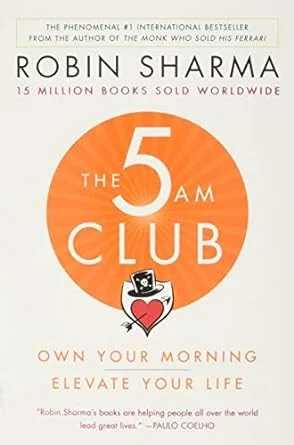
What is The 5 AM Club about?
The 5 AM Club is a personal-development book by Robin Sharma arguing that rising early and following a structured morning routine transforms your productivity, health, and life. Told as a fable, it centers on the 20/20/20 Formula — moving, reflecting, and growing in the first hour — and a wider philosophy of cultivating four interior empires and balancing hard work with deep recovery.
About the author
Robin Sharma is a Canadian writer and leadership adviser, best known for his earlier bestseller The Monk Who Sold His Ferrari. A former litigation lawyer, he left the law to write and to coach executives, athletes, and organizations on high performance and leadership. Over a career spanning decades he has built a large global following through books, courses, and speaking. Published in 2018, The 5 AM Club was the product of years of refinement and became one of his most popular works, striking a chord with a productivity-hungry audience. Sharma’s signature style is grand and aspirational — he favors parables and vivid characters over dry instruction — which makes his books motivating to some readers and melodramatic to others. Beneath the theatrics, though, his advice is rooted in familiar, defensible principles about routine, recovery, and consistency. Explore all Robin Sharma book summaries →
Key concepts at a glance
| Concept | What it means | Use it when |
|---|---|---|
| The Victory Hour | The 5–6 AM window of focused solitude | Starting a high-performance routine |
| 20/20/20 Formula | Move, reflect, grow — 20 minutes each | Structuring your first hour |
| Four interior empires | Mindset, heartset, healthset, soulset | Developing the whole self |
| Twin cycles | Alternating peak work and deep rest | Avoiding burnout |
| 66-day rule | How long habits take to automate | Sticking with a new routine |
| Own your morning | The first hour sets the day | Every single day |
Part 1: Own your morning — the case for 5 AM
Sharma frames the book as a story: a struggling entrepreneur and a self-doubting artist meet an eccentric billionaire at a conference, and he takes them under his wing to teach them the secret of his success. That secret, he insists, is not talent or luck but a habit anyone can adopt — rising at 5 AM to claim the day before it claims you. The theatrical wrapper is not to everyone’s taste, but its purpose is to make a simple idea memorable: the first hour of the morning is the “rudder of the day,” and whoever controls it controls the direction of everything that follows.
Why 5 AM specifically? Sharma’s argument is that the early morning offers something increasingly scarce — uninterrupted solitude. Before the emails, notifications, and demands of others begin, there is a pocket of stillness in which you can strengthen yourself without competition for your attention. He calls this the Victory Hour, and treats it as sacred. The claim is not that early rising is magic, but that a protected, distraction-free hour spent deliberately on your own growth compounds dramatically over months and years, while most people surrender that same hour to sleep-scrolling and grogginess. Own the morning, Sharma repeats, and you elevate your life.
TGR Note: Sharma’s Victory Hour is really a container for the deep, undistracted focus that Cal Newport argues is the modern superpower in Deep Work, and it echoes the “sharpen the saw” renewal habit in The 7 Habits of Highly Effective People. The specific hour matters less than the principle: protect a block of time for growth before the world can claim it.
Part 2: The 20/20/20 Formula
The most useful and portable idea in the book is the 20/20/20 Formula — a concrete blueprint for how to actually spend the Victory Hour. Sharma divides the first sixty minutes into three equal blocks.
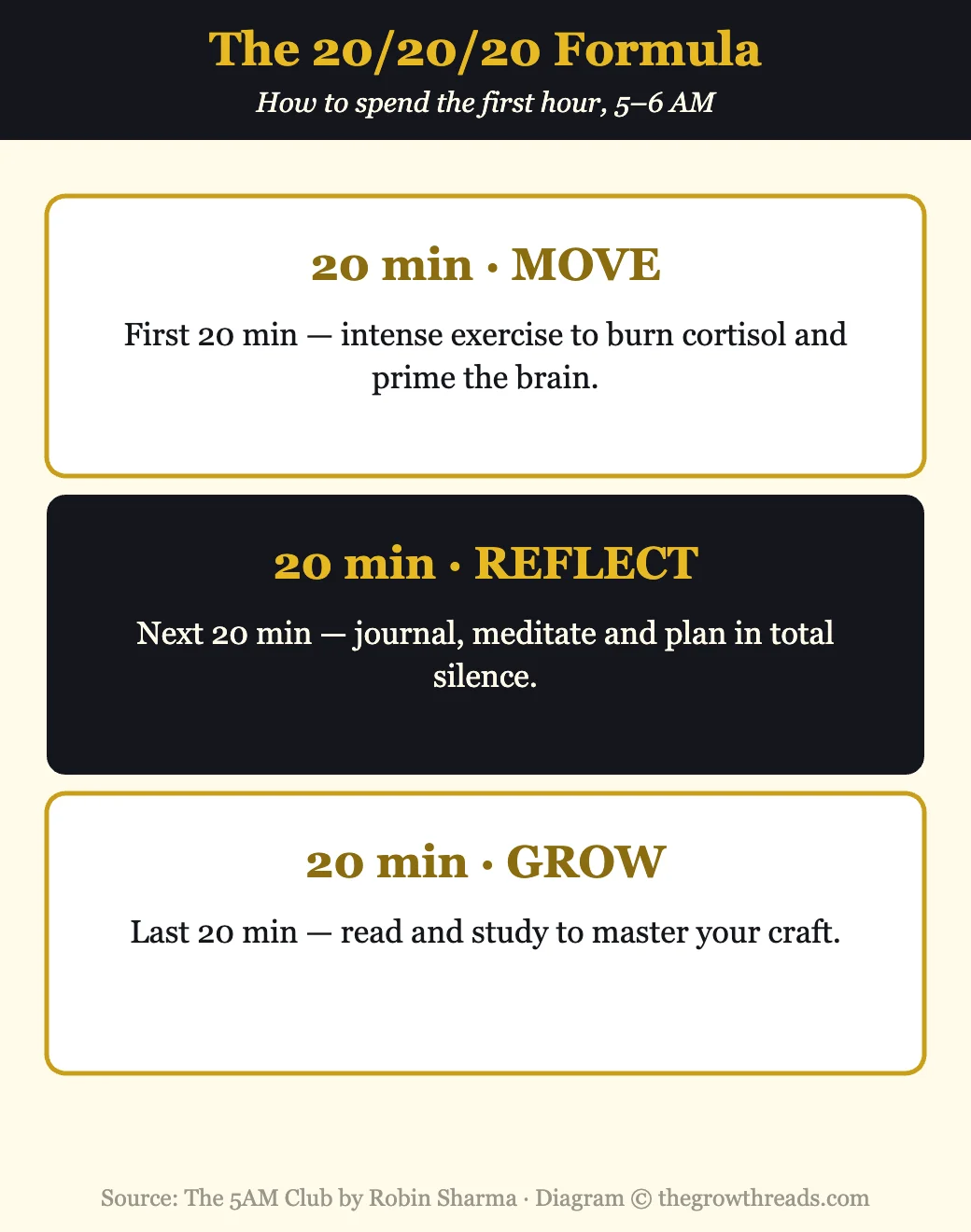
The first twenty minutes are for movement: intense exercise that makes you sweat. Sharma argues this early sweat burns off cortisol, the stress hormone that peaks in the morning, and stimulates a cascade of beneficial brain chemistry that sharpens focus and lifts mood for the rest of the day. The second twenty minutes are for reflection: sitting in silence to journal, plan the day, meditate, or pray. This block builds self-awareness and calm, letting you approach the day with intention rather than reaction. The final twenty minutes are for growth: reading, listening to something educational, or studying your craft, so that you are constantly learning and improving. The genius of the formula is its simplicity and completeness — in one hour it touches body, mind, and skill, and it is easy enough to remember that you can actually do it.
Part 3: The four interior empires and installing the habit
Sharma is careful to argue that high performance is not just about the mind. He describes four “interior empires” that world-class people cultivate in balance.
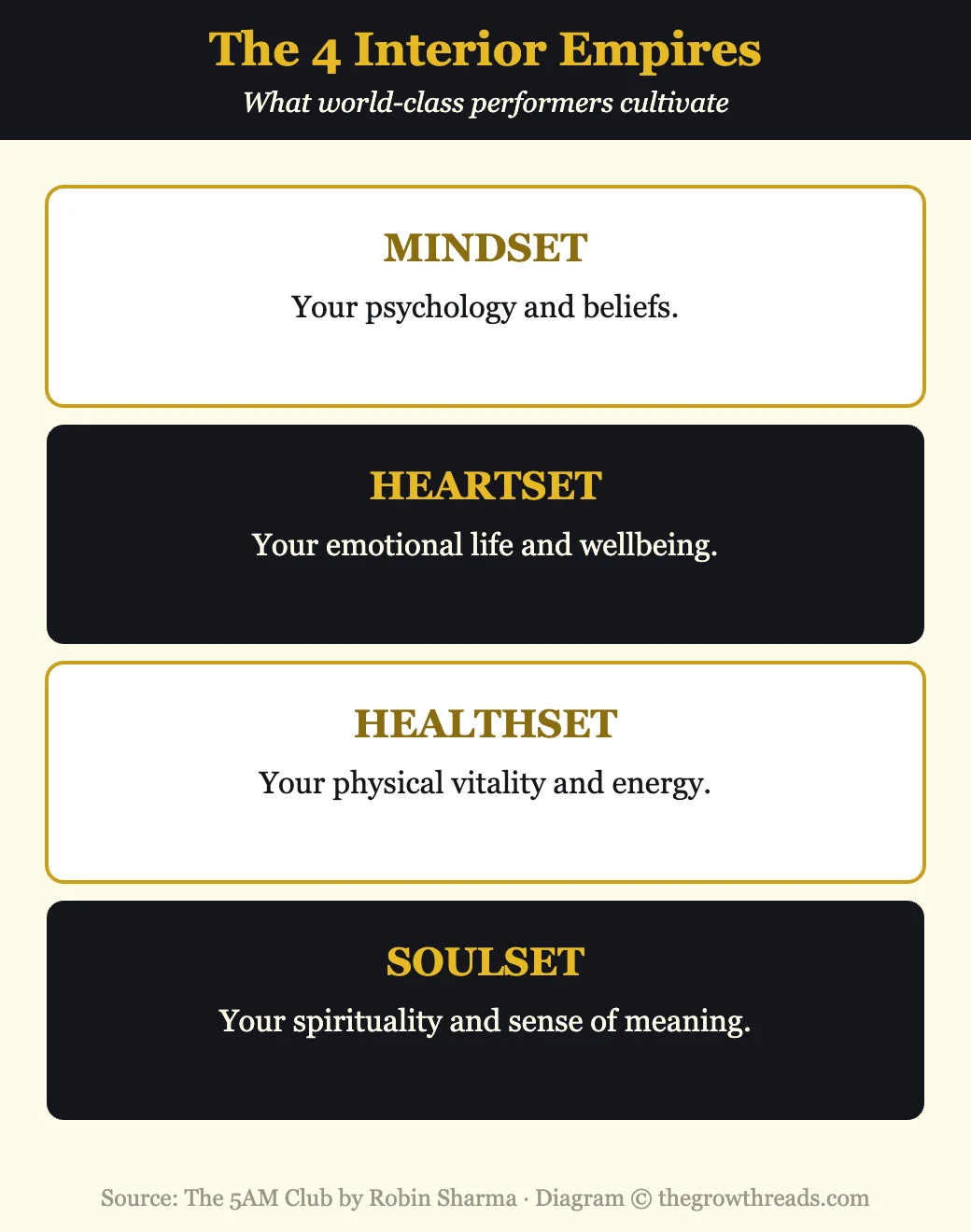
Mindset is your psychology and beliefs — the mental models you run on. Heartset is your emotional life, since unresolved emotion quietly sabotages performance. Healthset is your physical vitality, because energy and longevity underpin everything. And Soulset is your spirituality and sense of meaning, the deeper “why” that keeps you going. Sharma’s point is that developing only your mindset while neglecting your heart, health, or soul produces a brittle, unbalanced kind of success. The morning routine is designed to feed all four.
He is also realistic that rising at 5 AM is hard, and offers a model for making it stick. Lasting habit change, he says, takes roughly 66 days and moves through predictable phases: an initial burst, a difficult “messy middle” where it feels awful and you want to quit, and finally a stage where the new behavior becomes automatic and even enjoyable. Knowing the discomfort is temporary and expected, he argues, is what carries you through the phase where most people give up. The message is consistency over intensity — protect the routine daily, especially on the mornings you least feel like it.
TGR Note: Sharma’s 66-day, three-phase habit model is a rougher version of the precise, evidence-based system in Atomic Habits, where James Clear shows exactly how to make a habit obvious, attractive, easy, and satisfying. If The 5 AM Club sells you on the morning routine, Atomic Habits is the manual for actually installing it — and for surviving the messy middle.
Part 4: The twin cycles and the tactics of genius
The final theme corrects a common misreading of hustle culture. Elite performance, Sharma argues, is not about relentless grinding but about rhythm — what he calls the Twin Cycles of Elite Performance.
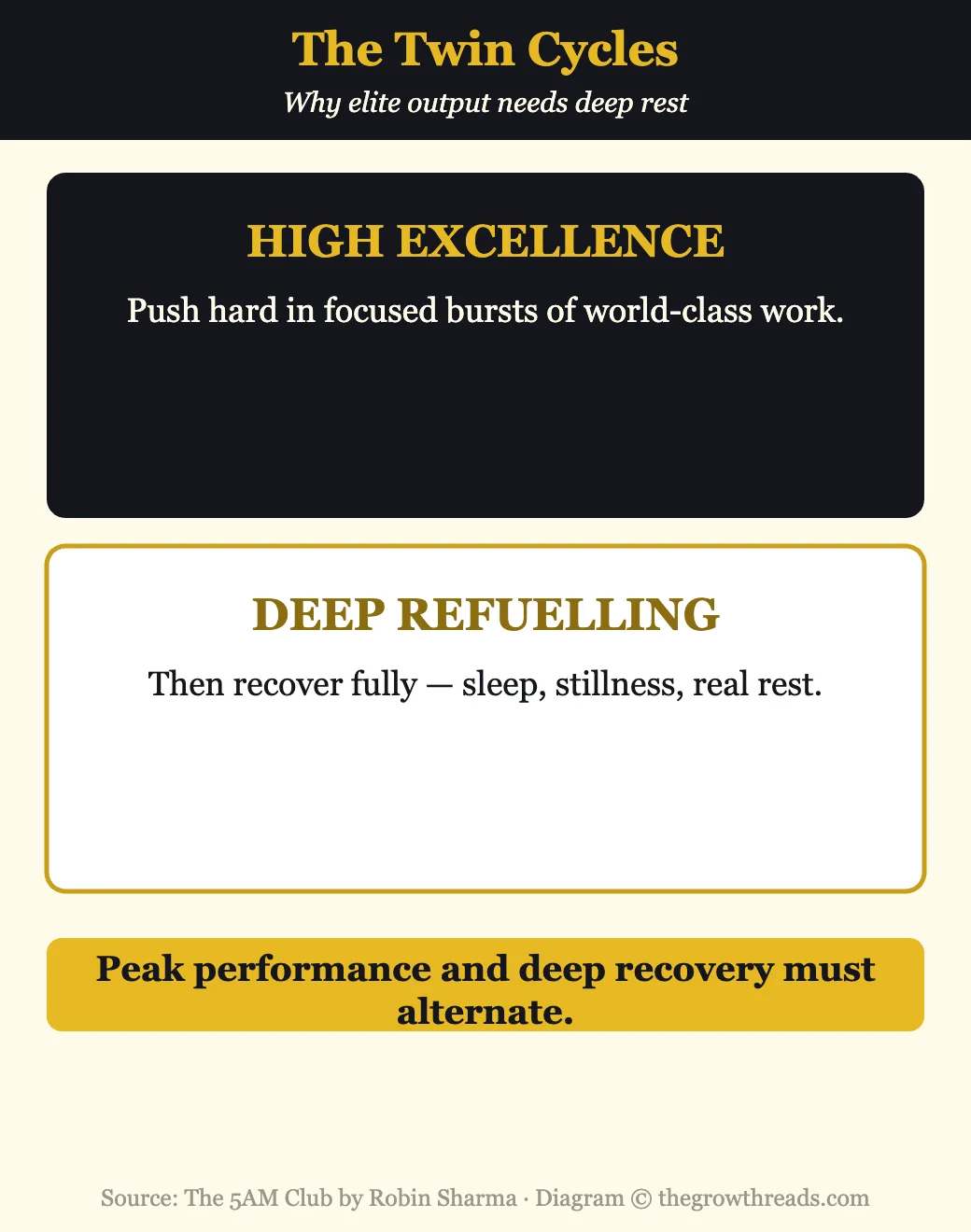
Peak output in a period of intense, focused work must be followed by genuine, deep recovery — sleep, stillness, and real rest — before the next push. Skip the recovery, and performance and health both collapse. This is why the 5 AM routine is paired with an emphasis on going to bed early and protecting sleep; the early rise only works if the recovery cycle is honored. Sharma surrounds all of this with a set of practical “tactics” — habits like a nightly shutdown, tight scheduling, and periodic longer rests — meant to support the core routine.
The book’s larger promise is aspirational: that anyone, regardless of starting point, can join the “club” of people who take radical ownership of their mornings and, through that daily discipline, transform their productivity, health, and sense of meaning over time. The story wrapping can feel overdone, and the science is presented loosely, but the practical spine — protect the first hour, follow the 20/20/20 Formula, develop all four interior empires, and balance hard work with deep rest — is a sound and repeatable routine that many readers find genuinely life-changing when they stick with it.
Who is The 5 AM Club best for — and who should read something else first?
This book is ideal for anyone who wants a structured morning routine and responds to big, motivating, aspirational writing. The 20/20/20 Formula alone is worth the price for many readers. It is not for you if you dislike parable-style self-help or want tight, evidence-based argument, since the fable is long and the science is loose. Night owls and shift workers should also take the specific 5 AM time as flexible rather than gospel. If you want the habit mechanics to make the routine stick, pair it with Atomic Habits; for the deeper focus the morning is meant to enable, read Deep Work.
Questions to reflect on
- What actually happens in the first hour of your day right now — and what is it setting up?
- Which of the four interior empires are you neglecting: mindset, heartset, healthset, or soulset?
- Where in your life are you grinding without honoring the recovery cycle?
- What would you do with a protected, distraction-free hour every morning?
- Which habit have you quit in the “messy middle” before it had time to become automatic?
🔥 Ready to own your morning?
This guide is the map — Sharma’s story and tactics are what turn the routine into a lifestyle.
How to apply The 5 AM Club (7-day plan)
- Day 1 — Set your bedtime first. To rise at 5, protect sleep by going to bed early tonight; the routine starts the night before.
- Day 2 — Try the Victory Hour. Wake at 5 (or 30 minutes earlier than usual) and simply protect the hour, phone away.
- Day 3 — Do the first 20: Move. Start with 20 minutes of exercise intense enough to sweat.
- Day 4 — Add the second 20: Reflect. Journal, plan your day, or sit in silence for 20 minutes.
- Day 5 — Add the third 20: Grow. Read or study your craft for 20 focused minutes.
- Day 6 — Audit your four empires. Rate your mindset, heartset, healthset, and soulset, and pick the weakest to feed.
- Day 7 — Plan for the messy middle. Decide in advance how you’ll keep the routine on the mornings you don’t feel like it.
Frequently asked questions
Is The 5 AM Club worth reading?
It depends on what you want. The core framework — the 20/20/20 Formula, the four interior empires, and the twin cycles of work and recovery — is genuinely useful and easy to apply, and many readers credit it with transforming their mornings. The catch is the delivery: the book is written as a long, theatrical fable that some readers love and others find overwrought and padded. If you enjoy parable-style self-help, it is a strong read. If you want a tight, evidence-based argument, you may prefer to take the 20/20/20 routine and skip much of the story.
What is the 20/20/20 Formula in The 5 AM Club?
It is Sharma’s plan for the first hour after waking. You divide the hour into three twenty-minute blocks: the first twenty minutes for intense movement to burn cortisol and energize the brain, the next twenty for reflection through journaling, planning, or meditation, and the final twenty for growth through reading or study. Done together, the formula touches body, mind, and skill in a single hour, which is why it is the book’s most popular and portable idea.
What is the main message of The 5 AM Club?
That owning your morning transforms your life. Sharma argues the first hour is the rudder of the day, and that rising at 5 AM to exercise, reflect, and learn — before distractions begin — builds the strength, focus, and meaning that compound into extraordinary results over time. Around this sits a wider message about developing the whole self and balancing intense work with deep recovery.
Do you really have to wake up at 5 AM?
Not literally, for everyone. The specific hour is less important than the principle: protecting a quiet, distraction-free block of time for your own growth before the day’s demands begin. Night owls, shift workers, and parents of young children may need to adapt both the timing and the length. What matters is claiming a consistent, protected window and using it deliberately, along with the sleep discipline that makes early rising sustainable.
How long does it take to read The 5 AM Club?
The book is around 330 pages and most readers take about five hours, though the fable format means the pace varies — some race through the story while others find it slow. Our summary above captures the practical framework in roughly 15 minutes, which is often enough to start applying the 20/20/20 routine without reading the entire narrative.
Is the science in The 5 AM Club accurate?
It is loosely presented. Sharma references real ideas — cortisol being higher in the morning, exercise benefiting the brain, the value of sleep and recovery, and habit formation taking time — but he states them broadly and dramatically rather than with rigorous citation, and specific claims like a fixed 66-day habit timeline are approximations. The general principles behind the routine are well supported; the book is best read as motivation and a practical framework rather than a scientific text.
Is The 5 AM Club good for beginners?
Yes, as a motivating introduction to morning routines and high-performance habits. It requires no background and its central formula is simple to follow. Beginners should be prepared for the fable style and take the science loosely. Pairing it with a more practical habit book helps turn the inspiration into a routine that actually survives the difficult early weeks.
Related summaries
- Atomic Habits Summary — the mechanics to make the 5 AM routine stick.
- Deep Work Summary — the focused work your morning hour is meant to enable.
- The 7 Habits Summary — renewal and putting first things first.
- The One Thing Summary — narrowing your mornings to what matters most.
- Browse all our best productivity books.
How we analyze books: We work from the full book — reconstructing its core arguments in our own words, adding commentary that connects it to related research and other books in our library, and pressure-testing the advice against how it plays out in real life. We never reproduce the text; we synthesize it. Read our full methodology.
Disclosure: The Growth Reads is reader-supported. When you buy through links on our site we may earn an affiliate commission at no extra cost to you. We only recommend books we believe are worth your time, and our summaries and opinions are written independently.