

★★★★☆ 4.3 / 5 — A philosophically grounded, immediately actionable guide to reclaiming your attention from the apps engineered to steal it.
Best for: Anyone who picks up their phone without knowing why, feels drained by social media, or wants a structured plan to reset their digital habits.
Reading time: ~6 hours (284 pages) | This summary: ~22 min
Difficulty to apply: Moderate to high — the 30-day digital declutter requires real commitment, but the payoff is immediate.
Page and product links in this article may earn us a small commission at no extra cost to you.
Digital Minimalism in one minute
You do not have a willpower problem — you have a design problem. Cal Newport argues that the biggest tech companies employ thousands of engineers whose sole job is to make their products maximally addictive. Fighting this with self-discipline alone is like trying to outrun a car. Instead, Newport proposes digital minimalism: a philosophy of technology use where you start from zero, identify the small number of tools that genuinely serve your deepest values, and use them with strict rules. The centrepiece is a 30-day digital declutter — a full reset that strips away optional technology so you can rediscover what you actually want your life to look like. The books second half provides a practical playbook for replacing low-quality digital leisure with high-quality analogue alternatives: crafting, structured socialising, physical skills, and solitude.
Key takeaways
- Digital minimalism is a philosophy, not a detox: It is not about temporary abstinence but about permanently choosing which technologies deserve a place in your life — and on what terms.
- Tech companies use intermittent reinforcement to hook you: The same variable-reward mechanism that makes slot machines addictive drives notifications, likes, and infinite scroll.
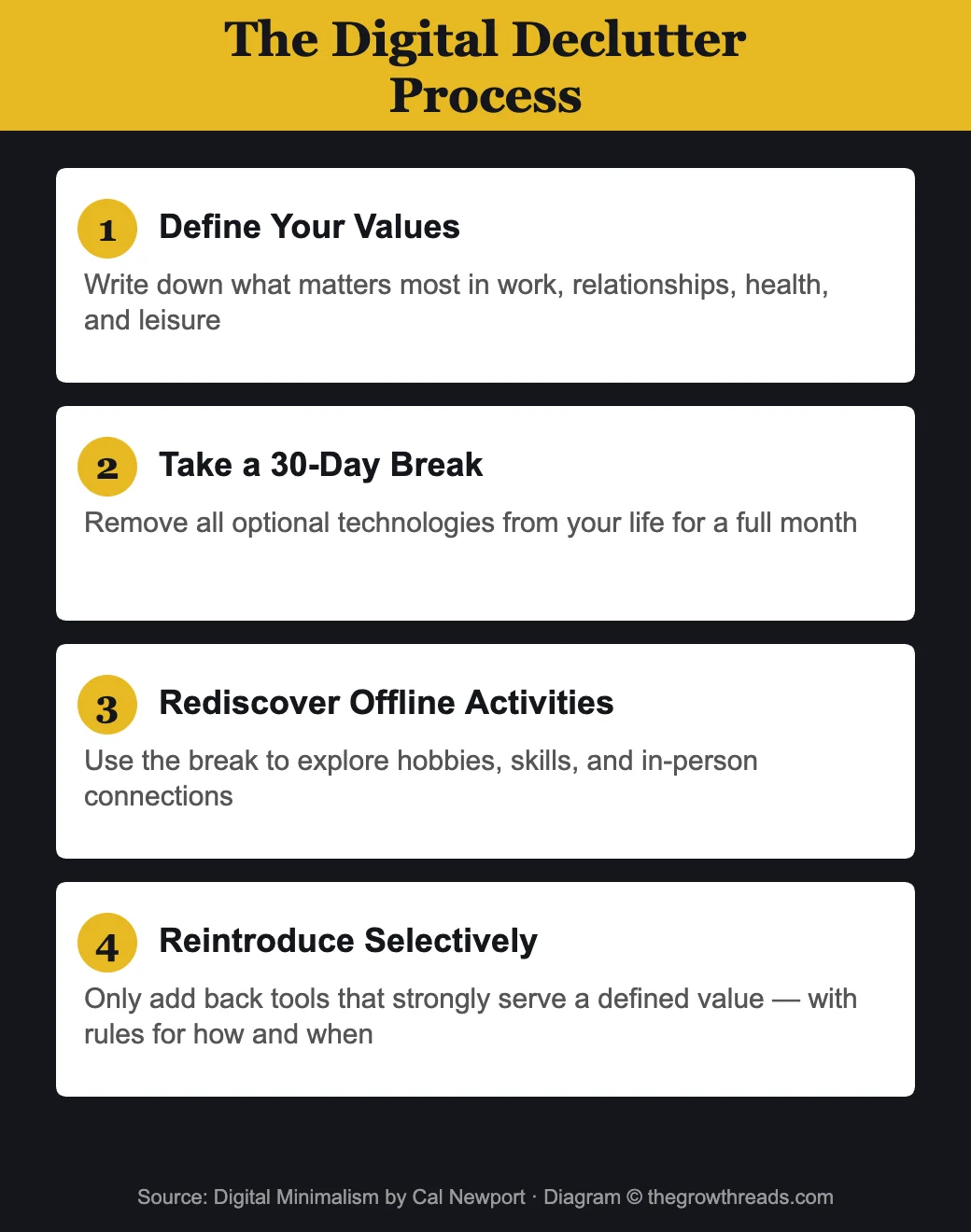
- The 30-day digital declutter is the foundational practice: Remove all optional technology for 30 days, rediscover offline activities, then reintroduce only tools that pass a strict value test.
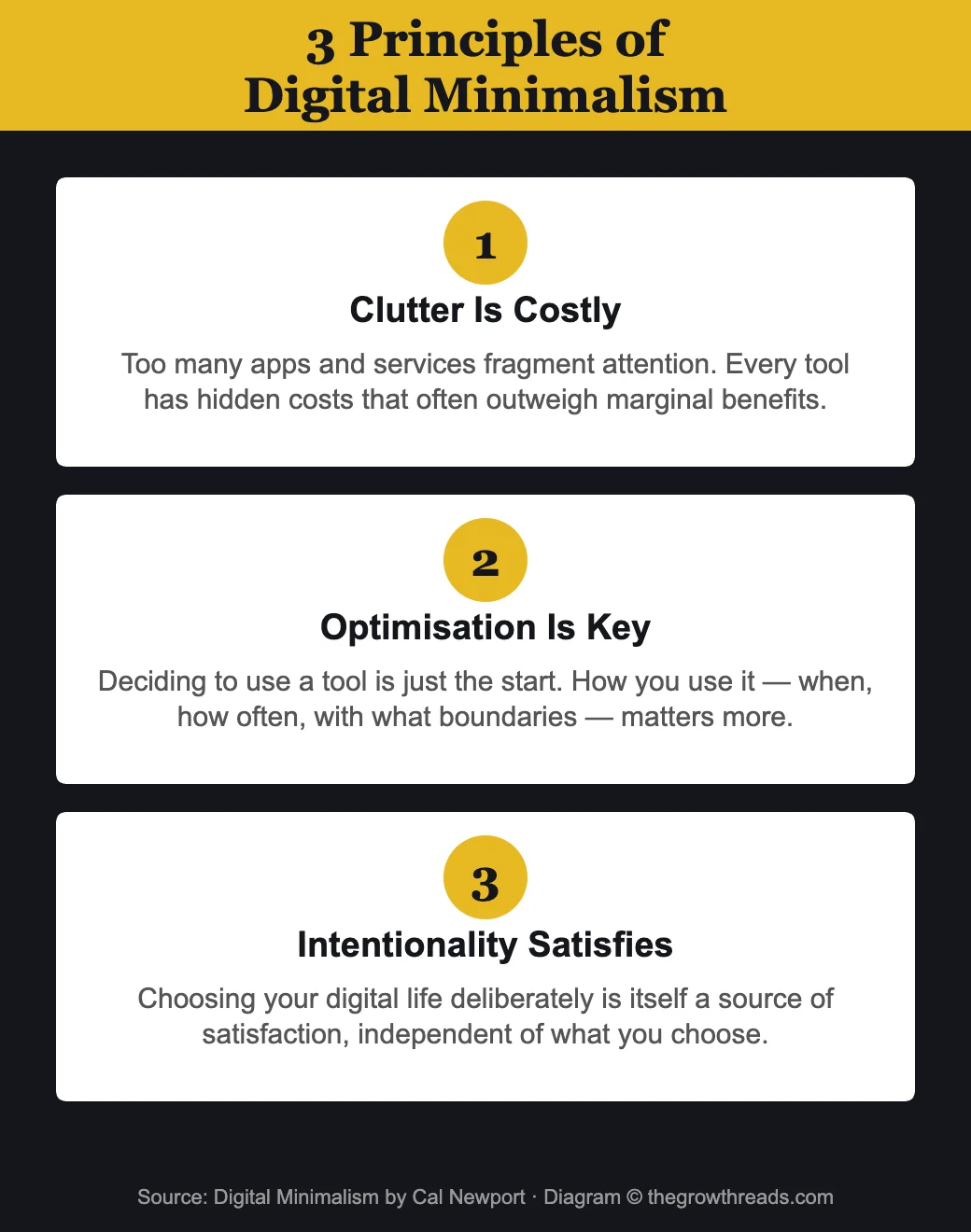
- Clutter is costly: Every app or service you add has hidden costs — time, attention, cognitive overhead — that usually outweigh the marginal benefit it provides.
- Optimisation matters more than adoption: Deciding to use a tool is the easy part. How, when, and how often you use it is where the real value (or damage) lives.
- Solitude is a human necessity, not a luxury: Newport defines solitude as freedom from other minds’ input — and argues that constant connectivity has made many people solitude-deprived for the first time in human history.
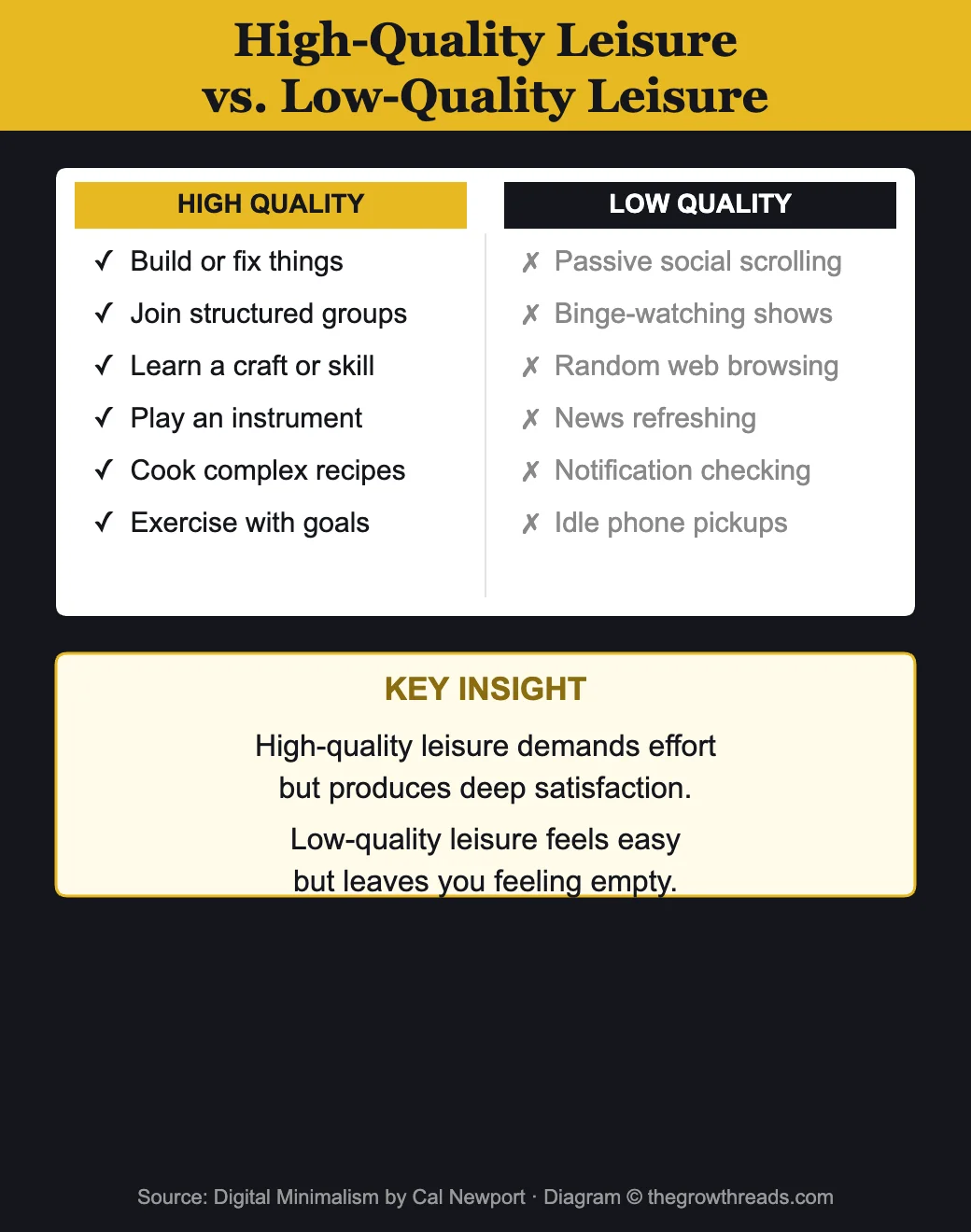
- High-quality leisure displaces low-quality scrolling: People who fill their free time with demanding, skill-based activities do not miss social media — they simply have better things to do.
- Conversation beats connection: Real conversation (voice, in-person) builds relationships; digital connection (likes, comments, texts) merely maintains the illusion of one.
- Operating procedures protect your boundaries: Specific rules — checking email twice a day, social media only on a laptop, no phones during meals — work better than vague intentions.
- Intentionality is itself satisfying: Choosing your digital life deliberately feels better than drifting through it — regardless of what you choose.
What is Digital Minimalism about?
Digital Minimalism presents a philosophy of technology use built on intentionality rather than reaction. Newport argues that modern tech is designed to be addictive, proposes a 30-day declutter to reset your relationship with screens, and provides practices for replacing low-value digital habits with high-quality offline alternatives.
About the author
Cal Newport is a computer science professor at Georgetown University and one of the most influential voices on focus, productivity, and technology criticism. He earned his PhD from MIT and has published multiple bestsellers, including Deep Work and A World Without Email. Newport is notably not on social media — a fact that gives his arguments unusual credibility. He writes the popular Study Hacks blog and has been featured in the New York Times, Wall Street Journal, and The New Yorker. His academic research focuses on distributed algorithms, but his popular work centres on the question of how to do meaningful work in a distracted world. Explore all Cal Newport book summaries →
Key concepts at a glance
| Concept | What it means | Use it when |
|---|---|---|
| Digital minimalism | A philosophy where you use only the technologies that strongly support your values, and ignore everything else | You feel overwhelmed by apps, notifications, and digital noise |
| Digital declutter | A 30-day break from all optional technology, followed by selective reintroduction | You want a clean reset rather than incremental adjustments |
| Solitude deprivation | A state where you never spend time alone with your own thoughts — always connected to other minds via screens | You feel anxious without your phone or cannot sit quietly without input |
| High-quality leisure | Demanding, skill-based activities (crafting, sports, music) that produce genuine satisfaction | Your free time feels empty despite being full of entertainment |
| Conversation vs connection | Real-time, rich interaction (voice, in-person) versus low-bandwidth digital signals (likes, comments) | You have hundreds of online connections but feel lonely |
| Operating procedures | Specific rules governing when and how you use each technology | You want boundaries but find willpower unreliable |
| Attention resistance | The practice of refusing to give your attention to companies that profit from exploiting it | You want to make a principled stand against the attention economy |
Part 1: The case against digital clutter
Newport opens by documenting a phenomenon that most readers will recognise: the feeling that technology controls you rather than the other way around. He traces this to a deliberate design strategy. Social media companies, he argues, employ attention engineers who use techniques borrowed from behavioural psychology — intermittent variable reinforcement (the same mechanism behind slot machines), social approval indicators (likes and followers), and infinite scroll — to maximise the time you spend on their platforms. The product is not the app. The product is your attention, sold to advertisers.
He draws on the philosophy of the Amish — not to suggest we reject all technology, but to borrow their method. The Amish do not reflexively adopt new tools. They ask: does this serve our community’s values? Does its benefit outweigh its cost? If they adopt it, they set strict rules for how it is used. Newport argues that most people do the opposite: they adopt every new service by default, set no rules, and wonder why they feel overwhelmed.
The three principles of digital minimalism follow from this analysis. First, clutter is costly — every tool you add fragments attention, and the cumulative cost of many marginal tools can exceed the benefit of each. Second, optimisation is key — how you use a tool matters more than whether you use it. Third, intentionality is satisfying — the act of choosing deliberately provides its own sense of autonomy and purpose, regardless of what you choose.
Part 2: The 30-day digital declutter
The centrepiece of the book is the digital declutter — a 30-day protocol that Newport considers non-negotiable for anyone serious about changing their digital habits. The process has four steps. First, define your values: write down what matters most to you in work, relationships, health, and leisure. Second, identify which technologies are optional — anything not required for work or safety qualifies. Third, remove all optional technology for 30 full days. Fourth, and most importantly, use the break to rediscover and invest in offline activities that genuinely fulfil you.
Newport is emphatic that the break alone is not enough. People who simply white-knuckle through 30 days without screens and then return to their old habits gain nothing. The magic happens during the break, when you have the space to discover (or rediscover) what you actually enjoy doing — woodworking, hiking, board games, cooking, long conversations, learning an instrument. These activities fill the void that scrolling was papering over. When the 30 days end, you reintroduce technology selectively: each tool must pass a strict test. Does it directly serve one of your defined values? Is it the best way to serve that value? And what operating procedures will you follow to keep it from becoming a time sink?
Newport shares results from 1,600 people who participated in his organised declutter. The most common finding: people were shocked by how little they missed. Services they had considered essential turned out to be habitual. The second most common finding: the offline activities they discovered during the break were so satisfying that they had no desire to return to their old digital habits. The declutter did not require willpower to maintain — it replaced bad habits with better ones.
Part 3: Solitude, leisure, and the art of being human
The second half of the book provides the positive vision: what a digitally minimalist life actually looks like. Newport begins with solitude — which he defines not as physical isolation but as freedom from other minds’ input. Reading a book is not solitude (you are processing another person’s thoughts). Walking alone without headphones is. He argues that smartphones have created a historically unprecedented condition: solitude deprivation. For the first time, it is possible — and common — for a person to go through an entire day without a single moment alone with their own thoughts. Every pause is filled: waiting rooms, elevators, red lights, even bathroom breaks become opportunities for input.
The consequences, Newport argues, are serious. Solitude is where self-reflection happens, where emotional processing occurs, where creative insights emerge, and where values clarify. People deprived of it report higher anxiety, difficulty making decisions, a weakened sense of identity, and — paradoxically — increased loneliness. His prescription is simple: take long walks without your phone, keep a reflection journal, and build regular periods of solitude into your schedule.
On leisure, Newport draws a sharp line between high-quality and low-quality activities. High-quality leisure is demanding, skill-based, and often physical: building furniture, playing a sport, learning to cook, joining a community group. Low-quality leisure is passive, consumptive, and digital: scrolling feeds, binge-watching, casual browsing. The crucial insight is that high-quality leisure, despite requiring more effort, produces far more satisfaction — and, critically, it crowds out the desire for low-quality alternatives. People who build rich offline lives do not need to resist social media. They simply have better things to do.
He also distinguishes between connection and conversation. Digital tools excel at connection — likes, comments, quick texts — which maintains a thin layer of social awareness. But research shows that well-being depends on conversation — real-time, rich, voice-based interaction where emotional nuance and genuine understanding flow. Newport recommends consolidating social media interactions into real conversations: instead of liking posts, call the person. Instead of commenting, meet for coffee.
Part 4: Building a sustainable digital life
The final chapters offer concrete operating procedures for maintaining digital minimalism long-term. Newport recommends designating specific times for checking email and messages rather than monitoring them continuously. He suggests using social media only on a laptop (the friction of opening a browser is enough to prevent casual scrolling). He advises removing all social apps from your phone and treating the device as a tool for calls, maps, and music — not a portable entertainment centre.
He also introduces the concept of the attention resistance — a growing cultural movement of people who refuse to give their attention to companies that profit from exploiting it. This is not Luddism, Newport insists. It is consumerism applied to attention: you would not let a company take money from your bank account without permission, so why let them take time and focus from your mind?
The book closes with a vision of what digital minimalism makes possible: deeper work, richer relationships, more satisfying leisure, and a clearer sense of self. Newport is careful to note that the goal is not to reject technology but to use it as a tool that serves your values rather than a distraction that undermines them. The minimalist does not have less — they have only what matters.
Who is Digital Minimalism best for — and who should read something else first?
Digital Minimalism is ideal for anyone who has tried app timers, screen-time limits, or digital detoxes and found them ineffective. Newport’s approach works because it replaces the entire system rather than patching individual apps. It is also excellent for parents trying to model healthy technology use for their children.
If your main challenge is not digital distraction but deep focus at work, start with Deep Work — it tackles the professional side of the same problem. If you want to understand the neurochemistry of why screens are addictive, Dopamine Nation by Anna Lembke is the scientific companion. And if your goal is to build better habits generally (not just digital ones), Atomic Habits by James Clear provides the foundational framework.
Questions to reflect on
- How many times did you pick up your phone today without a specific purpose? What were you actually looking for — information, or just stimulation?
- If you removed social media for 30 days, what would you do with the freed-up time? Do you know, or does the question feel uncomfortable?
- When was the last time you spent an extended period in true solitude — no phone, no podcast, no input from other minds? How did it feel?
- Look at your closest relationships. How much of your interaction is conversation (real-time, voice or in-person) versus connection (likes, texts, comments)?
- What is one high-quality leisure activity — demanding, skill-based, satisfying — that you have been meaning to try but have not made time for?
🔥 Ready to reclaim your attention?
Get Digital Minimalism and build a focused life that serves your values instead of someone else’s algorithm.
How to apply Digital Minimalism (7-day plan)
- Day 1 — Define your values: Write down 3–5 things that matter most to you (deep relationships, creative work, physical health, learning). These become the filter for every technology decision.
- Day 2 — Audit your digital life: List every app, service, and digital habit you use. For each, ask: does this directly serve one of my values? Is it the best tool for that purpose? Mark the ones that fail both tests.
- Day 3 — Plan your declutter: Set a 30-day start date. Delete or log out of every optional technology. Tell people you will be less reachable and give them your phone number for anything urgent.
- Day 4 — Start the declutter and explore: Begin your 30-day break. Use the first freed-up evening to try one high-quality leisure activity: visit a hardware store, cook a complex recipe, take a long walk, or call an old friend.
- Day 5 — Practice solitude: Take a 30-minute walk without your phone or headphones. Let your mind wander. Notice what thoughts, ideas, and emotions surface when there is no input to suppress them.
- Day 6 — Replace connection with conversation: Pick one person you normally interact with via likes or comments. Call them instead. Compare the quality of the interaction.
- Day 7 — Set operating procedures: For the tools you plan to reintroduce after the declutter, write specific rules: when you will use them, for how long, and on which device. Post these rules where you can see them.
Frequently asked questions
Is digital minimalism anti-technology?
Not at all. Newport is a computer scientist who uses technology extensively in his academic work. His argument is not against technology but against letting technology use you. Digital minimalists use fewer tools, but they use them more intentionally and effectively. The goal is to be the master of your devices rather than their product.
Do I really need to do the full 30-day declutter?
Newport argues yes — and the 1,600-person experiment supports him. Partial measures (deleting one app, setting a timer) treat symptoms rather than causes. The declutter works because it gives you the space to discover what you actually want from your free time, which makes the selective reintroduction meaningful rather than arbitrary. Without the full reset, you are negotiating with habits rather than replacing them.
What if I need social media for work?
Newport distinguishes between optional and professional technology. If social media is genuinely required for your job (marketing, journalism, community management), it is not optional and you do not remove it during the declutter. But he challenges you to be honest: is it truly required, or has it become habitual? Many people discover that their professional social media use takes 20 minutes a day, not two hours — the rest was personal scrolling disguised as work.
How is this different from a digital detox?
A digital detox is a temporary break — you step away, decompress, and then return to the same habits. Digital minimalism is a permanent philosophy. The 30-day declutter looks like a detox, but its purpose is different: it creates the space to rebuild your digital life from scratch based on your values, not to provide temporary relief. The difference is between going on a diet and changing how you eat.
What is solitude deprivation and why does it matter?
Solitude deprivation is a condition where you never spend time free from other minds’ input — always connected to someone else’s thoughts via screens, podcasts, or messages. Newport argues this is historically unprecedented and psychologically harmful. Solitude is where self-reflection, emotional processing, and creative insight happen. Without it, people report higher anxiety, difficulty with decisions, and a weakened sense of identity. The fix is simple: regular phone-free walks, journaling, and designated quiet time.
What counts as high-quality leisure?
Newport defines high-quality leisure as activities that are demanding, skill-based, and often produce something tangible. Examples include woodworking, cooking elaborate meals, playing a musical instrument, joining a sports league, learning a language, or participating in a structured community group. The key distinction from low-quality leisure (scrolling, binge-watching) is that high-quality leisure requires effort but produces genuine satisfaction and skill growth.
What should I read after Digital Minimalism?
For building deep focus at work, Deep Work by the same author is the natural companion. For understanding the neuroscience of digital addiction, try Dopamine Nation by Anna Lembke. For building better habits across all life domains, Atomic Habits by James Clear provides the system. And for reclaiming your time more broadly, Four Thousand Weeks by Oliver Burkeman offers the philosophical framework.
Related summaries
- Deep Work by Cal Newport — The professional companion: how to do focused work in a distracted world.
- Dopamine Nation by Anna Lembke — The neuroscience behind why screens hijack your brain.
- Atomic Habits by James Clear — The habit system that makes digital minimalism sustainable.
- Best Productivity Books — Our full ranked guide to the productivity shelf.
This article contains affiliate links to Amazon and Bookshop.org. If you buy through these links, we may earn a small commission at no extra cost to you. This never influences our reviews — we only recommend books we have read and believe in. See our full disclosure.