

★★★★★ 4.5/5 — A refreshingly data-driven guide to building wealth without the guilt trips or get-rich-quick promises.
Best for: Young professionals, new investors, and anyone paralyzed by “when should I invest?” anxiety.
Reading time: ~5 hours (288 pages)
Difficulty to apply: Easy — most advice boils down to automating simple habits.
Just Keep Buying in one minute
Stop overthinking and start investing — the data overwhelmingly favors it. Nick Maggiulli, Chief Operating Officer at Ritholtz Wealth Management, dismantles the guilt-driven savings culture and replaces it with evidence-based rules. His central argument: most people should spend less time optimizing their savings rate and more time growing their income and investing consistently. Whether markets are up, down, or sideways, the data shows that buying income-producing assets regularly — and never selling in a panic — is the most reliable path to wealth. The book is split into two halves: how to save (without torturing yourself) and how to invest (without pretending you can predict the future).
Key takeaways
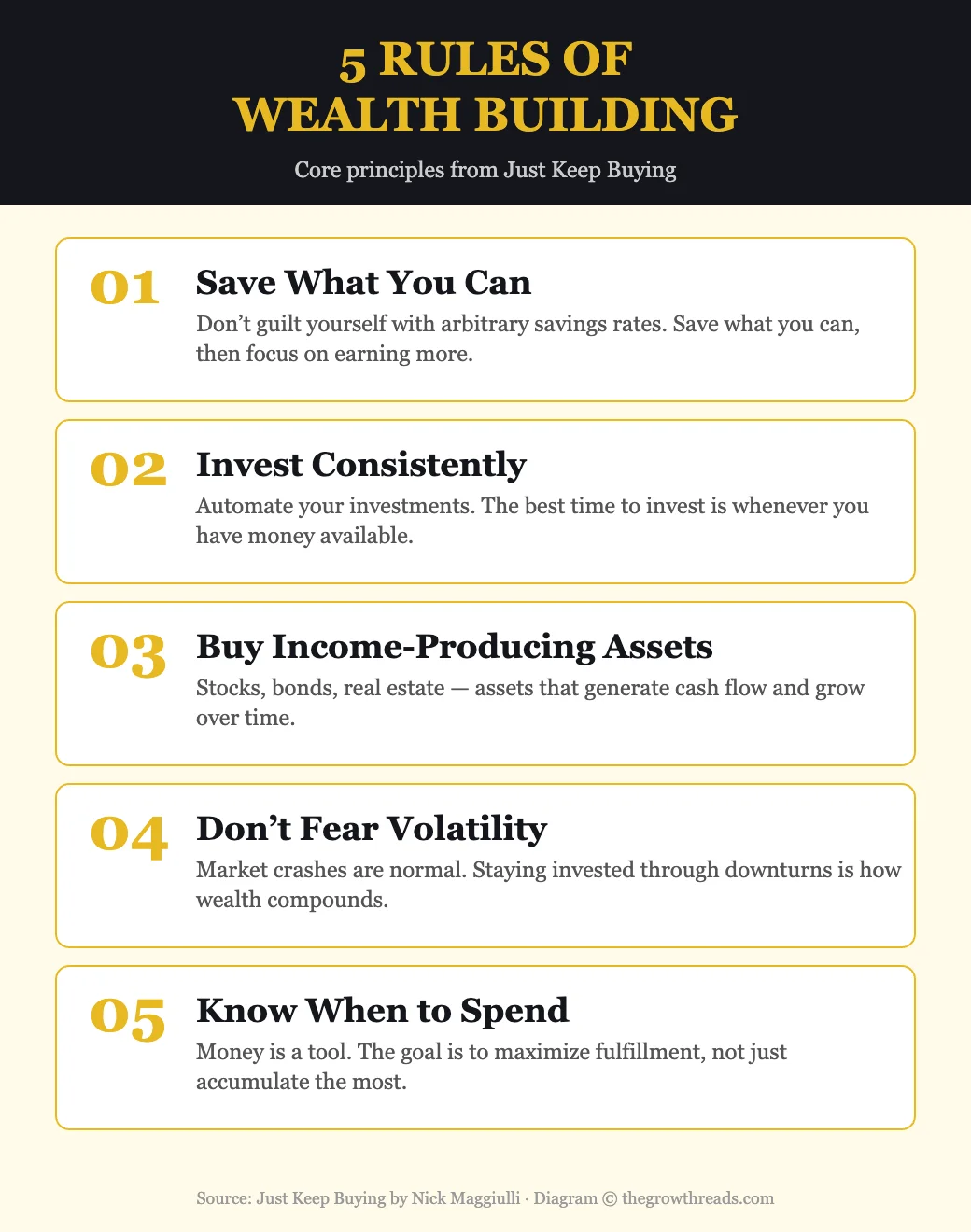
- Save what you can, not what gurus say: Arbitrary savings rates like “save 20%” ignore your actual life circumstances. Save what you realistically can, then focus on earning more.
- Focus on income growth early on: When your portfolio is small, increasing your income has a far greater impact than tweaking your investment strategy.
- The right time to invest is now: Data across decades shows investing immediately outperforms waiting for dips roughly 70% of the time.
- Buy consistently, not cleverly: Dollar-cost averaging removes emotion from the equation and captures long-term market growth without timing bets.
- Own income-producing assets: Stocks, bonds, and real estate that generate cash flow should form the core of your portfolio.
- Individual stocks are a losing game for most: Most active traders underperform index funds after fees. Keep stock picking to less than 10% of your portfolio if you must.
- Don’t fear volatility — expect it: Market crashes are not bugs but features. Staying invested through downturns is what separates wealth builders from wealth destroyers.
- Your biggest financial asset is time: Compounding needs decades, not days. Starting imperfectly today beats starting perfectly in five years.
- Lifestyle creep is not always evil: Spending more as you earn more is natural and healthy — the goal is fulfillment, not deprivation.
- Know when enough is enough: The purpose of money is to live well, not to accumulate endlessly. Spend on what matters once you have built a solid foundation.
What is Just Keep Buying about?
Just Keep Buying is a personal finance book that uses data, not opinions, to answer the most common money questions: how much to save, when to invest, what to buy, and how to think about spending. Maggiulli argues that consistently purchasing income-producing assets over time is the single most reliable wealth-building strategy, regardless of market conditions or your starting point.
About the author
Nick Maggiulli is the Chief Operating Officer and a data scientist at Ritholtz Wealth Management, one of the fastest-growing registered investment advisory firms in the United States. He writes the popular personal finance blog “Of Dollars and Data,” where he applies statistical analysis to everyday money decisions. His data-first approach — running the numbers before forming opinions — made him a standout voice in a space dominated by anecdote and ideology. Before entering finance, Maggiulli studied economics and worked in data analytics, which explains the book’s heavy reliance on historical datasets and probability thinking rather than motivational platitudes. Explore all Nick Maggiulli book summaries →
Key concepts at a glance
| Concept | What it means | Use it when |
|---|---|---|
| The Save-Invest Continuum | Early on, saving matters more; later, investing matters more | Deciding where to focus your financial energy |
| Just Keep Buying | Invest consistently regardless of market conditions | You feel tempted to time the market |
| Income-Producing Assets | Stocks, bonds, and real estate that generate returns | Building your core investment portfolio |
| The 2x Rule | Every time you splurge, invest the same amount | Managing guilt-free spending while still building wealth |
| Lifestyle Creep is OK | Spending more as income rises is natural, not a failure | Feeling guilty about upgrading your lifestyle |
| Buy the Dip Myth | Waiting for dips underperforms investing immediately ~70% of the time | Sitting on cash waiting for a crash |
| Time > Timing | Years in the market matter far more than entry points | Worrying about whether now is a good time to invest |
| When to Sell | Only sell for rebalancing, concentration, or genuine financial need | Tempted to sell after bad news or market drops |
Part 1: How to save (without hating your life)
Maggiulli opens by attacking one of personal finance’s most sacred cows: the fixed savings rate. The “save 20% of your income” advice that dominates financial media, he argues, was never grounded in data. It was grounded in simplicity. Different people at different life stages, income levels, and geographic locations face wildly different cost structures. A 22-year-old in San Francisco earning entry-level wages and a 45-year-old in Kansas with a paid-off house cannot meaningfully follow the same percentage rule.
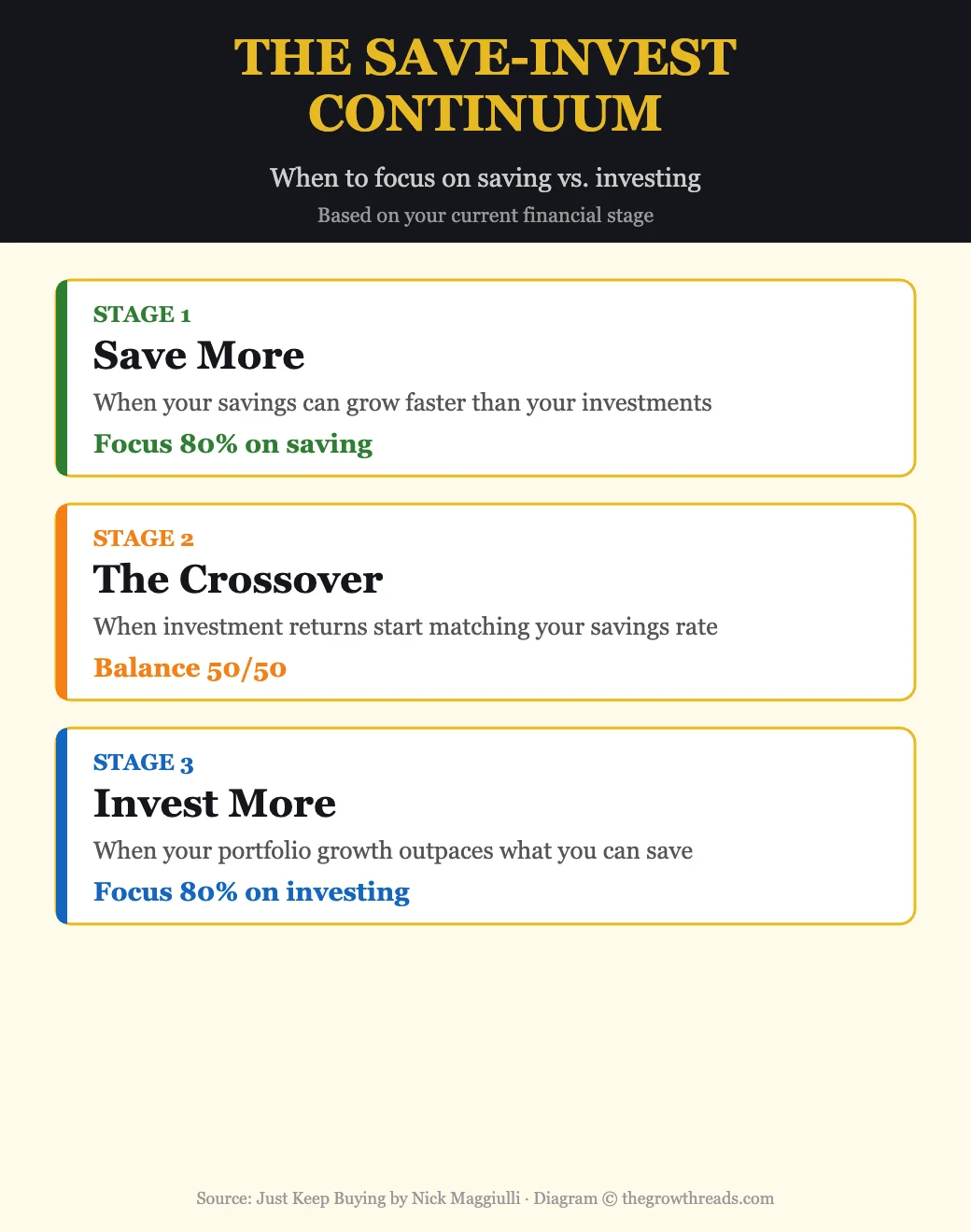
Instead of savings rates, Maggiulli introduces the Save-Invest Continuum. Early in your career, when your investment portfolio is small, focusing on saving more (and earning more) has a dramatically larger impact than optimizing your portfolio allocation. A 10% return on a $5,000 portfolio is $500 — but an extra $500 per month of savings adds $6,000 per year. The math is clear: when your human capital dwarfs your financial capital, income growth is your most powerful lever.
He also makes a case for spending money without guilt. The popular narrative that every latte is stealing your retirement is not just wrong — it’s counterproductive. People who feel guilty about spending tend to swing between extreme frugality and emotional overspending. Maggiulli’s alternative: the 2x Rule. When you want to splurge on something discretionary, invest the same amount. This creates a natural balance between enjoyment today and security tomorrow, without the emotional baggage.
Part 2: Why you should invest now (the data is overwhelming)
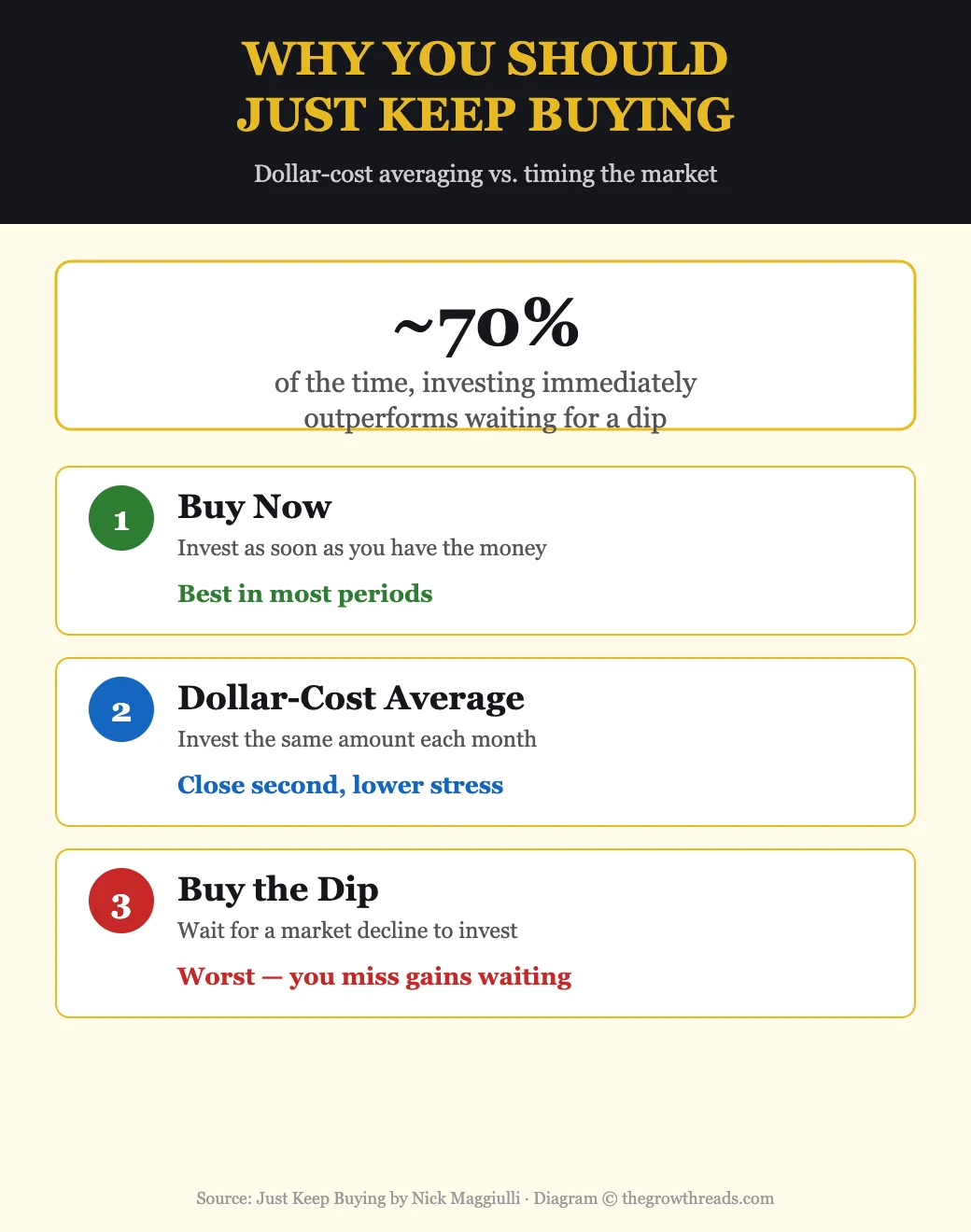
The heart of the book is a demolition of market timing. Maggiulli analyzed decades of S&P 500 data and found that investing a lump sum immediately outperformed dollar-cost averaging about two-thirds of the time, and outperformed “buying the dip” (waiting for a 10%+ decline) even more often. The reason is straightforward: markets go up more than they go down. While you wait for a crash, you miss the steady gains that drive most long-term returns.
This does not mean dollar-cost averaging is bad — for most people who earn and invest their paychecks monthly, it’s the natural and highly effective default. What Maggiulli is arguing against is sitting on a pile of cash, waiting for the perfect entry point. That perfect moment is almost always “now,” because you cannot reliably predict when dips will happen, and the cost of being wrong (missing months or years of gains) far exceeds the benefit of being right.
He addresses the psychological objection head-on: what about someone who invested right before a crash? Even those who bought at the absolute worst moments — the peak before the 2008 financial crisis, the dot-com bubble, Black Monday — were in positive territory within a few years if they simply held. The pain of buying at a peak is temporary; the cost of not investing at all is permanent.
Part 3: What to buy and how to think about risk
Maggiulli advocates for a portfolio built around income-producing assets: broad-market index funds (primarily U.S. and international stocks), bonds, and, for those who want it, real estate. He is not a stock picker and openly argues that most individual investors who try to pick stocks will underperform the market after fees and taxes. The data on active fund managers confirms this: roughly 80-90% of them fail to beat their benchmark over 15-year periods.
His asset allocation advice is simple but nuanced. Young investors should tilt heavily toward equities because they have decades to ride out volatility. As you approach retirement, gradually shifting toward bonds reduces the risk that a crash devastates your portfolio right when you need to start withdrawing. But he emphasizes that any reasonable allocation you can stick with is better than a theoretically optimal one you will abandon during a downturn.
On real estate, Maggiulli is balanced. Owning a home can be a good investment under the right conditions — primarily when you plan to stay for at least five years and the cost of ownership is roughly comparable to renting. But he pushes back hard against the “renting is throwing money away” myth, showing that in many high-cost cities, renters who invest the difference actually come out ahead. The right answer depends on local markets, your career mobility, and your personal preferences.
He also devotes a chapter to the question of when to sell. His rules are deliberately conservative: sell to rebalance, sell to exit a concentrated position, or sell when you genuinely need the money. Never sell because of headlines, fear, or a prediction that the market is “due for a correction.” The historical cost of panic selling — missing just the ten best market days in a decade — is devastating to long-term returns.
Part 4: The psychology of enough
The final section of the book moves beyond spreadsheets into something more philosophical: knowing when you have enough. Maggiulli argues that the personal finance community’s relentless focus on accumulation misses the point. Money is a tool for living well, not a score to maximize. Once your basic financial security is in place — an emergency fund, consistent investing, adequate insurance — the marginal value of each additional dollar saved diminishes rapidly compared to the experiences and comfort that dollar could buy.
He introduces the concept of the fulfillment curve, borrowed loosely from Vicki Robin’s Your Money or Your Life but updated with modern data. Below a certain income threshold, more money dramatically improves life satisfaction. Above it, the gains flatten. The exact number varies by location and family size, but the principle is universal: there is a point where optimizing for more money produces less happiness than optimizing for more time, better relationships, or meaningful work.
Maggiulli also tackles the FIRE (Financial Independence, Retire Early) movement with characteristic data-driven pragmatism. He respects the goal but questions the extreme frugality some FIRE adherents practice. Living on 30% of your income for 15 years to retire at 40 only makes sense if the sacrifice during those 15 years is worth it — and for many people, the research suggests it is not. A more moderate approach — saving and investing consistently while also enjoying your life along the way — tends to produce better outcomes for both wealth and wellbeing.
Who is Just Keep Buying best for — and who should read something else first?
This book is ideal for people in their twenties and thirties who earn a decent income but feel paralyzed about investing. If you keep meaning to open a brokerage account but aren’t sure if now is the right time, this is your book. It’s also excellent for data-minded readers who are tired of personal finance books built on anecdotes and motivational slogans — Maggiulli backs nearly every claim with historical analysis.
If you’re looking for a deep dive on specific investment vehicles or portfolio construction, you’ll want something more technical like A Random Walk Down Wall Street. And if you’re still in debt and need a step-by-step plan to get to zero before you invest, The Total Money Makeover is a better starting point.
Questions to reflect on
- Am I currently at the “save more” or “invest more” stage of the continuum — and am I allocating my energy accordingly?
- How much of my financial anxiety comes from trying to time the market rather than simply investing consistently?
- What would change in my daily life if I adopted the 2x Rule for discretionary spending?
- Have I been sitting on cash waiting for a dip — and what has that inaction already cost me in missed returns?
- Where am I on the fulfillment curve? Am I still in the zone where earning more meaningfully improves my life, or have I already crossed the threshold?
🔥 Ready to stop overthinking and start building wealth?
Maggiulli’s data-driven approach makes investing simple, guilt-free, and effective.
How to apply Just Keep Buying (7-day plan)
- Day 1 — Assess your stage: Calculate your net savings rate and your current portfolio size. Determine whether you are at the “save more” or “invest more” stage of the continuum.
- Day 2 — Automate one investment: Set up an automatic monthly transfer from your bank account to a low-cost index fund (e.g., a total stock market ETF). Start with whatever amount you can commit to.
- Day 3 — Kill the cash pile: If you have money sitting in a savings account beyond your emergency fund, invest at least half of it today. Remember: time in the market beats timing the market.
- Day 4 — Apply the 2x Rule: Identify one discretionary purchase you’ve been wanting. Buy it, then invest the same amount. Notice how guilt-free the purchase feels.
- Day 5 — Audit your portfolio: Check whether you hold individual stocks that make up more than 10% of your portfolio. If so, plan to gradually shift toward diversified index funds.
- Day 6 — Build your income plan: List three concrete actions you could take in the next 90 days to increase your income — negotiating a raise, freelancing, upgrading a skill. Pick one and schedule the first step.
- Day 7 — Define your “enough”: Write down the annual income and net worth at which you would feel genuinely secure and satisfied. Compare it to where you are now, and use the gap to calibrate your savings and investing intensity.
Frequently asked questions
Is Just Keep Buying worth reading if I already invest regularly?
Yes. While the core message is aimed at beginners, the data analysis on topics like lump-sum investing versus dollar-cost averaging, when to sell, and how to think about real estate provides fresh insights even for experienced investors. The book’s strength is replacing assumptions with evidence — and even seasoned investors carry assumptions they have never tested against data. The chapters on the fulfillment curve and knowing when you have enough are particularly valuable for people who have the investing habit but lack a clear endpoint.
What does Maggiulli recommend investing in specifically?
Maggiulli recommends building a portfolio of income-producing assets, primarily broad-market index funds covering U.S. and international stocks, supplemented by bonds as you approach retirement. He is agnostic about specific fund providers but implicitly favors low-cost options like those from Vanguard, Fidelity, or Schwab. He does not recommend actively managed funds or cryptocurrency as core holdings, though he acknowledges that a small allocation to speculative assets (under 10%) is acceptable if it keeps you engaged and prevents you from gambling with your main portfolio.
How is Just Keep Buying different from The Psychology of Money?
Both books argue that behavior matters more than brilliance in investing, but they approach the topic from opposite angles. Morgan Housel’s The Psychology of Money is built on stories and philosophical insights about how emotions drive financial decisions. Maggiulli’s book is built on data — he runs the numbers on every claim and shows you the historical evidence. If Housel changes how you feel about money, Maggiulli changes what you know about money. The two books complement each other perfectly and are best read as a pair.
What is the 2x Rule and how does it work?
The 2x Rule is Maggiulli’s framework for guilt-free spending. Whenever you make a discretionary purchase — say a $200 pair of shoes — you invest the same amount ($200) into your portfolio. This achieves two things: it guarantees that your wealth keeps growing even as you enjoy life, and it removes the psychological guilt that often accompanies spending. If you cannot afford to invest 2x, it is a signal that the purchase may be more than you should be spending at your current income level. The rule is simple, self-correcting, and avoids the all-or-nothing mentality that plagues most savings advice.
Does Maggiulli think buying a house is a good investment?
It depends. Maggiulli presents data showing that homeownership can be a wealth-building tool under the right conditions: you plan to stay at least five years, your all-in ownership costs are comparable to rent, and you are not stretching your budget to buy. In many expensive cities, renting and investing the difference produces equivalent or better returns. He does not moralize about the decision — he simply argues you should run the numbers for your specific market rather than defaulting to the cultural assumption that buying is always better. The emotional value of ownership is real, but it should not be confused with financial value.
Should I invest a lump sum or dollar-cost average into the market?
If you have a lump sum available right now, the data says invest it immediately. Maggiulli’s analysis of historical U.S. stock market data shows that lump-sum investing outperforms dollar-cost averaging roughly two-thirds of the time, because markets tend to go up over time and waiting means missing those gains. However, if investing it all at once causes you genuine anxiety that might lead to panic selling during a downturn, then dollar-cost averaging over three to six months is a reasonable compromise. The best strategy is the one you can actually execute without losing sleep.
What does Maggiulli think about the FIRE movement?
Maggiulli respects the financial discipline behind FIRE but questions the extreme frugality some practitioners adopt. His data-driven concern is that aggressively saving 50-70% of your income for 10-15 years often means sacrificing experiences and quality of life during your prime years — a trade-off the research on happiness and aging suggests may not be worth it. He advocates a more moderate path: save and invest consistently, grow your income, and enjoy your life along the way. Financial independence is a worthy goal, but the “retire early” part should be scrutinized carefully against what you would actually do with those decades of non-working life.
Related summaries
- The Psychology of Money by Morgan Housel — the emotional companion to Maggiulli’s data-driven approach.
- The Simple Path to Wealth by JL Collins — a similarly minimalist investing philosophy with even simpler portfolio advice.
- Die With Zero by Bill Perkins — takes the “know when enough is enough” idea to its logical extreme.
- Best Money Books — our complete ranked guide to personal finance reading.