

★★★★☆ 4.2/5 — A no-nonsense, step-by-step plan for getting out of debt and building wealth without gimmicks.
Best for: Anyone drowning in consumer debt, people who know what they should do with money but cannot seem to do it, and households ready to get on the same financial page.
Reading time: ~5 hours (this summary: 18 min)
Difficulty to apply: Medium — the steps are brutally simple; the discipline required to follow them is the hard part.
Not financial advice.
The Total Money Makeover in One Minute
Personal finance is not a math problem — it is a behavior problem, and the solution is a simple seven-step plan that anyone can follow regardless of income. Dave Ramsey, who went from millionaire to bankrupt and back again, argues that debt is the single biggest obstacle to wealth and that eliminating it requires intensity, sacrifice, and a willingness to be “weird” in a culture that normalizes borrowing. His Baby Steps — from a $1,000 emergency fund to debt-free living to building serious wealth — have helped millions of families transform their finances by focusing on behavior change rather than financial sophistication.
Key Takeaways
- Personal finance is 80% behavior, 20% head knowledge: Knowing what to do is not the problem. Doing it — consistently, when it is uncomfortable — is the problem.
- Debt is not a tool: Ramsey rejects the conventional wisdom that “good debt” exists. All debt is risk, and eliminating it is the fastest path to financial security.
- The debt snowball works because of psychology, not math: Paying off debts from smallest to largest gives you quick wins that build momentum and keep you motivated through the hard middle.
- You need a written monthly budget: Every dollar must have a name before the month begins. Without a budget, money disappears into vague spending categories.
- An emergency fund prevents debt relapse: A $1,000 starter fund handles small emergencies; 3-6 months of expenses handles the big ones — and keeps you from reaching for a credit card.
- Gazelle intensity is required: Half-measures produce half-results. Ramsey advocates attacking debt with the desperation of a gazelle being chased by a cheetah.
- Investing is simple when you are out of debt: Fifteen percent of household income into growth stock mutual funds consistently over decades builds serious wealth through compound interest.
- The paid-off home mortgage is the new status symbol: Ramsey considers paying off your home the ultimate financial milestone — eliminating your largest monthly expense frees massive cash flow.
- Both spouses must be on the same page: Money fights are the number one cause of divorce. The budget meeting is not optional — it is the foundation of a financially healthy marriage.
- Building wealth is a marathon, not a sprint: There are no shortcuts. The Baby Steps work because they are boring, repeatable, and rely on discipline rather than luck.
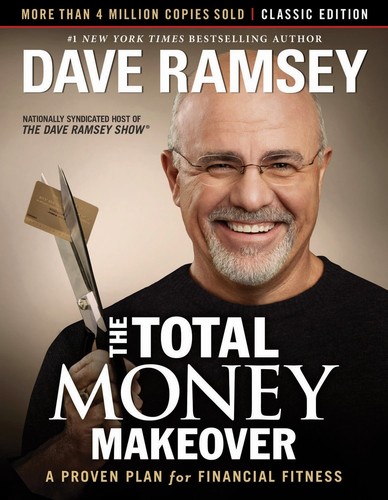
What Is The Total Money Makeover About?
The Total Money Makeover presents Dave Ramsey’s seven-step plan (the “Baby Steps”) for eliminating debt, building an emergency fund, investing for retirement, and ultimately achieving financial freedom. Drawing on his own bankruptcy experience and decades of coaching families through financial crises on his radio show, Ramsey argues that financial transformation is primarily a behavior change, not a knowledge problem.
About the Author
Dave Ramsey built a $4 million real estate portfolio by age 26, then lost everything when banks called in his loans during a market downturn. That painful journey through bankruptcy taught him the principles he now teaches millions. He hosts The Ramsey Show, one of the most listened-to radio programs in America, and has built Ramsey Solutions into a company with over $200 million in annual revenue — all while practicing the debt-free principles he preaches. His Financial Peace University course has been taught in over 50,000 churches, and his books have collectively sold over 10 million copies. Explore all Dave Ramsey book summaries →
Key Concepts at a Glance
| Concept | What It Means | Use It When |
|---|---|---|
| Baby Steps | Seven sequential steps from $1,000 emergency fund to wealth building | You need a clear, ordered roadmap and are willing to follow it exactly |
| Debt Snowball | Pay minimum on everything, throw all extra at the smallest debt first | You have multiple debts and need motivational wins to keep going |
| Gazelle Intensity | Extreme focus and sacrifice to eliminate debt as fast as possible | You are tired of living paycheck to paycheck and ready for radical change |
| Zero-Based Budget | Every dollar of income is assigned a specific purpose before the month starts | Money seems to vanish and you cannot explain where it went |
| Emergency Fund | Cash reserve that prevents debt relapse during unexpected expenses | A car repair or medical bill would normally go on a credit card |
| Sinking Funds | Saving monthly for known upcoming expenses (insurance, holidays, repairs) | Predictable expenses keep surprising you because you did not plan for them |
| Money Myths | Cultural lies about debt being normal, necessary, or beneficial | Someone tells you a car payment or credit score is essential |
Part 1: Destroying the Money Myths
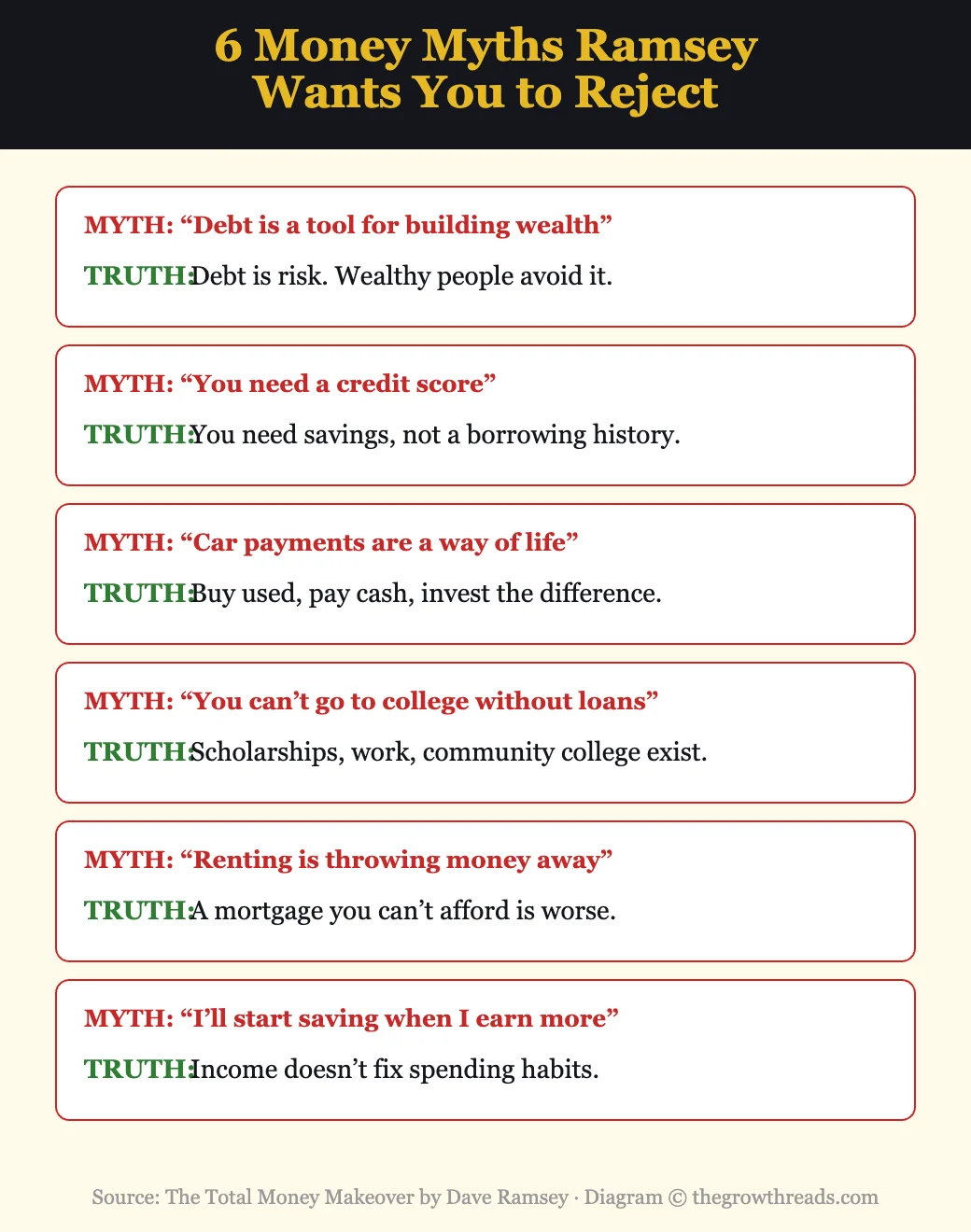
Ramsey opens not with advice but with demolition. Before he can teach you what to do, he needs to dismantle what you believe — because, he argues, most of what American culture teaches about money is wrong. He calls these beliefs “money myths” and attacks each with the enthusiasm of a man who lost everything by believing them.
The first myth is that debt is a useful tool. Banks, car dealers, and even financial advisors promote “leverage” as sophisticated wealth-building. Ramsey counters with data: no Forbes 400 billionaire cited debt leverage as a key factor in their wealth. Instead, they cited hard work, frugality, and risk management. The second myth is that you need a credit score. Ramsey argues that a credit score is simply a measure of how well you manage debt — and if you have no debt, you do not need one. He personally has no credit score and has never been unable to rent, travel, or obtain insurance.
Other myths he tackles: car payments are a way of life (the average car payment in America is over $700/month — invested from age 25 to 65 in growth stock mutual funds, that becomes over $5 million), 30-year mortgages are wise because of tax deductions (you spend $10,000 in interest to save $2,500 in taxes), and “I deserve it” spending is harmless (it is the exact rationalization that keeps millions in perpetual debt). Each myth is paired with real stories from his radio show — families who broke through by rejecting the conventional wisdom.
Part 2: The Baby Steps — A Proven Roadmap
The heart of the book is the seven Baby Steps — a sequential, non-negotiable plan that Ramsey has refined over decades of coaching. The sequence matters: you do not skip ahead, and you do not try to do multiple steps simultaneously (with the exception of Steps 4, 5, and 6, which run in parallel once you reach them).
Baby Step 1: Save $1,000 as a starter emergency fund. This is your financial buffer against life’s small emergencies — a flat tire, a broken appliance, a minor medical bill. Ramsey insists this be done fast — sell things, work overtime, do whatever it takes to get $1,000 in cash set aside within weeks, not months. The psychological purpose is equally important: it breaks the cycle of using credit cards as an emergency fund.
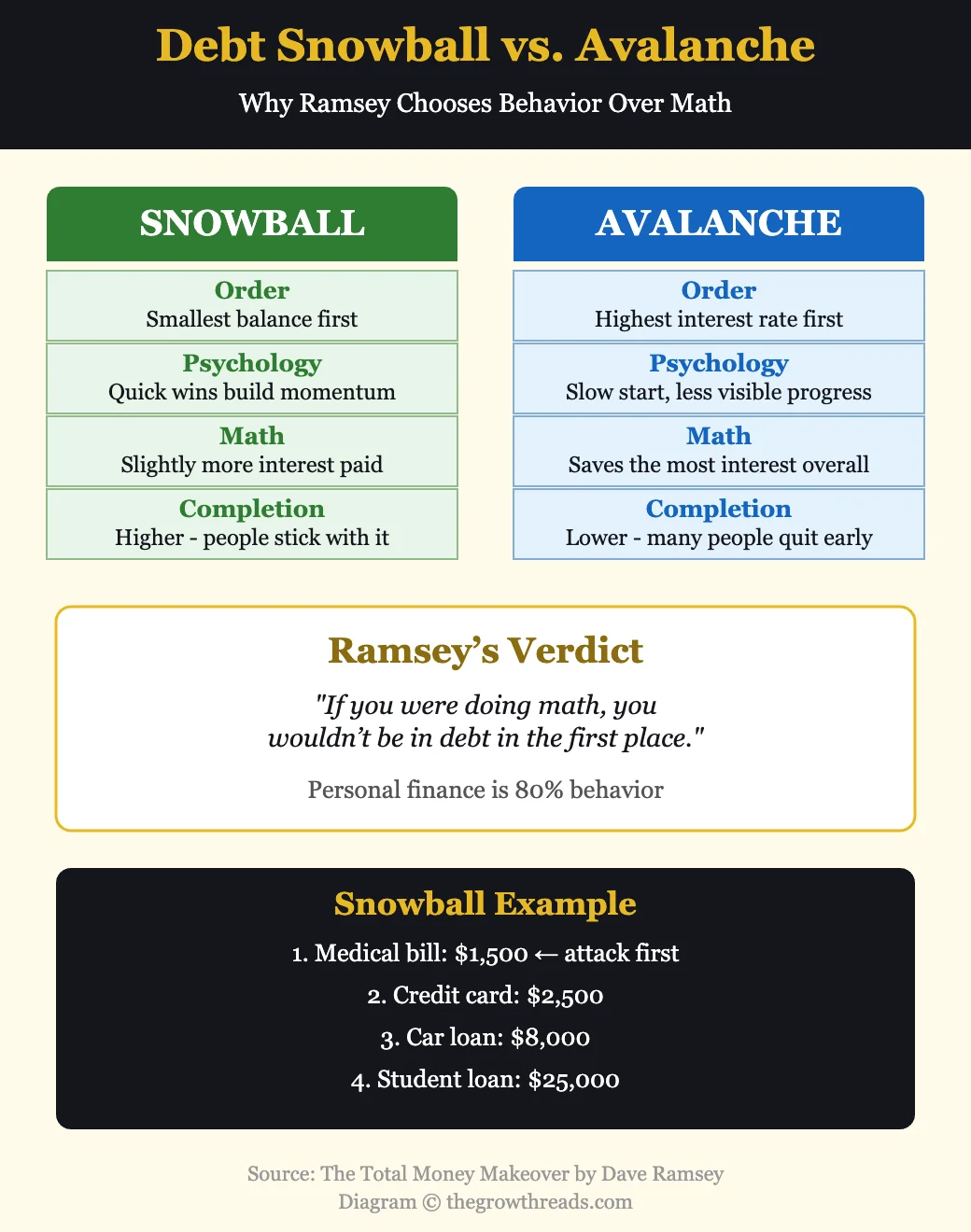
Baby Step 2: The Debt Snowball. List every non-mortgage debt from smallest balance to largest. Pay the minimum on everything except the smallest debt, which gets every extra dollar you can scrape together. When that debt is paid off, roll its payment into the next smallest. The snowball grows with each eliminated debt. Ramsey acknowledges that the “debt avalanche” (paying highest interest rate first) saves more in interest — but he does not care. “If you were doing math,” he says, “you wouldn’t be in debt in the first place.” The snowball works because quick wins create emotional momentum.
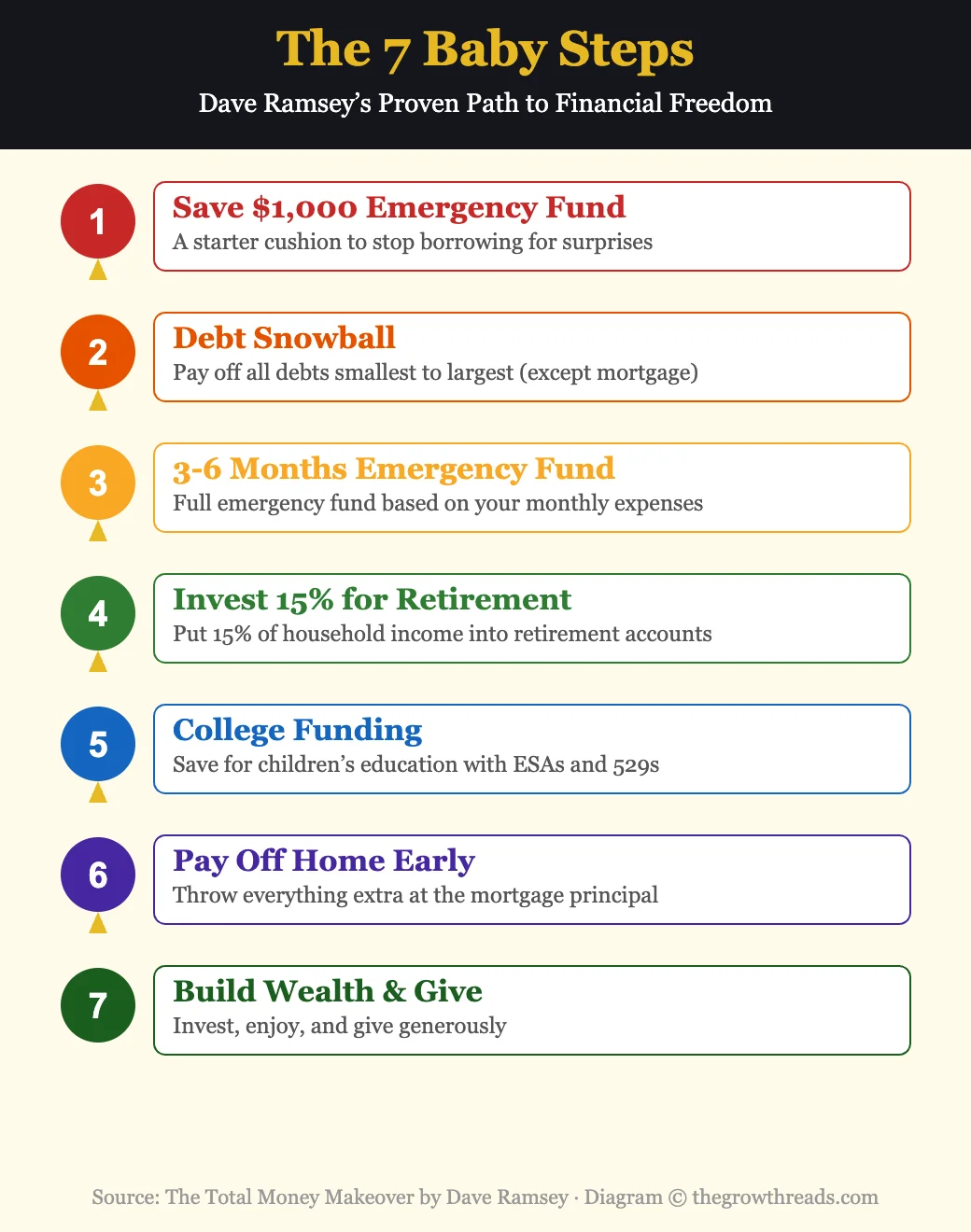
Baby Step 3: Build a full emergency fund of 3-6 months of expenses. Once all non-mortgage debt is gone, bulk up the emergency fund. Single-income households or those with variable income should aim for six months; stable dual-income households can target three. This fund is insurance, not an investment — keep it in a high-yield savings account where it is boring and accessible.
Part 3: Investing, College, and the Paid-Off Home
Baby Step 4: Invest 15% of household income into retirement. Ramsey recommends spreading contributions across a workplace 401(k) (up to the employer match) and Roth IRAs, investing in growth stock mutual funds with long track records. He adamantly opposes whole life insurance, annuities, and single-stock picking. His reasoning is simple: the S&P 500 has averaged roughly 10-12% annual returns over its history, and you do not need to beat the market — you need to consistently participate in it over decades.
Baby Step 5: Save for children’s college. Ramsey advocates Education Savings Accounts (ESAs) and 529 plans, funded with the same growth stock mutual funds. He is blunt about student loans: they are unnecessary for most families willing to use scholarships, part-time work, community college for the first two years, and state schools. He presents case after case of families who put children through college debt-free using creativity rather than borrowing.
Baby Step 6: Pay off the home mortgage early. With no consumer debt, a full emergency fund, 15% going to retirement, and college savings in place, every extra dollar attacks the mortgage. Ramsey shares stories of families who paid off 30-year mortgages in 7-10 years by maintaining the intensity of Baby Step 2. The math is powerful: eliminating a $1,500/month mortgage frees $18,000 per year — money that can be invested, given, or used to fund an early retirement.
Baby Step 7: Build wealth and give generously. With no payments in the world — not even a mortgage — your entire income is available for wealth building and generosity. Ramsey argues that this is not just a financial milestone but a spiritual and psychological one: the freedom from debt changes how you think about work, risk, and purpose.
Part 4: The Budgeting System and Staying the Course
Ramsey devotes an entire section to the zero-based budget — the tactical engine that powers every Baby Step. The concept is simple: before each month begins, write down every dollar of expected income and assign it a specific category (housing, food, transportation, debt payments, savings) until the balance hits zero. Every dollar has a job.
He recommends the “envelope system” for categories where overspending is common (groceries, dining, entertainment, clothing): withdraw the budgeted amount in cash, put it in labeled envelopes, and when the envelope is empty, stop spending in that category until next month. The physical pain of handing over cash, he argues, is a more effective governor than the abstract swipe of a card.
The final chapters address the social and emotional challenges of the makeover. Ramsey is candid: your family will think you are crazy, your friends will pressure you to spend, and your own psychology will create what he calls “Stupid Tax” — expensive mistakes driven by impatience or peer pressure. His solution is community: Financial Peace University classes, accountability partners, and the daily motivation of his radio show. The Total Money Makeover is not a solo endeavor — it works best when you surround yourself with people who share your values.
Who Is The Total Money Makeover Best For — and Who Should Read Something Else First?
This book is ideal for anyone currently in consumer debt (credit cards, car loans, student loans) who needs a clear, step-by-step plan rather than theory. It works especially well for couples who fight about money, because the shared framework gives both partners a common language and a shared goal. It is also excellent for young adults just starting their financial lives who want to avoid debt entirely.
If you are already debt-free and looking for more sophisticated investing strategies, The Intelligent Investor goes deeper into portfolio theory. If Ramsey’s tone feels too rigid (he is famously anti-credit-card and anti-all-debt), I Will Teach You to Be Rich offers a more flexible approach that still builds wealth. And if your challenge is more psychological — understanding why you overspend — The Psychology of Money provides the behavioral science foundation.
Questions to Reflect On
- If you listed every debt you owe from smallest to largest, which one could you realistically pay off within 30 days with focused intensity? What would it feel like to cross it off?
- How much of your current spending is driven by “I deserve it” thinking rather than alignment with your actual financial goals?
- Do you and your partner (if applicable) agree on financial priorities? When was the last time you sat down together and created a written budget?
- Which money myth from the book have you been living by? What would change if you rejected it starting today?
- If you had zero debt — no car payments, no student loans, no credit cards, no mortgage — what would you do with your income? How does that vision motivate you?
🔥 Ready to take control of your money?
The Total Money Makeover gives you a proven 7-step plan to eliminate debt and build lasting wealth.
How to Apply The Total Money Makeover (7-Day Plan)
- Day 1 — Face the numbers: Write down every debt you owe: creditor, total balance, minimum payment, and interest rate. Sort them from smallest balance to largest. Calculate your total debt. This is your starting line.
- Day 2 — Create a zero-based budget: List every dollar of expected income for next month. Assign every dollar to a category (housing, utilities, food, transportation, debt payments, savings) until you reach zero. If expenses exceed income, cut until they do not.
- Day 3 — Build your starter emergency fund: Identify items you can sell (electronics, furniture, clothes, extra vehicles). List them online today. Set a goal to reach $1,000 within two weeks. Cancel subscriptions you do not actively use.
- Day 4 — Set up the envelope system: Choose 3-4 categories where you tend to overspend (dining, groceries, entertainment). Withdraw that budget amount in cash, label your envelopes, and commit to spending only what is in the envelope.
- Day 5 — Make your first extra debt payment: Using your budget, identify every extra dollar available this month and apply it to your smallest debt. Even $50 extra starts the snowball rolling.
- Day 6 — Have the money talk: If you have a partner, sit down for a 30-minute budget meeting. Review the budget together, agree on priorities, and commit to weekly 15-minute check-ins for the next month.
- Day 7 — Find your community: Join a Financial Peace University class, find a Ramsey accountability partner, or start following debt-free journeys on social media. Tell one trusted person about your goal — accountability dramatically increases follow-through.
Frequently Asked Questions
What are the 7 Baby Steps?
The 7 Baby Steps are: (1) Save $1,000 as a starter emergency fund, (2) Pay off all non-mortgage debt using the debt snowball, (3) Build a full emergency fund of 3-6 months of expenses, (4) Invest 15% of household income for retirement, (5) Save for children’s college, (6) Pay off your home mortgage early, and (7) Build wealth and give generously. The steps are sequential — you do not advance to the next one until the current step is complete, except Steps 4-6 which run simultaneously.
What is the debt snowball method?
The debt snowball is a debt repayment strategy where you list all non-mortgage debts from smallest balance to largest, pay the minimum on everything except the smallest, and throw every extra dollar at that smallest debt until it is gone. Then you roll that payment into the next smallest debt. The snowball grows larger with each debt eliminated. Ramsey favors this over the mathematically optimal “avalanche” method (highest interest first) because the quick psychological wins keep people motivated through what is often a multi-year process.
What is a zero-based budget?
A zero-based budget means that every dollar of income is assigned a specific purpose before the month begins — income minus all assigned categories equals exactly zero. This does not mean you spend everything; savings and investments are categories too. The purpose is to eliminate the vague “leftover” money that typically gets spent unconsciously. Ramsey recommends doing this budget on paper or in his EveryDollar app at the end of each month for the upcoming month.
Does Dave Ramsey recommend using credit cards at all?
No. Ramsey is famously and absolutely opposed to credit card use in any form, including rewards cards. His argument is behavioral: studies show people spend 12-18% more when paying with cards versus cash, which wipes out any rewards benefit. He also argues that credit cards keep you psychologically connected to the borrowing system. This is his most controversial position — many financial experts disagree, noting that responsible credit card use with full monthly payoff can be beneficial — but Ramsey maintains that for the vast majority of people, the behavioral risks outweigh the mathematical benefits.
How long does it take to complete the Baby Steps?
Baby Step 1 should take 1-4 weeks with focused effort. Baby Step 2 (the debt snowball) typically takes 18-24 months for the average family, though Ramsey has seen it done in as little as 6 months and as long as 7 years depending on total debt. Baby Step 3 takes 3-6 months after becoming debt-free. Steps 4-6 run simultaneously and can take 10-20 years. Step 7 is a permanent lifestyle. Most families report feeling a dramatic shift in financial stress within the first 90 days of starting the plan.
Is The Total Money Makeover still relevant?
The core principles — spend less than you earn, eliminate debt, save consistently, invest for the long term — are timeless. Some specific numbers (the $1,000 emergency fund, for example) have been criticized as too low given inflation since the book was written, and Ramsey has adjusted some recommendations on his show. The investing advice (growth stock mutual funds) is simplified but sound for most beginners. The book remains one of the most effective starting points for anyone who needs a behavioral reset more than a financial education.
What should I read after The Total Money Makeover?
For the psychology behind your money habits, read The Psychology of Money by Morgan Housel — it explains why smart people make dumb financial decisions. For a more flexible approach to budgeting and lifestyle design, try I Will Teach You to Be Rich by Ramit Sethi. For deeper investing knowledge once you are out of debt, The Intelligent Investor by Benjamin Graham is the classic. And for building wealth through entrepreneurship rather than frugality alone, Rich Dad Poor Dad by Robert Kiyosaki offers a complementary perspective on assets and cash flow.
Related Summaries
- The Psychology of Money Summary — Why financial success is about behavior, not intelligence
- I Will Teach You to Be Rich Summary — Automate your finances and spend guilt-free
- The Intelligent Investor Summary — Value investing principles for long-term wealth
- Best Money Books — Our complete guide to the top books on personal finance and investing
How we analyze books: We read every book cover to cover, cross-reference key claims with peer-reviewed research, and distill the most actionable ideas into frameworks you can apply immediately. Our infographics are original, and our 7-day plans are designed for real-world implementation. Read our full methodology.