

★★★★☆ 4.3 / 5 — A comprehensive, evidence-based case for using whole-food, plant-based nutrition to prevent and reverse the diseases that kill most people.
Best for: Anyone concerned about heart disease, cancer, diabetes, or longevity. Health-conscious readers who want the science behind nutrition claims, not just opinions.
Reading time: ~10 hours (576 pages) · This summary: 18 min
Difficulty to apply: Medium — the Daily Dozen checklist makes daily practice simple, but fully adopting a plant-based diet requires lifestyle commitment.
How Not to Die in one minute
The leading causes of death in the developed world are largely preventable through diet — and the evidence overwhelmingly points to plants. Dr. Michael Greger, a physician and internationally recognized nutrition expert, systematically reviews the peer-reviewed research on each of the top 15 causes of death and shows how specific foods can prevent, arrest, and in many cases reverse these diseases. The book is divided into two parts: the first examines each killer disease and its dietary antidote, the second provides a practical framework — the Daily Dozen checklist — for incorporating protective foods into everyday life. It is the most thoroughly cited nutrition book most readers will ever encounter, with over a thousand scientific references.
Key takeaways
- Most premature death is preventable: The top 15 causes of death are driven primarily by lifestyle factors, not genetics — and diet is the single most powerful lever.
- The Daily Dozen is your roadmap: Greger distills optimal nutrition into 12 categories of foods and activities to check off every day, making the science actionable.
- Heart disease is a food-borne illness: Populations that eat plant-based diets have virtually no heart disease. Existing arterial plaque can be reversed with dietary changes alone.
- Whole grains reduce all-cause mortality: Each daily serving of whole grains is associated with a significant reduction in the risk of heart disease, diabetes, and cancer.
- Berries are nutritional superstars: Their anthocyanins and antioxidants have been shown to improve brain function, reduce cancer risk, and lower blood pressure.
- Flaxseeds are the most underrated food: One tablespoon daily has been shown in clinical trials to lower blood pressure as effectively as some medications.
- Turmeric fights inflammation at the molecular level: Curcumin has demonstrated anti-cancer, anti-inflammatory, and neuroprotective properties across hundreds of studies.
- Exercise is part of the prescription: Greger includes 90 minutes of moderate activity (or 40 minutes vigorous) in the Daily Dozen — movement is medicine.
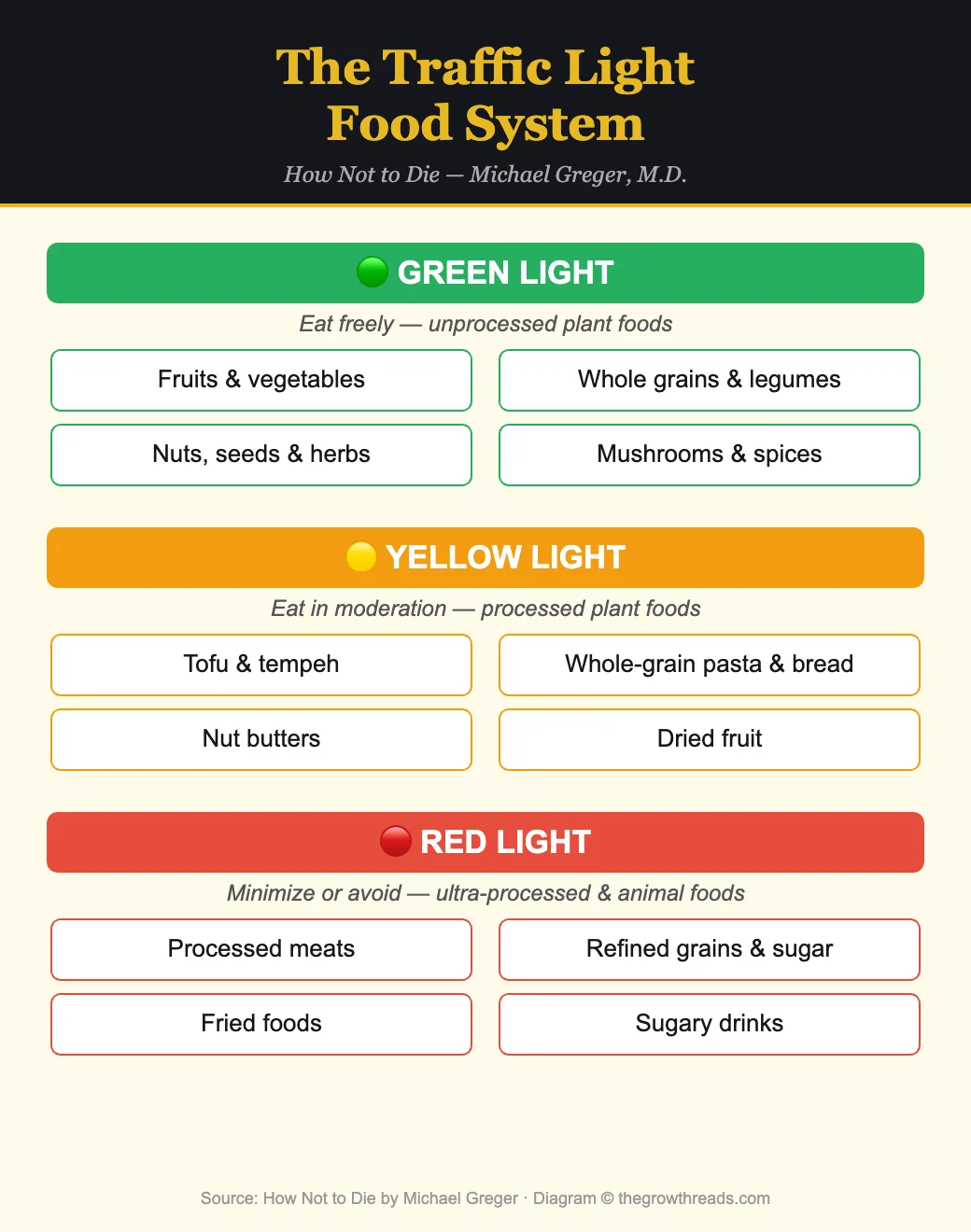
- The traffic light system simplifies choices: Green-light foods (unprocessed plants) can be eaten freely; yellow-light foods (processed plants) in moderation; red-light foods (ultra-processed and animal products) should be minimized.
- Industry-funded studies distort the evidence: Greger shows how food-industry research consistently produces results favorable to their products, and teaches readers to evaluate nutrition claims critically.
What is How Not to Die about?
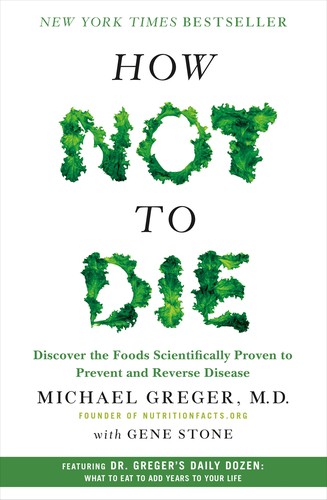
How Not to Die examines the top 15 causes of premature death — including heart disease, cancers, diabetes, and Alzheimer’s — and presents peer-reviewed evidence showing that each can be prevented, halted, or reversed through whole-food, plant-based nutrition. The second half provides a practical Daily Dozen checklist for daily implementation.
About the author
Dr. Michael Greger is a physician, New York Times bestselling author, and the founder of NutritionFacts.org, a nonprofit that provides free daily videos and articles on the latest nutrition research. He is a Fellow of the American College of Lifestyle Medicine and has testified before Congress on public health issues. Greger’s interest in nutrition was sparked by watching his grandmother recover from end-stage heart disease using Dean Ornish’s plant-based dietary program after she had been sent home to die. He has since dedicated his career to translating peer-reviewed nutrition research into practical advice. Explore all Michael Greger book summaries →
Key concepts at a glance
| Concept | What it means | Use it when |
|---|---|---|
| The Daily Dozen | 12 categories of foods and activities to include every day for optimal health | You want a simple daily checklist instead of complicated meal plans |
| Traffic Light System | Green (unprocessed plants), yellow (processed plants), red (ultra-processed/animal) food classification | You are standing in a grocery aisle and need a quick decision framework |
| Food as Medicine | Specific foods can prevent, arrest, and reverse specific diseases at the molecular level | You have a family history of a particular disease and want dietary strategies |
| The Ornish Reversal | Dean Ornish proved that heart disease can be reversed without drugs or surgery through plant-based diet | You or someone you love has been diagnosed with cardiovascular disease |
| Anti-angiogenesis | Certain plant compounds starve tumors by cutting off their blood supply | You want to understand how diet influences cancer at the cellular level |
| Nitric Oxide | Beets and greens boost nitric oxide, which dilates blood vessels and lowers blood pressure naturally | You want a drug-free approach to blood pressure management |
| Gut Microbiome | Fiber from whole plants feeds beneficial gut bacteria that produce anti-inflammatory compounds | You have digestive issues or want to strengthen immune function |
Part 1: The diseases — how not to die from the top killers
The first half of the book is organized by disease, with each chapter examining one of the leading causes of death and the evidence for dietary prevention and reversal. Greger’s approach is distinctive: every claim is backed by specific peer-reviewed studies, and the references section runs to over 100 pages.
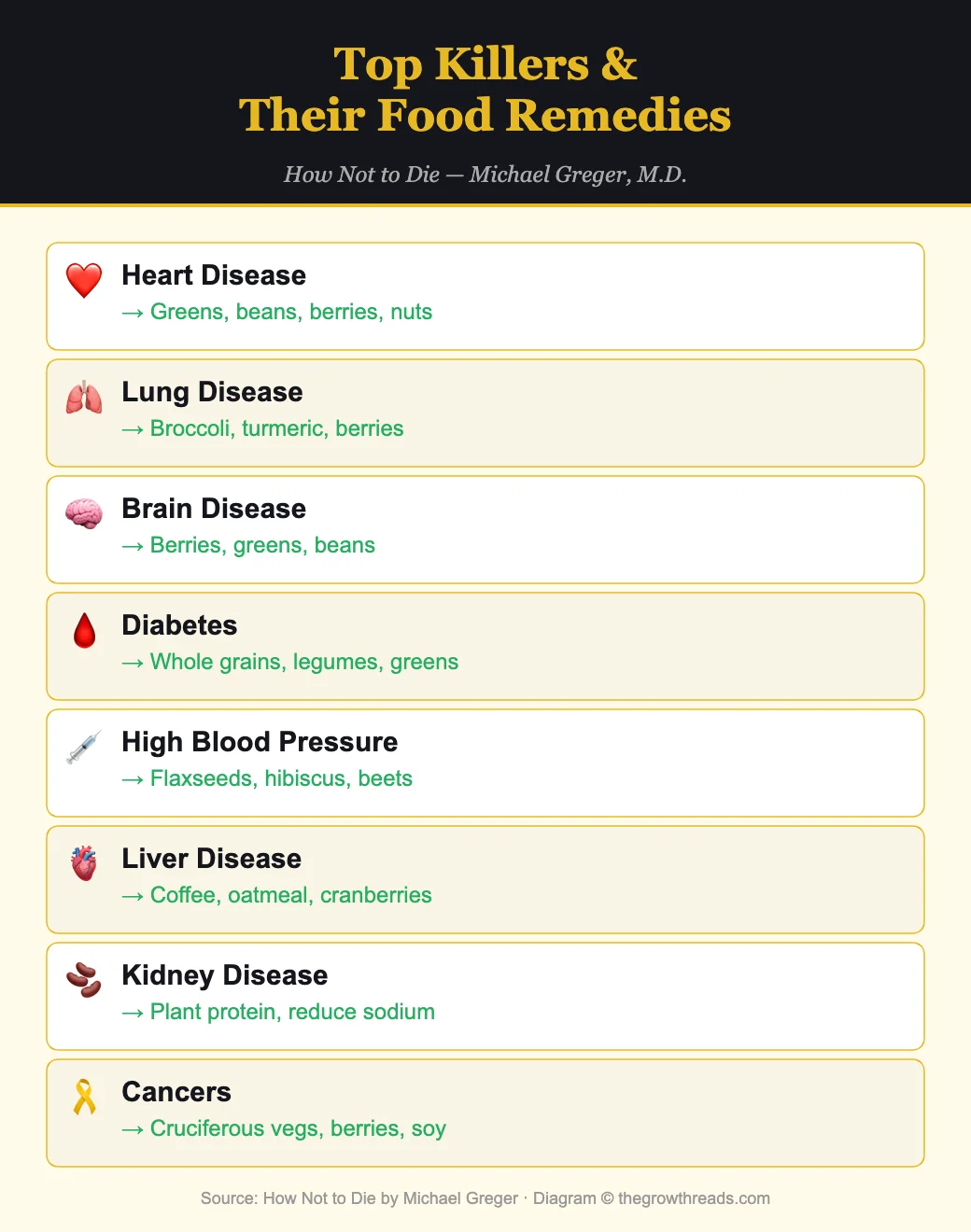
Heart disease, the number-one killer, receives the most thorough treatment. Greger traces the evidence from the Framingham Heart Study through Dean Ornish’s groundbreaking reversal trials, which showed that a plant-based diet could shrink arterial plaque without drugs or surgery. He highlights the work of Caldwell Esselstyn at the Cleveland Clinic, whose patients — many of whom had been told they were out of surgical options — saw their heart disease halt and reverse on a whole-food, plant-based diet.
The cancer chapters examine how specific plant compounds work at the molecular level. Sulforaphane in broccoli activates the body’s detoxification enzymes. Anthocyanins in berries inhibit angiogenesis — the process by which tumors recruit blood vessels to feed their growth. Soy consumption, far from being dangerous as popular myths suggest, is associated with reduced breast cancer risk and recurrence in large-scale epidemiological studies.
The diabetes chapter is particularly striking. Greger presents evidence that type 2 diabetes is caused not by sugar per se, but by intramyocellular lipid — fat buildup inside muscle cells that blocks insulin signaling. This finding reframes the conventional narrative: the problem is excess fat in the diet, not excess carbohydrates. Plant-based diets, which are naturally lower in saturated fat, have been shown to improve insulin sensitivity and in some cases eliminate the need for medication entirely.
Part 2: The Daily Dozen — building your plate for longevity
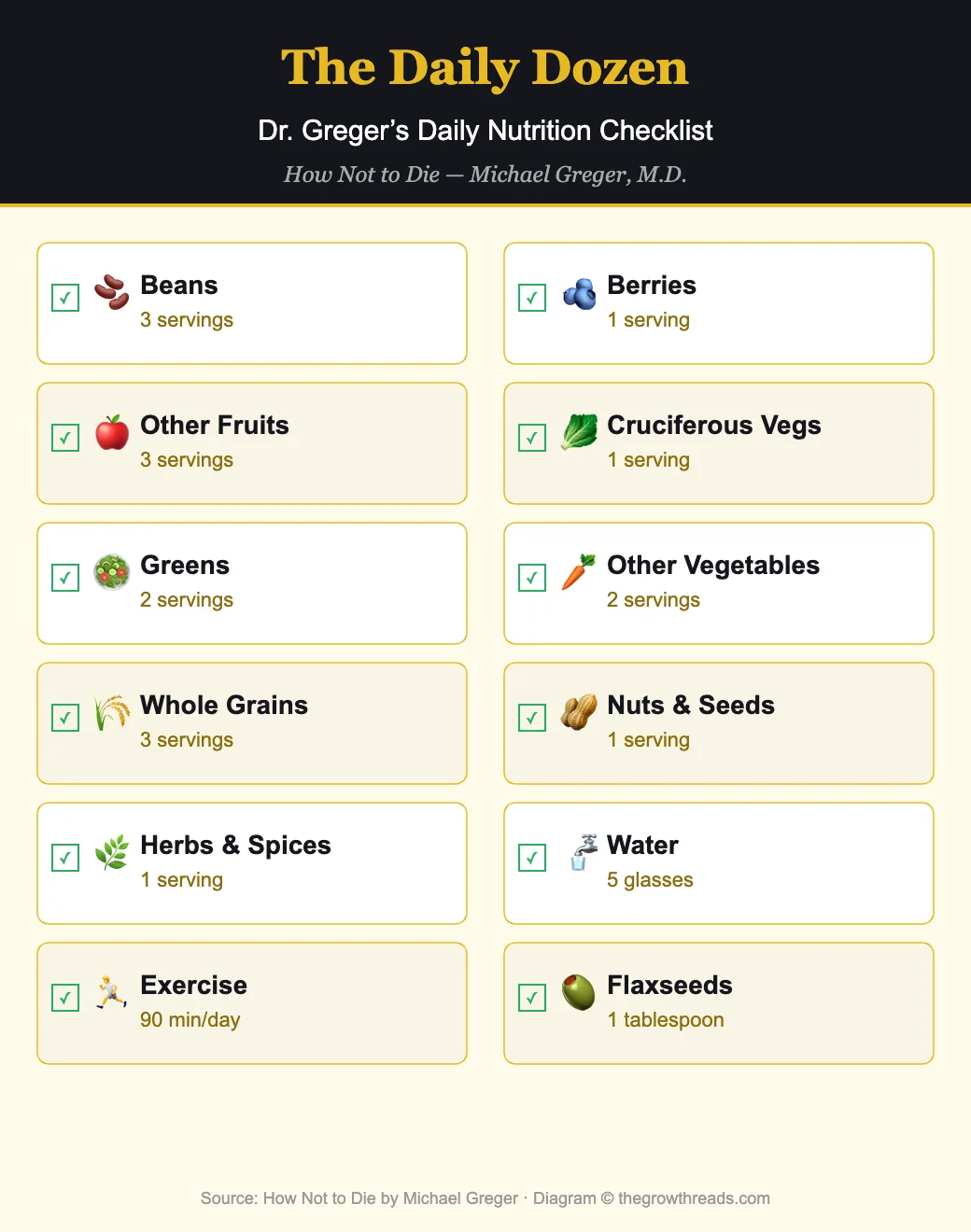
The second half transforms the science into a daily practice. Greger introduces the Daily Dozen: 12 categories of foods and activities to include every day. The categories are beans (3 servings), berries (1), other fruits (3), cruciferous vegetables (1), greens (2), other vegetables (2), flaxseeds (1 tablespoon), nuts and seeds (1 serving), herbs and spices (1), whole grains (3), water (5 glasses), and exercise (90 minutes moderate or 40 minutes vigorous).
What makes the Daily Dozen effective is its additive framing. Rather than telling people what to eliminate, Greger focuses on what to add. The psychological shift is significant: instead of deprivation, the experience is abundance. Most people find that as they add more whole plants, the less healthy foods naturally get crowded out.
Greger provides practical guidance on each category. For greens, he explains why dark leafy varieties (kale, spinach, arugula) are nutritionally superior. For berries, he shows that frozen berries retain virtually all their antioxidant content and are often more affordable. For flaxseeds, he recommends grinding them fresh (or buying pre-ground and refrigerating) because whole flaxseeds pass through the digestive system undigested.
The exercise inclusion is notable. Greger treats movement as a nutrient — something the body needs daily in specific doses, just like vitamins. His 90-minute recommendation is higher than many guidelines, but he emphasizes that it can be broken into smaller segments throughout the day and includes walking.
Part 3: The evidence hierarchy and industry influence
Throughout the book, Greger teaches readers to think critically about nutrition research. He explains the hierarchy of evidence — from case studies (weakest) through observational studies to randomized controlled trials and meta-analyses (strongest) — and shows how industry-funded studies systematically distort findings.
One compelling example involves the egg industry. Greger documents how studies funded by egg companies consistently frame results in the most favorable light — emphasizing that eggs raise “good” HDL cholesterol while downplaying the simultaneous increase in “bad” LDL cholesterol and total cholesterol. When independent researchers analyze the same data, the conclusions look very different.
He also addresses the complexity of nutrition science. Unlike drug trials, where you can give one group a pill and the other a placebo, nutrition studies face inherent challenges: people eat whole diets, not isolated nutrients, and dietary changes affect multiple biological systems simultaneously. Greger argues this is actually an advantage of the whole-food approach — unlike drugs that target one pathway, whole foods contain thousands of compounds that work synergistically.
The book’s transparency about its own bias is refreshing. Greger is upfront about his advocacy for plant-based eating and provides all his references so readers can evaluate the evidence independently. He also acknowledges areas of genuine scientific uncertainty, particularly around specific nutrient requirements like B12 (which he recommends supplementing) and omega-3 fatty acids.
Who is How Not to Die best for — and who should read something else first?
This book is ideal for anyone who wants to understand the scientific evidence behind plant-based nutrition. It is particularly valuable for people with a family history of heart disease, cancer, or diabetes, and for healthcare professionals who want a comprehensive reference on dietary prevention. The Daily Dozen checklist makes it practical even for people who do not plan to go fully plant-based.
If you are looking for a broader longevity framework that includes exercise, sleep, and emotional health alongside nutrition, Outlive by Peter Attia is the more comprehensive starting point. If your primary interest is the relationship between body, stress, and disease, The Body Keeps the Score explores how trauma manifests physically. For the Japanese approach to longevity through purpose and community, Ikigai offers a complementary perspective.
Questions to reflect on
- How many of the Daily Dozen categories did you hit yesterday? Which ones are consistently missing from your diet?
- What is your family’s medical history, and which chapters of the book speak most directly to your personal risk factors?
- When you encounter a nutrition headline, do you check who funded the study? How might industry funding have shaped the conclusions you have accepted as fact?
- If you could add just one Daily Dozen category to your routine starting today, which would give you the highest return on the smallest effort?
- What stories do you tell yourself about why a whole-food, plant-based diet would be too hard — and are those stories based on experience or assumption?
🔥 Ready to eat your way to a longer, healthier life?
How Not to Die gives you the evidence-based roadmap — one Daily Dozen checklist at a time.
How to apply How Not to Die (7-day plan)
- Day 1 — Download the Daily Dozen app. It is free. Check off whatever you already eat today — establish your baseline without changing anything.
- Day 2 — Add one tablespoon of ground flaxseed. Stir it into oatmeal, a smoothie, or yogurt. This is the single highest-impact addition Greger recommends.
- Day 3 — Eat a cup of beans. Any kind — lentils, chickpeas, black beans. Add them to a salad, soup, or rice bowl. Beans are the Daily Dozen’s most protective food group.
- Day 4 — Swap one refined grain for a whole grain. Brown rice instead of white, whole-grain bread instead of white, oats instead of a processed cereal.
- Day 5 — Add berries to breakfast. Frozen are fine — blueberries, strawberries, or mixed. Aim for one cup. Add them to cereal, a smoothie, or eat them plain.
- Day 6 — Include two servings of greens. One salad and one cooked green vegetable (spinach, kale, broccoli). Season with turmeric and black pepper for an anti-inflammatory boost.
- Day 7 — Review your week in the Daily Dozen app. Which categories are you consistently hitting? Which need work? Set a goal to add one more category next week.
Frequently asked questions
What is the main message of How Not to Die?
The central argument is that the leading causes of premature death — heart disease, cancer, diabetes, and others — are largely preventable through whole-food, plant-based nutrition. Greger reviews the evidence for each major disease and shows that specific foods can prevent, halt, and in some cases reverse these conditions. The Daily Dozen checklist provides a practical framework for daily implementation.
Is How Not to Die worth reading in 2026?
Yes. While some specific studies cited have been updated since publication, the overall body of evidence supporting plant-predominant diets for disease prevention has only grown stronger. The Daily Dozen framework remains one of the most practical tools for translating nutrition science into daily action, and Greger’s NutritionFacts.org continues to publish updated reviews of the latest research.
Do I have to go fully vegan to benefit from this book?
No. While Greger advocates for a whole-food, plant-based diet, the Daily Dozen framework works on an additive principle — the more plant foods you add, the more benefit you receive. Even people who continue eating some animal products can improve their health significantly by increasing their intake of beans, berries, greens, and whole grains. Greger himself focuses on maximizing plant foods rather than demanding perfection.
What is the Daily Dozen?
The Daily Dozen is Greger’s practical checklist of 12 categories of foods and activities to include every day: beans (3 servings), berries (1), other fruits (3), cruciferous vegetables (1), greens (2), other vegetables (2), flaxseeds (1 tablespoon), nuts and seeds (1), herbs and spices (1), whole grains (3), water (5 glasses), and exercise (90 minutes moderate). A free app is available for tracking.
Is the science in How Not to Die reliable?
Greger cites over a thousand peer-reviewed studies and provides references for every major claim. His approach is to follow the weight of evidence from meta-analyses and large cohort studies rather than relying on individual trials. He is transparent about his plant-based advocacy and encourages readers to verify claims independently. Some nutrition experts note he occasionally cherry-picks favorable studies, but the overall direction of his recommendations aligns with major health organizations’ guidance.
What supplements does Greger recommend?
Greger recommends vitamin B12 supplementation for everyone eating a predominantly plant-based diet (2,500 mcg cyanocobalamin per week or 250 mcg daily). He also suggests considering vitamin D supplementation (2,000 IU daily), especially for those in northern latitudes or with limited sun exposure. For omega-3 fatty acids, he recommends algae-based DHA/EPA supplements rather than fish oil. He emphasizes getting all other nutrients from whole foods rather than supplements.
How long does it take to read How Not to Die?
The book is approximately 576 pages, including extensive references. Most readers complete the main text in 8 to 12 hours. The audiobook runs about 17 hours and 9 minutes. Because the book is organized by disease, many readers choose to focus on the chapters most relevant to their personal health concerns first, then return to the others over time.
Related summaries
- Outlive Summary & Review — Peter Attia on the science of longevity across exercise, nutrition, sleep, and emotional health
- Breath Summary & Review — James Nestor on the lost science of breathing for health and performance
- Why We Sleep Summary & Review — Matthew Walker on sleep’s foundational role in health and disease prevention
- Ikigai Summary & Review — The Japanese secret to a long and purposeful life
- Best Health Books — Our complete ranked guide