

★★★★ 4.1/5 — a warm, gentle introduction to purpose and Japanese longevity wisdom. Light on hard science, but calming and quietly motivating.
Best for: anyone searching for purpose, or curious how the world’s longest-lived people actually live · Reading time: ~4 hours (this guide: 14 min) · Difficulty to apply: Easy — the lessons are simple and gentle
Ikigai in one minute
Ikigai is your “reason for being” — the thing that gets you out of bed each morning — and the people who have it tend to live longer, happier lives. Héctor García and Francesc Miralles blend two threads: the Japanese concept of ikigai, and a study of Ogimi, a village in Okinawa with one of the highest concentrations of centenarians in the world. From interviews with these remarkably vibrant elders, and from research on flow, diet, and community, they distill a gentle philosophy of a long and meaningful life. The lessons are simple: keep a sense of purpose, never fully retire, stay active in body and mind, eat lightly, belong to a close community, and lose yourself in work you love. It is not a rigorous scientific text — it is a soft, inspiring, easy read — but its core message, that purpose and connection are as important to longevity as diet and exercise, is both true and quietly powerful.
Key takeaways
- Ikigai is your reason for being: the intersection of what you love, what you’re good at, what the world needs, and what you can be paid for.
- Never retire from purpose: the Okinawans have no word for “retirement”; they stay useful and engaged for life.
- Keep moving gently: longevity comes less from the gym than from constant, low-intensity daily movement — walking, gardening, chores.
- Eat until 80% full: the Okinawan practice of hara hachi bu means stopping before you are stuffed.
- Belong to a moai: a lifelong circle of close friends who support one another is one of the strongest predictors of a long life.
- Find your flow: deep absorption in a task you love is a source of joy and meaning.
- Face difficulty with resilience: concepts like wabi-sabi and ichi-go ichi-e help you accept impermanence and treasure the moment.
- Manage stress and slow down: chronic stress ages you; a calm, unhurried pace protects health.
- Community and connection heal: strong social ties matter as much as any diet.
- Purpose is protective: having something to live for is linked to living longer.
What is Ikigai about?
Ikigai is a book by Héctor García and Francesc Miralles about the Japanese concept of ikigai — a reason for being — and the habits behind long, happy lives. Drawing on interviews with centenarians in Okinawa and research on purpose, flow, diet, and community, it offers gentle guidance for finding meaning and living well for a long time.
About the authors
Héctor García is a Spanish author and software engineer who has lived in Japan for many years and writes about Japanese culture, including the popular blog and book A Geek in Japan. Francesc Miralles is a Spanish writer of novels and self-help books with a long-standing interest in psychology and wellbeing. Together they traveled to Ogimi, a village in northern Okinawa famous for the longevity of its residents, and interviewed its oldest inhabitants about how they live, eat, work, and relate to one another. Published in 2016 and translated into dozens of languages, Ikigai became a global bestseller that helped popularize the term far beyond Japan. The book is best understood as a blend of travelogue, cultural exploration, and accessible self-help rather than a scientific study — its charm lies in its warmth and simplicity, and in the striking real-life example of the elders it profiles.
Key concepts at a glance
| Concept | What it means | Use it when |
|---|---|---|
| Ikigai | Your reason for being | Searching for purpose |
| Hara hachi bu | Eat until 80% full | At every meal |
| Moai | A lifelong support circle | Building community |
| Flow | Deep absorption in a task | Doing meaningful work |
| Wabi-sabi | Beauty in imperfection | Facing flaws and change |
| Ichi-go ichi-e | This moment, once only | Being present |
Part 1: What is ikigai — your reason for being?
The Japanese word ikigai roughly translates to “a reason to get up in the morning” — the source of meaning that makes life feel worth living. In Japan it is understood simply and personally: your ikigai might be your work, your family, a craft, or a cause, and it is not necessarily grand. In the West, the idea has become attached to a now-famous four-circle diagram that defines ikigai as the sweet spot where four things overlap.
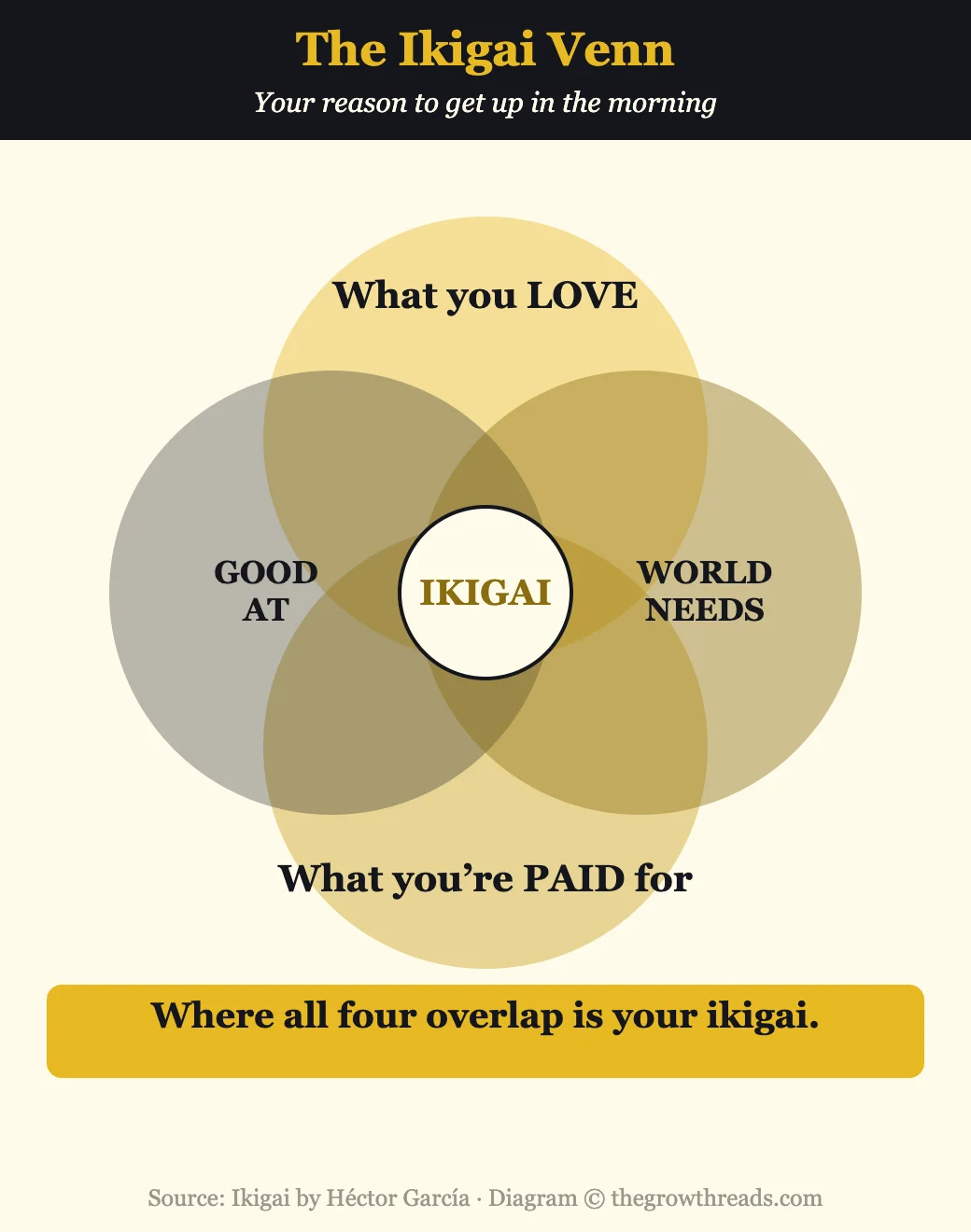
According to this popular framework, your ikigai lies at the intersection of what you love, what you are good at, what the world needs, and what you can be paid for. It is a useful tool for reflection — a way to think about aligning passion, skill, contribution, and livelihood. It is worth knowing, though, that this particular Venn diagram is a Western addition and does not actually appear in the book or in the traditional Japanese understanding, where ikigai is gentler and less tied to career or money. Still, the diagram captures something real, and the book’s deeper point stands: a clear sense of purpose is not a luxury but a foundation of a long, healthy, satisfying life. The rest of the book explores how the longest-lived people on earth cultivate exactly that.
Part 2: The secrets of Okinawa — the world’s longest-lived
The heart of the book is the authors’ visit to Ogimi, an Okinawan village whose elderly residents are famous for their vitality and longevity. Interviewing centenarians who were still gardening, laughing, and deeply involved in village life, García and Miralles noticed a set of shared habits that map remarkably well onto what longevity research suggests.
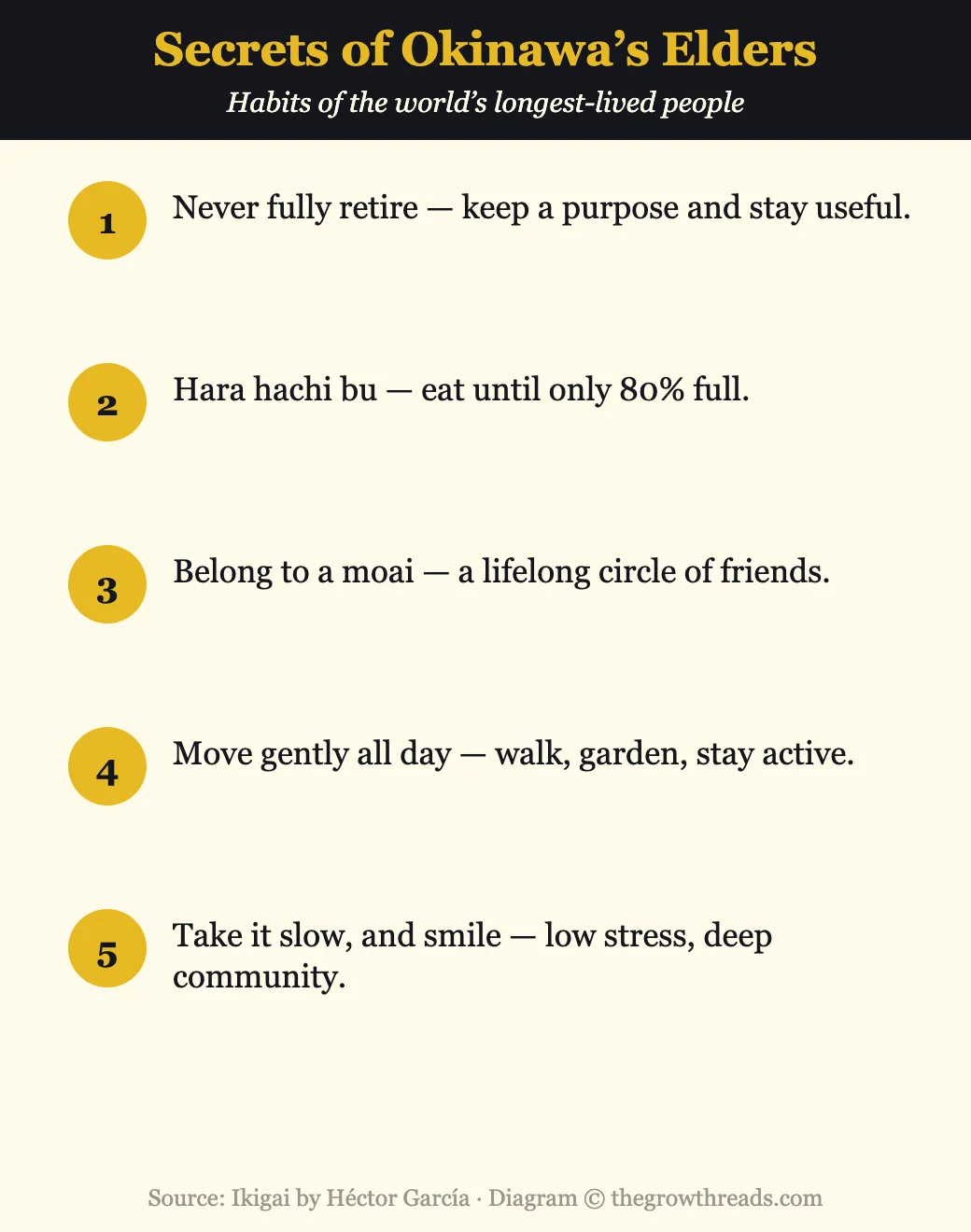
First, the Okinawans never truly retire — their language has no direct word for it — and they keep a sense of purpose and usefulness well into old age, tending gardens and contributing to the community. Second, they stay in near-constant gentle motion: rather than intense exercise, their days are full of walking, gardening, and manual chores, keeping their bodies active without strain. Third, they eat with restraint, following the practice of hara hachi bu — stopping when about 80% full — and favoring a plant-rich, varied, modest diet. Fourth, and perhaps most striking, they belong to a moai: a close-knit circle of lifelong friends who support one another emotionally and even financially. This deep, durable community may be one of the single most important ingredients, since strong social ties are among the most reliable predictors of a long life. Underlying it all is a calm, unhurried pace and a warm, optimistic outlook — low chronic stress, abundant connection, and a reason to keep going.
TGR Note: Where Ikigai gives you the human, cultural picture of longevity, Peter Attia’s Outlive gives you the rigorous medical version — and they agree far more than they differ. Attia’s emphasis on constant movement, muscle, and above all emotional and social health is Ogimi’s daily life translated into clinical science. Read Ikigai for the inspiration and Outlive for the mechanism.
Part 3: Flow — losing yourself in what you do
If purpose is what gets you up in the morning, flow is what makes the hours in between feel alive. The authors devote a large section to the psychology of flow — the state of complete, energized absorption in an activity, first studied by the psychologist Mihaly Csikszentmihalyi. In flow, you lose track of time and self-consciousness because your attention is fully engaged by a task that is challenging but achievable. The Okinawan elders, and the Japanese artisans the authors also admire, seem to spend much of their lives in this state, deeply devoted to their craft or work for its own sake rather than for external reward.
The book offers practical conditions for entering flow: choose a task with a clear goal, one that stretches your skills without overwhelming them, and then eliminate distractions and give it your single, undivided focus. It celebrates the Japanese ideal of takumi, the master craftsman who devotes a lifetime to perfecting a skill, finding meaning in the endless refinement of the work itself. The lesson for the rest of us is that ikigai is not only about identifying a grand purpose but about immersing yourself, daily, in activities you love enough to lose yourself in them. Meaning is found in the doing.
TGR Note: Ikigai’s chapter on flow is the gentle cousin of Deep Work, which turns the same idea into a rigorous productivity system. And the artisan’s daily devotion is exactly the kind of small, repeated practice Atomic Habits shows compounds into mastery. Ikigai supplies the why — meaning and joy — while those books supply the how of sustained focus.
Part 4: Resilience — wabi-sabi, ichi-go ichi-e, and the rules of ikigai
A long life inevitably includes hardship, so the book closes with Japanese ideas for facing adversity gracefully. Two stand out.
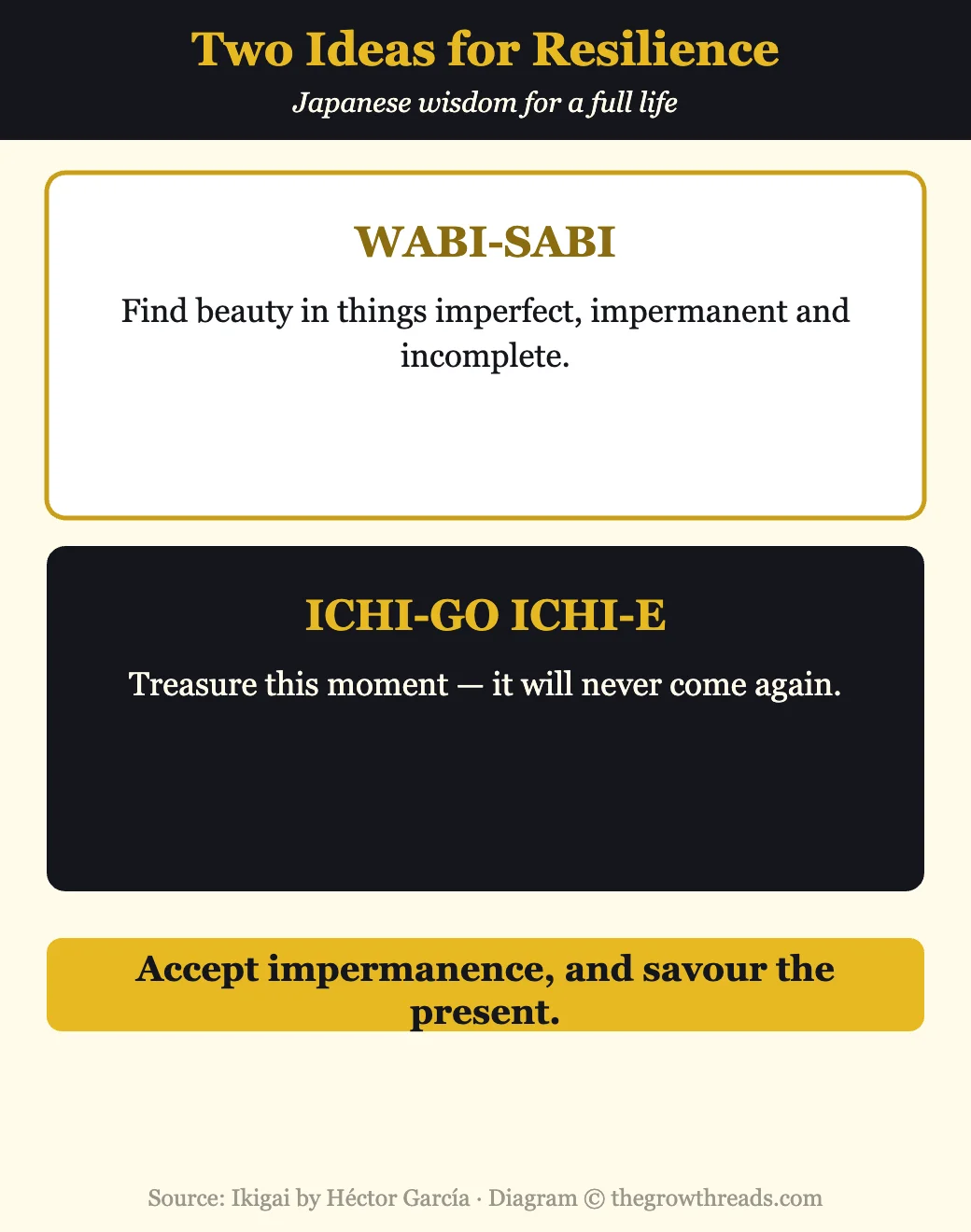
Wabi-sabi is the aesthetic and philosophical appreciation of beauty in things that are imperfect, impermanent, and incomplete — a cracked bowl, a weathered face, the fleeting cherry blossom. Embracing wabi-sabi means making peace with the transience and imperfection of life rather than fighting it, which is a quiet antidote to the modern pursuit of flawlessness. Ichi-go ichi-e translates roughly as “one time, one meeting” — the idea that every encounter and every moment is unique and will never be repeated, and should therefore be treasured. Together these teach a resilient, present-focused way of living: accept that everything changes and nothing is perfect, and precisely for that reason, savor what is here now.
The authors gather all of this into a set of gentle rules for cultivating your ikigai — among them: stay active and don’t retire, take it slow, don’t fill your stomach, surround yourself with good friends, get in shape through gentle daily movement, smile, reconnect with nature, give thanks, live in the moment, and above all follow your ikigai. None of it is revolutionary, and readers looking for hard science or a rigorous program will find the book thin. But its accumulated wisdom is genuinely calming, and its central insight is well supported: a long and happy life rests not on any single hack but on purpose, community, gentle activity, moderation, and presence. Read as a warm invitation to slow down and find your reason for being, rather than as a scientific manual, it delivers exactly what it promises.
Who is Ikigai best for — and who should read something else first?
This book is ideal for anyone seeking a gentle nudge toward purpose, or who is curious about Japanese culture and how the world’s longest-lived people actually live. It is short, soothing, and beautifully simple. It is not for you if you want rigorous science, data, or a detailed program — the book is impressionistic and light, and some readers find it repetitive or vague. If you want the hard longevity science beneath Okinawa’s habits, read Outlive; if you want to turn its “find your flow” advice into a real practice, pair it with Deep Work.
Questions to reflect on
- What is your ikigai — the thing that genuinely makes you want to get up in the morning?
- Where in your day could you add gentle, constant movement rather than relying on the gym?
- Who is in your “moai” — and if you don’t have one, how could you build it?
- What activity absorbs you so fully that you lose track of time?
- What imperfect, impermanent thing in your life could you learn to appreciate instead of fighting?
🔥 Ready to find your reason for being?
This guide is the map — the Okinawan elders’ stories are what make ikigai feel real.
How to apply Ikigai (7-day plan)
- Day 1 — Sketch your ikigai. Write what you love, what you’re good at, what the world needs, and what you can be paid for, and look for overlaps.
- Day 2 — Add gentle movement. Build constant, low-intensity motion into your day — a walk, the stairs, some gardening.
- Day 3 — Practice hara hachi bu. Stop eating at one meal when you’re about 80% full.
- Day 4 — Nurture your moai. Reach out to a close friend and strengthen one lasting connection.
- Day 5 — Enter flow. Do one absorbing task with full focus and no distractions.
- Day 6 — Slow down. Deliberately do one thing unhurriedly and notice the difference.
- Day 7 — Live one moment fully. Practice ichi-go ichi-e: treat one ordinary moment as unrepeatable.
Frequently asked questions
Is Ikigai worth reading?
Yes, if you take it for what it is: a gentle, warm introduction to purpose and Japanese longevity wisdom rather than a rigorous scientific text. It is short, calming, and quietly motivating, and its portrait of Okinawa’s centenarians is genuinely inspiring. The main criticism is that it is light on hard evidence and can feel repetitive or vague. But its central message — that purpose, community, moderation, and presence underpin a long, happy life — is both true and worth internalizing, and many readers find it soothing and useful.
What is ikigai?
Ikigai is a Japanese concept meaning roughly “a reason for being” or “a reason to get up in the morning” — the source of meaning that makes life feel worthwhile. In Japan it is understood personally and modestly: your ikigai could be your work, family, a hobby, or a cause. In the West it is often illustrated with a four-circle diagram placing ikigai at the overlap of what you love, what you are good at, what the world needs, and what you can be paid for, though that diagram is a modern Western addition.
What is the main message of Ikigai?
That a long and happy life comes from having a sense of purpose and living in a balanced, connected way. Drawing on Okinawa’s centenarians, the book argues that never fully retiring, staying gently active, eating with moderation, belonging to a close community, finding flow in work you love, and staying present are the real secrets to longevity and wellbeing — more than any single diet or exercise trick. Purpose and connection are as important as the physical basics.
Is the ikigai Venn diagram actually in the book?
No. The now-famous four-circle diagram — placing ikigai at the intersection of what you love, are good at, can be paid for, and the world needs — is a Western creation that predates and sits outside this book. The traditional Japanese idea of ikigai is gentler and less focused on career or money. The diagram is still a useful reflection tool, but it is worth knowing it represents a Westernized interpretation rather than the concept as understood in Japan or as presented in the book itself.
What are the Okinawan longevity habits in Ikigai?
The elders of Ogimi share several habits: they never fully retire and keep a sense of purpose; they stay in constant gentle motion through walking, gardening, and daily chores; they eat until only about 80% full (hara hachi bu) on a modest, plant-rich diet; they belong to a moai, a lifelong circle of supportive friends; and they live at a calm, unhurried pace with warmth and optimism. Community and purpose stand out as especially powerful, alongside gentle activity and dietary moderation.
How long does it take to read Ikigai?
The book is around 200 pages and most readers finish it in about four hours or less, because it is light, simple, and quick to read. Its short chapters make it easy to dip in and out. Our summary above captures the core ideas in roughly 14 minutes, which for this gentle book is often enough to absorb its main lessons and start applying them.
Is Ikigai scientifically accurate?
It is inspired by real research but is not a rigorous scientific work. The longevity habits it describes — purpose, social connection, gentle activity, dietary moderation — align well with genuine findings from longevity science, including studies of “Blue Zones” like Okinawa. However, the book presents these loosely, through interviews and cultural observation rather than data, and the popular ikigai diagram is not scientific at all. Read it as an inspiring, broadly evidence-consistent guide rather than a source of precise medical claims.
Related summaries
- Outlive Summary — the rigorous longevity science beneath Okinawa’s habits.
- Deep Work Summary — turning “find your flow” into a real practice.
- Atomic Habits Summary — the small daily habits behind a meaningful life.
- Browse all our best health books.
How we analyze books: We work from the full book — reconstructing its core arguments in our own words, adding commentary that connects it to related research and other books in our library, and pressure-testing the advice against how it plays out in real life. We never reproduce the text; we synthesize it. Read our full methodology.
Disclosure: The Growth Reads is reader-supported. When you buy through links on our site we may earn an affiliate commission at no extra cost to you. We only recommend books we believe are worth your time, and our summaries and opinions are written independently.