

★★★★★ 4.6/5 — An exhaustively researched, plant-forward playbook that treats aging as a set of biological processes you can actually influence, not just a number on a calendar.
Best for: Readers who want citation-backed, food-first strategies for healthy aging
Reading time: This guide: ~9 min · The book: ~14-16 hrs (576 pages)
Difficulty to apply: Moderate — most changes are additive (add foods and habits) rather than restrictive
How Not to Age in one minute
Aging is not just something that happens to you — it is a set of measurable biological processes, and Dr. Michael Greger argues you can influence several of them starting with your next meal. In How Not to Age, the physician and NutritionFacts.org founder spends more than 570 pages translating the scientific literature on aging biology — inflammation, oxidative stress, mitochondrial decline, and more — into a practical, food-first plan. The book works less like a diet manual and more like a study guide: for each biological “hallmark of aging,” Greger walks through the research, then narrows it down to what he calls his Anti-Aging Eight, a shortlist of food groups with the most consistent evidence behind them. It does not promise a fountain of youth. It promises that a handful of specific, repeatable habits can shift the odds.
Key takeaways
- Aging has mechanisms, not just symptoms: wrinkles and slower recovery are downstream effects of biological processes like inflammation and cellular damage that start decades earlier.
- Biological age can diverge from chronological age: two 60-year-olds can have meaningfully different internal “aging clocks” depending on lifestyle.
- Chronic, low-grade inflammation (“inflammaging”) is a common thread: across nearly every major hallmark of aging, unresolved inflammation shows up as an accelerant.
- Diet is the highest-leverage lever most people are not pulling: Greger argues food choices influence more hallmarks of aging, more consistently, than most supplements or procedures.
- The Anti-Aging Eight anchors the plan: a short list of food groups — including legumes, berries, and leafy and cruciferous vegetables — chosen for how often they appear across the aging research.
- Muscle and strength are longevity biomarkers: grip strength and lean muscle mass are treated as early-warning indicators worth protecting deliberately, not side effects of “looking fit.”
- Hormesis is helpful stress in the right dose: brief, controlled stressors like vigorous exercise or a shorter eating window can trigger the body’s own repair pathways.
- Sleep and stress management are not optional extras: both are folded directly into the biology of aging, not treated as separate “wellness” topics.
- Most anti-aging supplements outrun their evidence: Greger applies the same evidence bar to NAD+ boosters and resveratrol that he applies to food, and most come up short.
- Small, sustained changes compound: the book’s implicit thesis is that consistency over years beats intensity over weeks.
What is How Not to Age about?
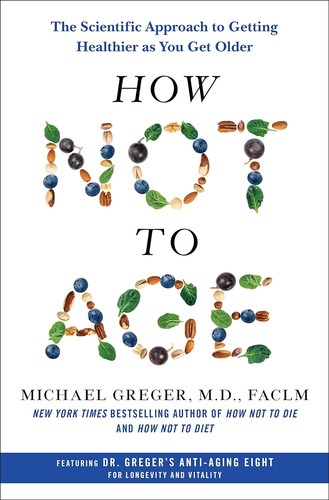
How Not to Age is a science-based guide by physician Dr. Michael Greger that explains the biological “hallmarks” driving aging — inflammation, oxidative stress, mitochondrial decline, and more — and translates the research into practical, food-first strategies, anchored by his Anti-Aging Eight food groups, to help readers influence their own biological aging.
About the author
Dr. Michael Greger, M.D., FACLM, is a physician, professional speaker, and founder of NutritionFacts.org, a nonprofit that has published a free, science-backed nutrition video almost every day for more than a decade. He has testified before the U.S. Congress, presented at institutions including the National Institutes of Health, and appeared in documentaries examining the link between diet and disease. Greger is the New York Times bestselling author of How Not to Die and How Not to Diet, both of which apply the same “review the studies, then simplify” approach that defines How Not to Age. He donates proceeds from his books and speaking engagements to charity.
Key concepts at a glance
| Concept | What it means | Use it when |
|---|---|---|
| Hallmarks of aging | The measurable biological processes — inflammation, oxidative stress, and others — that drive aging over time | You want to understand why aging happens, not just that it does |
| Anti-Aging Eight | Greger’s shortlist of food groups tied most consistently to healthy-aging markers in the research | Building a weekly grocery list |
| Inflammaging | Chronic, low-grade inflammation that tends to rise with age and touches multiple hallmarks at once | Explaining unexplained fatigue or slow recovery |
| Hormesis | Mild, controlled stressors — like vigorous exercise or a narrower eating window — that trigger protective adaptations | Deciding whether to add a challenge-based habit |
| Biological vs. chronological age | The idea that lifestyle can shift your body’s functional “age” independent of your birth year | Staying motivated regardless of your current age |
| NAD+ precursors | Supplements marketed to replenish a coenzyme involved in cellular energy production | Evaluating a supplement claim before buying it |
| Daily Dozen | Greger’s broader checklist from How Not to Die, referenced here as a nutritional baseline | Choosing a starting point before layering on aging-specific habits |
Part 1: Why We Age — The Hallmarks Behind the Wrinkles
Greger opens by reframing the question. Instead of asking “how do I look younger,” he asks “what is actually happening inside the body as it ages, and which of those processes can be influenced?” Drawing on the biology-of-aging literature — the same body of research that produced the widely cited “hallmarks of aging” framework — he walks through the mechanisms researchers now treat as the closest thing science has to a root-cause list for aging itself.
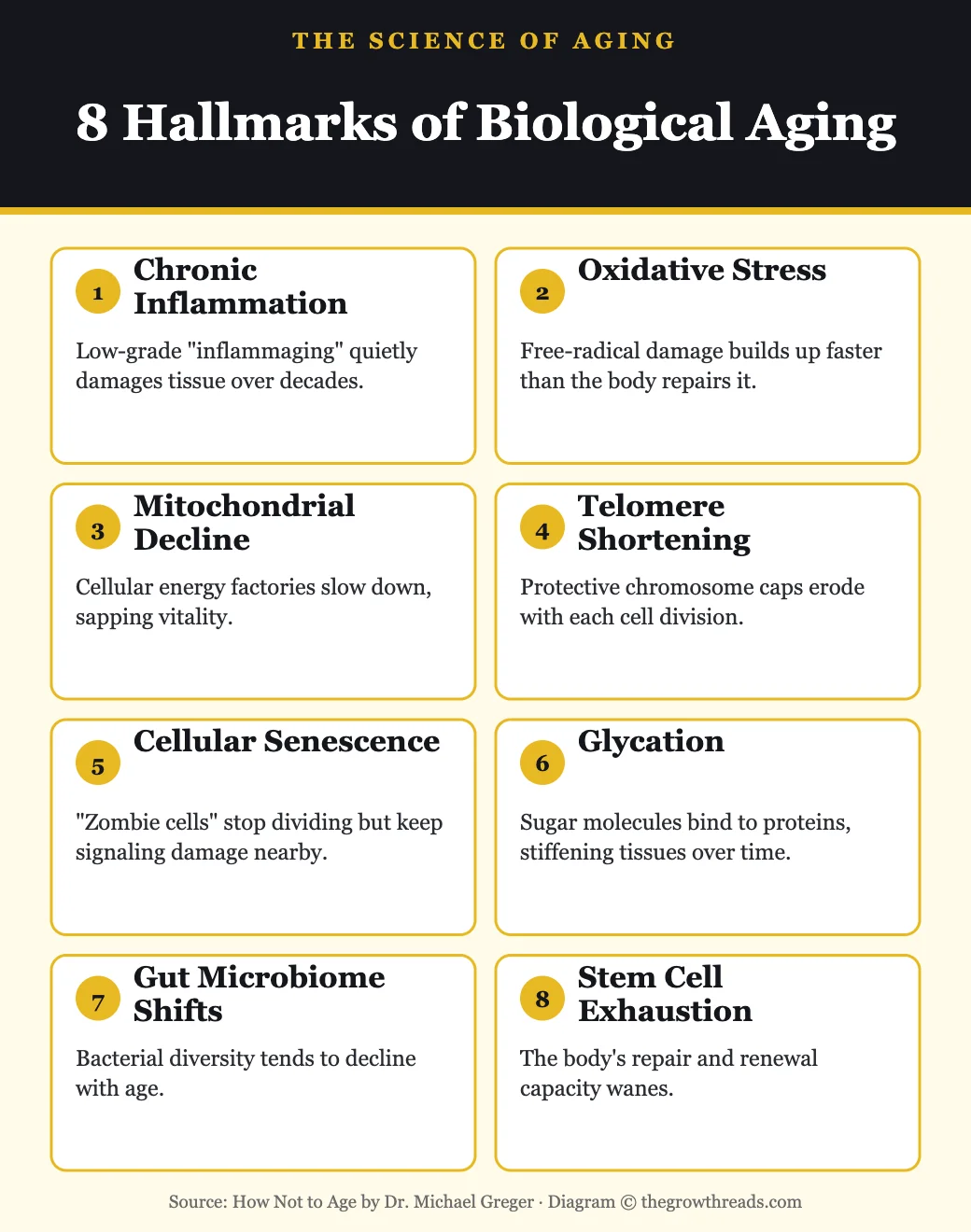
Chronic low-grade inflammation, sometimes called “inflammaging,” recurs throughout the book as a connective thread: it is not a single hallmark so much as an accelerant that touches nearly all of the others. Oxidative stress — the accumulation of free-radical damage faster than the body can repair it — gets similar treatment, alongside the slow decline of mitochondria, the cell’s energy-producing structures, which studies link to fatigue and reduced exercise capacity in older adults. Telomeres, the protective caps on the ends of chromosomes, shorten with repeated cell division; when they grow too short, cells can no longer divide safely. Some of those cells then become “senescent” — unable to divide, but still metabolically active and capable of releasing inflammatory signals that damage nearby healthy tissue, a process researchers sometimes describe with the memorable shorthand “zombie cells.”
Greger also covers glycation, in which excess sugar molecules bind to proteins and stiffen tissues over time; shifts in the gut microbiome, where bacterial diversity tends to narrow with age; and the gradual exhaustion of the body’s stem cell reserves, which slows its capacity for repair. None of these processes are exotic or fringe — they appear throughout mainstream aging research — but Greger’s contribution is compiling them into one narrative and then, crucially, asking which everyday choices measurably move the needle on each one.
TGR Note: If this hallmarks-based framing intrigues you, David Sinclair goes even deeper into the cellular biology of aging — including the controversial “information theory of aging” — in our Lifespan summary. For a more clinical, biomarker-driven take on the same goal, see our Outlive summary, where Peter Attia builds a personalized longevity protocol around lab work and exercise testing rather than food groups alone.
Part 2: The Anti-Aging Eight — Eating for Your Biological Clock
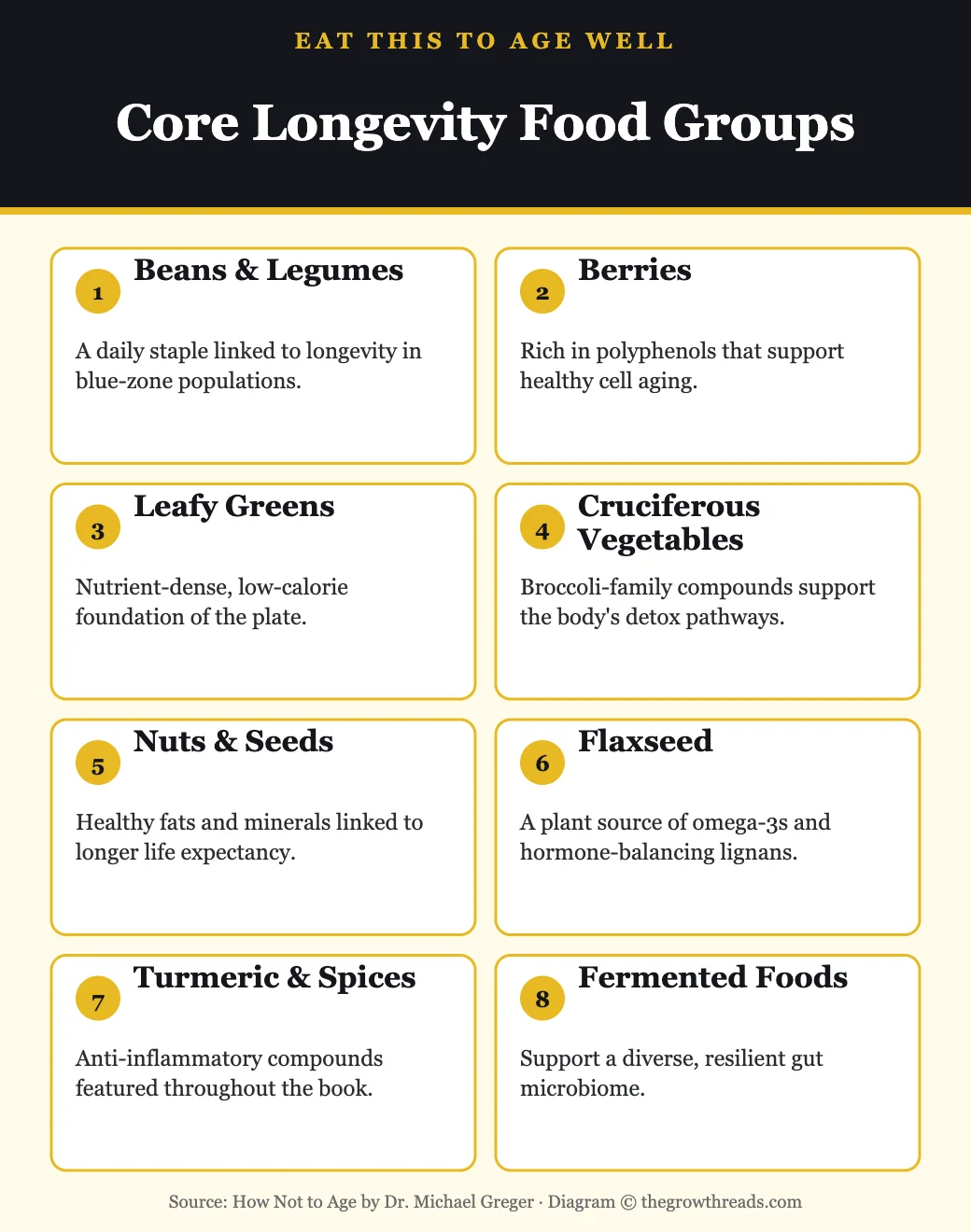
Having established what drives aging, Greger turns to what he calls the Anti-Aging Eight: a shortlist of food groups he argues show up most consistently across the research tying diet to healthy-aging markers. It functions as a distilled, aging-specific layer on top of the broader “Daily Dozen” checklist from his earlier book, How Not to Die — think of it as the highlight reel rather than a brand-new list to memorize from scratch.
The categories will be familiar to anyone who has read Greger’s earlier work: legumes (beans, lentils, chickpeas) as a near-daily staple linked to longevity in several long-lived populations; berries for their polyphenol content; leafy greens and cruciferous vegetables (broccoli, cabbage, Brussels sprouts) for nutrient density and detoxification-pathway support; nuts and seeds for healthy fats tied to lower mortality risk in cohort studies; flaxseed as a plant source of omega-3s and hormone-modulating lignans; turmeric and other spices for their anti-inflammatory compounds; and fermented foods for gut microbiome diversity. None of these are exotic superfoods — that is deliberate. Greger’s argument is that the unglamorous, repeatable staples outperform novelty ingredients when the outcome you care about is decades away.
What separates this section from a typical nutrition book is the way each food is tied back to Part 1’s mechanisms. Berries are not just “good for you” — they are framed in terms of oxidative stress. Fermented foods are not just trendy — they are framed in terms of the gut-microbiome hallmark. The repetition is intentional: it is much easier to stick to a habit when you understand the specific problem it is solving.
TGR Note: If a plant-forward checklist sounds familiar, it should — it is the same underlying philosophy Greger laid out in How Not to Die, which we cover in our How Not to Die summary. For a gentler, lifestyle-first framing of similar dietary patterns, our The Blue Zones summary looks at the same food groups through the lens of long-lived communities rather than individual biomarkers.
Part 3: Beyond the Plate — Movement, Sleep, and Productive Stress
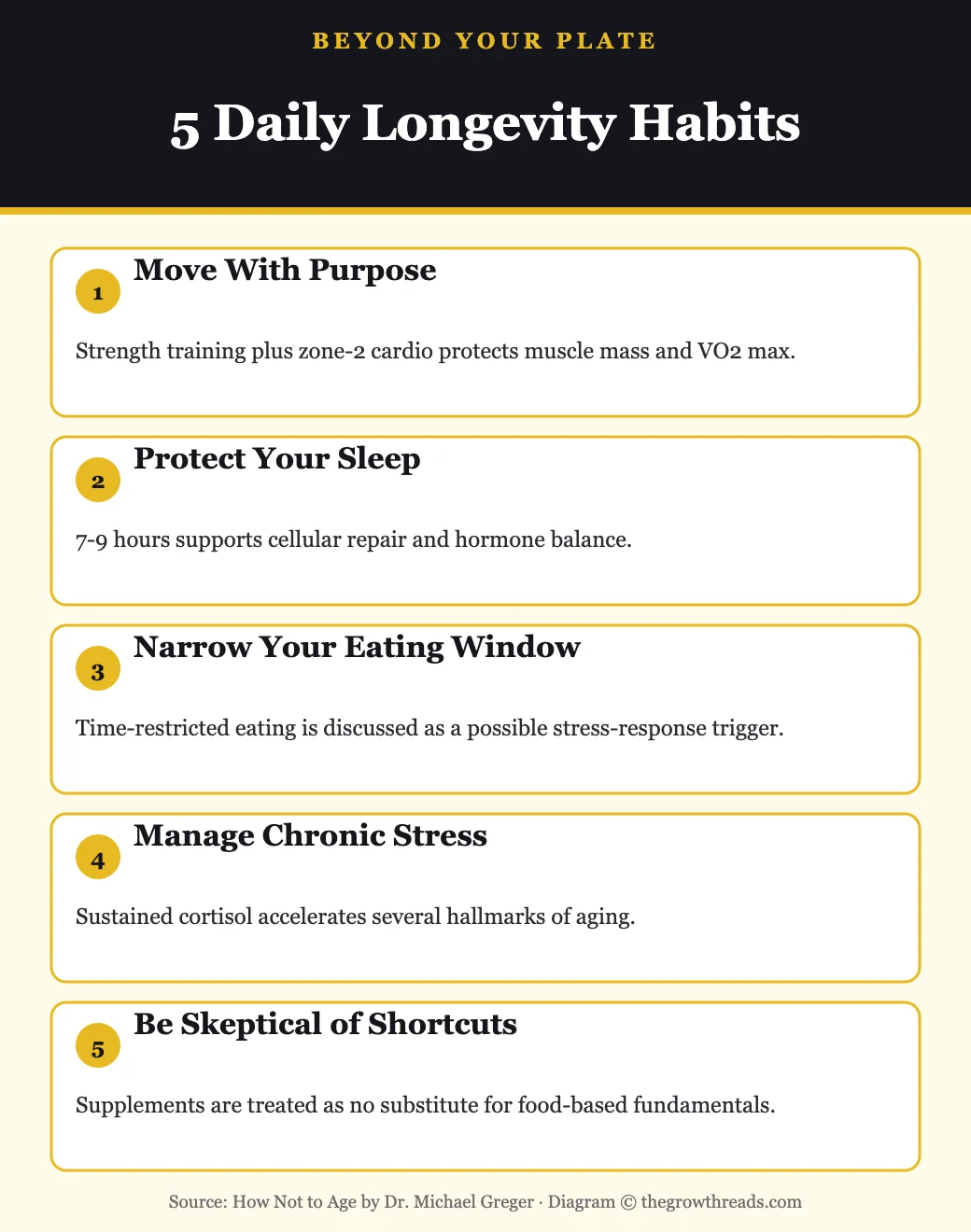
Diet gets the most page count, but Greger is explicit that food alone will not offset a sedentary, sleep-deprived, chronically stressed lifestyle. Muscle mass and strength are treated as longevity biomarkers in their own right — grip strength in particular shows up repeatedly in the research he cites as a simple, low-cost predictor of healthy aging. His exercise recommendations lean on a combination of resistance training, to protect muscle against age-related decline, and lower-intensity aerobic work, to support cardiovascular and mitochondrial health.
Sleep is treated as biology, not lifestyle fluff: the book connects insufficient or poor-quality sleep to several of the hallmarks from Part 1, particularly inflammation and impaired cellular repair. Stress management gets similar treatment — sustained cortisol elevation is framed as a direct accelerant of biological aging rather than a vague wellness concern.
One of the more nuanced threads in this section is hormesis: the idea that certain stressors, applied briefly and in a controlled way, trigger the body’s own protective and repair pathways rather than simply causing wear and tear. Greger discusses time-restricted eating and brief fasting periods in this light, treating them as a tool some readers may want to experiment with rather than a universal prescription — and he is careful to flag where the human evidence is still preliminary compared to the animal research it is often extrapolated from.
TGR Note: For a deeper dive into why sleep specifically matters this much, see our Why We Sleep summary. If the exercise angle is what interests you most, our Exercised summary makes the evolutionary case for why humans are built to move, and pairs well with the muscle-and-strength emphasis here.
Part 4: Separating Signal From Hype
The final section is where Greger’s evidence-first approach becomes most useful — and most contrarian relative to the broader longevity-supplement industry. He applies the same scrutiny to NAD+ precursors, resveratrol, and other popular anti-aging supplements that he applies to food claims throughout his work, and in most cases concludes the human evidence has not caught up with the marketing. Rather than dismissing the underlying science outright, he distinguishes between promising early-stage research and consumer products that are already being sold as if the question were settled.
He also touches on pharmaceutical interventions being studied for aging specifically, such as metformin and rapamycin, positioning them as areas worth watching rather than something the average reader should pursue outside clinical supervision. Throughout, the message is consistent: the highest-confidence, lowest-risk interventions available today remain diet, movement, sleep, and stress management — not the newest compound with a compelling backstory.
The book closes by encouraging readers to think in terms of a personal plan rather than a rigid checklist: pick a small number of Anti-Aging Eight foods to add this week, layer in one movement or sleep habit, and use simple, accessible markers like strength, energy, and blood pressure as feedback rather than waiting for a dramatic before-and-after.
TGR Note: If cognitive aging specifically is your main concern, our Keep Sharp summary covers Sanjay Gupta’s brain-focused take on many of the same lifestyle levers. And if you want the food-first approach distilled into a single daily checklist, our How Not to Die summary covers Greger’s original Daily Dozen.
Who is How Not to Age best for — and who should read something else first?
How Not to Age is best for readers who already appreciate a citation-heavy, “show me the research” style — fans of Greger’s earlier books, or anyone who wants a food-first, plant-forward approach to healthy aging backed by hundreds of studies rather than anecdote. It rewards readers willing to sit with some density; this is closer to a reference text you dip into than a breezy weekend read.
If you want a gentler, more narrative introduction to longevity lifestyles before tackling this level of detail, start with our The Blue Zones summary. If you are more interested in personalized biomarkers, lab testing, and a clinical framework than food groups, our Outlive summary is likely the better entry point. And if cellular biology and the “why” behind aging interests you more than the “what to eat,” our Lifespan summary covers that ground in depth.
Questions to reflect on
- Which of the eight hallmarks of aging feels most relevant to your current health — inflammation, low energy, slow recovery, or something else?
- How many of the Anti-Aging Eight food groups do you already eat regularly, and which one would be easiest to add this week?
- Where does your current exercise routine fall short on strength training specifically, versus general activity?
- Are you treating sleep as a fixed, low-priority constraint, or as a lever you can actually improve?
- Have you evaluated any anti-aging supplement you currently take against the same evidence bar Greger applies to food claims?
🔥 Ready to build your own anti-aging plan?
Grab a copy of How Not to Age and start applying the science this week.
How to apply How Not to Age (7-day plan)
- Day 1 — Audit your plate: tally how many of the Anti-Aging Eight food groups you ate yesterday. No changes yet, just a baseline.
- Day 2 — Add one legume serving: work a half-cup of beans, lentils, or chickpeas into one meal.
- Day 3 — Add berries or a cruciferous vegetable: pick whichever is easiest to buy this week and add it to one meal.
- Day 4 — Take a grip-strength and resting-heart-rate baseline: two simple, trackable numbers you can revisit in a few months.
- Day 5 — Schedule one resistance-training session: bodyweight is fine; the goal is starting a habit, not intensity.
- Day 6 — Protect a full night of sleep: set a wind-down alarm and keep screens out of the last 30 minutes before bed.
- Day 7 — Review and pick one habit to keep: of everything you tried this week, choose the single easiest one to sustain long-term, and build from there next week.
Frequently asked questions
What is the main message of How Not to Age?
The main message is that aging is driven by specific, studiable biological processes — inflammation, oxidative stress, mitochondrial decline, and several others — and that diet, exercise, sleep, and stress management can meaningfully influence several of them. Dr. Michael Greger argues that food choices, in particular, are the highest-leverage, lowest-risk lever most people are not using deliberately. The book is less about anti-aging in a cosmetic sense and more about extending the years you spend in good health.
What is Dr. Greger’s “Anti-Aging Eight”?
It is Greger’s shortlist of food groups he argues show up most consistently in research linking diet to healthy-aging markers, including legumes, berries, leafy greens, cruciferous vegetables, nuts and seeds, flaxseed, turmeric and other spices, and fermented foods. It functions as an aging-focused highlight reel layered on top of the broader “Daily Dozen” checklist from his earlier book, How Not to Die, rather than a completely separate list to memorize.
Is How Not to Age based on scientific research?
Yes — the book is heavily footnoted and draws on peer-reviewed studies throughout, consistent with Greger’s work at NutritionFacts.org. That said, some claims in longevity science remain actively debated among researchers, particularly around supplement efficacy and how well findings from animal studies translate to humans; Greger generally flags this uncertainty rather than glossing over it. As with any health guidance, it is worth discussing significant diet or supplement changes with your own doctor, especially if you have existing conditions or take medication.
Do I need to be vegan to follow this book’s advice?
No. While Greger is a well-known advocate for plant-forward eating and his own recommendations lean heavily vegetarian and vegan, the Anti-Aging Eight is framed as an “add these in” list rather than an “eliminate everything else” mandate. Readers who are not fully plant-based can still apply most of the book’s core advice by increasing legumes, vegetables, nuts, and fermented foods within whatever overall eating pattern they already follow.
Does How Not to Age recommend any supplements?
Greger is notably skeptical of most commercial anti-aging supplements, including popular NAD+ precursors and resveratrol products, arguing the human evidence generally has not caught up with the marketing claims. Rather than recommending a supplement stack, the book consistently redirects readers back toward food-based sources of the same compounds and treats supplementation as an area to watch rather than to act on prematurely.
How is How Not to Age different from How Not to Die?
How Not to Die is organized by disease category — heart disease, cancer, diabetes, and so on — and built around Greger’s Daily Dozen checklist. How Not to Age is organized around the biological mechanisms of aging itself and narrows the food recommendations into the more targeted Anti-Aging Eight. Readers familiar with one will recognize the underlying dietary philosophy in the other, but How Not to Age spends considerably more time on the “why,” including exercise, sleep, and supplement-evidence sections.
Is intermittent fasting recommended in the book?
Greger discusses time-restricted eating and brief fasting periods as an example of hormesis — a mild, controlled stressor that may trigger beneficial repair pathways — but he presents it as an option some readers may want to experiment with rather than a universal prescription. He is careful to distinguish between promising early findings and long-term human evidence, which is still developing, and generally frames diet quality as the more foundational lever.
Related summaries
- How Not to Die Summary & Review — Greger’s original disease-prevention playbook and the Daily Dozen checklist
- Lifespan Summary & Review — David Sinclair’s deep dive into the cellular biology of aging
- Outlive Summary & Review — Peter Attia’s biomarker-driven, clinical approach to longevity
- The Blue Zones Summary & Review — lifestyle lessons from the world’s longest-lived communities
See our full best health books list for more science-backed picks.
How we analyze books: our team reads the full text, cross-references key claims against the cited research and other reputable sources, and structures each summary around what readers can actually apply. Read our full methodology.