

★★★★☆ 4.2/5 — A practical, evidence-backed guide to protecting your brain at every age.
Best for: Anyone over 30 who wants to reduce cognitive decline risk through daily lifestyle changes.
Reading time: ~5 hours (304 pages)
Difficulty to apply: Low — most recommendations require zero equipment or special knowledge.
Scientific rigor: High — Gupta draws from decades of neurosurgical practice, peer-reviewed research, and interviews with leading Alzheimer’s researchers.
Keep Sharp in one minute
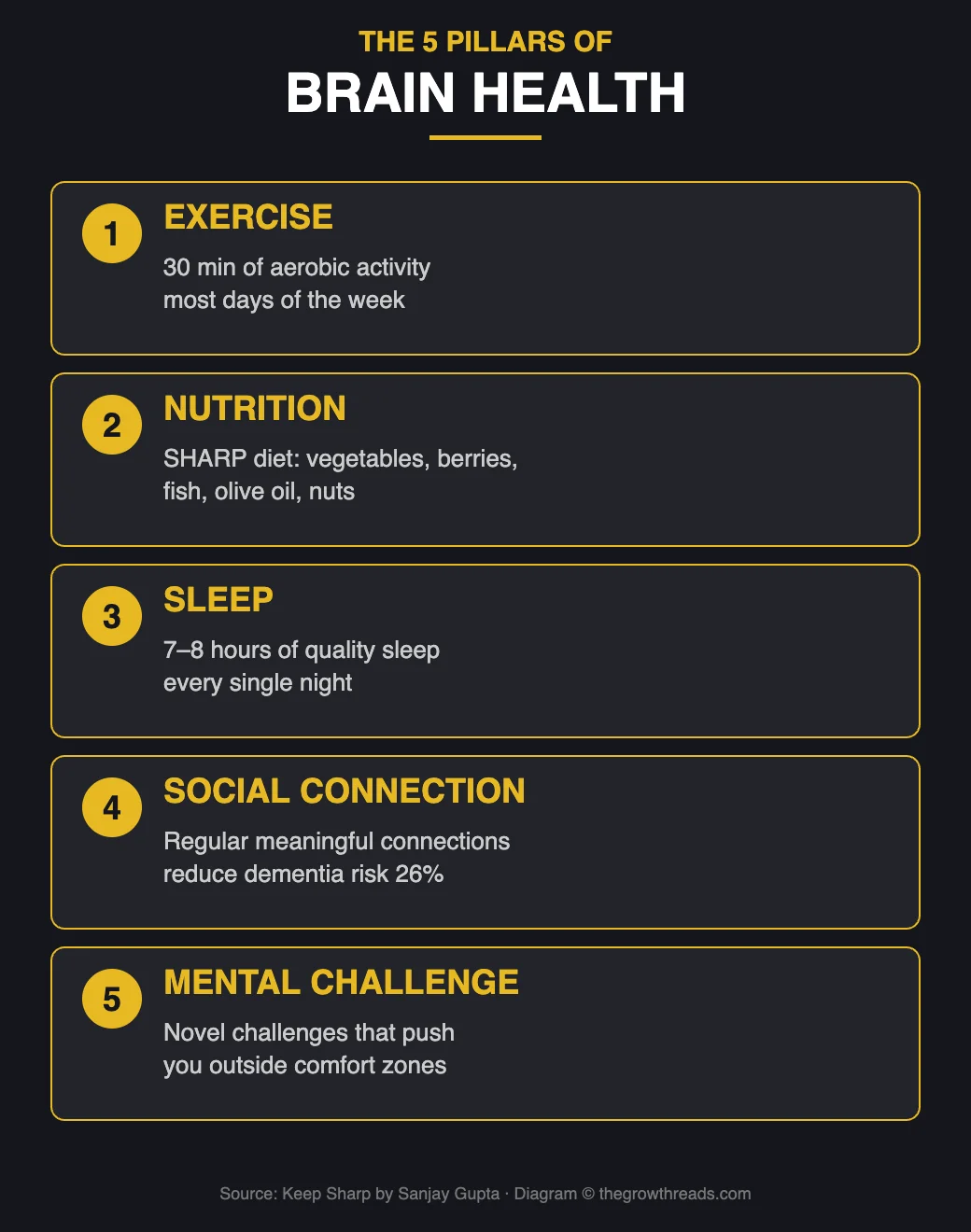
Your brain’s future is not predetermined by your genes. Neurosurgeon Sanjay Gupta argues that up to 90% of Alzheimer’s cases have no strong genetic link, meaning the choices you make daily matter enormously. The book distills the latest neuroscience into five actionable pillars — exercise, nutrition, sleep, social connection, and mental challenge — and shows how even small changes build a “cognitive reserve” that delays or prevents decline. Gupta calls this your brain’s insurance policy: the more you invest now, the more protection you have later.
Key takeaways
- Move your body first: Exercise is the single most powerful tool for brain health — it increases BDNF, the protein that builds new neural connections.
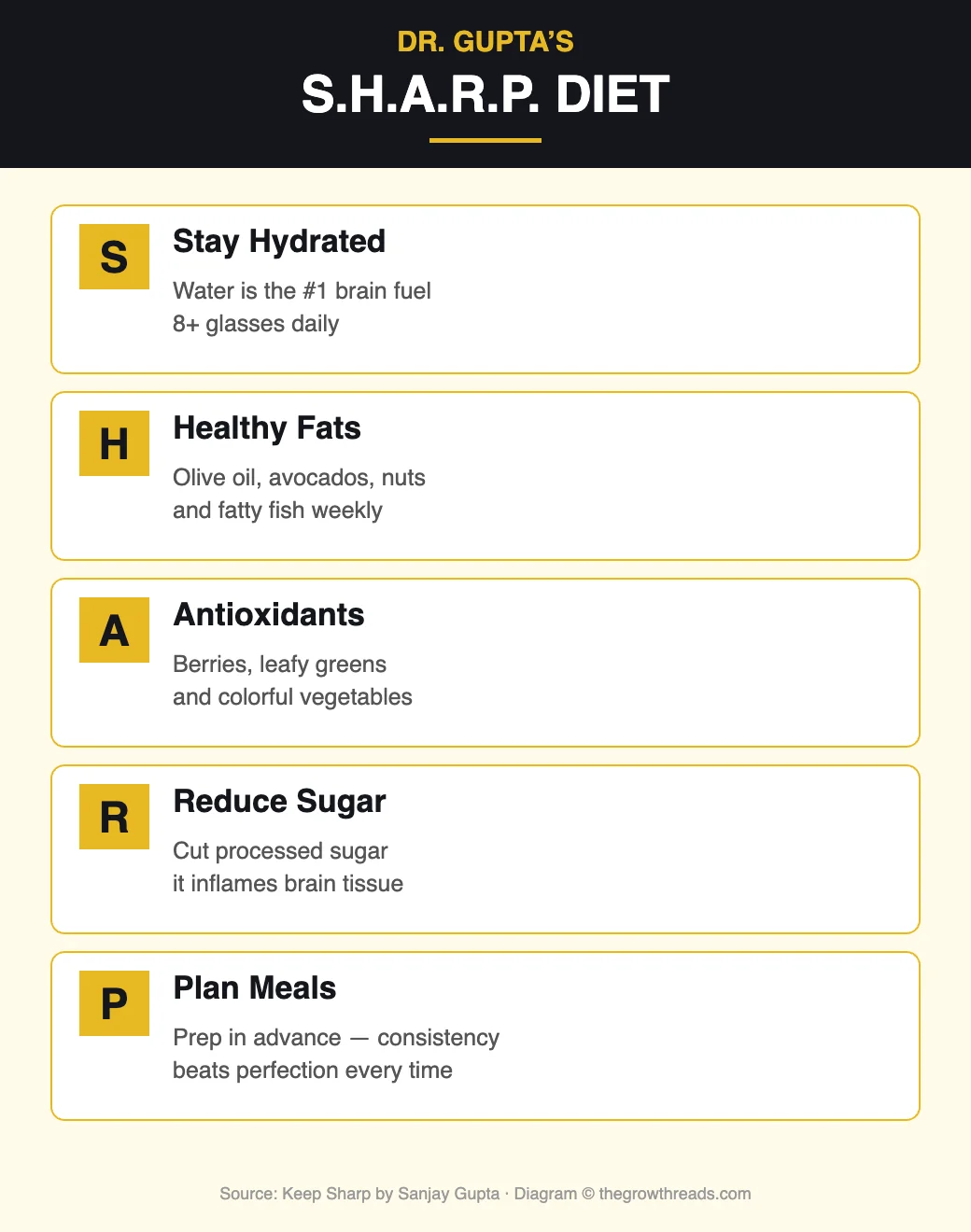
- Follow the SHARP diet: Stay hydrated, choose healthy fats, load up on antioxidants, reduce sugar, and plan meals ahead of time.
- Protect your sleep: During deep sleep, your brain’s glymphatic system flushes out toxic proteins linked to Alzheimer’s. Seven to eight hours is non-negotiable.
- Stay socially connected: Loneliness increases dementia risk by 26%. Meaningful relationships are medicine for the brain.
- Seek novel challenges: Your brain benefits most from activities that are new and difficult — not the crossword you’ve been doing for twenty years.
- Purpose protects: People with a strong sense of purpose show 2.4 times lower risk of developing Alzheimer’s disease.
- Manage chronic conditions: Untreated high blood pressure, diabetes, and hearing loss are modifiable risk factors for cognitive decline.
- Ditch the supplements: No brain supplement has proven effective in rigorous trials. Real food beats a pill every time.
- Start at any age: Neuroplasticity does not expire. People who begin healthy habits in their 60s still see measurable cognitive improvements.
- Build cognitive reserve: Education, bilingualism, and complex work create redundant neural pathways that the brain can draw on when damage occurs.
What is Keep Sharp about?
Keep Sharp is a neurosurgeon’s evidence-based guide to building and maintaining brain health at any age. Sanjay Gupta synthesizes findings from Alzheimer’s research, neuroscience studies, and clinical practice into a five-pillar lifestyle framework — exercise, nutrition, sleep, social engagement, and mental stimulation — that anyone can implement to reduce cognitive decline risk.
About the author
Dr. Sanjay Gupta is an Emmy-winning chief medical correspondent for CNN and a practicing neurosurgeon at Emory University Hospital in Atlanta. He has reported from war zones and disaster areas, performed brain surgery while covering stories, and has been named one of the most influential people in media by Forbes. Gupta trained at the University of Michigan Medical School and served as a White House Fellow under President Clinton. His personal mission — fueled by watching patients and family members face cognitive decline — drove him to spend years interviewing the world’s leading brain researchers for this book. He has authored multiple bestsellers including Chasing Life and World War C. Explore all Sanjay Gupta book summaries →
Key concepts at a glance
| Concept | What it means | Use it when |
|---|---|---|
| Cognitive reserve | Extra neural pathways built through education, complex work, and social activity | You want to understand why some brains resist decline |
| BDNF | Brain-derived neurotrophic factor — a protein that builds and repairs neurons | You need motivation to exercise; movement is BDNF’s biggest trigger |
| Glymphatic system | The brain’s waste-clearing network that activates during deep sleep | You want to understand why sleep deprivation accelerates decline |
| SHARP diet | Stay hydrated, Healthy fats, Antioxidants, Reduce sugar, Plan meals | You want a simple daily nutrition framework for brain health |
| Neuroplasticity | The brain’s ability to form new connections and reorganize at any age | You think it’s too late to change — it’s not |
| Subjective cognitive decline | Self-reported memory issues that may be early warning signals | You notice changes and want to know when to act |
| Novel vs. routine stimulation | New challenges grow the brain; familiar tasks maintain but don’t build | You want to choose the right mental exercises |
Part 1: The brain — what we know and what we don’t
Gupta opens by confronting a paradox: we know more about outer space than we do about the three-pound organ inside our skulls. He walks through the brain’s basic architecture — 100 billion neurons, each with up to 10,000 connections — and explains why the field of brain health has been revolutionized in the last two decades.
The key insight is that Alzheimer’s and other dementias are not simply genetic destiny. Gupta cites a landmark Finnish study (FINGER trial) showing that lifestyle interventions — diet, exercise, cognitive training, and vascular risk monitoring — improved or maintained cognitive function in at-risk older adults over a two-year period. This was the first large-scale randomized trial to demonstrate that multi-domain lifestyle changes could measurably protect cognition.
He introduces the concept of cognitive reserve: the brain’s ability to improvise and find alternative pathways around damage. People with more education, bilingual speakers, and those in cognitively demanding jobs build more reserve — not because they have bigger brains, but because they have more redundant wiring. When one pathway fails, the brain reroutes.
Part 2: The five pillars in depth
Exercise gets top billing because the evidence is overwhelming. Gupta cites research showing that 30 minutes of aerobic activity most days of the week raises BDNF levels by up to 300%. BDNF is essentially fertilizer for brain cells — it triggers the growth of new neurons in the hippocampus (the memory center) and strengthens existing connections. He notes that exercise is more effective at preventing cognitive decline than any drug currently available.
The specific recommendation: 150 minutes per week of moderate aerobic activity (brisk walking counts), plus strength training twice a week. Gupta emphasizes that you don’t need to run marathons — consistency matters more than intensity. A daily 30-minute walk is worth more than a weekly two-hour gym session.
Nutrition centers on the SHARP framework: Stay hydrated, Healthy fats, Antioxidants, Reduce sugar, and Plan meals. Gupta draws heavily from the MIND diet research (a hybrid of Mediterranean and DASH diets), which showed a 53% reduction in Alzheimer’s risk among people who followed it closely. The key foods: leafy greens daily, berries at least twice a week, fish once a week, olive oil as the primary cooking fat, and nuts as a daily snack.
Sleep may be the most underappreciated pillar. During deep sleep, the glymphatic system — discovered only in 2012 — opens channels between brain cells and flushes out beta-amyloid and tau proteins, the toxic plaques associated with Alzheimer’s. Gupta cites Matthew Walker’s research showing that even one night of poor sleep increases beta-amyloid accumulation. His practical advice: maintain a consistent sleep schedule, keep the bedroom cool and dark, stop screens one hour before bed, and avoid alcohol (which disrupts the deep-sleep stages where glymphatic clearance happens).
Social connection is not a nice-to-have — it’s medicine. Gupta reports that loneliness increases dementia risk by 26%, comparable to the risk from physical inactivity. The mechanism: social interaction forces the brain to read emotions, anticipate responses, manage conflict, and coordinate complex communication — all of which keep multiple brain regions active simultaneously. He recommends maintaining at least five close relationships and engaging in regular face-to-face interaction rather than relying on digital communication.
Mental stimulation comes with a critical caveat: it must be novel. The crossword puzzle you’ve done every morning for ten years stopped building new neural pathways years ago. Gupta recommends learning a musical instrument, studying a new language, taking a different route to work, or any activity that pushes you into a state of focused difficulty. The key marker: if it feels easy, it’s not growing your brain.
Part 3: Debunking brain myths
Gupta devotes significant space to dismantling popular beliefs that give people false confidence or unnecessary fear. The “10% of your brain” myth is the most famous — functional MRI studies show that virtually every region lights up during a normal day. The dangerous implication of this myth is that people believe there’s untapped capacity waiting to be unlocked by a supplement or technique, when in reality the brain is already working at full capacity.
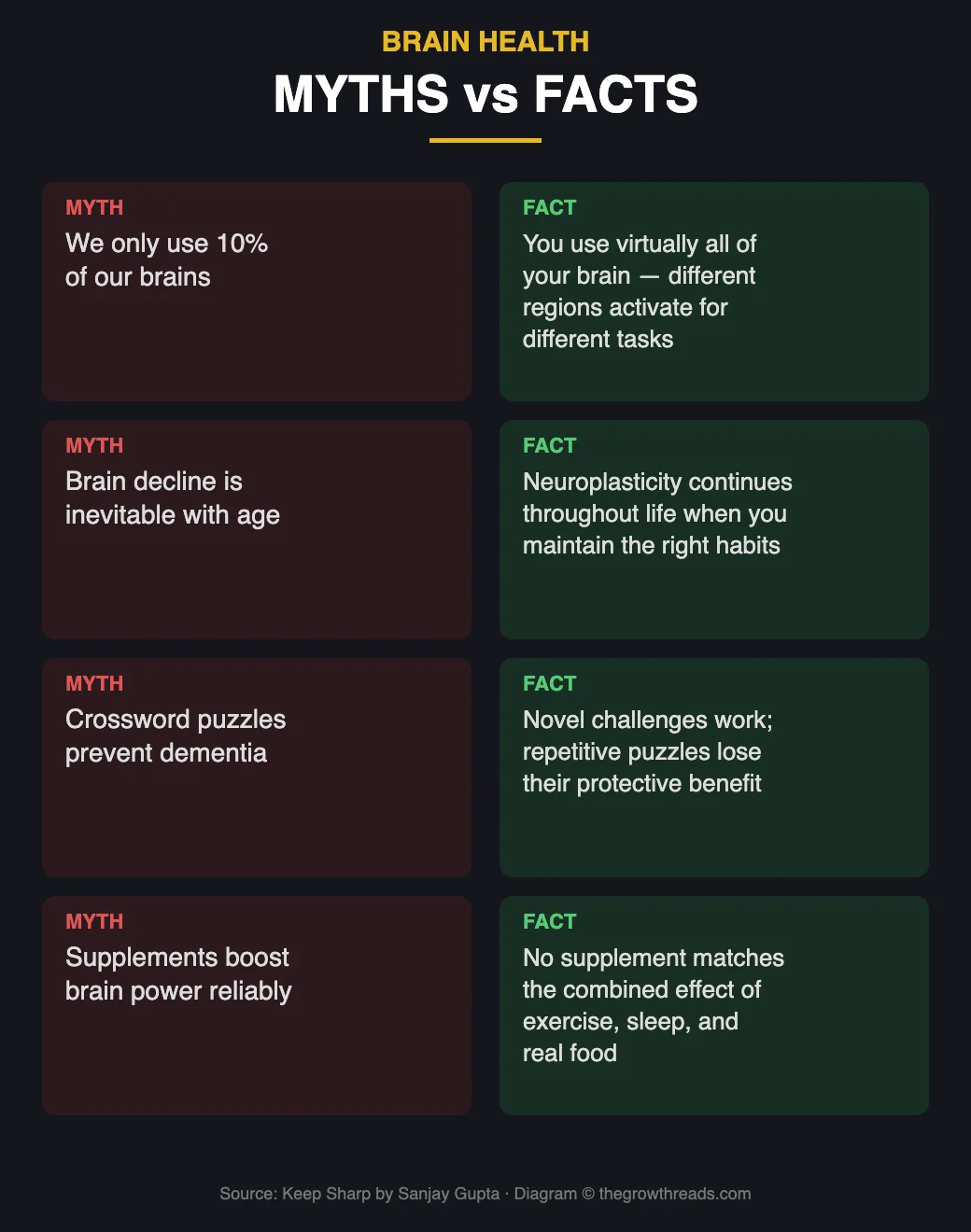
The supplement industry takes a direct hit. Gupta reviewed the evidence for popular brain supplements — ginkgo biloba, fish oil capsules, B vitamins, resveratrol — and found that none demonstrated consistent cognitive benefits in large, well-designed trials. His position is blunt: the only proven “supplement” for brain health is real food, sleep, and movement. He acknowledges that some people have genuine deficiencies (particularly vitamin D and B12) that warrant supplementation, but these should be diagnosed through blood tests, not self-prescribed from marketing claims.
Perhaps most importantly, Gupta pushes back on the idea that cognitive decline is an inevitable part of aging. He profiles individuals in their 80s and 90s — the “Super Agers” studied at Northwestern University — whose memory performance matches people 20 to 30 years younger. The common thread among them: they never stopped moving, they maintained rich social lives, and they continued to challenge themselves intellectually.
Part 4: Building your sharp brain program
The final section translates the science into a practical 12-week program. Gupta structures it as incremental habit-building rather than a complete lifestyle overhaul. Week one focuses solely on adding a daily walk. Week two adds a sleep hygiene audit. By week twelve, all five pillars are integrated into daily routines.
He introduces the concept of “S.M.A.R.T. brain goals” — Specific, Measurable, Achievable, Relevant, and Time-bound. Rather than “I’ll exercise more,” the goal becomes “I’ll walk for 30 minutes after lunch on Monday, Wednesday, and Friday this month.” This framework echoes behavior-design principles and makes the five pillars actionable rather than aspirational.
Gupta also addresses the emotional reality of brain health. He shares stories from his neurosurgical practice — patients who received devastating diagnoses, families who watched loved ones disappear into dementia — and uses these to underscore why prevention is worth the daily effort. His argument is not fear-based but empowering: you have more control than you think, and every positive action counts, regardless of your age or starting point.
Who is Keep Sharp best for — and who should read something else first?
Keep Sharp is ideal for anyone over 30 who wants a practical, science-backed blueprint for brain health. It is especially valuable for people with a family history of Alzheimer’s or dementia who want to understand their actual (not assumed) risk. Caregivers of people with cognitive decline will find the medical context reassuring and the practical advice immediately useful.
If you are already deeply versed in nutrition science, you may find the SHARP diet section introductory — in that case, start with Outlive by Peter Attia for a more technical approach. If your primary interest is sleep, Why We Sleep by Matthew Walker goes much deeper on the mechanisms Gupta summarizes. And if you want the longevity angle with a focus on communities rather than individual habits, The Blue Zones by Dan Buettner is the better starting point.
Questions to reflect on
- Which of the five pillars (exercise, nutrition, sleep, social, mental) am I currently weakest in — and what is one small change I could make this week?
- When was the last time I did something genuinely difficult for my brain — something where I felt like a beginner?
- Am I spending money on brain supplements when that budget could go toward real food, a gym membership, or a class?
- How many of my social interactions this week were face-to-face versus through a screen?
- If I imagine my brain health at 80, what daily habits would my future self thank me for starting today?
🔥 Ready to build a sharper brain?
Start with the five pillars and protect your most valuable asset.
How to apply Keep Sharp (7-day plan)
- Day 1 — Audit your baseline: Rate yourself 1–10 on each of the five pillars. Identify your weakest area — that’s where you’ll start.
- Day 2 — Add a daily walk: Walk briskly for 30 minutes after any meal. No gym required, no gear needed. Just move.
- Day 3 — Sleep audit: Set a consistent bedtime, remove screens from the bedroom, and lower the room temperature to 65–68°F.
- Day 4 — SHARP your kitchen: Buy leafy greens, berries, nuts, olive oil, and fish. Remove one processed snack from your pantry.
- Day 5 — Schedule a social connection: Call or meet one friend or family member face-to-face. Put a recurring weekly slot on your calendar.
- Day 6 — Try something new: Spend 20 minutes on an unfamiliar challenge: a language app, a musical instrument, or a drawing tutorial.
- Day 7 — Reflect and plan: Journal on what felt easiest and hardest this week. Set one S.M.A.R.T. brain goal for the next month using your weakest pillar.
Frequently asked questions
Is Keep Sharp only for older adults?
No. Gupta emphasizes that brain health habits should start as early as possible. Neurodegenerative changes can begin 20 to 30 years before symptoms appear, meaning your choices in your 30s and 40s directly affect your brain in your 60s and 70s. The five-pillar framework is designed to be implemented at any age. Younger readers benefit from building the habits early, while older readers benefit from the fact that neuroplasticity continues throughout life.
What is the SHARP diet exactly?
SHARP stands for Stay hydrated, Healthy fats, Antioxidants, Reduce sugar, and Plan meals. It is Gupta’s simplified version of the MIND diet, which combines principles from the Mediterranean and DASH diets. The emphasis is on leafy greens daily, berries twice a week, fatty fish once a week, olive oil as the primary fat, nuts as snacks, and minimal processed sugar. Research on the MIND diet showed a 53% reduction in Alzheimer’s risk among strict adherents.
Does Gupta recommend any brain supplements?
No. Gupta reviewed the clinical evidence for popular brain supplements including ginkgo biloba, fish oil capsules, B vitamins, and resveratrol, and found none demonstrated consistent cognitive benefits in large, rigorous trials. He recommends getting nutrients from real food instead. The only exception is medically diagnosed deficiencies — particularly vitamin D and B12 — which should be identified through blood tests and addressed with your doctor, not self-prescribed from marketing claims.
How much exercise does Gupta recommend for brain health?
Gupta recommends 150 minutes per week of moderate aerobic activity — equivalent to a brisk 30-minute walk five days a week — plus strength training twice a week. He emphasizes that consistency matters far more than intensity. A daily walk is more beneficial than an occasional intense workout. The mechanism is BDNF: aerobic exercise can increase levels of this neuron-building protein by up to 300%, directly stimulating growth of new brain cells in the hippocampus.
What is cognitive reserve and how do I build it?
Cognitive reserve is your brain’s ability to improvise and find alternative neural pathways when primary connections are damaged. People with more reserve can sustain more brain damage before showing symptoms of decline. You build cognitive reserve through education, learning new skills, complex work, bilingualism, rich social interactions, and any activity that creates diverse neural connections. Gupta compares it to a highway system with multiple routes — more roads means more detour options.
Do crossword puzzles actually help prevent dementia?
Not as much as people think. Gupta explains that crosswords and sudoku become routine once you’ve been doing them for years — your brain has already mapped the patterns and is no longer building new connections. For brain-building benefits, activities need to be novel and challenging. Learning a musical instrument, studying a new language, taking an art class, or navigating an unfamiliar city forces your brain into focused difficulty, which is where neuroplasticity happens.
Can you really improve brain health after age 60?
Yes. Gupta profiles the “Super Agers” studied at Northwestern University — individuals in their 80s and 90s whose memory performance matches people 20 to 30 years younger. The FINGER trial demonstrated measurable cognitive improvement in at-risk adults aged 60 to 77 who adopted lifestyle changes over two years. Neuroplasticity does not have an expiration date. Starting later means a smaller window for benefit, but Gupta’s point is clear: there is no age at which it becomes too late.
Related summaries
- Outlive by Peter Attia — the longevity-focused companion for brain and body health.
- Why We Sleep by Matthew Walker — deep dive into the sleep science Gupta references.
- The Blue Zones by Dan Buettner — community-level longevity that mirrors the five pillars.
- Best Health Books — our full curated list of essential health reads.
How we analyze books: Every book review at The Growth Reads follows a structured evaluation across five criteria: practical applicability, scientific rigor, writing quality, uniqueness of insight, and lasting impact. We read each book cover to cover, cross-reference key claims with primary research, and test the frameworks in real life before publishing. Read our full methodology.