

★★★★★ 4.6/5 — Aging, reframed as a disease you can start treating today.
Best for: Readers who want the science behind the health habits, not just a to-do list.
Reading time: ~6.5 hrs to read · ~14 min to skim this guide.
Difficulty to apply: Moderate — the daily habits are simple; the biomarker and supplement layers take more research.
This summary contains affiliate links (see disclosure at the end).
Lifespan in one minute
David Sinclair, a Harvard geneticist, argues that aging isn’t destiny — it’s a disease, and diseases can be treated. In Lifespan: Why We Age — and Why We Don’t Have To, he lays out the “information theory of aging”: we don’t fall apart because our DNA breaks down, but because the epigenetic instructions that tell our cells how to behave slowly turn to noise. That reframing matters because noise, unlike damage, can theoretically be corrected — which is why Sinclair spends the second half of the book on levers that already exist (fasting, exercise, cold exposure), levers coming soon (biomarker testing, drugs that clear “zombie” cells), and a longer-term bet that cells can be reset to a younger state entirely. It’s part biology lecture, part practical playbook, and part case for rethinking what a “full life” could look like.
Key takeaways
- Aging is one disease, not many: Sinclair argues that heart disease, cancer, and dementia are downstream symptoms of a single aging process — treat the root cause and every symptom gets easier to manage.
- Your DNA is not your destiny: twin studies suggest genetics explain only 10–25% of how long and how well you live. The rest comes down to habits and environment.
- Aging looks more like a software problem than a hardware problem: your epigenome — the system that tells genes when to switch on or off — degrades with age, even though the underlying DNA barely changes.
- Mild stress is medicine: fasting, hard exercise, and cold exposure all work through the same mechanism, hormesis, by triggering ancient survival genes that also happen to slow aging.
- Sirtuins need fuel to do their job: these repair enzymes rely on a molecule called NAD+, which naturally declines with age — a major reason NAD-boosting habits and compounds are being studied.
- “Zombie” cells poison their neighbors: senescent cells stop dividing but don’t die, and they leak inflammatory signals that appear to accelerate aging in nearby tissue.
- Cellular reprogramming is the frontier: a set of four genes called Yamanaka factors can reset a cell’s biological age in lab experiments — Sinclair believes a safe, targeted human version is decades away, not centuries.
- Tracking beats guessing: biomarker tests and epigenetic clocks let you see whether your habits are working before symptoms would ever show up.
- Sinclair lives what he studies, cautiously: he fasts, trains hard, gets cold exposure, avoids sugar and most meat, and takes a small stack of supplements — but says the free habits come first.
- The boldest claims are still debated: not every scientist agrees aging is fully “curable” on Sinclair’s timeline, which is a good reason to build on the well-supported basics before chasing the frontier.
What is Lifespan about?
Lifespan (2019) is Harvard geneticist David Sinclair’s argument that aging is a single, treatable disease rather than an unavoidable decline. Drawing on research from his own lab, Sinclair explains why we age at a cellular level and lays out the lifestyle habits, emerging biomarkers, and future biotechnology that could extend both how long we live and how long we stay healthy.
About the author
David Sinclair was born in 1969 in Sydney, Australia. He earned his PhD in molecular genetics from the University of New South Wales, then moved to MIT for postdoctoral research under Leonard Guarente, where he helped uncover the role of the Sir2 gene in yeast aging. In 1999 he joined Harvard Medical School, where he is now a professor of genetics and co-director of the Paul F. Glenn Center for Biology of Aging Research. His lab has published influential studies on sirtuins, NAD+, and cellular reprogramming, and he has co-founded several biotech companies developing anti-aging therapies. Time magazine named him one of its 100 most influential people in health. Lifespan, co-written with science journalist Matthew D. LaPlante, became a New York Times bestseller within weeks of its September 2019 release. Explore all David Sinclair book summaries →
Key concepts at a glance
| Concept | What it means | Use it when |
|---|---|---|
| Information Theory of Aging | Aging results from a loss of epigenetic information, not accumulated DNA damage. | You want to understand why reversing aging — not just slowing it — might be possible. |
| Antagonistic pleiotropy | Genes that help us survive and reproduce young can actively harm us once we’re past reproductive age. | You want to know why evolution never “fixed” aging. |
| Hormesis | Mild stress — fasting, cold, hard exercise — triggers survival and repair genes. | You want a free, daily longevity practice with real evidence behind it. |
| Sirtuins & NAD+ | Enzymes that repair DNA and calm inflammation, fueled by a molecule (NAD+) that declines with age. | You’re evaluating NAD-boosting habits or supplements. |
| Senescent cells | “Zombie” cells that stop dividing but keep signaling, spreading inflammation to healthy tissue. | You want to understand why senolytic drugs are in development. |
| Yamanaka factors | Four genes that can reset a cell’s biological age back to a younger state in lab studies. | You want to grasp the experimental edge of longevity science. |
| Biomarker testing | Blood panels and epigenetic clocks that estimate your biological age versus your calendar age. | You’re deciding whether to track your own aging rate. |
Part 1: Why We Age (And Why the Old Theories Fall Short)
For most of recorded history, people simply accepted aging as a fact of life. Sinclair says relatively few thinkers ever asked why it has to happen at all. The oldest attempt at an answer, tracing back to Aristotle, was that individuals age and die “for the good of the species” — making room for the next generation. That idea, part of a broader theory called group selection, fell out of favor among biologists by the 1950s because it doesn’t hold up mathematically: evolution selects for individual genes, not for the tidiness of a species.
The theory that replaced it is called antagonistic pleiotropy: we evolved to survive and reproduce, and evolution has no mechanism to select against problems that only appear after we’ve already passed on our genes. The same genes that make us strong and fertile in our twenties can actively work against us decades later. It’s a clue supported by an odd pattern across the animal kingdom — species tend to evolve toward either fast breeding or long lifespans, but rarely both, historically explained by the trade-off in energy and resources required for each strategy.
A separate, more mechanical theory says our bodies fail because DNA itself accumulates damage — from random mutations, radiation, pollution, and ordinary wear — until cells simply can’t function anymore. Sinclair pushes back with a striking piece of evidence: cloning. Scientists have taken cells from old, sick animals and used them to create healthy young clones. If the DNA itself were irreversibly damaged, that shouldn’t be possible. Something else, he concludes, is going wrong — and that something is information, not hardware.
TGR Note: If Sinclair’s angle is the biology of why we age, Peter Attia’s Outlive is the clinician’s playbook for what to do about it — risk-based screening, exercise prescriptions, and a more individualized approach to Medicine 3.0. Reading both gives you the mechanism and the checklist.
Part 2: The Information Theory of Aging
Every cell in your body — skin, brain, muscle — contains the exact same DNA. What makes a skin cell behave differently from a brain cell is the epigenome: a layer of proteins and chemical marks wrapped around your DNA that controls which genes are switched on or off in any given cell. Sinclair compares your genome to hardware and your epigenome to software. The hardware barely changes over your lifetime. The software, however, accumulates “noise” — incorrect on/off signals — as you age, similar to scratches accumulating on a CD until the music underneath becomes hard to make out.
This reframing matters because it changes what “curing” aging could mean. If the underlying information (the song) is still there, and it’s just the “noise” (the scratches) that’s causing the trouble, then in principle that noise could be cleared and the original signal restored — not merely slowed, but reversed. Sinclair and other researchers tie this process to a small number of measurable hallmarks: genomic instability, epigenetic alterations, loss of protein “housekeeping” (proteostasis), stem cell exhaustion, and chronic low-grade inflammation sometimes nicknamed “inflammaging.”
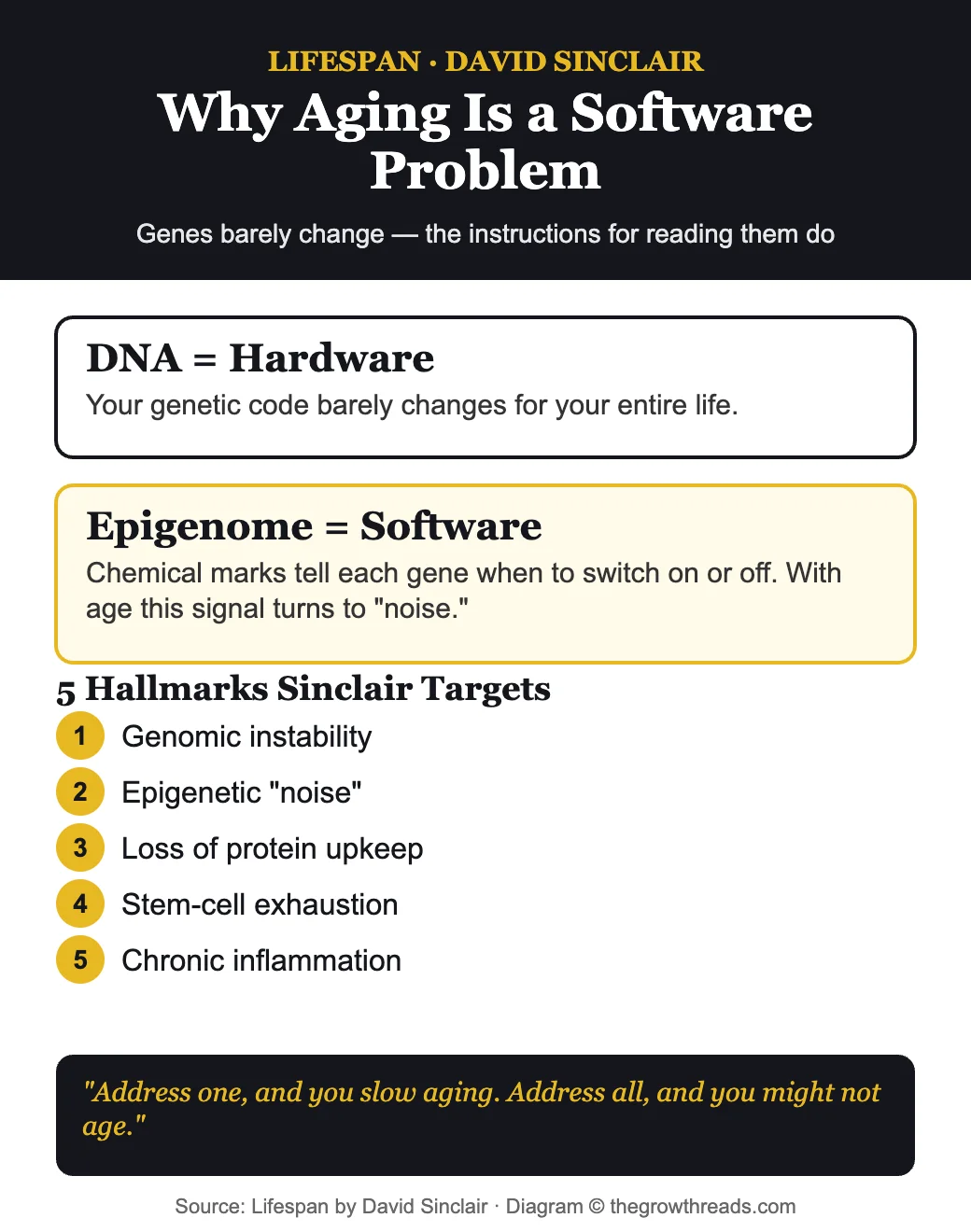
As Sinclair and LaPlante put it in the book, “Address one, and you can slow down aging. Address all, and you might not age.” That line is the hinge the rest of the book turns on: everything from Part 3 onward is really a menu of ways to address one or more of those five hallmarks — some available today, some still years from your medicine cabinet.
Part 3: Treating Aging Today — The Four Levers of Hormesis
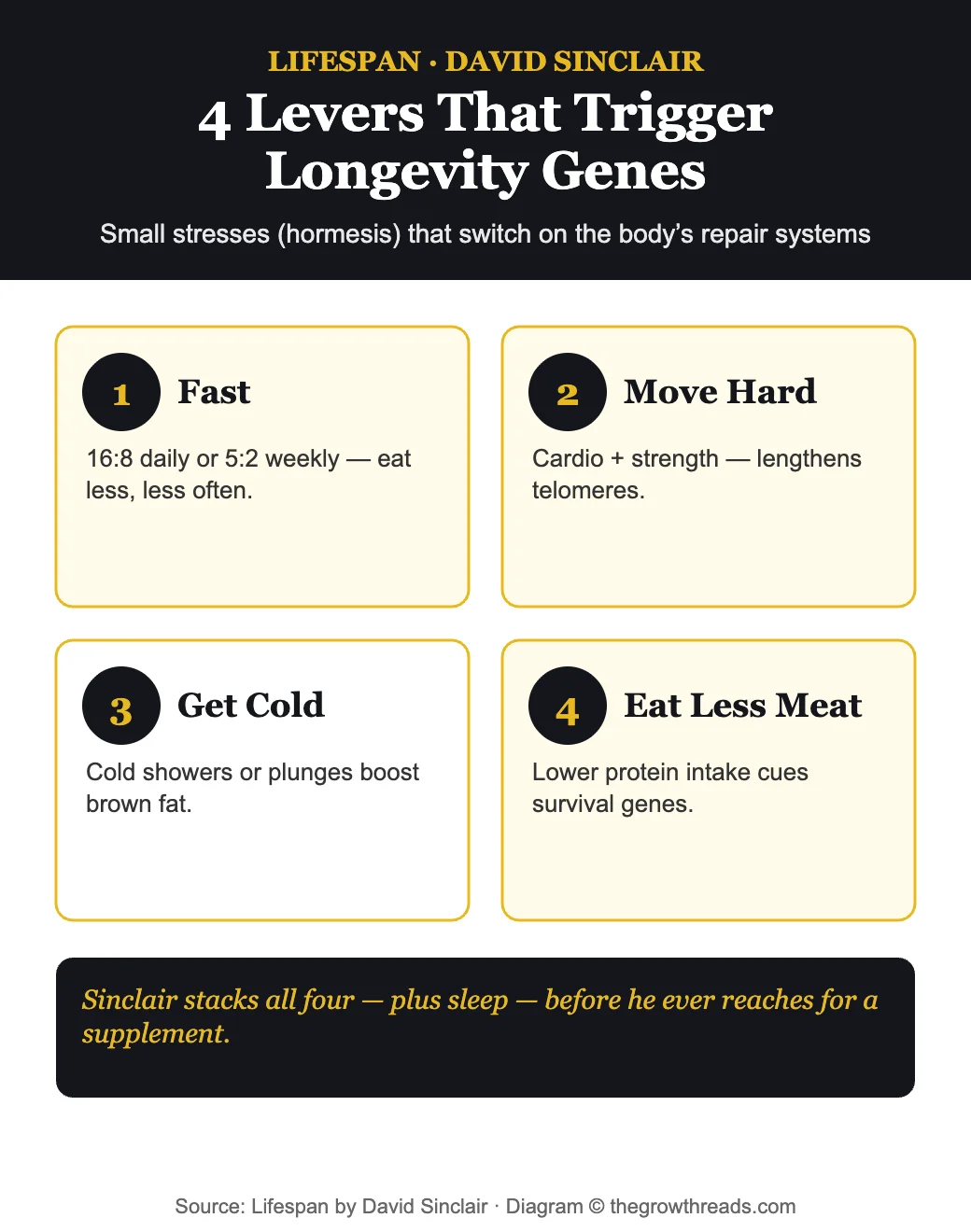
Sinclair’s practical case rests on a concept called hormesis: mild stress makes the body stronger by activating ancient survival and repair mechanisms. We already use hormesis without naming it — through dieting, exercise, and saunas — but Sinclair argues we can be far more deliberate about it. He highlights four levers with the strongest evidence behind them.
Fasting comes first. Sinclair discusses several patterns — the 16:8 method (eating within an 8-hour window), the 5:2 method (cutting calories by roughly 75% two days a week), and even a week of fasting once per quarter — and says the exact protocol matters less than triggering the stress response consistently. Reducing animal protein works through a similar channel: lower protein intake appears to activate some of the same survival genes as calorie restriction, which is part of why Sinclair leans toward a more plant-forward diet. Exercise is the third lever — and Sinclair points to research showing that exercise lengthens and protects telomeres, the protective caps on our chromosomes that shorten every time a cell divides. Once a telomere runs out, the cell stops dividing, contributing to the visible effects of aging. Finally, cold exposure — cold showers, cold plunges, or simply keeping your house cooler — appears to amplify the benefits of exercise when the two are combined, likely because both stressors activate overlapping repair pathways.
TGR Note: Cold exposure and hard breathing both trigger the same stress-adaptation systems Sinclair describes here. James Nestor’s Breath is a natural companion read if you want a deeper dive into how breathing practices specifically tap into that same hormetic machinery.
Beyond daily habits, Sinclair sees two nearer-term frontiers. The first is biomarker tracking: as DNA sequencing and wearable devices improve, it’s becoming possible to measure your biological age (via epigenetic “clocks” and blood panels) rather than relying on your birth certificate, and to see whether your habits are actually working before any symptom appears. The second is clearing senescent cells. As we age, some cells stop dividing but refuse to die — Sinclair calls them “zombie cells.” They send out inflammatory signals that damage nearby healthy tissue and can push neighboring cells into senescence too, creating a slow-motion cascade. In mouse studies, researchers who used drugs called senolytics to destroy senescent cells extended the animals’ remaining lifespan by a third or more and reversed several visible signs of aging. Human trials of senolytics began in 2018; Sinclair is candid that conclusive results for people are still years away.
Part 4: Where We’re Going — Reprogramming, Sinclair’s Own Stack, and the Future
Much of Sinclair’s own lab work centers on sirtuins — enzymes that repair DNA, calm inflammation, and help clean up the epigenetic “noise” described in Part 2. Sirtuins depend on a molecule called NAD+, which naturally declines as we age, leaving less fuel for repair right when it’s needed most. This is the biological logic behind NAD-boosting compounds and the sirtuin-activating molecule resveratrol, both of which have extended lifespan in animal studies; Sinclair is careful to note that human results are still being worked out.
The furthest edge of the book concerns cellular reprogramming. Stem-cell researcher Shinya Yamanaka discovered that four specific genes — now called Yamanaka factors — can take a mature adult cell and revert it to an immature, stem-cell-like state, which can then re-mature into a healthy young cell of any type. Sinclair’s own lab has shown partial reprogramming can restore vision in aged mice with damaged optic nerves. He believes a safe, targeted version of this technology could someday reset the biological clock on damaged tissue in humans — though he’s candid that safe, effective methods are likely at least a decade away.
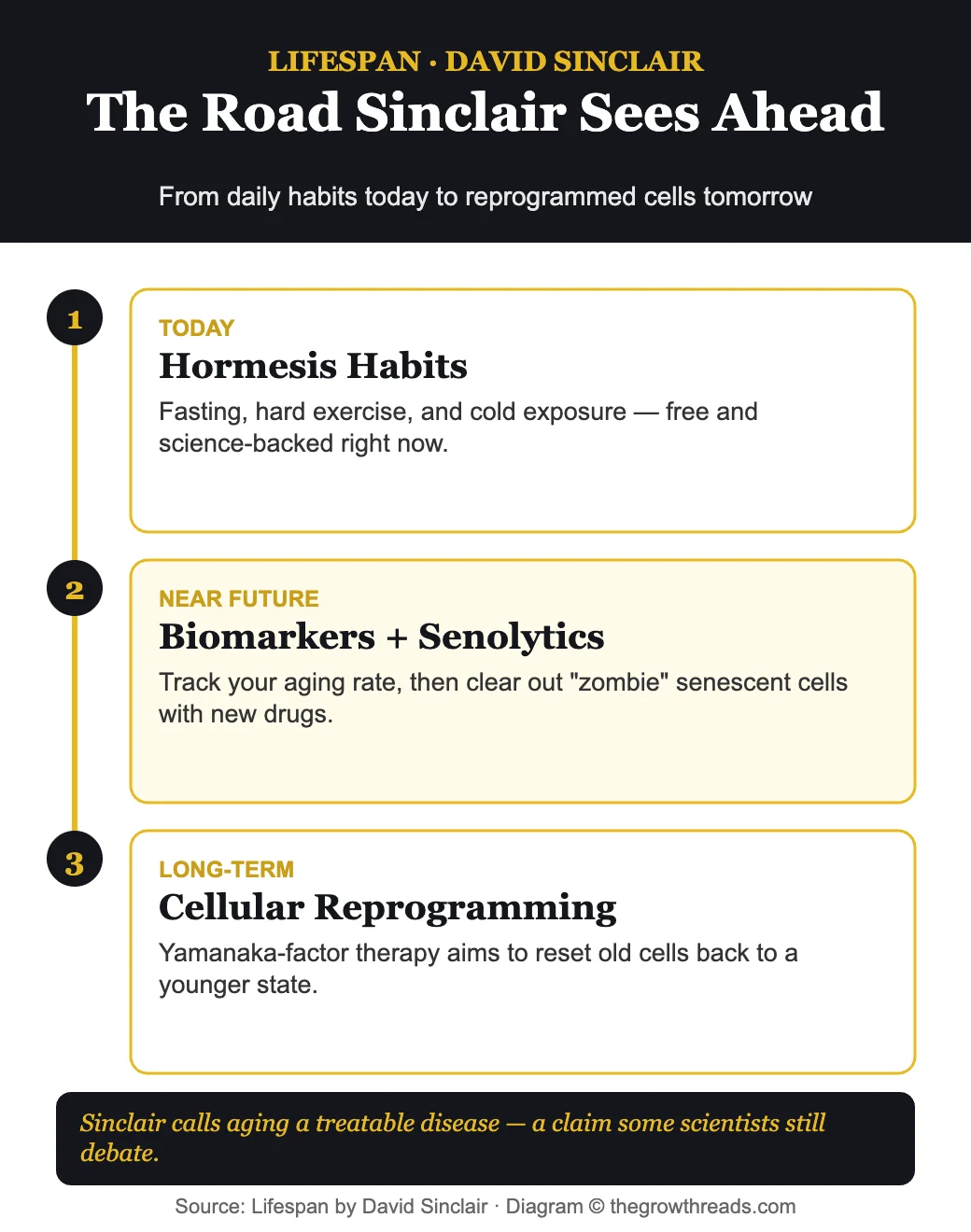
Sinclair is open about his own regimen, while stressing it’s a personal choice, not a prescription: he practices intermittent fasting, trains regularly, seeks out cold exposure, eats mostly plants, and takes a small stack that has included NMN, resveratrol (with a source of fat, since it’s fat-soluble), and metformin — though he’s said in interviews that his own supplement choices continue to evolve as new evidence comes in. The lifestyle habits, he emphasizes, come first; supplements are the last layer, not the foundation.
The book closes by zooming out to society. If radical life extension arrives, Sinclair acknowledges real risks: stagnating social progress if older generations don’t cede ground, widening wealth gaps if only the rich can access life-extending treatments first, and overpopulation. But he argues each concern is more manageable than it looks — global birth rates are already leveling off, technology has repeatedly expanded what the planet can sustainably support, and a healthier older population would keep contributing economically rather than becoming a growing care burden. His closing argument is less a prediction and more a call to plan for a future where 100-year health, not just 100-year life, becomes normal.
TGR Note: Notice how often Sinclair circles back to one unglamorous lever: sleep. If you want to shore up that foundation before anything else on this list, Matthew Walker’s Why We Sleep makes the single strongest case for why it may be the most underrated longevity habit of all.
Who is Lifespan best for — and who should read something else first?
Lifespan is best for readers who want the science behind the advice, not just a list of things to do. If you’re curious why fasting or cold showers might matter at a cellular level — not just that they’re generally considered healthy — Sinclair’s lab-level explanations will scratch that itch. It also suits early adopters who are genuinely interested in biomarker testing and the ethical questions around a much longer human lifespan.
If you’d rather start with a more clinically grounded, individualized risk-management approach and less speculative futurism, begin with Outlive instead. If the science feels like a lot up front and you’d rather build from one foundational habit, Why We Sleep is a gentler entry point. And if you want an immediately actionable, diet-first angle without the biotech detours, How Not to Die is the more direct read.
Questions to reflect on
- Which of the four hormesis levers — fasting, hard exercise, cold exposure, or lower protein intake — do you already practice, and which feels hardest to start?
- If aging is “a disease,” does that change how you think about your own health decisions today?
- Would you take a biological-age biomarker test if it were affordable and available? What would you do differently if the result came back worse than your calendar age?
- Sinclair takes several supplements based on early-stage research. Where’s your own line between “promising early data” and “wait for more evidence”?
- If healthy life expectancy jumped by twenty years in your lifetime, what would you want to do with those extra years?
🔥 Ready to Add Years to Your Life — and Life to Your Years?
Get Lifespan and start applying David Sinclair’s research today.
How to apply Lifespan (7-day plan)
- Day 1 — Pick a fasting window. Try stopping food three hours before bed, or ease toward a 12:12 or 16:8 eating window for the day.
- Day 2 — Add one hard session. Do 20–30 minutes of exercise intense enough to raise your heart rate noticeably. Intensity matters more than duration here.
- Day 3 — Try cold exposure. End your shower with 30–60 seconds of cold water, or take a short walk without an extra layer.
- Day 4 — Audit your protein. Swap one meat-based meal for a plant-based one and notice how it feels.
- Day 5 — Track your sleep. Note your time in bed, wake-ups, and how rested you feel — Sinclair treats sleep as foundational to every other lever.
- Day 6 — Research one biomarker test. Look into a basic blood panel or an at-home epigenetic clock and decide if and when you’d try one.
- Day 7 — Stack two levers. Combine a fasted morning with a workout, or a workout with a cold shower, and journal how you feel afterward.
Frequently asked questions
What is the “information theory of aging” in simple terms?
Sinclair’s theory says we age not because our DNA (the hardware) breaks down, but because the epigenome (the software that tells each gene when to switch on or off) accumulates errors over time. He compares it to scratches building up on a CD: the song is still encoded underneath, but the noise makes it harder to play correctly. This matters because it implies aging could, in principle, be reversed by clearing that “noise” rather than only slowed by preventing further damage — a more optimistic starting point than older damage-accumulation theories.
Does David Sinclair’s book recommend specific supplements?
Sinclair discusses compounds like NMN, resveratrol, and metformin because they influence pathways his lab studies — particularly sirtuins and NAD+ — and shares that he personally takes some of them. He’s consistently clear, though, that supplements sit on top of free lifestyle habits (fasting, exercise, cold exposure, sleep, and diet), not in place of them, and that human evidence for many compounds is still developing. Anyone considering supplements should discuss them with a doctor first, especially alongside existing medications.
Is the science in Lifespan widely accepted, or is it controversial?
It’s a mix. The underlying biology — hallmarks of aging, sirtuins, senescent cells, epigenetic drift — is active, credible research, and Sinclair’s own lab has contributed peer-reviewed work in the field. However, some scientists have publicly pushed back on specific claims in the book, including how directly yeast and mouse findings translate to humans and how soon reversal might be achievable, with at least one published critique calling parts of the book overly optimistic. The practical, well-supported basics — fasting, exercise, sleep, cold exposure — are uncontroversial; the boldest predictions about curing aging on a specific timeline are the part still being debated.
How long does it take to read Lifespan?
At roughly 310 pages, most readers finish Lifespan in six to seven hours of straight reading, or over a week or two at a relaxed pace of 20–30 pages a day. The book is organized into three parts — the past, present, and future of aging research — so it’s easy to read in one part at a time if you want to pause and apply the lifestyle sections before moving on to the more speculative later chapters.
What’s the difference between Lifespan and Outlive?
Lifespan is written by a geneticist and focuses on the cellular biology of why we age, plus emerging biotechnology like reprogramming and senolytics. Outlive, by physician Peter Attia, focuses more on individualized clinical strategy — bloodwork, exercise prescriptions, and preventing the specific diseases most likely to shorten your life. They’re complementary rather than competing: Lifespan explains the mechanisms, Outlive translates them into a personal action plan.
Can you actually reverse aging based on what’s in the book?
Not yet, at least not dramatically. The lifestyle levers in the book (fasting, exercise, cold exposure, sleep) are well-supported ways to support your body’s existing repair systems, but they don’t reverse aging outright. The more dramatic reversal Sinclair describes — cellular reprogramming via Yamanaka factors — has worked in specific lab and animal studies, not yet as an approved human treatment. Readers should treat the book as a roadmap for a field in progress, not a set of guaranteed results.
What is intermittent fasting and how does it relate to longevity, according to Sinclair?
Intermittent fasting means restricting eating to certain windows of time — Sinclair discusses the 16:8 method (an 8-hour eating window daily), the 5:2 method (sharply reduced calories two days a week), and even a week-long fast once a quarter. He argues fasting works by triggering hormesis: a mild stress response that activates ancient survival genes tied to cellular repair and stress resistance. He says the specific protocol matters less than fasting consistently enough to trigger that response.
Related summaries
- Outlive by Peter Attia — a clinical, individualized approach to the same longevity question.
- Why We Sleep by Matthew Walker — the foundational habit Sinclair keeps circling back to.
- Breath by James Nestor — more on the hormesis-adjacent power of breathing and cold.
- How Not to Die by Michael Greger — a diet-first companion to Sinclair’s protein and fasting advice.
- See all our picks on the best health books pillar page.