

★★★★☆ 4.3/5 — A compelling investigation into why the modern world makes sustained attention nearly impossible, packed with surprising science and bold solutions.
Best for: Anyone who feels increasingly scattered and wants to understand the forces behind it — not just the personal fixes, but the systemic causes.
Reading time: ~6.5 hours (304 pages)
Difficulty to apply: Medium — individual strategies are straightforward, but the book argues real change requires collective action.
Stolen Focus in one minute
Your inability to focus is not a personal failing — it is the predictable result of a system designed to fragment your attention. Johann Hari traveled the world interviewing leading scientists and experts to identify twelve causes of the attention crisis, from the design of social media to sleep deprivation to rising stress levels. His central argument is that while personal interventions help, the attention crisis will only be solved when we demand systemic changes to the technology, workplaces, and economic structures that profit from our distraction. The book offers both individual strategies you can start today and a framework for understanding why the problem runs far deeper than willpower.
Key takeaways
- Attention is not just willpower: Your ability to focus is shaped by at least twelve external forces, most of which are outside your individual control.
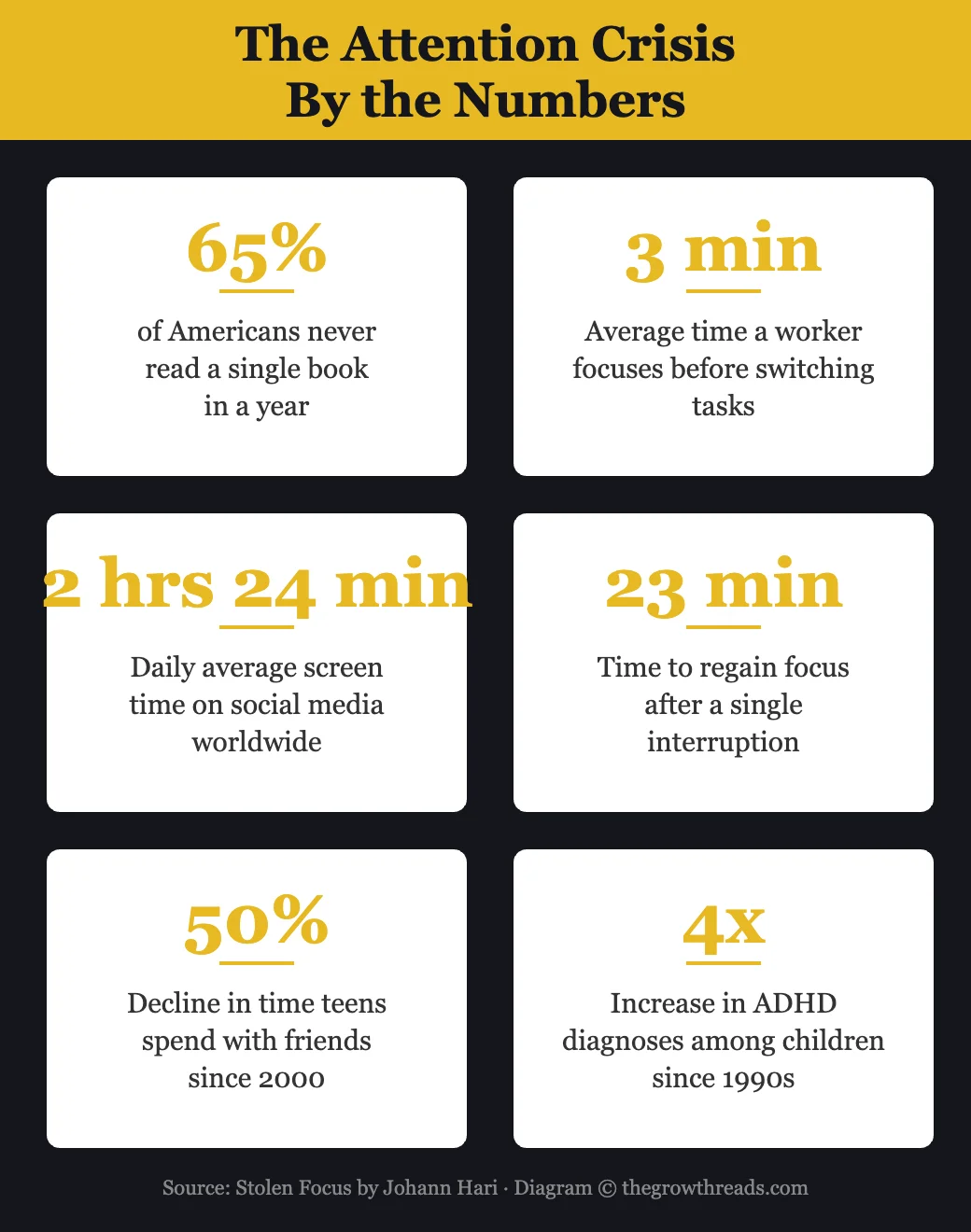
- Switching has a cost: Every time you shift between tasks, your brain pays a cognitive tax — research suggests it takes an average of twenty-three minutes to fully refocus after an interruption.
- Flow states require protection: Deep focus emerges when you have a clear goal, immediate feedback, and the task slightly exceeds your skill level — conditions modern work systematically destroys.
- Sleep deprivation is an attention killer: Losing even one hour of sleep significantly impairs your ability to concentrate, learn, and make decisions.
- Surveillance capitalism profits from distraction: Social media platforms are engineered to maximise engagement, not wellbeing — your attention is the product being sold.
- Children are especially vulnerable: The rise in childhood ADHD diagnoses correlates with reduced play, increased screen time, and environments that demand sustained stillness from developing brains.
- Mind-wandering is productive: Letting your mind wander freely — without reaching for a phone — is essential for creativity, problem-solving, and emotional processing.
- Diet affects focus directly: Blood-sugar spikes and crashes from ultra-processed food impair cognitive function and sustained attention.
- Stress shrinks the brain: Chronic stress physically reduces the size of brain regions responsible for attention, memory, and impulse control.
- Individual fixes alone are insufficient: Personal digital detoxes are like cleaning up pollution one cup at a time — real change requires redesigning the systems that pollute our attention in the first place.
What is Stolen Focus about?
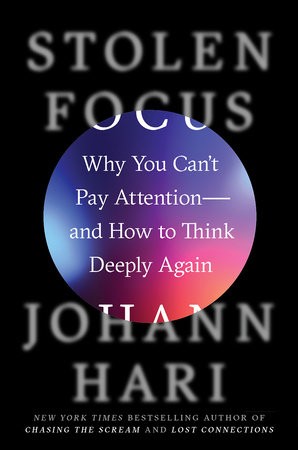
Stolen Focus investigates twelve causes behind the global decline in human attention, arguing that the crisis stems from systemic forces — technology design, work culture, diet, pollution, sleep loss, and stress — rather than individual weakness. Hari combines investigative journalism with cognitive science to propose both personal strategies and structural reforms.
About the author
Johann Hari is a British-Swiss journalist and bestselling author known for his investigative approach to complex social issues. His previous books, Chasing the Scream and Lost Connections, challenged conventional thinking on addiction and depression respectively. He has written for The New York Times, The Los Angeles Times, and The Guardian, and his TED talks have been viewed over 80 million times. Hari spent three years travelling to interview over 250 experts while researching Stolen Focus, visiting labs, clinics, and communities across multiple continents to understand the attention crisis from every angle. Explore all Johann Hari book summaries →
Key concepts at a glance
| Concept | What it means | Use it when |
|---|---|---|
| Spotlight attention | Narrowing focus onto a single task | You need deep work on a complex problem |
| Starlight attention | Slow, diffuse focus on long-term goals | You feel lost about life direction or purpose |
| Daylight attention | Broad awareness that connects ideas creatively | You need creative insight or synthesis |
| The switch-cost effect | Cognitive penalty from task-switching | You catch yourself toggling between apps |
| Flow states | Deep immersion where attention locks effortlessly | You design work sessions for maximum engagement |
| Cruel optimism | Believing personal discipline alone can fix systemic problems | You blame yourself for distractibility |
| Mind-wandering | Unfocused mental processing that enables creativity | You want to solve problems your conscious mind cannot |
| Surveillance capitalism | Business model that profits from capturing attention | You want to understand why apps are designed to hook you |
Part 1: The personal causes of the attention crisis
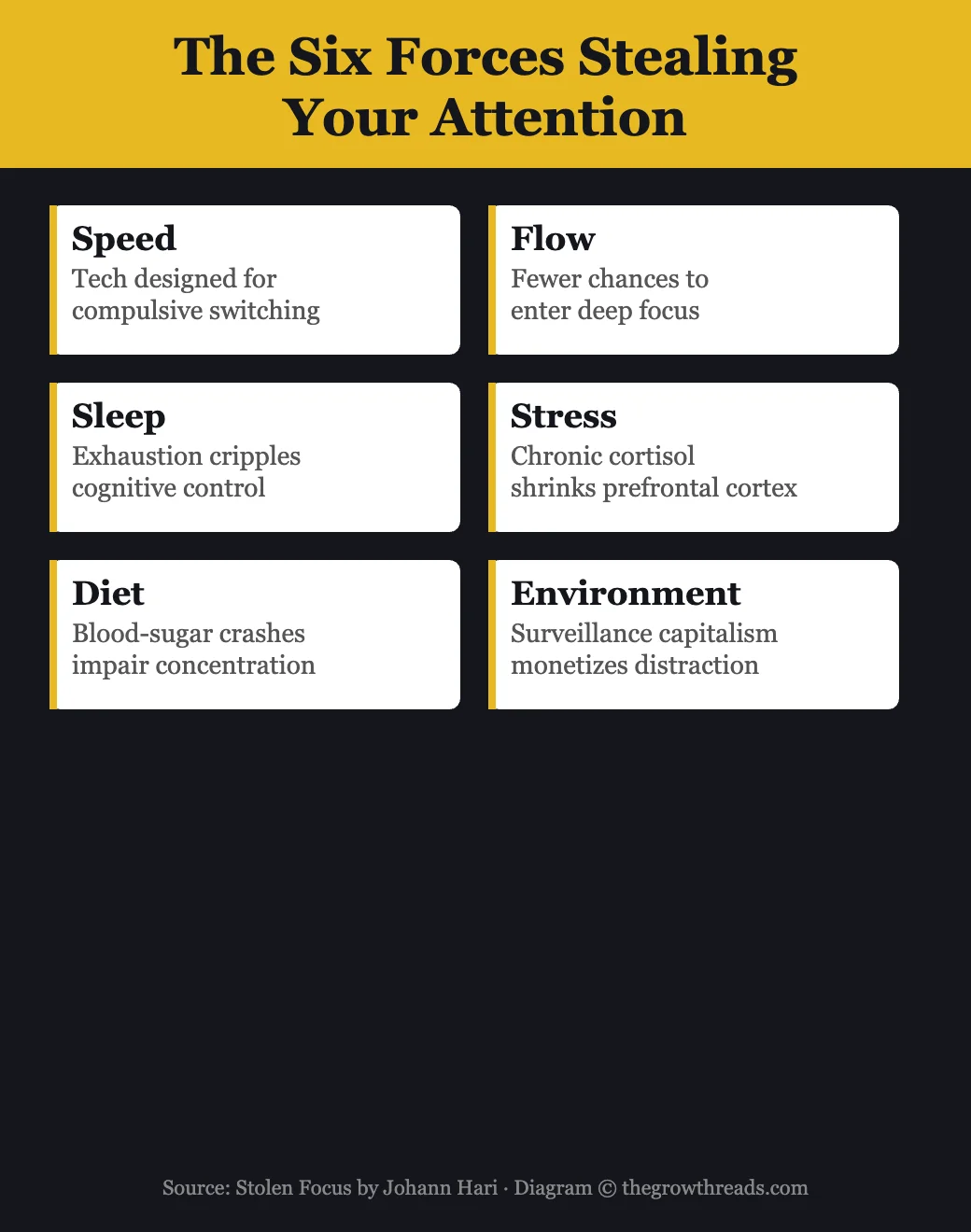
Hari opens by describing his own experience of struggling to read books he once devoured in a single sitting. He visits Professor Earl Miller at MIT, who explains one of the most important findings in attention research: the human brain cannot truly multitask. What feels like multitasking is actually rapid switching between tasks, and every switch carries a cognitive cost. Miller’s research demonstrates that people who believe they are good multitaskers are actually performing worse on each individual task — they just cannot perceive their own decline.
Hari then explores the work of Mihaly Csikszentmihalyi on flow states — those rare periods of deep immersion where attention locks effortlessly onto a task. Flow requires three conditions: a clear goal, immediate feedback, and a challenge level that slightly exceeds your current skill. The problem, Hari argues, is that modern environments systematically prevent these conditions from arising. Open-plan offices, constant notifications, and meeting-heavy calendars shatter the uninterrupted time flow demands.
The section also covers how physical exhaustion undermines attention. Professor Charles Czeisler at Harvard has documented that even modest sleep loss — getting six hours instead of eight — degrades concentration, working memory, and emotional regulation as severely as being legally drunk. Yet society treats sleep deprivation as a badge of productivity rather than a cognitive impairment.
Part 2: Technology and the design of distraction
The book’s most provocative section examines how technology companies deliberately engineer their products to capture and hold attention. Hari interviews Aza Raskin, the inventor of infinite scroll, who expresses deep regret about the feature. Raskin calculates that infinite scroll collectively costs humanity around 200,000 additional hours of scrolling every single day. He did not design it to be addictive — he designed it to remove a natural stopping cue, and the effect was catastrophic.
Hari visits Silicon Valley and speaks to former employees of major tech companies who describe the internal metrics that drive product design. Engagement — measured in time spent and interactions — is the metric that determines success. When engagement conflicts with user wellbeing, engagement wins every time. The algorithms learn what provokes strong emotional reactions, and outrage and anxiety generate more engagement than calm satisfaction. This is not a bug but a feature of the advertising-based business model Shoshana Zuboff calls surveillance capitalism.
The section draws a powerful analogy to the lead paint industry. For decades, companies told consumers that lead exposure was a matter of personal responsibility — wash your hands, keep children away from peeling paint. But the real solution was banning lead paint entirely. Hari argues the same logic applies to attention-draining technology: telling individuals to practice digital discipline while the entire system is designed to undermine that discipline is a form of what Lauren Berlant called cruel optimism.
Part 3: The social and environmental causes
Hari broadens his investigation beyond screens to examine how diet, pollution, stress, and the erosion of childhood play all contribute to the attention crisis. He visits researchers studying the effects of ultra-processed food on cognitive function and finds that blood-sugar roller coasters — the sharp spikes and crashes caused by refined carbohydrates — directly impair sustained attention. Studies show that children who eat more processed food score lower on attention tests, independent of other factors.
The chapter on stress draws on the work of neuroscientists who have documented how chronic stress physically shrinks the prefrontal cortex — the brain region most critical for sustained attention, impulse control, and working memory. In an economy that produces rising financial insecurity and longer working hours, stress is not just an emotional burden but a neurological one. Hari argues that attention cannot be understood without understanding the economic conditions that produce chronic anxiety.
Perhaps the most emotionally powerful chapter covers children. Hari visits schools, paediatricians, and researchers who study the dramatic rise in ADHD diagnoses. He presents evidence that the increase correlates with reduced unstructured play, increased academic pressure on young children, and environments that demand sustained stillness from brains that are developmentally wired for movement and exploration. He does not deny that ADHD is real but argues that environmental factors are dramatically inflating its prevalence.
Part 4: Reclaiming attention — what actually works
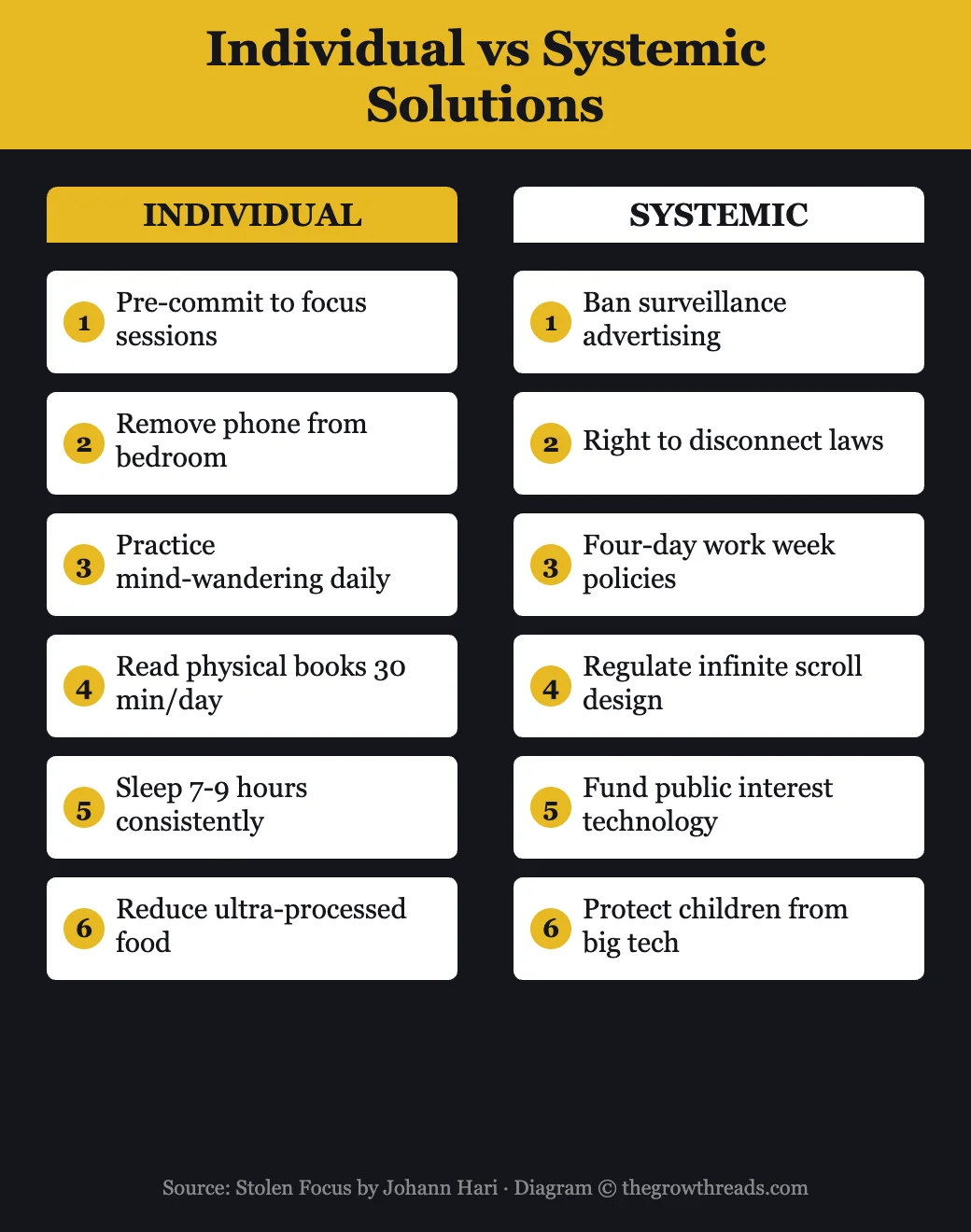
Hari’s final section proposes solutions at both the individual and systemic level. On the personal side, he advocates for pre-commitment — deliberately removing the option to be distracted before the temptation arises. This means locking your phone in a timed safe during deep work, rather than relying on willpower to resist checking it. He also champions the practice of deliberate mind-wandering: scheduling time to do nothing, without any device, and letting your mind roam freely. Research shows this activates the brain’s default mode network, which is essential for creativity, long-term planning, and making sense of your experiences.
But Hari’s most distinctive contribution is his argument that individual solutions are necessary but insufficient. He profiles communities and countries that have implemented systemic changes. France’s “right to disconnect” law prohibits employers from contacting workers outside office hours. Several Scandinavian companies have tested four-day work weeks with no loss in productivity and measurable gains in employee focus and wellbeing. Hari argues for banning the surveillance advertising model — removing the financial incentive for tech companies to maximise time-on-screen — and replacing it with subscription-based models that align company interests with user wellbeing.
The book ends with a call to action that reframes the attention crisis as a political issue, not just a personal one. Just as the environmental movement succeeded not by asking individuals to pollute less but by demanding regulatory change, Hari argues the attention movement must demand that the systems which profit from distraction be fundamentally redesigned.
Who is Stolen Focus best for — and who should read something else first?
Stolen Focus is ideal for anyone who senses their ability to concentrate has declined and wants to understand why — especially readers who are tired of being told the solution is simply “put your phone down.” It is particularly strong for parents, educators, and managers who want to understand the systemic forces behind the attention crisis. If you are looking for a purely practical productivity system with step-by-step tactics, you will find more actionable structure in Deep Work or Make Time. If you want to understand the neuroscience of habit formation rather than the politics of attention, start with Atomic Habits.
Questions to reflect on
- When was the last time you spent thirty uninterrupted minutes on a single task without checking any device — and how did it feel?
- Which of Hari’s twelve causes of the attention crisis resonates most with your own experience?
- Do you tend to blame yourself for being distracted, or do you recognise the systemic forces at play?
- How has your ability to read books, watch films, or have long conversations changed over the past decade?
- If you could change one structural thing about your work environment to protect your attention, what would it be?
🔥 Ready to understand why your attention keeps disappearing?
Stolen Focus will change how you think about distraction — and what you can actually do about it.
How to apply Stolen Focus (7-day plan)
- Day 1 — Audit your interruptions: Track every time you switch tasks or check your phone for one full day. Write down each interruption and its source. Most people are shocked by the number.
- Day 2 — Create a phone-free morning: Keep your phone in another room for the first 60 minutes after waking. Use this time for reading, thinking, or a quiet breakfast without any screen.
- Day 3 — Design one deep work block: Schedule a 90-minute block with all notifications disabled. Work on a single meaningful task. Notice how long it takes your mind to settle into focus.
- Day 4 — Practice deliberate mind-wandering: Take a 20-minute walk without your phone, headphones, or any input. Let your mind go wherever it wants. Observe what surfaces.
- Day 5 — Audit your diet: Track what you eat and notice any energy crashes that coincide with attention dips. Replace one ultra-processed snack with whole food and observe the difference.
- Day 6 — Protect your sleep: Set a firm screen curfew 60 minutes before bed. Aim for eight hours of sleep and notice how your focus feels the next morning compared to a short night.
- Day 7 — Identify one systemic change: Look at your workplace, school, or household. Identify one structural change — a meeting-free morning, a family device policy, a right-to-disconnect norm — and propose it.
Frequently asked questions
Is Stolen Focus an anti-technology book?
Not exactly. Hari is careful to distinguish between technology itself and the business model that drives its design. He does not argue that smartphones or social media are inherently harmful. His critique targets the surveillance advertising model that incentivises companies to maximise engagement at the expense of user wellbeing. He advocates for redesigning these incentives — through regulation or alternative business models — rather than abandoning technology altogether.
Does Hari believe ADHD is not real?
Hari explicitly states that ADHD is a real neurological condition. His argument is that environmental factors — reduced play, increased screen time, dietary changes, and educational environments that demand prolonged stillness — are dramatically increasing the number of children who display ADHD-like symptoms without necessarily having the underlying neurological condition. He calls for addressing these environmental causes alongside medical treatment for those who genuinely need it.
What are the twelve causes of the attention crisis?
Hari identifies: the increase in speed and switching, the crippling of flow states, the rise of physical and mental exhaustion, the collapse of sustained reading, the disruption of mind-wandering, the rise of technology designed to hack attention, the surge in stress and vigilance, the deterioration of diet, rising pollution, the decline of childhood free play, the rise of ADHD overdiagnosis, and the confinement of children to controlled environments. Each cause is backed by interviews with researchers and visits to relevant communities or labs.
How does Stolen Focus compare to Digital Minimalism?
Both books address the attention crisis, but they differ in scope and solution. Cal Newport’s Digital Minimalism focuses primarily on individual strategies — curating your technology use, scheduling analog activities, and building a personal philosophy of tech. Hari agrees these steps help but argues they are insufficient without systemic change. Stolen Focus spends significant time on structural causes like surveillance capitalism, workplace culture, and childhood environments that Newport does not address in depth.
What is the “cruel optimism” concept in Stolen Focus?
Hari borrows the term from cultural theorist Lauren Berlant to describe the belief that individual willpower can solve problems that are fundamentally structural. Applied to attention, cruel optimism is the conviction that if you just tried harder to focus, deleted the right apps, or followed the right morning routine, your attention would return to normal. Hari argues this ignores the overwhelming systemic forces designed to capture your attention, making individual resistance feel like bailing water from a sinking boat.
Is Stolen Focus scientifically rigorous?
Hari interviews over 250 experts and grounds most claims in published research. Some statistics he cites — such as the average attention span declining to eight seconds — have been debated by researchers who question the original methodology. However, the core arguments about task-switching costs, the effects of sleep deprivation on cognition, and the design principles behind social media engagement are well-supported by peer-reviewed science. The practical advice is uncontroversial even where specific numbers are contested.
Can I apply the ideas in Stolen Focus at work?
Yes — several strategies translate directly to workplace settings. You can advocate for meeting-free mornings, propose notification-off deep work blocks, and push for policies that protect uninterrupted focus time. Hari highlights companies that have implemented four-day work weeks and no-email-after-hours policies with measurable improvements in both productivity and employee wellbeing. The key insight is framing attention protection as a productivity gain, not an indulgence, which makes it easier to propose to management.
Related summaries
- Deep Work by Cal Newport — The tactical playbook for building sustained focus sessions.
- Digital Minimalism by Cal Newport — A personal philosophy for intentional technology use.
- Make Time by Jake Knapp and John Zeratsky — A practical framework for choosing a daily highlight and protecting it from distraction.
- Indistractable by Nir Eyal — A four-step model for mastering internal triggers and becoming less distractible.
📚 Explore more in our Best Productivity Books guide.