

★★★★½ 4.4 / 5
One-liner: An infectious disease doctor eats nothing but ultra-processed food for a month, gains weight rapidly, and then dismantles the science of how the food industry engineers addiction — making the most important nutrition book of the decade.
Best for: Anyone who eats packaged food (which is everyone), parents making food decisions for their families, and readers who want to understand why obesity is systemic, not personal.
Reading time: ~7 hrs (guide: 26 min)
Difficulty to apply: Moderate (UPF is everywhere — reducing it requires active effort)
Ultra-Processed People in one minute
Most of what we call “food” is not food at all — it is an industrially manufactured substance engineered to override your appetite signals and keep you eating. Chris van Tulleken, an infectious disease doctor at University College London, puts himself through a controlled experiment: for one month, he eats a diet where 80% of calories come from ultra-processed food (UPF) — the same proportion consumed by many people in the US and UK. The results are swift and alarming: rapid weight gain, disrupted sleep, anxiety, sluggish digestion, and measurable changes in brain activity resembling addictive patterns. The book then traces the science of UPF: how the food matrix is destroyed during manufacturing (making calories absorb faster), how emulsifiers damage the gut lining, how flavour engineering creates compulsive eating, and how the industry has systematically blocked regulation. The conclusion is not that you lack willpower — it is that these products are designed to be impossible to stop eating.
Key takeaways
- UPF is not food — it is an industrial product: Ultra-processed food contains substances never found in a domestic kitchen: modified starches, emulsifiers, hydrolysed proteins, maltodextrin, and hundreds of additives that exist to extend shelf life, enhance flavour, and reduce manufacturing cost.
- 60% of calories in the US/UK diet come from UPF: For children and low-income populations, the figure is even higher. Ultra-processed products now constitute the majority of what most people eat.
- UPF makes you eat 500 extra calories per day: The NIH’s 2019 Hall study — the gold-standard randomised controlled trial — found that people on a UPF diet consumed 500 more calories per day than those on a whole-food diet, even when meals were matched for macronutrients, fibre, sugar, and salt.
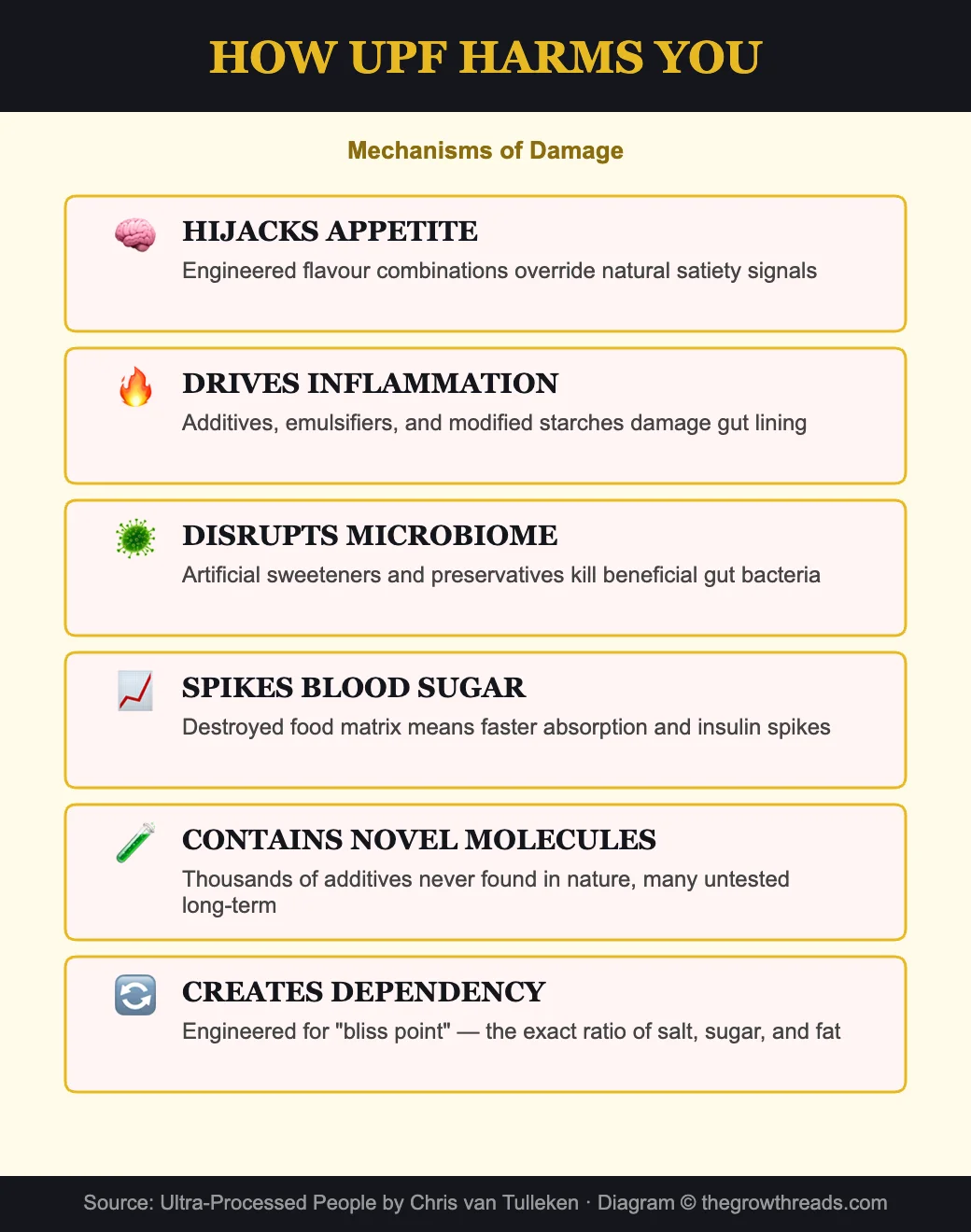
- The food matrix is the key concept: When food is industrially processed, its natural structure (the “matrix”) is destroyed. This means nutrients absorb faster, blood sugar spikes higher, and satiety signals arrive too late — you overeat before your body realises it is full.
- Emulsifiers damage the gut lining: Additives like polysorbate 80 and carboxymethylcellulose, found in ice cream, bread, and sauces, erode the mucus layer of the gut, increasing permeability and driving chronic inflammation.
- UPF is engineered for addiction: The “bliss point” — the precise ratio of salt, sugar, and fat that maximises craving — is calculated by food scientists. Van Tulleken’s brain scans during his UPF diet showed patterns consistent with substance addiction.
- The industry systematically blocks regulation: UPF companies fund research, lobby governments, sponsor nutrition conferences, and use the same playbook the tobacco industry developed to delay regulation.
- Poverty drives UPF consumption: UPF is cheaper per calorie than whole food, more convenient, and more heavily marketed in lower-income areas — making obesity a poverty issue, not a willpower issue.
- Reading labels is insufficient: Even “healthy” UPF products (protein bars, diet shakes, whole-grain breakfast cereals) are still ultra-processed and still drive overconsumption through the same mechanisms.
- The solution is structural, not individual: While individuals can reduce UPF intake, lasting change requires regulation: front-of-pack warnings, advertising restrictions, subsidies for whole food, and banning the worst additives.
What is Ultra-Processed People about?
Ultra-Processed People investigates why the majority of food in wealthy nations is now industrially manufactured rather than cooked. Chris van Tulleken combines his own self-experiment, the latest nutrition research, and food industry exposés to argue that ultra-processed food is engineered to override human appetite and is the primary driver of the obesity and chronic disease epidemics.
About the author
Chris van Tulleken, MBBS, BSc, PhD, FRCP, is an infectious disease doctor at the Hospital for Tropical Diseases and associate professor at University College London. He is also a BBC television presenter, known for making complex medical topics accessible to broad audiences. His twin brother, Xand, is also a doctor and media personality. Van Tulleken’s academic research focuses on how commercial determinants of health — particularly the food industry — shape population health outcomes. Ultra-Processed People became a Sunday Times bestseller in the UK and an international phenomenon, praised by scientists and public health advocates for translating complex food science into a compelling, evidence-based narrative that has already influenced policy debates. Explore all Chris van Tulleken book summaries →
Key concepts at a glance
| Concept | What it means | Use it when |
|---|---|---|
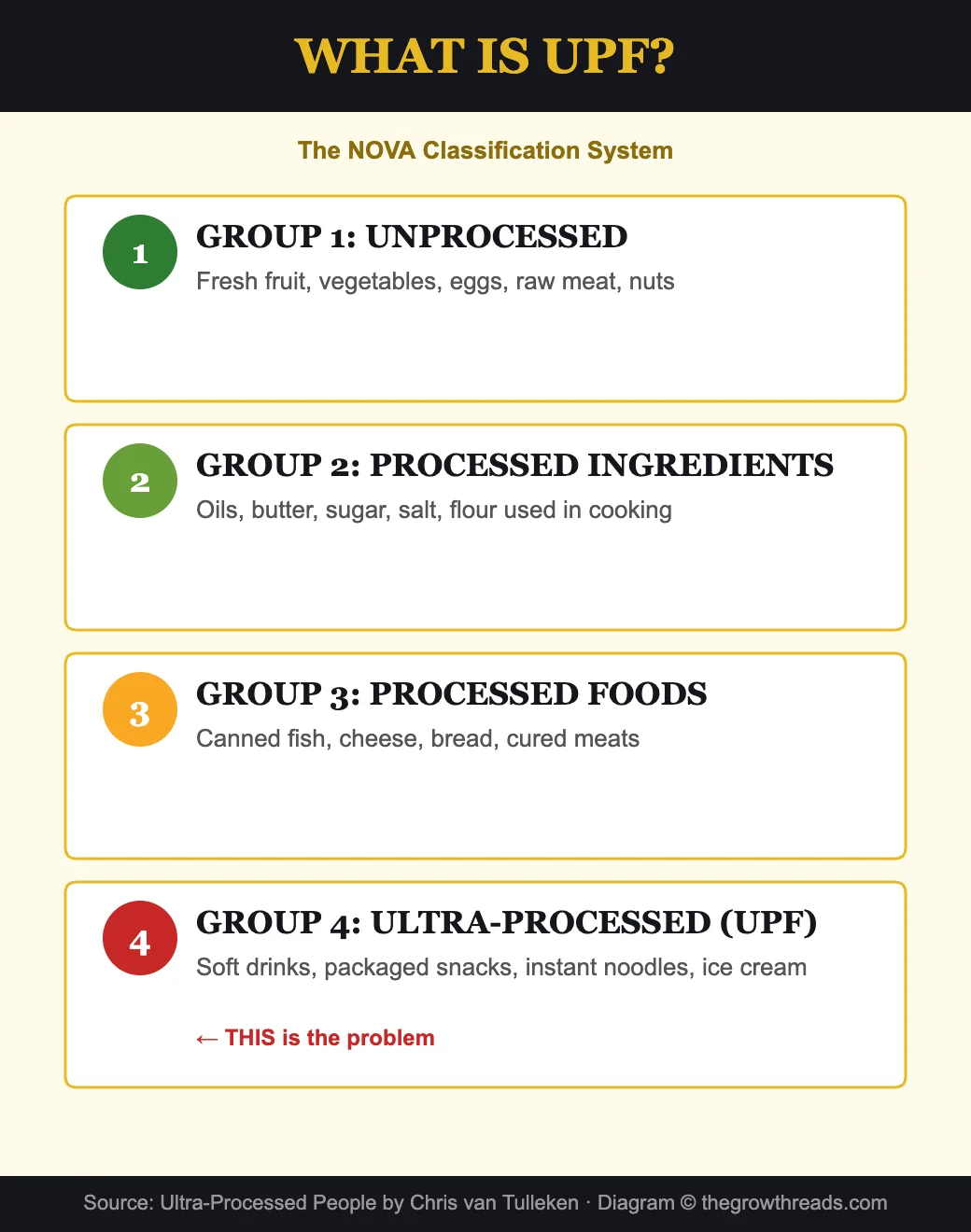
| NOVA classification | A system categorising food into 4 groups by degree of processing, from unprocessed to ultra-processed | You want to identify UPF in your diet |
| Food matrix | The natural physical structure of food that controls how quickly nutrients are absorbed | You want to understand why whole food fills you up and UPF does not |
| Bliss point | The precise ratio of salt, sugar, and fat engineered to maximise craving | You wonder why you cannot stop eating certain products |
| Emulsifiers | Additives that keep oil and water mixed in products — linked to gut lining damage | You are reading ingredient labels |
| Hall study (2019) | NIH randomised controlled trial showing UPF drives 500 extra calories/day | You want the strongest evidence that UPF causes overeating |
| Commercial determinants of health | How corporate practices shape population health outcomes through product design, marketing, and lobbying | You want to understand obesity as a systemic issue |
Part 1 — The self-experiment
Van Tulleken opens with his own body as the laboratory. For one month, he ate a diet where 80% of calories came from ultra-processed food — the same proportion consumed by a significant portion of the British and American population. This was not junk food in the traditional sense: it included “healthy” branded cereals, protein bars, diet drinks, ready meals, and whole-grain bread — products most people would consider normal, even virtuous.
The results were rapid and measurable. He gained roughly 6.5 kilograms. His sleep became disrupted. He experienced constipation, heartburn, and a pervasive sluggishness. Most strikingly, brain scans conducted by researchers at University College London showed that the connectivity between brain regions associated with reward and habitual behaviour had changed in ways that mirror patterns seen in substance addiction. The UPF diet had not just made him fatter — it had begun to rewire his brain’s motivation circuitry in a single month.
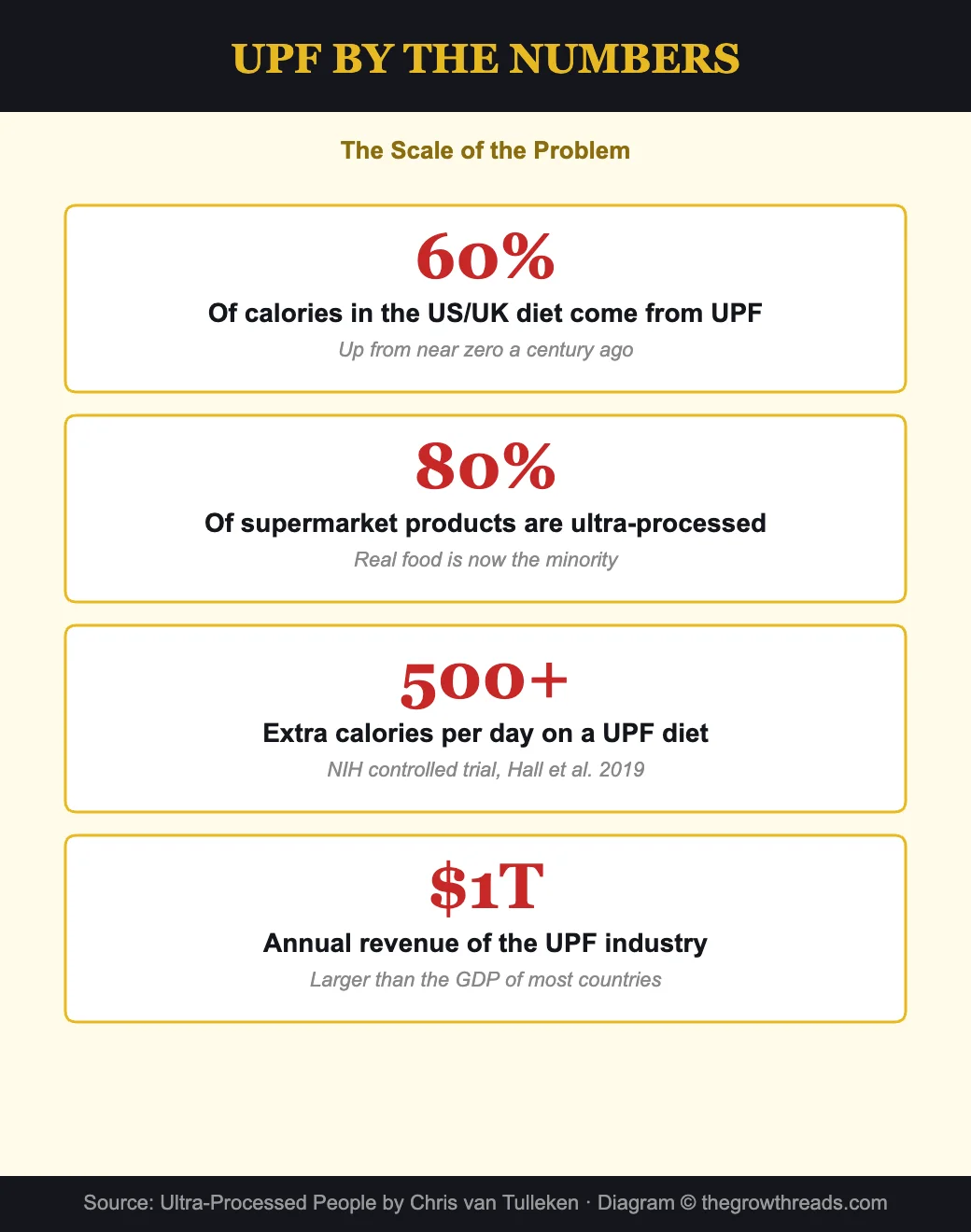
He contrasts his experience with the 2019 NIH study led by Kevin Hall — the most rigorous nutrition study ever conducted on this question. Hall housed participants in a metabolic ward for four weeks and gave them unlimited access to either a UPF diet or a whole-food diet, carefully matched for macronutrients, fibre, sugar, salt, and calorie density. The UPF group ate approximately 500 more calories per day and gained weight; the whole-food group lost weight. The difference was not about the nutrients — it was about the processing. This single study demolishes the “a calorie is a calorie” argument.
Part 2 — The science of UPF
The middle section unpacks the mechanisms by which UPF drives overconsumption and disease. The food matrix concept is central. When you eat a whole apple, the fibre matrix slows sugar absorption, giving your liver time to process fructose and your gut time to register satiety. When you drink apple juice — even “100% natural” juice — the matrix is destroyed: the sugar arrives in a bolus, the liver converts excess to fat, and your appetite system barely registers the calories. UPF takes this destruction further: industrial processes break down cell structures, gelatinise starches, hydrolyse proteins, and reconstitute ingredients into forms that are absorbed almost instantly.
The emulsifier evidence is particularly alarming. Substances like polysorbate 80 and carboxymethylcellulose — present in everything from ice cream to salad dressing to bread — have been shown in animal studies to erode the mucus layer that protects the gut lining. This increases intestinal permeability (“leaky gut”), allowing bacterial toxins to enter the bloodstream and trigger chronic low-grade inflammation. The same inflammation that is linked to obesity, type 2 diabetes, heart disease, and certain cancers. Van Tulleken notes that these additives are classified as “generally recognised as safe” (GRAS) based on decades-old assessments that never tested their effects on the gut microbiome — because the microbiome had not been discovered yet.
The flavour engineering chapter is where the addiction comparison crystallises. Food scientists optimise products for the “bliss point” — the precise combination of salt, sugar, fat, and flavour that maximises craving without causing conscious aversion. This is not conspiracy theory; it is published food science. The goal is what the industry calls “moreishness” — the inability to stop after one serving. Van Tulleken argues this meets the clinical definition of addictive engineering: creating a substance that drives compulsive consumption despite negative consequences.
Part 3 — The industry and the solution
The final section examines how the UPF industry maintains its dominance despite growing evidence of harm. Van Tulleken draws explicit parallels with the tobacco industry’s playbook: funding sympathetic research, creating doubt about unfavourable studies, lobbying against regulation, sponsoring health conferences and professional organisations, and framing obesity as a personal responsibility issue rather than a product-design issue.
The poverty dimension is crucial. UPF is cheaper per calorie than whole food in most Western countries. It is more convenient (longer shelf life, minimal preparation), more heavily marketed in lower-income areas, and more addictive by design. This means obesity is not a failure of willpower among the poor — it is the predictable result of an economic system that makes harmful food the most accessible option. Van Tulleken argues that individual dietary advice, while not useless, is insufficient. The problem is structural and requires structural solutions: front-of-pack UPF warnings (like Chile and Mexico have implemented), restrictions on marketing to children, reformulation mandates, subsidies for fresh produce, and banning the most harmful additives.
For individual readers, his practical advice is straightforward: cook more, from ingredients. If a product contains substances you would not find in a domestic kitchen (emulsifiers, modified starches, flavour enhancers, hydrolysed proteins), it is ultra-processed. You do not need to eliminate all UPF — that is nearly impossible in the modern food environment — but reducing it from 60% to 30–40% of your calories would make a meaningful difference to your health, your appetite regulation, and your microbiome.
Who is Ultra-Processed People best for — and who should read something else first?
This is essential reading for anyone who eats — which is everyone. It is particularly valuable for parents making food decisions for their families, for anyone struggling with weight despite “eating well” (you may be eating more UPF than you realise), and for health professionals who want to understand the food-industry mechanisms behind the obesity epidemic. Van Tulleken writes with anger, humour, and scientific rigour in equal measure.
If you want the simplest dietary guidance without the industry exposé, start with In Defense of Food. If the metabolic science interests you more than the political science, The Obesity Code focuses on insulin and hormonal regulation. And if gut health is your primary concern, Gut by Giulia Enders provides the foundational digestive science that explains why emulsifiers are so damaging.
Questions to reflect on
- What percentage of your daily calories come from products you could not make in a home kitchen?
- When you eat a food you “cannot stop eating,” is that your lack of willpower or the product’s engineering?
- How many ingredients on your favourite packaged food’s label could you define without looking them up?
- If UPF is the cheapest option, whose responsibility is it that you eat it — yours or the system’s?
- What would your diet look like if you cooked every meal from whole ingredients for one week?
🔥 Ready to understand what you are really eating?
Discover why most “food” is engineered to override your appetite — and what you can do about it.
How to apply Ultra-Processed People (7-day plan)
- Day 1 — Audit your kitchen: Check every item in your fridge and cupboards. If it contains ingredients you would not find in a domestic kitchen (emulsifiers, modified starches, flavour enhancers), it is UPF. Count how many items qualify. This is your baseline.
- Day 2 — Cook one meal from scratch: Make dinner tonight using only whole ingredients: meat or beans, vegetables, oil, salt, herbs. Notice the difference in how full you feel and how long satiety lasts compared to a ready meal.
- Day 3 — Replace one UPF product: Identify your most-consumed UPF (breakfast cereal, bread, snack bars, soft drinks) and swap it for a whole-food alternative. Porridge instead of cereal. Fruit instead of bars. Water instead of soda.
- Day 4 — Read five labels: In the supermarket, pick five products you buy regularly and read every ingredient. Look for emulsifiers (polysorbate, carboxymethylcellulose), modified starches, maltodextrin, and flavour enhancers. Count how many are UPF.
- Day 5 — Batch-cook for the week: Prepare a large pot of soup, stew, or grain salad from whole ingredients. Portion it for lunches. The biggest barrier to reducing UPF is convenience — batch cooking removes it.
- Day 6 — Eat only whole food for 24 hours: No packages, no labels, no additives. Cook breakfast, lunch, and dinner from ingredients you recognise. Pay attention to your appetite — do you eat less? Do you feel differently?
- Day 7 — Set a sustainable target: Based on the week, decide a realistic ongoing goal: cook X meals per week from scratch, limit UPF to X% of your diet, or eliminate your top 3 UPF products permanently. Progress, not perfection.
Frequently asked questions
What exactly counts as ultra-processed food?
The NOVA classification defines UPF as “formulations of ingredients, mostly of exclusive industrial use, made by a series of industrial processes.” In practice: if the product contains substances you would not find in a home kitchen — emulsifiers, hydrolysed proteins, modified starches, maltodextrin, flavour enhancers, colour stabilisers — it is ultra-processed. Common examples include soft drinks, packaged snacks, instant noodles, reconstituted meat products, ice cream, commercial bread, breakfast cereals, and most ready meals. The test is not whether the food has been processed (all cooking is processing) but whether it has been industrially manufactured using non-domestic ingredients and techniques.
Is all processing bad?
No. Van Tulleken is clear that processing exists on a spectrum. Fermentation (yoghurt, sauerkraut), canning, freezing, and traditional cooking are all forms of processing that are perfectly compatible with health. The NOVA system distinguishes between “processed foods” (canned beans, cheese, traditionally baked bread) and “ultra-processed foods” (products containing industrial additives). The problem is not processing per se but the degree and type of industrial transformation that creates products fundamentally different from anything you could make at home.
What is the Hall study and why does it matter?
The 2019 NIH study led by Kevin Hall is the gold standard in UPF research. Twenty adults lived in a metabolic ward for four weeks, with two weeks on a UPF diet and two weeks on a whole-food diet (in randomised order). Meals were matched for macronutrients, fibre, sugar, salt, and calorie density. Participants could eat as much as they wanted. On the UPF diet, they ate approximately 500 more calories per day and gained weight. On the whole-food diet, they ate less and lost weight. This proves that the processing itself — not the nutritional profile — drives overconsumption.
Is UPF really addictive?
Van Tulleken presents evidence that UPF meets many clinical criteria for addictive substances: it is consumed compulsively despite negative consequences, tolerance develops (you need more to get the same satisfaction), and withdrawal-like symptoms occur when it is removed. Brain imaging during his self-experiment showed changes in reward-circuit connectivity consistent with addiction. However, whether food can be “addictive” in the same clinical sense as drugs remains debated among researchers. What is clear is that UPF is engineered to maximise compulsive consumption, and that this engineering is effective.
Can I just read labels and choose “healthy” processed food?
Van Tulleken argues that label-reading is necessary but insufficient. Many products marketed as “healthy” — protein bars, whole-grain cereals, diet yoghurts, plant-based meat substitutes — are still ultra-processed. They may have better macronutrient profiles than a chocolate bar, but they contain the same industrial additives and destroyed food matrices. The simplest rule: if you cannot make it at home using recognisable kitchen ingredients, it is probably UPF regardless of what the front of the package says. Focus on ingredients lists, not nutrition labels.
Is avoiding UPF realistic on a tight budget?
This is the book’s most uncomfortable question, and van Tulleken addresses it directly. UPF is cheaper per calorie than whole food, and this is by design — subsidies, economies of scale, and long shelf lives make it economically dominant. On a tight budget, completely avoiding UPF is extremely difficult. His practical advice: focus on the cheapest whole foods available (dried beans, rice, oats, frozen vegetables, eggs, seasonal produce), batch-cook to save time, and reduce rather than eliminate UPF. His larger argument is that this should not be an individual burden — governments need to subsidise fresh food and regulate UPF the way they regulate tobacco.
How does this book compare to In Defense of Food?
Both books reach similar conclusions but from different angles. Pollan’s In Defense of Food (2008) provides simple personal dietary principles — “Eat food. Not too much. Mostly plants.” — with a journalist’s storytelling skill. Van Tulleken’s book (2023) provides the hard science behind why those principles work, plus the industry and policy analysis that Pollan only touches on. Ultra-Processed People is more evidence-dense, more politically confrontational, and more focused on the mechanisms of harm. Read Pollan for what to do; read van Tulleken for why you need to.
Related summaries
- In Defense of Food by Michael Pollan — The simplest dietary guidance: eat food, not too much, mostly plants.
- The Obesity Code by Jason Fung — The insulin and hormonal mechanisms behind why UPF drives weight gain.
- Gut by Giulia Enders — Why emulsifiers and additives damage the digestive system that UPF assaults.
- Dopamine Nation by Anna Lembke — The neuroscience of why UPF is addictive — the pleasure-pain balance framework.
- See all Health book summaries on our Best Health Books pillar page.