

★★★★☆ 4.2 / 5 — The foundational text on optimal experience: dense with research, occasionally academic, but packed with ideas that reshape how you think about happiness and engagement.
Best for: Anyone who has lost hours in absorbing work and wants to understand why — and how to make it happen more often.
Reading time: ~8 hours (303 pages) | This summary: ~22 min
Difficulty to apply: Moderate — the concepts are intuitive but require deliberate redesign of daily activities.
Page and product links in this article may earn us a small commission at no extra cost to you.
Flow in one minute
Happiness is not something that happens to you — it is something you build by structuring your attention. Mihaly Csikszentmihalyi spent decades studying what he calls “optimal experience” — moments when people feel fully alive, deeply focused, and intrinsically rewarded. He found that these moments share a common structure: clear goals, immediate feedback, and a challenge that closely matches your skill level. When these conditions align, consciousness enters a state he named flow — a state where self-consciousness dissolves, time distorts, and the activity becomes its own reward. The book argues that flow is available in any domain — work, sport, conversation, even solitude — and that learning to create it deliberately is the closest thing to a reliable recipe for a meaningful life.
Key takeaways
- Happiness is a byproduct of engagement, not a goal you pursue directly: People who chase pleasure end up less satisfied than people who structure challenging, absorbing activities into their days.
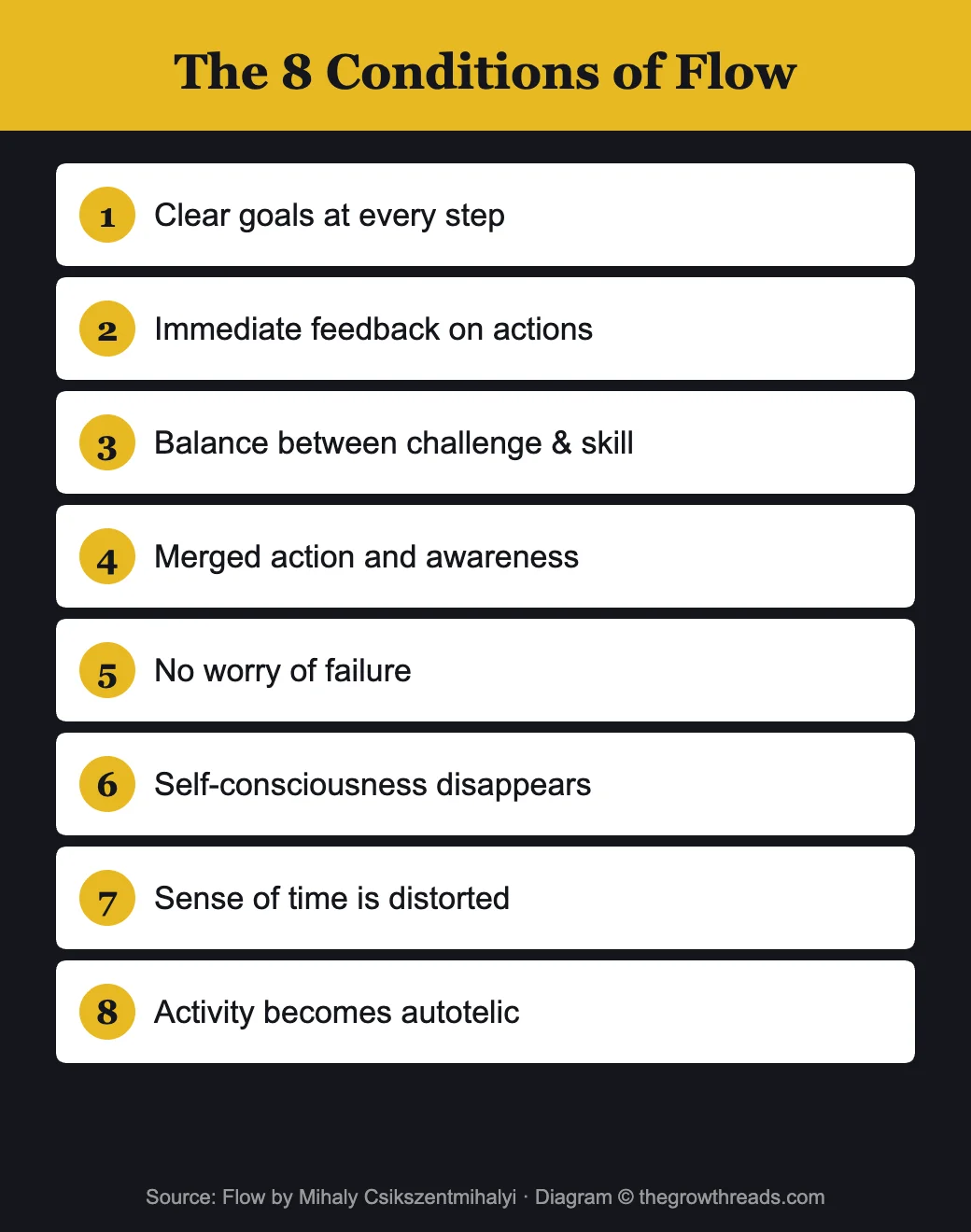
- Flow has eight identifiable conditions: Clear goals, immediate feedback, challenge-skill balance, merged action and awareness, concentration on the task, sense of control, loss of self-consciousness, and altered sense of time.
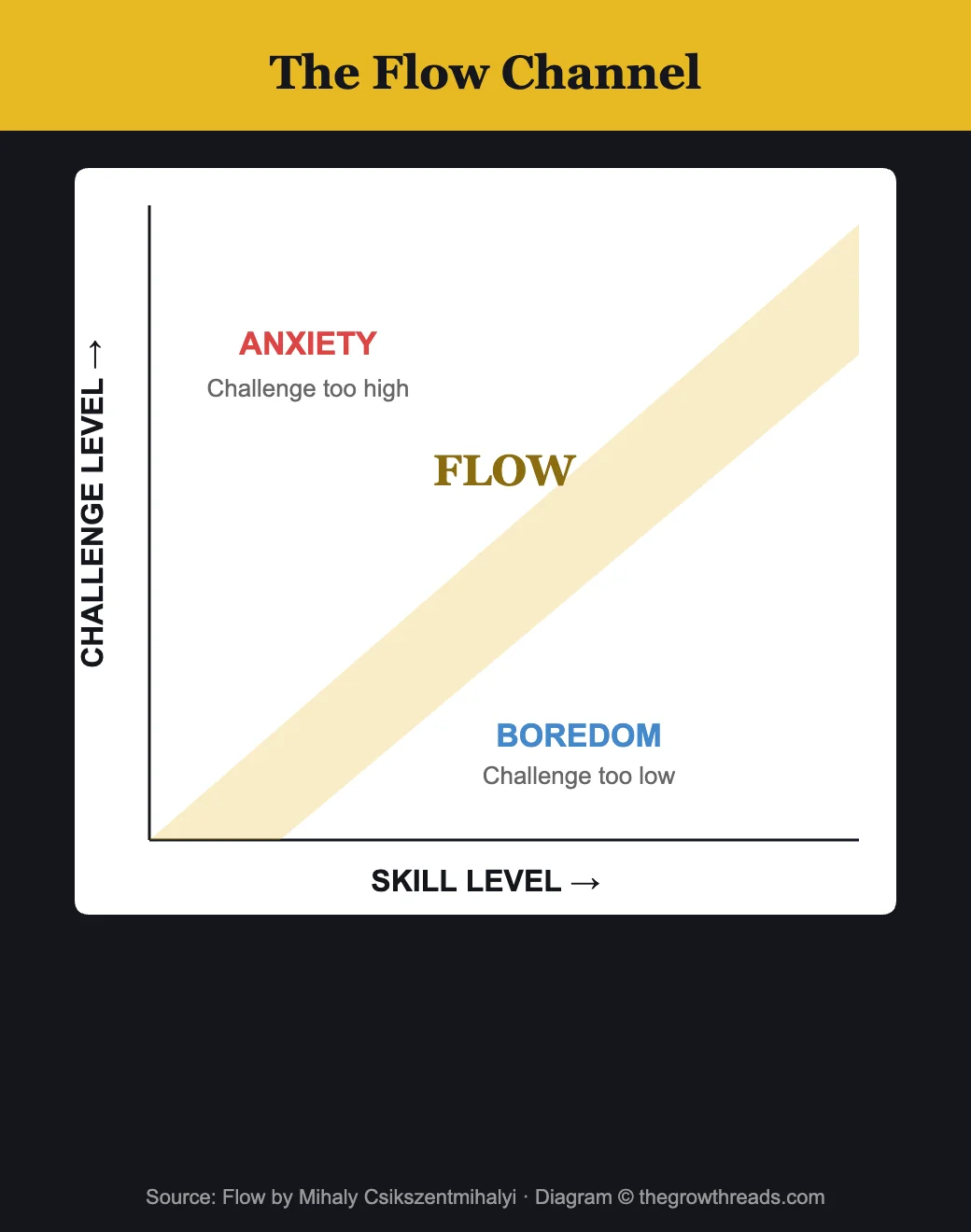
- The challenge-skill balance is the master variable: Too much challenge relative to skill produces anxiety; too little produces boredom. Flow lives in the narrow channel between.
- Attention is your most valuable resource: Csikszentmihalyi calls it “psychic energy” — how you invest it determines the quality of your experience moment to moment.
- Passive leisure rarely produces flow: Watching television, scrolling, and other low-challenge activities feel easy but leave people feeling worse, not better. Active leisure — hobbies, sports, creative projects — generates genuine satisfaction.
- Work can be a primary source of flow: Paradoxically, people report more flow experiences at work than during free time — provided the work offers clear goals and appropriate challenge.
- Autotelic personality is trainable: Some people naturally transform routine tasks into flow opportunities. The skill — setting micro-goals, finding feedback, raising challenge — can be learned.
- Relationships produce flow when they include shared challenge: Conversations, games, and collaborative projects generate deeper connection than passive co-presence.
- Solitude can be a flow state: Writing, meditation, structured reflection, and creative practice all qualify — provided they involve intentional focus, not idle rumination.
- A meaningful life is a flow-rich life: When you connect individual flow activities to a larger purpose or life theme, experience compounds into what Csikszentmihalyi calls a “unified flow experience.”
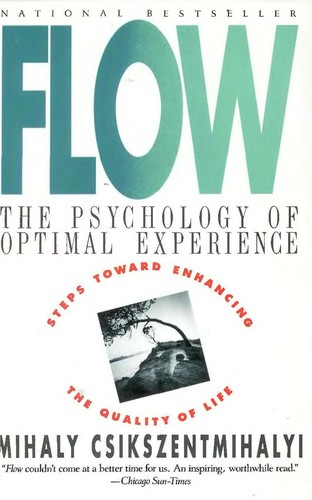
What is Flow about?
Flow explains the psychology of optimal experience — moments of deep absorption where challenge and skill align, self-consciousness fades, and the activity becomes intrinsically rewarding. Csikszentmihalyi shows how to engineer these states deliberately in work, relationships, leisure, and solitude to build a more satisfying life.
About the author
Mihaly Csikszentmihalyi (1934–2021) was a Hungarian-American psychologist widely regarded as the father of flow research. Born in Fiume (now Rijeka, Croatia), he survived World War II as a child and later emigrated to the United States, where he earned his PhD from the University of Chicago. He spent decades running the Experience Sampling Method — paging people at random moments to record what they were doing and how they felt — across cultures, ages, and occupations. This massive dataset became the empirical foundation of flow theory. He chaired the psychology department at the University of Chicago and later founded the Quality of Life Research Center at Claremont Graduate University. His work helped launch the positive psychology movement alongside Martin Seligman. Explore all Mihaly Csikszentmihalyi book summaries →
Key concepts at a glance
| Concept | What it means | Use it when |
|---|---|---|
| Flow state | A state of complete absorption where challenge matches skill, goals are clear, and feedback is immediate | You want to understand why some activities feel effortless and deeply satisfying |
| Psychic energy | Attention as a finite resource that determines the quality of experience | You are deciding how to spend your time and mental bandwidth |
| Challenge-skill balance | Flow occurs when the difficulty of a task is just above your current ability — enough to stretch, not enough to overwhelm | You feel bored (raise the challenge) or anxious (build the skill first) |
| Autotelic personality | A person who transforms ordinary activities into flow by setting internal goals and finding feedback | You want to enjoy routine tasks more — commuting, chores, meetings |
| Psychic entropy | Inner disorder caused by unmet goals, anxiety, or boredom — the opposite of flow | You feel restless, distracted, or dissatisfied and want to diagnose why |
| Unified flow experience | Connecting individual flow activities to a life theme or purpose for cumulative meaning | You have plenty of flow moments but lack a sense of overarching direction |
| Active vs passive leisure | Active leisure (hobbies, sports, creation) produces flow; passive leisure (TV, scrolling) does not | You feel drained after free time instead of recharged |
Part 1: The anatomy of consciousness and optimal experience
Csikszentmihalyi begins with a philosophical question most psychology books avoid: why do people who have everything — wealth, health, security — often feel empty, while people in objectively harder circumstances sometimes report deep satisfaction? His answer is that happiness does not depend on external conditions but on how consciousness is ordered. When attention is scattered, unfocused, or consumed by anxiety, experience feels chaotic — what he calls psychic entropy. When attention is fully invested in a challenging, goal-directed activity, experience feels ordered, and the result is flow.
He introduces the nervous system as an information processor with a limited bandwidth — roughly 110 bits per second of conscious attention. Listening to another person speak consumes about 60 bits. This scarcity means every moment is a zero-sum allocation: whatever captures your attention defines your experience. The implication is radical. If you control what you attend to, you control the quality of your life — not by changing your circumstances, but by changing where you point your mind.
The eight conditions of flow emerge from thousands of interviews across dozens of cultures. Rock climbers, chess players, surgeons, factory workers, and Navajo shepherds all described the same phenomenology: goals became clear, feedback was immediate, the challenge was just right, action and awareness merged, distractions fell away, self-consciousness dissolved, time warped, and the activity became worth doing for its own sake — autotelic, from the Greek auto (self) and telos (goal).
Part 2: The flow channel and the challenge-skill balance
The most cited model in the book is the flow channel — a diagonal band on a graph where challenge (y-axis) and skill (x-axis) are roughly matched. Below the channel lies boredom: the task is too easy for your ability, so attention drifts and dissatisfaction creeps in. Above the channel lies anxiety: the task is too hard for your current skill, so worry replaces focus. Flow sits between, in a zone where difficulty is just high enough to demand full engagement but not so high that it overwhelms.
Csikszentmihalyi emphasises that the channel is dynamic. As your skill grows, the same task that once produced flow starts producing boredom — you need to raise the challenge to stay in the zone. A chess player who has mastered opening theory needs tougher opponents. A surgeon who can perform a routine procedure in her sleep needs a harder case. This ratchet effect means that flow is inherently growth-oriented: staying in the channel requires continuous skill development and escalating challenge. Stagnation is not neutral — it produces boredom, which Csikszentmihalyi considers as psychologically corrosive as anxiety.
He supports this with data from the Experience Sampling Method (ESM), where thousands of participants carried pagers and recorded their psychological state at random beeps throughout the day. The ESM data confirmed the model: people reported the highest quality of experience when both challenge and skill were above their personal average, and the lowest when both were below it. The most surprising finding was that people often reported more flow at work than during leisure — a paradox he explores in detail.
Part 3: Flow in work, body, mind, and relationships
The middle sections of Flow apply the theory across life domains. Csikszentmihalyi examines how the body produces flow through sports, yoga, martial arts, and even sex — any physical activity where skill meets escalating challenge with immediate sensory feedback. He profiles a wheelchair-bound paraplegic who became a champion archer and a blind man who learned to navigate white-water rapids by sound alone, arguing that physical limitation does not preclude flow — it simply changes the channel.
The chapter on mental flow is particularly rich. Reading, writing, doing mathematics, and engaging with ideas all qualify as flow activities when they involve genuine challenge. Csikszentmihalyi cites amateur scientists, crossword enthusiasts, and lifelong learners who report some of their peak experiences during intellectual engagement. The critical distinction is between consuming information passively (which rarely produces flow) and wrestling with it actively — arguing with a text, solving a problem, connecting ideas across domains.
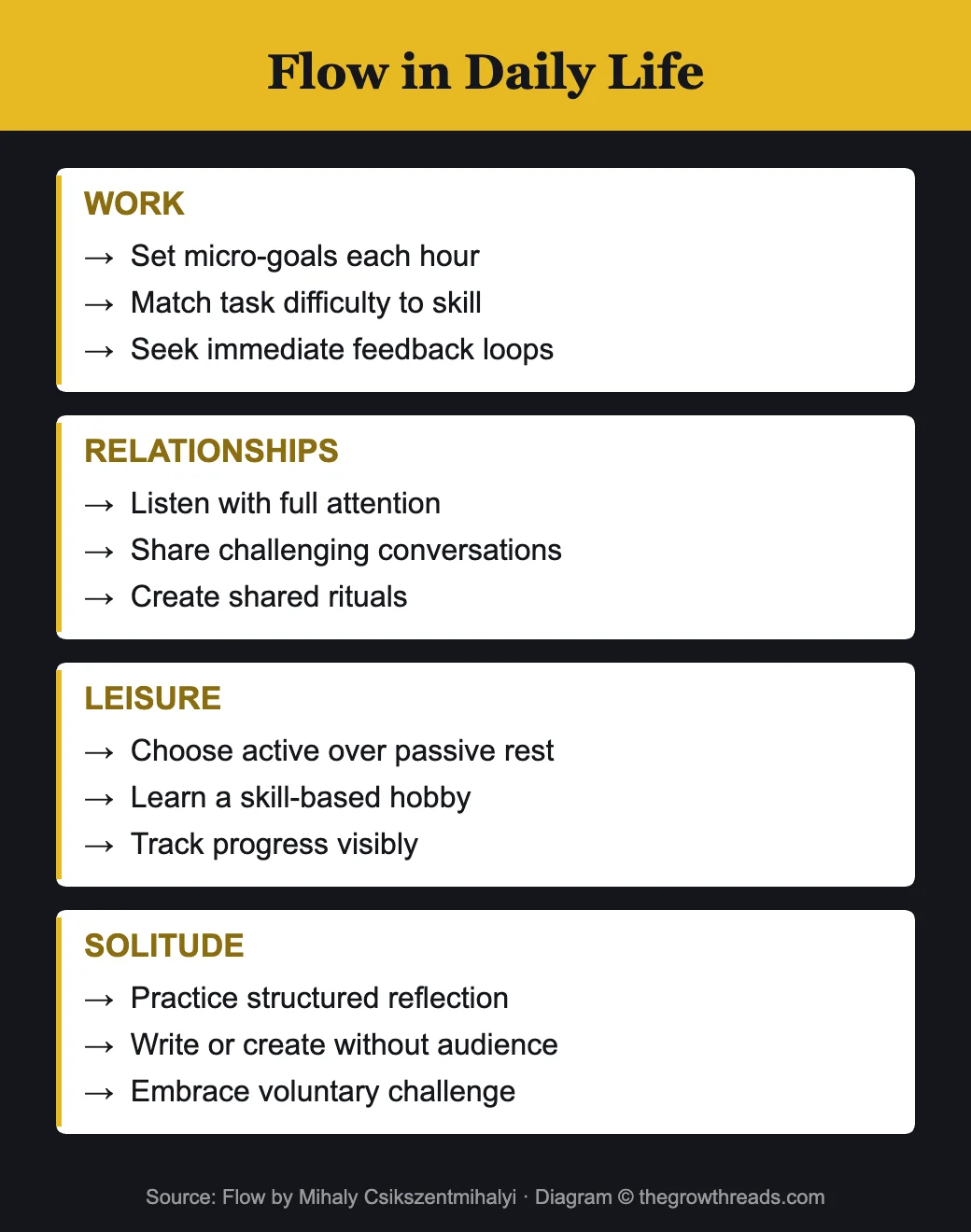
On work, the ESM data reveals the paradox of work: people report higher levels of flow at work than during leisure, yet they say they would rather be doing something else. Csikszentmihalyi attributes this to a cultural prejudice that frames work as inherently unpleasant and leisure as inherently enjoyable. In reality, many jobs — especially those with clear goals, autonomy, and feedback — are structurally ideal for flow. Many leisure activities — passive television, aimless scrolling — are structurally terrible for it. The practical lesson: redesign your leisure to look more like your best work.
Relationships, he argues, produce flow through shared challenge. Conversations where both people are genuinely trying to understand each other, games with matched opponents, collaborative projects with a common goal — these generate connection far deeper than parallel screen-watching. He notes that families that establish shared flow activities (cooking together, hiking, playing music) report higher cohesion and satisfaction than families that merely coexist in the same space.
Part 4: The autotelic self and creating meaning
The final chapters introduce the concept that ties the book together: the autotelic personality. Some people, Csikszentmihalyi observes, seem to find flow in almost any situation — waiting in line, doing repetitive work, even enduring hardship. They share a set of learnable traits: curiosity about the world, persistence when things get difficult, low self-centredness, and a habit of transforming external constraints into internal challenges. When stuck in traffic, an autotelic person might practice a foreign language, observe the architecture, or use the time for structured reflection. The activity does not change. The quality of attention does.
He then elevates the discussion to meaning. Individual flow experiences, no matter how satisfying, remain fragmented unless they connect to a larger purpose. A surgeon who experiences flow during operations but feels no broader commitment to healing has enjoyable moments but not a meaningful career. A musician who flows during practice but never performs or teaches has private satisfaction but no contribution. The unified flow experience occurs when a person weaves their flow activities into a life theme — a purpose that organises attention across time and gives individual moments cumulative weight.
Csikszentmihalyi is careful not to prescribe what that purpose should be. He draws on examples from religion, philosophy, art, science, and family life to show that the content of the purpose matters less than its structural role: it must be complex enough to sustain a lifetime of increasing challenge, broad enough to accommodate setbacks, and personally chosen rather than externally imposed. A life without purpose may contain flow. A life with purpose becomes flow.
Who is Flow best for — and who should read something else first?
Flow is ideal for anyone who suspects that the conventional formula — work hard, earn money, buy pleasure — is missing something fundamental. It is especially valuable for knowledge workers, creatives, and educators who want to understand why some tasks absorb them and others drain them. Parents looking to structure activities that genuinely engage their children (rather than merely entertain them) will find the framework immediately useful.
If you want a more practical, habit-focused approach to building focus, start with Deep Work by Cal Newport — it translates Csikszentmihalyi’s theory into specific rules for knowledge workers. If your challenge is more about building motivation and persistence, try Grit by Angela Duckworth. And if the philosophical dimension of meaning interests you most, Man’s Search for Meaning by Viktor Frankl is the essential companion.
Questions to reflect on
- When was the last time you lost track of time because you were so absorbed in what you were doing? What conditions made that possible?
- Look at your typical weekday: where does most of your attention go? Is it invested in activities that challenge you, or consumed by tasks that bore or overwhelm you?
- How much of your leisure time is active (creating, learning, playing) versus passive (watching, scrolling, consuming)? What would change if you shifted the ratio?
- What is one routine task — commuting, cooking, a weekly meeting — that you could redesign with clearer goals and immediate feedback to make it more engaging?
- If you had to name a single life theme that connects the activities where you experience the most flow, what would it be?
🔥 Ready to engineer more flow into your life?
Get Flow and learn to transform ordinary moments into optimal experiences.
How to apply Flow (7-day plan)
- Day 1 — Audit your flow moments: Set three random alarms throughout the day. At each alarm, note what you are doing, how challenged you feel (1–10), and how engaged you feel (1–10). This is your personal ESM baseline.
- Day 2 — Identify your flow activities: List the 3–5 activities where you most reliably lose track of time. For each, identify which flow conditions are present (clear goals? feedback? challenge-skill match?).
- Day 3 — Raise one challenge: Pick a task that has become boring through mastery — a workout, a work routine, a hobby — and deliberately increase the difficulty. Add a constraint, set a time target, or try a new variation.
- Day 4 — Convert passive leisure: Replace 30 minutes of passive screen time with an active alternative: sketch, cook a new recipe, play an instrument, or work on a puzzle. Compare how you feel afterward.
- Day 5 — Set micro-goals at work: Before each work session, write down a specific goal for the next 60–90 minutes and a way to measure progress. After each session, note whether the goal-feedback loop changed your engagement.
- Day 6 — Create relational flow: Have a conversation where you set an implicit challenge — understand one new thing about the other person, explore a topic neither of you has mastered. Notice the difference from small talk.
- Day 7 — Draft your life theme: Review your flow activities, micro-goals, and relational experiments. Write one sentence that captures a purpose connecting them. This is the seed of your unified flow experience — revisit and refine it monthly.
Frequently asked questions
Is flow the same as being “in the zone”?
Essentially, yes. “In the zone” is the colloquial term for what Csikszentmihalyi formally defined as the flow state. The difference is precision: flow theory specifies eight measurable conditions (clear goals, immediate feedback, challenge-skill balance, etc.) that predict when the zone will occur, rather than treating it as a random event. This makes flow something you can engineer rather than wait for.
Can you experience flow in boring jobs?
Yes — and this is one of the book’s most counterintuitive findings. Csikszentmihalyi profiles factory workers who transformed repetitive assembly-line tasks into flow activities by setting personal speed records, inventing quality challenges, or learning every station on the line. The autotelic personality does not need an inherently exciting task; it needs internal goals and self-generated feedback. The job does not change, but the quality of attention — and therefore the quality of experience — does.
Why does watching TV not produce flow?
Television (and by extension, passive scrolling) fails most flow conditions. There are no personal goals, no skill development, no genuine challenge, and no meaningful feedback. Csikszentmihalyi’s ESM data shows that people consistently report lower mood, lower energy, and lower concentration while watching TV — even though they chose to do it. Active leisure (hobbies, sports, creative projects) scores higher on every well-being measure because it engages the flow conditions that passive consumption lacks.
How is Flow different from Deep Work?
Flow is the foundational theory; Deep Work is the practical application for knowledge workers. Csikszentmihalyi explains why focused, challenging activity produces satisfaction and what psychological conditions enable it. Newport takes that insight and builds specific rules — time-blocking, quitting social media, embracing boredom — to create those conditions in a modern office environment. Reading Flow gives you the why; reading Deep Work gives you the how.
Is Flow too academic to be practical?
The book is denser than most popular psychology titles — Csikszentmihalyi was a research psychologist writing for a general audience, and some chapters read more like a textbook than a self-help book. However, every chapter includes vivid real-world examples (surgeons, rock climbers, factory workers, shepherds) that ground the theory. If you prefer a quicker, more prescriptive read, start with our summary and the 7-day plan, then decide whether the original is worth the deeper dive.
Can flow become addictive?
Csikszentmihalyi acknowledges this risk. Activities that produce flow — gaming, extreme sports, even work — can become compulsive if pursued at the expense of other life domains. A surgeon who only feels alive in the operating room, or a gamer who neglects relationships for another raid, is experiencing flow without balance. The antidote is the unified flow experience: connecting flow activities to a broader life purpose that includes relationships, health, and contribution, not just personal absorption.
What should I read after Flow?
For the practical productivity angle, Deep Work by Cal Newport is the natural next step. For the meaning and purpose dimension, Man’s Search for Meaning by Viktor Frankl deepens the question of why flow matters. For building the persistence to stay in the flow channel, Grit by Angela Duckworth is essential. And for understanding how motivation and autonomy fuel flow at work, Drive by Daniel Pink completes the picture.
Related summaries
- Deep Work by Cal Newport — The practical playbook for creating flow conditions in knowledge work.
- Grit by Angela Duckworth — What keeps you in the flow channel long enough for mastery to compound.
- Man’s Search for Meaning by Viktor Frankl — The philosophical foundation for why purpose turns flow into meaning.
- Best Psychology Books — Our full ranked guide to the psychology shelf.
This article contains affiliate links to Amazon and Bookshop.org. If you buy through these links, we may earn a small commission at no extra cost to you. This never influences our reviews — we only recommend books we have read and believe in. See our full disclosure.