

★★★★½ 4.5/5 — A coach’s clipboard for the voice that shows up when the hour gets loud.
Best for: people who already train the skill and still hear a critic at the start of the hard block.
Reading time: ~5.5 hours (288 pages) · this guide ~12 min
Difficulty to apply: Medium. The unit is one cue, one first action, and a three-second reset — not a new personality.
The Champion’s Mind in one minute
The body already knows the work. The remaining leak is the voice that talks when the scoreboard gets loud. Jim Afremow’s The Champion’s Mind is a sports psychologist’s clipboard for that voice. You decide who you are before the whistle. You rehearse the task with eyes, ears, and body — including the ugly minute, not only the highlight. You talk in cue words a coach would use. After a miss you reset in seconds and take the next play. The stories come from Olympic locker rooms because that is where the pressure is honest. The transfer is a desk block, a pitch, an exam, a hard conversation. You do not need a final. You need a sticky note with a verb, a first action you always take, and a rule that the critic does not get a courtroom between plays.
Write today’s cue. Take the first thirty seconds on purpose. After the first stall, three breaths. Next play. That is the whole entry fee.
Key takeaways
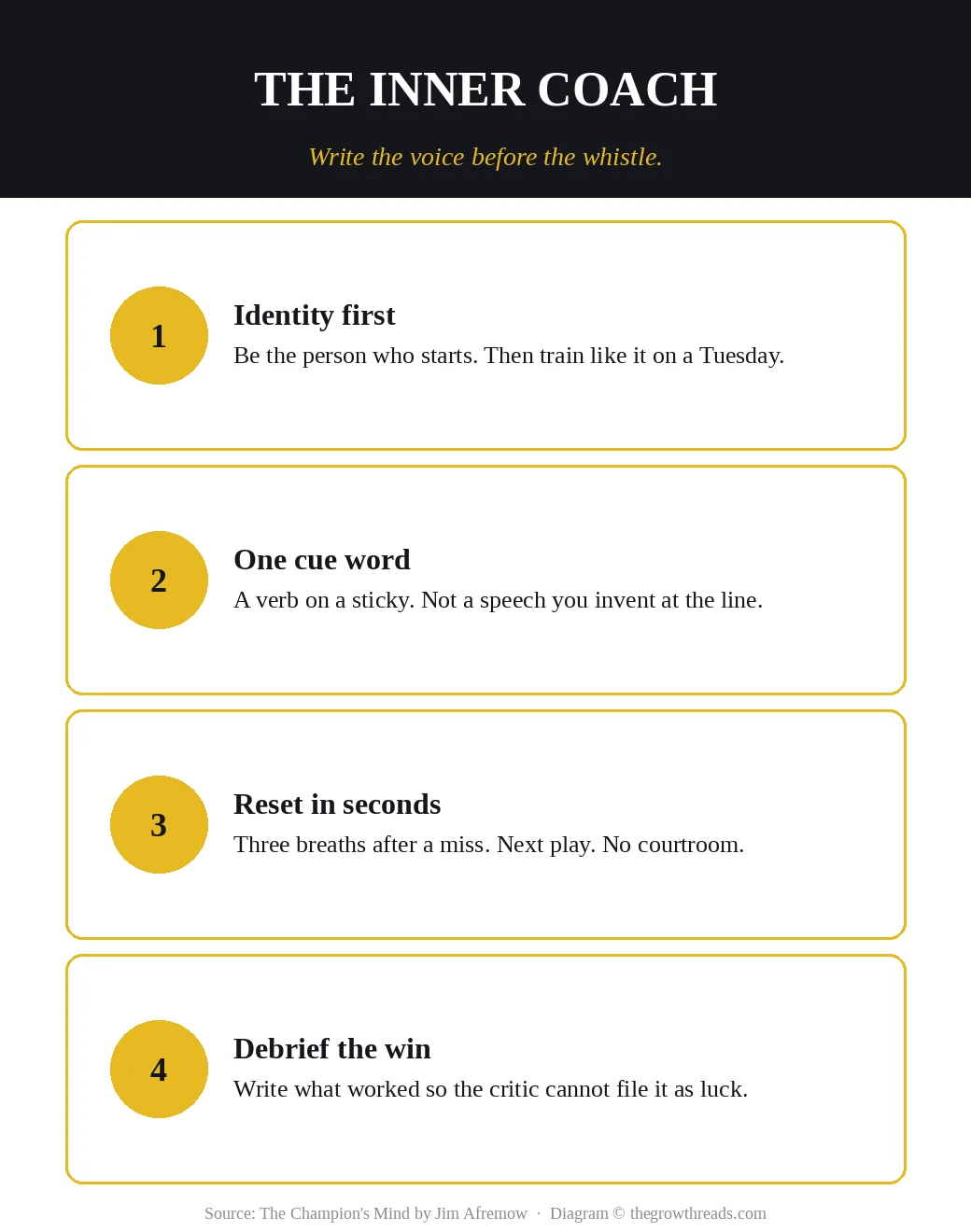
- Identity first: Be the athlete, then train like it. Waiting to feel like a champion is how the hour stays small.
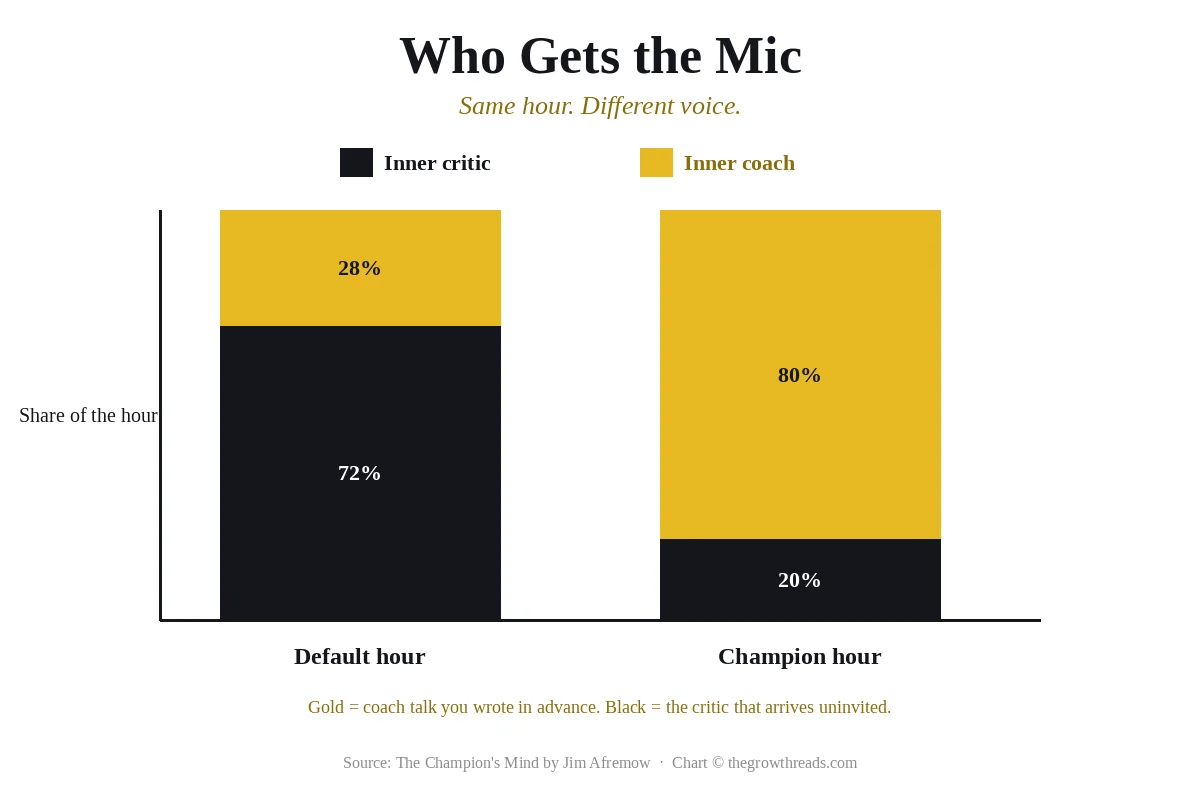
- Inner coach vs inner critic: Short, present, useful beats long, past, personal. Train the mic before the whistle.
- Cue words, not speeches: A verb you already wrote. The pep talk you invent at the line arrives too late.
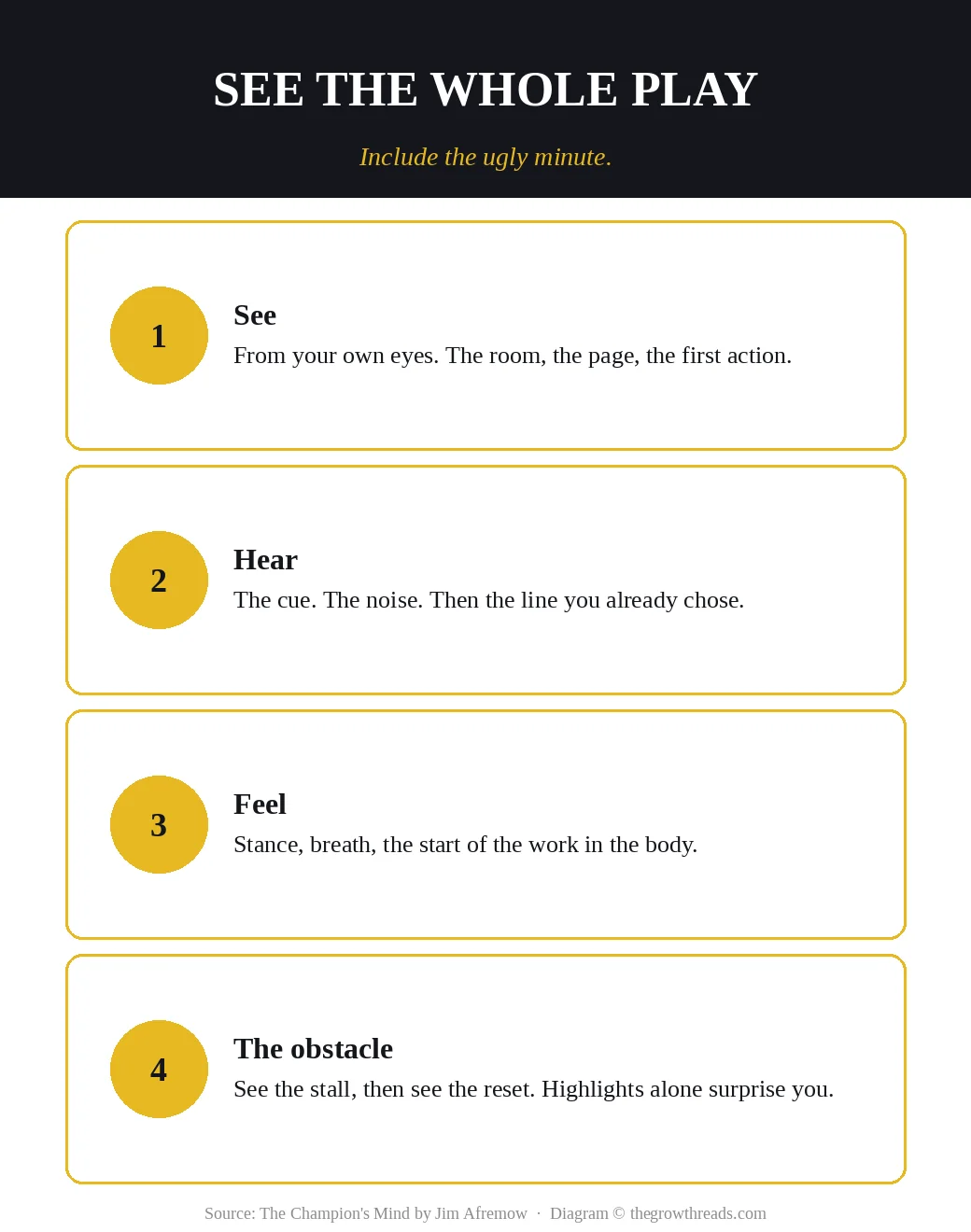
- Visualize all senses, including the obstacle: See, hear, feel the first ugly minute — then see the response.
- Process over scoreboard: Control the controllables. The outcome is a lagging report of the sequence.
- A pre-performance routine is the start: Breath, cue, first action. Same door every time.
- Reset in seconds: Three breaths after a miss. Next play. No story about what it means.
- Debrief the win: Write what worked. Otherwise the critic files it as luck.
- The desk is a field: Same sequence. Different uniform. One block this week, not a personality reboot.
What is The Champion’s Mind about?
The Champion’s Mind is Jim Afremow’s 2013 case that championship performance is an inner skill: you choose an identity, rehearse the work in all senses, talk like a coach, and reset in seconds so the body can do what it already trained.
About the author
Jim Afremow, PhD, is a mental performance coach and licensed psychologist who works with Olympic athletes, professionals, and teams on the inner game. The Champion’s Mind (Rodale, 2013) is the field manual that made his drills public: identity before the whistle, cue words instead of speeches, visualization that includes the obstacle, and a reset timed in seconds. Later books extend the same toolkit to comebacks, young athletes, and leadership. The voice is coach-plus-clinician. Short lines. Locker-room stories. Drills you can steal for a desk block without pretending you are in a final. Jim Craig, goalie for the 1980 U.S. hockey team, wrote the foreword. Read Afremow when the remaining leak is the voice that shows up under pressure, not a missing calendar or a missing start. Explore all Jim Afremow book summaries →
Key concepts at a glance
| Concept | What it means | Use it when |
|---|---|---|
| Champion identity | Decide who you are, then train like that person. | You wait to feel ready before you start. |
| Inner coach | Short, present, useful talk you wrote in advance. | The voice at the start is a courtroom. |
| Inner critic | Long, past-or-future, personal. It steals the mic. | A miss turns into a story about you. |
| Cue word | One verb. Not a speech you invent at the line. | You freeze and search for motivation. |
| Full-sense visualization | See, hear, feel — including the obstacle and the response. | You only daydream the highlight reel. |
| Process goals | Controllables: cue, first action, reset. Outcome is a lagging report. | You watch the scoreboard mid-block. |
| Pre-performance routine | Breath, cue, first action. Same door every time. | The start is a scroll and a stall. |
| Next-play reset | Seconds, not a meeting. Then the next action. | One miss poisons the rest of the hour. |
Part 1: Be a champion on purpose — identity before the whistle
Afremow’s opening move is not a new workout. It is a sentence about who you are when the work starts. Champions do not wait for a medal to grant the identity. They decide, then they train like that person on ordinary Tuesdays. The inner critic runs the opposite script: prove it first, then maybe you can claim the name. That script is how talented people stay small in the first ten minutes. You do not need their sport. You need their order of operations. Be, then do. Not the reverse.
Desk translation is blunt. If you only feel like a writer after a good paragraph, the blank page will keep winning. If you only feel like an operator after the dashboard turns green, the hard block will keep slipping. Write one identity line that is a job, not a fantasy: I am the person who takes the first thirty seconds. That is enough. If Mindset is the belief that skill can grow, this chapter is the talk track that belief still needs when the hour starts. If Atomic Habits is identity through a tiny cue, Afremow is identity spoken out loud before the hard thing, then proved by the first action — not by a mood.
TGR Note: If the remaining leak is still a missing start, Mini Habits is the two-minute door. If the remaining leak is heat as a costume, Relentless and Winning are Grover’s language. Come back to Afremow when you can already sit down and the remaining failure mode is the voice that makes the first ugly minute mean something about you.
Part 2: Speak and see the work — self-talk and visualization
The inner coach is not nicer. It is shorter. Instructional talk tells the body what to do now. Motivational talk is a brief push, not a TED speech. The inner critic is a novelist: you always, last time, what if they notice. Afremow wants the coach on a sticky note before the whistle so you are not inventing language at the free throw. Visualization is the same idea in pictures. Not a highlight reel you watch from the cheap seats. From your own eyes. Hear the room. Feel the stance. Include the obstacle — the miss, the stall, the noisy thought — and then include the response you already chose. A visualization that only shows the win trains surprise when the ugly minute arrives. A visualization that includes the ugly minute trains the reset.
Steal it for a desk. Sixty seconds before the block: see the first stuck sentence. Hear the urge to open a tab. Feel the chair. Then see the cue word and the first action. That is mental rehearsal, not daydreaming. If The Inner Game of Tennis is quieting Self 1 so Self 2 can play, this chapter is the script Self 1 is allowed to keep — one line, then silence. If Inner Excellence is present, other-centered attention, Afremow is the clipboard that attention can hold. The critic will still speak. The job is that it gets less of the hour.
TGR Note: If the remaining leak after the script is wasted hours that never densify, The Rise of Superman is the flow cycle. If the remaining leak is talent-as-myth, Peak and Bounce are the practice cousins. Afremow does not cancel those books. He writes the talk track the practice still hears.
Part 3: Prepare, practice, compete — routines under pressure
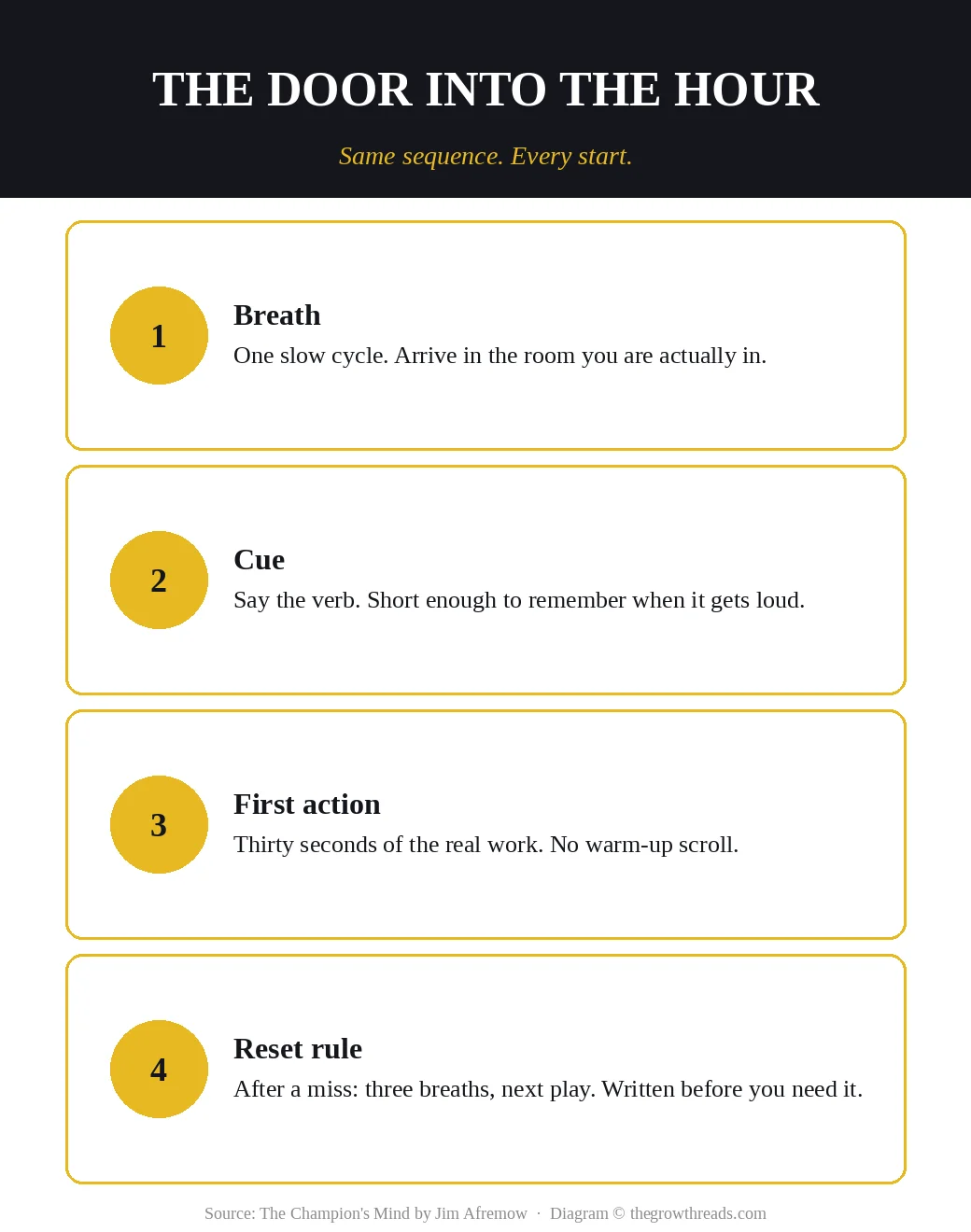
Champions look calm because the start is already decided. Breath. Cue. First action. The pre-performance routine is not superstition. It is a door you can find in the dark. Practice, in Afremow’s telling, is where you install that door at game speed — not where you only look good in an empty gym. Compete is one play at a time. The scoreboard is information after the play, not a narrator during it. Process goals (cue used, first action taken, reset run) are the stats you can actually move. Outcome goals are lagging. Watching them mid-block is how the critic gets the mic. Body language is part of the routine: stand like the person who already started. You are not faking a medal. You are giving the nervous system a posture that matches the identity line.
Desk translation: the first thirty seconds are the routine. Same document. Same timer. Same first sentence or first ticket. No warm-up scroll. Mid-block, keep one process stat. After a stall, the reset is the compete skill — not a new plan. If The Mamba Mentality is obsessing over details on film, this chapter is the detail you run live: the door into the hour. If Do Hard Things is notice discomfort and choose, Afremow is what you do in the next three seconds so the choice has a body. Pressure is not a different sport. It is the same sequence with less spare attention. That is why you write the sequence when you are calm.
TGR Note: If the remaining leak is a missing deep-work door, close it with Deep Work first — a cue word still needs a room the phone cannot enter. If the remaining leak is too many yeses, stay with Essentialism. Afremow is the sequence inside the one block you kept.
Part 4: Recover fast, then transfer the mental game to the desk
The last movement of the book is speed of recovery and the transfer out of sport. Champions are not people who never miss. They are people whose misses do not get a meeting. Three seconds. Next play. Then a short debrief: what worked, what to run again. The critic wants to steal both the miss and the win — the miss as proof you are a fraud, the win as luck. Write one line either way. Sleep and a life outside the arena are how the inner coach has a nervous system tomorrow. You do not graduate. You run the sequence again on a smaller field.
Steal the protocol without the uniform. Cue. First action. Reset. Debrief. That is the whole transfer. If Can’t Hurt Me is taking the first step when the story is loud, this chapter is the talk track for the steps after the first. If Grit is passion plus perseverance toward a long goal, Afremow is the in-the-hour skill that perseverance still needs so a miss does not become a new identity. Finish the week with one cue you will keep. Put next week’s hardest block on the calendar before Sunday becomes other people’s urgency.
TGR Note: If the remaining leak after the sequence is still waiting to feel ready, The Motivation Myth is start-first. If the remaining leak is identity through a tiny cue, stay with Atomic Habits. The Champion’s Mind is the voice those two books can hang on when the work is already underway and the critic still wants the hour.
Who is The Champion’s Mind best for — and who should read something else first?
Best for people who already train and whose remaining leak is the voice: athletes crossing into knowledge work, operators on a judged deliverable, students on an exam, anyone who has the skill and still hears a courtroom at the start. If you want present, other-centered attention, start with Inner Excellence. If you want the original quiet-the-narrator book, start with The Inner Game of Tennis. If you want practice science, start with Peak or Bounce.
Read something else first if you need a tiny start or a cue. Begin with Mini Habits or Atomic Habits. If you want toughness as noticing discomfort, start with Do Hard Things. If you want locker-room heat as the first language, start with Relentless. Come to The Champion’s Mind when you can already work and the remaining failure mode is the voice that turns a miss into a story.
Questions to reflect on
- Whose voice gets the first thirty seconds of your hardest block — coach or critic?
- What one cue word would a coach actually say, and is it written down where you start?
- When did you last visualize the obstacle instead of only the highlight?
- How many seconds does a miss currently get before you take the next play?
- After a good hour, do you write what worked, or do you let the critic file it as luck?
🔥 Ready to train the voice that shows up?
Cue. First action. Three-second reset. That is the whole inner game.
How to apply The Champion’s Mind (7-day plan)
- Day 1 — One cue word. Pick today’s hardest block. Write one verb on a sticky. That is the whole inner coach for today.
- Day 2 — First thirty seconds. Write the first action you will take when the block starts. No warm-up scroll. The routine is the start.
- Day 3 — Visualize the obstacle. Before the block, sixty seconds: see the first ugly minute, then see the cue and the first action.
- Day 4 — Three-second reset. After a miss or a stall, three breaths. Next play. No courtroom about what it means.
- Day 5 — Process, not scoreboard. Keep one process stat: cue used, first action taken, reset run. Ignore the outcome until the block ends.
- Day 6 — After a win, one line. Write what worked. Champions debrief the good hour so the critic does not steal it as luck.
- Day 7 — Keep the sequence. Review the week. Keep the cue, the first action, and the reset. Put next week’s hardest block on the calendar.
Frequently asked questions
What is The Champion’s Mind about?
The Champion’s Mind is Jim Afremow’s 2013 field manual for the inner game. Championship work is not a different body. It is a different voice: you decide who you are before the whistle, rehearse the task in all senses, talk like a coach instead of a critic, and reset in a few seconds after a miss. The stories come from sport because that is where the pressure is loud. The transfer is a hard block at a desk, a pitch, or an exam. Read it when the remaining leak is the voice that shows up under pressure, not a missing calendar.
How long does it take to read The Champion’s Mind?
The Rodale paperback is about 288 pages. Most readers finish in five to six hours. This summary is a twelve-minute pass: identity, inner coach, visualization, a pre-performance routine, and a seven-day plan you can run on one work block. If you only have lunch, pick today’s hardest task, write one cue word on a sticky, and decide the reset: three breaths after the first ugly minute, then the next play. Come back to the athlete stories once that block exists. The book is a drill kit, not a personality transplant by Friday.
Is The Champion’s Mind only for athletes?
The locker room is the lab. The mechanism is for anyone whose job includes a demand that will be judged: operators, founders, writers, students, surgeons, anyone who has trained the skill and still hears a critic at the start. Cue words, a first action you always take, and a three-second reset after a miss all transfer to a blank page. If you want locker-room heat as the whole meal, Relentless will feel closer. If you want toughness as noticing discomfort, start with Do Hard Things. Come here when the remaining leak is the voice, not the willingness.
How is The Champion’s Mind different from Inner Excellence or The Inner Game of Tennis?
The Inner Game of Tennis is quieting Self 1 so Self 2 can play. Inner Excellence is present, other-centered attention under pressure. The Champion’s Mind is the coach’s clipboard: identity statements, cue words, visualization that includes the obstacle, a pre-performance sequence, and a next-play reset timed in seconds. You can run Gallwey and Murphy without a script. Afremow wants the script written before the whistle. Relentless and Winning are Grover’s heat. Bounce and Peak are the practice science. This one is the talk track those books still need when the hour starts.
What is the inner coach in The Champion’s Mind?
The inner coach is the voice you train on purpose so it is the one that speaks when the scoreboard gets loud. It is short, present, and useful: a cue word, a first action, a next-play instruction after a miss. The inner critic is longer, past-or-future, and personal: you always, what if, don’t blow it. Afremow’s claim is not that the critic vanishes. It is that the coach gets more of the hour. You replace the critic with a line you already wrote, rather than arguing with it in paragraphs.
Who should read something else before The Champion’s Mind?
If you still need a two-minute start, begin with Mini Habits. If you need a cue-and-identity install, begin with Atomic Habits. If the leak is a missing deep-work door, Deep Work closes it without a locker-room vocabulary. If you want toughness as noticing discomfort, Do Hard Things is the better first language. Come to The Champion’s Mind when you can already sit down and the remaining leak is the voice that turns the first ugly minute into a story about you. Mindset is the belief layer. This is the talk track for the hour you already booked.
What should I do on day one with The Champion’s Mind?
Pick one block that already has a finish line. Write one cue word — a verb, not a speech. Write the first action you will take in the first thirty seconds. Write the reset: three breaths after a miss, then the next play, no courtroom. Put the phone in another room. Do not rewrite your identity in a journal marathon. Be the person who runs that sequence once. Read a chapter after the block exists, not instead of putting the block on the calendar.
Related summaries
- Inner Excellence — present attention under pressure, the cousin to Afremow’s clipboard.
- The Inner Game of Tennis — quiet Self 1 so the work can play.
- Relentless — Grover’s heat when the remaining leak is intensity, not the talk track.
- The Mamba Mentality — obsess the details; Afremow writes the voice that runs them live.
- Best productivity books — the full Productivity silo.
How we analyze books: every book on The Growth Reads is read cover to cover, summarized in thousands of words of original analysis, and rated against our five-criteria rubric (lasting impact, evidence quality, practical application, writing & originality, external consensus). Read our full methodology.