

★★★★⅗ 4.6/5 — A blunt competitor OS for people who finish the job and then quietly stop.
Best for: operators and athletes who can already close, then coast once the checkmark lands.
Reading time: ~4 hours (240 pages) · this guide ~12 min
Difficulty to apply: High. The unit is one race you keep running after “done,” not a two-minute habit.
Winning in one minute
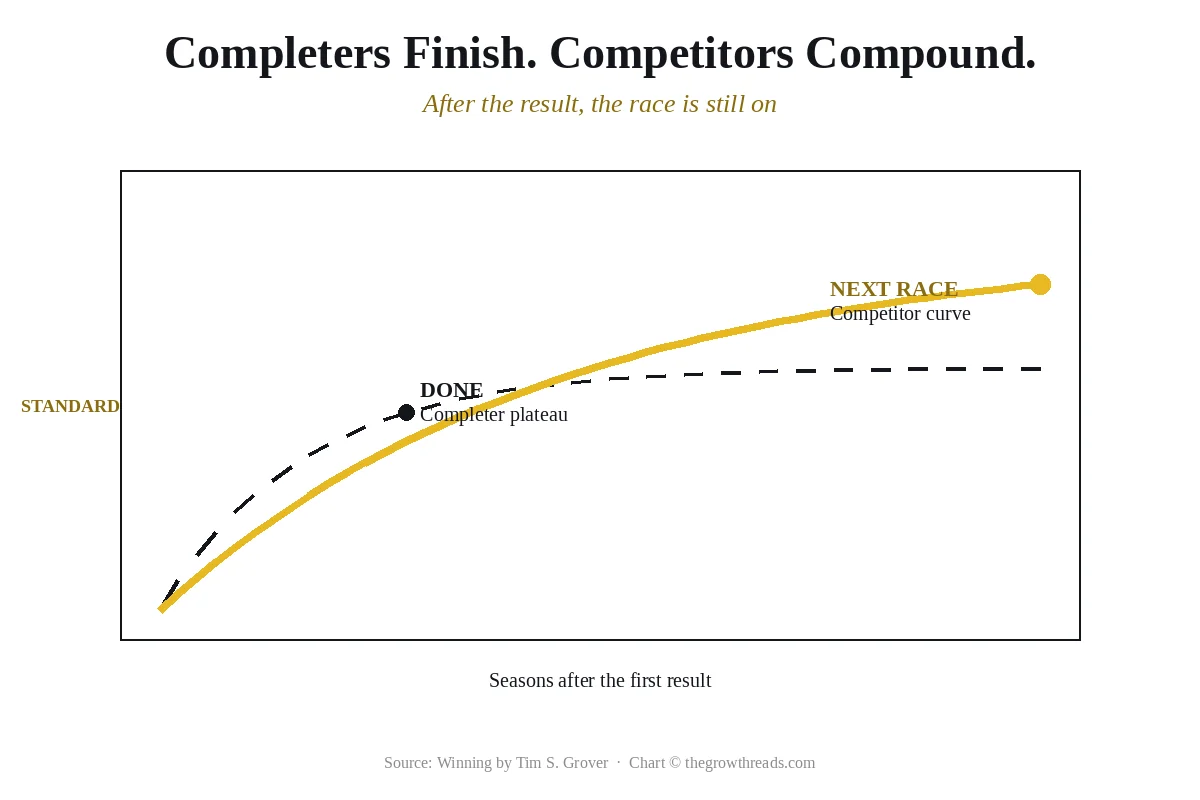
Completers finish the assignment. Competitors keep racing after the result. Tim S. Grover’s Winning is the sequel to Relentless: less about surviving the loud room, more about what you do when the room already clapped. Written with Shari Lesser Wenk, it names the fork most high-output weeks hide. Completers want a plan, a finish line, and credit. Competitors want the result more than the credit, handle the ugly middle, take the shot without a perfect binder, and treat the next test as the only one that counts. Grover learned it in ATTACK rooms with Michael Jordan, Kobe Bryant, and Dwyane Wade. You do not need that roster. You need a week where you already know how to do the work and still stop at good enough.
You do not need a new personality by Friday. Name the column you were in yesterday, pick one race, and add twenty minutes after you feel done.
Key takeaways
- Completer vs Competitor: Finishing the job is the floor. The fork is whether you keep racing after the result lands.
- Winning is a sprint with no tape: Treat “done” as a lap marker, not a vacation. The next test starts now.
- Want the result more than the credit: Status updates and applause are Completer fuel. Competitors let the scoreboard talk.
- Handle everything: The ugly email, the extra film, the boring rep. Winning is not only the highlight.
- Take the shot without a perfect plan: Planning can be a hiding place. Competitors move while the binder is still thin.
- Pay the unforgiving price: Obsession, boredom, and saying no are the fee. You do not get the race for free.
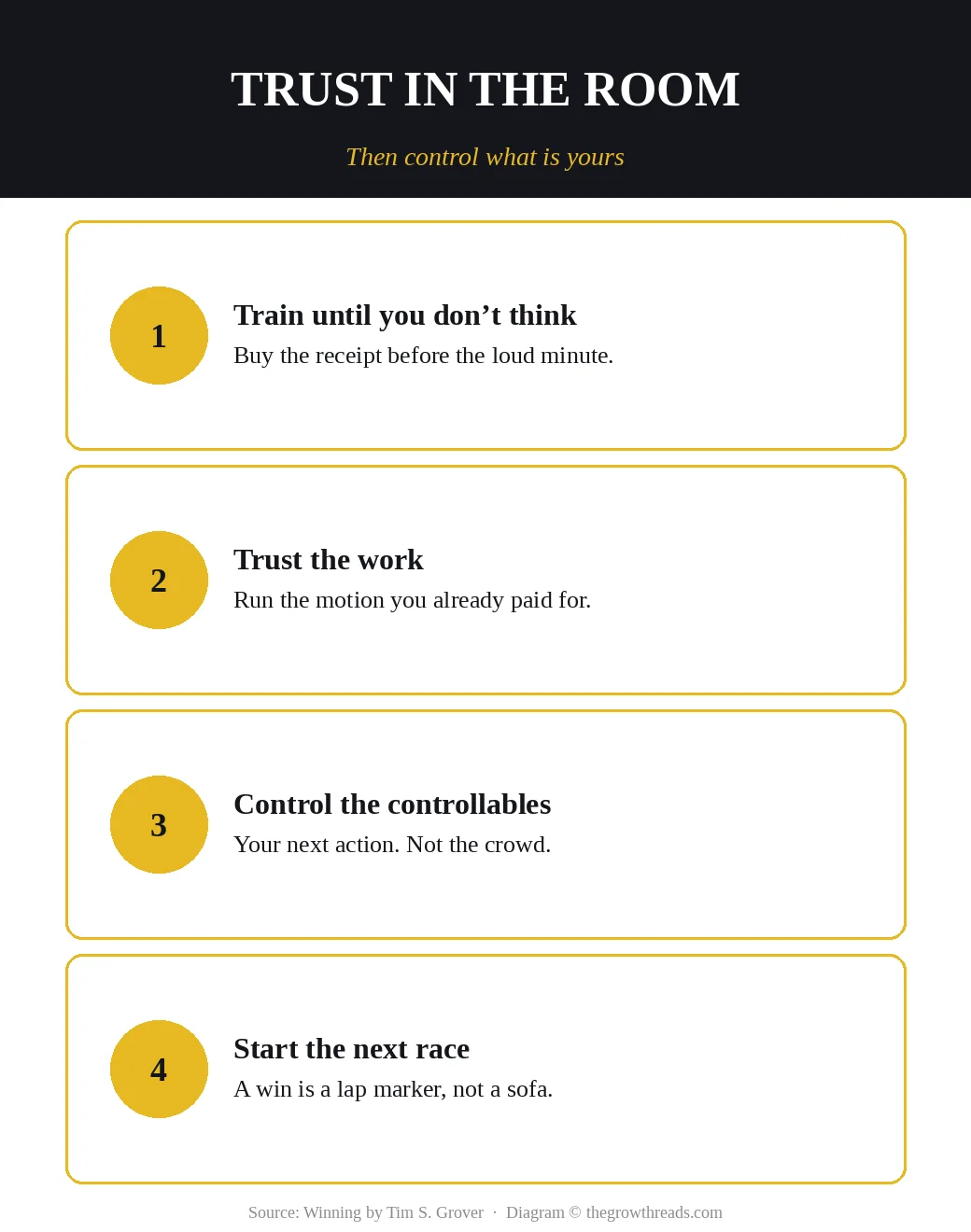
- Trust the work you already did: Train until you do not have to think, then trust it when the room is loud.
- Control the controllables: Your next action is yours. Other people’s opinions are weather.
- The next race is the job: A win that becomes a finish line is how Completers are born from Competitors.
What is Winning about?
Winning is Tim S. Grover’s operating system for competitors: people who refuse to stop when the assignment is complete. Completers finish the job and wait for credit. Competitors keep racing after the result, handle whatever the day throws, and treat the next test as the only one that counts.
About the author
Tim Singh Grover is a performance coach who built ATTACK Athletics after cold-calling the Chicago Bulls in 1989 and earning the chance to train Michael Jordan. He later worked with Kobe Bryant, Dwyane Wade, and a long list of NBA stars whose seasons had a scoreboard. Relentless (2013) was the first book: Cooler, Closer, Cleaner, and the instruction not to negotiate with pressure. Winning (2021), written with Shari Lesser Wenk, is the second: what you do after you can already close. The authority is not a lab. It is three decades of rooms where “good enough” was a firing offense, translated for anyone whose week has a result that can still get better after the first checkmark. Explore all Tim S. Grover book summaries →
Key concepts at a glance
| Concept | What it means | Use it when |
|---|---|---|
| Completer | Does the job as written, wants credit, stops at done. | Your week is full of checkmarks and empty of a harder second hour. |
| Competitor | Wants the result more than the credit; starts the next race. | You already know how to close and still coast after the nod. |
| No finish line | Winning is a sprint that does not get a tape. | You treat a win as permission to ease off. |
| Handle everything | The ugly middle is the job, not an interruption of the job. | You only show up for the highlight. |
| Take the shot | Move before the plan is perfect. | You hide in research, decks, and “almost ready.” |
| The price | Obsession, boredom, and no’s you will not post about. | You want the outcome without paying for the hours. |
| Trust | Train until you do not think; then trust it in the loud room. | You overthink the moment you already prepared for. |
| Next race | A win that becomes a finish line creates a Completer. | Last week’s result is still the story you are telling. |
Part 1: Completers finish. Competitors keep racing.
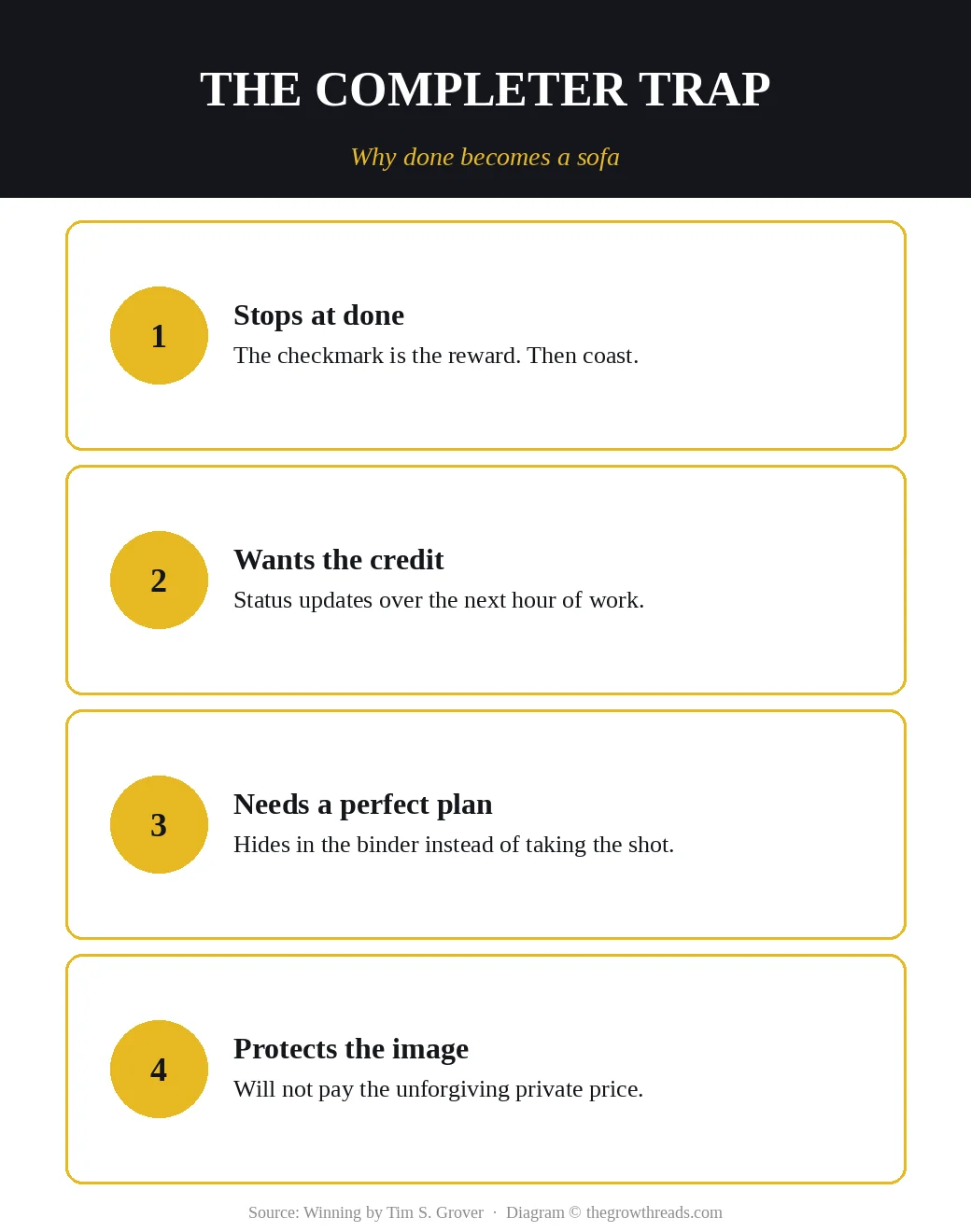
Grover’s opening split is the whole book in one hallway. Completers do what was asked. They want a map, a finish line, and a round of recognition. That is how most work gets shipped, and Grover is not pretending a company can run on thirteen obsessed people. He is naming the other column: Competitors who treat the assignment as the start of the real test. They want the result more than the story of having worked. They stay after the clap. They do not need a new speech to begin the next hour. If Relentless taught you to walk toward pressure, Winning asks what you do in the quiet after you already handled it.
The split shows up in ordinary weeks. You ship the deck and then refresh email for a reaction. You hit the workout as written and skip the extra set. You close the quarter and coast for ten days. That is Completer physics, and it is why talent stalls after a promotion. Competitors use the same hour differently: the result lands, and they immediately ask what the next test is. You do not have to live in an NBA gym to run that loop. You have to stop treating “done” as a personality. The book’s heat is that Grover will not soften the column. You were one or the other yesterday. Write it down.
TGR Note: If the job is still walking toward pressure instead of negotiating with it, start with Relentless. If the job is staying free when the number gets personal, Inner Excellence is the chest-training under this race. Grover is the competitor OS. Murphy is why the OS does not have to own your worth.
Part 2: The Winning 13 as an operating system
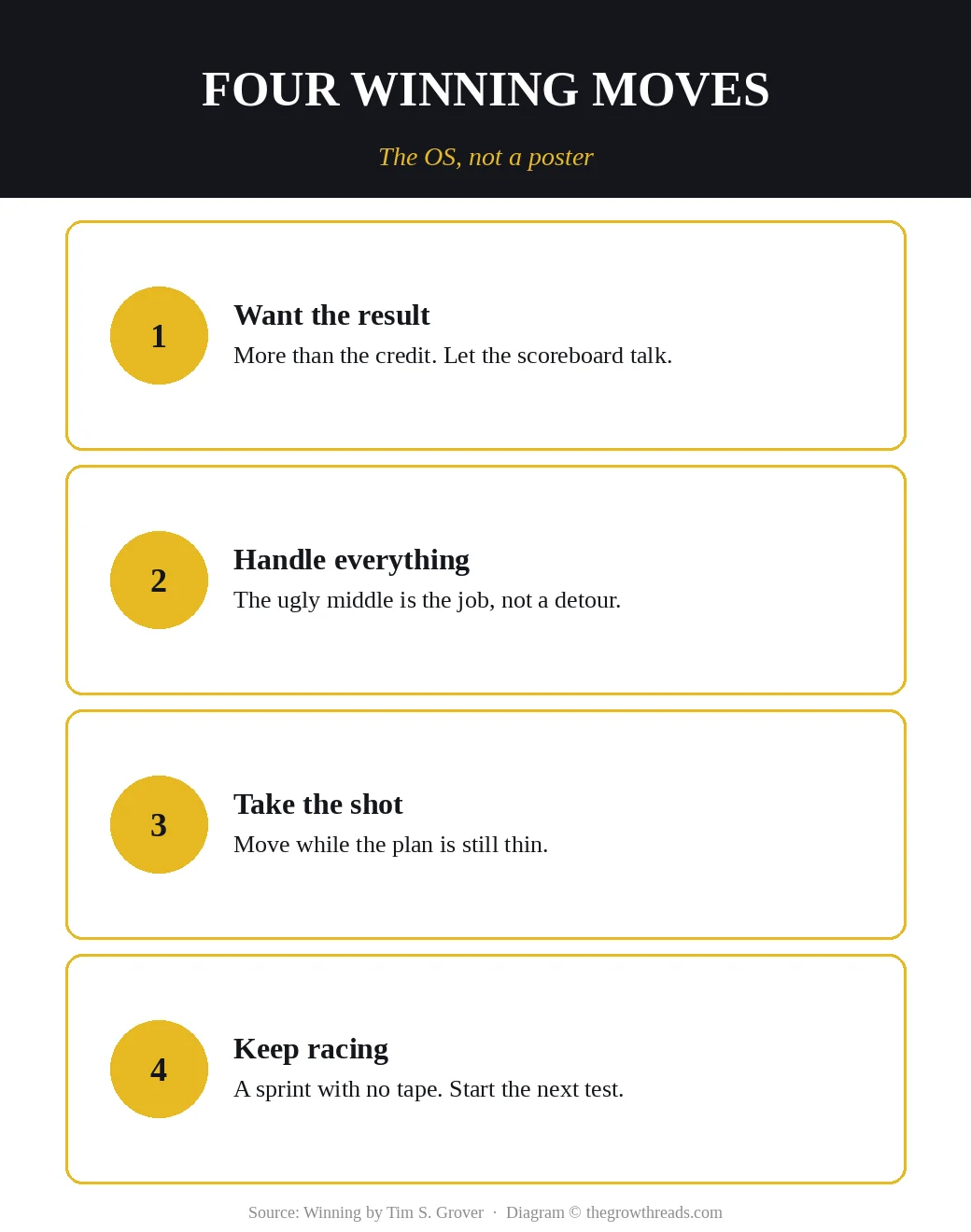
The middle of the book is Grover’s Winning 13 — not a poster of slogans, an operating system. Clustered, they say four things. Want it all: the result, not the participation trophy. Handle everything: the boring film, the hard conversation, the extra hour nobody will clap for. Take the shot: move while the plan is still thin, because a perfect binder is how Completers hide. Keep racing: a sprint with no tape, a private fee, a habit you repeat after the result. Grover writes them as tests with no single correct answer, which is the point. Competitors do not wait for the teacher to mark the paper. They decide, act, and live with the next test.
This is also where the book gets practical about planning. A plan can be a tool. It can also be a bunker. Completers collect advice, templates, and “almost ready.” Competitors take the shot they have, then adjust. That is not recklessness. It is refusing to let uncertainty become a lifestyle. Readers who used Can’t Hurt Me for the accountability mirror will hear a colder cousin: Goggins makes you prove you can stay in the dark. Grover makes you prove you will not stop once the lights come up. Both books refuse the wait-until-you-feel-ready loop. Grover’s version is shorter on memoir and longer on the fork after a win.
TGR Note: If the remaining leak is simply getting out of bed, Discipline Equals Freedom is the morning veto. If you need a cue you can repeat, Atomic Habits is the cleaner install. Grover is the standard you hold after those systems already work and you still stop at good enough.
Part 3: Trust the work, then control what is yours
The third movement is trust. Grover’s athletes did not invent clutch in the last two minutes. They trained until the skill did not need a committee meeting. “Don’t think” from Relentless is still here, now aimed at people who overthink after they already put the hours in. Trust is not vibes. It is the receipt for work you already paid for. When the room gets loud, Completers start negotiating with the last miss. Competitors run the motion they already own. Visualization, film, and extra reps are how you buy that trust. You do not ask to feel ready. You become someone the moment can use.
Control sits next to trust. You do not control the crowd, the call, the other person’s mood, yesterday’s error. You control the next action. Completers spend the afternoon litigating weather. Competitors spend it on the controllables. That sounds like a poster until you watch a week where every opinion has to be answered: the calendar fills with recovery from the story instead of reps. Trust plus a shorter argument with the uncontrollable is how the reps get their time back. If that sounds like presence work, it is — just written in Grover’s voice instead of Murphy’s.
TGR Note: If the job after trust is simply showing up on dull Tuesdays, Chop Wood Carry Water is the process romance. If you want the science of skill once the fork is chosen, Peak and Talent Is Overrated are the deliberate-practice pair. Grover is the reason those hours do not stop the first time someone already clapped.
Part 4: After you win, the race is still on
The last movement is the unforgiving part of the subtitle. A win that becomes a finish line is how Competitors turn into Completers. Grover has watched it after titles, contracts, and “I made it” seasons. The next race is the job. That is not a threat. It is the only way the standard survives contact with success. You can still celebrate. You cannot move in. Endgame, in this book, is not retirement math. It is the twenty minutes after done, the next test on the calendar, the refusal to let last week’s result become your personality. The fee stays due. The clap is not payment.
You do not need Grover’s roster to run the last chapter. You need a week where a result already landed and you can feel the coast starting. Name the next test in one line. Put it on the calendar before you post the win. Then go do the work. The scoreboard is allowed to report. It is not allowed to become a sofa. That is Winning in practice: Completer or Competitor, one race, handle the middle, take the shot, keep racing. Repeat on a calendar, not on a feeling.
TGR Note: If the remaining leak after the race is a missing deep-work block, Deep Work is the door closer. If the remaining leak is still negotiating with pressure, go back to Relentless. Grover’s second book is the layer that sits on top of both once you already know how to close.
Who is Winning best for — and who should read something else first?
Best for people whose skill is already real and who still stop at done: operators, athletes, makers, anyone whose week has a checkmark that quietly becomes a sofa. If you want locker-room intensity first, start with Relentless. If you want the inner clench named, start with Inner Excellence. If you want a cue-and-habit install, start with Atomic Habits.
Read something else first if you need an inbox or a tiny first step. Start with Deep Work or Mini Habits. If the fight is simply getting out of bed, read Discipline Equals Freedom. Come to Winning when the calendar is already open and the leak is coasting after a win.
Questions to reflect on
- Yesterday, were you a Completer or a Competitor — and what is the evidence, not the story?
- Where in your week do you stop at the first checkmark and wait for credit?
- What ugly middle have you been parking because it will not go on a highlight reel?
- What shot are you delaying until the plan is perfect?
- If last week’s result could not become a finish line, what is the next race in one sentence?
🔥 Ready to stop completing?
Name the column. Pick one race. Keep going twenty minutes after done.
How to apply Winning (7-day plan)
- Day 1 — Name the column. Write one sentence: yesterday, Completer or Competitor. No defense. Put it where you will see it tomorrow morning.
- Day 2 — Pick one race. Circle one result you will keep chasing after the first checkmark. Cross out the other nine. Competitors do not run ten races at once.
- Day 3 — Drop one credit move. Skip one status update, one “just checking in,” one request for a pat. Do the work. Let the result speak.
- Day 4 — Handle one ugly thing. Pick the task you have been parking because it is messy. Do a twenty-minute pass. Winning is handling everything, not only the highlight.
- Day 5 — Take the shot without a perfect plan. Send the draft, make the ask, run the set. Competitors do not wait for the binder. Completers hide in planning.
- Day 6 — Twenty minutes after done. When you feel finished, add one more unit: twenty minutes, one extra pass, one more rep. That is the fork Grover keeps pointing at.
- Day 7 — Write the next race. The result you already got does not get to be a finish line. Name the next test in one line. Put it on next week’s calendar.
Frequently asked questions
What is Winning about?
Winning is Tim S. Grover’s operating system for competitors: people who do not stop when the assignment is complete. Completers finish the job, want the credit, and wait for a new plan. Competitors keep racing after the result, handle whatever the day throws, and treat the next test as the only one that counts. Written with Shari Lesser Wenk, it is the sequel to Relentless — less about surviving the loud room, more about staying in the race after you already won a round. The unit is a choice you repeat, not a pep talk.
How long does it take to read Winning?
The Scribner hardcover is 240 pages, about four hours for most readers. This summary is a twelve-minute pass: Completers versus Competitors, the Winning 13 as an operating system, trust in the room, and a seven-day plan. If you only have lunch, write whether yesterday was Completer or Competitor behavior, then pick one race for the next seven days. Come back to later chapters once that race has a calendar slot, not once you feel motivated. The book rewards a second pass more than a highlight dump.
How is Winning different from Relentless?
Relentless is the cleaner-closer gear: Cooler, Closer, Cleaner, and the instruction not to negotiate with pressure. Winning is what happens after you can already survive the loud room. Completers still want a finish line and a round of applause. Competitors treat winning as a sprint with no tape. If you are backing down when it counts, start with Relentless. If you already close and then coast, read Winning. Inner Excellence sits under both: it trains the heart so the race does not own your worth. Grover trains the competitor. Murphy trains the chest the competitor stands on.
Is Winning only for athletes?
The stories come from Jordan, Kobe, Wade, and other ATTACK rooms, and the language is locker-room blunt. The mechanism is not sport-only. Any week you complete the assignment, collect the nod, and then drift — a launch, a quarter, a manuscript — is Completer week. Operators, makers, and students hit the same fork. If you want a calendar first, start with Deep Work. If you want a tiny first step, start with Mini Habits. Read Winning when the craft is already real and the leak is stopping at done.
What is a Completer versus a Competitor?
A Completer does the job as written, wants credit for doing it, and treats “finished” as the reward. A Competitor wants the result more than the credit, keeps working after the result lands, and does not need a new speech to start the next test. Grover is not insulting Completers — most of a company has to complete or nothing ships. He is naming the minority whose standard is the next race. If your week is full of checkmarks and empty of a harder second hour, you already know which column you were in.
Who should read something else before Winning?
If you still need an inbox, a cue, or permission to start small, start elsewhere. Mini Habits is the tiny first step. Atomic Habits is the cue-and-identity install. Deep Work is the closed door. Relentless is the walk toward pressure. Winning assumes you can already do the work and still stop at good enough. Grover is blunt about obsession and the price. That bluntness is the point, not a mood to wait out. Come here when the calendar is open and the leak is coasting after a win.
What should I do on day one with Winning?
Write one sentence: yesterday, were you a Completer or a Competitor? Then pick one race for seven days — one result you will keep chasing after the first checkmark. Do not pick ten. Grover’s loop is want the result, handle the ugly middle, take the shot without a perfect plan, then start the next test. Day one is a named column plus one race. The book is not a substitute for that sentence. Read a chapter after the race is on the calendar, not instead of putting it there.
Related summaries
- Relentless — walk toward pressure when you are still negotiating with it.
- Inner Excellence — stay free when the number gets personal.
- Can’t Hurt Me — stay in the dark long enough to prove you can.
- Atomic Habits — turn the next race into a cue you can repeat.
- Best productivity books — the full Productivity silo.
How we analyze books: every book on The Growth Reads is read cover to cover, summarized in thousands of words of original analysis, and rated against our five-criteria rubric (lasting impact, evidence quality, practical application, writing & originality, external consensus). Read our full methodology.