

★★★★½ 4.5/5 — the cleanest map in print for people who already work hard and still bargain when the clock is loud.
Best for: Operators, athletes, and knowledge workers who already have the skill and leak the last 10% when pressure shows up
Reading time: ~4 hours (233 pages) · this guide ~14 min
Difficulty to apply: Hard — the book asks you to drop mood as a decision-maker
Relentless in one minute
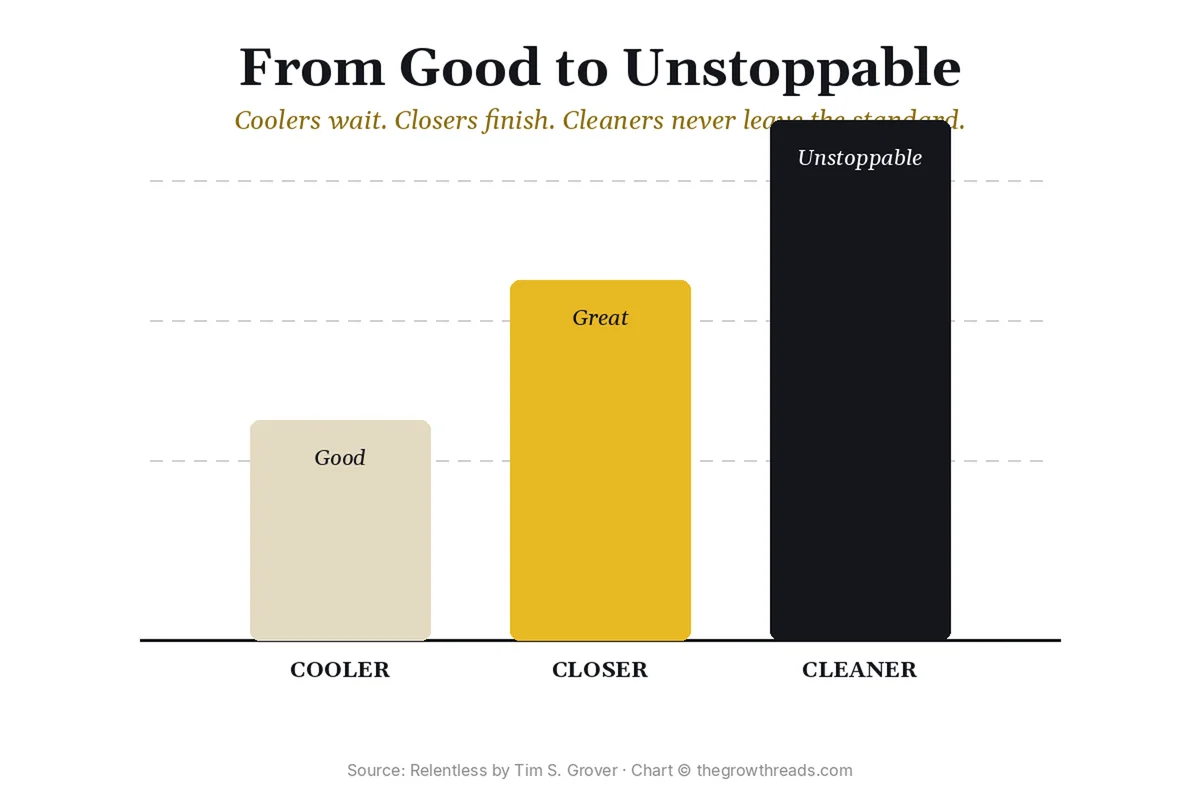
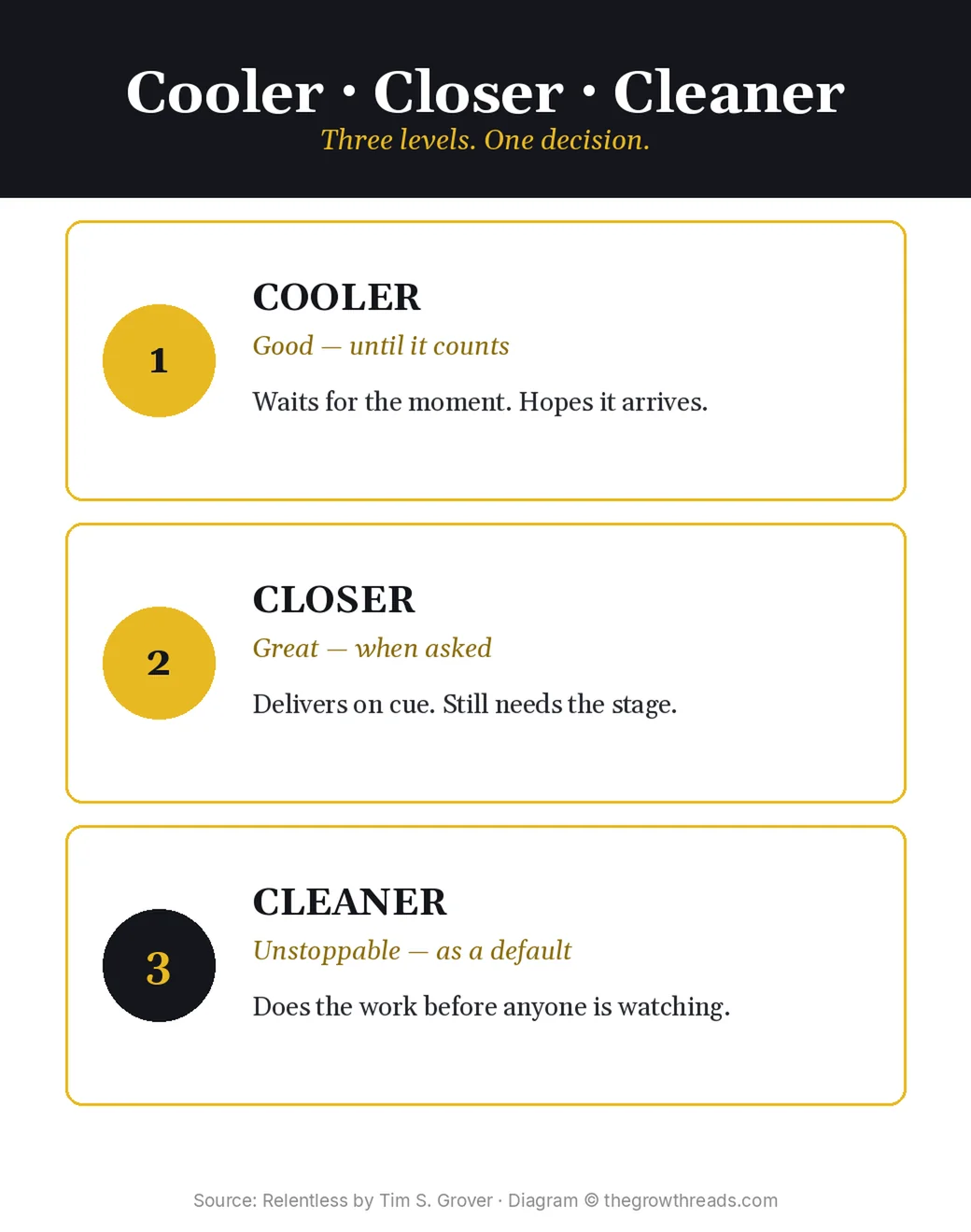
Coolers are good. Closers are great. Cleaners are unstoppable — and they do not wait to feel ready.
Tim Grover trained Michael Jordan, Kobe Bryant, and Dwyane Wade. Relentless is the mental operating system he saw in them, written for anyone whose work has a scoreboard. You already know what to do. The leak is the inner meeting that starts when the room gets loud. Grover’s move is to name three levels of competitor, then train the Cleaner as a Tuesday default instead of a playoff personality.
Key takeaways
- Cooler, Closer, Cleaner: Good until it counts; great when the stage is set; unstoppable as a weekday standard. Name which one you were in the last hard hour.
- You already know: More research is often a delay costume. Start the thing you can name in one sentence.
- Don’t wait to feel ready: Mood is not a gate. Cleaners start cold and let quality catch up.
- Don’t think in the pocket: Thinking belongs in practice. In the loud room you trust the reps you already paid for.
- Pressure is fuel: The loud room is the job, not an interruption of the job. Write the first move before you need it.
- Never recognize failure in the moment: Keep the next rep. File the lesson after, not during.
- The Zone is trained: Quiet hours build the instinct you will need when there is no time to hold a meeting with yourself.
- Being liked is optional: The standard will confuse people who want you easier. That is data, not a veto.
- Trust is scarce: Fewer voices in the last two minutes. One card. One move.
- Stay Clean on Tuesday: Unstoppable that only appears for a final is still a Closer in costume.
What is Relentless about?
Relentless is Tim Grover’s field manual for mental toughness at work. It sorts competitors into Coolers, Closers, and Cleaners, then shows how Cleaners treat pressure, instinct, and standards as a default. You leave with a language for the last 10% of hard work — the part most people negotiate away when the room gets loud.
About the author
Tim Singh Grover was born in 1964 and built his name in Chicago gyms, not on a podcast. Trained as an exercise physiologist, he cold-called the Bulls staff in 1989 and began working with a second-year Michael Jordan. That relationship became ATTACK Athletics. Over the next two decades he trained Kobe Bryant, Dwyane Wade, and a long list of NBA stars who already had talent and still wanted the last edge. Relentless (2013, with Shari Wenk) is the first book: the mental operating system of those rooms, written so a person with a calendar can steal it. Winning (2021) is the sequel. Grover’s public talks stay blunt: instinct over mood, pressure as fuel, and a three-level map from Cooler to Closer to Cleaner. Explore all Tim S. Grover book summaries →
Key concepts at a glance
| Concept | What it means | Use it when |
|---|---|---|
| Cooler | Good — skilled, still waiting for the moment | You did the work in practice and went quiet when it counted |
| Closer | Great — delivers when the stage is set | You are excellent on game day and uneven on Tuesdays |
| Cleaner | Unstoppable as a default, not a special event | You want the same bar with no audience |
| Don’t think | Trust trained instinct in the loud room | You are holding a meeting with yourself in the last two minutes |
| The Zone | Quiet focus built in ugly hours, spent when it counts | You only “find” focus if the playlist is perfect |
| Pressure as fuel | The loud room is the workplace | You reschedule the hard thing because it feels important |
| Dark side | Willingness to be disliked in service of the standard | You keep shrinking the work so everyone stays comfortable |
| Relentless 13 | The Cleaner traits Grover saw in champions, grouped here as weekday standards | You want a checklist instead of a highlight reel |
Part 1: Coolers, Closers, and Cleaners
Grover’s origin story is a cold call. The Bulls did not ask a young trainer to invent a philosophy. Jordan already had the talent. What Grover wrote down later was a person who treated the standard as the weather — not a mood he waited to arrive. That is the seed of the three-level map.
A Cooler is not lazy. Coolers hit numbers in easy weeks and go quiet when the matchup is ordinary. The tell is the wait: they need the moment to feel like a moment. A Closer can finish. Give them the fourth quarter, the deadline, the stage, and they produce. Organizations love Closers because they are visible. The leak is dependence on the stage. In a knowledge job that looks like a brilliant deck the night before the board meeting and an empty page on Wednesday.
A Cleaner makes the result the default. They do the work before anyone is watching and keep doing it when the watching is ugly. Grover’s Jordan and Kobe stories are a pattern, not a dare: the standard does not wait for applause. The usable version is you sending the draft when the room is loud, instead of waiting for a calmer hour that will not come.
TGR Note: David Goggins builds a furnace for people who have been negotiating with pain in Can’t Hurt Me. Grover’s map sits one layer up: you can already stay in the fire and still be a Closer who needs the lights. Use Goggins when the problem is staying. Use Grover when the leak is which version of you shows up once the clock is loud.
Part 2: The Cleaner standard (the Relentless 13, usable)
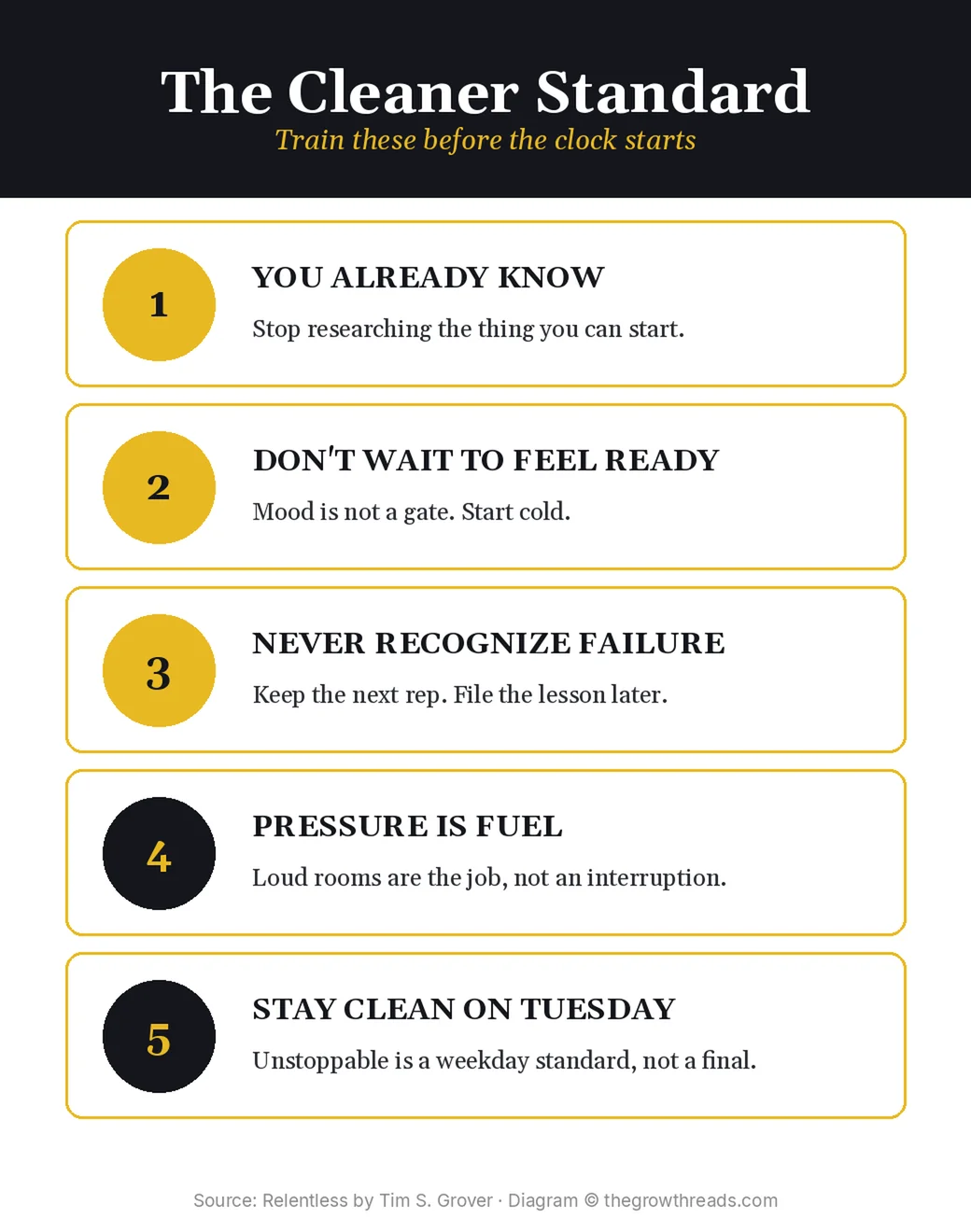
The middle of the book is a list of traits Grover saw in Cleaners. Reproducing thirteen lines as a poster is a fair-use dead end and a weak way to work. The useful move is to group them into weekday standards you can fail in public.
You already know. The extra article, the extra podcast, the extra “I just need to think” — Grover treats that as a costume for delay. If you can name the next physical action in one sentence, you are past research. Start. Coolers collect maps. Cleaners leave the parking lot.
Don’t wait to feel ready. Readiness is a feeling the work creates, not a ticket you buy before the work. Cleaners start cold. The first ten minutes are allowed to be ugly. Quality is allowed to catch up.
Never recognize failure in the pocket. This is not “never learn.” It is a timing rule. During the set, the shift, the live hour, you keep the next rep. You do not hold a performance review in the hallway. Notes happen after. Athletes understand this in their bones. Knowledge workers often do the opposite: one awkward sentence and the whole morning becomes a meeting about the sentence.
Pressure is fuel, and being liked is optional. Grover’s “dark side” is not cruelty for sport. It is the willingness to keep the standard when it makes you less convenient. If your version of kindness is shrinking the work so nobody is uncomfortable, you will stay a pleasant Closer. The Cleaner is still decent. They are simply not for sale at the price of the last 10%.
TGR Note: Jocko Willink’s Discipline Equals Freedom is the default-yes twin of this chapter. Jocko kills the morning negotiation. Grover kills the loud-room negotiation. If your leak is 5:30 a.m., start with Jocko. If your leak is the meeting where everyone watches, stay here and put the first move on a card.
Part 3: Don’t think — instinct and the Zone
“Don’t think” is the line people quote and misunderstand. Grover is not anti-intelligence. He is against holding a committee in the last two minutes. Thinking belongs in the ugly hour: film, reps, drafts, the work nobody claps for. That is where instinct is built. Anders Ericsson would call the same hours deliberate practice. Grover’s wording is shorter because the athletes he trained did not need a journal. They needed to stop arguing with a shot they had taken ten thousand times.
The Zone, in this book, is not a mystical fog that visits nice people. It is what trained quiet looks like when it is spent. You cannot playlist your way into it on demand. You can show up to the quiet hour often enough that, when the room gets loud, there is something to trust. That is why the 7-day plan starts with an ugly hour, not a visualization.
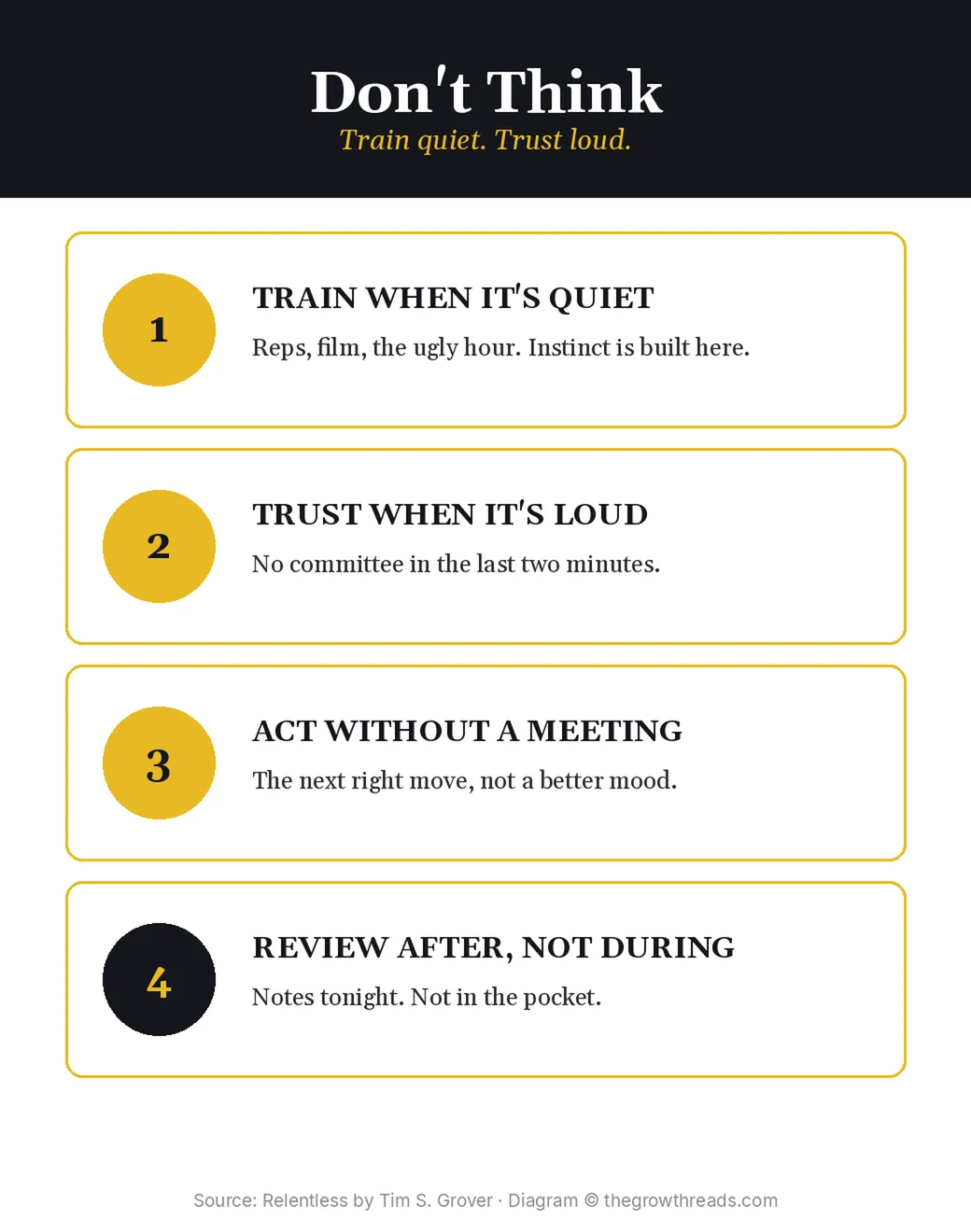
The practical test is simple. When the clock is loud, do you reach for a new idea or for the move you already paid for? If you open a new tab, you are thinking in the pocket. Close it. Play the card you wrote when it was quiet. Review tonight. That loop — train, trust, act, review after — is the whole chapter in four verbs.
TGR Note: Ericsson and Pool’s Peak is the laboratory version of Grover’s instinct. Peak tells you how to design the ugly hour so the instinct is real. Relentless tells you when to stop redesigning and shoot. Use Peak to build the reps. Use Grover so you do not hold a seminar in the pocket you trained for.
Part 4: Pressure, the dark side, and staying a Cleaner
Pressure is not a special guest. In Grover’s gym it is the weather. If you only bring the Cleaner for launches and playoffs, you are still a Closer with good branding. The application is almost boring: same start time, same finish rule, on a day when nobody is watching. That is why Day 7 is a Tuesday test.
The dark side is the willingness to keep the standard when it makes you less convenient. Used badly, that sentence becomes an excuse to be a jerk. Used well, it is a boundary: you will not reschedule the hard block for a longer chat, and you will not add a sixth opinion to a decision that already has the data. Cleaners are often quieter than the stereotype. They are busy keeping the bar.
Staying a Cleaner has a cost in isolation. If your life also needs recovery, that is how you remain able to take the next ugly hour — not a betrayal of the book. Relentless is the standard, not a permission slip to skip sleep. Grant Cardone’s The 10X Rule asks for massive action. Grover would ask whether those hours are a Cleaner default or a Closer spike when the crowd arrives. Put them on a Tuesday.
Who is Relentless best for — and who should read something else first?
Best for people who already know the work and leak it when it gets loud: operators, athletes, founders, surgeons of a calendar, anyone with a scoreboard. If you have been collecting toughness quotes and still bargaining in the meeting, this is your language.
Read something else first if you cannot start at all. Stephen Guise’s Mini Habits is the tiny door. Come back to Grover when the problem is no longer the first two minutes, it is the last 10%. If your “relentless” has already become injury, read Rest and then return — a Cleaner who cannot take the next ugly hour is just a story. If you need the science of skill, start with Peak. If the work is a team that will not own the miss, Jocko’s Extreme Ownership is the leadership twin, not a substitute for this map.
Questions to reflect on
- In the last seven days, when were you a Cooler, a Closer, and a Cleaner? Date each one.
- What is the one task you already know and keep researching instead of starting?
- Where do you hold a meeting with yourself in the last two minutes?
- Whose opinion do you add that you do not actually need?
- What would “the same bar on a Tuesday with no audience” look like on this calendar?
🔥 Ready to stop bargaining when it gets loud?
Get Grover’s Cooler–Closer–Cleaner map in the original book, then run the 7-day plan below.
How to apply Relentless (7-day plan)
- Day 1 — Name the levels. Write last week’s Cooler moment and last week’s Cleaner moment. Two dated sentences. No audience.
- Day 2 — Start the thing you already know. Pick one task you already know. Put it on tomorrow before inbox. Start cold when the clock hits.
- Day 3 — Ugly hour first. Do a 25-minute ugly hour first. Film, draft, numbers — the work you hide. No pep talk.
- Day 4 — Pressure as a card. Name one loud room this week. Write the first move on a card. When it starts, play the card, not your mood.
- Day 5 — Cut one committee. Cut one committee: one extra opinion, one extra tab, one extra “quick think.” Do the next right move.
- Day 6 — Notes tonight. Review after, not during. Ten minutes at night: what you did, where you bargained, what you will not reopen.
- Day 7 — Tuesday standard. Keep the same bar on a Tuesday with no audience. Same start time, same finish rule. That is the Cleaner test.
Frequently asked questions
What is Relentless about in one paragraph?
Relentless is Tim Grover’s field manual for the last 10% of hard work. He sorts competitors into Coolers (good until it counts), Closers (great when the stage is set), and Cleaners (unstoppable as a weekday default). The book is not a workout plan. It is a language for pressure, instinct, and the inner negotiation that starts when the room gets loud. You already know what to do. Grover’s claim is that Cleaners stop asking permission from their mood. The 7-day plan below is how you test that on a Tuesday, not after a highlight reel.
How long does it take to read Relentless?
The Scribner paperback is about 233 pages — a focused afternoon or two evenings, roughly four hours. It is short on drills and long on stories from Jordan, Kobe, Wade, and the gyms Grover ran. Read it once for the Cooler–Closer–Cleaner map, then keep this guide for the apply layer: the five weekday standards, the “don’t think” loop, and a week of tiny tests. Do not treat the book as a biography of stars. The useful unit is one pressure moment from your own calendar this week.
What is a Cleaner in Relentless?
A Cleaner is Grover’s name for the person who treats the standard as the default, not a special event. Coolers wait for the moment. Closers finish when the lights are on. Cleaners do the work before anyone is watching and keep doing it when the room is ugly. They are not louder. They are less negotiable. In practice: start the hard block without a pep talk, keep the next rep after a miss, and treat pressure as fuel. You need one task you already know and a refusal to bargain with it.
Is Relentless only for athletes?
No. The stories are from basketball because that is Grover’s laboratory. The map is for any work with a scoreboard: a launch, a match, a sales quarter, a manuscript, a night shift. If your week already has a clock and an audience, you have Cooler, Closer, and Cleaner versions of yourself. The book is a poor fit only if you still need a tiny start — in that case read Mini Habits first and come back when the problem is no longer starting, it is staying in the last 10% when it gets loud. Operators, founders, and performers tend to feel named, not lectured.
How is Relentless different from Can’t Hurt Me or Discipline Equals Freedom?
David Goggins’ Can’t Hurt Me is a furnace for people who have been negotiating with pain. Jocko’s Discipline Equals Freedom is a default-yes operating system: stop asking whether you feel like it. Grover sits next to both and adds a three-level map. You can be disciplined and still be a Closer who needs the stage. Relentless asks whether the standard survives a Tuesday with no crowd. Use Goggins when you need to prove you can stay in the fire. Use Jocko when mornings are the leak. Use Grover when the leak is the loud room — the meeting, the fourth quarter, the send button.
Is Relentless still relevant in 2026?
The inner negotiation has not been patched by a new app. Teams still wait to feel ready. People still call research a plan. Grover’s Cooler–Closer–Cleaner language is still the fastest way to name that pattern in a 1:1. What has changed is the volume of advice that tells you to optimize mood first. This book is the counter-weight: train when it is quiet, trust when it is loud. Pair it with Peak if you need the science of how instinct is actually built, and with Rest if your version of relentless has already become injury. The map is current. The recovery layer is yours to add.
What should I do first after reading Relentless?
Do not highlight the Relentless 13 and change nothing. Pick one task you already know how to start. Put it on tomorrow’s calendar before any inbox. When the clock hits, start cold — no extra tab, no new podcast, no wait for a better mood. After you finish, write three lines: what you did, where you almost bargained, what you will not reopen tomorrow. That is Day 1 and Day 2 of the plan below. If you want a second move, name last week’s Cooler moment out loud to one person who will not flatter you. The book works when the next loud room is treated as the job.
Related summaries
- Can’t Hurt Me Summary & Review
- Discipline Equals Freedom Summary & Review
- The 10X Rule Summary & Review
- Peak Summary & Review
- Best Productivity Books
How we analyze books: every book on The Growth Reads is read cover to cover, summarized in thousands of words of original analysis, and rated against our five-criteria rubric (lasting impact, evidence quality, practical application, writing & originality, external consensus). Read our full methodology.