

★★★★¾ 4.7/5 — A clear inner-training manual for performing under pressure without letting the scoreboard own your worth.
Best for: people whose skill is already good enough and who still tighten when the number is on the line.
Reading time: ~6.5 hours (368 pages) · this guide ~12 min
Difficulty to apply: Medium. The unit is a daily presence drill plus one less self-centered action, not a new personality.
Inner Excellence in one minute
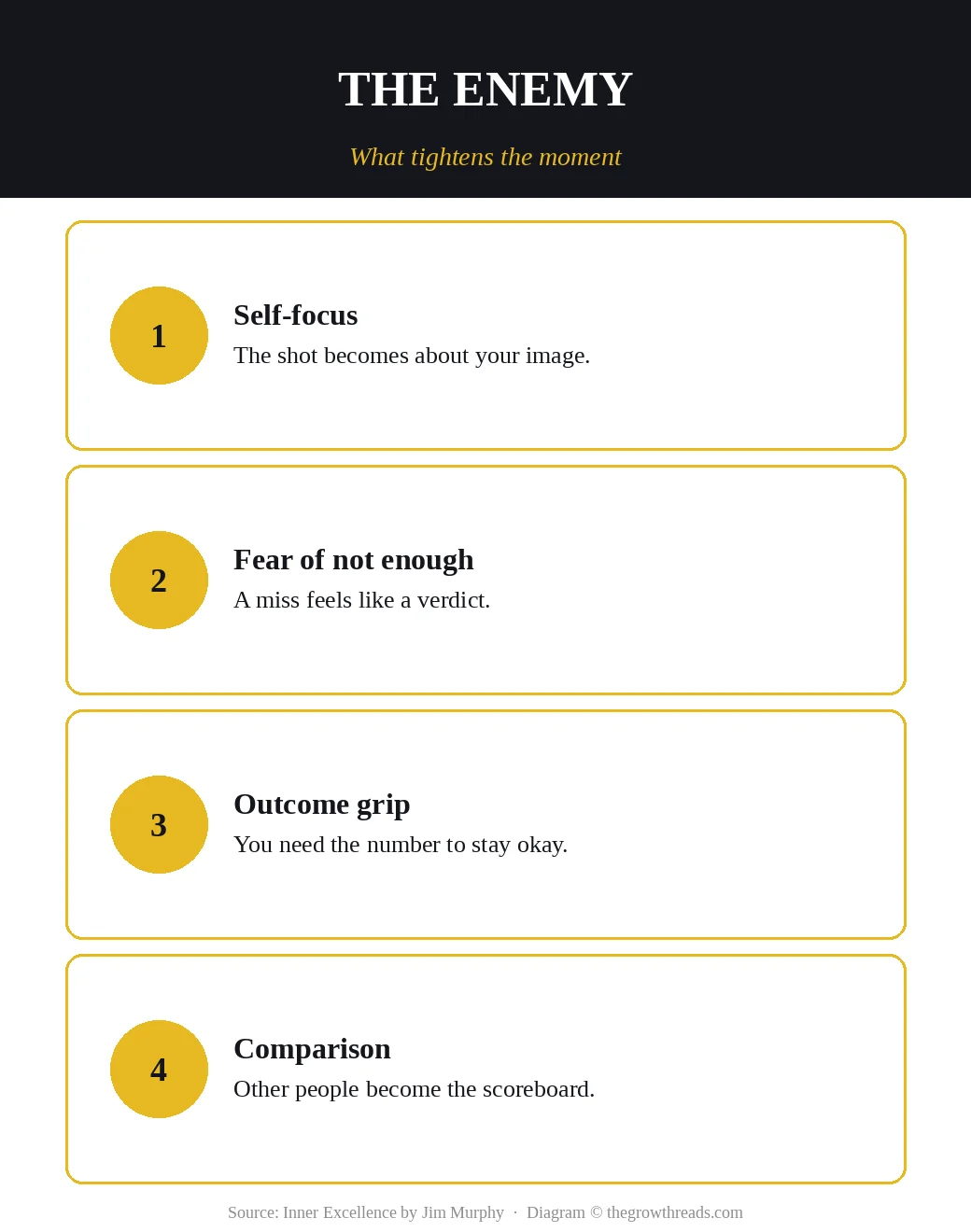
The result you are squeezing is the one you cannot hold. Jim Murphy’s Inner Excellence trains the moment that usually goes wrong: you have the skill, the room gets quiet, and your worth climbs onto the scoreboard. He learned it as a Cubs-organization player, then spent two decades coaching Olympians, tour golfers, and executives with the same tightness. The enemy is self-centeredness — fear of not being enough. The practice is love, wisdom, and courage, in the present tense. Extraordinary performance and a good life are the same path.
You do not need a new identity by Friday. Notice the self-centered story, return to your feet, and take the next action that serves the work rather than your image.
Key takeaways
- Self-centeredness is the enemy: When the moment is about your image, the body tightens and the skill you already have gets smaller.
- Worth is not a number: A scoreboard can tell you what happened. It cannot tell you who you are. Stop bargaining with it.
- Love, wisdom, courage: Want the good of others, see the moment as it is, and act while you are still scared. Those are drills, not traits.
- Be where your feet are: Presence is the only place a performance can actually happen. The future score is a thought, not a room.
- Let go of what you cannot control: Weather, judges, other people, yesterday. Keep the next honest action. Release the rest on purpose.
- Train the heart, not just the hands: Visualization, gratitude, and a mission bigger than your ego are practice, the way a swing is practice.
- Fear is attachment: You clench because you need a certain outcome to feel safe. Need less, and the shot gets simpler.
- A good life is the same path: Peace and peak performance are not a trade. The person who is free plays better.
What is Inner Excellence about?
Inner Excellence is Jim Murphy’s training system for performing under pressure without tying your worth to the scoreboard. Drop self-centered fear, practice love, wisdom, and courage, and stay present so extraordinary performance and a good life become the same daily path, not two competing goals.
About the author
Jim Murphy is a performance coach and the #1 New York Times–bestselling author of Inner Excellence. He began as a professional baseball player in the Chicago Cubs organization. Vision problems ended the playing career, and the question that followed — how do the best stay free when it counts — became the work. He later coached with the Texas Rangers and the South African Olympic baseball team, then spent years with tour golfers, including world champions and world number ones. He now runs offsite retreats and the Inner Excellence Freedom Project, which builds communities aimed at spiritual and physical poverty. The authority is not a lab paper. It is two decades of locker rooms plus a book that jumped from athletes’ bags to a Grand Central edition in April 2025 after a very public season on NFL sidelines. Explore all Jim Murphy book summaries →
Key concepts at a glance
| Concept | What it means | Use it when |
|---|---|---|
| Self-centeredness | The moment becomes about your image, not the work. | You tighten as soon as someone is watching. |
| Love | Want the good of others; get out of your own way. | The day is a highlight reel you are trying to protect. |
| Wisdom | See the moment as it is, including what you do not control. | You are arguing with weather, judges, or yesterday. |
| Courage | The next honest action while the stomach is still tight. | You wait to feel ready before you take the shot. |
| Presence | Be where your feet are. Performance only happens now. | Your head is already in the scoreboard of Friday. |
| Attachment | Needing a result in order to feel safe. | A miss feels like a verdict on your worth. |
| Heart training | Gratitude, visualization, and a mission bigger than ego. | You only train the skill and wonder why you still clench. |
| Same path | A good life and a great performance are not a trade. | You treat peace as something you will earn later. |
Part 1: Why chasing the number makes you worse
Murphy’s playing years are the opening case. Worth rode on results. Achievement and fear of failure sat in the same chair. When the career ended, he started watching people who stayed free in rooms that make most of us smaller — and people who had more talent than they could use because the moment got personal. The pattern was stable across sports and later across offices: the more the outcome had to prove you were enough, the more the body braced, and the more the skill leaked. That is not a motivation problem. It is an attention problem. The work is in front of you. The story is about you. The story wins, and the work gets a smaller share of the nervous system.
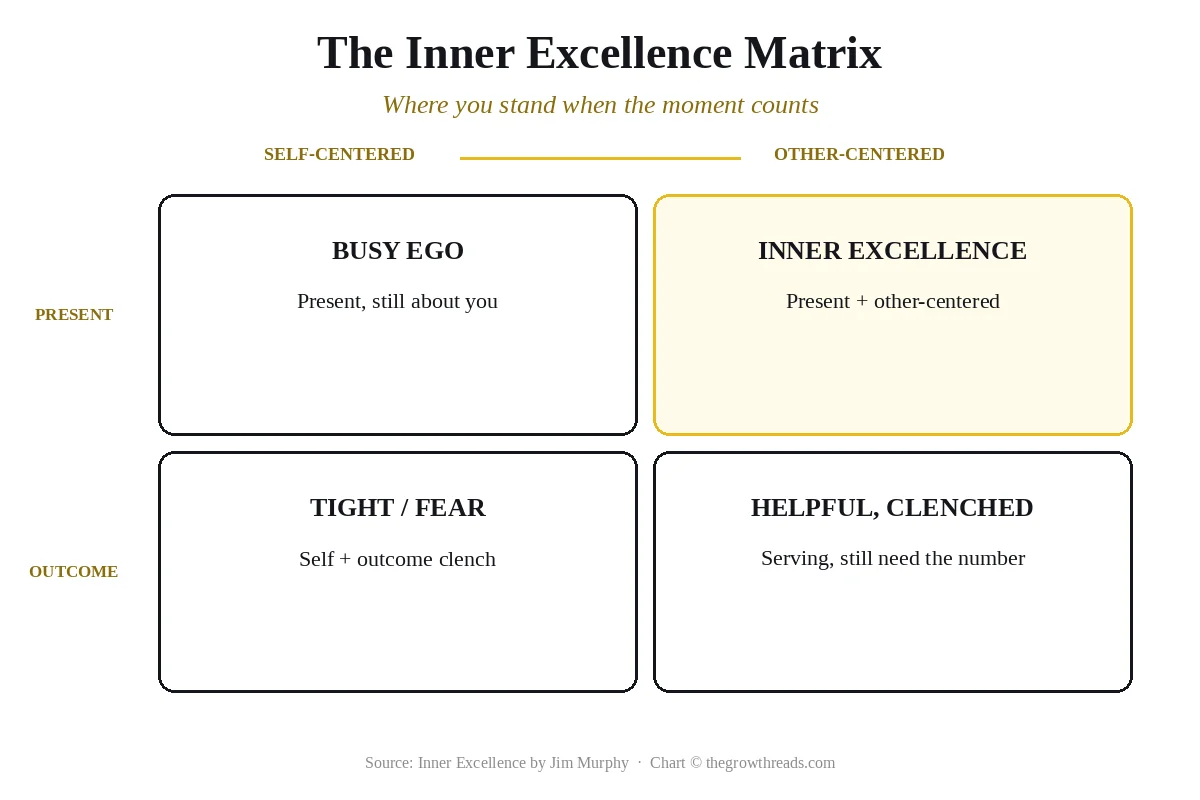
Self-centeredness here is not vanity with a mirror. It is the quiet calculation under a presentation, a tee shot, a hard conversation: what will this say about me. Comparison is the same math with extra people. Murphy’s first move is to name that calculation as the enemy, not as professionalism. Caring about the work is fuel. Needing the work to rescue your identity is a clenched jaw. If you already have a craft, you will recognize the week where skill was present and freedom was not. That week is the book’s subject.
TGR Note: If the job is to walk toward pressure instead of negotiating with it, Relentless is the cleaner-closer gear. If the job is to stay with the process when the product is loud, The Practicing Mind is the process-versus-product cousin. Murphy is the inner reason those two books have somewhere to stand when the number gets personal.
Part 2: Love, wisdom, and courage
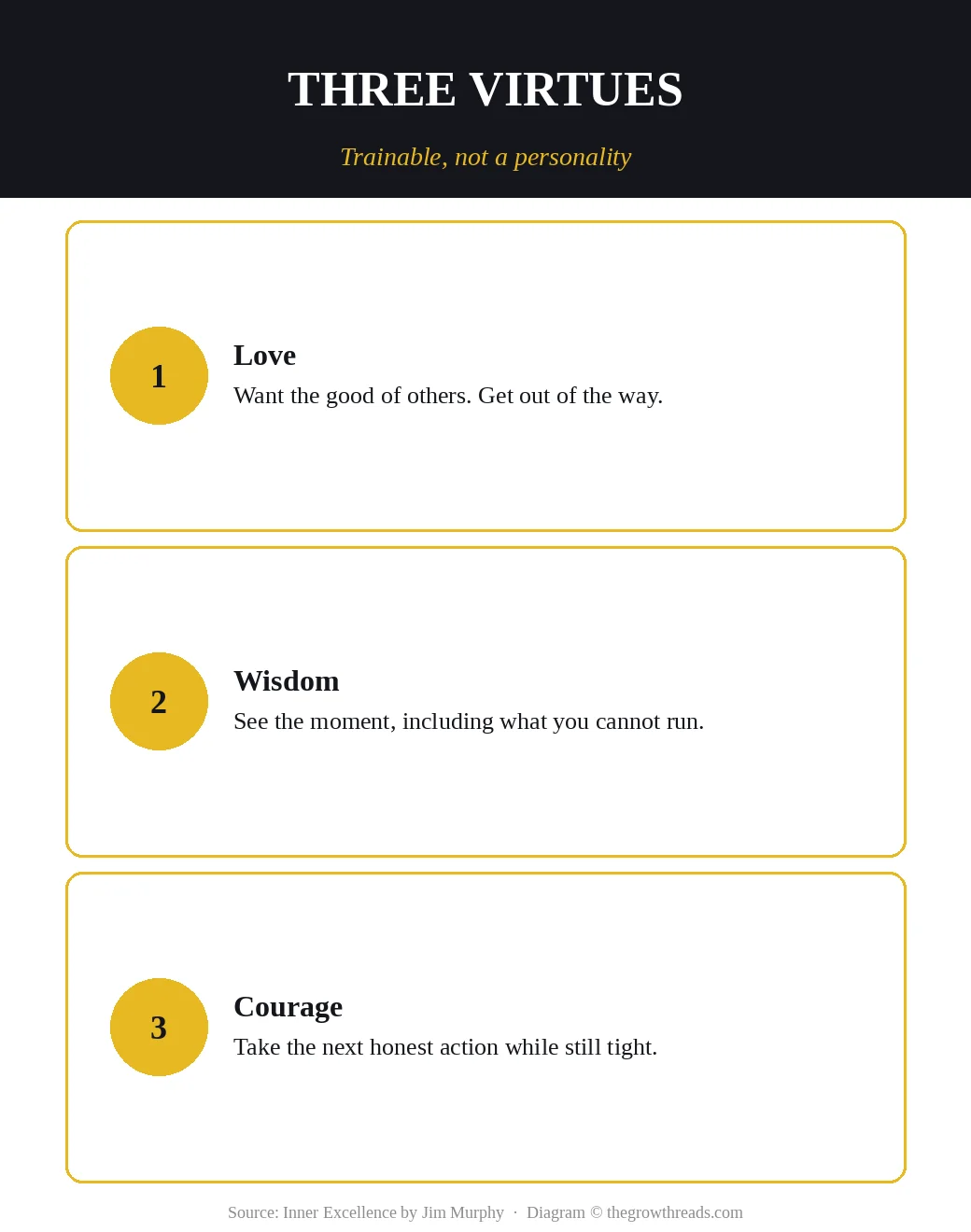
The middle of the book is a virtue stack, written for people who roll their eyes at the word. Love is wanting someone else’s good and getting your ego out of the shot. Wisdom is seeing what is in front of you — including the slice of the result that was never yours to run. Courage is the send, the swing, the ask, while the chest is still loud. All three are trainable. You do not wait to become a loving person. You do one less self-centered action before lunch. You do not wait to feel brave. You take the smallest honest action the old story wanted to delay.
This is also where the book gets practical about fear. Fear, in Murphy’s account, is mostly attachment: you need a certain outcome to remain okay. Need less, and the same skill has more room. That is not indifference. You can still want the win. You stop requiring the win in order to keep your name. Readers who have used You Are a Badass for the identity shove will hear a quieter version of the same permission. Sincero says decide and act like it. Murphy says love something more than your image, then act. Both books refuse the wait-until-you-feel-ready loop. Murphy’s version is less funny and more useful on a tee box or in a review meeting, where jokes will not lower your heart rate.
TGR Note: Once the virtue stack is a sentence, Atomic Habits is the cleaner install for cues. If the remaining leak is simply getting out of bed and doing the thing, Discipline Equals Freedom is the morning veto. Murphy is the inner training that keeps those systems from becoming another way to prove you are enough.
Part 3: Presence and the story under the skill
Performance only happens in the present tense. That sounds like a poster until you watch a good player leave the shot they are standing over and travel into a leaderboard, a parent, a contract year. Murphy’s most portable line is the instruction to be where your feet are. Presence is not a mood you wait for in traffic. It is a drill: return to the room, name what is here, then take the next unit of work. Visualization and subconscious training sit next to that drill. You rehearse the free version of yourself on purpose, the way you would rehearse a motion, because the clenched version is already well practiced. Gratitude is not decoration. It pulls attention off the missing number and onto the actual ground you are standing on.
The story under the skill is usually older than the job. Murphy does not ask you to litigate the past in public. He asks you to stop letting it vote on this swing. Forgiveness, including of your last miss, is how you take the vote away. If that sounds soft, watch a week when every error has to mean something about your character: the calendar fills with recovery from the story instead of reps. Presence plus a shorter memory is how the reps get their time back.
TGR Note: If the job after presence is simply to keep showing up on dull Tuesdays, Chop Wood Carry Water is the process romance. If you want the science of skill once the inner clench is quieter, Peak and Talent Is Overrated are the deliberate-practice pair. Murphy is the reason those practice hours do not collapse the first time someone is watching.
Part 4: A daily practice for the best possible life
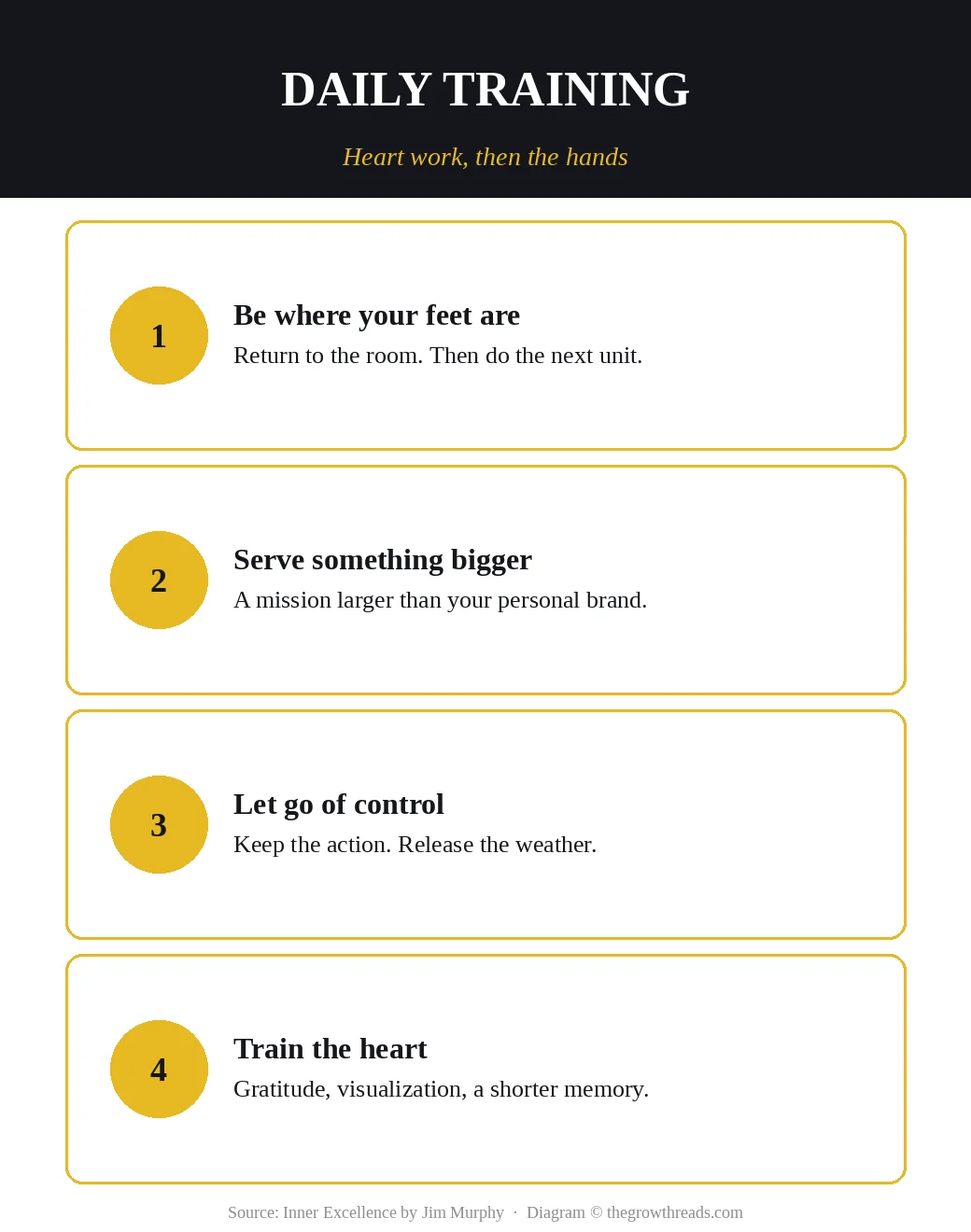
The last movement of the book is a loop, not a makeover. Train the heart the way you train the hands. Serve a mission that is larger than your personal brand — Murphy’s own Freedom Project is the example he lives, not a homework assignment you have to copy. Use a short daily sitting: presence, gratitude, one thing you will release, one action you will take while still tight. Then go do the work. The scoreboard is allowed to report. It is not allowed to name you. That is the “best possible life” half of the subtitle, and it is why the book landed with people who do not play for a living. A product launch and a Sunday pin are different crafts. The inner clench is the same animal.
The 2025 Grand Central edition is the current trade paperback of a book athletes had already been handing each other. You do not need the sideline photo. You need a week where a number owns your sleep, and a willingness to treat inner work as training, not as a reward after you finally hit the number. Hit it from a free chest, or miss it and still be a person. Less self, more presence, the next honest action. Repeat on a calendar, not on a feeling.
TGR Note: If the remaining leak after the inner work is a missing deep-work block, Deep Work is the door closer. If the remaining leak is a story that you are not allowed to want more, go back to You Are a Badass. Murphy is the performance-under-pressure layer that sits on top of both.
Who is Inner Excellence best for — and who should read something else first?
Best for people whose skill is already real and who still tighten when the moment gets personal: athletes, operators, makers, anyone whose worth has climbed onto a number. If you want locker-room intensity first, start with Relentless. If you want a cue-and-habit install, start with Atomic Habits. If you want a process-versus-product reset, start with The Practicing Mind.
Read something else first if you need an inbox or a tiny first step. Start with Deep Work or Mini Habits. If the fight is simply getting out of bed, read Discipline Equals Freedom. Come to Murphy when the calendar is already open and the clench is what ruins the hour.
Questions to reflect on
- Which number, person, or outcome currently owns your mood on a Tuesday?
- In the last high-stakes hour, were you in the work or in a story about what the hour said about you?
- What is one thing you keep trying to control that was never yours to run?
- What would “be where your feet are” look like in the next ten minutes, in this room?
- If a miss did not get to name you, what action would you take this week while still scared?
🔥 Ready to train the inside?
Name the tightness. Return to your feet. Take the next honest action.
How to apply Inner Excellence (7-day plan)
- Day 1 — Name the tightness. Write the number, person, or outcome that currently owns your mood. One sentence. Put it where you will see it tomorrow morning. Do not solve it today.
- Day 2 — Catch the self-centered story. When you hear “what will they think” or “I have to hit this,” write the sentence down. Label it as self-focus, not as truth. That is the whole job.
- Day 3 — One act of love with no scoreboard. Help one person in a way that cannot go on a highlight reel. No post. No receipt. Notice whether your chest loosens when the work is not about you.
- Day 4 — Be where your feet are. Ten minutes: name what you can see, hear, and feel. Then do the next unit of work without checking a metric. Presence is a drill, not a vibe.
- Day 5 — Drop one thing you cannot control. Circle one worry that is not yours to run. Write the next action that is yours. Do only that action. Leave the circle alone for the rest of the day.
- Day 6 — Courage while still tight. Take the smallest public action that matches the work: send the draft, take the shot, ask the question. Do it before the stomach goes quiet.
- Day 7 — Review the quadrant. Were you self-centered and clenched, or present and other-centered? Schedule three more presence drills on next week’s calendar. Grade the week on returns to your feet, not on the number.
Frequently asked questions
What is Inner Excellence about?
Inner Excellence is Jim Murphy’s training system for performing when it counts without chaining your worth to the scoreboard. As a former Cubs-organization player and later a coach to Olympians and tour golfers, he watched people need the result so badly they tighten and miss it. The fix is inner work: drop self-centered fear, practice love, wisdom, and courage, and stay present. Extraordinary performance and a good life are one path. The unit is a daily drill, not a personality you wait to feel.
How long does it take to read Inner Excellence?
The Grand Central paperback is 368 pages, about six to seven hours for most readers. This summary is a twelve-minute pass: the enemy, the three virtues, presence, and a seven-day plan. If you only have lunch, write where your worth is tied to a number, then do one ten-minute presence drill before email. Come back to later chapters once that drill has a calendar slot, not once you feel calm. The book rewards rereads more than a single highlight pass.
Is Inner Excellence only for athletes?
The stories come from baseball, golf, and Olympic rooms, and the 2024–25 season made the book a sideline staple. The mechanism is not sport-only. Any week a number — a launch, a grade, a review — owns your mood is the same tightness Murphy coached out of players. If you want locker-room intensity, start with Relentless. If you want a calendar, start with Deep Work. Read this when the stall is fear of not being enough, not a missing inbox.
How is Inner Excellence different from Relentless or Atomic Habits?
Relentless is the cleaner-closer gear: stop negotiating with pressure. Atomic Habits is the cue-and-identity install. Inner Excellence sits under both. It asks who you are when the number is on the line — self-centered and clenched, or present and other-centered. Grover trains the competitor. Clear trains the loop. Murphy trains the heart so both have somewhere stable to stand. Read Grover when you are backing down. Read Clear when you need a cue. Read Murphy when the cue is there and you still tighten.
Does Inner Excellence replace therapy or a skills coach?
No. Murphy is a performance coach, not a clinician, and some blocks need a specialist. The drills — presence, gratitude, letting go of what you cannot control, serving something bigger than your ego — are training, not a diagnosis. If anxiety is clinical, keep your care team. If the leak is a missing skill, keep the coach who teaches that skill. Use this book for the inner clench that appears after the skill is already good enough and the moment still feels too big.
What are the three virtues in Inner Excellence?
Love, wisdom, and courage. Love is wanting the good of others and getting out of your own way — not a mood. Wisdom is seeing the moment as it is, including the result you do not control. Courage is the next honest action while the stomach is still tight. Murphy treats them as daily practice, not a personality type. A Tuesday with all three looks ordinary: you showed up, you told the truth, you did the shot. The scoreboard reports. It does not get to name you.
What should I do on day one with Inner Excellence?
Write the number that currently owns your mood — a metric, a person, a result you are bargaining with. Sit for ten minutes and name five things in the room you can see or feel. That is the first presence drill. Do not reread the book as a substitute for the sitting. Murphy’s loop is notice the self-centered story, return to your feet, then take one action that serves the work rather than your image. Day one is a named tightness plus one return to the room.
Related summaries
- Relentless — walk toward pressure when you are negotiating with it.
- The Practicing Mind — stay with the process when the product is loud.
- You Are a Badass — drop the story that you are not allowed to want more.
- Atomic Habits — turn the inner decision into a cue you can repeat.
- Best productivity books — the full Productivity silo.
How we analyze books: every book on The Growth Reads is read cover to cover, summarized in thousands of words of original analysis, and rated against our five-criteria rubric (lasting impact, evidence quality, practical application, writing & originality, external consensus). Read our full methodology.