

★★★★☆ 4.3/5 — a clean reversal of the pep-talk: start, win small, then feel it.
Best for: People who wait to feel ready before they begin
Reading time: ~7 hours (256 pages) · this guide ~12 min
Difficulty to apply: Easy to understand — hard to start before you feel like it
The Motivation Myth in one minute
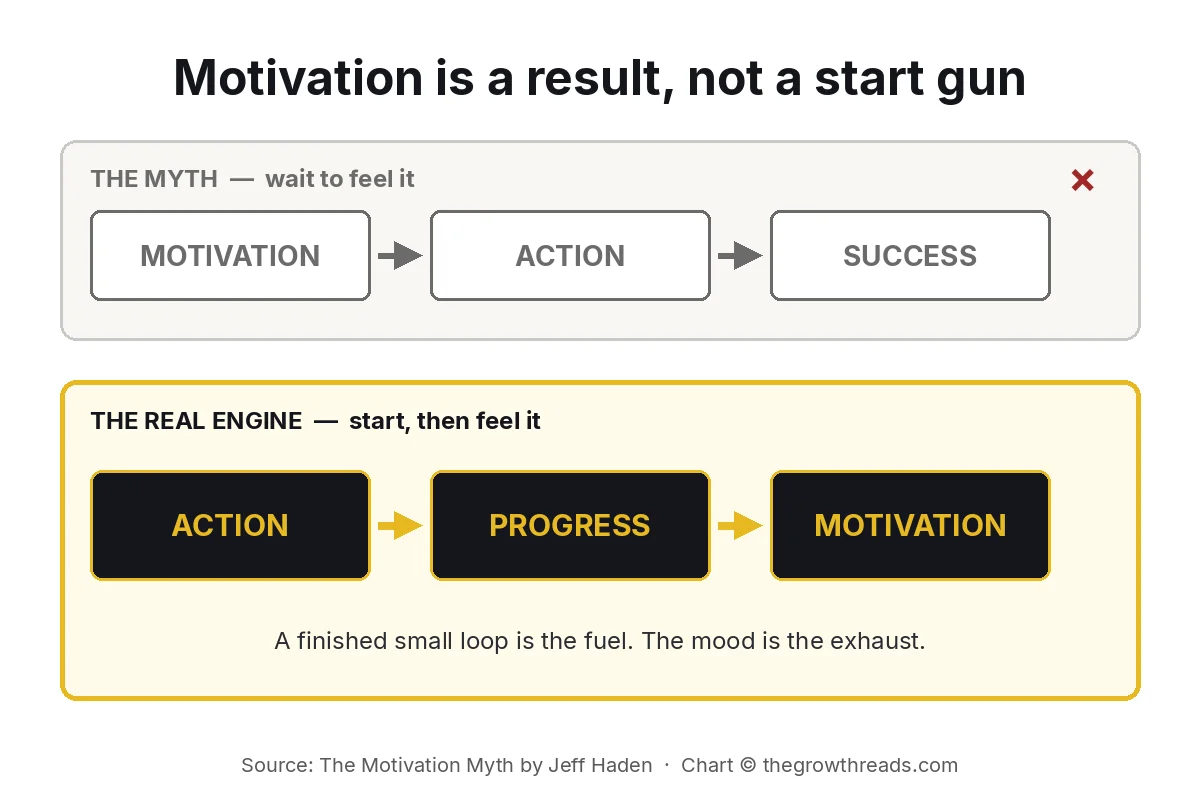
Motivation is the exhaust, not the fuel. Jeff Haden’s The Motivation Myth (Portfolio, 2018) is a shop-floor argument against waiting to feel ready. High achievers do not sit in the driveway until inspiration arrives. They start on a schedule, collect a small win, and the want shows up after the close — the same way heat follows a fire you actually lit. Passion is often a lagging indicator of competence, not a permission slip. Outcome trophies are someone else’s scoreboard; process goals are on your calendar. The usable move is not a better morning playlist. It is a start small enough to finish today, a done line you can tick, and a refusal to treat a missing mood as a gate. This summary is the application layer — two models, first-win loop, 7-day plan — not a highlight reel of other people’s highlight reels.
Key takeaways
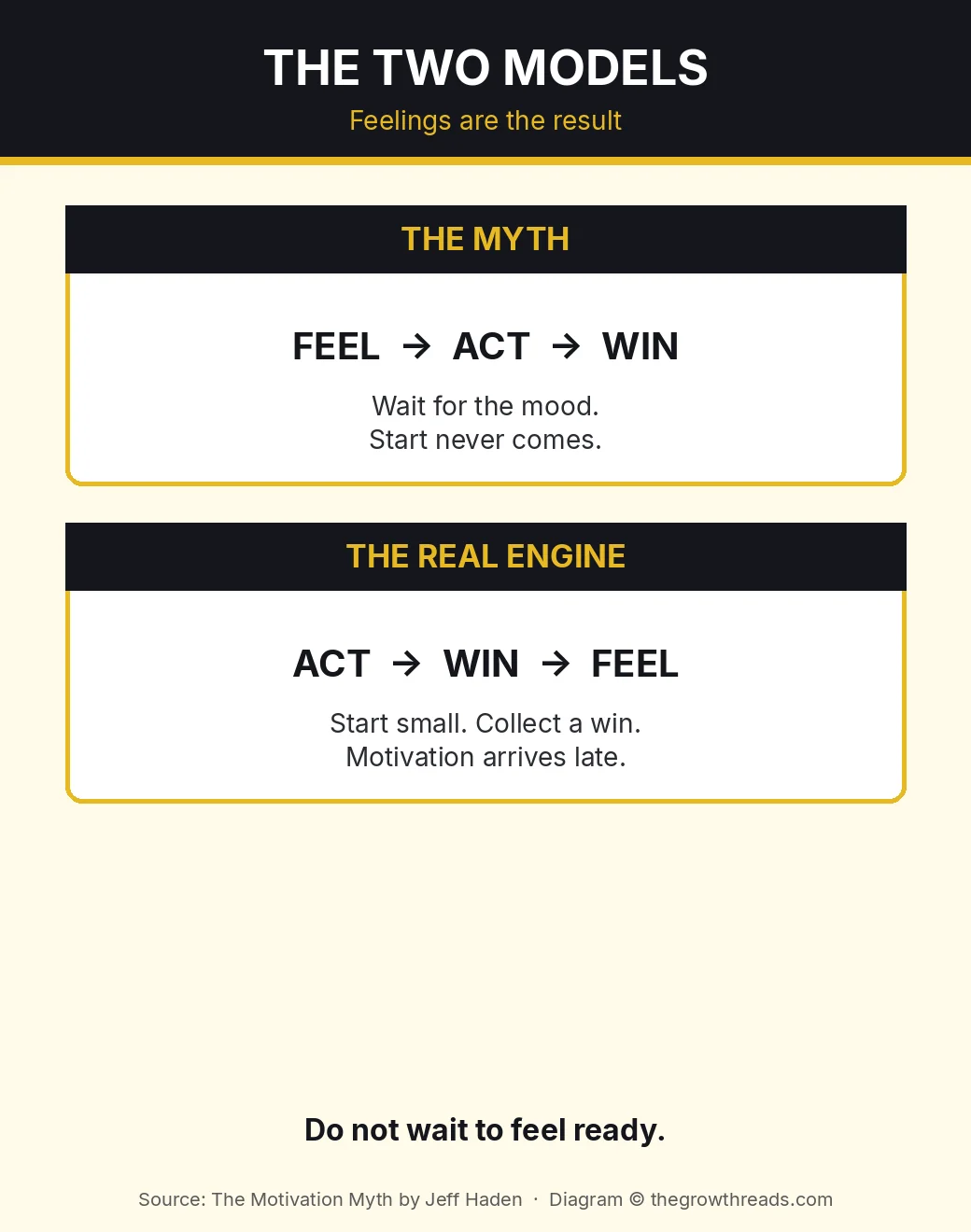
- The order is backwards: Feel → act → win is the myth. Act → win → feel is the engine.
- Motivation is real and late: The feeling is useful. It is not a start gun. It arrives after progress.
- Passion often lags skill: People grow to love what they have become able to do. Waiting to “find” it keeps the file closed.
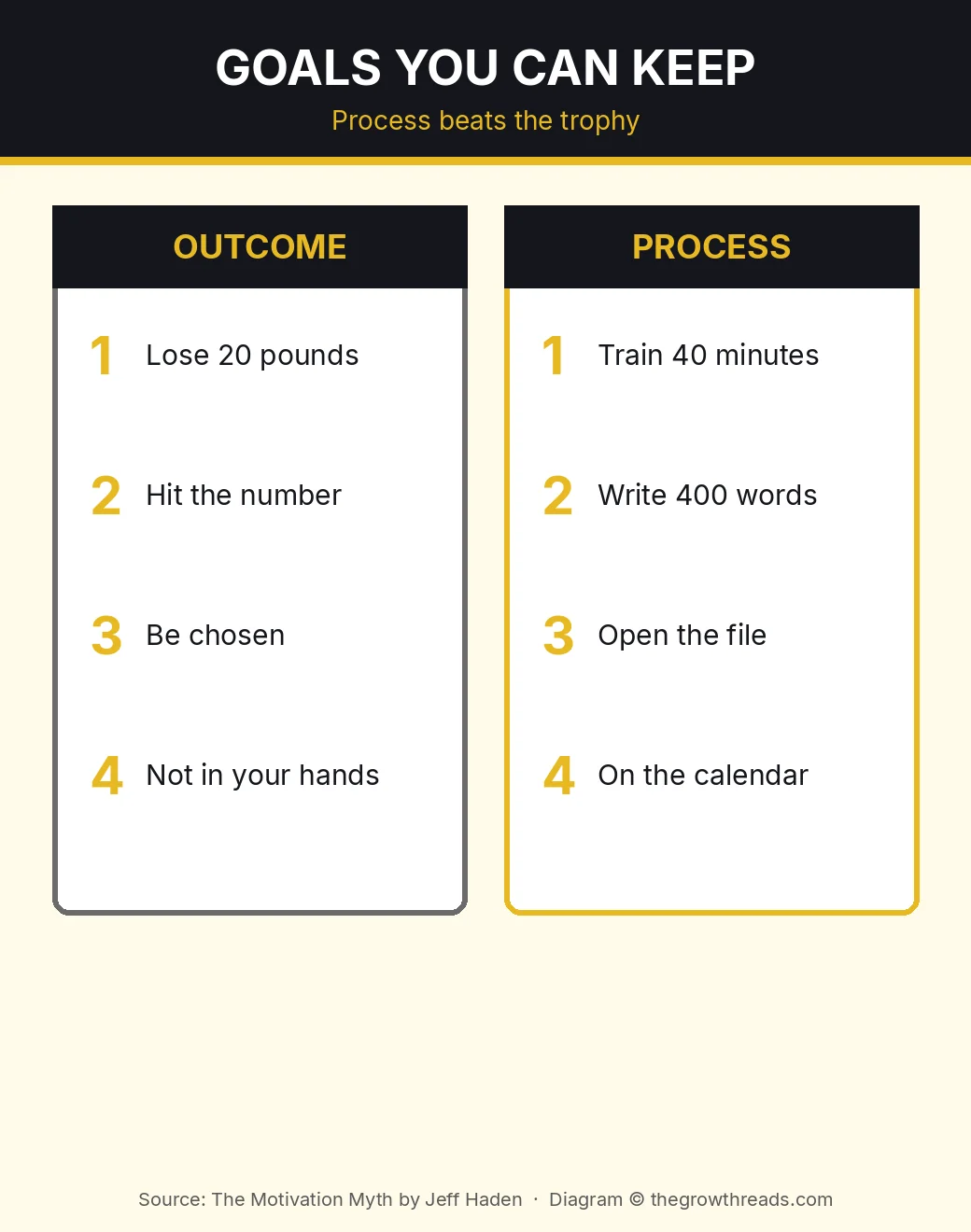
- Process beats the trophy: Forty minutes and four hundred words are yours. The scale and the yes are not.
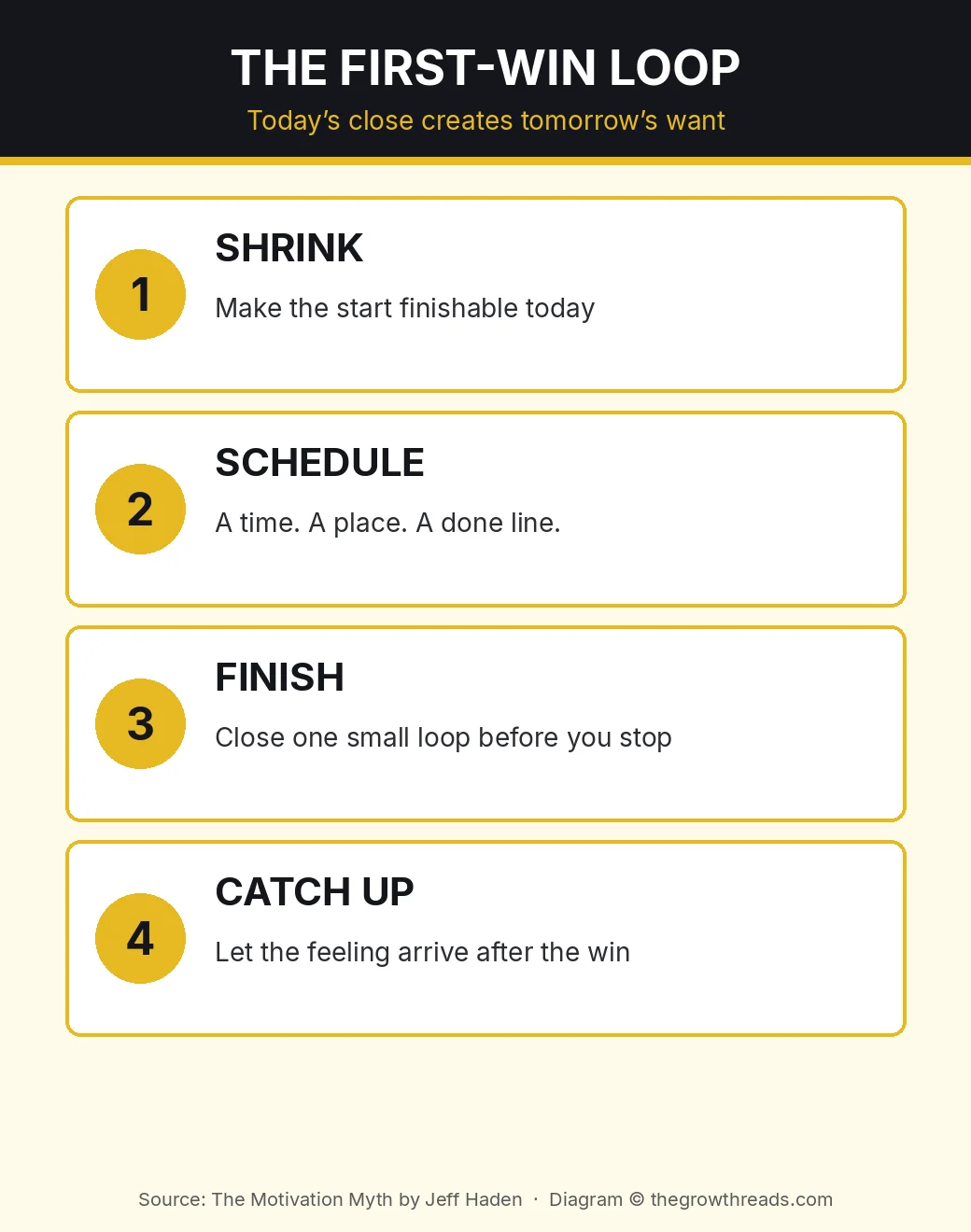
- Shrink until today can finish it: A heroic start you cannot close is how Sunday becomes shame.
- The calendar is the system: Time, place, done line. Mood does not get a vote at the start of the block.
- A first win is fuel: Completing a small loop is what people later call being motivated.
- Identity is the process: After a goal, many people crash. The work has to be who you are, not a finish line.
- Teaching locks the order: Explain the loop and you are less likely to wait for a feeling next Tuesday.
What is The Motivation Myth about?
The Motivation Myth argues that high achievers start before they feel ready. Motivation follows a finished small loop, passion often follows competence, and process goals on a calendar beat trophies you cannot control. Haden’s job is to take away the sentence “I’ll start when I feel like it.”
About the author
Jeff Haden is a contributing editor at Inc. and a long-time ghostwriter of business books who came to the page from a factory floor, not a writing-school waiting room. He spent years as a manufacturing plant manager, then built a writing practice the same way this book recommends: on a schedule, before anyone had granted him the identity of “writer.” The Motivation Myth (Portfolio, 2018) is the public version of that sequence — start, collect a small win, let the feeling catch up. He writes like an operator who later sat in boardrooms: concrete, slightly impatient with inspiration-as-strategy, more interested in Tuesday’s done line than in a better pep talk. Inc.com is the public home; there is no Wikipedia page to lean on. Start here if the block in your way is a missing mood. Explore all Jeff Haden book summaries →
Key concepts at a glance
| Concept | What it means | Use it when |
|---|---|---|
| The motivation myth | Waiting to feel ready before you begin | The file stays closed until the mood arrives |
| Real sequence | Action, then progress, then the feeling | You keep reversing the order |
| Lagging passion | Love often follows competence | You are hunting a calling instead of a skill |
| Process goal | A unit of work you can finish today | The only target is a trophy |
| Outcome goal | A score that needs luck or other people | You cannot tick it without a committee |
| First win | A closed loop small enough for today | You binge, then vanish |
| Calendar as system | Time, place, done line — mood has no vote | You renegotiate every morning |
| Identity after arrival | The process has to be who you are | You crash after a goal |
Part 1: The myth — waiting to feel ready
The opening move of The Motivation Myth is almost rude in its simplicity. Most plans die in week two because they were never started. They were postponed until a feeling arrived that the postponement made less likely. Haden names that loop the myth: get motivated, then act, then win. It sounds adult. It is how a driveway fills with cars that never leave. The mood people wait for is usually the aftertaste of a finished loop, not weather that rolls in if you sit still.
He is not claiming desire is fake. He is claiming the order is wrong. You do not wait to be hungry in a useful way before you cook every night of your life. You cook, then the body reports. High achievers treat work the same way. The session that “felt inspired” is typically the one that followed a win, a streak, a closed loop — not the one that preceded the first ugly page. If you have been using a missing mood as proof that the project is not the one, Haden’s picture is a sequence change, not a personality verdict.
TGR Note: If the block is resistance and shame more than a missing mood, our War of Art summary is the sibling. If you need a two-minute wedge that does not argue with your identity, Atomic Habits is the habit book. Haden is the order-of-the-feeling book. Do not collect all three as a new way to wait.
Part 2: The real sequence — action, progress, then the want
Haden’s engine is a short loop. You act. You make progress you can see. The nervous system reports that as motivation, confidence, even a flicker of joy. Then you act again. The first unit has to be small enough that today can finish it. A novel is not a first win. Four hundred words can be. A transformed body is not a first win. A training block you actually closed can be. The people who look “driven” from the outside are often just people who stopped asking the mood for permission to start the block.
His own path is the quiet case study. Plant manager, then writer, then Inc. columnist and ghostwriter — not because a muse assigned him a vocation in a waiting room, but because he did the work on a clock until the identity caught up. That is the same shape Cal Newport later popularised as passion following skill, and Haden is happy to be in that family. The practical difference is the size of the first close. If the start still requires a weekend, a perfect desk, and a feeling, it is not a first win. It is a movie of a first win. Shrink until Tuesday can hold it.
TGR Note: So Good They Can’t Ignore You is the career-length version of lagging passion. The Practice is Seth Godin’s sibling: ship before you feel like an artist. If Haden is the Tuesday loop, those two are the longer arc. Still run Day 4. A finished small loop beats another tab of theory.
Part 3: Process goals, routines, and a calendar that votes
Outcome goals make stirring slides. They are also a poor daily contract. You do not control the yes, the scale, the ranking, the luck. You control whether the block happened. Haden’s process goal is boring on purpose: a unit of work with a done line you can tick without a committee. Forty minutes. Four hundred words. One opened file. One practiced opener. When the only target is a trophy, every morning becomes a negotiation with a feeling that has not been fed.
Routines are how you stop holding a daily referendum. Time, place, what “done” looks like. The calendar is not a vibe board. It is the motivation system wearing work clothes. Haden is impatient with people who keep rewriting the goal instead of keeping the appointment. If you missed the block, the fix is not a new vision board. It is a smaller unit and a more honest done line. Knowledge work is worse than sport here because the score is delayed. Invent a close the day can hold, or the engine has nothing to fire on.
TGR Note: If you start and then quit at 90 percent, our Finish summary (Acuff) is the closer sibling — cut the goal in half, survive the day after perfect. Tiny Habits is the shrink-the-start lab. Haden tells you why the first close matters for the feeling. Fogg and Acuff tell you how to keep it laughably small. Use one shrink this week, not three books as a delay.
Part 4: Identity, teaching, and a life that fuels itself
The last movement is the one people skip because it sounds softer than calendars. It is not. After a goal, many people crash. The trophy was the identity. The process was a tunnel they were willing to hate until the banner. Haden’s warning is that a life built only on arrival will keep manufacturing empty arrivals. The work has to be who you are on a Wednesday with no audience. That is not mysticism. It is what keeps the loop running when the medal is in a drawer.
Teaching is the lock. Explain the sequence to someone else — or to future-you in six sentences — and you are less likely to wait for a feeling you already know is late. Helping another person get a first win is also a first win of its own. Happiness, in this book, tracks progress more than destination. That is why a day with one closed loop can feel better than a month of almost. If you have been collecting courses as a substitute for closing, Part 4 is the unflattering mirror: the identity you want is on the other side of a done line, not on the other side of one more tab.
Who is The Motivation Myth best for — and who should read something else first?
Best for people who wait to feel ready. Collectors of courses. Starters who binge a heroic Saturday and vanish by Wednesday. Anyone whose current “goal” cannot be ticked without luck or other people. Haden will not give you a new app. He will take away the sentence that the missing mood is a gate.
Read something else first if you already open the file and still cannot stay with it — Grit or Finish will serve you faster. If you need a two-minute identity wedge, start with Atomic Habits. If the block is skill-building rather than a missing mood, Talent Is Overrated or Peak. If you want the career-length passion argument, So Good They Can’t Ignore You. The Motivation Myth is the order-of-motivation book. Use it for that.
Questions to reflect on
- What sentence do you use to delay a start — and which feeling did you make into a gate?
- Which of your goals cannot be ticked today without luck or other people?
- What is the smallest close that would still count as a win before dinner?
- When did a feeling of “motivation” last show up — before the work, or after a finished loop?
- If the trophy vanished, would the process still be who you are on a Wednesday?
🔥 Ready to start before you feel like it?
Get The Motivation Myth, then run the 7-day plan on one project you have been saving for a better mood.
How to apply The Motivation Myth (7-day plan)
- Day 1 — Name the wait. Write the sentence you actually use: “I’ll start when I feel like it,” or “I need to be inspired first.” Circle the feeling you made into a gate. That sentence is the myth in your voice.
- Day 2 — Design a first win. Pick one skill or project. Shrink the start until it is finishable in twenty to forty minutes. Write the done line in a notebook: what “closed” looks like today.
- Day 3 — Put it on the calendar. A time and a place. Not a vibe. When the block starts, open the file before you negotiate. The calendar is the motivation system.
- Day 4 — Finish one loop. Close the unit you named. Stop at done, even if the mood finally arrived and wants a hero session. The point is a complete loop, not a binge.
- Day 5 — Log the feeling after, not before. Two lines: what you finished, and whether the want got louder. No personality lecture if it didn’t. Run the same block tomorrow.
- Day 6 — Rewrite one outcome as a process. Take a trophy goal and turn it into a daily unit you control. If it still needs luck or other people to tick, it is not a process goal yet.
- Day 7 — Teach the loop once. Explain the sequence to one person, or write six sentences for future-you. Teaching locks the order: start, win small, let the feeling catch up.
Frequently asked questions
What is The Motivation Myth about in one paragraph?
The Motivation Myth is Jeff Haden’s 2018 case that motivation is a result of progress, not a feeling you wait for before you begin. High achievers start on a schedule, collect a small win, and let the want catch up. Passion often arrives after competence, not before it. Outcome trophies are not in your hands; process goals are. This summary is the application layer: shrink a start until it is finishable today, put it on the calendar, close the loop, and run the 7-day plan. You do not need a better pep talk. You need a done line before dinner.
Does The Motivation Myth say motivation is fake?
No. Haden treats the feeling as real and useful — just late. The myth is the order: people wait to feel ready, then wonder why the file never opens. The feeling shows up after a finished loop, the way hunger eases after a meal rather than before you cook. If you already love the work, you do not need permission. If you stall because the mood has not arrived, this is a sequence change, not a claim that desire is a lie. Day 3 is the test: one small close, then notice whether the want got louder.
How is The Motivation Myth different from Atomic Habits, Grit, or So Good They Can’t Ignore You?
Atomic Habits is the identity-and-environment system for a tiny repeat. Grit is stamina past the sparkle. So Good They Can’t Ignore You is Cal Newport’s case that passion often lags rare skill. Haden sits next to Newport on passion and next to Atomic Habits on the calendar, but his lock is the order of the feeling. He is not building a habit stack and not measuring grit. He is telling you to stop using a missing mood as a gate. Read those three for the wider shelf. Read this if the sentence in your way is “I’ll start when I feel like it.”
What is a process goal in The Motivation Myth?
A process goal is a unit of work you can finish without a committee or a scale: forty minutes of training, four hundred words, one opened file, one call. An outcome goal is the trophy — the weight, the number, the yes from someone else. Haden’s point is not that trophies are silly. It is that they are a lagging score. You cannot reliably feel your way into them. You can put a process block on Tuesday. If your current goal cannot be ticked without luck or other people, rewrite it until today’s close is under your hands. That rewrite is the whole chapter.
Who should read The Motivation Myth — and who should start elsewhere?
Read it if you wait to feel ready, collect courses instead of closing loops, or crash after a goal because the process was never the identity. Skip it as a first book if your problem is a missing two-minute habit — Atomic Habits is faster. If you start and then quit when the work stops feeling special, Grit or Finish will serve you sooner. If you need the lab protocol for skill, Peak or Talent Is Overrated. If the block is resistance and shame, The War of Art. Haden is the order-of-motivation book. It is not a time-management system and not a talent manual.
How do I apply The Motivation Myth if my job has no obvious small wins?
Invent a close you can finish without a quarterly review. Knowledge work hides the score. That is not an excuse to wait for inspiration; it is a reason to define “done” in a unit the day can hold: a shipped paragraph, a reviewed pull request, a closed inbox slice, a practiced opener. Write the done line before you start so the brain can collect a win. If the only score in your role is annual, Haden’s engine has nothing to fire on. Day 2 of the plan is that design job. Do not wait for the company to invent a carrot. Hang a small one you can reach this afternoon.
Is The Motivation Myth just “just do it”?
The slogan is the cartoon. The book is the sequence plus a first win. “Just do it” without a shrink-step is how people burn a Saturday on a novel and call Sunday a failure. Haden’s usable move is smaller: a start you can finish today, on the calendar, with a done line, so the feeling has something to attach to. That is a process goal, not a poster. If you already open the file every morning, the chapters will feel repetitive. If you do not, the repetition is the point — the order does not change because you knew it in theory.
Related summaries
- So Good They Can’t Ignore You — passion as a lagging indicator of skill
- Atomic Habits — the tiny repeat that does not wait on a mood
- The Practice — ship creative work before you feel like an artist
- Talent Is Overrated — deliberate practice, not a better pep talk
- Best productivity books — the full silo list
How we analyze books: every book on The Growth Reads is read cover to cover, summarized in thousands of words of original analysis, and rated against our five-criteria rubric (lasting impact, evidence quality, practical application, writing & originality, external consensus). Read our full methodology.