

★★★★⅗ 4.6/5 — A toughness rewrite for people whose grind has started to cost them judgment.
Best for: operators, athletes, and anyone whose “I’m fine” has become a management style.
Reading time: ~5.5 hours (272 pages) · this guide ~12 min
Difficulty to apply: Medium. The unit is a noticed signal and a ninety-second pause, not a new identity.
Do Hard Things in one minute
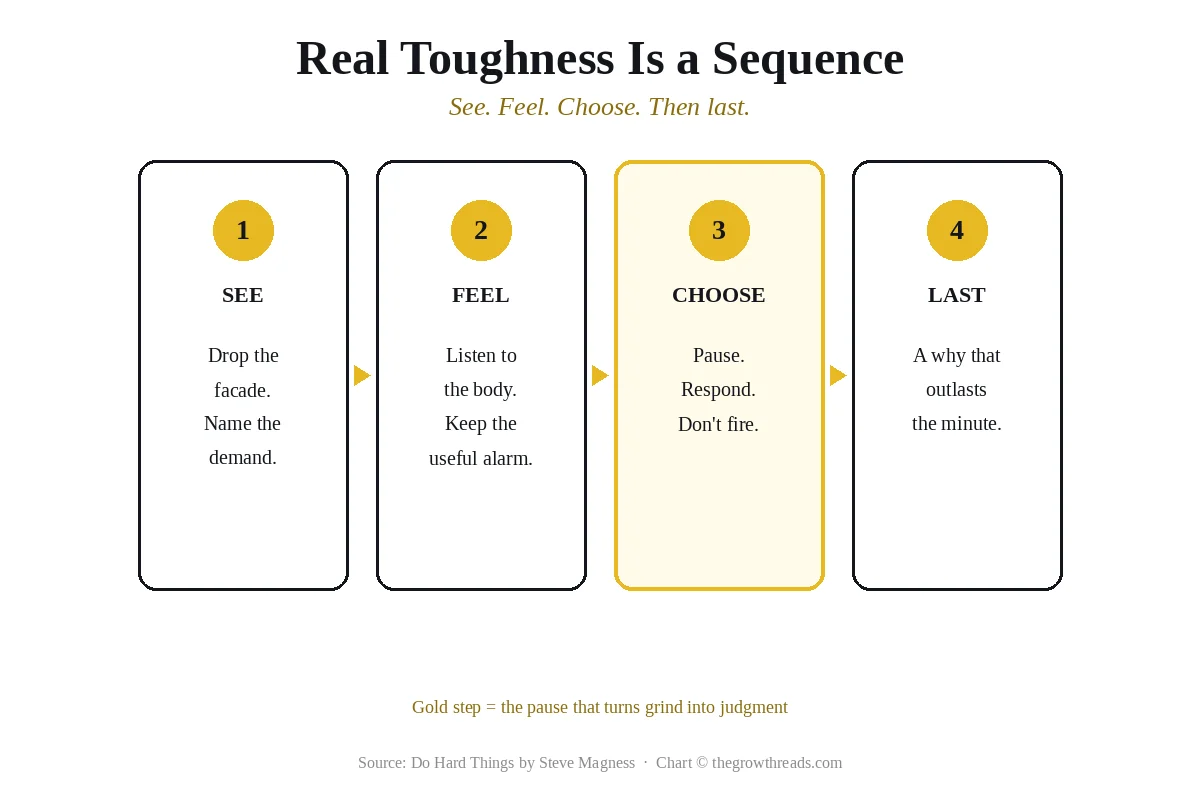
Real toughness is not looking unbothered. It is staying with discomfort long enough to choose the next move. Steve Magness’s Do Hard Things argues that we trained the wrong skill: hide the wince, push past the signal, treat quitting as a character flaw. That costume produces fragility. The replacement is four pillars. Drop the facade and see the demand against your actual resources. Listen to the body instead of crushing it. Insert space so you respond instead of fire. Attach the minute to a purpose so you can last without going numb. You do not need a new personality by Friday. You need one pause in front of the hard block.
Write the last override in one sentence. Put ninety seconds of noticing before today’s hardest work. Then start.
Key takeaways
- Fake toughness hides: Looking unbothered is a costume. Real toughness lets the signal in.
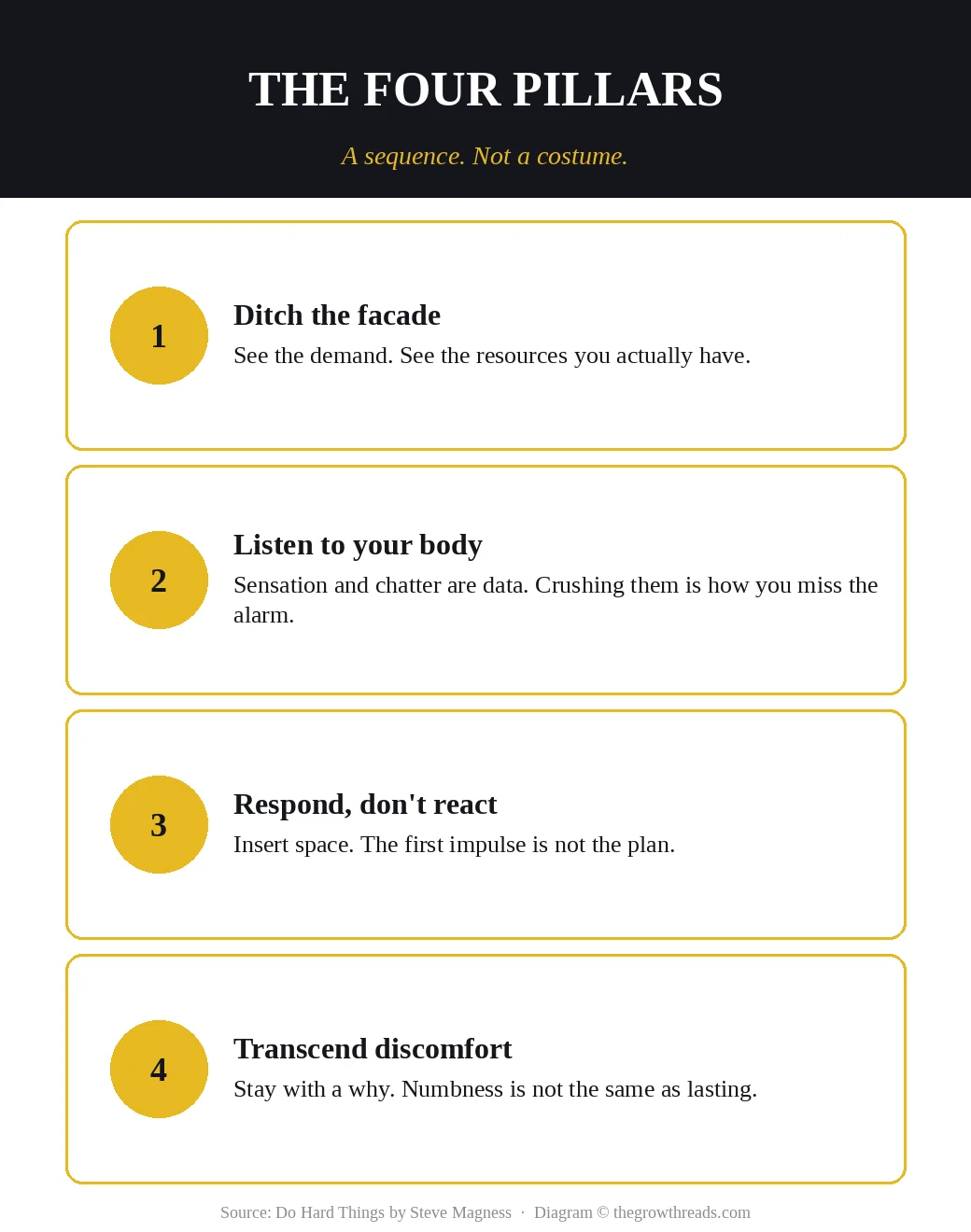
- Four pillars: Reality, body, space, purpose. A sequence, not a poster wall.
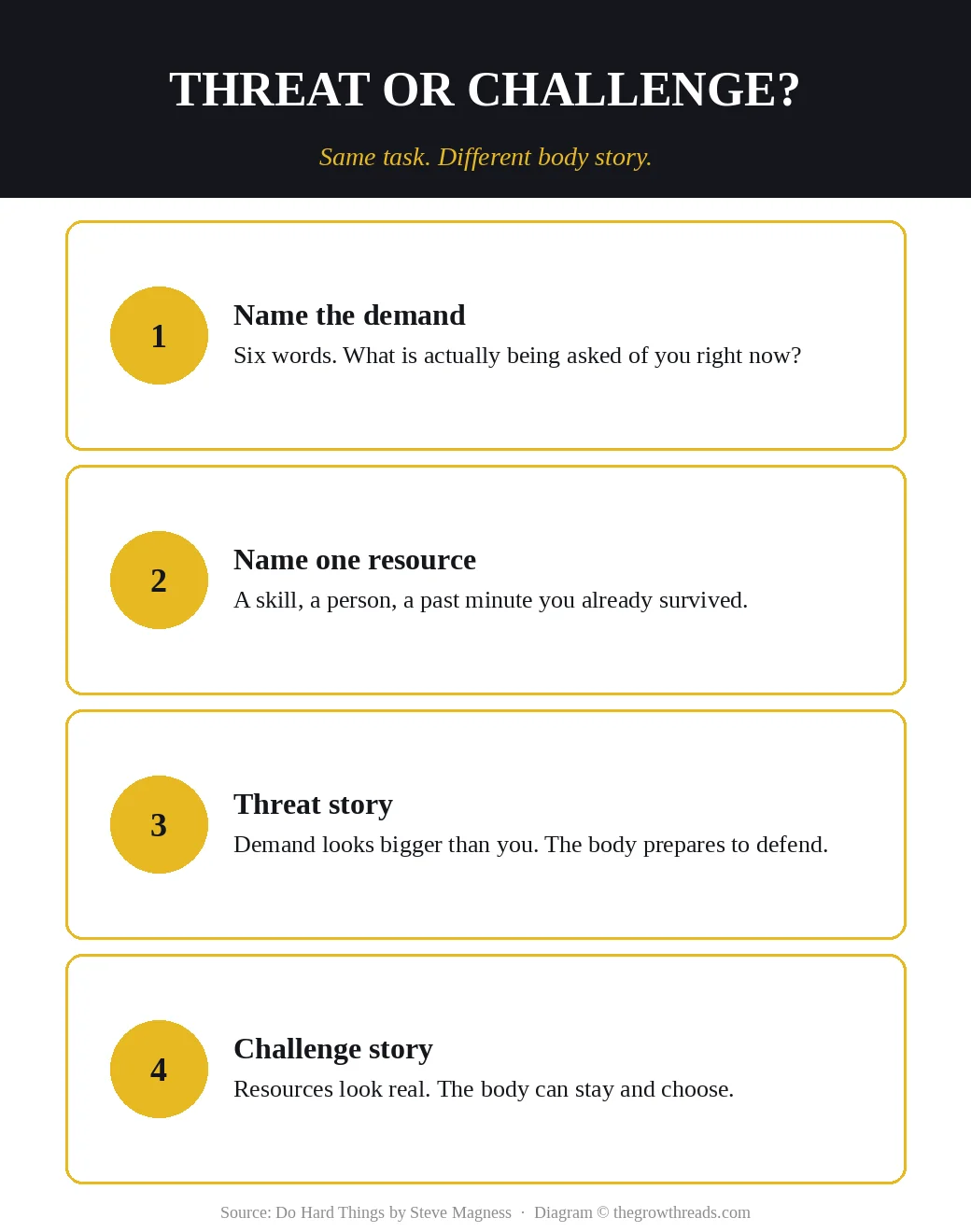
- Threat versus challenge: Same demand, different story — do you have the resources or not?
- The body is data: Sensation and chatter are inputs. Crushing them is how you miss the useful alarm.
- Space is the skill: A pause turns a reaction into a response. Without it, discipline is just speed.
- Confidence is evidence: Quiet proof you handled a minute. Bravado is a loan against next week.
- Quitting can be toughness: Stopping when the signal says stop is a choice, not a confession.
- Purpose outlasts the minute: A why keeps you in the work without requiring numbness.
- Inner drive beats fear-drive: Fear can start a sprint. It cannot run a career.
What is Do Hard Things about?
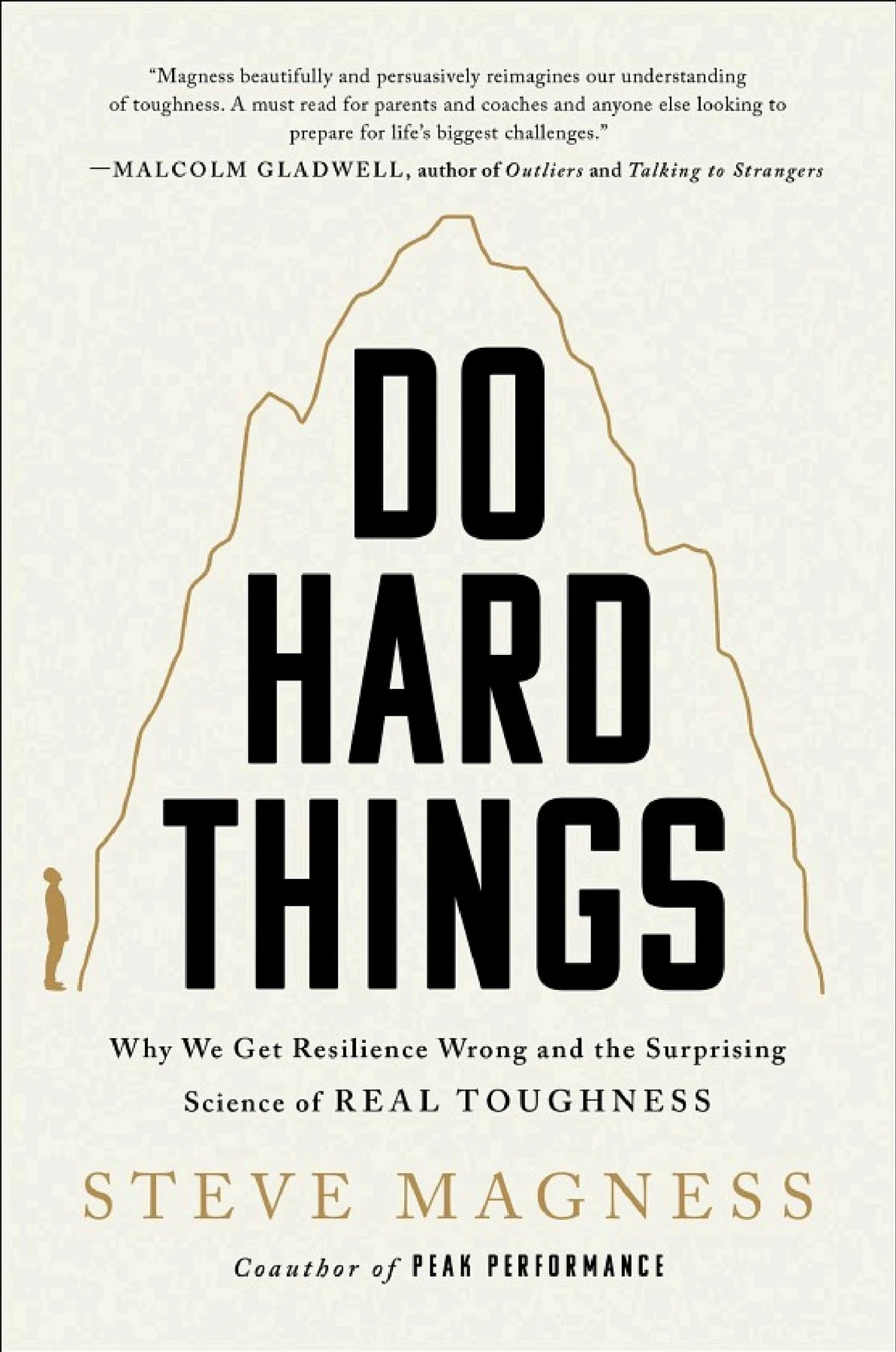
Do Hard Things is Steve Magness’s 2022 rewrite of toughness: stop hiding pain to look strong, and instead notice discomfort, stay with it, and create enough space to choose — four pillars that turn grind into judgment you can actually use at work.
About the author
Steve Magness is a performance coach and writer who came up as a runner — including a sub-four-minute mile — and then spent years around elite tracks, professional teams, and executives who were quietly breaking. He co-wrote Peak Performance and The Passion Paradox with Brad Stulberg, hosts work under The Growth Equation, and has written for places that do not usually print locker-room slogans. Do Hard Things is his solo toughness book: less periodization math, more what you do inside the hard minute. The voice is coach-plus-researcher. The useful residue is a pause you will actually take, and a definition of toughness that does not require you to go numb. He lives and coaches from that mix of lab and field, which is why the stories stay specific and the drills stay small. Explore all Steve Magness book summaries →
Key concepts at a glance
| Concept | What it means | Use it when |
|---|---|---|
| Fake toughness | Hide the signal. Look unbothered. Treat stopping as shame. | Your grind is rising and your judgment is falling. |
| Real toughness | Notice discomfort, stay with it, choose the next move. | You can work hard and still miss the useful alarm. |
| Threat vs challenge | Demand against resources. Same task, different body. | The meeting feels like a verdict before it starts. |
| Facade | The costume of being fine. It costs information. | “I’m good” is your default in the hard block. |
| Listen to the body | Sensation and inner lines as data, not enemies. | You override every wince until you snap. |
| Respond, don’t react | Insert space. The first impulse is not the plan. | You fire the reply, the send, or the extra set on reflex. |
| Inner drive | A why that outlasts fear. Fear can start; it cannot last. | You only move when someone is watching. |
| Transcend discomfort | Stay without going numb. Purpose holds the minute. | You either bail early or disappear into the grind. |
Part 1: We trained the costume — real toughness starts with reality
Magness opens with a pile-up of the old model. Toughness got sold as stoic theater: do not wince, do not name the limit, do not let anyone see the wobble. Coaches, parents, and workplaces borrowed the look from sports and the military and left the judgment behind. The cost shows up as people who can push and cannot steer. They miss the cramp that was information. They stay in the workout, the job, or the conversation past the point where staying is skill. Magness’s claim is blunt and easy to skip because it sounds soft next to a max-effort video: real toughness is experiencing discomfort, leaning in, paying attention, and creating space to take thoughtful action. The hard thing is the noticing, not the mask.
Pillar one is ditch the facade. See the demand as it is. See your resources as they are. A task becomes a threat when the demand looks bigger than what you have; it becomes a challenge when the resources look real. That appraisal is not a personality. It is a snapshot you can update. If Can’t Hurt Me is the heat that gets some people moving, this chapter is the diagnostic that heat still needs. If Discipline Equals Freedom is Jocko’s door — stop negotiating every morning — Magness is what you do after you walk through and the body still has a comment. You can use both. You cannot use the costume and still call the result judgment.
TGR Note: If the remaining leak is a missing recovery equation, Magness and Stulberg’s Peak Performance is the earlier book: stress plus rest. Do Hard Things assumes the load exists and asks whether you are seeing it. If the remaining leak is present-moment work under pressure, Inner Excellence is the cousin that stays on the shot, not the scoreboard.
Part 2: Listen to the body — the alarm is not the enemy
Pillar two is the one grind culture skips. Magness wants you to treat the body as an instrument. Tight chest, heavy legs, a fast inner narrator, a voice that says this is a threat — those are inputs. The old model treats them as weakness to crush. Crushing them is how you miss the difference between “this is uncomfortable and I can stay” and “this is damage.” Athletes learn a version of this or they get hurt. Knowledge work learns it late, usually after a year of being “fine.” Listening is not indulgence. It is how you keep the next hour usable.
The practical move is small. Mid-block, name one sensation and one inner line. Keep the line that is data. Park the line that is costume. You do not need a meditation career. You need a label so the signal stops impersonating a verdict. If The Practicing Mind is stay with the process instead of the product, this chapter is stay with the process in the body. If Bounce is talent as practice under pressure, Magness is the pressure-reading skill that practice still needs. Readers coming from The Science of Self-Discipline will hear a useful correction: discipline that never listens is just speed with a moral story.
TGR Note: If the leak is still a two-minute start, Mini Habits is the first unit. If the leak is a missing identity cue, stay with Atomic Habits. Come back to Magness when the start exists and the remaining failure mode is overriding every useful wince.
Part 3: Respond instead of react — space is the whole skill
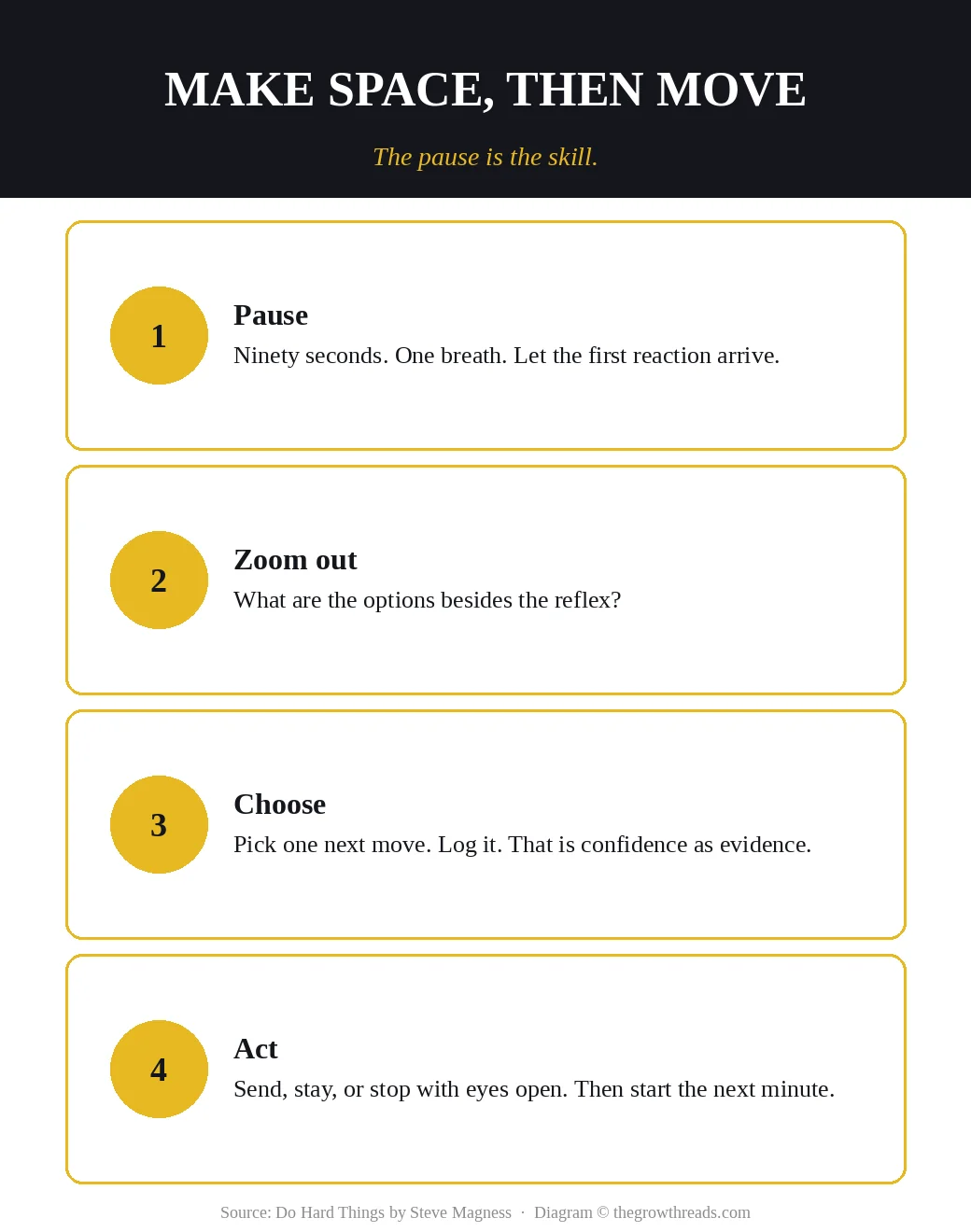
Pillar three is the productivity core hiding in a sports book. A reaction is the first impulse driving. A response is the same impulse plus a gap. Magness wants the gap. Zoom out long enough to see options. Zoom back in to take one. The pause can be ninety seconds. It can be one breath before you send. It is not a spa day. It is how you stop letting the amygdala write the status update. Without space, “discipline” is just doing the fastest available thing with a better slogan.
This is also where confidence gets rewritten. Fake confidence is a speech. Real confidence is a stack of minutes you stayed in and chose. You do not talk yourself into being the kind of person who never wobbles. You collect evidence that you can wobble and still pick. If Relentless is the walk toward pressure, this chapter is the walk you take without turning pressure into a personality. If Winning is stay in the race after the completer would stop, Magness is how you stay without going blind. You still send the thing. You do not have to become a machine to send it. The send is better when it is a choice.
TGR Note: If the remaining leak after the pause is a missing deep-work door, Deep Work closes it. If the remaining leak is too many yeses, Essentialism is the disciplined no. Magness is the inner half: the yes you keep still has to be a response, not a reflex.
Part 4: Transcend the minute — purpose beats looking tough
Pillar four is why you stay once the pause exists. Magness does not want you to worship discomfort. He wants a why that is larger than the costume. Purpose lets you last the ugly minute without requiring numbness. Inner drive outlasts fear-drive. Fear can start a sprint, a cram, a heroic Thursday. It cannot run a decade. Meaning is not a poster over the desk. It is one line you read before the block: this is for the race, the patient, the book, the kid — not for looking unbothered in Slack.
This is also where quitting gets its dignity back. Stopping when the signal says stop can be the tough move. Continuing past that point is often the facade. Magness is not handing out permission to bail on anything hard. He is handing back judgment. If Grit is passion plus perseverance toward a long goal, this chapter is the in-the-minute skill that perseverance still needs so it does not become stubbornness. If The Mamba Mentality is obsess over details, Magness is obsess over the signal those details ride on. Finish the week with one thing you kept and one override you will not repeat. Put next week’s pause on the calendar before Sunday becomes other people’s urgency.
TGR Note: If the remaining leak after the why is still waiting to feel ready, The Motivation Myth is start-first. If the remaining leak is identity through a tiny cue, stay with Atomic Habits. Do Hard Things is the toughness definition those two books can hang on when the work is already underway and the costume is the problem.
Who is Do Hard Things best for — and who should read something else first?
Best for people who already work hard and whose remaining leak is numbness dressed as discipline: operators, coaches, athletes, parents, anyone whose default is “I’m fine.” If you want the earlier Magness/Stulberg load-and-rest equation, start with Peak Performance. If you want present-moment work under pressure, start with Inner Excellence. If you want talent as practice, start with Bounce.
Read something else first if you need a tiny start or a cue. Begin with Mini Habits or Atomic Habits. If you want locker-room heat as the first language, start with Relentless or Can’t Hurt Me. Come to Do Hard Things when you can already push and the remaining failure mode is ignoring the signal that would have let you push smarter.
Questions to reflect on
- When did you last override a useful signal to look unbothered — and what did it cost the next hour?
- On today’s hardest block, is the story a threat or a challenge, and what resource did you actually name?
- Where do you fire a reply, a send, or an extra set before a pause has a chance?
- What inner line is data, and what inner line is costume?
- If the ugly minute had a why that was not “look tough,” what would the line be?
🔥 Ready to stay with the hard minute instead of performing it?
Notice the signal. Take the pause. Choose the next move — that is the whole skill.
How to apply Do Hard Things (7-day plan)
- Day 1 — Name the last override. One sentence. When did you ignore a useful signal to look unbothered? No four-pillar manifesto yet.
- Day 2 — Demand versus resources. Before the hard block, write the demand in six words and one resource you actually have. Threat or challenge — pick with evidence.
- Day 3 — Ninety-second pause. Stand. Breathe. Phone down. Let the first reaction arrive without driving. Then start the block.
- Day 4 — Listen once on purpose. Mid-block, name one body signal and one inner line. Keep the useful one. Park the costume.
- Day 5 — Respond, don’t fire. Pick one reply, send, or skip you usually do on reflex. Insert the pause. Choose. Log what you chose.
- Day 6 — Attach a why. Write one line: this block is for ____, not for looking tough. Read it before you start.
- Day 7 — Keep or quit with eyes open. Review the week. One thing to keep. One thing that was fake toughness. Put next week’s pause on the calendar.
Frequently asked questions
What is Do Hard Things about?
Do Hard Things is Steve Magness’s 2022 case that toughness got hijacked. The old model hides pain, looks unbothered, and treats quitting as shame. Real toughness is noticing discomfort, staying with the signal, and creating enough space to choose the next move. Four pillars carry the book: drop the facade, listen to your body, respond instead of react, and use purpose to outlast the ugly minute. Read it when grind culture is costing you judgment. Peak Performance is the earlier Magness/Stulberg growth equation; this is the toughness rewrite that equation still needs.
How long does it take to read Do Hard Things?
The HarperOne edition is about 272 pages. Most readers finish in five to six hours. This summary is a twelve-minute pass: fake toughness versus real toughness, the four pillars, and a seven-day plan. If you only have lunch, write one sentence about the last time you ignored a useful signal, then put a two-minute pause in front of today’s hardest block. Come back to the sports and military stories once that pause exists. The book is a field manual, not a pep talk — the application is one noticed signal, not a new personality by Friday.
Is Do Hard Things only for athletes?
The stories come from tracks, locker rooms, and a few military cases, because that is where Magness has coached. The mechanism is for anyone whose job includes discomfort: operators, founders, parents, students, anyone who has been told to push through. Threat-versus-challenge appraisal, a pause before the reply, and a purpose that outlasts the minute all transfer to a hard conversation or a blank page. If you want locker-room heat as the whole meal, Relentless or Can’t Hurt Me will feel closer. Come here when the leak is numbness dressed as discipline.
How is Do Hard Things different from Peak Performance?
Peak Performance, co-written with Brad Stulberg, is the growth equation: stress plus rest equals growth. Do Hard Things is Magness solo, and the question is what you do inside the stress. Peak Performance tells you to periodize the load. This book tells you to stop treating the load as a test of whether you look unbothered. They stack. If your calendar has no recovery, start with Peak Performance. If you recover and still override every signal until you snap, start here. Inner Excellence is the present-moment cousin; Bounce is the talent-as-practice cousin. This one is the toughness definition.
What are the four pillars in Do Hard Things?
Ditch the facade and embrace reality: drop the costume of being fine, see the demand, and see your actual resources. Listen to your body: treat sensation and inner chatter as data, not as enemies to crush. Respond instead of react: insert space so the next move is a choice. Transcend discomfort: attach the minute to a purpose larger than looking tough, so you can stay without going numb. You do not install four posters on Monday. You pick the leak — usually the override or the missing pause — and run it for seven days. The pillars are a sequence, not a quiz.
Who should read something else before Do Hard Things?
If you still need a two-minute start, begin with Mini Habits. If you need a cue-and-identity install, begin with Atomic Habits. If the leak is a missing deep-work door, Deep Work closes it without a toughness debate. If you want pressure as a walk toward the hard thing, Relentless is the first heat. Come to Do Hard Things when you can already work hard and the remaining leak is ignoring useful pain until judgment collapses. Operators, coaches, and anyone whose ‘I’m fine’ has become a management style will recognize the problem.
What should I do on day one with Do Hard Things?
Write one sentence: the last time you overrode a useful signal. Cramps, a tight chest before a send, a voice that said this meeting is a threat. Then put a ninety-second pause in front of today’s hardest block — stand, breathe, name the demand and one resource you actually have. Do not rewrite your identity. Real toughness is a noticed signal plus a chosen next step. Read a chapter after the pause exists, not instead of putting it there. If the pause already exists and the leak is purpose, write one line for why the block is even yours.
Related summaries
- Peak Performance — Magness and Stulberg’s earlier growth equation.
- Inner Excellence — stay with the present shot, not the scoreboard.
- Bounce — talent as practice under pressure.
- Relentless — the walk toward the hard thing.
- Best productivity books — the full Productivity silo.
How we analyze books: every book on The Growth Reads is read cover to cover, summarized in thousands of words of original analysis, and rated against our five-criteria rubric (lasting impact, evidence quality, practical application, writing & originality, external consensus). Read our full methodology.