

★★★★⅗ 4.6/5 — A flow field manual for people whose practice hours are stacking and still not compounding.
Best for: operators, makers, and anyone whose hard work feels like grinding sand instead of getting denser.
Reading time: ~4.5 hours (234 pages) · this guide ~12 min
Difficulty to apply: Medium. The unit is one trigger on one block, not a lifestyle reboot.
The Rise of Superman in one minute
Flow is not a mood you wait for. It is a cycle you can start, and the hours inside it compound faster than grind. Steven Kotler’s The Rise of Superman watches action-sports athletes do things that were supposed to be impossible, then asks what state they were in when the impossible became a training problem. The answer is flow: action and awareness merge, the inner critic goes quiet, time bends, and skill jumps. Kotler treats that state as hackable. A four-stage cycle — struggle, release, flow, recovery — plus a stack of psychological, environmental, social, and creative triggers. You do not need a cliff. You need a finish line, a demand just past current skill, and a recovery window you will actually protect.
Write today’s hardest block in six words. Put the phone in another room. Work until the problem is loaded, then take a ten-minute walk. Come back. That is the whole entry fee.
Key takeaways
- Flow is a skill: The state has a cycle. Waiting to feel ready is how it never starts.
- Struggle is the door: Frustration loads the problem. Skip it and there is nothing to release.
- Release, then drop in: A walk, a shower, a pause. Grip less, then return.
- Recovery is stage four: Rest is part of the protocol. Skipping it is how flow goes dark.
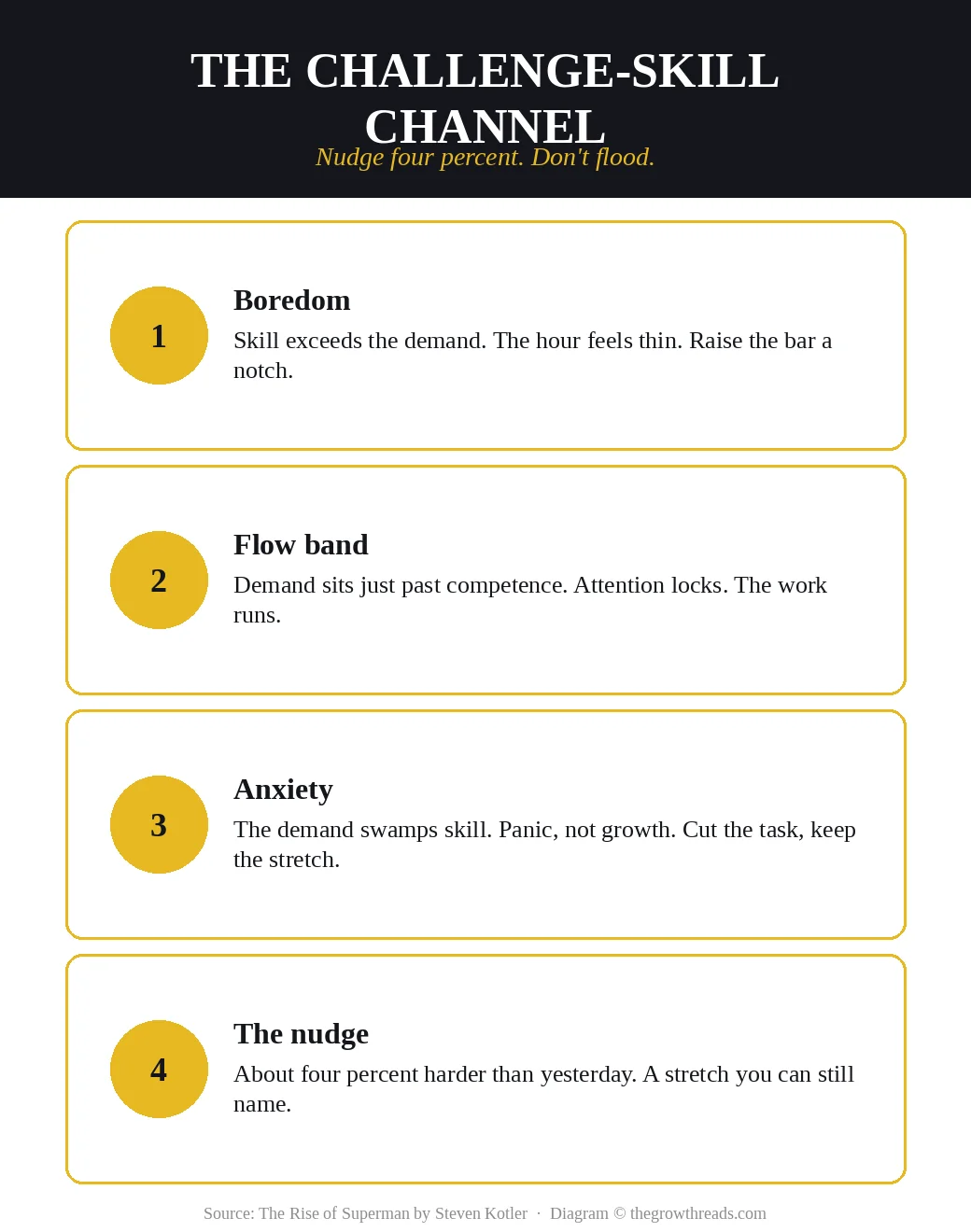
- Challenge sits ~4% past skill: Too easy is boredom. Too hard is panic. Nudge, don’t flood.
- Clear goals plus now-feedback: A finish line you can see, and a signal that you are on it.
- The body is a trigger: Stand, move, put stakes in the room. Disembodied work starves flow.
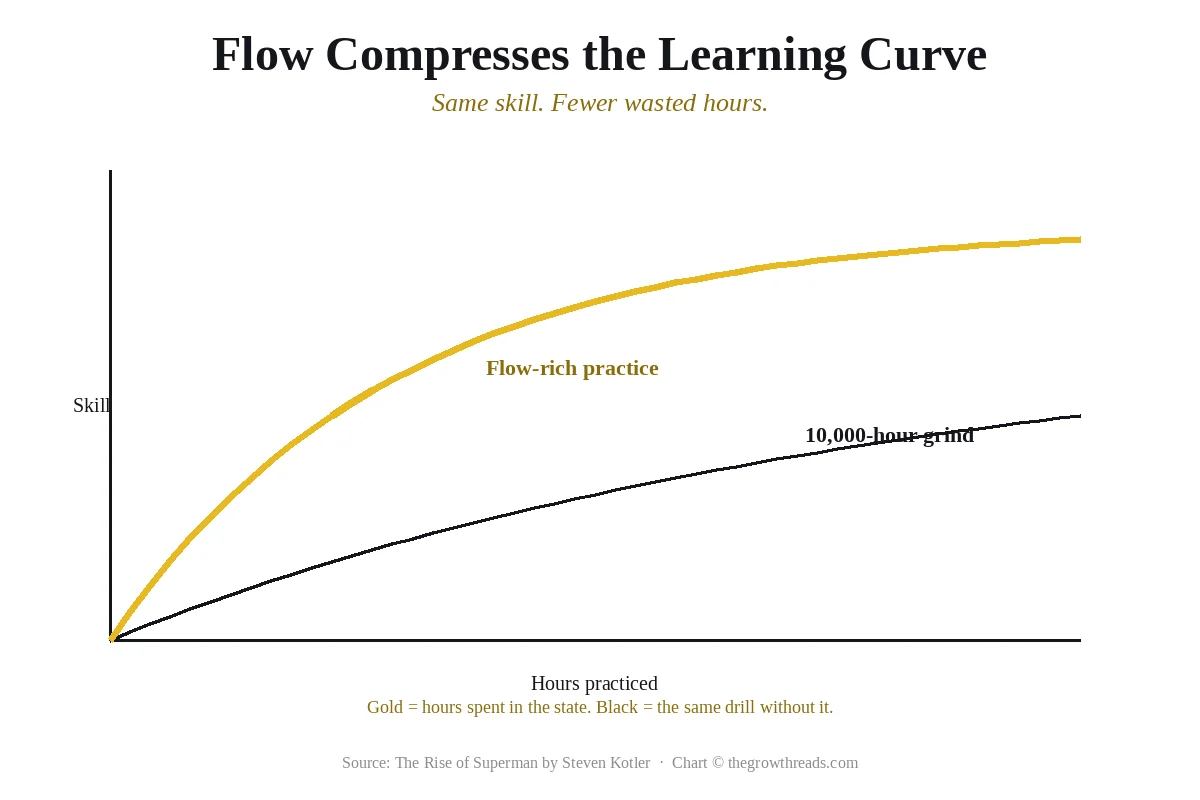
- Hours compress in the state: Flow-rich practice beats 10,000 unfocused hours of the same drill.
- One trigger this week: Install the leak, not the poster of seventeen.
What is The Rise of Superman about?
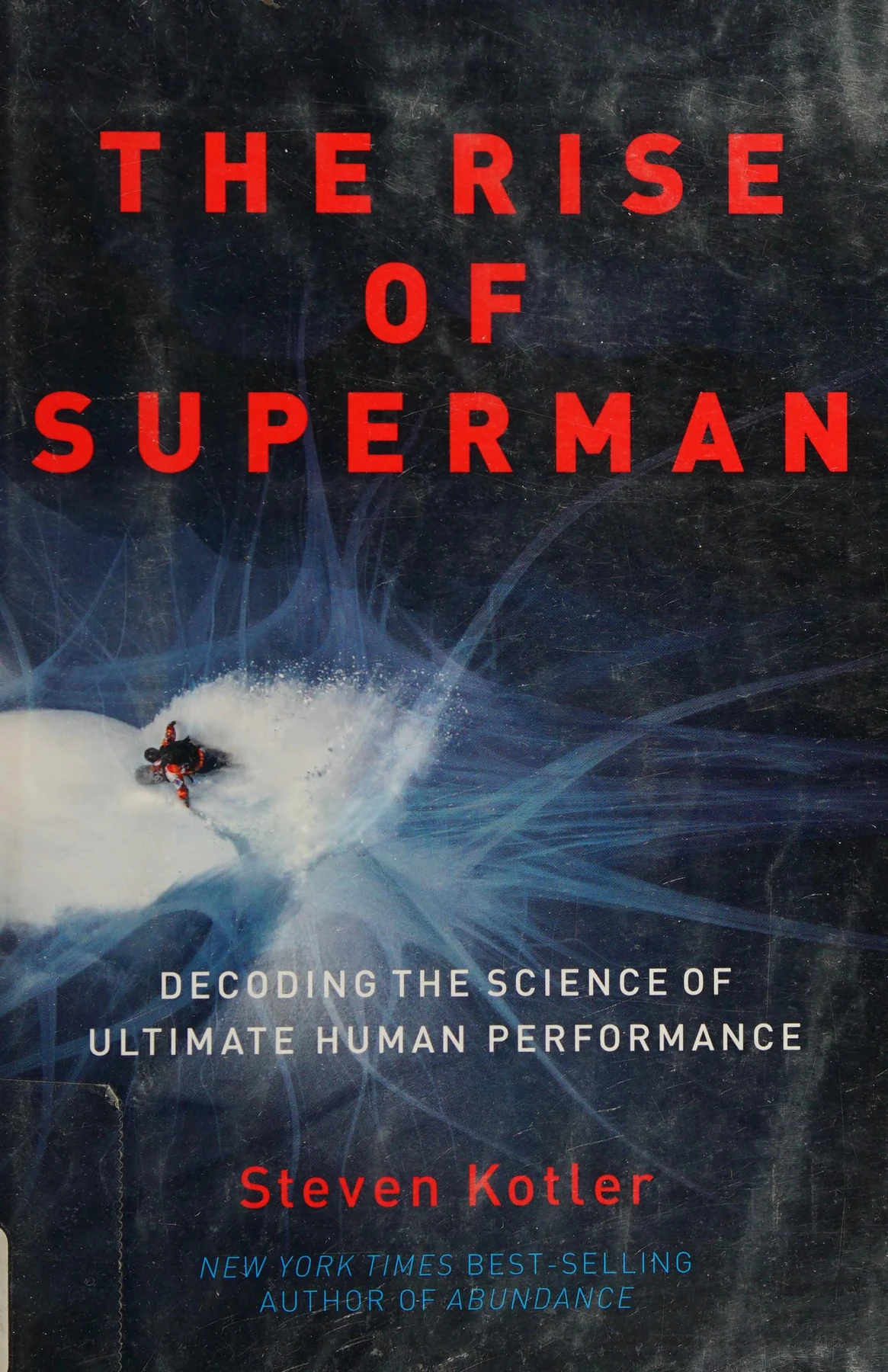
The Rise of Superman is Steven Kotler’s 2014 case that flow — the state where action and awareness merge — is the hidden engine behind “impossible” performance, and that a four-stage cycle plus a trigger stack can bring that engine to ordinary hard work.
About the author
Steven Kotler is an American journalist and author who spent years around scientists, entrepreneurs, and athletes trying to explain why some people get more out of the same hour. He wrote Abundance and Bold with Peter Diamandis, later Stealing Fire, and in 2021 The Art of Impossible — the desk-side sequel to this book’s field report. He co-founded the Flow Research Collective to study and teach the state this book made famous in action sports. The voice is reporter-plus-translator: interviews, neurochemistry in plain language, and a bias toward protocols you can run. The Rise of Superman is the origin story of that beat. Read it for the cycle and the triggers. Read Art of Impossible next if you want the same author on knowledge-work skills without the cliff. Explore all Steven Kotler book summaries →
Key concepts at a glance
| Concept | What it means | Use it when |
|---|---|---|
| Flow | Action and awareness merge. Time bends. Skill jumps. | Hours are stacking and the work still feels thin. |
| Struggle | Load the problem. Frustration is the entry fee. | You quit at the first ugly minute. |
| Release | Let the grip go, then return. | You grind straight through and never drop in. |
| Recovery | Stage four of the cycle, not a weekend hobby. | You “earn” rest by skipping it. |
| Challenge-skill ratio | Demand sits just past competence — about four percent. | The block is either boring or a panic. |
| Psychological triggers | Clear goals, immediate feedback, concentration. | The task has no finish line you can see. |
| Environmental triggers | Stakes, rich input, the body in the work. | You work only from a chair and a feed. |
| Group flow | Shared aim, equal voice, egos blended. | The meeting is a pile of solos. |
Part 1: The lab was a mountain — impossible became a training problem
Kotler opens in the only place the data was loud enough to hear. Action-sports athletes kept doing things coaches had ranked as not yet possible — bigger gaps, heavier water, later tricks — and they kept doing them on purpose. The point is not that you should jump off a building. The point is that “impossible” was a calendar problem once the athletes learned to spend more of the session in flow. Self-consciousness drops. The inner narrator goes quiet. Time dilates. Pattern recognition speeds up. What looked like a gift from the outside was a state they could re-enter. Kotler’s reporter’s claim is simple: if we can decode that state, we can stop treating elite performance as a personality and start treating it as a protocol.
This is why the book sits in Productivity, not only in sports memoir. A founder staring at a product, a writer staring at a page, a student staring at a proof — the same hour is not the same hour. If Flow is Csikszentmihalyi naming the channel, this chapter is Kotler watching people live in it. If Peak is Ericsson’s deliberate practice, Kotler is the missing density: practice inside the state compounds faster than practice beside it. You still need the hours. You stop wasting them on half-attention.
TGR Note: If the remaining leak is talent-as-myth, Talent Is Overrated and Bounce are the practice cousins. Kotler does not cancel those books. He asks what state the practice is in. If the remaining leak is a missing deep-work door, close it with Deep Work first — flow still needs a room the phone cannot enter.
Part 2: Struggle, release, flow, recovery — skip a stage and the state dies
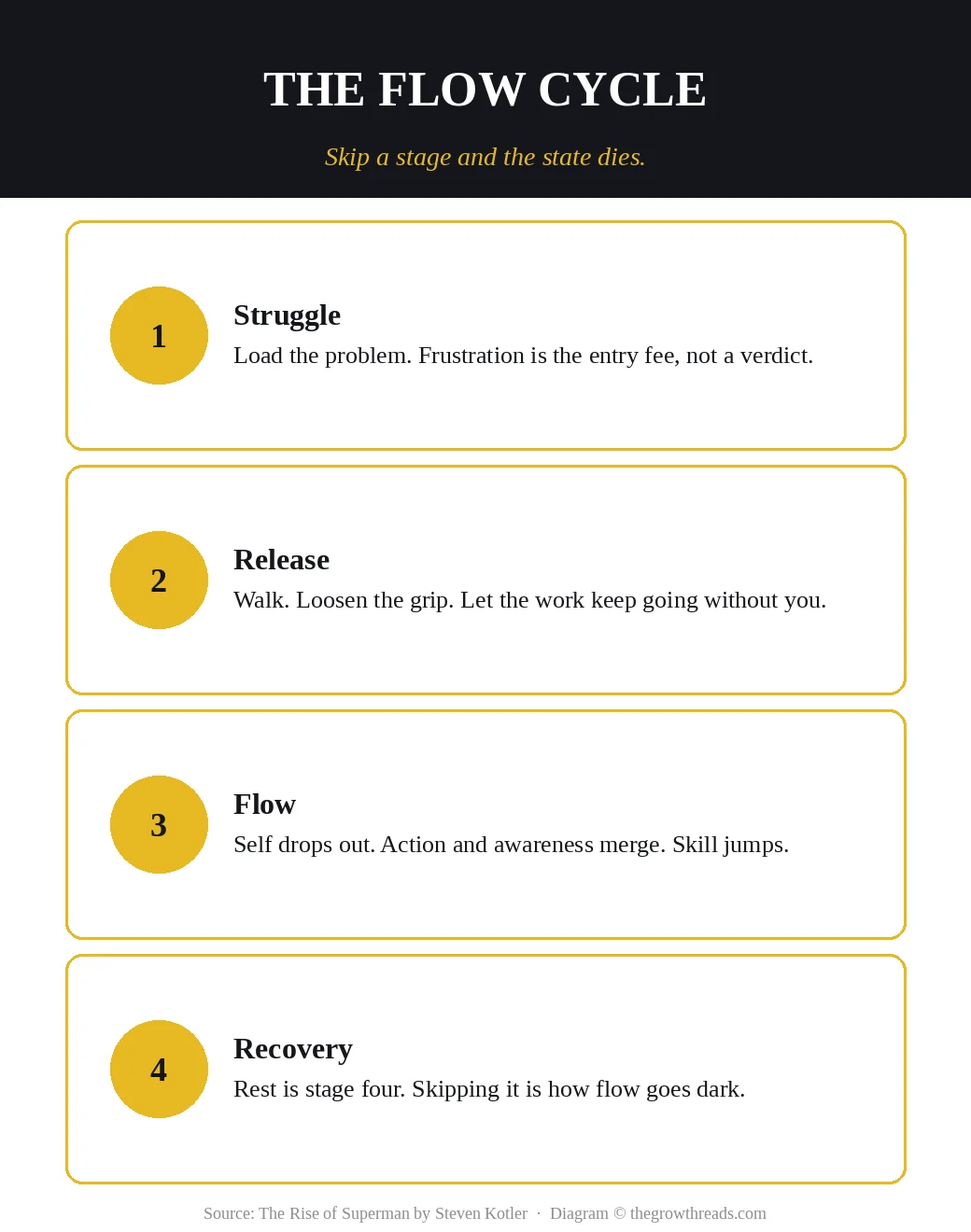
The four-stage cycle is the book’s operating system. Struggle is loading: research, reps, the ugly draft, the problem you cannot yet hold. It feels like friction because it is. Release is the unfashionable middle. You walk. You wash a dish. You stop squeezing the problem so the nonconscious can keep working. Flow is the drop-in — self vanishes, the work runs. Recovery is how you get to do it again tomorrow. Skip struggle and there is nothing loaded. Skip release and you stay clenched. Skip recovery and the chemistry turns on you: irritability, crashes, the “dark side” Kotler flags when people treat flow as a drug instead of a cycle.
Desk translation is blunt. A two-hour block with no loaded problem is browsing. A six-hour block with no walk is just longer browsing with better lighting. A week with no recovery is how a good Tuesday becomes a useless Thursday. If The Inner Game of Tennis is quieting Self 1 so Self 2 can play, this chapter is the schedule that quiet needs. If Do Hard Things is notice discomfort and choose, Kotler is what happens after you choose to stay in the loaded problem long enough for the state to arrive. The cycle is the skill. The cliff is optional.
TGR Note: If you still cannot start the struggle stage, Mini Habits is the two-minute door. If the remaining leak is identity through a tiny cue, stay with Atomic Habits. Come back to Kotler when the start exists and the remaining failure mode is that the hours never densify.
Part 3: Seventeen triggers, one job — fire the leak, not the poster
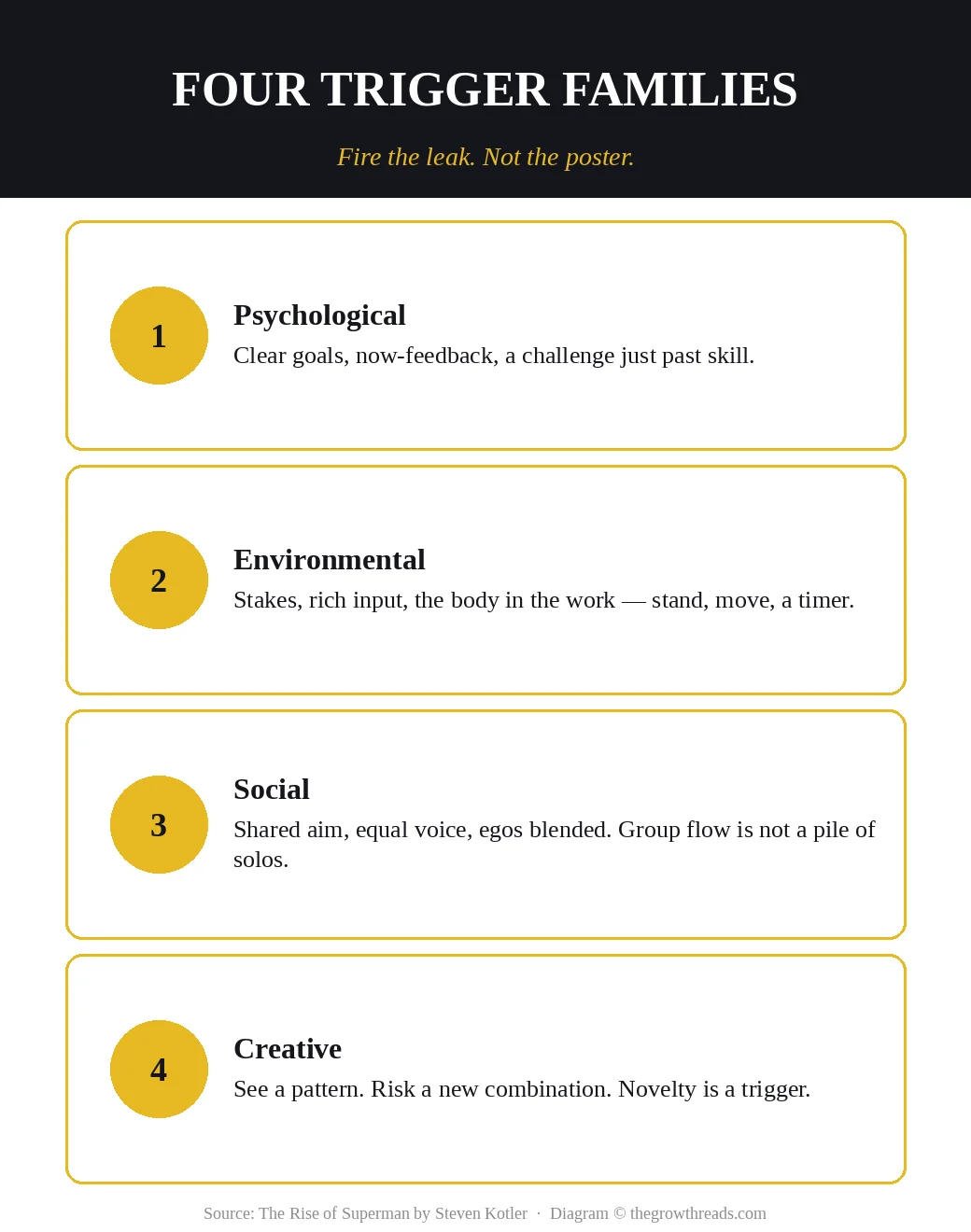
Kotler lists on the order of seventeen triggers so the state is not magic. You do not need all of them. You need the family that matches the leak. Psychological: a goal so clear you could photograph the finish, feedback now rather than at quarter-end, a challenge about four percent past skill, concentration that has been defended. Environmental: something at stake, a rich enough environment that the senses have work to do, the body in the task — standing, moving, a timer you can see. Social: shared goals, equal participation, blended egos, close listening. Creative: the risk of connecting two patterns that do not yet belong together. High consequences in the book often means a cliff. At a desk it can mean a deadline you actually honor, a customer who will see the work, a timer that ends the block whether you feel done or not.
The mistake is turning the list into wallpaper. Pick one. If the block has no finish line, that is the psychological leak. If the phone is on the desk, concentration never starts. If you only sit, add embodiment. If the meeting is a pile of solos, you need a shared aim, not another brainstorm. If The Art of Impossible is Kotler’s later four-skill stack for knowledge work, this chapter is the trigger primer that stack still uses. If Essentialism is the disciplined no, Kotler is the disciplined yes inside the one thing you kept — a yes with a finish line and a body.
TGR Note: If the remaining leak after the trigger is too many yeses, stay with Essentialism. If the remaining leak is toughness as a costume, Magness’s Do Hard Things is the noticing skill. Kotler is the density skill: same hour, more of it spent in the channel.
Part 4: Steal the protocol for desk work — without needing the cliff
The last movement of the book is the transfer. Group flow is a team that shares a goal, listens hard, and stops performing status. The dark side is chasing the chemistry without the recovery — more risk, less sleep, a life that only feels real in the spike. Desk workers copy the spike and skip the cycle. They want the merge without the struggle, the high without the walk, the identity of “in the zone” without a finish line. Kotler’s useful ending is unglamorous: protect the cycle. Load a real problem. Release on purpose. Take the drop-in when it comes. Recover as if it were part of the job, because it is. The 10,000-hour story is not wrong. It is incomplete. Hours in flow compress the curve. Hours beside flow are how people get ten years of experience one time each.
Write the block. Nudge the demand. Get the phone out. Walk after the struggle. Sleep. That is the stolen protocol. If Grit is passion plus perseverance toward a long goal, this chapter is the in-the-hour skill that perseverance still needs so the years are not empty repetitions. If Deep Work is the door, Kotler is what you do once you are inside it. Finish the week with one trigger you will keep. Put next week’s block on the calendar before Sunday becomes other people’s urgency.
TGR Note: If the remaining leak after the protocol is still waiting to feel ready, The Motivation Myth is start-first. If the remaining leak is identity through a tiny cue, stay with Atomic Habits. The Rise of Superman is the state those two books can hang on when the work is already underway and the hours are not compounding.
Who is The Rise of Superman best for — and who should read something else first?
Best for people who already sit down and whose remaining leak is thin hours: makers, operators, athletes crossing into knowledge work, anyone who has been told to “just put in the time.” If you want the original theory, start with Flow. If you want Kotler’s later desk manual, start with The Art of Impossible. If you want talent as practice, start with Peak or Bounce.
Read something else first if you need a tiny start or a cue. Begin with Mini Habits or Atomic Habits. If you want toughness as noticing discomfort, start with Do Hard Things. If you want locker-room heat as the first language, start with Relentless. Come to The Rise of Superman when you can already work and the remaining failure mode is that the work never densifies.
Questions to reflect on
- Where do your hours stack without a finish line you could photograph?
- Is today’s hardest block boring, in the channel, or a panic — and what four-percent nudge would fix it?
- When did you last skip release and call the extra hour “discipline”?
- Which trigger family is the actual leak: goals, environment, people, or a missing recovery?
- If recovery were stage four of the job, what would you protect after the block?
🔥 Ready to make the same hour count for more?
Load the problem. Release. Drop in. Recover — that is the whole cycle.
How to apply The Rise of Superman (7-day plan)
- Day 1 — One finish line. Pick today’s hardest block. Write the finish in six words. No trigger manifesto yet.
- Day 2 — Four percent harder. Nudge the demand just past current skill. Not a cliff. A stretch you can still name.
- Day 3 — Phone out of the room. Concentration is a trigger. The pocket buzz is how flow never starts.
- Day 4 — Struggle, then release. Work until the problem is loaded. Then a ten-minute walk with no inbox. Come back.
- Day 5 — Put the body in it. Stand, whiteboard, timer you can see. Embodiment is an environmental trigger, not a gym hobby.
- Day 6 — Recover on purpose. Protect thirty minutes after the block. Sleep, a walk, or quiet. Recovery is stage four, not a leak.
- Day 7 — Keep the trigger that fired. Review the week. One trigger to keep. One distraction that killed the cycle. Put next week’s block on the calendar.
Frequently asked questions
What is The Rise of Superman about?
The Rise of Superman is Steven Kotler’s 2014 map of flow, built from action-sports athletes who kept doing things coaches called impossible. Flow is the state where action and awareness merge, time bends, and skill jumps. Kotler treats that state as trainable: a four-stage cycle and a stack of psychological, environmental, social, and creative triggers. The lab happens to be a cliff. The transfer is a hard block at a desk. Read it when practice hours are stacking and the work still feels like grinding sand. Art of Impossible is the later desk-friendly sequel; this is the origin story of the protocol.
How long does it take to read The Rise of Superman?
The New Harvest hardcover is about 234 pages. Most readers finish in four to five hours. This summary is a twelve-minute pass: the flow cycle, the trigger families, and a seven-day plan you can run on one work block. If you only have lunch, pick today’s hardest task, write a finish line in six words, and put the phone in another room. Come back to the surf and BASE-jump stories once that block exists. The book is a field report, not a pep talk — the application is one trigger you can fire on purpose, not a new personality by Friday.
Is The Rise of Superman only for athletes?
The stories come from skate ramps, big-wave lineups, and wingsuits because that is where the data was loud. The mechanism is for anyone whose job includes a demand slightly beyond current skill: operators, founders, writers, students, surgeons, anyone who has logged hours and still feels stuck one percent under the work. Clear goals, immediate feedback, a challenge just past competence, and a recovery window all transfer to a blank page. If you want locker-room heat as the whole meal, Relentless will feel closer. Come here when the leak is wasted hours, not missing aggression.
How is The Rise of Superman different from Flow by Csikszentmihalyi?
Mihaly Csikszentmihalyi named the state and mapped the challenge-skill channel. Kotler is the journalist who asked what happens if you treat that map as a protocol and watch people who live near the edge. Flow is the theory you should still read. The Rise of Superman is the field manual: struggle, release, flow, recovery, plus seventeen triggers grouped so you can install one. Art of Impossible (2021) is Kotler’s later four-skill stack for knowledge work. Start with Csikszentmihalyi if you want the original lab. Start here if you want the trigger list you can run this week.
What are the 17 flow triggers in The Rise of Superman?
Kotler groups them so you do not have to memorize a poster. Psychological: clear goals, immediate feedback, challenge-skill ratio, intense concentration, the rest of the inner setup. Environmental: high consequences, a rich environment, deep embodiment — the body in the work. Social: shared goals, equal participation, blending egos, close listening, always say yes, plus the rest of group flow. Creative: pattern recognition and the risk of a new idea. You do not install seventeen on Monday. You pick the leak — usually a missing finish line or a phone in the block — and run it for seven days.
Who should read something else before The Rise of Superman?
If you still need a two-minute start, begin with Mini Habits. If you need a cue-and-identity install, begin with Atomic Habits. If the leak is a missing deep-work door, Deep Work closes it without a flow debate. If you want toughness as noticing discomfort, Do Hard Things is the better first language. Come to The Rise of Superman when you can already sit down and the remaining leak is that the hours do not compound. Peak is the deliberate-practice cousin. Bounce is talent as practice seen from far away. This one is the state that makes those hours denser.
What should I do on day one with The Rise of Superman?
Pick one block that already has a finish line. Write the finish in six words. Put the phone in another room. Set the demand about four percent past what you can already do — not a cliff, a nudge. Work until the struggle is real, then take a ten-minute release walk with no inbox. Do not rewrite your identity. Flow is a cycle you can start, not a mood you wait for. Read a chapter after the block exists, not instead of putting the block on the calendar. If the block already exists and the leak is recovery, protect thirty minutes after it on purpose.
Related summaries
- Flow — Csikszentmihalyi’s original map of the state.
- The Art of Impossible — Kotler’s later four-skill stack for knowledge work.
- Peak — deliberate practice, the hours Kotler wants spent in flow.
- Deep Work — the door the trigger stack still needs.
- Best productivity books — the full Productivity silo.
How we analyze books: every book on The Growth Reads is read cover to cover, summarized in thousands of words of original analysis, and rated against our five-criteria rubric (lasting impact, evidence quality, practical application, writing & originality, external consensus). Read our full methodology.